Screenplay by David Matalon, Sasha Perl-Raver & Jen D’Angelo
Story by David Matalon & Sasha Perl-Raver
Produced by Jason Blum, Adam Hendricks & Greg Gilreath
Cast: Kiernan Shipka, Olivia Holt, Charlie Gillespie, Lochlyn Munro, Troy L. Johnson, Liana Liberato, Kelcey Mawema, Stephi Chin Salvo, Anna Diaz, Ella Choi, Jeremy Monn-Djasgnar, Nathaniel Appiah, Jonathan Potts, Randall Park, Julie Bowen, etc.
Cinematography by Judd Overton
*** MAY CONTAIN SPOILERS ***
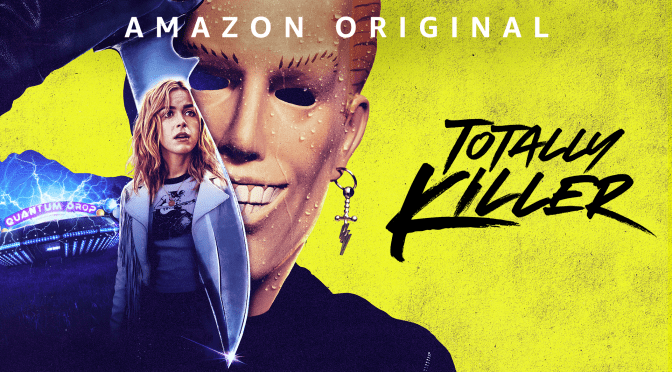
Here’s a thing that rarely happens, I actually watched a trailer and thought, “Hey, that film looks really entertaining, so I am going to watch it now.” That trailer was for Totally Killer (2023) which is currently streaming on Amazon Prime. The story is essentially Back to the Future (1985) meets Scream (1996), but the hilarious and pacey screenplay wears it’s influences proudly and even cleverly name-checks those two classic examples of the time-travel and slasher sub-genres.
Based in the present day, Totally Killer (2023) is set in the small town Vernon, USA. The film opens with a Vernon podcaster and tour guide revealing how the horrific “Sweet 16 Killer” struck killing three teenage girls in 1987. Unfortunately, the murderer suddenly reappears and kills again. In a frenetic chase through the house, Pam Hughes (Julie Bowen) battles the 1980’s masked slicer, but unfortunately she meets her demise. In grief from the death of her mother is sparky teenager, Jamie Hughes (Kiernan Shipka), and she finds solace with her friend Amelia (Kelcey Mawema), who happens to be designing a time machine as a science project. Well, what do you know!! Jamie finds herself being attacked by the “Sweet 16 Killer” and somehow goes sent back to 1987. There she has a chance to investigate the original crime and perhaps save her mum from being murdered in the future.
Even as I write this basic synopsis of the opening act I realise Totally Killer (2023) seems so contrived and derivative, but I found it to be an absolute blast. The script is clever and knowing with energetic and fun characters. Kiernan Shipka as Jamie is especially brilliant with great comedy timing and delivery. The filmmakers embrace the joy of time-travel and horror film tropes, and there’s also some excellent set-pieces involving the obligatory 1980’s false-faced psycho with a grudge. Moreover, the “fish-out-of-time” gags which derive from Jamie’s reactions to the 1980’s people, fashion and moral attitudes are a real joy. I was smiling and laughing throughout. Yet, significantly this film also deftly balances the suspense, action, horror and science-fiction aspects brilliantly. Stranger Things gets a lot of critical acclaim for stealing wholesale from Stephen King’s back catalogue. Totally Killer (2023) blatantly borrows permanently from everything and for me remains one of the consistently entertaining films of 2023.
Main cast: Sandra Hüller, Swann Arlaud, Milo Machado Graner, Antoine Reinartz, Samuel Theis, Jehnny Beth, Saadia Bentaieb, Camille Rutherford, Anne Rotger, Messi (the Dog), etc.
Cinematography by Simon Beaufils
Acclaimed director Justine Triet defies the old advice of not to work with children and animals to deliver a compelling courtroom, domestic and psychological suspense drama in Anatomy of the Fall (2023). Indeed, the performances of teenage actor, Milo Machado Graner and Messi the dog are of terrific quality. The dog’s acting is only surpassed by a formidable tour-de-force portrayal by Sandra Hüller. She excels as a wife accused of murdering her husband in the French Alps town of Grenoble. Did she? Well, there are no easy answers as the script dissects the crime and the couple’s marriage with forensic intensity.
Triet and her screenwriting partner, Arthur Harari, do not waste any time setting up the mystery element of the drama. The film opens as we follow visually impaired, Daniel Maleski (11 years old) taking his dog for a walk in the snow. At the same time his mother, an author, Sandra, is being interviewed by a research student in the chalet. But we never see the husband, Samuel, who plays thumping music from upstairs. When Daniel returns, the student has left and his father is found dead on the hard white, but blooded, ground. Sandra is upstairs unaware of her husband’s demise. Or is she? Herein begins the did-she-or-didn’t she kill him question? It’s a brilliant opening sequence where Triet and her production team demonstrate impressive filmmaking skill, an adroitness which continues throughout.
Anatomy of the Fall (2023) is an extremely complex film, both intelligent and thematically powerful. The courtroom exchanges between Sandra, her son Daniel, Samuel’s psychotherapist, the prosecution and defense lawyers are brilliantly written and acted. The flashback arguments between Samuel and Sandra are gut-wrenching and all too familiar to anyone who has been in or witnessed the crumbling of a marital or parental relationship. As well as the central mystery, Triet and Harari also skilfully weave in thematic subplots relating to literary plagiarism and mental health. While slightly overlong with mild pacing issues toward the end, Anatomy of the Fall (2023) is overall an absorbing thriller about what happens when the love between two people runs its tragic course and the shock and grief that can follow.
Screenplay by Samy Burch (Story by Samy Burch and Alex Mechanik)
Produced by Natalie Portman, Sophie Mas, Christine Vachon, Pamela Koffler, Grant S. Johnson, Tyler W. Konney, Jessica Elbaum and Will Ferrell.
Main Cast: Natalie Portman, Julianne Moore, Charles Melton, Cory Michael Smith, Elizabeth Yu, etc.
Cinematography by Christopher Blauvelt
*** MAY CONTAIN SPOILERS ***
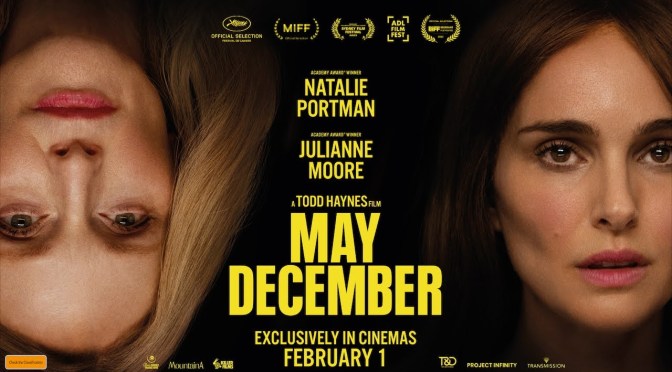
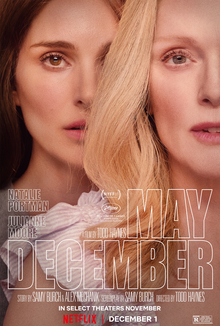
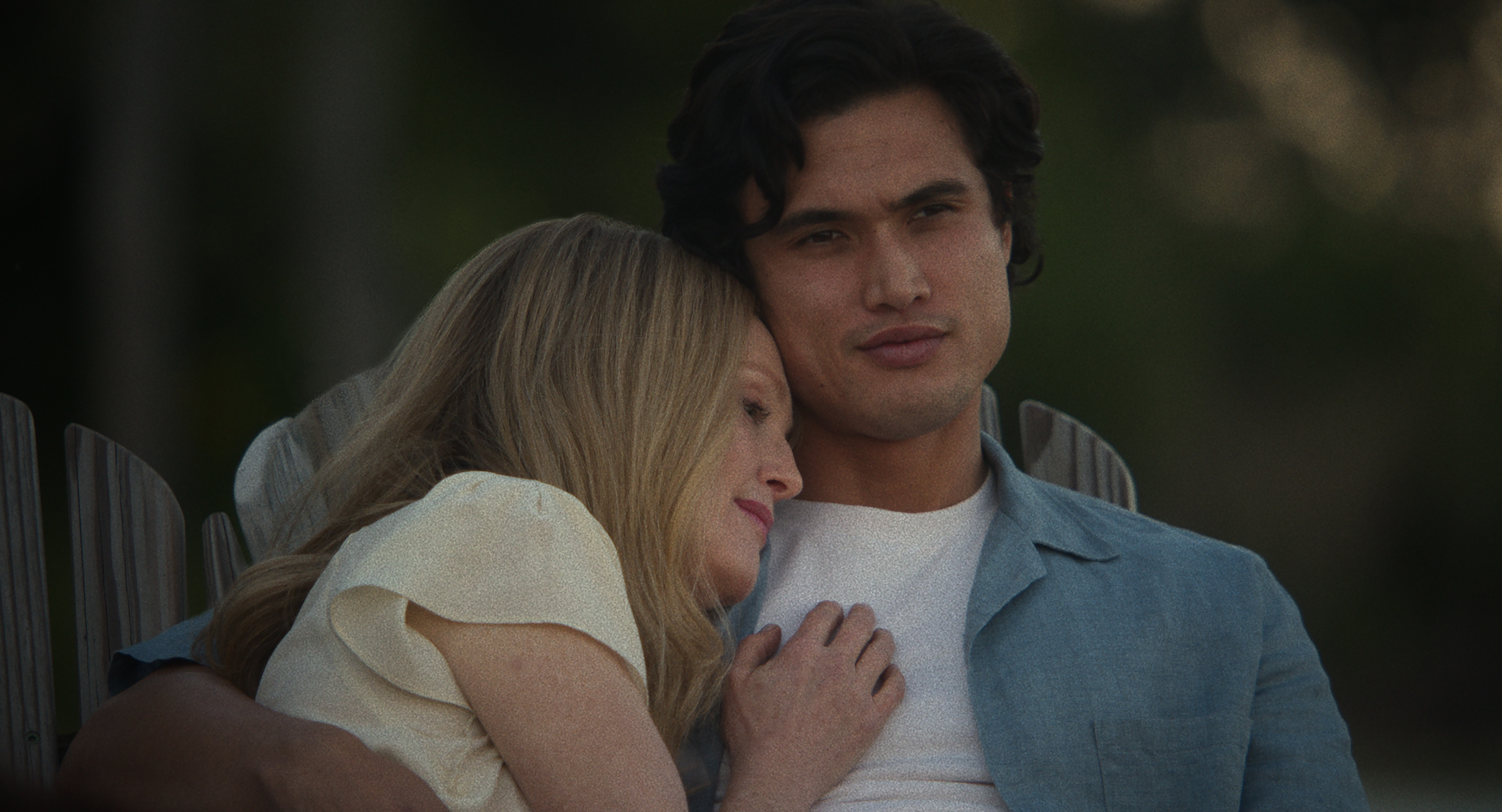
The story of May December (2023) is set in 2015 against the sunny backdrop of Savannah, Georgia. Loosely inspired by the real-life Mary Kay Letourneau scandal, Natalie Portman is Elizabeth Berry, an actress who desires to study the lives of Julianne Moore’s Gracie Atherton-Yoo and her partner Joe Yoo (Charles Melton). Elizabeth is set to play Gracie in an indie film, with latter being infamous for her twenty-three-year-long relationship with Joe, which started when he was thirteen. With a hook like that I was intrigued as to where the story would go with such a controversial subject matter dealing with a convicted sex offender and illicit romance. Here lies a major thematic thumbprint of the filmmakers.
What unfolds is a superbly acted and understated drama which really gets under the skin and into the mind. While watching the ever-shifting points-of-view and identification with the characters May December (2023) became so compelling to me. Gracie is a convicted sex-offender, but she married Joe for love and they had children together after she left jail. But should she have acted on her desires and rejected Joe as a thirteen year old? The simple answer is yes, but it is more complex than that as presented here. Because the couple felt so much emotion for each other that Gracie was prepared to go to jail. This is what attracts Berry and she homes in on Gracie and Joe like the proverbial moth to a flickering bulb.
Structured around Berry’s methodical probing into the past events and Gracie and Joe, she quizzes them, their children, family, friends, work colleagues and legal team. As Berry researches further it becomes apparent she is getting obsessive and almost predatory herself. There are several very awkward scenes involving Berry, notably when she visits the pet store where Gracie and Joe used to work together. As Berry revisits the past she begins to loosen the stitches of old wounds, as both Gracie, and Joe especially, reflect and question the moral validity of their relationship.
I am sure when Natalie Portman and Julianne Moore read the script for May December (2023) they must have been doing back flips with creative excitement. Because it is clearly is a layered screenplay of the highest intelligence, ambiguity, dark humour and intensity by Samy Burch. Along with Melton they deliver on the script with three tremendous performances too. Moreover, acclaimed director Todd Haynes directs this tonally awkward story with a deft touch drawing on the constant grey areas of drama so expertly. May December (2023) may not be for everyone because the film is a slow burn without much in the way of dramatic closure. Conversely, so much of the drama occurs in the acting and script’s subtext, yet it remains a fine example of ambiguous cinema. Finally, the re-orchestration and use of Michel Legrand’s music forThe Go-Between (1971) is a masterstroke.
As an alternative to the usual Christmas films that are on our TVs, streaming platforms and cinemas now, I have spent the last few weeks watching many recent horror film releases. Like a big, black Christmas stocking I present to you some quick reviews of said bloody entertainment with the usual marks out of 11.
Merry Christmas and a Happy New Year to you and your family!
BIRDBOX BARCELONA (2023)
Spanish sequel to the Netflix original and it’s not quite as good. Some excellent filmmaking and deadly set-pieces are hamstrung by poor structure and over-familiarity with the central alien-suicide concept. The themes of religion, sacrifice and guilt are well explored and the pacey death rate make it worth watching though.
Mark: 6.5 out of 11
BULL (2021)
Brutal British B-movie with Neil Maskell on deadly form as a vengeful career criminal killing off his former gang members after they left him for dead. There are better revenge films out there, but there is some bone-crushing gore to please horror fans like me.
Mark: 6 out of 11
THE CLOVEHITCH KILLER (2018)
Slow-paced but suspenseful rites-of-passage-horror with Charlie Plummer’s teenager suspecting his father (Dylan McDermott) may be a notorious serial killer. Inspired by the evil crimes of BTK murderer, Dennis Rader, this compels throughout until the slightly unbelievable ending.
Mark: 7.5 out of 11
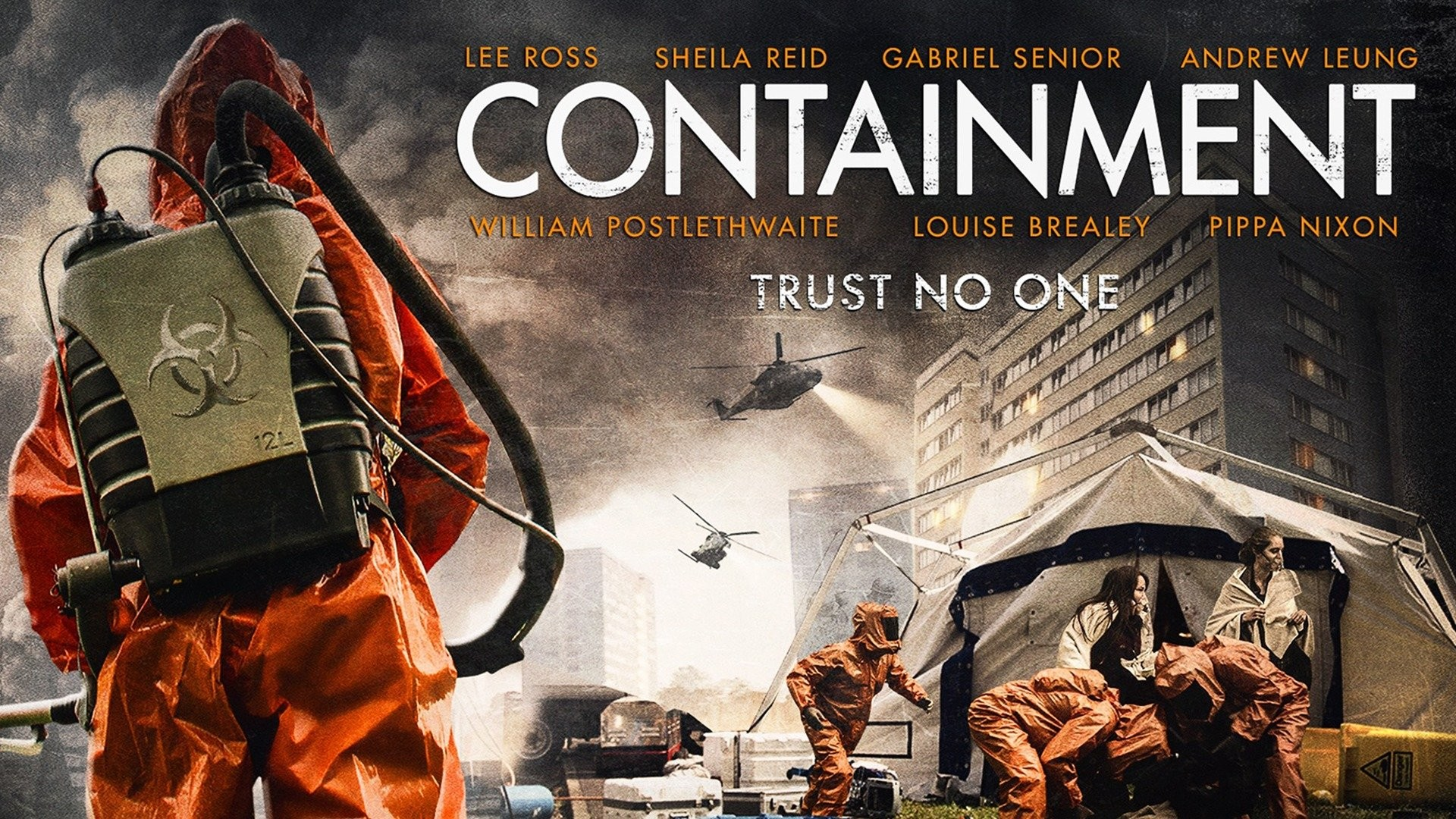
CONTAINMENT (2015)
Low-budget British horror-thriller set in a tower block during a viral outbreak and deadly lock-down. A prescient and chilling film which finds authorities attempting to stop the contagion by all means necessary. Some nail-biting suspense ensues and decent ensemble cast drive a film where chaos and paranoia feel all too familiar to recent global events.
Mark: 7.5 out of 11
EL CONDE (2023)
Pablo Larrain’s horror-comedy-satire is based around a very funny one-joke premise. The gag is Chilean dictator General Pinochet was in fact a blood-sucking vampire draining the life out of the common people. After a really powerful and amusing opening twenty minutes, the film devolves into a Pinochet family drama that runs out of steam until the frankly insane ending which has to be seen to be believed.
Mark: 7 out of 11
EVIL DEAD RISE (2023)
Some fantastically horrific and bloody gore cannot save this Evil Dead reboot/sidequel from feeling both redundant and unnecessary. Contrived plot, paper-thin characters and so badly lit I could hardly see anything. I recommend you watch the original films or the series Ash versus Evil Dead instead, with the awesome Bruce Campbell kicking Deadite ass!
Mark: 6 out of 11
INFINITY POOL (2023)
Another off-the-chart offering from Brandon Cronenberg after the spectacularly grim sci-fi horror of Possessor (2020). Infinity Pool similarly deals with themes of alienation, identity and duality as a writer, portrayed by Alexander Skarsgard, ends up on the holiday from hell. With obnoxious characters and a screeching Mia Goth going full gonzo I almost turned this film off, but such is the misery heaped upon the privileged James Foster, I eventually felt sorry for this tortured narcissistic soul. Trippy and bloody thrills contrast the luxury of the beautiful coastal resort with Cronenberg convincing us there is only ever trouble in paradise.
Mark: 8 out of 11
LUTHER: FALLEN SUN (2023)
Idris Elba returns in this big budget Netflix film version of the BBC maverick cop drama. Stylish, moody and effective thriller with a scenery-chewing turn by Andy Serkis as the nemesis from hell. Favours pace and action over plot consistency, Elba is always excellent value for money even if the Luther character has always been quite slight. Serkis’ fiendish plan is written for shock value rather than actually making any sense.
Mark: 7 out of 11.
PEARL (2022)
Prequel to Ti West’s porno horror X (2022) (see mini-review below), this establishes the early years of Mia Goth’s eponymous anti-heroine, Pearl. As a young woman in 1918 she dreams of escaping and becoming a silent movie star. Yet her dominant mother cannot contain the passionate darkness within Pearl. I much preferred this stylish period and character horror to the exploitative and nasty X (2022). There remains much gruesome violence here but Mia Goth finally convinces me as Pearl, delivering one the best film monologues I have seen in some time.
Mark: 8 out of 11.
RENFIELD (2023)
This vampire story from the point-of-view of the familiar, Renfield, contains the most horrific filmmaking in the very worst way. With a hopeless script, terrible acting and bad CGI it wastes the talent of Nicholas Hoult and Awkwafina. While I expected Nicolas Cage’s Dracula to be over-the-top, the film direction is so tonally awful that I have to say this is one of the worst films I have seen all year.
Mark: 3 out of 11
THANKSGIVING (2023)
A very effective by-the-numbers grind-house slasher film from Eli Roth. Set around the eponymous American holiday period, a masked killer starts murdering a small town’s occupants a year after a Black Friday sale turns into a mall riot. The functional script and generic teenagers lack the spark of the classic Scream (1996), however, Thanksgiving (2023) has some highly imaginative murder scenes, with Roth respecting both the genre and audience. A bit more social satire about greedy capitalism would have raised my mark.
Mark: 7.5 out of 11.
VIOLENT NIGHT (2022)
Die Hard (1988) is NOT a Christmas movie, but a film set AT Christmas. Here Norwegian genre movie director, Tommy Wirkola, unofficially remakes Die Hard/Die Hard 2 (1990), with Santa (David Harbour) replacing John McClane fighting criminals and mercenaries robbing a rich businesswoman’s house. Wirkola made an even better version of the violent home invasion comedy inThe Trip (2021). But this rattles along, rings a lot of bells and crunches enough calcium and funny bones to make it worth a watch. David Harbour as Saint Nick sleighs us with his usual fine character acting work.
Mark: 7.5 out of 11.
X (2022)
I know he is a very well respected low-budget film director, and I should like Ti West’s work. Yet, for some reason, I have never enjoyed his previous horrors or Western that much. I feel like his previous films lack pace, contain unsympathetic characters and his horrors lack actual suspense. X (2022) finds a number of unlikable characters setting out to make a porno film on a rural farm, only to encounter danger lurking in the woods, lake and the farmhouse. I really wanted to enjoy this more than I did because Ti West has such control over exploitative material that delivers some genuinely sickening moments of horror. Mia Goth is the standout and West certainly casts her imaginatively, but I just did not connect with this expertly made Texas Chainsaw Massacre (1974) homage.
Produced by Emerald Fennell, Josey McNamara and Margot Robbie
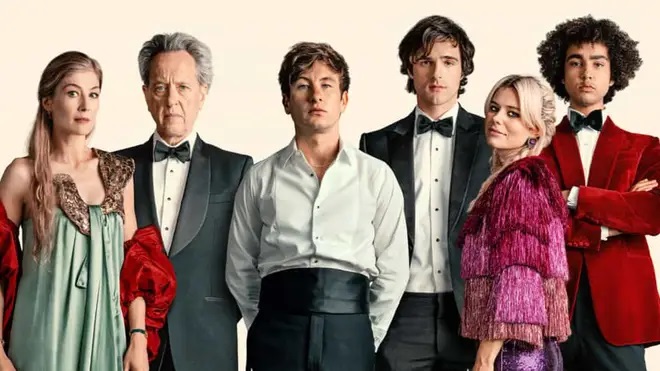
Cast: Barry Keoghan, Jacob Elordi, Rosamund Pike, Richard E. Grant, Alison Oliver, Archie Madekwe, Carey Mulligan, Paul Rhys, etc.
Cinematography by Linus Sandgren
*** MAY CONTAIN SPOILERS ***
As the awards garnered upon Emerald Fennell’s brilliant Promising Young Woman (2020) will testify, she is clearly a major talent. Fennell has also acted in TV shows such as Call the Midwife and The Crown, as well as writing and producing the second series of Killing Eve. Not only is Fennell an excellent actress, writer, director and producer, but is also now an Oscar and BAFTA winner. Thus, Fennell’s “difficult second film” arrives in the guise of the pitch black comedy,Saltburn (2023). Although to describe this hilarious, bleak, sexy, and often twisted exploration of the British class system as such evidently tests the very definition of comedy.
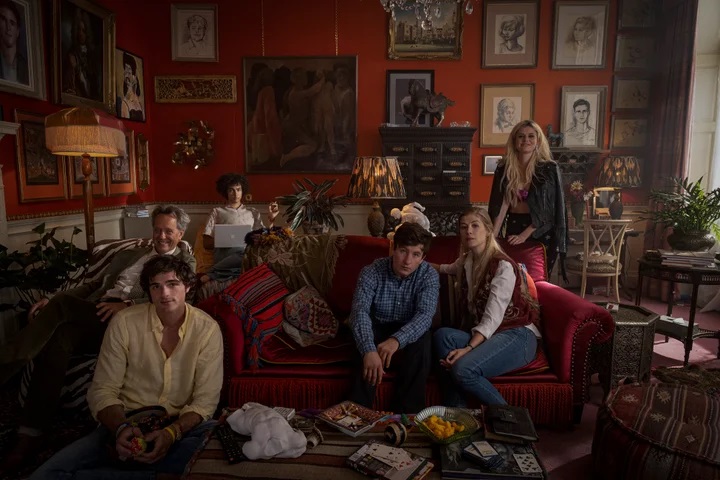
Saltburn (2023) is set in 2006. Oliver Quick (Barry Keoghan) attends Oxford University as a naive fresher with an inferiority complex and desire for company. While he is incredibly intelligent, coming from a lower class background places bookish Oliver as a very small fish in big water. Especially when compared to the so-called Oxford elite including handsome and wealthy, Felix Catton (Jacob Elordi) and his cousin, the handsome and not-as-wealthy, Farleigh Start (Archie Madekwe). While Farleigh is suspicious of Oliver, Jacob soon befriends him and takes the Northerner under his wing. The two connect and form an “odd couple” bromance, with Felix even going so far as to invite Oliver to his stately home, Saltburn, for the summer. There we meet the rest of Felix’s family including his flaky sister, Venetia (Alison Oliver), eccentric father, Sir James (Richard E. Grant) and effervescent mother, Lady Elspeth (Rosamund Pike).
After building Oliver and Felix’s characters carefully during their time at Oxford, Fennell’s savage and satirical screenplay gathers pace in the second act at Saltburn. Here Oliver tries to fit in and ingratiate himself into the Catton family, but it soon becomes clear that however friendly they may be, he will only ever be an outsider to them. Simultaneously, Farleigh sees Oliver as a rival for the Cattons’ emotional and financial affections and the two begin a retaliatory personal war amidst the balmy summer days, breakfasts, dinner parties and social gatherings. Oliver’s main journey is to connect as much with Felix as possible, so much so his passion veers toward obsession. But Felix is a roaming spirit and a hedonist and does not quite requite Oliver’s feelings. Yet, Felix does show compassion for Oliver, as illustrated when he drives him on a mercy mission to visit Oliver’s family. This is where the story takes an intriguing and ever deadly turn.
I cannot recommend Saltburn (2023) enough for its fantastically witty script, devastatingly brilliant cast and some quite disgustingly explicit, but contextually justifiable, character moments and scenes. Fennell takes the setting and structure of Evelyn Waugh’s Brideshead Revisited and turns it upside down, spinning a devious tale of infatuation, love, privilege and social climbing. Through the character Oliver Quick, and I really don’t want to give anything away, there is a powerful and jaw-dropping character arc of upward mobility. Rosamund Pike’s and Keoghan’s performances are both amazing and award-worthy. While the final act twists certainly do shock and surprise they arguably are rushed when compared with the more effective pacing of the opening and middle acts. Moreover, I am also unsure why the exquisite cinematography and stunning locations were presented in the 4:3 (1:33:1) aspect ratio. Why squeeze in Linus Sandgren’s light and framing and not expand them to the widescreen format?
Ultimately, Emerald Fennell proves herself an important voice in British cinema. Unafraid to test the boundaries of taste, genre, and audience expectations, she has crafted one of the most consistently challenging films of the year with Saltburn (2023). One could easily describe the themes presented here as a critique of the upper classes and how the uber-rich are bad people to be brought down to their knees. However, Fennell’s script is not that simplistic. It cleverly careers between love/hate for the characters and irony-bombing the class system, before becoming a damning indictment on the darkest flaws of humanity. Lest one forget the indelible one-liners throughout and THAT final dance sequence, which are both to die for!
Produced by: Ridley Scott, Kevin J. Walsh, Mark Huffam, and Joaquin Phoenix.
Main Cast: Joaquin Phoenix, Vanessa Kirby, Tahar Rahim, Rupert Everett, Ben Miles, Ludivine Sagnier, and more.
Cinematography by Dariusz Wolski
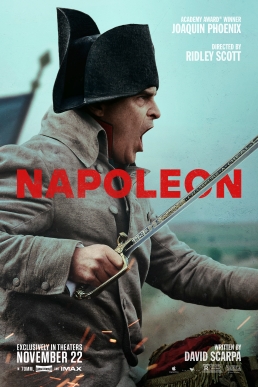
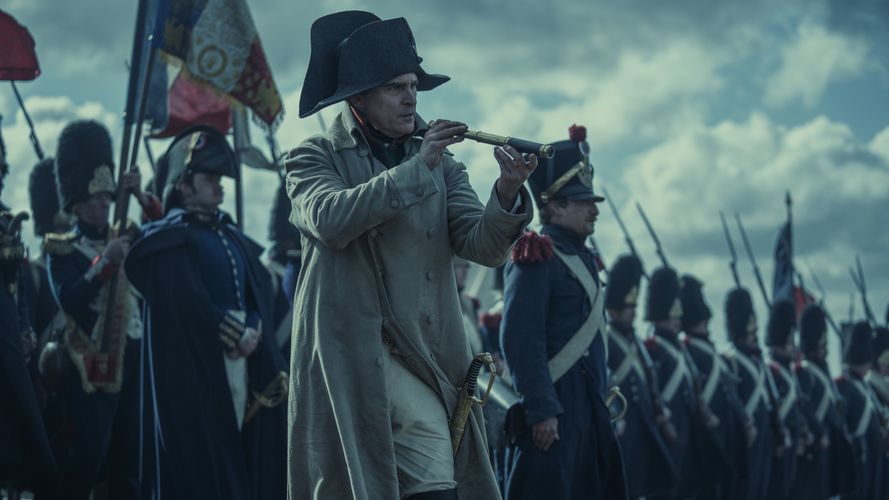
If you didn’t know, Napoleon I, was also called Napoleon Bonaparte. He was a French military general and statesman and played a key role in the French Revolution (1789–99), before serving as first consul of France (1799–1804). Napoleon was also the first emperor of France (1804–14/15) and given his many years of military campaigns in France and overseas, striving to build an empire for France, he is now widely considered one of the greatest generals in history. I don’t purport to be a history buff, but I was intrigued by the release of Ridley Scott’s latest directorial epic cinematic behemoth, Napoleon (2023). This almost-three-hour release comes to the screen courtesy of Sony and Apple TV with Joaquin Phoenix in the titular role.
Opening in 1793, a young, but up-and-coming army officer Napoleon witnesses Marie Antoinette get her head cut off at the guillotine, followed quickly by one of the many thrilling battle sequences in the film at the ‘Siege of Toulon.’ It was during this siege that young Napoleon first won fame when his strategy, forced the Anglo-Spanish fleet to withdraw. After which David Scarpa’s adaptation and Scott’s editing team rattle through the battles, romances, trials and decades of Napoleon’s life so breathlessly, as an audience member, I felt like this film was more of a “Now That’s What I Call Napoleon!” greatest hits package rather than a compellingly intense drama and study that really delves into the complex psychology of Napoleon’s character.
Ridley Scott, at 85 years old, brings his masterly cinematic experience to many explosive battle sequences in Egypt, Austria, France and throughout Europe. The stunning cinematography by Dariusz Wolski supports Scott’s vision and it is safe to say the production design and costumes are par excellence for this massively budgeted production. However expertly shot, edited and rendered on screen the battles are, they often feel rushed through at times, providing jarring punctuation to the central human focus of the film, the love story between Napoleon and Josephine (Vanessa Kirby). I feel like I would have preferred a deeper analysis of Napoleon’s military strategics and perhaps a more serious approach to his importance to France through his victories on the battlefield.
Vanessa Kirby, as Josephine, brought a class, elegance and intelligence to the role and gives a standout performance. Joaquin Phoenix, who is one of the finest actors around, however, gives us a misfiring characterization as Bonaparte. I just felt it was too knowing and flippant throughout. I am not averse to humour in serious dramas, but I just did not warm at all to his portrayal. Scott’s director of Phoenix plus Scarpa’s screenplay only touch the surface of Napoleon’s character. I mean here is a historical figure who has an incredible series of chapters in his life, but there is no major journey or arc in his story. At times I even felt there was ridicule for Napoleon, but if you wish to critique him, then why not make him more dangerous, a monster even. Especially given his predilection and desire for war and sending thousands of lives to their tragic end.
Like I say, Scott and his amazing creative team deliver a greatest “hits” of Napoleon’s life and some spectacular cinematic moments. But quite often I was bored and questioning why I should care about any of the characters on screen. Scott and his screenwriter have been stung by criticisms of historical inaccuracies. That doesn’t bother Scott at all and would not bother me if such changes enhanced the drama. Yet, the compression of certain scenarios seem to be more for pacing reasons. Lastly, there is apparently a four-hour directorial cut of the film so perhaps that contains more depth, emotion and psychological analysis of Napoleon, rather than the paper-thin filmic treatise delivered here.
Based on: The Killer by Alexis “Matz” Nolent and Luc Jacamon
Produced by: William Doyle, Peter Mavromates, Ceán Chaffin
Cast: Michael Fassbender, Arliss Howard, Charles Parnell, Kerry O’Malley, Sala Baker, Tilda Swinton and Sophie Charlotte.
*** MAY CONTAIN SPOILERS ***
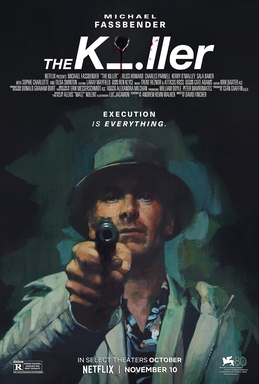
David Fincher is one of those filmmakers whose form and style is often unsettling and remarkable. He has built up a formidable body of directorial work over the years and his qualities were displayed perfectly in the Netflix FBI drama Mindhunter. Greens, dark yellows and browns stained the screen as Fincher and other series directors created a haunting stylistic palette. Furthermore, with the gripping narratives, great direction and memorable performances I just did not want the latest season of Mindhunter to end. Choosing to stay with the theme of death, Fincher now presents The Killer (2023), again released by Netflix.
Michael Fassbender is the unnamed assassin who has a specific set of rules. The film opens with him currently preparing for his latest job. He chimes and opines via a voiceover like a monk praying allowing us into his way of working. Methodical and meticulous, the ‘Killer’ waits patiently for the moment his planning comes to a head and he shoots. All the while he listens to songs by Mancunian indie band, The Smiths. The opening sequence is the strongest of the film and is a masterclass of visual storytelling, character work by Fassbender and suspense building. Inevitably, for a consummate professional and organiser, the hit goes awry and the ‘Killer’ find himself a target for death himself.
After such a memorable opening, reminiscent of one of Paul Schrader’s compelling existential-lone-man-in-a-room dramas, the remainder of the film is a more generic series of chases and fights enlivened by one stand-out acting duologue scene between Fassbender and Tilda Swinton. Moreover, for a character to have renounced emotional connections with anyone or anything, the ‘Killer’s’ motivations to wreak revenge on those who harmed his girlfriend seemed at odds with his governing principles. Also, for someone who is meant to “stick to the plan” he does improvise a fair amount. Putting my personal pedantry aside, this is a fine B-movie in the assassin crime subgenre with terrific work by Fassbender as the quirky killer and also Fincher, who even in second gear, is capable of delivering darkly compelling filmic entertainment.
Cast: Song Kang-ho, Gang Dong-won, Bae Doona, Lee Ji-eun and Lee Joo-young.
Cinematography: Hong Kyung-pyo
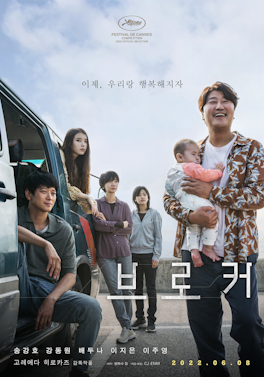
Arguably Japanese director’s Hirokazu Kore-eda’s most accessible film to date is the slice-of-life comedy-drama, BROKER (2022). Elements of Little Miss Sunshine (2006) meetsParasite (2019) meets Juno (2007) as kind-of-likeable and empathetic criminals create a dysfunctional family unit around stealing orphans and finding them families to makes ends meet. Lighter than many of his other brilliant human dramas, there is much to savour here from one of the best filmmakers working today.
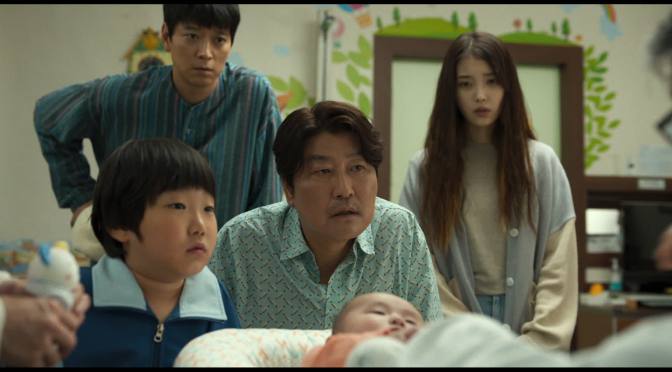
There’s a lot going on in Broker (2022) as the duo of Sang-hyeon (Song Kang-ho) and Dong-soo (Gang Dong-won) work a grift of taking the unwanted babies, a police thriller involving murder, an impromptu road movie in a camper van, a cute kid looking for a surrogate father and a mother, Moon So-young (Lee Ji-eun) battling the dilemma of whether to sell or keep her child. A lesser filmmaker could have struggled balancing the many story, character and tonal shifts but Kore-eda manages it with aplomb.
Broker (2022) arguably has too many intertwining subplots though, as it strives to redeem all of the complex characters, but the wonderfully believable performances and brilliant screenplay really grabs you and rarely lets you go. Kore-eda’s direction is, as usual, masterly and assured as he balances the various tones confidently. Overall, this film makes you laugh, cry and is really moving as it highlights that family units can be lovingly born of collective experience, as well as blood.
Mark: 9 out of 11
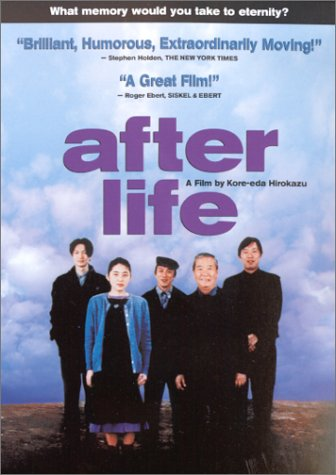
AFTER LIFE (1998)
Directed and written by Hirokazu Kore-eda Produced by Masayuki Akieda, Shiho Sato
What a delightful, surreal and beautiful film. AFTER LIFE (1998), is easily one of the most imaginative and human films I have watched in a long time. It is set in an administrative centre somewhere between the realms of life and death. Here the staff of the office, kind of social workers, welcome recently deceased people and ask them to recall their life and choose a single memory. After which the filmmaking staff will recreate the memory, shoot this scene and the souls will be able to re-experience this moment forever in heaven.
To me this is a mind-blowing concept for a feature film and I am surprised that it has not been remade (and probably ruined) by Hollywood for either cinema or TV. What makes it so great is, that despite the high concept idea, the design and delivery is so down-to-earth. The offices where events confirmed are not presented with any of the usual angelic or heavenly cliches. Instead, Hirokazu Kore-eda, of which this is only his second feature film, and his production team, decide that the after-life is an unglamorous place run by kindly bureaucrats.
One of the many strengths of After Life (1998) lies with the human representations, both the people who have passed and the office angels who counsel them. The love, humour and emotion derived from the various interviews given by many of the characters are full of joy, sadness and longing. Along with the soulful characters coming to terms with their recent passing, the narrative also focuses on two “young” counsellors, Takashi (Arata Iura) and Shiori (Erika Oda), who must overcome their personal conflicts while helping others. Overall, After Life (1998) builds slowly and beautifully weaves so many fantastic human stories. When the filmed memories are revealed my heart melted, as Kore-eda delivers cinematic moments that will stay with one eternally.
FILMS THAT GOT AWAY #16: OFFICIAL COMPETITION (2021)
Directed by Gastón Duprat and Mariano Cohn
Written by: Mariano Cohn, Andrés Duprat and Gastón Duprat
Produced by: Jaume Roures
Main cast: Penélope Cruz, Antonio Banderas, Oscar Martínez, José Luis Gómez, Irene Escolar, Manolo Solo, Nagore Aranburu, Pilar Castro Koldo Olabarri, etc.
Cinematography Arnau Valls Colomer
**MAY CONTAIN SPOILERS**
It’s no surprise there are an abundance of films about the actual process of filmmaking. The film industry is full of rich possibilities in terms of drama, action, tragedy, romance and comedy. Moreover, cinema down the years is replete with imaginative, tough, evil, spoilt, egotistical, eccentric, pretentious and frankly insane individuals working in the film industry. 8 1/2 (1963),Dolemite is My Name (2019), Shadow of the Vampire (2000), Sullivan’s Travels (1941), Barton Fink (1991), State and Main (2000), Once Upon A Time In Hollywood (2019), Hugo (2011), Living In Oblivion (1995), Boogie Nights (1997), The Disaster Artist (2017), Ed Wood (1994), The Player (1992), and Tropic Thunder (2008) are just a few brilliant films about filmmaking. Now you can add the hilarious Argentinian-Spanish co-production, Official Competition (2021) to that list.
With stunningly funny performances from Penelope Cruz, Antonio Banderas and Oscar Martinez, Official Competition (2021), centres on a film-within-a-film production, as Cruz’s ostentatious director, Lola Cuevas, helms a billionaire-backed-big-budget adaptation of a critically acclaimed book. Banderas is Felix Rivero, a famous movie star, while Martinez is a method-driven actor, and with the wildly unpredictable Cuevas between them, a rivalry soon develops between their different acting styles and personalities. As the production progresses any respect they had evaporates and descends into hilarious acrimony amidst a series of expertly staged comedic set-pieces.
I find it incredibly irritating that so many films get critical praise and win awards and you watch them and, while technically brilliant, they are ultimately boring and pretentious. Then we get Official Competition (2021), with a perpetually inventive screenplay by Mariano Cohn, Andrés Duprat and Gastón Duprat, that has not received nearly enough critical praise or awards. In fact, it mocks those artistically inflated directors and actors whom often get over-praised by fawning film critics and journalists. So, if you love films about filmmaking and funny ones at that, please do check this film out streaming on Netflix. It is certainly a cut above the pretentious films, actors and directors it is cleverly satirising.
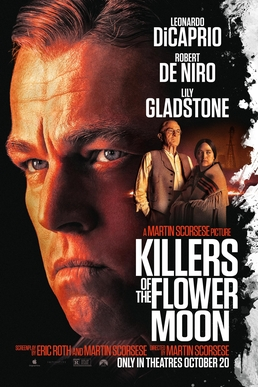
Based on: Killers of the Flower Moon by David Grann
Produced by: Dan Friedkin, Bradley Thomas, Martin Scorsese and Daniel Lupi
Main cast: Leonardo DiCaprio, Robert De Niro, Lily Gladstone, Jesse Plemons, John Lithgow, Tantoo Cardinal, Scott Shephard, etc.
Cinematography: Rodrigo Prieto
Edited by: Thelma Schoonmaker
*** MAY CONTAIN SPOILERS ***
Who can tell how the world and society as we know it would’ve evolved if Christopher Columbus, the explorer credited with finding the Americas in 1492, had not landed and begun the first steps toward colonising this uncharted part of Earth. Of course, there were existing natives in the Americas and over time they would experience first contact with Spanish, Portuguese, British and other European, predominantly white, settlers. It may be that the natives would have had equally difficult experiences, and colonists brought with them many positive things. But one has to surmise they would not have had their land and lives gradually taken from them over the centuries without the European invasion.
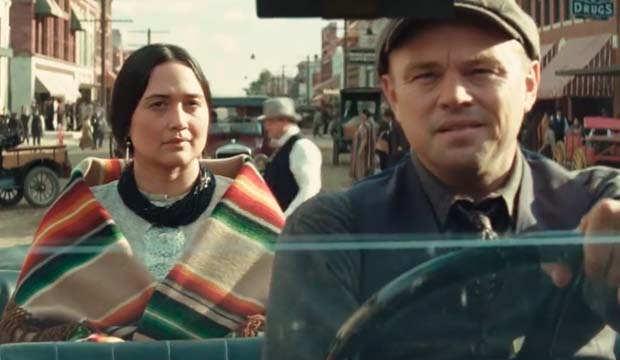
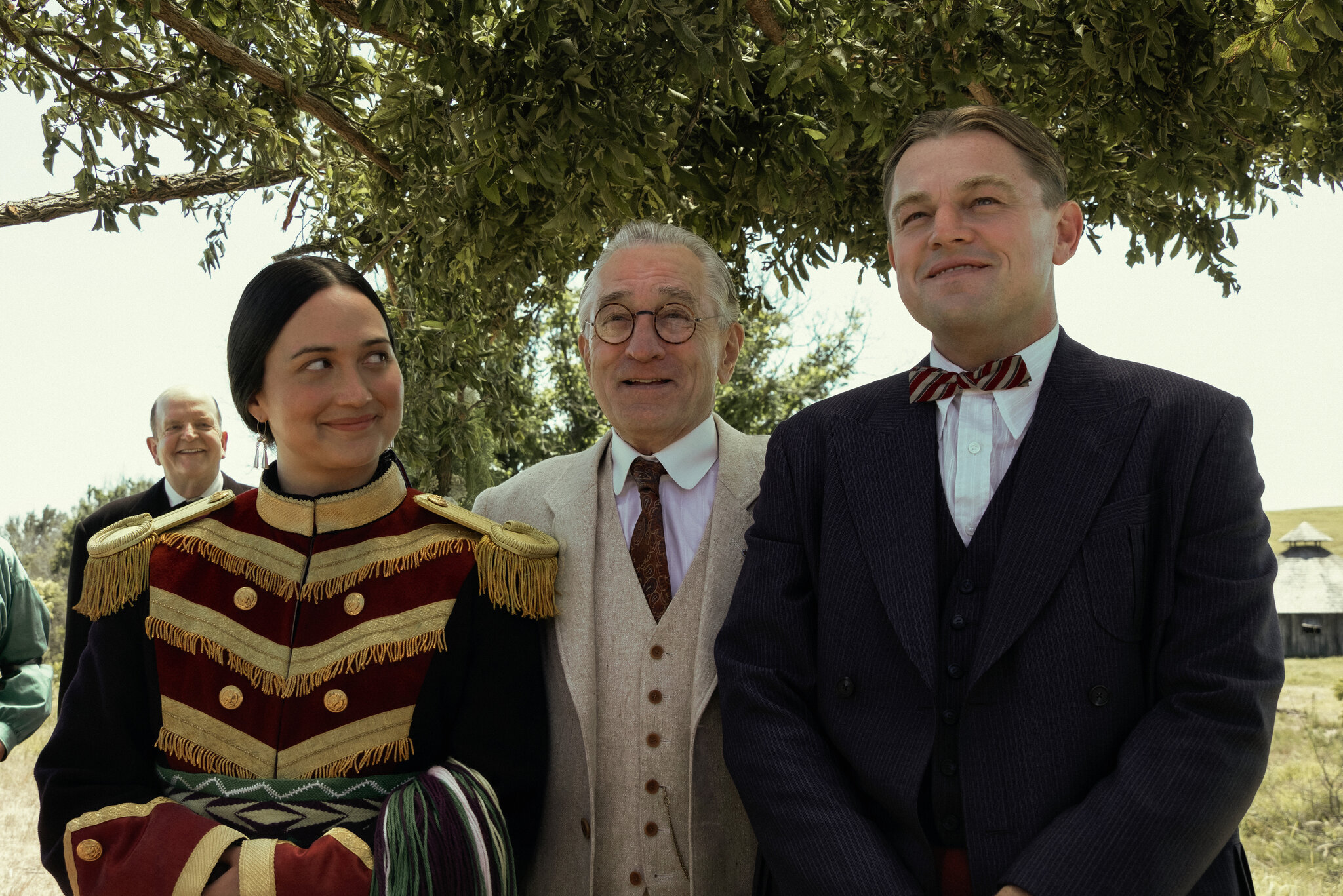
The violent theft of land and wealth from Native Americans forms the bedrock of the narrative of Martin Scorsese’s latest epic drama, Killers of the Flower Moon (2023). Adapted from David Grann’s critically acclaimed nonfiction book, the film centres on the series of murders of wealthy Osage people that occurred in Oklahoma in the early 1920s. The motive for the heinous culling was the greed of white men. Such individuals lusted after the richness present after big oil deposits were discovered beneath the Osage people’s land. Whereas Grann’s book is a monumental study of the murders, perpetrators, the Osage culture, politics of the era, and how the newly formed FBI delved into the crimes, Scorsese’s incredibly slow and long adaptation does all that, while also exploring the romance and murderous treachery between Osage native, Mollie (Lily Gladstone) and war veteran, Ernest Burkhart (Leonardo DiCaprio).
Opening by establishing how the oil erupted and blackened the green land, the film then firmly sets up how the American businessmen used the legality of the headright system to manipulate the flow of sudden wealth that came to the Osage people. One such man is William King Hale (Robert DeNiro) who presents himself as a benefactor to the Osage, but truly speaks with a forked tongue. Having left the infantry unit after World War One, Hale’s nephew Ernest joins him to work and ultimately do his bidding. Hale cajoles Ernest to romance wealthy Mollie and get further feet under the table and closer to that beloved black gold money. Yet, enough is never enough for the likes of Hale and driven by another formidable Scorsese directed performance, De Niro delivers a deviously evil characterisation.
DiCaprio here takes the less charismatic role as the doltish Ernest. As Hale urges him to do further misdeeds the banality of everyday evil is palpable in Ernest’s actions. Along with a litany of professional and thuggish cowboy types Ernest and Hale’s other minions wreak havoc on the Osage people, committing arson, murder, poisonings, robbery, and shootings. All just for more money. The tragedy is that Ernest clearly has feelings for Mollie, serenely portrayed by a revelatory Lily Gladstone, but he just cannot stand up for himself against his wicked uncle. So much so that I just wondered why the hefty runtime was concentrating on Ernest’s character. I mean, Scorsese and DiCaprio give us little in the way of anti-heroism to bounce off, or even some cathartic sense of redemption. Ernest starts out as a loser and finished the story the same. Over three hours spent with a gurning idiot left me frustrated.
Directed, as one would expect with a masterful hand, mind and eye by Scorsese, who once again surrounds himself with an incredibly talented cast and production crew. Not to forget the unbelievable $200 million budget. But Scorsese’s movement of late to ultra-long and methodical cinema is an artistic choice that requires much patience. While Killers of the Flower Moon (2023 is thematically very powerful, beautifully filmed, and contains a number of exceptionally impressive sequences, there was genuinely not enough story to justify such a long running time. Whereas The Irishman (2019) was slow, it was methodically thrilling and absorbing throughout. Killers of the Flower Moon (2023) on the other hand becomes repetitive in its reveals of greedy Cowboys breaking bad and raising hell to the cost of the Osage. The introduction of the FBI and their subsequent investigation comes way too late to save the over-bloated length and pace. However, there is no doubt, the film remains vital in highlighting the historial horror perpetrated upon the Osage land and people. Perhaps Apple TV should have just given the money to the Osage descendants as reparation?










 The Cinema Fix presents