Tag Archives: 2026 films

Cinema Review: The End of Oak Street (2026) – a fun and exciting Twilight Zone meets Jurassic Park movie mash-up!

Cinema Review: The End of Oak Street (2026)

Directed by David Robert Mitchell

Written by David Robert Mitchell

Produced by: J. J. Abrams, Hannah Minghella, Jon Cohen, David Robert Mitchell, Matt Jackson, Tommy Harper, etc.

Main cast: Anne Hathaway, Ewan McGregor, Maisy Stella
Christian Convery, etc.


Cinematography by Michael Gioulakis

** CONTAINS SPOILERS **
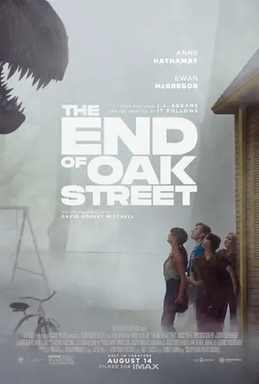


David Robert Mitchell announced himself as a filmmaker to watch with the amazing It Follows (2014), one of the most original and unnerving American horror films of the last decade. Its relentless, shape-shifting entity, dreamlike suburban landscapes and wonderfully simple central conceit turned teenage sexuality and anxiety into something genuinely nightmarish. Four years later came the altogether stranger Under the Silver Lake (2018), a bizarre, labyrinthine Hollywood conspiracy thriller that seemed determined to disappear down every rabbit hole it could find. Now, after an eight-year absence from directing, Mitchell lands somewhere between those two extremes with The End of Oak Street (2026)— a wacky movie mash-up, certainly, but one pitched on considerably safer and more commercial ground: dinosaurs destroying the neighbourhood.

The premise is gloriously fun. It is the early 1980s and the Platt family — Denise (Anne Hathaway), Greg (Ewan McGregor) and their children Audrey (Maisy Stella) and Brian (Christian Convery) — are already experiencing their own domestic extinction event when a mysterious cosmic phenomenon transports their suburban neighbourhood millions of years into the past. Suddenly the comfortable American cul-de-sac is surrounded by prehistoric vegetation and populated by creatures considerably less friendly than the people next door.

It is difficult not to think of Spielberg. Jurassic Park (1993) is the obvious reference, but there are also echoes of E.T. (1982), Poltergeist (1982) and the Amblin school of ordinary suburban families confronted by extraordinary events. Mitchell effectively reverses the Jurassic Park formula: instead of humans visiting the dinosaurs, the suburbs are dropped into their world. The result is part science fiction, part creature feature, part dysfunctional-family drama and part disaster movie — a cinematic pick-and-mix that rarely stops moving long enough for us to question how absurd the whole thing is.

And when the dinosaurs arrive, Mitchell has fun with them. These aren’t simply majestic CGI museum exhibits waiting for somebody to stare upwards in wonder. They are animals, predators and occasionally wrecking balls, turning driveways, kitchens, gardens and picket fences into prehistoric feeding grounds. There is something inherently amusing about seeing the reassuring iconography of American suburbia invaded by creatures that existed millions of years before the mortgage, the station wagon and the neighbourhood barbecue.
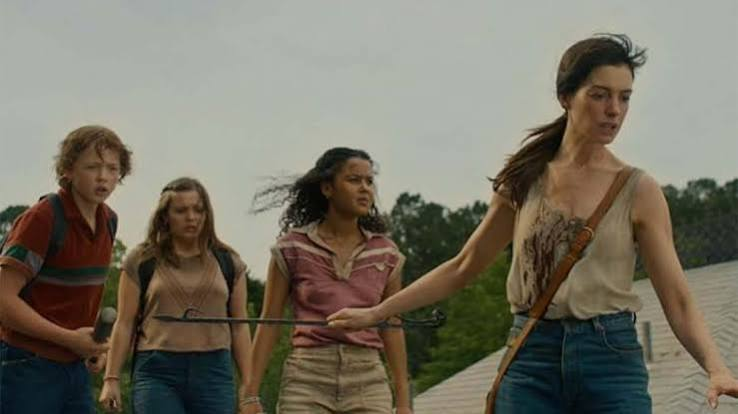


Michael Gioulakis’ cinematography gives Mitchell’s suburban apocalypse considerably more visual personality than the average effects-driven blockbuster, while Michael Giacchino’s score understands exactly when to embrace the grandeur and when to undercut it. Mitchell even deploys split-diopter compositions during comparatively mundane family conversations — an indication that, beneath the expensive dinosaur spectacle, the director of It Follows hasn’t entirely disappeared.

Hathaway and McGregor also prevent the human story from being completely trampled beneath giant reptilian feet. Denise and Greg’s marriage is already in trouble before prehistoric nature intervenes, giving the film a neat central joke: sometimes it takes being transported millions of years into the past and nearly eaten by dinosaurs to put your domestic problems into perspective. Hathaway is particularly good at giving Denise the necessary toughness without turning her into a generic action heroine, while McGregor brings warmth and vulnerability to Greg.

There are some surprisingly brutal moments too. Mitchell hasn’t forgotten his horror roots, and when the film wants its dinosaurs to be frightening rather than spectacular, they genuinely are. The neighbourhood becomes a hunting ground where screams, gunshots and sudden silences remind us that families in the surrounding houses are experiencing their own unseen horror stories. One major mid-film development is especially effective because Mitchell briefly allows us to believe that this apparently family-friendly adventure might be prepared to become something much nastier. Plus, I have to say that gigantic prehistoric snake is a seriously terrifying predator, especially when wrapped within the rooms and doorways of the house.

The later time-warp mechanics allow Mitchell to play with paradoxes, alternative outcomes and some intriguingly strange ideas, but they also provide the screenplay with convenient escape routes. The film constructs a wonderfully impossible situation and then becomes noticeably more generous toward its characters as it approaches the finishing line. That choice makes for an audience-friendly conclusion, but there is a tantalisingly darker version of this movie buried somewhere underneath — one in which Mitchell follows his premise to a more apocalyptic and cruel destination.

Still, the neat, wrapped up conclusion totally makes sense and Bad Robot’s J.J. Abrams crowd-pleasing, commercial sensibility has clearly reined in Mitchell’s more risky storytelling approach. Overall, The End of Oak Street (2026) knows exactly what kind of Saturday-night movie it wants to be. It has movie stars, monsters, scares, humour, family melodrama, science-fiction, time travel and enormous prehistoric creatures smashing their way through suburbia. Sometimes cinema doesn’t need to reinvent the dinosaur, even though some conspiracy theorists believe dinosaurs never existed. But, that’s another film altogether.
Mark: 8 out of 11


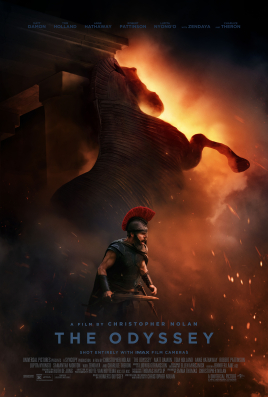
Cinema Review: The Odyssey (2026) – a loud, proud and phenomenal cinematic voyage!

Cinema Review: The Odyssey (2026)

Directed by Christopher Nolan

Screenplay by Christopher NolanBased on Homer’s Odyssey

Produced by Emma Thomas & Christopher Nolan


Main cast: Matt Damon, Tom Holland, Anne Hathaway, Robert Pattinson, Lupita Nyong’o, Samantha Morton, Zendaya, Charlize Theron, Himesh Patel, Jon Bernthal, John Leguizamo, Bill Irwin and many more!

Cinematography by Hoyte van Hoytema

Edited by Jennifer Lame

Music by Ludwig Göransson

*** REVIEW CONTAINS SPOILERS ***


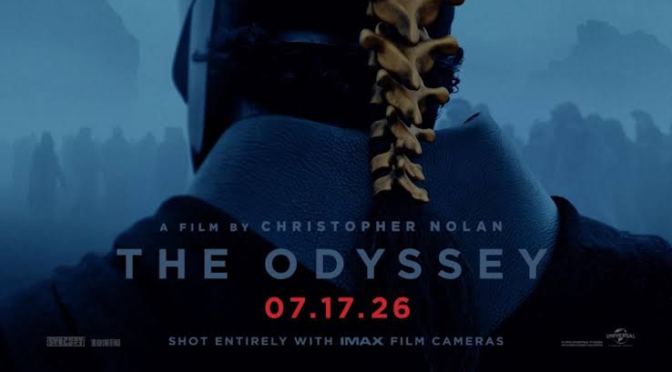
I’ve been weirdly reluctant to review Christopher Nolan’s rendition of Homer’s epic poem, The Odyssey (2026). Being honest, what I think of the film is pretty irrelevant. I mean, it’s an incredible feat of big budget filmmaking from, Sir Christopher Nolan, who remains one of the most brilliant filmmakers of the modern era. The film is likely to make more money at the box office than the debt of a small country as it sails the cinema seas. But I have to say amidst the incredible entertainment, stellar cast, jaw dropping sound and visuals and lengthy running time it does contain some dubious creative decisions, mainly where accents and casting are concerned.

I’m a big Nolan fan, but not all of his films land fully with me. My favourites remain: Memento (2000), The Prestige (2006), The Dark Knight (2008), Inception (2010) and Dunkirk (2017). Conversely, The Odyssey (2026) matches Oppenheimer (2023) for the array of Nolan’s ensemble of stars, confident and masterly direction, plus the sheer seismic scale of what his production team have committed to screen. Similarly though, while Cillian Murphy and Matt Damon give compelling performances as leaders in their field having to make tough choices to win wars, am I meant to care about these characters, who are effectively, “destroyers of worlds.”

Well, in J. Robert Oppenheimer’s case , dependent on your point of view, a huge debt of gratitude is owed to him and his team for producing a weapon to end all wars. If you ignore all the subsequent actual wars, proxy wars, invasions, conflicts and the blasted ‘Cold War’ which ensued after World War II ended, nuclear weapons have meant no other wars have occurred. So, The Odyssey (2026) is another Nolan film about war. But it’s also about duty, family, love, honour, comradeship, guilt and making the perilous journey home. Let’s be honest though, Odysseus is either a hero of Troy or a war criminal. Further, he’s a sneaky so and so – hiding in a gigantic hollow horse, and making the Trojans pull it into the city too! At least the Trojans got some cardiovascular exercise before they were all slaughtered.

Told in a non-linear fashion from shifting character perspectives, The Odyssey (2026) shows our hero and his crew facing a dangerous voyage back to Ithaca, questing the Gods, fighting nasty weather and meeting creatures like the Cyclops Polyphemus, gigantic metal knights, the Sirens, Charybdis and Scilla along the way. Furthermore, as well as focusing on Odysseus’ hazy, drugged memories, poisoned with lotus flowers by Calypso (a shrinking, Charlize Theron), we get woven historical flashes from Telemachus (Tom Holland) as he searches for his father, Penelope (Anne Hathaway) as she recounts their romantic commitments before the war, and Menelaus (Jon Bernthal), as he provides revelation on the post-war fate of his brother, King Agamemnon. I watched the stories-within-stories unfold totally enthralled and feeling like this was the Citizen Kane (1941) of epic mythical cinema.


While the action and spectacle are undeniably compelling, it’s Nolan’s gift for weaving ancient myth into gripping cinema that impresses just as much. The casting, too, is full of intriguing choices. As expected, Nolan reunites with several familiar collaborators, and Matt Damon is superb as an ageing Odysseus – a battle-scarred general worn down by years of war but still determined to get his men home. Unfortunately, a string of catastrophically bad decisions ensures the gods have other ideas. In the world of The Odyssey (2026), poor judgement is practically a death sentence, and every time the crew think they’ve caught a break, another vengeful deity or monster appears to remind them who’s really in charge. None is more delightfully capricious than the witch Circe (Samantha Morton), who transforms the crew into pigs simply because… well, she can. Morton’s wonderfully imperious performance, thankfully delivered in her own British accent amidst an ocean of American ones, is a genuine scene-stealer.

Which does raise an interesting question. Why does Tom Holland, playing Telemachus, sound American? Is he following his on-screen father? Fair enough—but then what about the suitors, led by Antinous (Robert Pattinson), who’ve spent years occupying Ithaca while pestering Penelope and circling the throne like particularly persistent estate agents? Nolan famously pursued authenticity elsewhere, filming extensively in Greece, utilizing full-sized wooden ships, combining practical effects (Jet-Skis for the killer whirlpool) with discreet CGI, even building an enormous Cyclops model for Polyphemus. Yet somehow Jon Bernthal still sounds as though he’s just wandered in from a Brooklyn deli. (I know he’s not actually from Brooklyn… but, hey, what are ya gonna do?) The quest epics I grew up with often great British Shakespearean actors in them. While Laurence Olivier and Maggie Smith are not Greek either, they paradoxically somehow seem more authentic.

Still, The Odyssey (2026) is a glorious reminder of what cinemas were built for. It is loud, proud, unapologetically epic, and although it runs for three hours, the time flies even as it threatens to blow your eardrums out. This is filmmaking on the grandest possible scale—war, monsters, storms, impossible voyages and heroes—designed to overwhelm an audience in ways no living room ever could. Nolan understands that some stories demand the biggest IMAX screen imaginable. In an age when entertainment is increasingly consumed in fragments, The Odyssey (2026) insists on total immersion. It isn’t subtle, and it isn’t trying to be. It’s spectacular cinema in the truest sense of the word.

Perhaps that’s what cinema has always been for: gathering in the dark to watch wars, death and monsters on a screen, if only to distract ourselves from the wars, death and monsters waiting for us in reality. As the philosopher Guy Debord observed, “The spectacle is not a collection of images, but a social relationship between people that is mediated by images.” And as Heraclitus famously put it, “War is the father of all things.” The Odyssey (2026) reminds us that, three thousand years later, humans are still captivated and bombarded by both.

Mark: 9.5 out of 11