Tag Archives: IMAX

Cinema Review: The Odyssey (2026) – a loud, proud and phenomenal cinematic voyage!

Cinema Review: The Odyssey (2026)

Directed by Christopher Nolan

Screenplay by Christopher NolanBased on Homer’s Odyssey

Produced by Emma Thomas & Christopher Nolan


Main cast: Matt Damon, Tom Holland, Anne Hathaway, Robert Pattinson, Lupita Nyong’o, Samantha Morton, Zendaya, Charlize Theron, Himesh Patel, Jon Bernthal, John Leguizamo, Bill Irwin and many more!

Cinematography by Hoyte van Hoytema

Edited by Jennifer Lame

Music by Ludwig Göransson

*** REVIEW CONTAINS SPOILERS ***
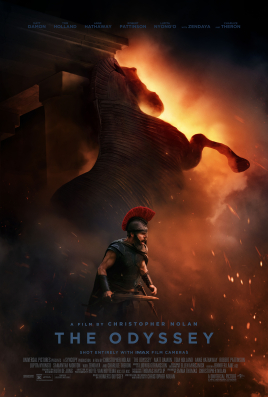


I’ve been weirdly reluctant to review Christopher Nolan’s rendition of Homer’s epic poem, The Odyssey (2026). Being honest, what I think of the film is pretty irrelevant. I mean, it’s an incredible feat of big budget filmmaking from, Sir Christopher Nolan, who remains one of the most brilliant filmmakers of the modern era. The film is likely to make more money at the box office than the debt of a small country as it sails the cinema seas. But I have to say amidst the incredible entertainment, stellar cast, jaw dropping sound and visuals and lengthy running time it does contain some dubious creative decisions, mainly where accents and casting are concerned.

I’m a big Nolan fan, but not all of his films land fully with me. My favourites remain: Memento (2000), The Prestige (2006), The Dark Knight (2008), Inception (2010) and Dunkirk (2017). Conversely, The Odyssey (2026) matches Oppenheimer (2023) for the array of Nolan’s ensemble of stars, confident and masterly direction, plus the sheer seismic scale of what his production team have committed to screen. Similarly though, while Cillian Murphy and Matt Damon give compelling performances as leaders in their field having to make tough choices to win wars, am I meant to care about these characters, who are effectively, “destroyers of worlds.”

Well, in J. Robert Oppenheimer’s case , dependent on your point of view, a huge debt of gratitude is owed to him and his team for producing a weapon to end all wars. If you ignore all the subsequent actual wars, proxy wars, invasions, conflicts and the blasted ‘Cold War’ which ensued after World War II ended, nuclear weapons have meant no other wars have occurred. So, The Odyssey (2026) is another Nolan film about war. But it’s also about duty, family, love, honour, comradeship, guilt and making the perilous journey home. Let’s be honest though, Odysseus is either a hero of Troy or a war criminal. Further, he’s a sneaky so and so – hiding in a gigantic hollow horse, and making the Trojans pull it into the city too! At least the Trojans got some cardiovascular exercise before they were all slaughtered.

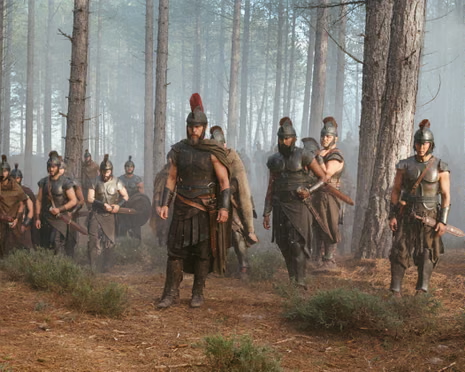
Told in a non-linear fashion from shifting character perspectives, The Odyssey (2026) shows our hero and his crew facing a dangerous voyage back to Ithaca, questing the Gods, fighting nasty weather and meeting creatures like the Cyclops Polyphemus, gigantic metal knights, the Sirens, Charybdis and Scilla along the way. Furthermore, as well as focusing on Odysseus’ hazy, drugged memories, poisoned with lotus flowers by Calypso (a shrinking, Charlize Theron), we get woven historical flashes from Telemachus (Tom Holland) as he searches for his father, Penelope (Anne Hathaway) as she recounts their romantic commitments before the war, and Menelaus (Jon Bernthal), as he provides revelation on the post-war fate of his brother, King Agamemnon. I watched the stories-within-stories unfold totally enthralled and feeling like this was the Citizen Kane (1941) of epic historical cinema.


While the action and spectacle are undeniably compelling, it’s Nolan’s gift for weaving ancient myth into gripping cinema that impresses just as much. The casting, too, is full of intriguing choices. As expected, Nolan reunites with several familiar collaborators, and Matt Damon is superb as an ageing Odysseus – a battle-scarred general worn down by years of war but still determined to get his men home. Unfortunately, a string of catastrophically bad decisions ensures the gods have other ideas. In the world of The Odyssey (2026), poor judgement is practically a death sentence, and every time the crew think they’ve caught a break, another vengeful deity or monster appears to remind them who’s really in charge. None is more delightfully capricious than the witch Circe (Samantha Morton), who transforms the crew into pigs simply because… well, she can. Morton’s wonderfully imperious performance, thankfully delivered in her own British accent amidst an ocean of American ones, is a genuine scene-stealer.

Which does raise an interesting question. Why does Tom Holland, playing Telemachus, sound American? Is he following his on-screen father? Fair enough—but then what about the suitors, led by Antinous (Robert Pattinson), who’ve spent years occupying Ithaca while pestering Penelope and circling the throne like particularly persistent estate agents? Nolan famously pursued authenticity elsewhere, filming extensively in Greece, utilizing full-sized wooden ships, combining practical effects (Jet-Skis for the killer whirlpool) with discreet CGI, even building an enormous Cyclops model for Polyphemus. Yet somehow Jon Bernthal still sounds as though he’s just wandered in from a Brooklyn deli. (I know he’s not actually from Brooklyn… but, hey, what are ya gonna do?) The quest epics I grew up with often great British Shakespearean actors in them. While Laurence Olivier and Maggie Smith are not Greek either, they paradoxically somehow seem more authentic.

Still, The Odyssey (2026) is a glorious reminder of what cinemas were built for. It is loud, proud, unapologetically epic, and although it runs for three hours, the time flies even as it threatens to blow your eardrums out. This is filmmaking on the grandest possible scale—war, monsters, storms, impossible voyages and heroes—designed to overwhelm an audience in ways no living room ever could. Nolan understands that some stories demand the biggest IMAX screen imaginable. In an age when entertainment is increasingly consumed in fragments, The Odyssey (2026) insists on total immersion. It isn’t subtle, and it isn’t trying to be. It’s spectacular cinema in the truest sense of the word.

Perhaps that’s what cinema has always been for: gathering in the dark to watch wars, death and monsters on a screen, if only to distract ourselves from the wars, death and monsters waiting for us in reality. As the philosopher Guy Debord observed, “The spectacle is not a collection of images, but a social relationship between people that is mediated by images.” And as Heraclitus famously put it, “War is the father of all things.” The Odyssey (2026) reminds us that, three thousand years later, humans are still captivated and bombarded by both.
Mark: 9.5 out of 11


THE GUARDIANS OF THE GALAXY (2014) – FILM REVIEW

THE GUARDIANS OF THE GALAXY (2014) F

**THERE BE SPOILERS AHEAD**

“Hence, once again, pastiche: in which stylistic innovation is no longer possible, all that is left is to imitate dead styles, to speak through the masks and with the voices of the styles… means that one of its essential messages is… the failure of the new, the imprisonment in the past.” Frederic Jameson – POSTMODERNISM & CONSUMER SOCIETY (1983)

starwars

I loved this film for so many reasons.  It’s a nostalgic rush and push of music, action, fantastical creatures, space operatics, zinging one-liners, knowing humour, spectacular effects and in Chris Pratt — a new cinema star (lord) for the millennium is born.  Let’s be honest there isn’t an original bone in its body but the fleshy pastiche and meaty cultural references Guardians of the Galaxy wears proudly on its sleeves take the audience on one hell of a journey.

guardians4

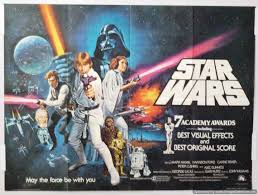
Marxist and cultural theorist Frederic Jameson spoke of the rise of the “Nostalgia” film and postmodernist movies such as Star Wars (1977) and American Graffiti (1973) in his seminal essay aforementioned above.  The Nostalgia film harks back and references the past drawing influences not from reality but rather cultural artefacts such as films, comics, radio, TV and music etc.  Guardians of the Galaxy involves an orphaned hero — with mysterious father — who must do battle against an evil empire, save a “damsel” in distress, all the while accompanied by a motley crue of intergalactic misfits.  Sound at all familiar?  Yes, finally the kids of today have their Star Wars. They have a new hope, kind of; a pastiche of a pastiche of a pastiche based solely on the cultural fossils of yesteryear.

guardians1

Watching this film on IMAX 3D at Wimbledon Odeon Screen 4 (my favourite cinema screen by the way) made me feel nostalgic in so many ways. It felt more like the comic books I read as a child than any film I’ve seen recently. Further, I felt a surge of history as the film opened taking me back to 1977 when my Dad took me to see Star Wars (1977).  I recall the massive queues waiting to go see Lucas’ classic and the giddiness and excitement I felt as a youth rushed through me; even more so when the film started and my consciousness was treated to one impressive set-piece after another.  I felt young again and all because of a movie!

In a major ironic twist I too felt nostalgic for my University days and my discovery of postmodern theorists such as Jameson, Baudrillard and Foucault while studying. While it served no purpose in the real world my academic life was a great time for me.  The knowledge of postmodernism I gained enhanced further this funky fusion of comic-book anti-heroes blowing stuff up to a 70s soundtrack. Indeed, I was at peace with the world.  A bomb could have hit the cinema and I would not have cared.  It was cinematic heroin. I was happy.

Guardians is the 10th Marvel Universe movie to be produced and is based on a lesser known product from the uber-comic overlords’ oeuvre. Young Peter Quill is not having the best day. At the beginning he suffers the loss of his mother. As he runs away from the hospital he is then kidnapped by a gigantic spaceship which airlifts him to a life with the Ravagers; a group of space cowboys and outlaws – led by Michael Rooker’s Yondu.  Flash forward some many years to a galaxy far, far far away and an older Quill (effortlessly charismatic Chris Pratt) is on the hunt for a mysterious orb in order to make a few intergalactic dollars.  Quill proves himself a decent dancer and well as fighter as he uses hi-tech weapons to outfox his foes.

guardians6

The opening action sequence is a sheer joy and essentially riffs on the opening of Raiders of The Lost Ark (1981) while using Blue Swede’s funky classic Hooked on a Feeling  also used in Reservoir Dogs (1992). Let’s be honest it is all very silly but I am not watching this as a fortysomething man but rather a young boy living in the warmth of the past bathing in the nostalgia of recalling Star Wars, Raiders, Reservoir Dogs and MIXTAPES!!   I used to do mixtapes and it was such fun before the devilish digital age took over.  Anyway, the orb Quill has stolen turns out to be one of those END OF THE WORLD plot McGuffin thingy’s and a whole host of benign and nefarious characters are after it notably evil Titan Thanos (Josh Brolin), Kree mentalist Ronan (Lee Pace) and the Collector (Benicio Del Toro) etc.

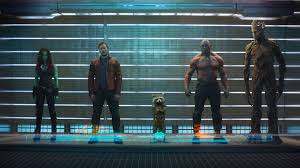
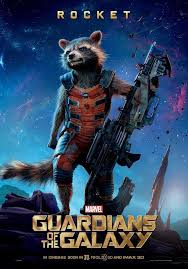
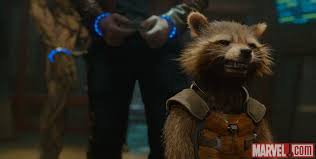
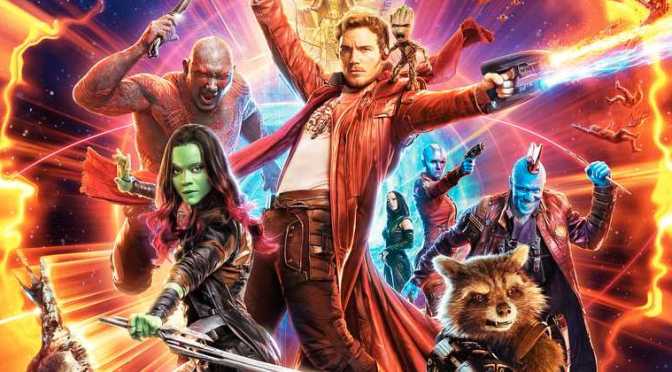
So, Quill consequently finds himself pursued and caught and thrown in prison by the Nova Corps (basically humans with funny hair.) He then unwittingly becomes part of a bunch of misfits including: Rocket (Bradley Cooper) – a feisty raccoon and weapons expert; Groot (Vin Diesel) – a tree-like humanoid; Gamora (Zoe Saldana) – Thanos’s adopted assassin daughter; and finally Drax (Dave Bautista) – a giant blue alien muscle guy. Together these unusual suspects form an uneasy but at times hilarious alliance as they fight and argue and bicker and eventually accept each other and combine to overcome the villains before them.

m7

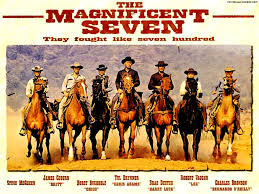
If The Avengers (2012) was a remake of The Magnificent Seven (1964) then this is a remake of the Dirty Dozen (1967) (minus seven). Moreover, the film follows the successful Marvel template of superheroes (or in this case anti-heroes) saving a very Earth-like world from destruction from said poisoned destructive orb (see Tesseract).  But what makes this Space-Western such fun is the oddball off-centre characters which director James Gunn and his fellow writers clearly gave a lot of time developing. While special effects reign over the production the likes of Quill, Rocket and Groot are given a humanity and humour which adds heart to story.  Indeed the script is full of empathetic backstories and themes including: fatherless, motherless and adopted children, genocide, slaves, nature v. technology, medical experimentation, grief, tyranny of dictatorship; all of which add some depth to the otherwise fluffy frivolity of the script.

Gunn was an interesting choice of director as he had written some mildly successful screenplays and directed two low-budget movies: the hilarious horror Slither (2006) and anti-super-hero oddity Super (2010).  But he marshals the army of cast and crew with a great sense of timing and while Guardians is generic in structure, the delight is in the incredible visuals and action, character detail and witty dialogue splashed throughout. The tone almost tipped over into farce in a dance off scene near the end and Del Toro is disappointing underused as The Collector. Plus Zoe Saldana’s character Gamora is gutsy and kick-ass until she turns to type and is saved by Quill. Although I forgave this stereotype because the scene was so memorably rendered and realised in a kind of space version of Jean Vigo’s poetic classic L’Atalante (1934).

The film finishes with a lovely post-credit kick in the nuts with an appearance of another comic-book-anti-hero. Marvel once again has delivered the goods and their standard template will continue to be a success if they choose off-centre directors such as Gunn, Whedon and the Russo Brothers. These are young (ish) guns like Lucas and Spielberg who while they wear their cultural influences proudly on their sleeves, jackets and underwear they paradoxically retain some originality amidst the pastiche and intertextuality. Thus, Frederic Jameson’s theories seem even more valid today. He himself argued that postmodernist culture was linked to the rise of late capitalism from the 1960s onwards and as the Marvel money-making monopoly marches on who can disagree with him.