Produced by Ali Abbasi, Louis Tisné, Ruth Treacy, Julianne Forde, Jacob Jarek, Daniel Bekerman
Main cast: Sebastian Stan, Jeremy Strong, Martin Donovan and Maria Bakalova, etc.
Cinematography Kasper Tuxen
*** CONTAINS SPOILERS ***
Ali Abbasi’s previous directed films such as Holy Spider (2022) and Border (2018) are brilliant and powerful films centered around stories relating to serial killers and trolls, respectively. So, I had to pause for a moment and ask: what attracted him to a film about businessman, reality TV personality and now, President of the USA, Donald Trump?
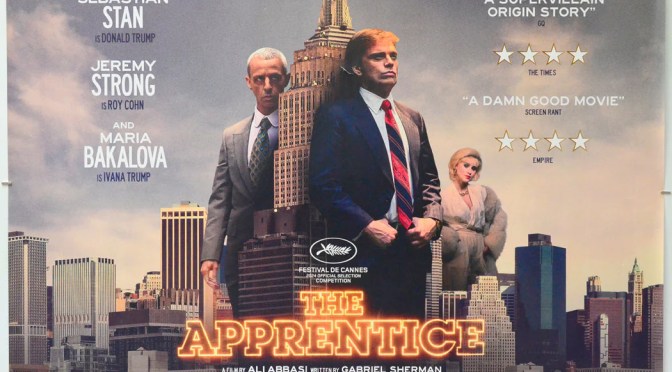
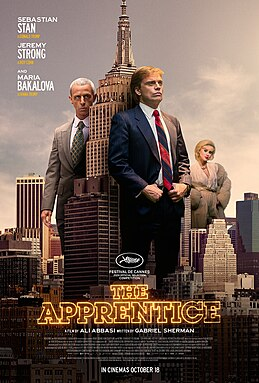
Abbasi’s The Apprentice (2024) is less a deep psychological excavation than a chillingly slick chronicle of power corrupted at its root. Framed like a “greatest hits” package of Donald Trump’s (Sebastian Stan) formative years, the film charts his transformation from brash outer-borough real estate hustler into the ruthless media manipulator and future political juggernaut — all under the tutelage of the infamous Roy Cohn (Jeremy Strong) and his three essential rules of business and life.
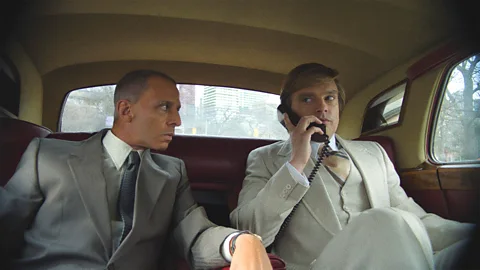
Sebastian Stan delivers a startling performance as a young Trump, capturing the man’s bravado, insecurity, and relentless hunger for dominance without slipping into caricature. Opposite him, Jeremy Strong is mesmerizing and serpentine as Cohn — a master manipulator who recognizes, nurtures, and ultimately weaponizes Trump’s worst instincts. Together, they form a grotesquely compelling duo: two charismatic monsters locked in a dance of mutual ambition and moral decay.
While the film occasionally skims across the surface of its characters — opting for scenes that feel like historical checkpoints rather than dramatic revelations — it compensates with a queasy momentum and sharp stylistic flair. It also looks great with the film and video stock reflecting the era of which it is set. Overall, this isn’t a biopic searching for sympathy or redemption; it’s a portrait of the making of one of the most divisive figures in modern history, seen through the lens of a mentor whose own legacy drips with cynicism and menace. In conclusion: The Apprentice (2024) may not dig as deep as it could, but what it shows is enough: monsters aren’t simply born — they’re coached.
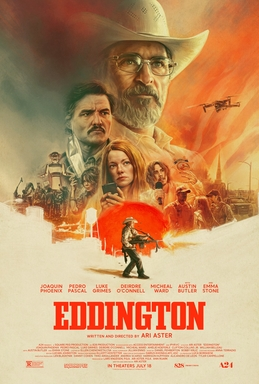
Main Cast: Joaquin Phoenix, Pedro Pascal, Luke Grimes, Deirdre O’Connell, Micheal Ward, Austin Butler and Emma Stone. Cinematography by Darius Khondji
*** MAY CONTAIN SPOILERS ***
Ari Aster’s first two horror films, Hereditary (2018) and Midsommar (2019) were rightly critically acclaimed and delivered at the box office too. His third film Beau is Afraid (2023) was a flop when compared and in my view not surprising. The film was arguably, depending on your view, a hilarious, risk-taking arthouse tragi-comedy or a self-indulgent act of egregious career self-sabotage. Safe to say I did not enjoy it, so approached the latest A24-produced film of Aster’s,Eddington (2025), with emotional caution.
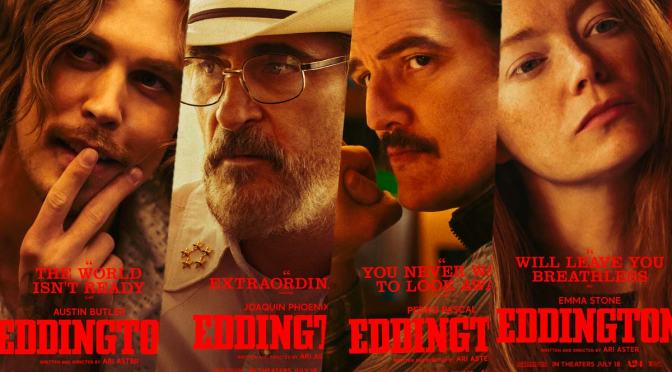
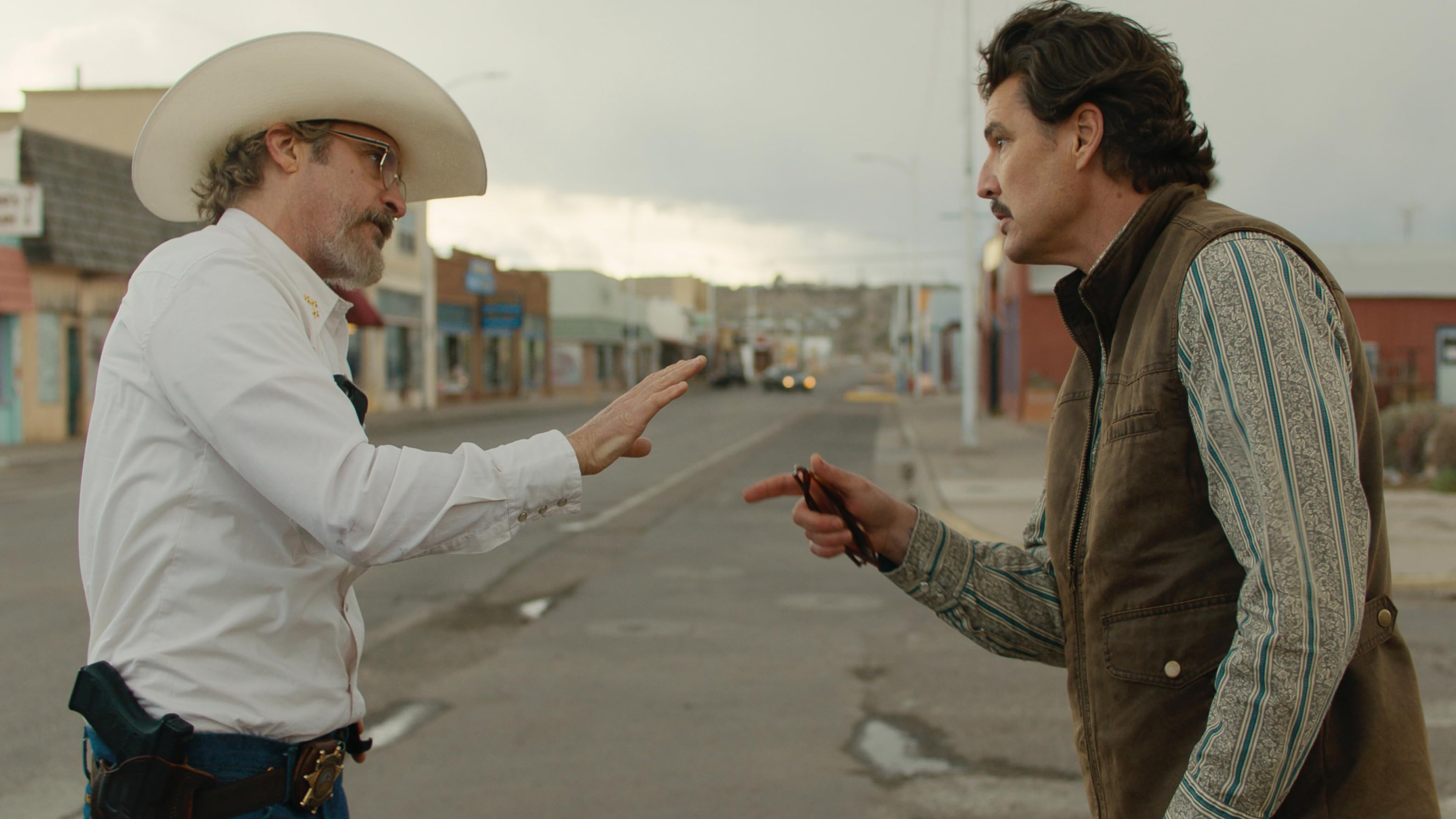
Thankfully Aster’s screenplay, characters and all-round production of Eddington (2025), are far more accessible and focused than his third feature. Pedro Pascal and Joaquin Phoenix anchor Eddington (2025) superbly, as Aster delivers a blistering small-town allegory that uses a public health crisis as the spark for something far larger. What begins with Mayor Ted Garcia (Pascal) dutifully following the Governor’s lockdown orders quickly escalates when Sheriff Joe Cross (Phoenix) refuses to comply and runs for Mayor himself. This casts the town and people into a conflict that mirrors America’s own political division.
Phoenix brings his trademark intensity to Sheriff Cross, whose defiance feels equal parts principled and unhinged, while Pascal’s Mayor, revealed to be a corporate puppet, balances him as a leader losing grip on his authority. Thus, Eddington (2025) is a powerful film whose strength lies in the performances and a brave, intelligent screenplay which asks many questions. The main issues I had were under-developed character arcs for Emma Stone’s and Austin Butler’s characters. Further, as in previous films Aster relies heavily on left-field plot turns, which go more for shock, rather than understandable character development. Indeed, the final act Western-style shootout, while incredibly exciting, seems out-of-sync with the thoughtful build-up and drama established in the first hour.
Ultimately, Director Ari Aster resists turning Eddington (2025) into just a COVID-era-morality tale; instead, the film confidently threads together a powerful mix of left and right-wing US politics, toxic masculinity, historical sexual abuse, conspiracy and alternative theories, cultish religious fervour, white saviour virtue-signalling, homegrown terrorism, algorithmic influence of social media, and the creeping threat of corporate greed. Each theme and subplot fold back into the central question: who really controls the narrative in modern America or is it a nation spiraling out of control toward inevitable civil war? The result is a tense, unsettling portrait of a town—and a country—at war with itself.
Produced by Trevor Matthews, Nick Gordon, Brian Young, Andrew Morrison, Andrew Lauren, D.J. Gugenheim and Brady Corbet.
Cast: Adrien Brody, Felicity Jones, Guy Pearce, Joe Alwyn, Raffey Cassidy, Stacy Martin, Emma Laird, Isaach de Bankolé and Alessandro Nivola.
Cinematography Lol Crawley
Edited by Dávid Jancsó
*** MAY CONTAIN SPOILERS ***
A new wave of American filmmakers—directors like Todd Field, Robert Eggers, and Brady Corbet—have emerged as some of the most technically proficient and ambitious voices in contemporary cinema. Their work is marked by rigorous formal control, deep thematic ambition, and an almost obsessive dedication to craft. These filmmakers, arguably influenced by auteurs like Sofia Coppola and Paul Thomas Anderson, demonstrate an understanding of film language that is both deeply referential and boldly experimental. Whether it’s Eggers’ meticulous historical recreations, Field’s austere and cerebral storytelling, or Corbet’s overtly intellectualized narratives, they all exhibit an undeniable mastery of their medium. Their films, often dense with literary and philosophical allusions, cater to cinephiles who relish formal precision and narrative audacity.
Yet, for all their brilliance, there’s an argument to be made that their work veers into self-indulgence, if not outright pretension. Their films sometimes feel like exercises in artistic superiority, catering to an audience that appreciates the challenge but perhaps not the emotional accessibility that cinema can offer at its best. Whether it’s the cold remove of TÁR(2022), the self-serious mythologizing of The Lighthouse(2019), or the arch, affect-laden approach of Vox Lux (2018), these works often feel encased in a layer of knowing detachment. There’s a fine line between intellectual rigor and a kind of smug, insular artistry, and some critics argue that these filmmakers, however talented, sometimes tip too far in the latter direction—prioritizing aesthetic and conceptual ambition over genuine human connection. I mean, I love a lot of these filmmakers’ work, but I was raised on the American films of Coppola, Scorsese, DePalma, Spielberg, Lucas and Friedkin; auteurs who knew their art, but also how to entertain the audience too.
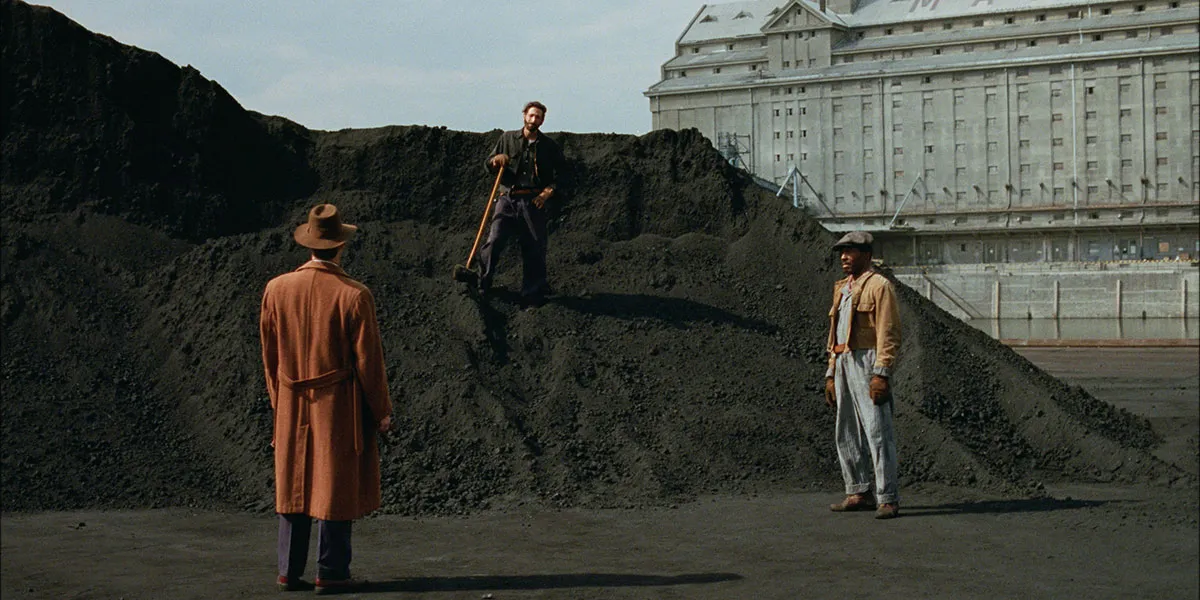
In Corbet’s, and film partner’s Mona Fastvold’s, phenomenally designed and constructed film, The Brutalist (2024), Adrien Brody portrays fictional László Tóth, a Hungarian-Jewish architect and Holocaust survivor. Brody’s is an incredibly memorable piece of work, acting as a spiritual performance sequel to his Oscar-winning role inThe Pianist (2002). But rather than focus on an individual attempting to escape the Nazis during the war, the narrative concentrates on Tóth, who arrives in post-war America with nothing but his talent and ambition, only to find himself trapped in a system that celebrates his work while rejecting him as a person. In America, racism is delivered with a smile, and generosity is a means of control. High society rewards Tóth but also suffocates him with subtle condescension, as he is paraded around as an artistic trophy but never fully embraced as an equal.
As an epic character study of the life of an immigrant and exploitation of the financially stricken Jew in America, The Brutalist (2024), is a powerful work. Such themes compel us to think of today and the fact that America continues to struggle with the integration of people travelling there, even though it was built with the hands of migrant families. Here the screenplay exerts true power in critiquing the United States’ treatment of those travelling to America with hope. As the narrative unfolds across the decades, Corbet, Fastfold and Brody illustrate the slow erosion of Laslo’s dreams in an America that welcomes his work but not his humanity. As the key antagonist, Harrison Lee Van Buren, Guy Pearce delivers another chilling and precise character study. Van Buren is a spoilt, rich and brattish man whose charm and refinement mask a deeply exploitative nature.
Photographically, The Brutalist (2024) is indeed a work of art. Lol Crawley and the production team immerse viewers in a stark, architectural visual language—monolithic structures, rigid compositions, and a muted, desaturated color palette mirroring the emotional and physical isolation Tóth experiences. Yet, for for all its incredible craftsmanship and bold cinematic ambition, the film is a test of endurance—an unrelenting, patience-draining experience that stretches well beyond three hours. Even the inclusion of chapters, and a self-consciously “prestigious” intermission only serve to amplify the film’s pretensions, prolonging the agony of watching layer upon layer of misery unfold like a slow-moving roller-coaster that induces motion sickness with no escape. It’s a brilliant film that demands submission rather than engagement, wielding its bleakness like a weapon against the audience’s stamina. It will probably win the Academy Award for Best Film. That or Wicked (2024).
Produced by Andrew Macdonald, Allon Reich, Gregory Goodman
Main Cast: Kirsten Dunst, Wagner Moura, Cailee Spaeny, Stephen McKinley Henderson, Sonoya Mizuno, Nick Offerman, etc.
Cinematography by Rob Hardy
*** MAY CONTAIN SPOILERS ***
Alex Garland has an impressive literary, cinema and televisual curriculum vitae. He gained acclaim as the writer of the novel, The Beach, before moving onto screenwriting duties with fine films such as: 28 Days Later (2002), Sunshine (2007), Never Let Me Go (2010), and under-rated Dredd (2012). He made his directorial debut with Ex Machina (2014), which earned him an Academy Award nomination for Best Original Screenplay. His second film,Annihilation (2018), garnered further acclaim, so much so, FX bypassed a pilot and went straight to series for his science fiction TV narrative, Devs (2020).
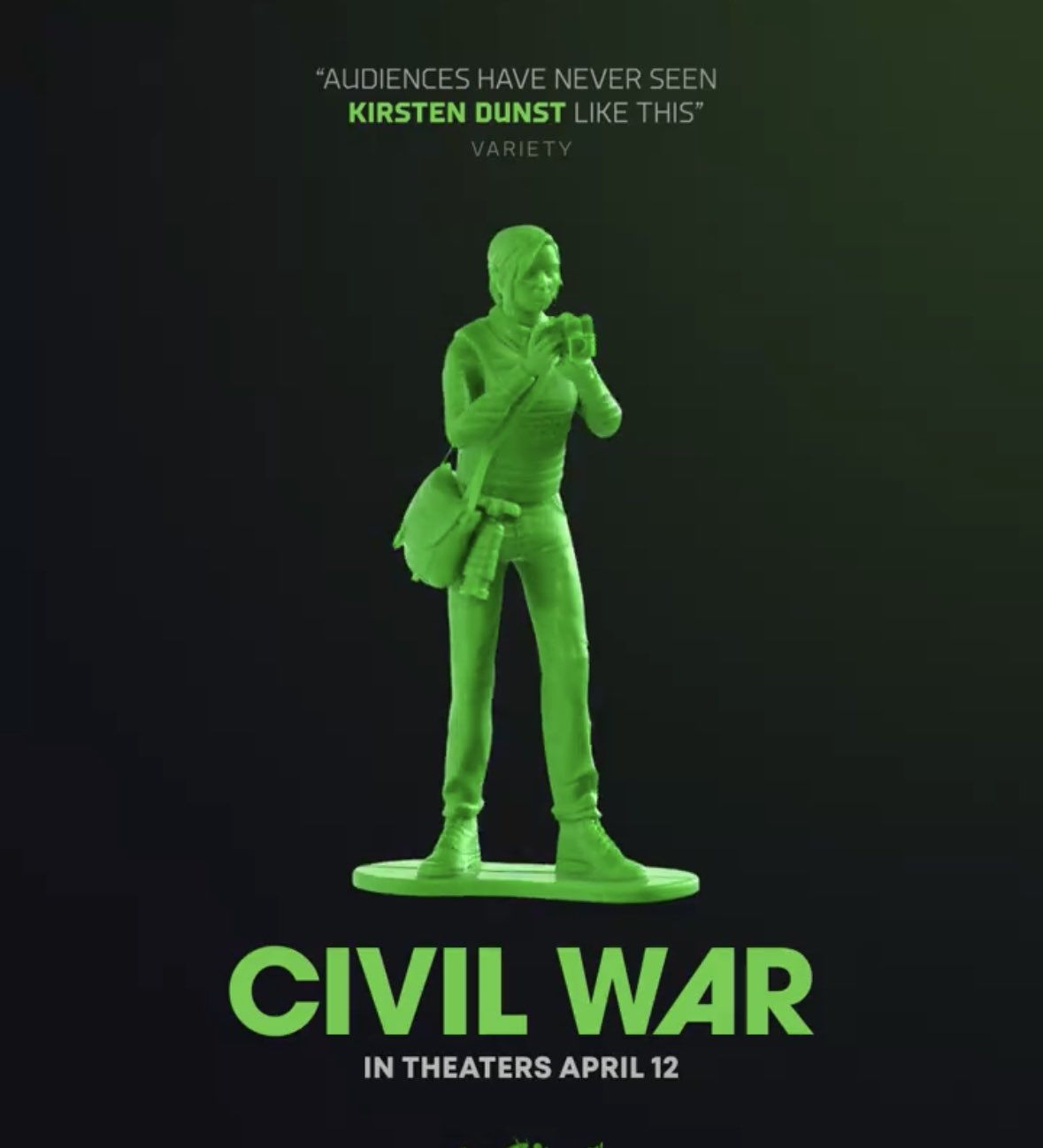
While I am a massive fan of Garland’s work, I wasn’t too enamoured of Annihilation (2018). I found it brilliantly made with some fantastic concepts and incredible moments, yet overall it was too slowly paced. With eight superlative episodes of Devs (2020), Garland delivered a story which really connected with me by merging a compelling technological espionage plot to an intelligent exploration of philosophical thought and human behaviour. Where Devs (2020) presciently examined the impact of artificial intelligence, Garland’s new political thriller, Civil War (2024), prophetically imagines an apocalyptic America in the throes of war between combined California and Texas state rebel forces and the current President’s (Nick Offerman) retreating army.
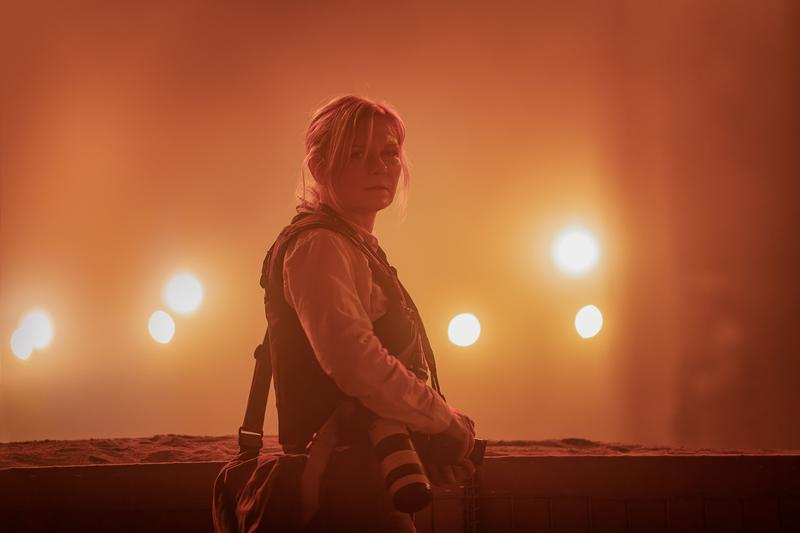
With the ‘January 6 United States Capitol attack’ in mind, Garland opens up a “what if” narrative where the whole of America is conflicted and consuming itself from within. At the heart of the violence is the war photographer, represented by Lee Smith (Kirsten Dunst) and Reuters journalist, Joel (Wagner Moura). Their journey to Washington to photograph the President reveals confusion, destruction and further bloodshed. Generically speaking, a road movie meets dystopian thriller, Civil War (2024) contains thought-provoking themes and incredible cinematography, but with shaky writing in places.
Films about war photographers and/or journalists can be problematic for me. Such characters lend themselves to heroic and the anti-heroic. The writing has to be right because I can lose empathy between such crusading journos and the narcissistic adrenaline junkies looking to deflect their own loathing and self-destructive tendencies. Civil War (2024) struggled to get me onside with the lead characters, although Dunst’s characterisation of Lee Smith is superb. However, her mentor-apprentice relationship with Cailee Spaeny, Jessie Cullen, was under-developed. Spaeny’s “innocent” being used more as a suspense device as opposed to learning the true horrors of humanity and war. Perhaps Garland intended for her to be a sociopath without depth just looking for blood? She finds it!
Moreover, Jessie’s journey from a political perspective was weak as there was no real sense of development in her character. That’s where the decision not to overtly take political sides causes a lack of sociological depth. War films such as Salvador (1986) and The Killing Fields (1984) are more successful as Civil War (2024) loses political impact by not choosing precise sides. But I guess whether they are Democratic or Republican is the whole point. Garland is saying that political parties are all as bad as each other, with human beings their own worst enemy. Politics, like football, gender, sexuality, and religion, are propellants for humans to fight each other.
For a film about photographers, the images on show are incredible and Rob Hardy’s work is genius. Fire, blood and war have never looked so brutal and aesthetically impressive. As well as Dunst, Wagner Moura and Stephen McKinlay Henderson are terrific in their respective roles. Further, there are some nail-biting and suspenseful scenes, notably one involving a film-stealing performance from Jesse Plemons. However, many of the characters’ decisions were weakly written for me. This is surprising given Garland’s prodigious literary and screenwriting talent. Civil War (2024), however, remains another stunning addition to his oeuvre and for all my perceived script weaknesses, the hell of war has never been so artistic and artful.
Produced by: Wes Anderson, Steven Rales, Jeremy Dawson
Ensemble Cast: Jason Schwartzman, Scarlett Johansson, Tom Hanks, Jeffrey Wright, Tilda Swinton, Bryan Cranston, Edward Norton, Adrien Brody, Liev Schreiber, Hope Davis, Stephen Park, Rupert Friend, Maya Hawke, Steve Carell, Matt Dillon, Hong Chau, Willem Dafoe etc.
Cinematography Robert Yeoman
*** MAY CONTAIN SPOILERS ***
Wes Anderson is a phenomenal filmmaker with an imaginative set of style and narrative conceits. Everyone one of his releases is a rich tapestry containing memorable ensemble casts, adjacent framing, effervescent use of colour, geographical pertinence, intellectual humour and subjects situated in the far-left field of genre cinema. Yet, I do not enjoy ALL his films. Often, they veer too far into eccentric pretentiousness. Indeed, I found The French Dispatch (2021), frustrating and, other than the tremendous story set in the asylum with the mad artist (Benicio Del Toro), disconnected with it overall. While it was another admirable work of cinema, I did not enjoy it as a paying punter.
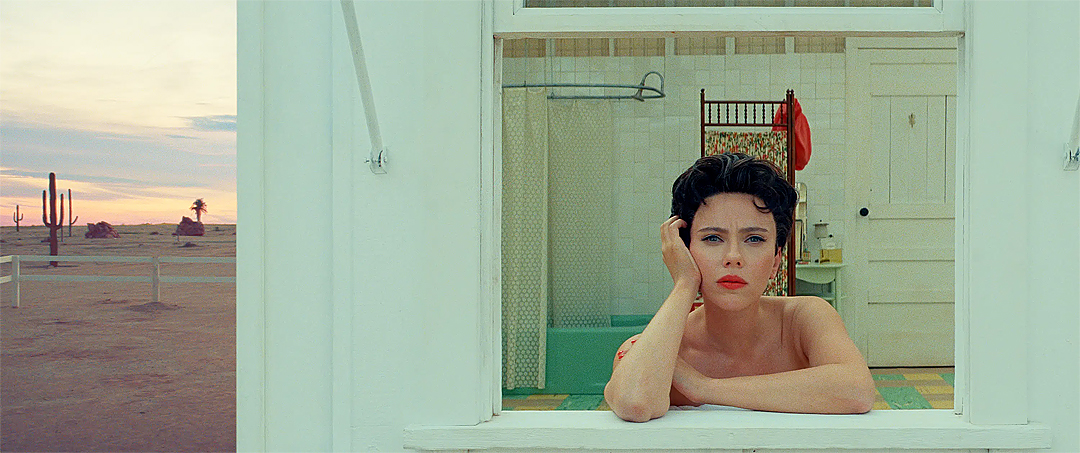
Asteroid City (2023), however, is a film I enjoyed greatly. The famous actors immersed within the ensemble, the cinematic artifice, the clever meta-narrative structure, symmetrical shot composition, beautiful use of colour, offbeat characters, specific era and geographical setting, imaginative props and costume design, and witty humour are all present as per Anderson’s impressive body of work. But Asteroid City (2023) had a larger emotional heart than his recent films, and is my favourite since the superb, The Grand Budapest Hotel (2014).
A heady combination of genres, one could describe, Asteroid City (2023), as a hyper-sci-fi-Western-retro-romantic-futuristic-comedy and study of grief set in 1950s, America. Despite filming taking place in Spain. Anyway, Anderson establishes the characters through the structure of a film within a play. Bryan Cranston’s narrator introduces us to the various middle-class, working class, military and scientific personalities who become trapped in the town of Asteroid City by a series of unlikely but hilarious misfortunes. Throughout the chapter inter-titles the scenes return us to our narrator as Anderson cleverly comments on the process of creating a story while delivering the narrative events.
Anderson delves into familiar themes of grief via the story of war photographer, Augie Steenbeck (Jason Schwartzmann) and his four kids, one of whom is a genius, Woodrow (Jake Ryan). He is there for a Junior Stargazer competition amidst the setting of the gigantic meteorite bunker. Again, the theme of prodigious children is mined for great humour and intellectual wit by Anderson. The futuristic inventions created by the children are especially fantastic. The plot strand of the science geniuses being exploited by the military and corporate sharks is deftly done. Yet, the main emotional heft is delivered within Augie and Hollywood actress, Midge Palmer’s (Scarlett Johansson) budding relationship. Johansson is especially compelling in the role, anchoring the film in welcome pathos, amidst the flurry of idiosyncratic absurdities Anderson throws at us. His framing of Augie and Midge between the their chalets is aesthetically memorable, visually augmenting their growing human connection.
Asteroid City (2023) proves once again Wes Anderson is one of the most original filmmakers of this generation. Will he gain some more converts to his particular set of cinematic bag of tricks? Who knows. What I do know is that I was completely immersed in the colour, movement, pace, humour, aesthetics, performances and themes with the film. I must say though, while it was necessary, the “Area 51” style — and I don’t want to give it away — absurd plot-turn halfway through was not my favourite aspect of the piece. But I realise it was narratively integral to the story. The meta-framing also seemed to get in the way at times of the main action effecting the occupants of Asteroid City. But these are minor gripes at a thoroughly artistic, beautifully immersive, and technically impressive cinematic achievement.
Based on: West Side Story by Jerome Robbins, Leonard Bernstein, Stephen Sondheim and Arthur Laurents
Produced by: Steven Spielberg, Kristie Macosko Krieger, Kevin McCollum
Cast: Ansel Elgort, Ariana DeBose, David Alvarez, Mike Faist, Rita Moreno, Rachel Zegler etc.
Cinematography: Janusz Kamiński
Choreography: Justin Peck
Music by: Leonard Bernstein
*INEVITABLE SPOILERS WITH THIS STORY*
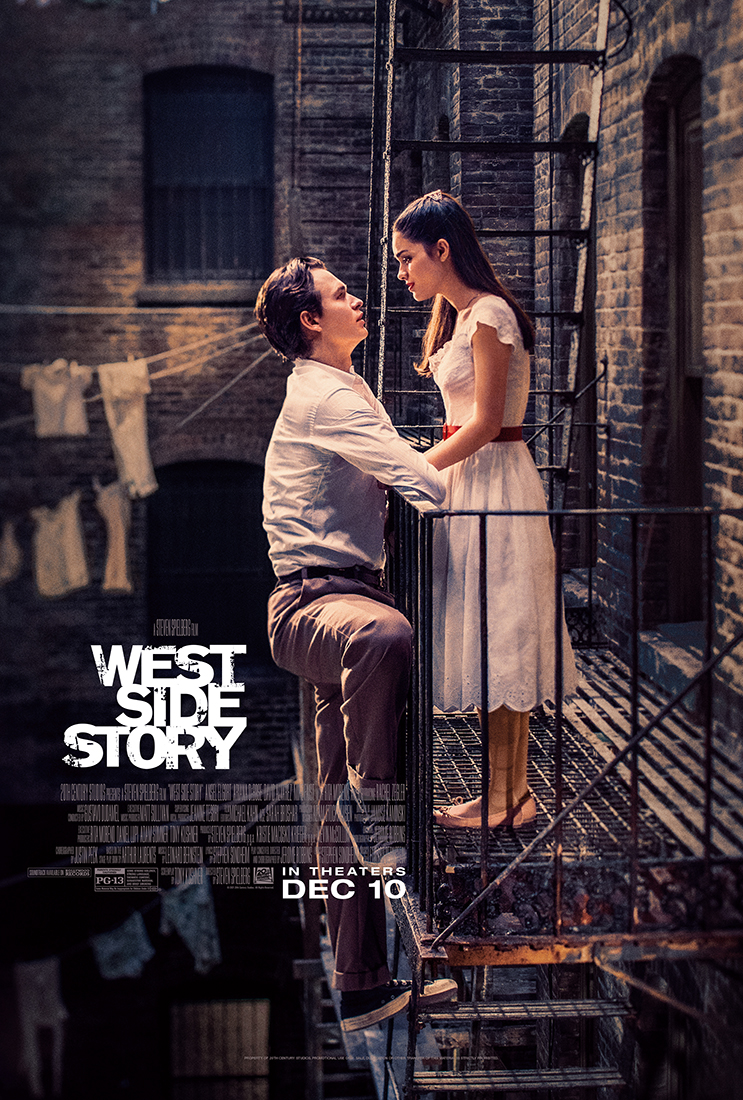
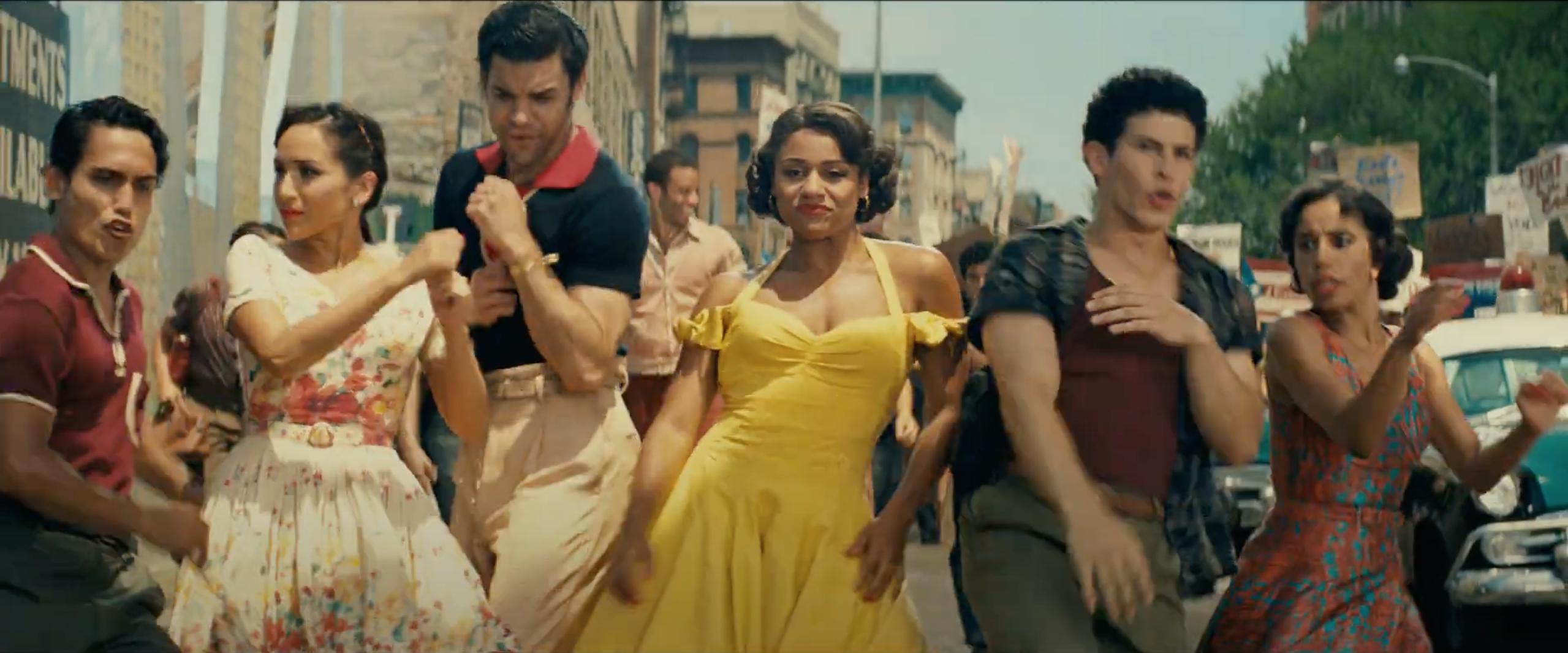
Well, if you removed all the songs and added more dialogue to West Side Story (2021), then I guarantee it would make an amazing stage play. Oh, it has already. I thought it felt extremely familiar. Silly jokes aside, one often hears the decrying of originality in Hollywood cinema. Sequels, prequels, remakes, adaptations and reboots are plentiful as big business. Known quantities are a better bet to executives than original never-heard-of speculative screenplays. And not everyone is averse to re-doing fully developed properties. Thus, one of the most talented filmmakers of a generation, Steven Spielberg, has delivered a stunning remake of a film adaptation of a stage musical that was developed from William Shakespeare’s Romeo and Juliet.
You know the story. If you don’t, stop reading. Young star-crossed lovers fall in love against their families wishes. Their romance explodes into unbridled passion as war escalates between the two rival factions. As the lovers attempt to find a way to be together the conflict brings about eventual tragedy. Shakespeare was a genius and knew how to structure and spin a yarn. No surprise his works have been adapted infinitely to much success. One of the greatest was the musical West Side Story (1961). Exchanging Verona for New York and pitting the Puerto Rican Sharks against the local firm, the Jets, the play and film contain some of the most incredible numbers ever sang and danced to. The original play won awards and broke box-office records. The film West Side Story (1961) deservedly won many Oscars. It is considered almost a perfect musical. How could it be improved?
West Side Story (2021) cannot possibly be classed as better than the original because Jerome Robbins, Arthur Laurent, Leonard Bernstein and Stephen Sondheim, plus their incredible team, had already done all of the challenging work crafting the production. But with this new version Steven Spielberg has once again proved he is one of the great genre directors. Assembling an ultra-talented team including Josh Peck as choreographer, Tony Kushner as screenwriter, Janusz Kaminski as cinematographer and an effervescently wonderful cast.
Everything about the film screams colour, energy and movement. The dancing and editing and swinging beats take you on a breathless journey through the romance and street war. Tony (Ansel Elgort) and Maria’s (Rachel Zegler) love story is bounced effortlessly between the expertly devised gang battles. Moreover, West Side Story (2021) keeps all the memorably catchy songs such as: Maria, Tonight, America, Cool, and Somewhere, capturing the heart and imagination in equal measure. If there is a better directed, choreographed and edited set-piece all year in the Gee, Officer Krupke number then I haven’t seen it.
The cast are uniformly excellent with Ansel Elgort, while lacking slightly in the vocal department, more than making up for it with his magnetic screen presence. Rachel Zegler is charming if bland as Maria, but Ariana DeBose absolutely steals the scenes with her all-round performance as fiery Anita. The cast all deliver Tony Kushner’s excellent dialogue and the iconic songs with aplomb. Lastly, West Side Story (2021) is an absolute tour-de-force as cinematic entertainment. However, there is a sense that it is a missed opportunity for Steven Spielberg and his team to perhaps update the themes for the modern day. Kushner’s script hints at some analysis of racism that ultimately only scratches the surface. Spielberg is satisfied emulating a classic adaptation of a classic play, remaining trapped in a shiny post-modern time-warp full to the brim with powerful nostalgia.
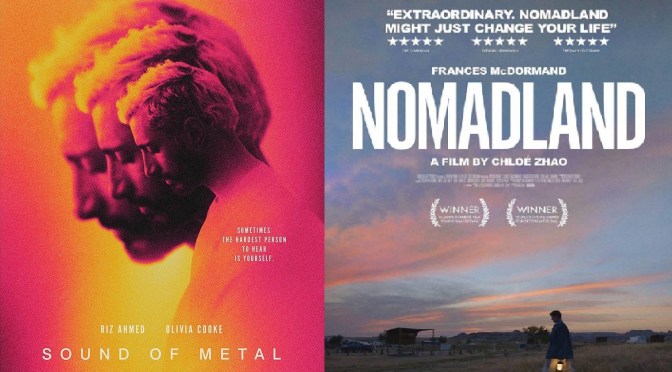
“CINEMA” REVIEWS: NOMADLAND (2020) & SOUND OF METAL (2019)
Due to the being very busy at my day job I have fallen slightly behind with my film reviews. Thus, I am consolidating two quality dramas I have watched in a double bill review presentation. In fact, it is quite apt that these two films are critiqued together as they are both Oscar winners, both focus on an individual’s struggle against difficult personal trauma, both films represent an alternative vision of America and are told in a meditative and absorbing style.
NOMADLAND (2020)
Directed and written by: Chloé Zhao
Produced by: Frances McDormand, Peter Spears, Mollye Asher, Dan Janvey, Chloé Zhao
Based on: Nomadland: Surviving America in the Twenty-First Century by Jessica Bruder
Cast: Frances McDormand, David Strathairn, Linda May, Swankie etc.
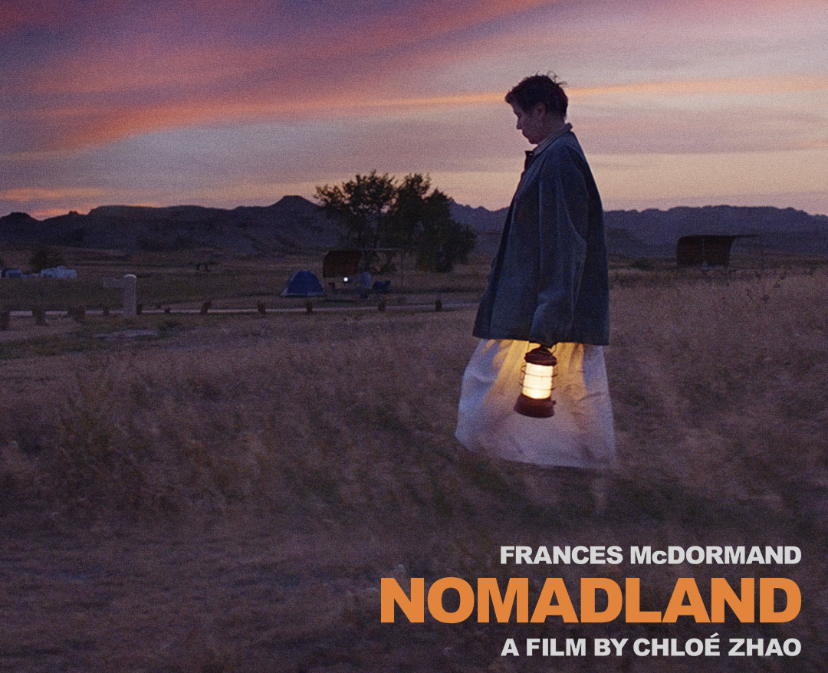
Winning the Oscar for Best Picture, Best Director and Best Actress in a leading role, perhaps upsold my expectations for Nomadland (2020). It is an example of amazing filmmaking without being a particular brilliant film. I get why it won Best Picture, but that was more to do with there not being one specifically superb standout film among the nominees. Frances McDormand isn’t even very memorable as the lead protagonist, Fern. Don’t get me wrong she is highly empathetic and admirable in her resilience to stick to the road, living in her van and scrapping by independently. However, the film is one-paced. It is all set-up and little pay-off, with the odd flat tyre, van breakdown and Fern having to shit in a bucket providing occasional spikes in the drama.
Much praise though goes to the incredible cinematography and Chloe Zhao’s intelligent and naturalistic direction. She really gets into the weeds of the flailing American dream, as well as providing insight into the lives of working-class people disenfranchised by American capitalism. Moreover, Zhao’s use of non-professional actors is quite astounding, as at times you feel like you are watching a pseudo-documentary. Ultimately, Nomadland (2020) though, is arguably too meditative and glacially paced. It remains a brave and quietly powerful film, but it’s just too quiet for my dramatic needs.
Mark: 8 out of 11
SOUND OF METAL (2019)
Directed by: Darius Marder
Produced by: Bill Benz, Kathy Benz, Bert Hamelinck, Sacha Ben Harroche
Screenplay by: Darius Marder, Abraham Marder
Cast: Riz Ahmed, Olivia Cooke, Paul Raci, Mathieu Amalric etc.
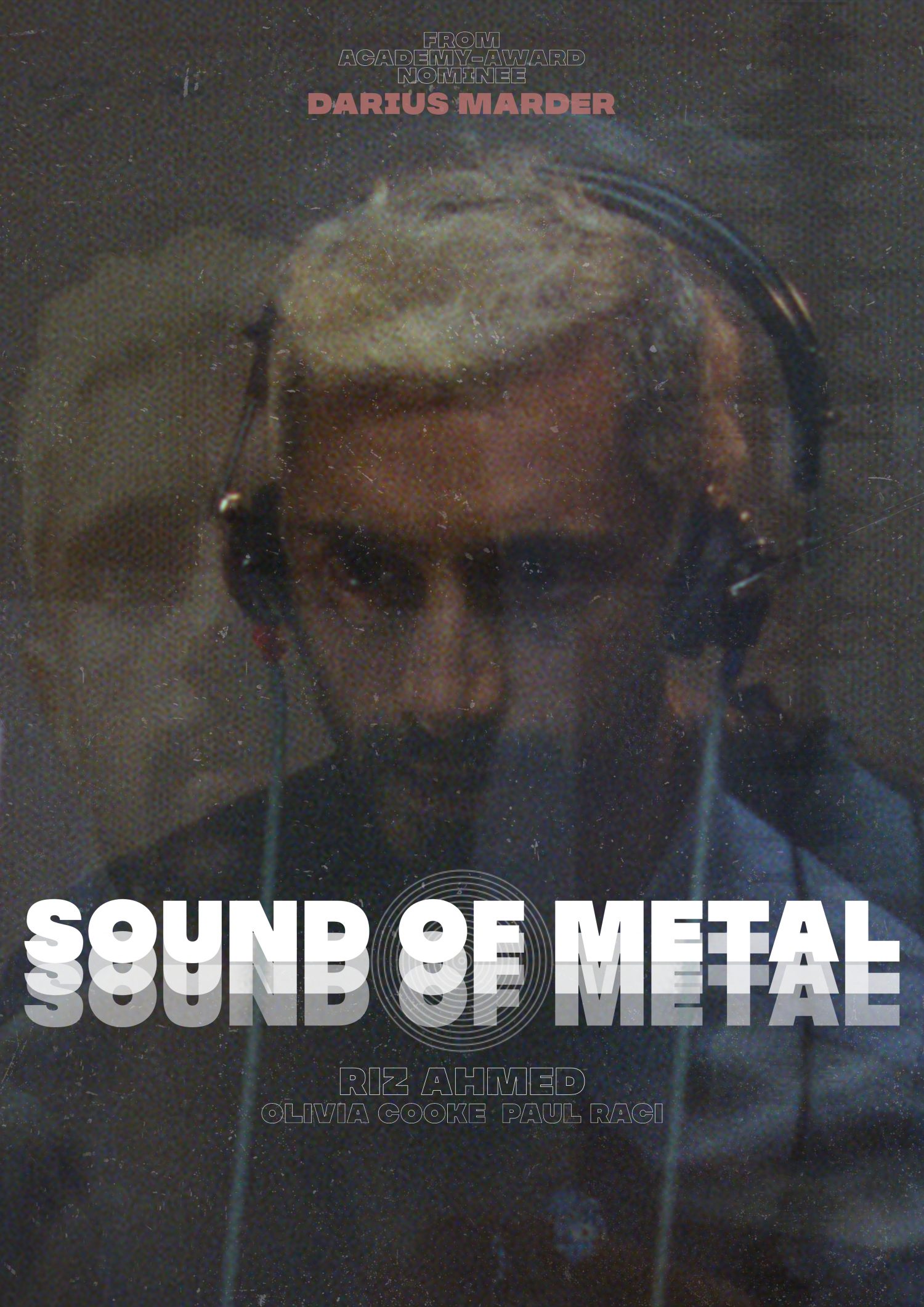
Sound of Metal (2019) is another quiet drama, however, it really begins with a load of noise. It derives from Riz Ahmed’s drummer, Ruben, thrashing on stage with his girlfriend, Lou, as she fronts their heavy metal band giving an energetic performance to a lustful crowd. Ruben and Lou live out of their R.V. travelling and gigging around America, but he soon discovers his hearing has been severely damaged. Doctors offer hope in the form of an operation, but it’s extremely expensive. As Ruben is an addict, he also seeks spiritual help at a shelter for deaf people in recovery. There he meets, Joe (Paul Raci), the facilitator at the shelter and Ruben’s slow road to recuperation begins.
Riz Ahmed is outstanding as Ruben, a talented, bright and strong-willed individual who finds himself tested by a loss of hearing. His journey is a slow-moving but compelling one. I especially enjoyed the process where Ruben learns to cope, sign and believe that deafness should not be considered a disability. Indeed, the scenes Ruben shares with the wiser Joe are incredibly moving and thought provoking. Further, Darius Marder directs with a sure hand and really uses the sound effects powerfully, getting us into Ruben’s head both literally and figuratively. Overall, Sound of Metal (2019) beats along steadily but with incredible purpose and rhythm. It teaches us that losing a major sense need not be the end of one’s life, but rather the beginning of an altogether different one.
Cast: Björk, Catherine Deneuve, David Morse, Peter Stormare, Joel Grey
Music by: Björk
Cinematography: Robby Müller
Edited by: François Gédigier, Molly Marlene Stensgård
***MAY CONTAIN SPOILERS***
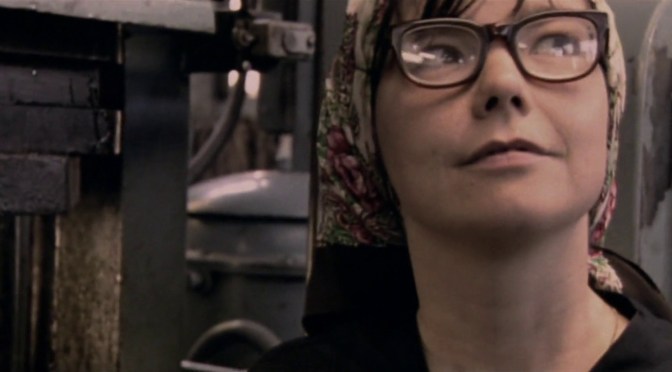
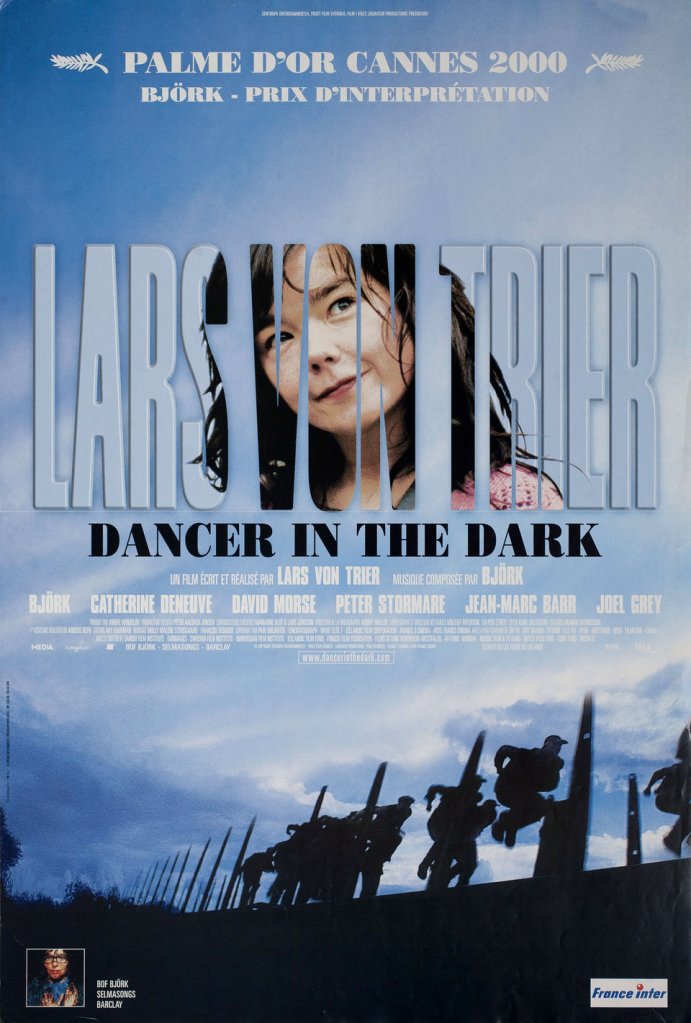
Rather incredibly, until very recently, I had never seen DANCER IN THE DARK (2000). However, it has quickly gone up the ranks in my mind as one of the best musical films I have ever seen. Having given it a lot of thought, it was difficult to place my review of Lars Von Trier’s eccentric, magical and moving tragedy. I could have reviewed it as a cult or under-rated classic film, but it was too high profile really; AND it won the Palm D’Or at Cannes. Thus, I decided, because it is such a compelling story and told in a magnetically creative style it definitely qualifies as a classic film.
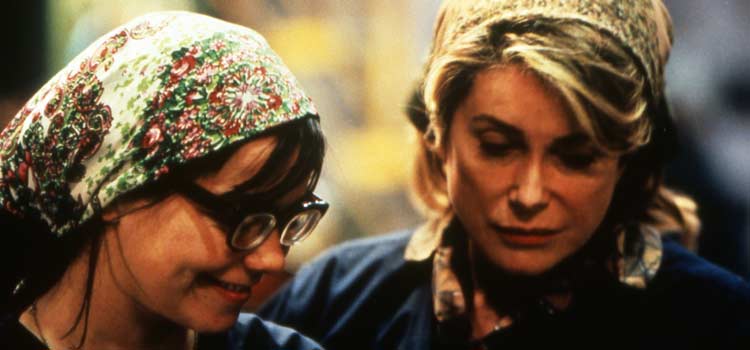
Set in Washington State, circa 1964, the story centres on the life of Selena Ježková (Bjork), a Czech immigrant, who works in a factory supporting herself and her teenage son, Jean. She is good friends with co-worker Kathy (Catherine Deneuve), and has a good relationship with her landlord, a police officer called Bill (David Morse), and his wife, Linda (Cara Seymour). Selena is also romantically pursued by Jeff (Peter Stormare). Yet despite him being a pleasant and easy-going guy she prefers to be just friends. Selena is an admirable character because she works round-the-clock with at least two jobs, striving to make ends meet. But she also hides a secret. She is, in fact, going blind. Kathy helps cover for her where she can at the factory, however, the condition is irreversible. Selena is extraordinarily brave, but foolhardy too. Her condition puts herself and factory productivity at risk. Yet, this is merely a suggestion of the drama and tragedy which later befalls her. Because someone close to her will betray a trust, setting in motion a series of extremely depressing eventualities.
In order to escape the trials of her everyday existence, Selena often daydreams in song and dance form. These fantasies are further contextualised by Selena and Kathy taking part in a town production of THE SOUND OF MUSIC, plus their visits to the cinema to watch Hollywood musicals. Von Trier is careful though to establish verisimilitude and plausible reality prior to the first musical number. Even so, it is initially extremely jarring when the song begins. Nonetheless, the power of surprise provides an electrical surge to the narrative and Selena’s characterisation. The first number set in the factory finds the mechanical sounds of the machinery providing a metronomic rhythm to the song and dance routine. Furthermore, songs such as, I’ve Seen It All (with the sequence set on a locomotive), and Smith and Wesson link Selena’s character to metal, machines and American industrialisation. Essentially, Selena’s experiences as a working class immigrant find her attempting to escape via song, but being trapped by American machines and later on in the film, their justice system too.
Filmed on digital cameras the presentation is arguably inspired somewhat by Von Trier’s established Dogme 95 style. In terms of content, DANCER IN THE DARK (2000), combines elements of melodrama and film noir reminiscent of films by Douglas Sirk. Such thematic and visual cues are then filtered through a meta-textual inversion of the Hollywood musical. While the classical musical is all about joy, love, family, companionship, song and performance, Von Trier effectively represents these genre tropes, but twists them into calamitous trials and tribulations for Selena. I for one felt such pain, regret and sympathy for her character. Indeed, Bjork, who had never acted before and has rarely acted since, gives an incredibly moving and soulful performance as the dedicated mother only trying to do her best for her son. Similarly, the songs she co-wrote with Mark Bell, Sjón Sigurdsson and Lars von Trier, sparkle and spike and tug at the heartstrings passionately.
Lars Von Trier is a divisive filmmaker and personality. He has always sailed close to the wind in regard to his challenging filmmaking style and content, as well as causing dissension over the years with his perceived outrageous comments. Moreover, Bjork herself spoke openly about a “Danish filmmaker” who oppressed and harassed her persistently on set. One must deduce that this indeed was Von Trier, thus I must respect and sympathise with the anguish she felt while filming, DANCER IN THE DARK (2000). Lastly, reviews of the film at the time were equally dichotomous. Peter Bradshaw of The Guardian dubbed it the: “most shallow and crudely manipulative film of 2000. . . and one of the worst films, one of the worst artworks and perhaps one of the worst things in the history of the world.” Yet, Roger Ebert of the Chicago Sun-Times stated: “It smashes down the walls of habit that surround so many movies. It returns to the wellsprings. It is a bold, reckless gesture.” Personally, I am with Roger Ebert, as I found the film to be one of Lars Von Trier’s most emotionally moving, stylistically daring and human dramas.
Produced by: Lindsay Law, Julie Dash, Arthur Jafa, Steven Jones
Written by: Julie Dash
Cast: Cora Lee Day, Barbara O, Alva Rogers, Trula Hoosier, Umar Abdurrahamn, Adisa Anderson, Kaycee Moore etc.
Music by: John Barnes
Cinematography: Arthur Jafa
***MAY CONTAIN SPOILERS***
“I didn’t want to tell a historical drama about African-American women in the same way that I had seen other dramas. I decided to work with a different type of narrative structure…[and] that the typical male-oriented western-narrative structure was not appropriate for this particular film. So I let the story unravel and reveal itself in a way in which an African Gullah would tell the story, because that’s part of our tradition. The story unfolds throughout this day-and-a-half in various vignettes. It unfolds and comes back. It’s a different way of telling a story. It’s totally different, new.” — Julie Dash
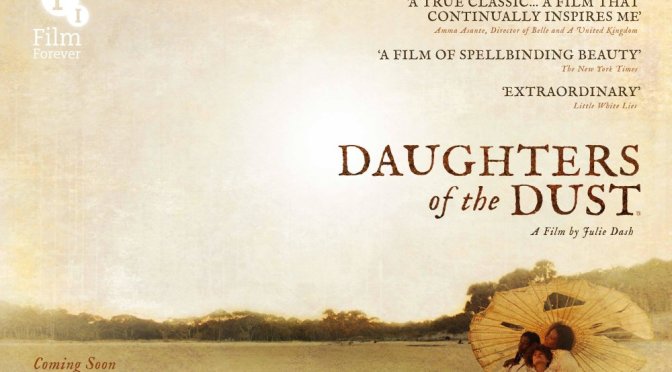
If you didn’t know the British Film Institute (or BFI) is the UK’s lead organisation for film, television and the moving image. It is a cultural charity that: presents world cinema for audiences in cinemas, at festivals and online; cares for the BFI National Archive, the most significant film and television archive in the world; is a registered charity that actively seeks out and supports the next generation of filmmakers; organises and runs the annual London Film Festival; and works with the government and industry to make the UK the most creatively exciting place to make film internationally. As my wife and I are members we get sent films on Blu-Ray/DVD as part of the membership. These can be re-released classics or remastered arthouse masterpieces such as Daughters of the Dust (1991).
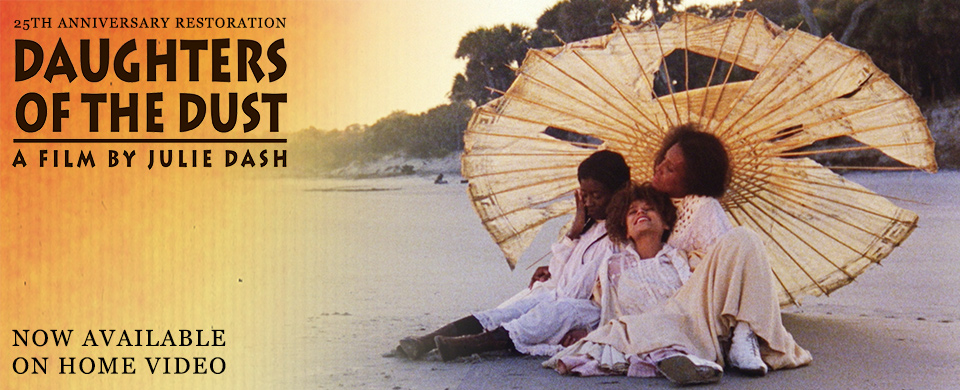
Daughters of the Dust (1991) was a labour of love for writer and director Julie Dash. Originally inspired, way back in 1975, by her father’s experiences, she strived to create a short, poetic and cinematic account of a Gullah family’s migration from idyllic island life to New York at the turn of the century. Eventually, and after many year’s of development and struggle, PBS’ American Playhouse would grant the low budget for a feature film. The film is set in 1902. It tells the story of three generationsof Gullah women in the Peazant family and their varying viewpoints, thoughts and philosophies in regard to the move from Helena Island.
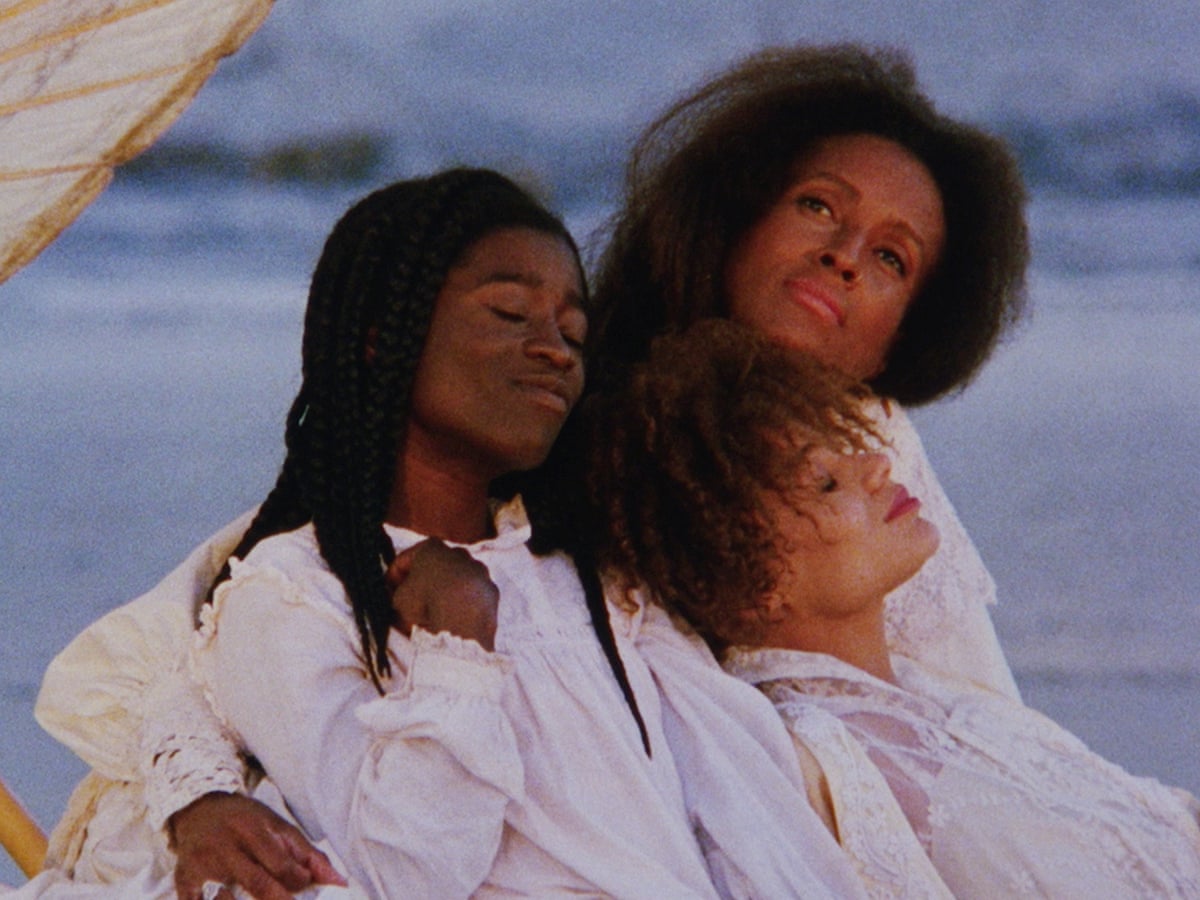
Daughters of the Dust (1991) was made for a reported $800,000, but it looks worth far more in terms of cinematography, costumes and settings. Arthur Jafa’s camera placement and use of the natural light, on the beach and swamp land especially, conjures up some magical imagery. The iconic images of the women on the beaches in their bright white dresses are stunningly memorable. While watching I felt like I was viewing a gallery of moving paintings, such was the exceptional nature of the composition. Again, despite a low budget and use of actors from independent cinema, Julie Dash, gets some incredibly natural and compelling performances from her cast. It’s all the more amazing as most of the cast had to learn the Gullah language employed from scratch.
Thematically the film is very powerful too. Conflict derives from dialectics such as the clashing of elder versus younger people, ancient beliefs versus Christian religion, African heritage versus Neo-American capitalism and nature versus technology. Julie Dash structures these themes and the character’s desires in a non-linear fashion over a period of a long weekend. There are poetic flashbacks and flashforwards too as the imagery is supported by a voiceover from a yet to be born child of parents, Eli and Eula. Ultimately, this film is a very immersive experience. There are no subtitles, so the language can be tricky to understand, but for me that enhanced the desire to feel the narrative. Indeed, the lyrical beauty of Daughters of the Dust (1991), combined with the humming percussion-driven music, stunning landscapes and inventive cinematic language mean you are swept out to sea by the powerful emotions of Julie Dash’s spectacular vision.
Produced by: Daniele Melia, Peter Saraf, Marc Turtletaub, Andrew Miano, Chris Weitz, Jane Zheng, Lulu Wang, Anita Gou
Main Cast: Awkwafina, Tzi Ma, Tzi Ma, Diana Lin, Jiang Yongbo, Zhao Shuzhen, Lu Hong, Chen Han, Aoi Mizuhara etc.
Cinematography: Anna Franquesca Solano
Music: Alex Weston
**MAY CONTAIN SPOILERS**
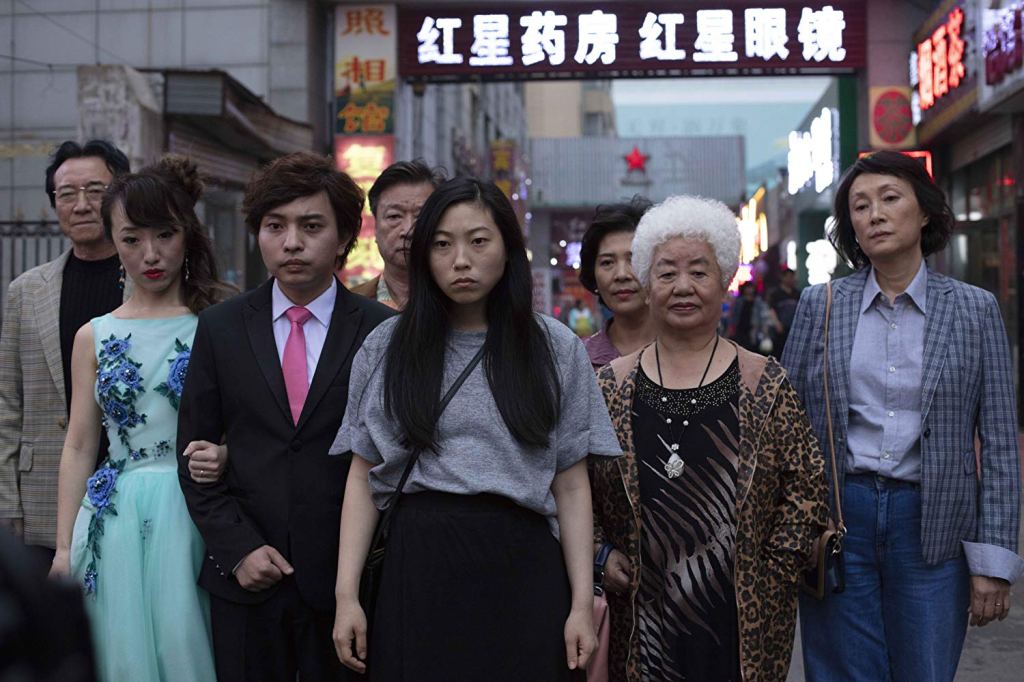
High concept film pitches usually take a tremendously marketable idea that can hook you in seconds, but also cost tens of millions of dollars to make. Sometimes though you’ll get a lower budget, more art-house character film, which will have an equally alluring premise for a fraction of the price. Lulu Wang’s second directorial release, The Farewell (2019), is one such film.
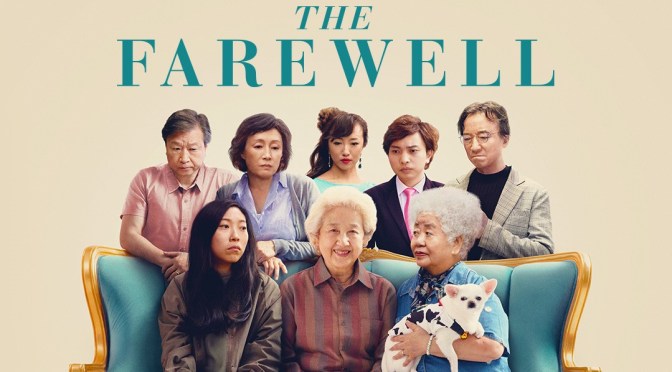
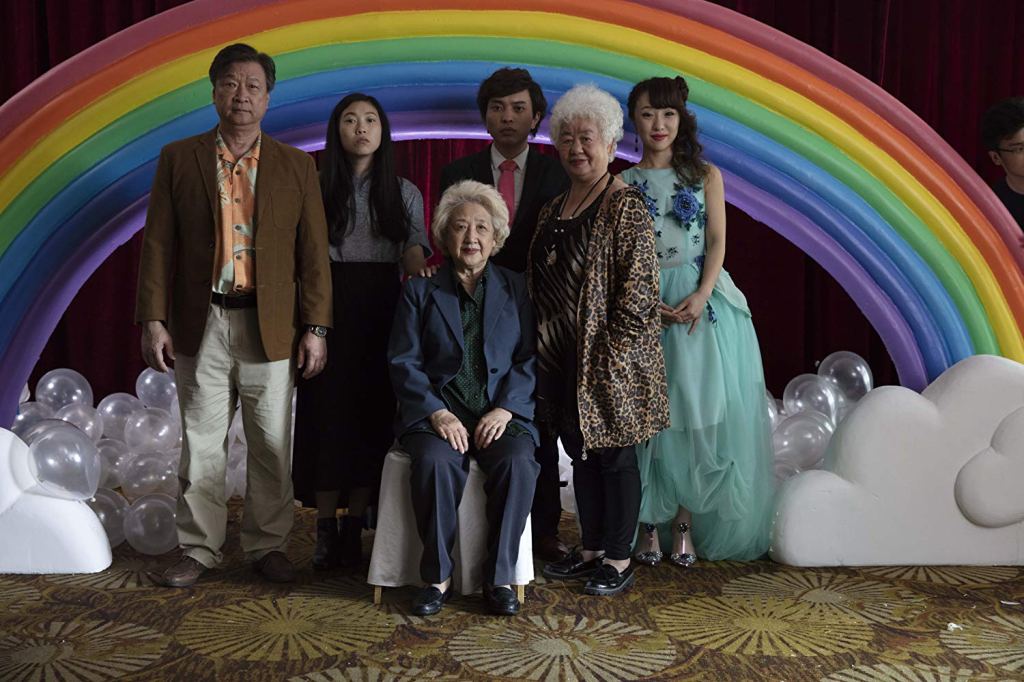
Based on a true story or “actual lie” as the prologue text reveals, the narrative revolves around a Chinese family and their decision not to reveal to their paternal Grandmother, or Nai-Nai (Zhao Shuzhen), that she has terminal cancer. This leads to a bittersweet series of scenes, full of comedy and pathos, as the whole family must keep the secret while arranging a fake family wedding in China.
While it is an ensemble cast generally, the audience conduit is Awkwafina’s Billi Wang. As her character, along with her mother and father, have lived in America for several years she believes that the Grandmother she loves has a right to know about her illness. As the scenes unfold, she clashes with various family members creating a palpable suspense as to whether Billi will reveal the truth. Moreover, we get many scenes where the family debate the various cultural and philosophical reasons why Nai-Nai should or should not be told. These I found very thoughtful and engaged both my heart and mind in equal measure.
Overall, it’s a low-key character study but nonetheless gripping, funny and sad throughout. I was especially drawn in because I wondered what I would have done in that situation. Personally, I think it is best to tell the person they are ill, but as the film wore on, I could see the other side of the argument too. In other hands this could have been turned into a poorly conceived farcical comedy, but as this is based on the writer and director’s Lulu Wang’s real-life experiences, we ultimately get a very touching film about life, death, family, love, culture and truth.
Personally, I would have liked Billi’s character to have been a bit more fleshed out at the start. Mainly because I was unsure of her personality and she just seemed a bit depressed. I mean was she a writer or a pianist and what was her job? Having said that, Awkwafina provides subtle brilliance in her role as Billi, yet, Zhao Shuzhen steals the show as the effervescent Nai-Nai, whose character shows an unabated lust for life throughout this fine film.







 The Cinema Fix presents