Tag Archives: drama

NETFLIX FILM REVIEW: BLONDE (2022)

NETFLIX FILM REVIEW: BLONDE (2022)

Directed and written by: Andrew Dominik

Based on: Blonde by Joyce Carol Oates

Produced by: Brad Pitt, Dede Gardner, Jeremy Kleiner, Tracey Landon, Scott Robertson

Main cast: Ana de Armas, Adrien Brody, Bobby Cannavale, Xavier Samuel, Julianne Nicholson, Evan Williams, Toby Huss, David Warshofsky, Caspar Phillipson, etc.

Cinematography: Chayse Irvin

*** CONTAINS HISTORICAL SPOILERS ***


Aside from expertly directing episodes of the Netflix drama, Mindhunter and the documentary One More Time with Feeling (2016), filmmaker Andrew Dominik’s directorial output has been sparse of late. Indeed, he hasn’t released a feature film since quirky gangster drama, Killing Them Softly (2012). I imagine this is due to many reasons including: slow-gestating methodology, several unrealized projects failing to see a greenlight, and the dreaded COVID-19. It’s a shame as I believe he is one of the most compelling filmmakers around at present. Chopper (2000) remains one of my favourite cult stories about a charismatic, larger-than-life criminal anti-hero. Similarly, The Assassination of Jesse James by the Coward Robert Ford (2007) is one of the best films I have seen from the last twenty years.  It was pretty much a box-office flop but everything about it screamed greatness to me: stunning cinematography; brilliant cast; and resonating themes regarding celebrity and legend in the Wild West.

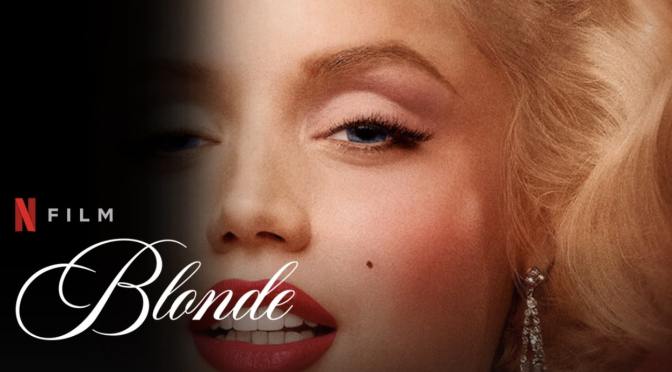
After Chopper Read and Jesse James, once again Dominik explores the iconic life of a real person in Blonde (2022). You may have heard of her, Norma Jean Mortenson/Baker, or as she was more famously known: Marilyn Monroe. Using Joyce Carol Oates’ book as a springboard, plus no doubt many other written, visual and media sources available, Dominik has crafted a stylish and singular vision of the peroxide icon’s life and career. In no doubt should a viewer believe this to be a “true” story in the documentary-drama style, but rather an impressionistic, poetic and compelling imagining of Marilyn’s short, yet tumultuous, existence on this planet.

For me, Marilyn Monroe was one of the most stunning movie stars who ever existed. She lit up the screen and was a mightily under-rated actor also. In her heyday she was the biggest star in the world. Her role as Sugar in Some Like it Hot (1959), is one of the most gorgeously funny, beautiful and vulnerable performances ever committed to celluloid. Enter Ana De Armas as Marilyn in Blonde (2022). De Armas is a revelation on-screen in terms of her looks, movement, body language and the nuanced depth she brings to the screen siren. It’s a brave role too as the script demands much of her. Throughout many exquisitely filmed and edited scenes lies the ugly degradation of Marilyn’s body and soul. De Armas gives her all in these vignettes of domestic abuse, sexual assault, rape, abortions, overdoses, miscarriages, mental breakdowns and further sexual gaslighting at the hands of people she believed were friends.


So, why should you want to watch Blonde (2022), you may ask yourself. Well, De Armas’s performance alone is worth enduring much of the emotionally draining misery. Moreover, Dominik again proves himself to be a director of the highest quality. He’s a maverick and iconoclast who has an impressive and intelligent cinematic eye. The opening sequence where Norma, as a young child, is driven by her unwell mother through Los Angeles forest fires is a frightening and imperious interpretation of mental health, full of fear, heat, and portentous symbolism. Such fire and trauma foreshadows the distress and torment that is to come to young Norma throughout her life. A schizophrenic Mother also echoes the schism of persona that impacts Norma the individual, and Marilyn the movie star. The division of personalities is a theme which the screenplay sensitively explores, despite being buried in the more lurid and shocking events of Marilyn’s sad life.

Overall, Blonde (2022) is a startling and shocking rendition of Marilyn Monroe. Of course, hers was an existence full of drama, intensity, darkness and tragedy. But you have to think there was some light in there, some happiness, humour and joy. On some fleeting occasions during Blonde (2022), Dominik presents this, but ultimately this is a beautifully filmed yet ugly-hearted cinematic tragedy. On the surface the film genre is biopic, but it really is a horror film, as Marilyn’s exploitation by the men in her life is laid bare on the screen. I’ve read some critics describe the film as exploitational, however, this is a film ABOUT exploitation. Marilyn was exploited by agents, photographers, directors, producers, the press, the Hollywood system, the audience, her doctors, her lovers, her husbands and a President of the United States.

Dominik is perhaps suggesting Monroe did not kill herself, but was disintegrated by those who should have loved and cared for her. The ultimate tragedy is that Norma/Marilyn could not find the love and mental strength inside herself to survive those who perpetually sought to profit from this beautiful shining star. If the events realised in Blonde (2022) are to be believed, what person could?

Mark: 8 out of 11


CINEMA REVIEW: TRIANGLE OF SADNESS (2022)

CINEMA REVIEW: TRIANGLE OF SADNESS (2022)

Directed by Ruben Östlund

Written by: Ruben Östlund

Produced by: Erik Hemmendorff, Philippe Bober

Main cast: Harris Dickinson, Charlbi Dean, Dolly de Leon, Zlatko Burić, Henrik Dorsin, Vicki Berlin, Woody Harrelson etc.

Cinematography: Fredrik Wenzel

Edited by: Ruben Östlund, Mikel Cee Karlsson

Music by: Mikkel Maltha, Leslie Ming

*** MAY CONTAIN SPOILERS ***


Ruben Ostlund is fast becoming one of those go to directors who can be relied upon to deliver cinema of the highest quality. His latest film, Triangle of Sadness (2022) is his finest to date. Having said that, his Force Majeure (2014) was one of those excellent films I hated.  Technically, it was beautifully shot, performed, and directed, however, I just found the characters too irritating. Personally despising ski holidays probably didn’t help either. I actually wished the characters had been killed in the avalanche to save on all the middle-class matrimonial moaning.

Ostlund’s next film The Square (2017) was bravura arthouse storytelling containing wonderful digs at the nature of modern art and how rich people will buy any old crap if it is put in a gallery. While a tad overlong, it was wonderfully funny with hilarious mocking of the bourgeoisie, art and the rise of social media. With Triangle of Sadness (2022), Ostlund has moved up the social strata and focussed his satirical eye on the uber-wealthy, combining socialist dialectic with gross-out comedy, as Das Kapital meets Monty Python’s The Meaning of Life (1983).


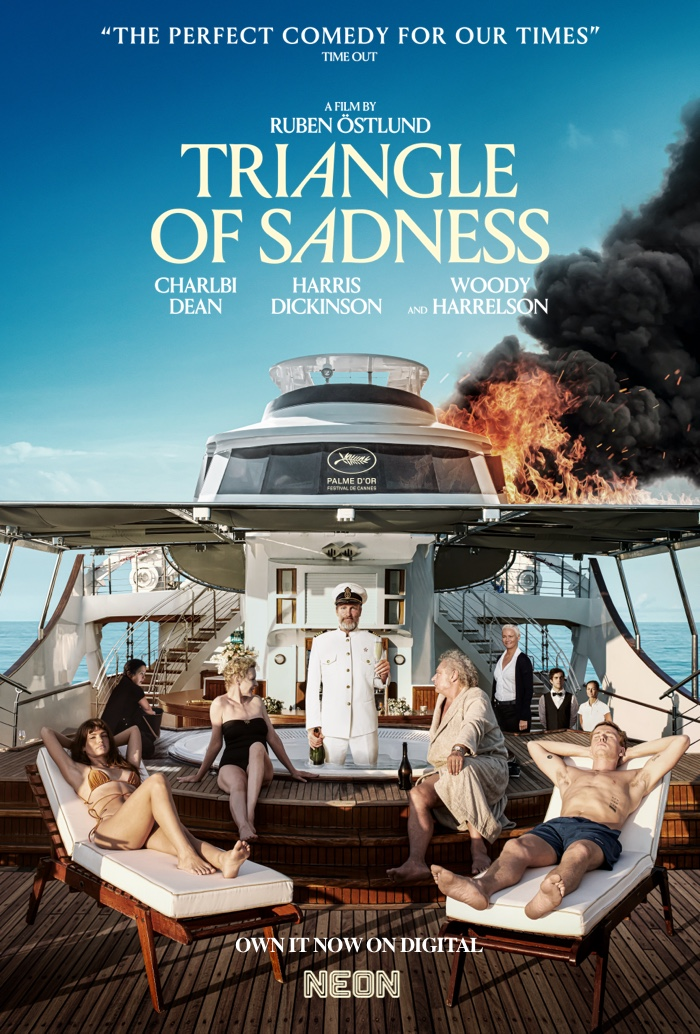
The film opens with Carl (Harris Dickinson) and Yaya (Charlbi Dean), a model and Social Media influencer, as a couple whose relationship is fraught with problems. Through Yaya’s connections she secures them free passage on one of the most luxurious yachting holidays on the ocean. While they aren’t short of money, they have nothing compared to the wealthy millionaires and business types on the boat. As Carl and Yaya act as our conduits in the story, Ostlund uses them to explore the petty first world problems which impact many romances. The staff are also introduced as key players in the “Upstairs, Downstairs” character dynamic, notably Woody Harrelson’s drunken socialist Captain Thomas Smith, and Vicki Berlin’s staff supervisor, Paula. Lastly, the money is represented essentially by lonely tech millionaire, Jarmo (Henrik Dorsin), obnoxious Russian, Dimitry (Zlatko Burić) and stroke victim, Therese (Iris Berben) and her husband.

Throwing these disparate, and latterly desperate personalities, into the trapped spaces of a superyacht is great writing by Ostlund. What unfolds in the second act of the film is an extended set-piece of riotous fun. As the yacht becomes battered by the stormy sea and weather, the guests all become violently ill to devasting impact. While it may not be to everyone’s taste, I was laughing for twenty odd minutes straight at this sickening skewering of these privileged people. At the same time the drunken Dimitry and Captain Smith argue relentlessly about the differences and merits of capitalist and Marxist ideologies. It’s easily one of the funniest and impressively directed sequences of this cinematic year.

But Ostlund isn’t finished yet. These characters have not suffered enough for him, and the final section of Triangle of Sadness (2022) drenches the story in another hilarious and satirical direction. I won’t spoil the events which unfold, but Carl and Yaya’s relationship issues come to the fore as a darkly comedic peril strikes the yacht and passengers. Here Ostlund strikes a further blow against capitalism, exploring the nature of survival of the fittest and true values of human currency in a savage indictment against the obscenely rich. Overall, while the characters may not be the most likeable, that is never Ostlund’s aim. Ostlund’s desire is to critique capitalist hegemony through both high and low brow humour. He succeeds, making Triangle of Sadness (2022) one of the most thought-provoking and exhilarating cinema experiences of the year.

Mark: 9.5 out of 11


SIX OF THE BEST #37 – FOOTBALL FILMS!

SIX OF THE BEST #37 – FOOTBALL FILMS!

With the World Cup beginning in Qatar on Sunday 20th November 2022, I thought it was the perfect time to jump on the bandwagon and consider six of the best football films ever made.

Now, when I say “best” I say this cautiously. The relationship between football and cinema hasn’t always delivered the highest of cinematic art. However, there have been some highly entertaining films set in and around the world of this great game. A sport that involves human beings kicking a sphere into a net. A game I love!


ESCAPE TO VICTORY (1981) – Directed by John Huston

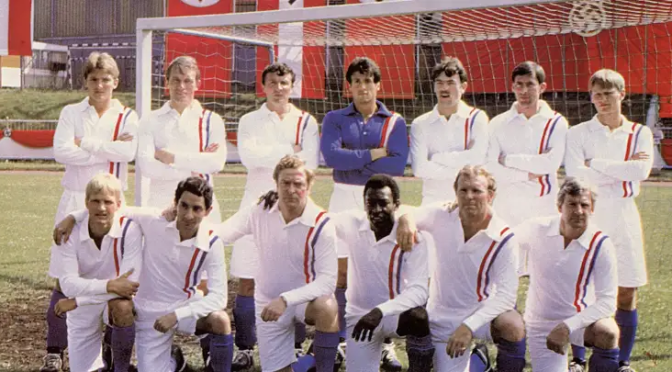
Wow! What a cast! This prisoner-of-war film starring Michael Caine, Sylvester Stallone, Max Von Sydow, Pele, Bobby Moore, Osvaldo Ardiles, John Wark and many more football stars of the era, shouldn’t really work. Yet, it somehow successfully combines football and WW2 prison break subgenres in a beat-the-Nazis-boy’s-own adventure of stirring derring do.


THE FIRM (1988) – Directed by Alan Clarke

An unflinching and gritty exploration of the football hooligan subculture so prevalent in the English game in the 1970’s and 1980’s. Gary Oldman and Phil Davis portray rival gang-leaders of opposing football teams, highlighting how football was used as a substitute for urban warfare up and down the cities and motorways of our green and pleasant land.


GRAHAM TAYLOR: AN IMPOSSIBLE JOB (1994)

Firstly, I must say that Graham Taylor was a great man and exceptional football manager at clubs teams including Watford and Aston Villa. This soul crushing fly-on-the-wall documentary covers in painful depth the ill-fated attempt by the England football team to qualify for the 1994 World Cup. Brutally honest, poignant, funny and embarrassing all at the same time, this is one of the most absorbing sports docs of all time.


SHAOLIN SOCCER (2001) – directed by Stephen Chow

Combining football and martial arts is a master stroke of the highest order. In the turbo-charged, Shaolin Soccer, we get both an underdog story and a litany of incredible kung-fu action set-pieces with scorching goals at the end of them. Brilliantly choreographed by Stephen Chow and his production team, this is a funny, kicking and net-busting classic!


THE DAMNED UNITED (2009) – directed by Tom Hooper

This exceptional adaptation of David Peace’s classic novel scores on many levels. None more so than Michael Sheen’s eloquent portrayal of top manager, Brian Clough and the excellent Timothy Spall as his assistant, Peter Taylor. Dramatically picking apart Clough’s disastrous tenure at premier football club, Leeds United, it shows even genius can get it utterly wrong. Clough would last 44 days at the damned United, but would later prove at Nottingham Forest what an incredible manager he was.


DIEGO MARADONA (2019)

Asif Kapadia’s documentary is arguably one of the finely crafted sports films of all time. Here he takes his razor-sharp filmmaking focus to the massive highs and eventual lows of Diego Maradona’s time at Napoli following his move from Barcelona in 1984. Maradona is regarded as one of the greatest footballers of all time, but had not hit expected heights at the Catalan Kings before moving to Naples. Here Maradona elevated a mostly unsuccessful team to the top of the Italian league. After becoming a footballing god to the Napoli fans, off and on-pitch behaviour would subsequently sour the romance in a powerfully thrilling documentary drama.

[BOOK REVIEW] Directing Great Television: Inside TV’s New Golden Age – by Dan Attias

Directing Great Television: Inside TV’s New Golden Age – by Dan Attias  – Review by Paul Laight

The opening quotes of praise from a myriad of industry colleagues will make my little review pale into insignificance, as there is no doubt that Dan Attias is a director of some repute, expertise, and experience. Here is an Emmy-nominated director who has worked on an incredible list of amazing television shows such as: Miami Vice, Beauty and the Beast, Wolf, It’s Always Sunny in Philadelphia, The Sopranos, The Wire, House, Homeland, Witness (Peter Weir), Northern Exposure, Penny Dreadful: City of Angels, The Americans, The Killing, The Boys, Six Feet Under, The Wire, Marvellous Mrs Maisel, Friday Night Lights, etc.

With such a breath of experience Dan Attias therefore offers much to those seeking insight into the world of directing high quality TV. Moreover, it will also give priceless advice to those seeking a career in directing for all forms of creative media. It is structured and presented eloquently in a language that doesn’t blind the reader with techno-speak either.

The author began as an actor before moving into directing. In fact he states that the best training he had for directing was being an actor. Dan Attias moved from in front of the camera to behind it as assistant director for Steven Spielberg and Francis Ford Coppola before directing the feature film Silver Bullet (1985). After which he moved into directing episodic television. 

Throughout the book, the author shares his wealth of experiences, highs, lows, and scars got from directing many great TV shows of recent years. Dan Attias does not glamorise the industry but illustrates that the craft of television production is all about the hard work and harder knocks. He advises honing one’s craft through being prepared, with collaboration also being vital. It’s a fast-paced endeavour where choices can often go wrong. But learning from those mistakes builds one’s directorial nous. Preparation is invaluable. Even if episodic television does not always allow it. The director will often arrive late to the party as it were with the showrunners, writers, actors, and pre-production crew having worked months developing a project.


I was seriously inspired by many of Dan Attias’ informative anecdotes. Having worked in both drama and comedy it is clear he is not just a point-and-shoot director. One senses a burning desire on his part to tell stories an imaginative, creative, and emotionally interesting style. Moreover, the book provides key insight into the rehearsal process, positioning actors, use of lenses, shifting points-of-view within scenes, framing, background mise-en-scene and of course lighting. For Attias, above all else, engaging with the environment is imperative as, “Each scene is staging a journey.”

As well as the technical knowledge delivered, the author continually promotes the idea that coordinating positively with showrunners and writers is integral when creating the best work. That does not mean there won’t be disagreements or having to overcome material which appears dramatically unpromising. It is the director’s job to be creative and collaborative while breathing new life into well-known characters within long running shows. 

The final chapters share excellent scene breakdowns from the author’s experience of working on three different TV shows, Snowfall, Manhattan, and Good Girls Revolt. Here he delivers a fine perspective of a director’s vision, using the camera and stylistic choices to tell the story, both following and breaking the rules. If you’re breaking the rules you may face conflict from certain crew members, but it is all about staying confident in one’s vision for the storytelling. Overall, Attias’ honesty in overcoming difficult creative moments is to be admired.

Some may think that television was always the lesser cousin, locked in the artistic attic when compared to the noble art of cinema. No more though as programmes such as Game of Thrones, The Wire, The Sopranos, Homeland, Breaking Bad, and many more have proved. Such classic television finds the writing, cinematography, acting and increased production values, elevating their status to the cinematic. The old-school image of a 1970’s TV director shouting at a bank of monitors giving orders to the beleaguered floor manager and cast in a studio is now gone. Dan Attias and his book are testament to that.

This image has an empty alt attribute; its file name is image.png


Buy the book from here:

Publication from https://mwp.com/product/directing-great-television-inside-tvs-new-golden-age/  

Michael Wiese Productions (MWP) was launched in San Francisco in 1976 primarily to produce films. Today, the company is known worldwide having published some 200 books. Some of the bestsellers have been translated into 18 languages, are used in over 700 film courses, in the Hollywood studios and by emerging filmmakers.

Paul Laight is a screenwriter, filmmaker, and blogger. In 2005, he formed Fix Films and has written and produced many shorts and other promos. Many of his films have been screened all over the world at various film festivals.

Paul is currently working on feature and short film scripts for future productions. His work can be found here: 

https://www.youtube.com/c/FixFilmsLtd 

https://thecinemafix.com/

CINEMA REVIEW: THE BANSHEES OF INISHERIN (2022)

CINEMA REVIEW: THE BANSHEES OF INISHERIN (2022)

Written and Directed by Martin McDonagh

Produced by: Graham Broadbent, Peter Czernin & Martin McDonagh

Main Cast: Colin Farrell, Brendan Gleeson, Kerry Condon, Barry Keoghan, etc.

Cinematography: Ben Davis

Edited by: Mikkel E. G. Nielsen

Music by: Carter Burwell

*** MAY CONTAIN SPOILERS ***


The Banshees of Inisherin (2022) is Martin McDonagh’s latest cinematic masterpiece. Not only is it one of the best films of the year he has, as with Three Billboards Outside Ebbing, Missouri (2017), constructed one of the most formidable screenplays of many a year. As a playwright McDonagh has won many awards for his works. His debut film, In Bruges (2008), was a deceptively simple story of two hitmen on the run which, with rich thematic power, became a darkly hilarious existential cult classic. His follow-up Seven Psychopaths (2012), a heady mix of criminals versus writers in a meta-fictional Hollywood-based narrative was brilliantly written and acted, if slightly lacking thematic clarity. Like Three Billboards Outside Ebbing, Missouri (2017), The Banshees of Inisherin (2022) is a highly emotional human drama which contains intelligent allegory, incredible characterization, and cracking dialogue.

Set in 1923 on an island off of Southern Ireland called aptly Inisherin, the film opens by focussing on genial everyman farmer, Pádraic Súilleabháin (Colin Farrell) and his daily routine. After tending to his animals, he usually calls for his friend, Colm Doherty (Brendan Gleeson) to go to the island pub, the J.J. Devine or Jonjo’s. In England there is an idiom called, “sending someone to Coventry.” This means to ignore or ostracize an individual or individuals. So, basically Colm chooses to do this to his long-standing friend, Pádraic. This shunning completely bemuses Pádraic and despite Colm’s pleading for Pádraic to respect his wishes, he continually seeks an answer to his former friend’s decision.


After this intriguing premise is established, what follows is a tremendously original, darkly funny and emotionally penetrating succession of scenes. The exchanges between the two characters begins as bickering but then descends into some seriously disturbing acts of recrimination. Attempting to make them see sense are various eccentric characters on the island who provide many witty and absurd exchanges that McDonagh specialises in. Further, Pádraic’s sister Siobhán (Kerry Condon) is almost the one voice of reason as the feud escalates. As she tries to diffuse the conflict, even Barry Keoghan’s young idiot, Dominic Kearney, the initial comic relief in the film, attempts to make these two men see sense.

Visually, The Banshees of Inisherin (2022), is incredibly rich. The territory displays gorgeously photographed shots of the rocks, the sea, the stone roads and the lush green countryside. But while there is a sense of expanse and freedom initially, the feeling of isolation pervades. As the story continues the characters feel more and more segregated by the sea and their own or other’s decisions. None more so than Farrell’s Pádraic. A simple man who just wants to do his work and get drunk with his friend, he finds he is sequestered by Colm’s desire to self-isolate and concentrate on his music. Here, Farrell and Gleeson give tremendous character work. Farrell especially has rarely been better as Pádraic’s attitude turns initially from shock to bitterness over the journey of the narrative.


A film director’s job is for me about making key creative choices. Martin McDonagh makes brilliant choices while working from his own exceptional script. I loved everything about The Banshees of Inisherin (2022). The look, the performances, the pacing, the locations and Carter Burwell’s phenomenal score are absolutely first class. I haven’t even mentioned Barry Keoghan’s memorable supporting turn. He surely is one of the most naturally gifted actors of his generation. Not to forget other striking characters in the ensemble such as the creepy, Mrs McCormick (Sheila Flitton), an old harridan who acts as a portent for death on the island.

Martin McDonagh expertly combines a superb ear for dialogue, a psychologically absorbing analysis of the human condition with elements from Waiting For Godot and Channel Four situation comedy, Father Ted. Above all else, The Banshees of Inisherin (2022) is a darkly, spectacular cinematic experience which works on many levels. On one level it is about the isolation of island life and its inhabitants. On another it’s about the death of a friendship. While on yet another level it is about the analogous absurdity of civil war and how conflict can start for the merest of reasons. While the best cinema is certainly about showing and not telling, McDonagh proves again that dialogue-driven films can produce cinematic theatre, comedy and tragedy of the highest order.

Mark: 10 out of 11


CINEMA REVIEW: SMILE (2022)

CINEMA REVIEW: SMILE (2022)

Directed and written by Parker Finn

Based on Laura Hasn’t Slept by Parker Finn

Produced by: Marty Bowen, Wyck Godfrey, Isaac Klausner, Robert Salerno, Gabby Olivera

Cast: Sosie Bacon, Jessie T. Usher, Kyle Gallner, Caitlin Stasey, Kal Penn, Rob Morgan, etc.

Cinematography: Charlie Sarroff


If you search YouTube by typing ‘short horror film’ you will find hundreds of really good and often scary, surprisingly enough, short horror films. A great majority of them will have a lengthy suspenseful set-up, before ending on a startling jump scare. The model itself is arguably overdone, however, it is an excellent set-up-punchline structure for new filmmakers to learn film techniques and scare the viewers. Many such short videos go viral and, in the case of Laura Hasn’t Slept by Parker Finn, get picked up for feature development. Hence, we have Parker Finn’s film debut, Smile (2022).

Smile (2022) opens with a suggestion of childhood trauma for lead protagonist, psychiatrist Doctor Rose Cotter when a child. The action then moves to the present day and brings us Rose’s confrontation with the disturbed patient, Laura. What follows is an expertly crafted and incredibly disturbing sequence, which plunges Rose into major threat from a nefarious force. Parker Finn then slowly builds Rose’s psychological breakdown as she experiences hallucinations, frights and memory loss as her partner, family and friends find her behaviour to be disturbing to say the least. A particularly grisly scene at a child’s birthday party was especially deadly and memorable.


As the film continues, I could not help but be reminded of both The Ring (1998/2002) and It Follows (2014) in terms of the story beats. Rose, while being pursued by some unknown demon, faces a race against time to avoid death. Both the aforementioned films are far superior as they have more plot and characterisation to propel the running time. Indeed, one of the major issues with Smile (2022) is that 115 minutes are too long for the character arc Rose Cotter is given. By the time her character revelation is complete it has taken an eternity to get there. Moreover, I was suffering jump-scare fatigue by the end, thus rendering the scarily horrific monster reveal to feel fearfully redundant.

Yet, Smile (2022) has an impactful thematic spine. While It Follows (2014) dealt with the threat of sexual disease within the subtext, Parker Finn’s debut powerfully delves into the impact of grief, guilt and mental health. Having said that, the narrative could have dug more into Rose’s past to really reveal the trauma she suffered as a child. Personally, I think a longer set-up of her character while growing up would have increased the drama. But Parker Finn gets an excellent performance from Sosie Bacon throughout, even if her perpetual appearance on screen as the harassed and troubled victim eventually promotes further fatigue. A scene-stealing exchange between Bacon and the electric Rob Morgan suggests his character should be lead in the inevitable horror sequel.

Mark: 7 out of 11


CINEMA REVIEW: DON’T WORRY DARLING (2022)

CINEMA REVIEW – DON’T WORRY DARLING (2022)

Directed by: Olivia Wilde

Screenplay by: Katie Silberman – Story by Carey Van Dyke, Shane Van Dyke and Katie Silberman

Produced by: Olivia Wilde, Katie Silberman, Miri Yoon, Roy Lee

Main Cast: Florence Pugh, Harry Styles, Olivia Wilde, Gemma Chan, KiKi Layne, Nick Kroll, Chris Pine etc.

Cinematography Matthew Libatique

*** MAY CONTAIN SPOILERS ***


Part arthouse character study, part science fiction social satire and eventually a rushed concertinaed thriller, the Olivia Wilde directed, Don’t Worry Darling (2022) is a visual feast, anchored by Florence Pugh’s devastatingly brilliant performance. However, the ambition of the themes remains hamstrung by pacing and structure which fails to serve the story to its full potential.

Set within a utopian 1950’s sun blanched town called Victory, Wilde and her writers throw us straight into the hedonistic lives of a set of youthful and dynamic couples, drinking, partying and sexing. They work and play hard. Well, the husbands work as the dutiful women stay at home cleaning and churning out kids. So far-so-Stepford Wives! At the heart of Don’t Worry Darling (2022) is Pugh as the loyal but inquisitive, Alice. Her husband, Jack (Harry Styles) is ambitious, seeking the approval of big boss, the hubristic Frank (Chris Pine). When Alice begins to experience Kafkaesque dreams of feeling trapped by her daily life, she slowly realises all is not quite perfect in paradise.


No one does anguish and anxiety on screen like Florence Pugh. As Alice falls deeper down the rabbit hole of despair, Pugh produces true cinematic power once again. Olivia Wilde also brings a compelling image system to fully visualise Alice’s hellish descent. In comparison, the male characters are far less developed and the exchanges between Pugh and Styles, especially in the final act, are really lacking in dramatic punch. Styles himself I felt was miscast, but he does have an engaging screen presence. It’s just I didn’t feel enough threat from him.

Structurally, Don’t Worry Darling (2022) is also flawed. The major reveal comes way too late to assuage the pacing issues. While the narrative contains some striking visual set-pieces there are too many parties, barbecues and social events getting in the way of the potential thrills that could have occurred if Alice had discovered her plight much earlier. Overall, there is too much set-up and not enough punch. The longer you wait to reveal the twist, the bigger the revelation needs to be. The Outer Limits and The Twilight Zone have done this style of story with more emotional impact and better economy. Pugh and Wilde though prove once again they are major talents and thematically speaking it’s good that men get another kick in. Men are fast becoming the go-to villains of this century and long may it continue.

Mark: 6.5 out of 11


[Book Review] Psychology For Screenwriters: Building Conflict In Your Script (2nd Edition) – William Indick

Psychology For Screenwriters: Building Conflict In Your Script (2nd Edition) by William Indick

Film as dream, film as music. No art passes our conscience in the way film does, and goes directly to our feelings, deep down into the dark rooms of our souls.  Ingmar Bergman


William Indick’s excellent book takes us from the dream like world of the cinema to the pages of great psychoanalytical theorists, combining Freud with screenwriting in a most intelligent and approachable way. But his is not a how-to manual for writers, instead an immersive experience mixing theoretical, practical, and thoughtful processes in regard to writing your next film.

If psychology and screenwriting are two sides of the same coin then this book is most definitely for screenwriters and filmmakers with an interest in psychoanalytic theory that enables them to explore archetypes, plot development, structure, and character building from the inside out. Moreover, the author provides an excellent framework with which to weave psychoanalytic theories into one’s writing. But not in a cookie-cutter style. This book is smarter than that.

While many of the theories are complex, the author writes with clarity and expertise. The useful bullet-pointed summaries at the end of each chapter crystallize the concepts with aplomb. Further, the various chapters also delivers ideas from a whole host of great minds of psychoanalytic and structuralist theory such as Carl Jung, Erik Erikson, and Joseph Campbell. There were also theorists I was not too familiar with such as Alfred Adler, Rollo May, and Maureen Murdock. By utilising his expansive knowledge and examples from many classic Hollywood films the author places you into the heart of the character’s mind and motivations.

What I found most fascinating was the book provides an invaluable framework to build your characters with. I certainly could see myself applying various ideas from Freud and Jung within my writing. Indeed, I was certainly drawn to Rollo May’s theories about existential anxiety driving and increasing the complexity of my characters. One could argue though, the author overuses references to Hollywood cinema. I would really have found it intriguing how certain psychoanalytical theories may relate to cinema from, e.g.  Japan, Spain, and France. Furthermore, psychological analysis of a particular director’s work such as Ingmar Bergman could also have proved so interesting.

In conclusion, to many an experienced writer the screenwriting theories, terms and structures covered are instantly recognisable, yet William Indick freshens up the study field with psychoanalytical language, breathing life into the saturated library of scriptwriting releases. Finally, each chapter succinctly bullet-points how a writer may utilise the theories within their work as the book concludes with three brilliant essays relating said theories to the Western, Fantasy and Sci-fi genres. One could even say this book is a dream to work with.


Psychology For Screenwriters: Building Conflict In Your Script (2nd Edition) is available here.

Publication date is January 2023 from https://mwp.com/

Michael Wiese Productions (MWP) was launched in San Francisco in 1976 primarily to produce films. Today, the company is known worldwide having published some 200 books. Some of the bestsellers have been translated into 18 languages, are used in over 700 film courses, in the Hollywood studios and by emerging filmmakers.

NETFLIX FILM REVIEWS: DAYSHIFT (2022), THE GRAY MAN (2022) & SPIDERHEAD (2022)

NETFLIX FILM REVIEWS: DAYSHIFT (2022), THE GRAY MAN (2022) & SPIDERHEAD (2022)

Along with fashion, football, and Formula One, the cinema is one of many capitalistic and cyclical industries which spends and makes money that seems to self-perpetuate its own existence. My lord though there are many more. But isn’t it a bit obscene that so much money is spent on movies while so many people struggle in the world?

Maybe I’m just old. Jaded. Drifting away from the dream factory where such large amounts of cash should be spent on film folly. People are starving, energy bills are rising and there are so many sick across the world, can we not divert some of that money to them? Some people may say I’m a dreamer, but I’m not the only one. Plus, I’m a hypocrite. Using film and alcohol to divert my mind from the world’s problems.

What has prompted this sober reflection? Netflix! Now, I have no idea about business and money and algorithms and subscription revenue. What I have read is that $370 million dollars have allegedly been spent on these three blockbuster films. Could the cash have been spent on more interesting and entertaining product? I mean, why not give $15 million to a whole host of up-and-coming filmmakers to produce thirty lower-budgeted films? Why not concentrate on script, characterisation and strive to explore more original concepts. Surely, the law of averages dictate that there would be a number of gems produced?

Blumhouse Productions and A24 both seem, from the outside, to have industry models which produce successful genre and arthouse films. One may not rate all of their releases, however, these studios appear to avoid burning huge sums of money on their cinematic offerings. Netflix, continue to invest in tentpole monsters which are NEVER released on a cinema screen and are of questionable quality. What of these films? Here are three short reviews of new Netflix releases I have watched recently. With the usual marks out of eleven.


DAYSHIFT (2022)

Directed by J. J. Perry

Screenplay by: Tyler Tice, Shay Hatten

Main cast: Jamie Foxx, Dave Franco, Natasha Liu Bordizzo, Meagan Good, Karla Souza, Steve Howey, Scott Adkins, Snoop Dogg etc.

I’d say this is a cheap, photo-copied and terrible rip-off of Blade (1998) drizzled with John Wick (2014) style fight-scenes, but Dayshift (2022) isn’t bloody cheap. It’s a gigantic waste of money and the viewer’s time. Jamie Foxx, portrays a pool cleaner moonlighting as a vampire hunter, pitted against a den of uber-vampires threatening to take over Los Angeles.

An insult to my intelligence, the script plunders Men in Black (1997) and the execrable R.I.P.D (2013), with the villain’s plan making no sense at all. Dave Franco adds some humour as the unlikely buddy/partner, but this one of those films where the stuntmen get most credit for some amazing fight and vehicle work. It’s a shame the story, plot and characters are so anaemic.

Mark: 5.5 out of 11


THE GRAY MAN (2022)

Directed by Anthony Russo & Joe Russo

Screenplay by Joe Russo, Christopher Markus and Stephen McFeely

Main cast: Ryan Gosling, Chris Evans, Ana de Armas, Jessica Henwick, Regé-Jean Page, Wagner Moura, Julia Butters, Alfre Woodard, Billy Bob Thornton etc.

The apparent reports that $200 million dollars were spent on this film make The Gray Man (2022) a crime against humanity. This is such a bad film. Nikita (1990) is the template as Ryan Gosling’s lifer is offered the chance to become an assassin for a secret US government agency. Flash forward a number of years and Gosling, who doesn’t look any older, gets screwed on a mission and psychotic Chris Evans has to take him down. Cue expertly choreographed death, explosions, shouting, shoot-outs, and zero emotional connection.

I like all the talent involved in this. Gosling, Evans and Ana de Armas are genuine stars. But were they trapped on a brainless rollercoaster that wouldn’t stop? Did it even have a script? And if it did who thought it was worth spending money on. The camera swoops around the globe like a maniac hoovering up the budget. Everyone takes a grand payday as the bullets fly and fire fills up the screen. I was with Gosling’s anti-heroic blank until they introduced the girl moppet and I deflated. Everyone involved is better that the $200 million spent.

Mark: 5 out of 11


SPIDERHEAD (2022)

Directed by Joseph Kosinski

Screenplay by: Rhett Reese, Paul Wernick

Based on:
“Escape From Spiderhead” by George Saunders

Main Cast: Chris Hemsworth, Miles Teller, Jurnee Smollett etc.

This is actually a brilliant film concept absolutely ruined by the miscasting of Chris Hemsworth and a director obsessed with filling the dark themes with inane humour and incongruous 1980’s music. Maybe these elements were all in George Saunders original short story from The New Yorker, but I doubt it. It’s a butchered adaptation from my instinct. By the way, Chris Hemsworth is a brilliant film star, but he cannot act.

So, imagine a Black Mirror episode done really badly with Miles Teller’s criminal being given certain freedoms within a prison as long as he tests drugs and adheres to the rules of the medical experimentation. The plot beats are impactful and Teller’s character arc is very moving. as he tries to escape his past wrongdoings and guilt, but Kosinski and Hemsworth piss over the potential with awful creative decisions that grate and drain all emotion away. It’s a character drama trapped in an insulting action comedy, which must be called out.

Netflix. Stop wasting money.

Mark: 6 out of 11


CINEMA REVIEW – ELVIS (2022)

CINEMA REVIEW – ELVIS (2022)

Directed by Baz Luhrmann

Screenplay by: Baz Luhrmann, Sam Bromell, Craig Pearce, Jeremy Doner

Story by: Baz Luhrmann, Jeremy Doner


Produced by: Baz Luhrmann, Catherine Martin, Gail Berman, Patrick McCormick, Schuyler Weiss

Cast: Austin Butler, Tom Hanks, Helen Thomson, Richard Roxburgh, Olivia DeJonge, Kelvin Harrison Jr., Xavier Samuel, David Wenham , Kodi Smit-McPhee etc.

*** MAY CONTAIN HISTORICAL SPOILERS ***


Since 1992, Baz Luhrmann has directed only six feature films. Each of them, aside from the lower-budgeted, Strictly Ballroom (1992), is a gigantic and epic extravaganza, full of colour, imagination, verve, energy, music, poetry and larger-than-life characters. Even Strictly Ballroom contains many of the stylistic and formal elements which would become part of Luhrmann’s oeuvre. I pretty much feel this auteur’s excessive approach to filmmaking including the fast-cutting, opulent settings, big musical numbers, all-star casts, plus grandiose and melodramatic narrative delivery are always a wonderful spectacle to experience.

Arguably, adapting the American novel, The Great Gatsby (2013), in this periphrastic packaging, took away from the enigma and majesty of Fitzgerald’s classic. However, with Elvis (2022), Luhrmann and his incredible production team, marry such genius excessive style with the perfect subject matter: the King of Rock and Roll! Because in colliding the life, music and films of Elvis Aaron Presley with Luhrmann’s stunning methodology brings to the screen one of the best films of the year Indeed for Luhrmann, Elvis (2022), is evidently a stylistic, subjective and thematic labour of love, marking it as his best film to date.


I wasn’t even going to watch Elvis (2022) at the cinema. I’d recently seen Spencer (2021) on Amazon Prime and was happy to have streamed that. While that eerie adaptation was a valiant attempt to breathe life into the ghost of Diana. An elegiac attempt to explain the oppressive result of her naïve choice to land her Princess dream. With Kristen Stewart’s exceptional impression rescue breathing Diana’s tragic existence, I knew the story. I knew enough to care for someone whose mental health was discarded by the heartless Windsor’s. But the monarchy have been killing the working class for years, so why should I care deeply for one singular spoilt individual? Similarly, I pondered whether I wanted to watch another film about Elvis Presley. A God-given talented singer, heartthrob, actor, musician and legendary performer had a story I was already familiar with. But, I am so happy I overcame my ignorant prejudice because Elvis (2022) is a humdinger of a part-musical-part-biopic-part-drama-part-American tragedy.

Elvis (2022) is structured around the memories of shadowy manager, Colonel Tom Parker (Tom Hanks). He is suffering illness in his old age, close to hospital demise. Parker is a grotesque in a billowing gown, drifting around the nightmarish Vegas slot-machines as Elvis’ voice echoes within his mind. Is it the guilt or the morphine? The story flashes back to a younger Parker promoting country singers at a travelling Carny. Until that fateful day when he hears a miracle on the radio, a young singer who everyone thinks is Black. But he isn’t. In the markedly racist times of 1950s America (has it really changed in certain States or Police departments?), a Black singer won’t sell records like this white dude will. Seizing his chance Parker attends Elvis’ first gig and witnesses a phenomenon. An attractive, sexual, gyrating and angelic powerhouse with an incredible voice who sends sex-waved into the audience, especially the teenage girls.


A star is born, and it takes a star to play a star. Take as many bows as you want, Austin Butler. He is a genuine phenomenon in Elvis (2022). Of course, the wardrobe, postiche and make-up artists work wonders to help recreate Elvis’ iconic looks as the narrative flashes through various stages of Presley’s devastatingly successful career, Yet, Butler just lights up the screen, producing acting fireworks in a physically, spiritually, emotionally and musically astounding screen presentation. It is not an impression, but a tour-de-force for a relatively unknown actor who has jettisoned his career to glory.

Butler, lives and breathes the King. This rendition and great direction from Luhrmann make you feel tragic empathy for a career which was manipulated and controlled by grubby gambling addict, Parker. Hank’s portrayal of the Colonel feels unnatural and theatrical compared to Butler’s organic turn. Perhaps that was the intention? Deliver a pantomime villain to boo and hiss at. Although, Hanks’ cigar-chomping and jowly make-up made me think the evil touch of Orson Welles’, Captain Hank Quinlan, had somehow been resurrected.

I cannot praise Elvis (2022) enough as a cinematic biopic and musical spectacle. While the choppy editing style is jarring at the start, once the film settles down into a groove, Butler’s stunning incarnation shines through. Overall, I was enlivened by, not only the constant remixing of Elvis Presley hits, but Luhrmann’s choice to alloy gospel, rhythm and blues, rap, rock, pop, ballad and protest songs throughout the scintillating soundtrack. Much, quite rightly, is made of how much diverse music influenced Elvis’s formative life and how he connected with Black musicians of the era. Luhrmann also ensures we are aware of how much of a threat Presley was seen by the establishment due to the sexual nature of his sang satanic verses. Sent to Germany to prevent him demonising America, his comeback special after seven years in movies is one of the finest movie set-pieces I have seen in many a year. Funny, rocking, poignant, effervescent, beautiful and astounding, just like Elvis, the man and myth, and Elvis (2022) the film.

Mark: 10 out of 11