Tag Archives: Thriller

Cinema Review: Mission Impossible – The Final Reckoning (2025) plus my 1-8 ranking of the franchise.

CINEMA REVIEW: MISSION IMPOSSIBLE – THE FINAL RECKONING

Directed by Christopher McQuarrie

Written by Christopher McQuarrie & Erik Jendresen

Based on Mission: Impossible by Bruce Geller

Produced by Tom Cruise & Christopher McQuarrie

Main Cast: Tom Cruise, Hayley Atwell, Ving Rhames, Simon Pegg, Henry Czerny, Angela Bassett, Pom Klementieff, Esai Morales, Holt McCallany, Janet McTeer, Mark Gatiss, Nick Offerman, Tramell Tillman, Shea Wigham, Rolf Saxon, etc.

*** MAY CONTAIN SPOILERS ***


Christopher McQuarrie returns to helm the final chapter of Mission: Impossible, delivering exactly what fans have come to expect—exquisite stunt work, globe-trotting chaos, MacGuffins galore, and Tom Cruise running like the fate of cinema depends on it. What stands out during Dead Reckoning (2025) is McQuarrie’s deft layering of callbacks from across the franchise: masks, betrayals, teamwork, sacrifice and even thematic echoes to Ethan Hunt’s original arc as a man constantly outpaced by the very institutions he serves. I mean bringing back Rolf Saxon as banished CIA analyst, William Donloe, from the first film is absolute genius.

Further highlights include the icy St Matthew Island cabin shootout. Plus, the hauntingly atmospheric silent submarine sequence is an exercise in pure cinematic tension that, while a bit dark on the screen I saw it on, was incredibly designed and delivered. In the final thrilling act McQuarrie and his team flex their editing chops in a virtuoso ticking-clock sequence that cross-cuts a rapidly escalating nuclear threat with a spiraling physical stunt—clearly tipping its hat to Dr. Strangelove but with a modern blockbuster pulse. The bi-plane action that Cruise and the stunt team perform is just breathtaking. Lastly, there was also some emotional weight in certain scenes as Hunt shares touching moments throughout, especially with stalwart, Ving Rhames, Luther Stickell.

But while the ambition is laudable, one can’t help but question whether it all needed to stretch across a bum-numbing three hours, weighed down by dense exposition about AI, allegiance, and global power games. The storytelling sometimes forgets to trust the audience, explaining what we already understand or could intuit. It’s thrilling, yes—but occasionally exhausting, especially as Mission: Impossible – Dead Reckoning Part One (2023), had done a lot of the heavy work setting up the Entity and Esai Morales as the nemeses of the piece. Still, along with an impressive ensemble cast, expert production team and of course Tom Cruise doing what he does best, McQuarrie proves himself the rare modern action director who respects his audience’s intelligence and patience—even if he tests both.

Mark: 8 out of 11


MISSION IMPOSSIBLE – MY FAVOURITES 1 to 8

  1. Mission ImpossibleFallout (2018)
  2. Mission Impossible – Rogue Nation (2015)
  3. Mission Impossible – Ghost Protocol (2011)
  4. Mission Impossible (1996)
  5. Mission Impossible – Dead Reckoning (2023)
  6. Mission Impossible III (2006)
  7. Mission Impossible – The Final Reckoning (2025)
  8. Mission Impossible II (2000)


Apple TV+ Film Reviews – Part Two

Apple TV+ Film Reviews – Part Two

As is standard procedure when one creates a part one of a series, the logical and linear progression is to have a part two. So, having watched the majority of the AppleTV+ films currently streaming I now move onto part two. The first set of reviews can be found here:


Coda (2021)

For some unknown alphabetical amnesia I forgot to include this Oscar -winning film in the first set of reviews, so I rectify that omission now. Arguably one of the best films on the platform, it is simultaneously a feelgood, tearjerker and a Save-the-Cat-screenplay-template-box-ticker hitting wholly familiar beats and a well-trodden genre path. Nonetheless, it is a terrifically entertaining, moving, funny and heart-warming story which, on reflection kind of surprisingly won the Academy Award for best film. I personally think another remake West Side Story (2021) was a far more scintillating work of cinema, but hey what do I know? My original review of Coda (2021) can be found below. Mark: 9 out of 11.


Ghosted (2023)

Of late Chris Evans has been choosing roles, as with Red One (2024), that go against the Alpha-heroic persona of Captain America. Unfortunately, Knives Out (2019) aside, the results are average at best. Aside from a series of amusing cameos in the middle act, not even the alluring Ana De Armas can save this clunky AI-written-spy-romance. With better scripting and direction this attractive action fluff could’ve been almost bearable. I remember when Dexter Fletcher made really good low-budget indie films like Wild Bill (2011). Mark: 5 out of 11.


The Gorge (2025)

I really enjoyed this big-budget-romantic-monster shoot-em up. I need to watch it again sober before deciding if it is going to make my top films of the year list or did I love it because I was drunk. Miles Teller and Anya Taylor-Joy revel in fine on-screen chemistry as the physical and symbolic divide provides no barrier to their lustful wants. My full review can be found below. Mark: 8.5 out of 11.


The Greatest Beer Run Ever (2022)

Likeable every-guy, Chickie Donohue (Zac Efron), has the crazy notion of hand delivering beer to his buddies fighting in Vietnam. But his naïve morale-boosting trip soon becomes an eye-opening and perspective changing nightmare. There’s a really good dramatic character arc in this historical 1968-set “road” movie but the comedic tone dilutes the overall catharsis of the journey. Efron is full of energy while the formidable presence of Russell Crowe is memorable if woefully under-used. Mark: 7 out of 11.


Greyhound (2020)

A fast-paced and technically impressive WW2 film with Tom Hanks portraying the Commander of a destroyer battling to survive an enemy onslaught amidst a part of the sea called ‘the Black Pit’. It’s been a while since I watched this but recall it being a solid suspense thriller with great production design and effects, although a little light on meaty character development. Mark: 7 out of 11.


The Instigators (2024)

Matt Damon and Casey Affleck team up once again for this underdog heist film which tries to be funny and dramatic, but misses the nuanced tone a director like Steven Soderbergh can deliver. I kind of enjoyed this because I like Damon, Affleck and Hong Chau, but many scenes suffer from the sense the actors are “improvising” and rewriting the script as they go along. Also, why can’t we have some proper 1970’s hard-boiled crime films like Sam Peckinpah and David Mamet used to deliver. Not all robbery films have to have one-liners throughout. Mark: 6 out of 11.


Killers of the Flower Moon (2023)

My critical feelings of Martin Scorsese’s most recent epic did not shift on the second watch. This profile of the horrors that befall the Osage people after they have struck oil remains compelling. Indeed the film contains powerful themes relating to the greed, power and psychopathy of the white man, but focusing the main thrust of the narrative from their perspective creates a skewed and oddly unimpactful viewing experience. Of course, Scorsese’s filmmaking expertise shines through and the performances are terrific. Mark: 8 out of 11. My full review is here:


Luck (2022)

I felt more than a tad unlucky after watching this animated misfire which didn’t work on any level. I know hundreds of crafts-people worked hard creating this, but why not spend a bit more time on the script. Or film another script altogether. The fact that the budget for this film is reported to be $140 million and there are people starving in the world is a travesty against humanity. Mark: 3 out off 11.


Napoleon (2023)

I haven’t had the spiritual gumption to re-watch this messy biopic from Joaquin Phoenix and Ridley Scott. There’s a four-hour directorial version to contemplate watching too. Oh, if only Stanley Kubrick had made his version. My original review is below. Mark: 7 out of 11


Palmer (2021)

Justin Timberlake again proves himself an adept leading man, having successfully graduated from the Disney-groomed production line he started out on. Palmer (2021) is overall a well-acted and directed redemptive crime drama, which also tackles themes relating to gender nonconformity to differentiate the well worn “parolee-trying-to-go-straight” narrative. Mark: 7 out of 11.


Sharper (2023)

Sharper (2023), directed by Benjamin Caron, skillfully uses classic con artist film tropes to craft a layered and compelling drama. By blending familiar elements of the genre with sleek cinematography and a nonlinear narrative, the film elevates itself above typical heist fare and leans into character-driven storytelling. The terrific cast, notably Julianne Moore, have fun with a genre script containing emotional depth, deliberate pacing, and decent characterisation. Mark: 7.5 out of 11.


Tetris (2023)

Tetris (2023), directed by Jon S. Baird, turns the unlikely origin story of a video game into a surprisingly engaging Cold War-era techno-thriller—at least for a while. Rooted in real historical tensions, the film smartly weaves espionage, corporate greed, and political paranoia into the story of how a simple puzzle game became a global phenomenon. However, its descent into exaggerated action sequences, particularly the climactic chase, turns it into something closer to parody than period drama. It’s a film that ultimately undercuts the suspense by choosing spectacle over substance. Mark: 7 out of 11


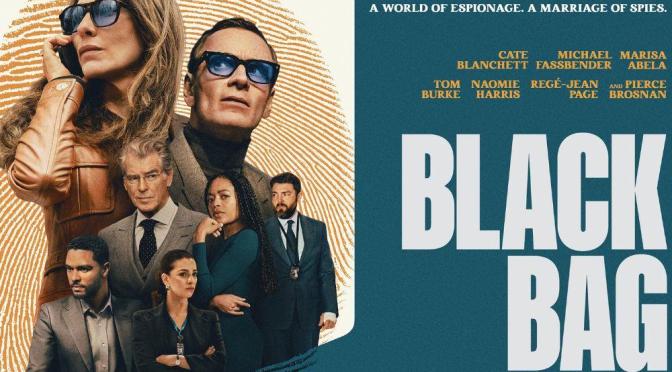
Cinema Review: Black Bag (2025) – Christie meets le Carré in this stylish, sexy and witty spy whodunnit!

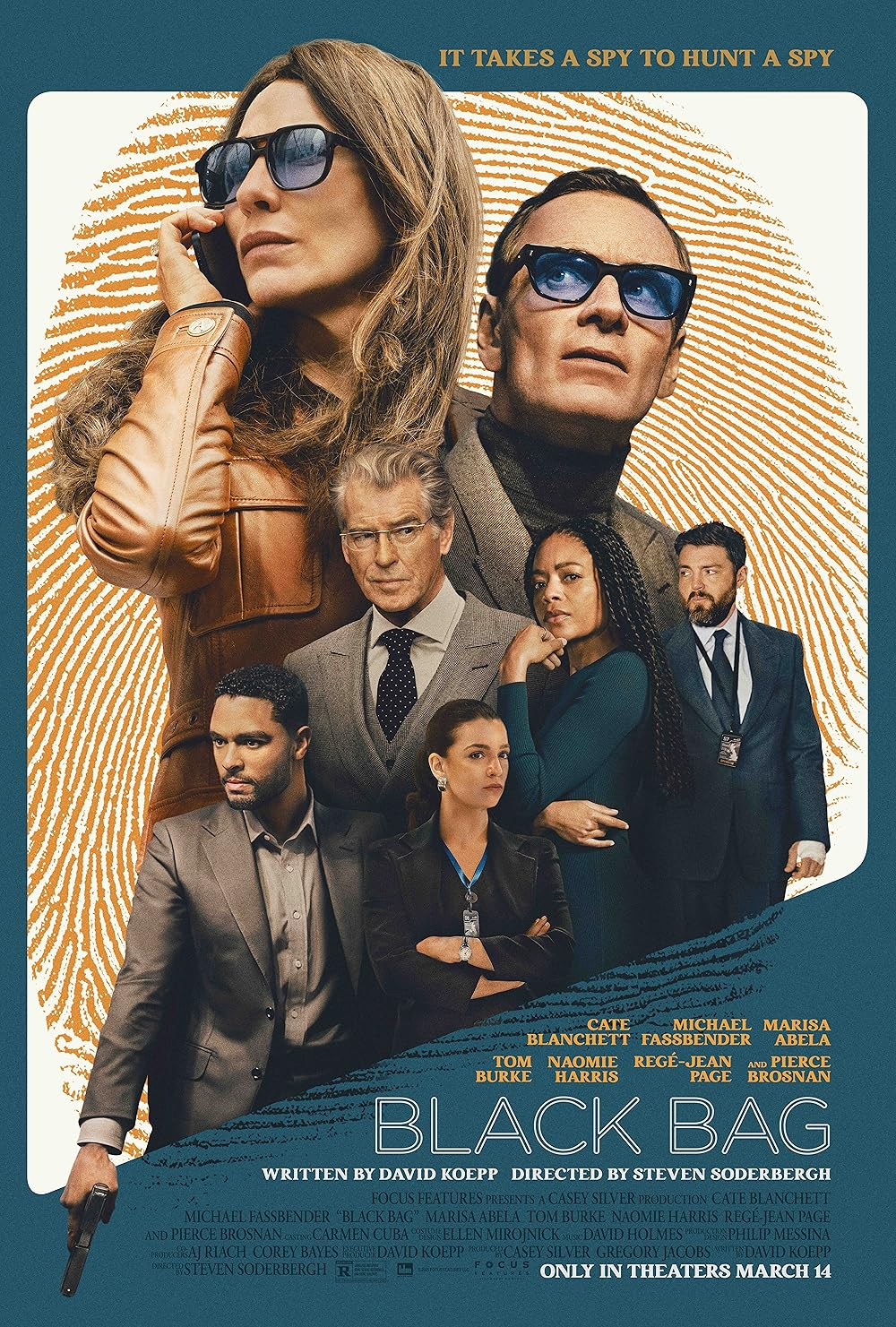
CINEMA REVIEW: BLACK BAG (2025)

Directed by Steven Soderbergh

Written by David Koepp

Produced by: Casey Silver, Gregory Jacobs

Main cast: Cate Blanchett, Michael Fassbender, Marisa Abela, Tom Burke, Naomie Harris, Regé-Jean Page, Pierce Brosnan, etc.


Cinematography by Peter Andrews

*** MAY CONTAIN SPOILERS ***


Steven Soderbergh’s career has been nothing short of a cinematic roller-coaster, blending big-budget spectacle, indie sensibilities, and a keen embrace of genre films in ways that defy easy categorisation. What makes his career so distinctive is his ability to seamlessly navigate between these different filmmaking realms, constantly evolving while retaining a unique voice and artistic freedom. His latest film Black Bag (2025) is a striking, starry, and decent-budgeted genre effort.

Soderbergh first rose to prominence with Sex, Lies, and Videotape (1989), a low-budget indie that catapulted him into the spotlight. The film’s success established him as one of the defining voices of American independent cinema during the 1990s. His subsequent works, such as Kafka (1991) and The Underneath (1995), reflected his interest in experimenting with narrative structures and visual styles, blending genre conventions with deep, sometimes surreal exploration of characters. These works were still firmly rooted in indie filmmaking, but they hinted at a growing ambition and versatility in his cinematic process.

Then, in the late ’90s and early 2000s, Soderbergh took a bold leap into big-budget territory. His Ocean’s Eleven (2001) series stands as a perfect example of his ability to handle mainstream, star-studded films with finesse. It combined slick, fast-paced storytelling with elements of the heist genre, demonstrating that Soderbergh could not only handle massive budgets but could also bring style, wit, and substance to a genre film. However, Soderbergh was never one to be pigeonholed, and in the same decade, he also directed both Erin Brockovich (2000) and Traffic (2000), both socially conscious, multi-layered dramas, with the latter about the war on drugs. Traffic earned him an Academy Award for Best Director, proving that Soderbergh but could also tackle politically charged narratives with profound depth.

Having moved back to indie filmmaking with The Bubble (2005) and The Girlfriend Experience (2009), Soderbergh made another unexpected turn with Magic Mike (2012), which, despite its premise (a male stripper drama), was a sharp social commentary on gender, exploitation, and masculinity. This film not only tapped into a niche market but was also a critical success, further cementing his ability to bring depth to various genres, whether mainstream or niche. Even when he announced his “retirement” from directing in 2013, he still found ways to work in other mediums, such as producing and experimenting with quality television (The Knick), and in 2017, he returned to directing with Logan Lucky (2017), a heist comedy that balanced mainstream appeal with Soderbergh’s signature offbeat style.


Soderbergh’s ability to jump between blockbuster entertainment and intimate, experimental narratives has been the hallmark of his career. Yet for me his serious genre dramas like the aforementioned Traffic (2000), plus Contagion (2011), Side Effects (2013), and his most recent project, Black Bag (2025) represent the pinnacle of his narrative precision and impact, solidifying his reputation as one of the best directors in genre cinema. One could argue that Black Bag (2025) leans heavily on spy film tropes, yet it has a certain emotional and conspiratorial depth beneath the familiar beats and sheen.

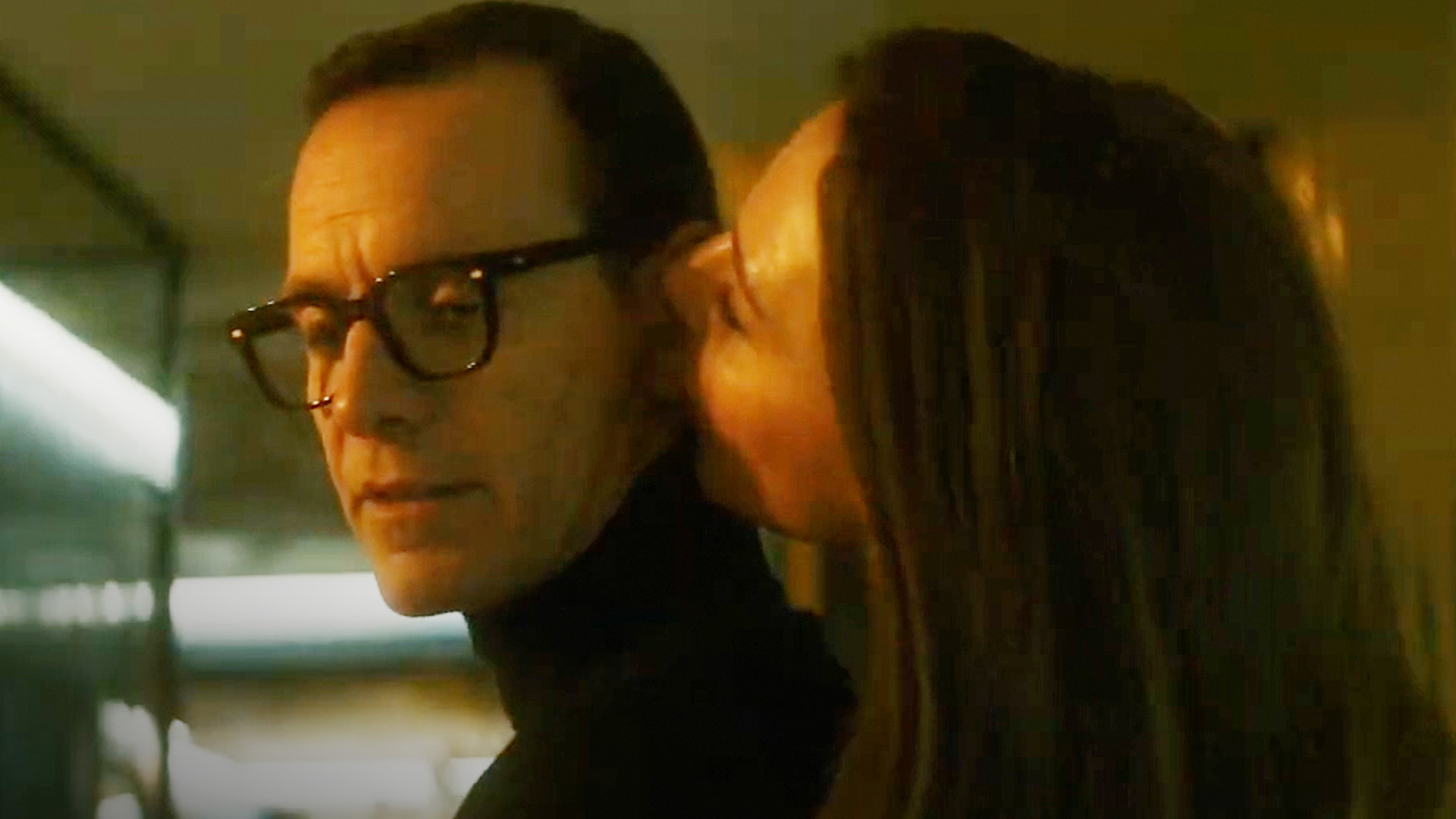
What sets these films apart from the rest of Soderbergh’s career is the seamless way in which he blends his usual intellectual ambition with a masterful, almost surgical delivery of genre tropes. Whether tackling the global panic of a viral outbreak in Contagion (2011), the psychological twists of a modern Hitchcockian thriller in Side Effects (2013), or the high-stakes political intrigue in Black Bag (2025), where a deadly uber-weapon McGuffin falls into the wrong hands. Here master-agent George Woodhouse (Michael Fassbender) must track down a mole, who may-or-may-not be one of his colleagues or indeed his wife, Kathryn (Cate Blanchett).

Black Bag (2025), expertly combines spy-game thrills within a series of “who’s-cheating-on-who” twists. It certainly helps that Soderbergh is working with an exceptionally crafted script from David Koepp and a cast to die for. Fassbender, Blanchett and Tom Burke especially stand-out, with Fassbender delivering yet another masterclass in filmic understatement. Overall, it’s a viciously funny and sexy genre piece that combines Agatha Christie, classic espionage thrillers and Soderbergh’s trademark framing, lens and lighting tricks. It’s the kind of genre filmmaking where every scene, every act, every word, every frame and every moment serves a narrative purpose. It’s a handsome bit of cinema and my word is my Bond!

Mark: 8.5 out of 11


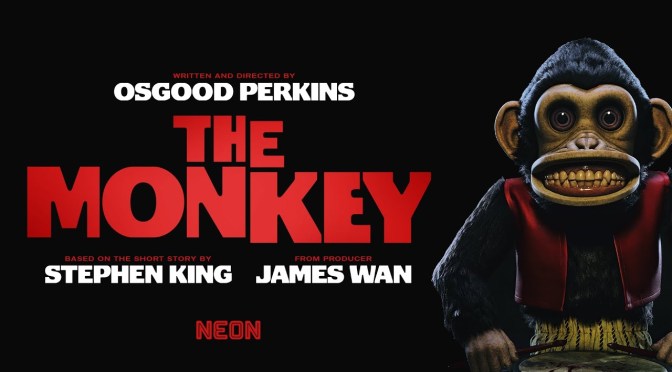
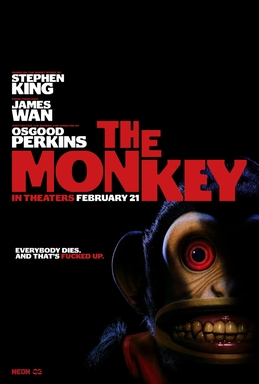
Cinema Review: The Monkey (2025) – a hilarious horror sketch-show with gore masking an inconsistent totemic tale!

Cinema Review: The Monkey (2025)

Directed by Osgood Perkins

Written by Osgood Perkins

Based on “The Monkey” by Stephen King

Produced by James Wan, Dave Caplan, Brian Kavanaugh-Jones, Chris Ferguson, etc.

Main Cast: Theo James, Tatiana Maslany, Christian Convery, Colin O’Brien, Rohan Campbell, Sarah Levy, Adam Scott and Elijah Wood.

Cinematography by Nico Aguilar


Following the financial success of his 2024 psychological thriller Longlegs (2024), Osgood Perkins has recently embarked on adapting Stephen King’s short story, The Monkey, into a feature film. While I didn’t quite connect with it Longlegs (2024) it had many impressed with its strange, atmospheric tension as well as Nic Cage’s crazy look and performance. The Monkey (2025), differs in tone though as it this adaptation with a blends horror and dark comedy, allowing Perkins to showcase his versatility as a filmmaker.

The narrative of The Monkey (2025) centres on twin brothers, portrayed by Theo James, who encounter a cursed toy monkey linked to a series of gruesome deaths. Perkins expands upon King’s original short story, infusing it with themes of family, fatherhood, reconciliation and a litany of grisly sudden deaths. Having found the simian death totem as teenagers, Hal and Bill Shelburn find their lives and those around them impacted in the most bloody explosive of ways. Indeed, there is much thought and planning given to these Saw and Final Destination franchise influenced on-screen set-pieces. In fact, the exquisite surprise and laugh-out-loud hilarity which occur throughout somewhat overpowers any emotional connection with the thinly-written protagonists.


The film’s gore and relentless pace are undeniably its strongest assets — the kills are extreme, inventive, and staged with a gleeful disregard for realism, echoing the chaotic energy of ’80s horror comedies. Each death sequence feels like a miniature horror short, packed with practical effects and over-the-top carnage. Perkins crafts these moments with a twisted sense of humour, making the film feel like a sketch-show carousel of nightmarish vignettes, each more outrageous than the last.

However, despite the visceral fun, The Monkey (2025) struggles to leave a lasting impression. Unlike the original Saw (2004) by James Wan and Leigh Whannell — a film that balanced its brutal horror with sharp social commentary and tightly woven mythology — Perkins’ adaptation lacks a deeper foundation. The cursed toy monkey serves as a simple harbinger of death, but the film never establishes consistent rules for how the curse operates or why it escalates the way it does. Without clear internal logic or meaningful subtext, the horror loses weight, and the emotional stakes fizzle.

While The Monkey (2025) succeeds as a frenetic, blood-soaked thrill ride, it ultimately feels ephemeral. The film’s surface-level scares and comedic flair make for an entertaining watch, but the absence of narrative substance or thematic resonance leaves it as little more than a fleeting novelty — a film you enjoy in the moment, but rarely think about after the credits roll.

Mark: 6.5 out of 11


Cinema Review: I’m Still Here (2024) – A searing portrait of resistance in the face of military tyranny!

Cinema Review: I’m Still Here (2024)

Directed by Walter Salles

Screenplay by Murilo Hauser and Heitor Loreg

Based on I’m Still Here by Marcelo Rubens Paiva

Produced by Maria Carlota Bruno, Rodrigo Teixeira and Martine de Clermont-Tonnerre

Main cast: Fernanda Torres, Selton Mello, Fernanda Montenegro, Valentina Herszage, Luiza Kosovski, Barbara Luz, etc.

Cinematography by Adrian Teijido

*** MAY CONTAIN SPOILERS ***


On March 31, 1964, the Brazilian military, with support from the United States and segments of the civilian population, overthrew the government of President João Goulart in a coup d’état. Goulart, a left-wing president who had been in power since 1961, faced rising opposition due to his policies that included land reforms and more progressive labour laws. These policies alarmed conservative sectors of society, including the military, business elites, and parts of the middle class, who for many feared the spread of communism in the context of the Cold War. From reports I have read, the military’s move was framed as a necessity to prevent Brazil from descending into a left-wing revolution, but the coup marked the beginning of a brutal 21-year period of military dictatorship. Be careful what you wish for.

Under the military regime (1964–1985), Brazil saw widespread censorship, repression of political dissidents, the establishment of a climate of fear, and the use of torture against suspected leftist militants and activists. The military government justified its actions as necessary to combat communist insurgency, but its reign was characterised by systematic violations of human rights. The regime implemented institutional acts that curtailed democratic freedoms, silenced political opposition, and controlled the media, all while claiming to defend the country from Marxism. The dictatorship lasted until 1985, ending when the military handed power back to a civilian government, but the effects of this period are still deeply felt in Brazilian society, as many families continue to search for the truth about the victims of torture and forced disappearances during the dictatorship.


Yet, while the film may not explicitly focus on the 1964 coup or the military dictatorship. I’m Still Here (2024) addresses the aftermath and themes of identity, resistance, and survival in the face of oppressive systems. Director, Walter Salles, uses the personal as a lens through which broader social and political issues are explored. One could consider how the legacy of fear, control, and the impact of a regime still reverberates in contemporary Brazil.

In I’m Still Here (2024), the filmmakers take a distinctive approach to the thriller genre by moving away from the typical tropes associated with suspense-driven narratives. Instead of focusing primarily on action or a series of dramatic plot twists, the film shifts its attention toward a more intimate, personal, and familial story. There is suspense and tension, but it is more under-stated and subtle. This departure from overt political thriller conventions allows the film to delve into the emotional and psychological terrain of its characters, with a particular focus on the matriarch, Eunice Paiva, played by the powerhouse Fernanda Torres.

Rather than relying on external action or traditional thrills, I’m Still Here (2024), centres around Eunice’s emotional journey and the impact of her environment on her family when her husband, Rubens Paiva (Selton Mello) is taken away by what may-or-not-be the military. The film positions Eunice as the central figure whose personal evolution drives the narrative, illustrating the profound effects of her choices and relationships on her family. Salles skilfully weaves family celebrations, events, and home movie footage to create a swell of warmth amidst the fear and paranoia created when Rubens disappears.


Eunice Paiva’s character is given a powerful depth in I’m Still Here (2024), with Fernanda Torres delivering a standout performance. Rather than positioning Eunice as a victim or a purely heroic figure, the film complicates her character, showing her as a multifaceted individual. Eunice’s actions are driven not by external thrills or pressures, but by the emotional and psychological burdens she carries as a matriarch, dealing with familial responsibility and navigating the complexities of her relationships with her children, spouse, and extended family.

Torres’s portrayal emphasises Eunice’s inner conflict—her desire to protect her loved ones, while also grappling with personal loss, regret, and the external societal forces that shape her world. Constantly denied answers and closure by the authorities, Eunice refuses to give in and continues to fight for decades, even when the military rule is over. The emotional intensity of Eunice’s character arc is one of the most compelling aspects of the film, as Torres’s performance brings a deep authenticity to the role, grounding the story in real, human struggles rather than sensationalised action.

By moving away from traditional thriller tropes, I’m Still Here (2024) creates a more reflective and intimate cinematic experience. Rather than simply delivering suspense through external action, the film explores the internal tensions of its characters and their relationships, magnifying the quiet, profound impact that such personal struggles can have on a family. Having lived through such adversity the Paiva family would stand proud in the face of this evil regime, overcoming all that is thrown at it. I mean, there is so much evil in this world and throughout history, that Eunice Paiva and similar quiet heroes are to be cherished. In short: why can’t such admirable individuals run the often horrible world we live in.

Mark: 8.5 out of 11


Cinema Review: September 5th (2024) – an inside-out snapshot of tragedy at the 1972 Munich Olympics!

Directed by Tim Fehlbaum

Written by Moritz Binder, Tim Fehlbaum and Alex David

Produced by Philipp Trauer, Thomas Wöbke, Tim Fehlbaum, Sean Penn, John Ira Palmer and John Wildermuth

Main cast: Peter Sarsgaard, John Magaro, Ben Chaplin, Leonie Benesch, Jim Mckay (archival footage), Zinedine Soualem, etc.

Cinematography by Markus Förderer

Edited by Hansjörg Weißbrich

*** MAY CONTAIN SPOILERS ***


The events of September 5th, 1972, during the Munich Olympics are deeply connected to the tragic and harrowing story of the attack by the Palestinian group ‘Black September’, which targeted the Israeli Olympic team. This day is crucial in understanding the impact of the attack, as it marks the beginning of what became known as the ‘Munich Massacre’. The documentary One Day in September (2000) directed by Kevin Macdonald, offered a detailed account of the events providing chilling footage, interviews with survivors, and insights from those who witnessed the attack and as a moment that deeply altered the course of history, influencing global politics, the perception of terrorism, and the nature of security at international events.

Steven Spielberg’s fictionalised film Munich (2005) dramatized the aftermath of the ‘Munich Massacre’, focusing on Israel’s covert response to the attack. The film based on the book Vengeance by George Jonas, told the story of a team of Israeli agents tasked with assassinating those involved in the planning of the massacre. The plot of Munich (2005) unfolds as these agents track down and kill individuals connected to ‘Black September’. The film, criticized for a series of inaccuracies, portrayed the moral complexities and psychological toll of vengeance, showing the personal conflict faced by the agents as they carry out their mission. Now, covering the same event, we have September 5th (2024), a drama-documentary that snapshots the conflict from the perspective of the ABC Sports crew and their coverage of the events.


Director, Tim Fehlbaum, and his talented production team effectively utilize constraints in geography, time, space, and structure to craft a highly claustrophobic thriller, drawing viewers into the escalating crisis as it unfolds. From the moment the athletes are taken hostage the ABC media team headed by Peter Sarsgaard as Roone Arledge, the president of ABC Sports, John Magaro as Geoffrey Mason, the head of the control room in Munich and Ben Chaplin as Marvin Bader, the head of operation at ABC Sports are on red alert striving to capture the story and prevent it being taken from them by the ABC News team. Fehlbaum makes use of limited settings, “real-time” structure, and confined spaces expertly as the audience find out information of the hostages plight and subsequent runway killings at precisely the same time as the crew do.

The films’ use of psychological space, close-ups, shadows and screens, creates a claustrophobic atmosphere, starving the audience of air and making them feel the increasing emotional pressure on each character. Like the world’s population today witnessing the brutal events unfold between Israel and Palestine on the news, they ultimately have little power over the situation as news of tragedy bleeds through to them. Further, the cast are uniformly compelling with Peter Sarsgaard, John Magaro and Leonie Benesch, as a translator for the ABC crew, stand out amongst an impressive ensemble. Lastly, special mention for the editing team led by Hansjörg Weißbrich, who skilfully weaved in actual footage from the ABC archive, creating a seamless and powerful cinematic experience.

Mark: 8 out of 11


The Cinema Fix presents: 12 Favourite Films of 2024!

The Cinema Fix presents: 12 Favourite Films of 2024!

Good day and I hope you are well. I am slightly late to the party with these but happy new year nonetheless.

Here are my favourite films of 2024 that I watched at the cinema and on streaming platforms. The majority would have been released last year, however there were quite a few that crossed the last eighteen months or so. I cheated slightly with The Quiet Girl, but I watched in 2024, so there you go.

If I have missed any films then please let me know in the comments. I have either NOT seen them or did not enjoy them as much as you. Remember these are my FAVOURITE films seen in 2024 of new(ish) releases. So all purely subjective and am happy if you agree or disagree. Have a wonderful 2025!

Oh, for control and interest, I include my favourite films of 2023!


Ten Favourite Films of 2023

https://wordpress.com/post/thecinemafix.com/77015

ANATOMY OF A FALL (2023)
ASTEROID CITY (2023)
BROKER (2022)
MAY DECEMBER (2023)
OPPENHEIMER (2023)
PAST LIVES (2023)
SALTBURN (2023)
TAR (2022)
TOTALLY KILLER (2023)
THE WONDER (2022)


Twelve Favourite Films of 2024

ALL OF US STRANGERS (2023)


AMERICAN FICTION (2023)


HERETIC (2024)


THE HOLDOVERS (2023)


THE IRON CLAW (2023)


LATE NIGHT WITH THE DEVIL (2023)


MONSTER (2023)


POOR THINGS (2023)


THE QUIET GIRL (2023)


SPEAK NO EVIL (2024)


THE SUBSTANCE (2024)


THE ZONE OF INTEREST (2023)

Apple TV+ Film Review: Blitz (2024) – A fine testament to the Human Spirit during Wartime!

Apple TV+ Review: Blitz (2024)

Directed by Steve McQueen

Written by Steve McQueen

Produced by Tim Bevan, Eric Fellner, Steve McQueen, Anita Overland, Adam Somner, Arnon Milchan, Yariv Milchan, Michael Schaefer

Main Cast: Saoirse Ronan, Elliott Heffernan, Harris Dickinson, Benjamin Clementine, Kathy Burke, Paul Weller, Stephen Graham etc.

Cinematography by Yorick Le Saux

*** MAY CONTAIN SPOILERS ***


Officially classed as acclaimed filmmaker Steve McQueen’s first feature since the release of Widows (2018), Blitz (2024) is a WW2 drama of extremely high quality. But before I get into the review, lest we forget the series of films Steve McQueen delivered to the BBC a few years. The ‘Small Axe’ anthology should and shall be revisited as one of the most important documents of British history, such is its searing power, dramatic drive and the stunning rich tapestry of characterful moments. So, I urge you to watch, if you haven’t, what I consider to be Steve McQueen’s masterworks. I have reviewed the first one Mangrove (2020) here and the remaining of the collection here:


Blitz (2024) is a bigger budgeted production when compared to the ‘Small Axe’ anthology. But, similarly, it is a period piece, focusing on the working class and Black experience, this time set during the brutal bombing of London in 1940. McQueen shoots very much from the perspective of George (Elliot Heffernan), his mother, Rita (Saoirse Ronan) and grandfather, Gerald (Paul Weller). George, like many war children, is packed on a train to the relative safety of the countryside, while parents live in the hope of surviving the incessant German bombs.

After establishing the close family bond between the Hanways, and the wrenching emotion of sending her son away, Rita continues working in a munitions factory and sings beautifully on a national radio show. At the same time, George, finds trouble with a gang of child bullies on the train, before fighting back and jumping off. A tough and resourceful boy, George, makes the perilous choice to return to battered and burning London to reunite with his mother. The city, scarred by the relentless ‘Blitzkrieg’, is a treacherous labyrinth of collapsing buildings and choking smoke, but George’s determination burns brighter than the fires raging across the skyline.


Like a modern Oliver Twist, Blitz (2024) George’s journey through the devastated capital is both a physical and moral odyssey, with each encounter shaping his understanding of loyalty, survival, and the fragile threads that bind people together in times of crisis. George becomes trapped by his own choices, the bombs, bricks, buildings and characters he meets on the way. Some are friendly, but others exploit George preventing his return home. McQueen’s script also finds time to flashback to show Rita meeting George’s father, providing significant context to his mixed race background. Indeed, through George, McQueen explores themes relating to race and his emotional journey to find his place in the world as a person of colour.

Blitz (2024) is a superbly shot and designed film, with Yorick Le Saux’s cinematography rendering war torn London with an almost mythical beauty. However, Hans Zimmer’s overblown soundtrack is too much for me. Further, Steve McQueen’s hagiographic and episodic approach does somewhat diminish the raw drama and bloody horror of war. Notably, the under-use of Kathy Burke and Stephen Graham’s gutter snipe thieves. Plus a thrilling action set-piece during a flooded tube station that cuts away from George’s almost-demise, denying us suspense and dramatic catharsis. Thus, at times, the film sacrifices potential complexity during George’s journey, making his survival seem almost predestined rather than hard-fought. Still, Steve McQueen remains one of the country’s most important cinematic artists and Blitz (2024) is yet another fine testament to the strength and resilience of the human spirit.

Mark: 8 out of 11


Netflix Film Review: Emilia Perez (2024) – A Trans-formative song of Risk and Redemption!

NETFLIX FILM REVIEW: EMILIA PEREZ (2024)

Directed by Jacques Audiard

Screenplay by Jacques Audiard

Based on Écoute by Boris Razon

Produced by Jacques Audiard, Pascal Caucheteux, Valérie Schermann, Anthony Vaccarello

Main Cast: Zoe Saldaña, Karla Sofía Gascón, Selena Gomez, Adriana Paz, Mark Ivanir, Édgar Ramírez etc.

Cinematography by Paul Guilhaume

*** MAY CONTAIN SPOILERS ***


There’s such a thing as having too much going on.” Howard Moon from The Mighty Boosh.

I am a big champion of the films of Jacques Audiard. When his eccentric Western, The Sisters Brothers (2018), was released I wrote a positive review and tribute to several other fine films he has directed here. Audiard likes to take risks representing human beings on the edge of society and perhaps struggling with life; people who often make left-field decisions to improve or escape their existential plight. With his latest film Emilia Perez (2024) the filmmaking master challenges the audience again with a multi-blended genre film that also contains powerful themes of transformation, redemption, violence, crime and family values. Oh and there are songs too.

The narrative begins strongly as Rita Mora Castro (Zoe Saldana), a fiercely talented yet overlooked lawyer in Mexico City, finds herself thrust into the spotlight when she defends the wife of a prominent media mogul in a controversial murder trial. Despite her misgivings, Rita crafts a chillingly persuasive argument that frames the death as a suicide, securing an unexpected victory in the case—one that leaves her both celebrated and haunted.

As the dust settles, Rita’s restless dissatisfaction with her life grows louder. Then comes an anonymous phone call: an enigmatic voice offers her a chance at something extraordinary—and extraordinarily dangerous. Intrigued and desperate for change, she agrees to a clandestine meeting. The mysterious client turns out to be none other than Juan “Manitas” Del Monte (Karla Sofía Gascón), a ruthless and feared cartel kingpin. But the request they make isn’t what Rita expects from a crime-lord. Manitas dreams of living authentically by undergoing gender-affirming surgery and becoming a woman. Rita must decide: will she help Manitas rewrite their story, or will she risk becoming the next chapter in a tale of betrayal and bloodshed?


This fascinating set-up draws you in and I believe if Audiard’s narrative had concentrated mostly on the relationship between Rita, the transitioned, Emilia, then the film would have retained much emotional and thematic power. Yet, after Emilia’s operation the screenplay introduces several other story strands and characters to take in, including Selena Gomez’ feisty Jessi Del Monte, Manitas’ ex-wife who thinks “he’s” dead. This development works initially but then Audiard hurls so many more ideas and genres at the audience wall, not all of them sticking.

Admittedly, the film’s audacious blend of melodrama, crime, thriller, musical, and comedy creates an unpredictable and frenetic narrative that keeps viewers on their toes. However, this constant genre-shifting can undermine the weight of its core themes—gender and identity—by overshadowing them with spectacle and tonal inconsistency. The story’s rapid turns and refusal to settle into a single emotional or narrative groove risk, arguably trivializing the profound struggles and triumphs of its trans-protagonist. Moments that could serve as deeply reflective or cathartic explorations of gender identity are sometimes undercut by abrupt pivots into slapstick humor or hyper-stylized action. While these shifts might aim to reflect the disarray and fluidity of identity in a chaotic world, they can also dilute the thematic resonance.

At the same time, it’s clear Audiard is deliberately embracing this chaos and analysis of human flaws. The fractured tone might symbolize a world where stability and clarity are illusions, mirroring the internal and external conflicts of someone navigating personal transformation in an unyielding environment. This approach, while conceptually intriguing, can feel alienating. Nonetheless, the cast’s stellar performances anchor the film, ensuring that the characters remain compelling even when the story spirals into excess. Lastly, Emilia Perez‘ (2024) relentless energy often leaves little room for introspection, and whether this genre-chaos enriches or undermines the narrative depends largely on the viewer’s tolerance for Audiard’s embrace of choral disorder in a world seemingly allergic to calm and pattern.

Mark: 7.5 out of 11


Cinema Review: Heretic (2024) – A Devilish Twist on Religious Horror

Heretic (2024)

Directed by Scott Beck & Bryan Woods

Written by Scott Beck & Bryan Woods

Produced by Stacey Sher, Scott Beck, Bryan Woods, Julia Glausi and Jeanette Volturno

Main cast: Hugh Grant, Sophie Thatcher, Chloe East and Topher Grace.

Cinematography by Chung Chung-hoon


Hugh Grant has been leaning into edgier, more complex roles in recent years, breaking away from the charming, rom-com archetype that first made him famous in films like Notting Hill (1999) and Four Weddings and a Funeral (1994). His performance as the scheming Fletcher in The Gentlemen (2019) showcased his versatility and willingness to play morally ambiguous, darker characters, a notable shift from his earlier, more likeable characters. Additionally, his involvement in projects like Heretic (2024) demonstrates a continued exploration of grittier, layered personas, signaling a reinvention of his career as he embraces unconventional, often villainous roles that display a new level of depth and unpredictability.

In the theologically-driven horror thriller, Heretic (2024), he portrays a certain Mr Reed, who is door-stepped by two Mormon missionary’s, Sister Barnes (Sophie Thatcher) and Sister Paxton (Chloe East). After the opening scenes which establish empathy for the Mormons, despite some slightly risque dialogue, they knock on the door of Mr Reed and soon the tension begins to rise as he clearly has ulterior motives. But what could they be?


The excellent script by Scott Beck and Bryan Woods truly comes alive in the second act, diving into a sharp, intelligent critique on the nature of religion and faith. The narrative shifts into thought-provoking territory, dissecting the contradictions and complexities of belief systems with nuance and wit. Hugh Grant, delivers these lines with palpable relish, embodying a character that’s both captivating and unsettling. His performance amplifies the script’s incisive commentary, bringing a darkly charismatic edge to the film’s anti-treatise that leaves a lasting impression on the viewer. There’s some great humour in there too, even name-checking South Park and The Book of Mormon during a thrilling game of verbal cat-and-mouse as Mr Reed challenges the sweet missionaries’ whole doctrine. Which, let’s face it, as invented by Joseph Smith, is arguably founded on many ridiculous ideas.

Heretic loses some of its originality toward the end as it leans into familiar horror and “final girl” tropes, diluting the impact of its earlier, more mazy, twisted and thought-provoking narrative. After building a layered critique on religion and faith, the climax reverts to predictable genre conventions, somewhat undermining the complexity established in the second act. This shift might feel like a missed opportunity, as the nuanced themes give way to traditional horror cliches that prioritize shocks over substance. While still entertaining, the reliance on these tropes makes the conclusion feel less daring compared to the film’s more intellectually ambitious setup. Still, Hugh Grant’s devilish Mr Reed and a fantastic soundtrack, make it well worth the admission fee. Meanwhile Woods and Beck again prove themselves as genre filmmakers worth keeping faith with.

Mark: 8.5 out of 11