Category Archives: New Releases

CINEMA REVIEW: THE IRON CLAW (2023)

CINEMA REVIEW: THE IRON CLAW (2023)

Directed by Sean Durkin

Written by Sean Durkin

Produced by: Tessa Ross, Juliette Howell, Sean Durkin, Angus Lamont, Derrin Schlesinger

Cast: Zac Efron, Jeremy Allen White, Harris Dickinson, Maura Tierney, Stanley Simons, Holt McCallany and Lily James.

Cinematography: Mátyás Erdély

*** CONTAINS SPOILERS ***


According to research on the internet the biggest killer of men in the UK under fifty-years of age is suicide. Nationally and locally seventy-five percent of those that die by suicide are men, with the highest numbers being forty-five to fifty-four years of age. In the USA, reports show suicide is the second leading cause of death among Americans ages ten to thirty-four, and the fourth leading cause of death in the thirty-five to fifty-four age group. I personally have known two close male friends who have taken their own lives in the last decade.

In addition, mortality rates for professional wrestlers are reportedly up to 2.9 times greater than the rate for men in the wider United States population. Statistics also show that the early deaths of professional wrestlers were significantly higher than that of athletes in other sports. Potentially due to the consistent mental and physical detriment as well as a proclivity toward higher rates of cardiovascular disease, depression and drug addiction. Thus, with this in mind, Sean Durkin’s film, The Iron Claw (2023), a profile of the Von Erich family, while full of exciting wrestling action, is NOT one of those generic feelgood underdog sports dramas. It is however a complex exploration of masculinity, familial pressure, sports politics, suicide, grief, religion, addiction, love, and the resilience of the human spirit.


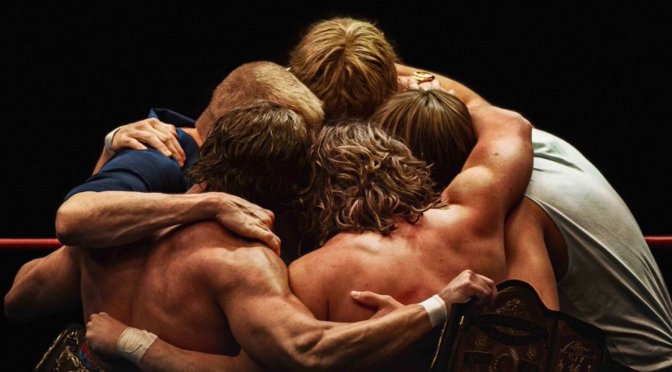
A prologue establishes Jack “Fritz” Von Erich (Holt McCallany) as an uncompromising professional wrestler in the 1960s with a signature move called the ‘Iron Claw.’ A number of years later Von Erich Snr. is a wrestling promoter who runs successful WCCW events in Texas. His unique selling point for the shows is that he has four sons, Kevin (Zac Efron), Kerry (Jeremy Allen White), David (Harris Dickinson) and Mike (Stanley Simons), who throughout the narrative, all test themselves to the limit in the wrestling ring.

While it is certainly a strong ensemble cast, the main focus of Durkin’s compelling screenplay is Zac Efron’s, Kevin. A strong, fast and muscular athlete in the ring, Kevin, however, is not a confident personality out of it. He, and his brothers, live in the shadow of his domineering father, who controls and dictates to those around him. Jack’s resentment at not winning the NWA Worlds Heavyweight Championship during his career, and dissatisfaction at the politics of the higher-ups in wrestling, has made him a bitter, angry man. Thus, the theme of toxic masculinity bleeds throughout the story as Jack keeps his sons, and wife (Maura Tierney), under control. Therefore The Iron Claw (2023) is not just a signature wrestling move, but also the means with which the Von Erich family are treated by Jack.

There are moments of glory in the ring for the brothers, notably Kevin, Kerry and David in The Iron Claw (2023). Indeed the wrestling action is often pulsating and Durkin does include several genre-pleasing action montages. But, tragedy is never far away from the Von Erich family. Kevin even tells his wife-to-be, Pam (Lily James) that he believes the family are cursed. She dismisses this, but given what occurs during the film and the heartbreak which befalls the brothers, you begin to think he may be right. As Kevin, Zac Efron gives an incredibly moving performance as the brother seeking love, success and family community. Lastly, I truly disliked Sean Durkin’s last film The Nest (2020), as it said very little about people I did not care about. The Iron Claw (2023), on the other hand, says so much about people I was emotionally rooting for, with Kevin Von Erich in particularly admirable as he showed ultimate fighting spirit by surviving such unforgiving loss.

Mark: 9 out of 11


CINEMA REVIEW: THE ZONE OF INTEREST (2023)

CINEMA REVIEW: THE ZONE OF INTEREST (2023)

Directed by Jonathan Glazer

Written by Jonathan Glazer – based on The Zone of Interest by Martin Amis

Produced by James Wilson, Ewa Puszczyńska

Main cast: Christian Friedel, Sandra Hüller, Imogen Kogge, etc.

Cinematography by Łukasz Żal

Sound Designer: Johnnie Burns

Music by Mica Levi


Jonathan Glazer is not the most prolific of directors, so when he releases a film it provides powerful cinematic coffee to wake up the cultural senses. His last film, the mesmeric Under The Skin (2013), is one of the most original of the century for me and once again with, The Zone of Interest (2023), Glazer has determined to take a provocative approach to cinematic form, style and themes.

I usually advise near the top of my reviews that the piece may contain spoilers. However, there is so little plot in The Zone of Interest (2023), that is difficult to give anything away. The depth of the story comes from the intellectual approach to cinematic form and the wartime setting, with a narrative based on Martin Amis’ novel about the Holocaust and specifically, the concentration camp, Auschwitz. But Glazer only hints at such Nazi barbarism as the point of view of the film is presented solely from the commandant Rudolf Hoss’ (Christian Friedel) and his family’s perspective. Glazer and his outstanding production team deny us sight of the death and torture from within the Hoss house and garden.


Glazer and his sound designer, Johnnie Burns, employ powerful aural style to incredible effect as screams, tools smashing, gun shots and shouting pierce the screen throughout. Mica Levi’s minimalist score also punches through to startle too. Further, as the Hoss family, notably his spoilt children and privileged wife (Sandra Huller) go about their everyday business puffs of smoke billow over their garden as they remain unimpacted by what is occurring outside. Glazer also uses negative film processing, gliding tracking shots and metronomic editing from multi-camera set-ups to stylistic devices to break the fourth wall and to reinforce the everyday routine where all is not what it seems.

One may argue Glazer’s film is experimental and anti-narrative. I rarely cared about the Hoss family and not enough of the Auschwitz inmates is seen to raise one’s emotions. Thus, The Zone of Interest (2023) is a cold and intellectual film to absorb. Yet, I would argue that it is not experimental because Glazer is so in control of the filmmaking process. His creative choices and results are delivered in an extremely confident way. Certainly I felt that the film was more anti-drama than anti-narrative or experimental. For those looking for a more conventional addition to the war film genre could be disappointed.

Ultimately, The Zone of Interest (2023) is a horror film with the barbarism hidden. As the murder and genocide are occurring, the Hoss family unit remain unmoved by such atrocities. From a safe distance the audience watch them attend parties, tend their vegetables, feed their children, eat their dinner, play games and sunbathe. Is Glazer asking if we as humanity are complicit in our privileged comfortable homes while horrors go on around us in the world? Is this Nazi version of the Garden of Eden a metaphor for the world as a whole now? Does a lack of action or inaction to known crimes make one complicit? There are no easy answers, but it gets you thinking. Just like this highly intellectual and expertly constructed work of cinema.

Mark: 9 out of 11


CINEMA REVIEW: ALL OF US STRANGERS (2023)

CINEMA REVIEW: ALL OF US STRANGERS (2023)

Directed by Andrew Haigh

Written by Andrew Haigh

Based on Strangers by Taichi Yamada

Produced by: Graham Broadbent, Peter Czernin and Sarah Harvey

Main cast: Andrew Scott, Paul Mescal, Jamie Bell, Claire Foy etc.

Cinematography by Jamie D. Ramsay


Andrew Haigh is a director who has slowly built an impressive body of work over the last decade or so. I haven’t seen his first two low-budget features but have watched films 45 Years (2015), Lean on Pete (2017) and the recent brutal TV drama, The North Water (2021). Together they show Haigh to be a director capable of delivering drama of devastating power. His latest independent film, All of Us Strangers (2023) is arguably his best film to date deserving of all the awards coming its way.

Andrew Scott portrays Adam, a lonely screenwriter, who lives in a London newbuild block of flats where he seems to be the only occupant. Struggling with writer’s block he spends his days and nights remembering his parents, Mum (Claire Foy) and Dad (Jamie Bell.) Seeking inspiration for his work he revisits his childhood home in Sanderstead, Croydon during a fascinating trip down memory lane. Surprised one night by drunken neighbour, Harry (Paul Mescal), knocking at his door, Adam rebuffs Harry at first. However, the two latterly begin a love affair, with this relationship intertwined with Adam’s visits to his former home.


I won’t say anymore as I believe this is a film which benefits from knowing as little as possible, but it is safe to say that All of Us Strangers (2023) is one of the most emotionally cathartic films I have seen for some time. Even my frozen heart began to melt as I experienced Adam’s journey into the past and his attempts to find love and peace. Andrew Scott, under Haigh’s expert direction, gives an astonishing performance. Like his co-star Mescal was in Aftersun (2022), Scott just has that innate ability to convey sheer meaning from a look or the slightest of gestures. Obviously, the script and characterization provide an appreciable weight of feeling in Adam’s story, one that Haigh exerts real control over. Further, Mescal himself is excellent too, once again cementing his status as one of the best actors around.

On a low budget with just a handful of brilliant actors, Andrew Haigh demonstrates that less is indeed more. But while the locations and cast are minimal the emotional landscapes are painted on an expansive cinematic canvas. Grief, love, death, relationships and family are universal themes that are explored with fresh method by Haigh, as he delivers a film of mature power. With impactful performances, direction, cinematography, city locations and soundtrack, All of Us Strangers (2023) is a brilliant love story about loss. But, paradoxically, I didn’t feel empty or downbeat by the end, I actually felt full and lifted. 

Mark: 9.5 out of 11


CINEMA REVIEW: THE HOLDOVERS (2023)

CINEMA REVIEW: THE HOLDOVERS (2023)

Directed by Alexander Payne

Written by David Hemingson

Produced by Mark Johnson, Bill Block & David Hemingson

Main cast: Paul Giamatti, Da’Vine Joy Randolph, Dominic Sessa, Carrie Preston, Gillian Vigman, Tate Donovan etc.

Cinematography: Eigil Bryld

*** MAY CONTAIN SPOILERS ***


The Holdovers (2023) is the latest film from director Alexander Payne. Over the last, coming up to nearly thirty years, Payne has made eight films, often collaborating with writing partner, Jim Taylor. While hardly prolific Payne clearly favours quality over quantity of film product. He tends to gravitate to literary adaptations that are driven by strong characterisations and universally identifiable themes. His films often focus on every-men and women, outsiders, eccentrics, losers and underdogs of society. Such characters may have a certain middle-class privilege, yet they are never alpha-heroes. Payne’s collection of teachers, writers, actuaries, lawyers and therapists are never too far away from career, personal, financial or mental breakdowns.

This directorial facet is prevalent in The Holdovers (2023) with Paul Giamatti cast as classics professor, Paul Hunham. He teaches at New England private school, Barton Academy, where he once attended with a scholarship. Giamatti is absolutely perfect as this arrogant and often brutally honest teacher. Linguistically and intellectually superior to those around him, he is pretty much despised by most of the pupils and especially his own boss, the ineffective Principal. Only Carrie Preston as Lydia Crane, another staff member, shows him any warmth. Having cost the school an important donor Hunham still will not compromise his ethics. Thus the Principal forces him to manage the “holdovers”, pupils who cannot, for significant reasons, get home for the Christmas.


The theme of being held over is more than just being trapped in a virtually empty school amidst the wintry landscape of 1970’s New England. The characters of curmudgeon Hunham, troubled student Angus Tully (Dominic Sessa), and grieving head cook, Mary Lamb (Da’Vine Joy Randolph), are also held over by their respective career, familial and emotional conflicts. This trio of memorable characters contain so much feeling within David Hemingson’s often hilarious and moving screenplay. Initially being confined gives way to a road movie of sorts as the narrative carefully builds discord, humour and ultimately a sense of community and understanding between the three.

The Holdovers (2023) is a nostalgia film of the highest quality. For me it’s as if Hal Ashby had directed The Breakfast Club (1985). Ashby’s 1970’s films were certainly an influence on the genre, story and rich cinematographic style present here. Moreover, the fantastic trailer and marketing clearly privilege the 1970’s styling, including the font used. However, Payne’s rendition is not as darkly themed as Ashby’s work, even though in Mary Lamb’s character there is a suggestion of social commentary in respect of her son’s death in the Vietnam war. While Payne takes less creative risks, that is unsurprising given the critical and box-office failure of his last film, the highly original but frankly disappointing, Downsizing (2017). Finally, with a terrific screenplay and Paul Giamatti and Da’Vine Joy Randolph on sterling form, The Holdovers (2023) is a sophisticated comedy-drama that stimulates the brain, strengthens the rib muscles and warms the heart.

Mark: 8.5 out of 11


CINEMA REVIEW: POOR THINGS (2023)

CINEMA REVIEW: POOR THINGS (2023)

Directed by Yorgos Lanthimos

Screenplay by Tony McNamara


Based on Poor Things: Episodes from the Early Life of Archibald McCandless M.D., Scottish Public Health Officer by Alasdair Gray

Produced by Ed Guiney, Andrew Lowe, Yorgos Lanthimos and Emma Stone

Main cast: Emma Stone, Mark Ruffalo, Willem Dafoe, Ramy Youssef, Christopher Abbott, Kathryn Hunter and Jerrod Carmichael.

Cinematography by Robbie Ryan


*** MAY CONTAIN SPOILERS ***


I have now seen all of Greek filmmaker Yorgos Lanthimos’ most recent directorial works, namely: Dogtooth (2009), Alps (2011), The Lobster (2015), The Killing of a Sacred Deer (2017), and The Favourite (2018). Collectively they defy conventional film styles and tropes to deliver absurd, surreal, funny, disturbing, thought-provoking, erotic and imaginative visions of human behaviour. Also, let’s not forget the writers too; so kudos to his writing partner Efthymis Filippou, and latterly Tony McNamara, who have combined with Lanthimos to create such memorable cinematic offerings.

The director’s early lower-budget dysfunctional comedy-dramas such as Dogtooth (2009), and Alps (2011) are unforgettably strange films to experience. They feature uncomfortable depictions of family, sex, death and relationships. While offbeat, you sense they are from the mind of a filmmaker seeking to provoke thought rather than exploit. While equally dark and strange The Lobster (2015) is clearly more comedic, even though it probes strange love, fascism and violence within romantic relationships. Further, in The Killing of a Sacred Deer (2017), Lanthimos and Filippou, in Godardian fashion, constantly called attention to cinema form; especially with a strangely effective form of anti-acting within the arguably more conventional revenge narrative. Whereas in The Favourite (2018), Lanthimos’ delivered a unique period satire, with the language and behaviour of the characters often crude and shocking. His visual choices are always fascinating, with his use of the fish-eye lens creating a distorted effect that made the characters seem trapped by their surroundings and circumstances.


With the success of The Favourite (2018), both critically and commercially, Lanthimos has of late been given an increased budget, reported as $35 million. His bold choice, along with screenwriter Tony McNamara is to adapt award-winning novel, Poor Things: Episodes from the Early Life of Archibald McCandless M.D., Scottish Public Health Officer by Alasdair Gray has produced by far the most originally conceived and fantastic genre-bending comedy, drama, horror, rites of passage and salacious film of many a year. If there is a more bizarre, enthralling and enjoyable film of 2024, than Poor Things (2023) then this will be a most excellent year for cinema releases.

Set in Victorian London, we are introduced to the rather eccentric household of Dr Godwin “God” Baxter, an expert but secretive surgeon whose home hides bizarre animal experiments, and the beautiful but frankly odd human specimen, Bella Baxter (Emma Stone). Entering this weird abode of pig-hens and goose-dogs, comes innocent medical student, Max McCandless (Remy Youseef). “God” asks Max to assist with the childlike Bella’s development, charting her daily physical, speech and mental growth. Now, if you think the chimeric beast experiments are disturbing then brace yourself for the events of Bella’s ‘Frankensteinesque’ happenstance. I am not going to spoil it here, but it truly is a fantastic concept as invented by the author, Alasdair Gray, to contemplate. I was teetering on the fence with the film until this stunning reveal was given, but then I was committed to this medical oddity.


The first act finds Bella developing her speech, emotions and intelligence, as if a young child growing within this woman’s body. Bella also locates her libido and begins experimenting with her lust to great pleasure. Here Lanthimos continues exploring the themes of previous films with sex not only a natural expression of humans, but also an act used to control and drive people mad. Enter Mark Ruffalo’s caddish lawyer, Duncan Wedderburn who spirits a willing and rebellious Bella on a European trip. One where she truly discovers and satisfies her continual carnal desire or “furious jumping” as she hilariously calls it. Bella’s rites of passage, frankness and rapid growth threatens Duncan’s masculine insecurities and he finds it difficult to control her. Here the hilarious screenplay shows Bella and Duncan becoming more and more fraught until she craves further independence from his cloying envy. The central theme of Bella overcoming the chains of controlling masculinity dominates right up until the extremely dark final act.

While there is a lot of sex and nudity in this film, I felt that Lanthimos balances the exploitative nature of such material by contextualising it within Bella’s fascinating character arc. Emma Stone also provides a complex performance, funny and moving, as the woman-child discovering her mind, body, soul and the world. Ruffalo is particularly over-the-top as the sneaky but pathetic reprobate, Wedderburn. While Remy Youssef’s young medical student adds some compassionate balance within the ensemble, Willem Dafoe gives his customary brilliant turn as the tragic man of science. He himself had his childhood tainted by a father determined to use Godwin Baxter as a human guinea pig.

With a spectacular production design that employs a rich palette of colours, sets, lighting and immaculately furnished rooms, Lanthimos, stamps his authorial style along with genius cinematographer Robbie and his array of lens. Such creative choices evolve a spectacularly hyper-real vision of Victoriana. Indeed, the form and style coalesce with the content and themes in Poor Things (2023) to create what could already be the favourite film of my year. The screenplay dares to provoke the audience with gender political, sociological, historical and hysterical analysis as Yorgos Lanthimos again proves himself to be one of the most original filmmakers of his generation. Owing much to the imagination of Alasdair Gray’s source book, this is a shocking and explicit Frankenstein’s monster of a film. Lastly, it had me consistently thinking and laughing throughout, testifying to the power of family, however dysfunctional that Victorian household may be.

Mark: 10 out of 11


NETFLIX WINTER FILM REVIEWS including: MAESTRO (2023), LEAVE THE WORLD BEHIND (2023), SOCIETY OF SNOW (2023) etc.

NETFLIX WINTER FILM REVIEWS

Good day! I have spent the last week or so concentrating my viewing around some recent Netflix releases. These films could be seen to be as Oscar-worthy products from the streaming behemoth. So, here are my reviews with the usual marks out of eleven.

*** MAY CONTAIN SPOILERS ***


BARDO, FALSE CHRONICLE OF A HANDFUL OF TRUTHS (2022)

Directed by Alejandro G. Iñárritu
Written by: Alejandro G. Iñárritu and Nicolás Giacobone

A slightly older new release on Netflix’s roster which I avoided watching due to the close-to-three-hour-running time. Plus my instinct it could be a pretentious and indulgent arthouse project by a brilliant director, Alejandro G. Iñárritu. Centring on Silverio Gama (Daniel Giménez Cacho), a Mexican journalist turned documentary filmmaker living in Los Angeles with his wife who reflects on his own life, job, politics, relationship and past. We are very much in the realms of Federico Fellini’s (1963) and Luis Bunuel with this surrealist and intellectual existential crisis film. Containing some incredibly imaginative visual sequences and thoughtful themes, the relentless stream-of-conscious ultimately bore me down and worst of all I just did not care about the main protagonist. Ultimately this proved to be a pretentious and indulgent arthouse project by a brilliant director.

Mark: 6 out of 11


LEAVE THE WORLD BEHIND (2023)

Directed by Sam Esmail
Screenplay by Sam Esmail – Based on the book by Rumaan Alam

Brilliant cast including Ethan Hawke, Julia Roberts and Mahershala Ali star in this anxiety-building-first-world-problem-apocalyptic-drama which finds middle class winners and their kids trying to overcome a series of strange events, such as no Wi-Fi and staring deer, while staying in a posh AirBnB holiday home. All empty suspense and chatter without much of a dramatic punchline overall. This only really comes alive cinematically with a neat Tesla pile-up set-piece and a slice of Kevin Bacon. Other than that, it is essentially a stage play on the big screen with pretty bland characters suspecting and accusing each other, for various reasons, with stunning cinematography. I enjoyed the production, but I didn’t care about anybody. Why the hell Kevin Bacon’s survivalist-scene-stealer was only given one major scene in the film is beyond me.

Mark: 6.5 out 11


MAESTRO (2023)

Directed by Bradley Cooper
Written by Bradley Cooper and Josh Singer

Clearly a labour of love to bring the life, relationships and music of Leonard Bernstein to the big screen by Bradley Cooper, Maestro (2023) contains some stunning filmmaking set-pieces, imaginative scene transitions and obviously a wonderful musical score. Cooper and Carey Mulligan are cast as Felicia Montealegre and Leonard Bernstein respectively, and both give compelling performances. Mulligan’s more so emotionally when compared to Cooper’s expert mimicry. The film’s structure is mainly bullet-pointed around their blossoming and then strifeful relationship during the later years. Bernstein’s music successes punctuate the ups and downs of this first world couple who I found difficult to warm to. Several grandstanding scenes with Mulligan galvanising feeling from her sheer acting craft do not save the film from lacking dramatic momentum. It is so well crafted that it is difficult not to admire everyone involved in the making of Maestro (2023). I just wanted more about the Bernstein’s way of working rather than who he had been sleeping with.

Mark: 7.5 out 11


SOCIETY OF THE SNOW (2023)

Directed by J. A. Bayona
Screenplay by J. A. Bayona, Bernat Vilaplana, Jaime Marques & Nicolás Casariego
Based on La sociedad de la nieve by Pablo Vierci

This expertly produced survival thriller centres on the tragic events of 1972, when a Uruguayan rugby team’s plane crashed in the Andes. Claiming the lives of twenty-nine friends and family with the survivors somehow managing to cling on to dear life for seventy-two days in freezing and deadly conditions. J.A. Bayona directs the action superbly in what must have been testing conditions for cast and crew. Further, the screenplay contains a certain poetry within the soothing delivery of the Spanish language voiceover. Obviously though there is nothing soothing about what happened to the human beings involved in the plane crash and the horrific choices they had to make to survive. It’s a true testament to the strength of the human spirit and will to live despite the freezing conditions and lack of food. Not the film’s fault but while dramatically compelling, it lacks narrative surprise for anyone who has seen Alive (1993). If you haven’t then Society of the Snow (2023) will have you psychologically gripped, eating away at your very emotional core.

Mark: 8 out of 11


CINEMA REVIEW: ANATOMY OF A FALL (2023)

CINEMA REVIEW: ANATOMY OF A FALL (2023)

Directed by Justine Triet

Written by Justine Triet and Arthur Harari

Produced by Marie-Ange Luciani and David Thion

Main cast: Sandra Hüller, Swann Arlaud, Milo Machado Graner, Antoine Reinartz, Samuel Theis, Jehnny Beth, Saadia Bentaieb, Camille Rutherford, Anne Rotger, Messi (the Dog), etc.

Cinematography by Simon Beaufils


Acclaimed director Justine Triet defies the old advice of not to work with children and animals to deliver a compelling courtroom, domestic and psychological suspense drama in Anatomy of the Fall (2023). Indeed, the performances of teenage actor, Milo Machado Graner and Messi the dog are of terrific quality. The dog’s acting is only surpassed by a formidable tour-de-force portrayal by Sandra Hüller. She excels as a wife accused of murdering her husband in the French Alps town of Grenoble. Did she? Well, there are no easy answers as the script dissects the crime and the couple’s marriage with forensic intensity.

Triet and her screenwriting partner, Arthur Harari, do not waste any time setting up the mystery element of the drama. The film opens as we follow visually impaired, Daniel Maleski (11 years old) taking his dog for a walk in the snow. At the same time his mother, an author, Sandra, is being interviewed by a research student in the chalet. But we never see the husband, Samuel, who plays thumping music from upstairs. When Daniel returns, the student has left and his father is found dead on the hard white, but blooded, ground. Sandra is upstairs unaware of her husband’s demise. Or is she? Herein begins the did-she-or-didn’t she kill him question? It’s a brilliant opening sequence where Triet and her production team demonstrate impressive filmmaking skill, an adroitness which continues throughout.

Anatomy of the Fall (2023) is an extremely complex film, both intelligent and thematically powerful. The courtroom exchanges between Sandra, her son Daniel, Samuel’s psychotherapist, the prosecution and defense lawyers are brilliantly written and acted. The flashback arguments between Samuel and Sandra are gut-wrenching and all too familiar to anyone who has been in or witnessed the crumbling of a marital or parental relationship. As well as the central mystery, Triet and Harari also skilfully weave in thematic subplots relating to literary plagiarism and mental health. While slightly overlong with mild pacing issues toward the end, Anatomy of the Fall (2023) is overall an absorbing thriller about what happens when the love between two people runs its tragic course and the shock and grief that can follow.

Mark: 8.5 out of 11


SKY CINEMA REVIEW: MAY DECEMBER (2023)

SKY CINEMA REVIEW: MAY DECEMBER (2023)

Directed by Todd Haynes

Screenplay by Samy Burch (Story by Samy Burch and Alex Mechanik)

Produced by Natalie Portman, Sophie Mas, Christine Vachon, Pamela Koffler, Grant S. Johnson, Tyler W. Konney, Jessica Elbaum and Will Ferrell.

Main Cast: Natalie Portman, Julianne Moore, Charles Melton, Cory Michael Smith, Elizabeth Yu, etc.

Cinematography by Christopher Blauvelt

*** MAY CONTAIN SPOILERS ***


The story of May December (2023) is set in 2015 against the sunny backdrop of Savannah, Georgia. Loosely inspired by the real-life Mary Kay Letourneau scandal, Natalie Portman is Elizabeth Berry, an actress who desires to study the lives of Julianne Moore’s Gracie Atherton-Yoo and her partner Joe Yoo (Charles Melton). Elizabeth is set to play Gracie in an indie film, with latter being infamous for her twenty-three-year-long relationship with Joe, which started when he was thirteen. With a hook like that I was intrigued as to where the story would go with such a controversial subject matter dealing with a convicted sex offender and illicit romance. Here lies a major thematic thumbprint of the filmmakers.

What unfolds is a superbly acted and understated drama which really gets under the skin and into the mind. While watching the ever-shifting points-of-view and identification with the characters May December (2023) became so compelling to me. Gracie is a convicted sex-offender, but she married Joe for love and they had children together after she left jail. But should she have acted on her desires and rejected Joe as a thirteen year old? The simple answer is yes, but it is more complex than that as presented here. Because the couple felt so much emotion for each other that Gracie was prepared to go to jail. This is what attracts Berry and she homes in on Gracie and Joe like the proverbial moth to a flickering bulb.


Structured around Berry’s methodical probing into the past events and Gracie and Joe, she quizzes them, their children, family, friends, work colleagues and legal team. As Berry researches further it becomes apparent she is getting obsessive and almost predatory herself. There are several very awkward scenes involving Berry, notably when she visits the pet store where Gracie and Joe used to work together. As Berry revisits the past she begins to loosen the stitches of old wounds, as both Gracie, and Joe especially, reflect and question the moral validity of their relationship.

I am sure when Natalie Portman and Julianne Moore read the script for May December (2023) they must have been doing back flips with creative excitement. Because it is clearly is a layered screenplay of the highest intelligence, ambiguity, dark humour and intensity by Samy Burch. Along with Melton they deliver on the script with three tremendous performances too. Moreover, acclaimed director Todd Haynes directs this tonally awkward story with a deft touch drawing on the constant grey areas of drama so expertly. May December (2023) may not be for everyone because the film is a slow burn without much in the way of dramatic closure. Conversely, so much of the drama occurs in the acting and script’s subtext, yet it remains a fine example of ambiguous cinema. Finally, the re-orchestration and use of Michel Legrand’s music for The Go-Between (1971) is a masterstroke.

Mark: 9 out 11


CINEMA REVIEW: SALTBURN (2023)

CINEMA REVIEW: SALTBURN (2023)

Directed by Emerald Fennell

Written by Emerald Fennell

Produced by Emerald Fennell, Josey McNamara and Margot Robbie

Cast: Barry Keoghan, Jacob Elordi, Rosamund Pike, Richard E. Grant, Alison Oliver, Archie Madekwe, Carey Mulligan, Paul Rhys, etc.

Cinematography by Linus Sandgren

*** MAY CONTAIN SPOILERS ***


As the awards garnered upon Emerald Fennell’s brilliant Promising Young Woman (2020) will testify, she is clearly a major talent. Fennell has also acted in TV shows such as Call the Midwife and The Crown, as well as writing and producing the second series of Killing Eve. Not only is Fennell an excellent actress, writer, director and producer, but is also now an Oscar and BAFTA winner. Thus, Fennell’s “difficult second film” arrives in the guise of the pitch black comedy, Saltburn (2023). Although to describe this hilarious, bleak, sexy, and often twisted exploration of the British class system as such evidently tests the very definition of comedy.

Saltburn (2023) is set in 2006. Oliver Quick (Barry Keoghan) attends Oxford University as a naive fresher with an inferiority complex and desire for company. While he is incredibly intelligent, coming from a lower class background places bookish Oliver as a very small fish in big water. Especially when compared to the so-called Oxford elite including handsome and wealthy, Felix Catton (Jacob Elordi) and his cousin, the handsome and not-as-wealthy, Farleigh Start (Archie Madekwe). While Farleigh is suspicious of Oliver, Jacob soon befriends him and takes the Northerner under his wing. The two connect and form an “odd couple” bromance, with Felix even going so far as to invite Oliver to his stately home, Saltburn, for the summer. There we meet the rest of Felix’s family including his flaky sister, Venetia (Alison Oliver), eccentric father, Sir James (Richard E. Grant) and effervescent mother, Lady Elspeth (Rosamund Pike).


After building Oliver and Felix’s characters carefully during their time at Oxford, Fennell’s savage and satirical screenplay gathers pace in the second act at Saltburn. Here Oliver tries to fit in and ingratiate himself into the Catton family, but it soon becomes clear that however friendly they may be, he will only ever be an outsider to them. Simultaneously, Farleigh sees Oliver as a rival for the Cattons’ emotional and financial affections and the two begin a retaliatory personal war amidst the balmy summer days, breakfasts, dinner parties and social gatherings. Oliver’s main journey is to connect as much with Felix as possible, so much so his passion veers toward obsession. But Felix is a roaming spirit and a hedonist and does not quite requite Oliver’s feelings. Yet, Felix does show compassion for Oliver, as illustrated when he drives him on a mercy mission to visit Oliver’s family. This is where the story takes an intriguing and ever deadly turn.

I cannot recommend Saltburn (2023) enough for its fantastically witty script, devastatingly brilliant cast and some quite disgustingly explicit, but contextually justifiable, character moments and scenes. Fennell takes the setting and structure of Evelyn Waugh’s Brideshead Revisited and turns it upside down, spinning a devious tale of infatuation, love, privilege and social climbing. Through the character Oliver Quick, and I really don’t want to give anything away, there is a powerful and jaw-dropping character arc of upward mobility. Rosamund Pike’s and Keoghan’s performances are both amazing and award-worthy. While the final act twists certainly do shock and surprise they arguably are rushed when compared with the more effective pacing of the opening and middle acts. Moreover, I am also unsure why the exquisite cinematography and stunning locations were presented in the 4:3 (1:33:1) aspect ratio. Why squeeze in Linus Sandgren’s light and framing and not expand them to the widescreen format?

Ultimately, Emerald Fennell proves herself an important voice in British cinema. Unafraid to test the boundaries of taste, genre, and audience expectations, she has crafted one of the most consistently challenging films of the year with Saltburn (2023). One could easily describe the themes presented here as a critique of the upper classes and how the uber-rich are bad people to be brought down to their knees. However, Fennell’s script is not that simplistic. It cleverly careers between love/hate for the characters and irony-bombing the class system, before becoming a damning indictment on the darkest flaws of humanity. Lest one forget the indelible one-liners throughout and THAT final dance sequence, which are both to die for!

Mark: 9.5 out of 11


CINEMA REVIEW: NAPOLEON (2023)

CINEMA REVIEW: NAPOLEON (2023)

Directed by Ridley Scott

Written by David Scarpa

Produced by: Ridley Scott, Kevin J. Walsh, Mark Huffam, and Joaquin Phoenix.

Main Cast: Joaquin Phoenix, Vanessa Kirby, Tahar Rahim, Rupert Everett, Ben Miles, Ludivine Sagnier, and more.

Cinematography by Dariusz Wolski


If you didn’t know, Napoleon I, was also called Napoleon Bonaparte. He was a French military general and statesman and played a key role in the French Revolution (1789–99), before serving as first consul of France (1799–1804). Napoleon was also the first emperor of France (1804–14/15) and given his many years of military campaigns in France and overseas, striving to build an empire for France, he is now widely considered one of the greatest generals in history. I don’t purport to be a history buff, but I was intrigued by the release of Ridley Scott’s latest directorial epic cinematic behemoth, Napoleon (2023). This almost-three-hour release comes to the screen courtesy of Sony and Apple TV with Joaquin Phoenix in the titular role.

Opening in 1793, a young, but up-and-coming army officer Napoleon witnesses Marie Antoinette get her head cut off at the guillotine, followed quickly by one of the many thrilling battle sequences in the film at the ‘Siege of Toulon.’ It was during this siege that young Napoleon first won fame when his strategy, forced the Anglo-Spanish fleet to withdraw. After which David Scarpa’s adaptation and Scott’s editing team rattle through the battles, romances, trials and decades of Napoleon’s life so breathlessly, as an audience member, I felt like this film was more of a “Now That’s What I Call Napoleon!” greatest hits package rather than a compellingly intense drama and study that really delves into the complex psychology of Napoleon’s character.


Ridley Scott, at 85 years old, brings his masterly cinematic experience to many explosive battle sequences in Egypt, Austria, France and throughout Europe. The stunning cinematography by Dariusz Wolski supports Scott’s vision and it is safe to say the production design and costumes are par excellence for this massively budgeted production. However expertly shot, edited and rendered on screen the battles are, they often feel rushed through at times, providing jarring punctuation to the central human focus of the film, the love story between Napoleon and Josephine (Vanessa Kirby). I feel like I would have preferred a deeper analysis of Napoleon’s military strategics and perhaps a more serious approach to his importance to France through his victories on the battlefield.

Vanessa Kirby, as Josephine, brought a class, elegance and intelligence to the role and gives a standout performance. Joaquin Phoenix, who is one of the finest actors around, however, gives us a misfiring characterization as Bonaparte. I just felt it was too knowing and flippant throughout. I am not averse to humour in serious dramas, but I just did not warm at all to his portrayal. Scott’s director of Phoenix plus Scarpa’s screenplay only touch the surface of Napoleon’s character. I mean here is a historical figure who has an incredible series of chapters in his life, but there is no major journey or arc in his story. At times I even felt there was ridicule for Napoleon, but if you wish to critique him, then why not make him more dangerous, a monster even. Especially given his predilection and desire for war and sending thousands of lives to their tragic end.

Like I say, Scott and his amazing creative team deliver a greatest “hits” of Napoleon’s life and some spectacular cinematic moments. But quite often I was bored and questioning why I should care about any of the characters on screen. Scott and his screenwriter have been stung by criticisms of historical inaccuracies. That doesn’t bother Scott at all and would not bother me if such changes enhanced the drama. Yet, the compression of certain scenarios seem to be more for pacing reasons. Lastly, there is apparently a four-hour directorial cut of the film so perhaps that contains more depth, emotion and psychological analysis of Napoleon, rather than the paper-thin filmic treatise delivered here.

Mark: 7 out of 11