Tag Archives: drama

Hirokazu Kore-eda Film Reviews: AFTER LIFE (1998) and BROKER (2022)

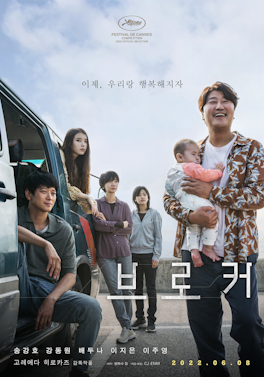
BROKER (2022)

Directed and written by Hirokazu Kore-eda

Produced by Eugene Lee

Cast: Song Kang-ho, Gang Dong-won, Bae Doona, Lee Ji-eun
and Lee Joo-young.

Cinematography: Hong Kyung-pyo


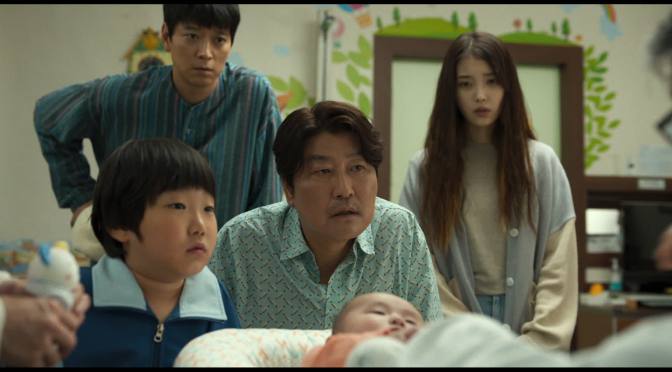
Arguably Japanese director’s Hirokazu Kore-eda’s most accessible film to date is the slice-of-life comedy-drama, BROKER (2022). Elements of Little Miss Sunshine (2006) meets Parasite (2019) meets Juno (2007) as kind-of-likeable and empathetic criminals create a dysfunctional family unit around stealing orphans and finding them families to makes ends meet. Lighter than many of his other brilliant human dramas, there is much to savour here from one of the best filmmakers working today.

There’s a lot going on in Broker (2022) as the duo of Sang-hyeon (Song Kang-ho) and Dong-soo (Gang Dong-won) work a grift of taking the unwanted babies, a police thriller involving murder, an impromptu road movie in a camper van, a cute kid looking for a surrogate father and a mother, Moon So-young (Lee Ji-eun) battling the dilemma of whether to sell or keep her child. A lesser filmmaker could have struggled balancing the many story, character and tonal shifts but Kore-eda manages it with aplomb.

Broker (2022) arguably has too many intertwining subplots though, as it strives to redeem all of the complex characters, but the wonderfully believable performances and brilliant screenplay really grabs you and rarely lets you go. Kore-eda’s direction is, as usual, masterly and assured as he balances the various tones confidently. Overall, this film makes you laugh, cry and is really moving as it highlights that family units can be lovingly born of collective experience, as well as blood.

Mark: 9 out of 11


AFTER LIFE (1998)

Directed and written by Hirokazu Kore-eda

Produced by Masayuki Akieda, Shiho Sato

Cast: Arata Iura, Erika Oda, Susumu Terajima, Sayaka Yoshino, Takashi Naito, Kei Tani, etc.

Cinematography Yutaka Yamazaki


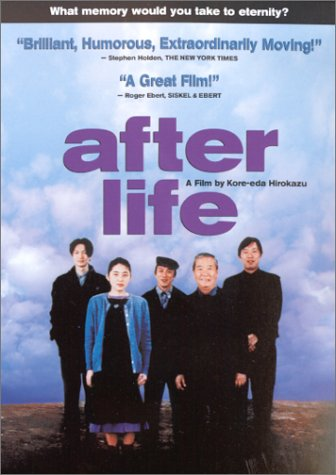
What a delightful, surreal and beautiful film. AFTER LIFE (1998), is easily one of the most imaginative and human films I have watched in a long time. It is set in an administrative centre somewhere between the realms of life and death. Here the staff of the office, kind of social workers, welcome recently deceased people and ask them to recall their life and choose a single memory. After which the filmmaking staff will recreate the memory, shoot this scene and the souls will be able to re-experience this moment forever in heaven.

To me this is a mind-blowing concept for a feature film and I am surprised that it has not been remade (and probably ruined) by Hollywood for either cinema or TV. What makes it so great is, that despite the high concept idea, the design and delivery is so down-to-earth. The offices where events confirmed are not presented with any of the usual angelic or heavenly cliches. Instead, Hirokazu Kore-eda, of which this is only his second feature film, and his production team, decide that the after-life is an unglamorous place run by kindly bureaucrats.

One of the many strengths of After Life (1998) lies with the human representations, both the people who have passed and the office angels who counsel them. The love, humour and emotion derived from the various interviews given by many of the characters are full of joy, sadness and longing. Along with the soulful characters coming to terms with their recent passing, the narrative also focuses on two “young” counsellors, Takashi (Arata Iura) and Shiori (Erika Oda), who must overcome their personal conflicts while helping others. Overall, After Life (1998) builds slowly and beautifully weaves so many fantastic human stories. When the filmed memories are revealed my heart melted, as Kore-eda delivers cinematic moments that will stay with one eternally.

Mark: 10 out of 11


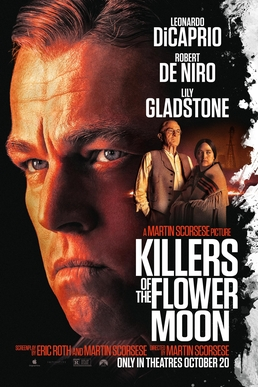
CINEMA REVIEW: KILLERS OF THE FLOWER MOON (2023)

CINEMA REVIEW: KILLERS OF THE FLOWER MOON (2023)

Directed by: Martin Scorsese

Screenplay by: Eric Roth and Martin Scorsese

Based on: Killers of the Flower Moon by David Grann

Produced by: Dan Friedkin, Bradley Thomas, Martin Scorsese and Daniel Lupi

Main cast: Leonardo DiCaprio, Robert De Niro, Lily Gladstone, Jesse Plemons, John Lithgow, Tantoo Cardinal, Scott Shephard, etc.

Cinematography: Rodrigo Prieto

Edited by: Thelma Schoonmaker

*** MAY CONTAIN SPOILERS ***


Who can tell how the world and society as we know it would’ve evolved if Christopher Columbus, the explorer credited with finding the Americas in 1492, had not landed and begun the first steps toward colonising this uncharted part of Earth. Of course, there were existing natives in the Americas and over time they would experience first contact with Spanish, Portuguese, British and other European, predominantly white, settlers. It may be that the natives would have had equally difficult experiences, and colonists brought with them many positive things. But one has to surmise they would not have had their land and lives gradually taken from them over the centuries without the European invasion.

The violent theft of land and wealth from Native Americans forms the bedrock of the narrative of Martin Scorsese’s latest epic drama, Killers of the Flower Moon (2023). Adapted from David Grann’s critically acclaimed nonfiction book, the film centres on the series of murders of wealthy Osage people that occurred in Oklahoma in the early 1920s. The motive for the heinous culling was the greed of white men. Such individuals lusted after the richness present after big oil deposits were discovered beneath the Osage people’s land. Whereas Grann’s book is a monumental study of the murders, perpetrators, the Osage culture, politics of the era, and how the newly formed FBI delved into the crimes, Scorsese’s incredibly slow and long adaptation does all that, while also exploring the romance and murderous treachery between Osage native, Mollie (Lily Gladstone) and war veteran, Ernest Burkhart (Leonardo DiCaprio).


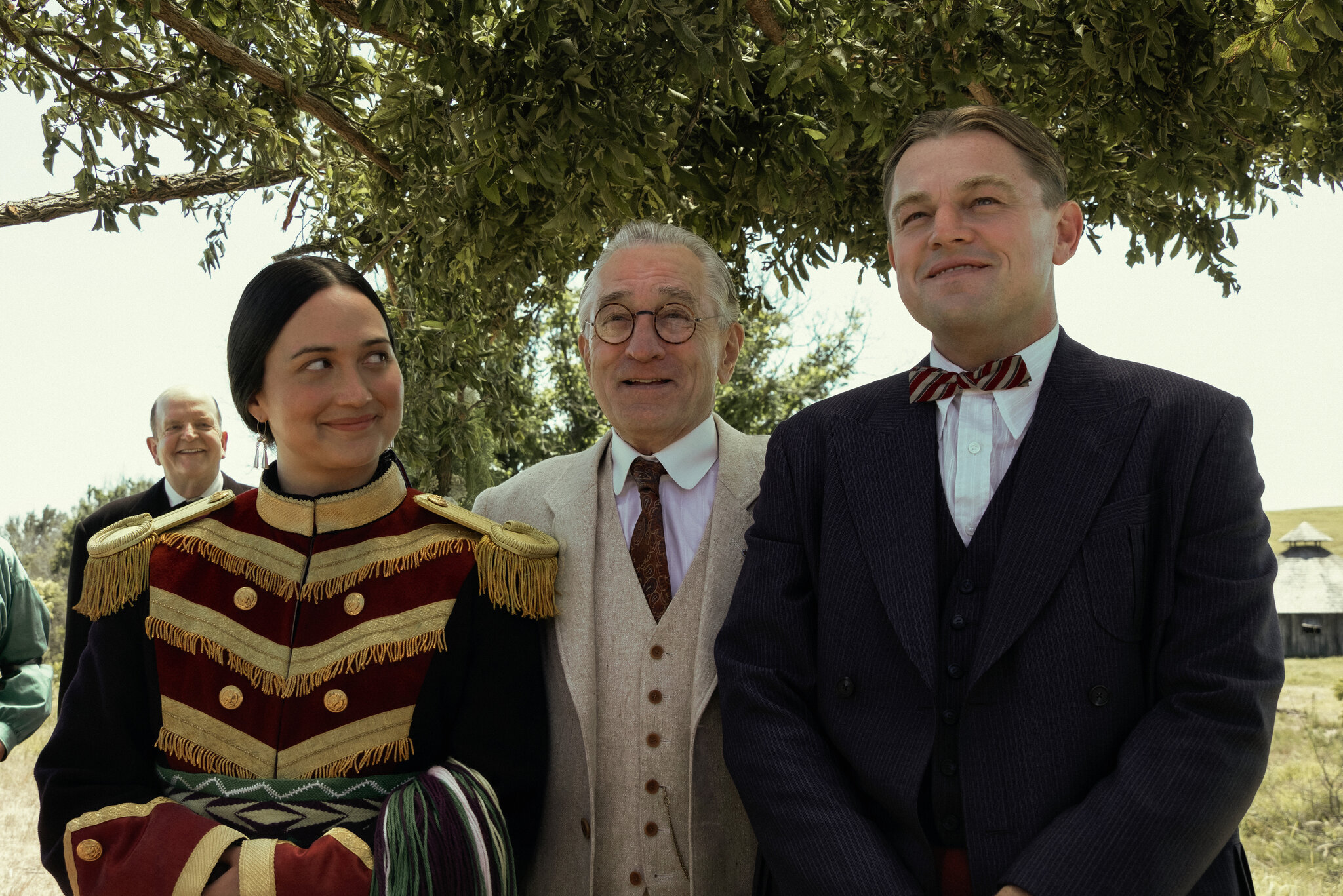
Opening by establishing how the oil erupted and blackened the green land, the film then firmly sets up how the American businessmen used the legality of the headright system to manipulate the flow of sudden wealth that came to the Osage people. One such man is William King Hale (Robert DeNiro) who presents himself as a benefactor to the Osage, but truly speaks with a forked tongue. Having left the infantry unit after World War One, Hale’s nephew Ernest joins him to work and ultimately do his bidding. Hale cajoles Ernest to romance wealthy Mollie and get further feet under the table and closer to that beloved black gold money. Yet, enough is never enough for the likes of Hale and driven by another formidable Scorsese directed performance, De Niro delivers a deviously evil characterisation.

DiCaprio here takes the less charismatic role as the doltish Ernest. As Hale urges him to do further misdeeds the banality of everyday evil is palpable in Ernest’s actions. Along with a litany of professional and thuggish cowboy types Ernest and Hale’s other minions wreak havoc on the Osage people, committing arson, murder, poisonings, robbery, and shootings. All just for more money. The tragedy is that Ernest clearly has feelings for Mollie, serenely portrayed by a revelatory Lily Gladstone, but he just cannot stand up for himself against his wicked uncle. So much so that I just wondered why the hefty runtime was concentrating on Ernest’s character. I mean, Scorsese and DiCaprio give us little in the way of anti-heroism to bounce off, or even some cathartic sense of redemption. Ernest starts out as a loser and finished the story the same. Over three hours spent with a gurning idiot left me frustrated.

Directed, as one would expect with a masterful hand, mind and eye by Scorsese, who once again surrounds himself with an incredibly talented cast and production crew. Not to forget the unbelievable $200 million budget. But Scorsese’s movement of late to ultra-long and methodical cinema is an artistic choice that requires much patience. While Killers of the Flower Moon (2023 is thematically very powerful, beautifully filmed, and contains a number of exceptionally impressive sequences, there was genuinely not enough story to justify such a long running time. Whereas The Irishman (2019) was slow, it was methodically thrilling and absorbing throughout. Killers of the Flower Moon (2023) on the other hand becomes repetitive in its reveals of greedy Cowboys breaking bad and raising hell to the cost of the Osage. The introduction of the FBI and their subsequent investigation comes way too late to save the over-bloated length and pace. However, there is no doubt, the film remains vital in highlighting the historial horror perpetrated upon the Osage land and people. Perhaps Apple TV should have just given the money to the Osage descendants as reparation?

Mark: 8 out of 11


CINEMA REVIEW: THE CREATOR (2023)

CINEMA REVIEW: THE CREATOR (2023)

Directed by: Gareth Edwards

Screenplay by: Gareth Edwards and Chris Weitz

Story by Gareth Edwards

Produced by: Gareth Edwards, Kiri Hart, Jim Spencer, Arnon Milchan

Main Cast: John David Washington, Madeleine Yuna Voyles, Gemma Chan, Ken Watanabe, Sturgill Simpson, Allison Janney, Ralph Ineson and Marc Menchaca.

Cinematography: Greig Fraser and Oren Soffer

*** MAY CONTAIN SPOILERS ***


The Creator (2023) is Gareth Edwards first directorial release since the tremendous Star Wars prequel Rogue One (2016). Of all the Disney-funded Star Wars products that remains my favourite. Overall, Rogue One (2016) is not just a great Star Wars film but a brilliant movie too, as it transcended the franchise while delivering a pulsating, heroic, nostalgic and emotional film experience. It also had an influence on the stunning visual look, action, and effects of The Creator (2023) too. So much so, The Creator (2023), in terms of style, often felt like a Star Wars film in all but name.

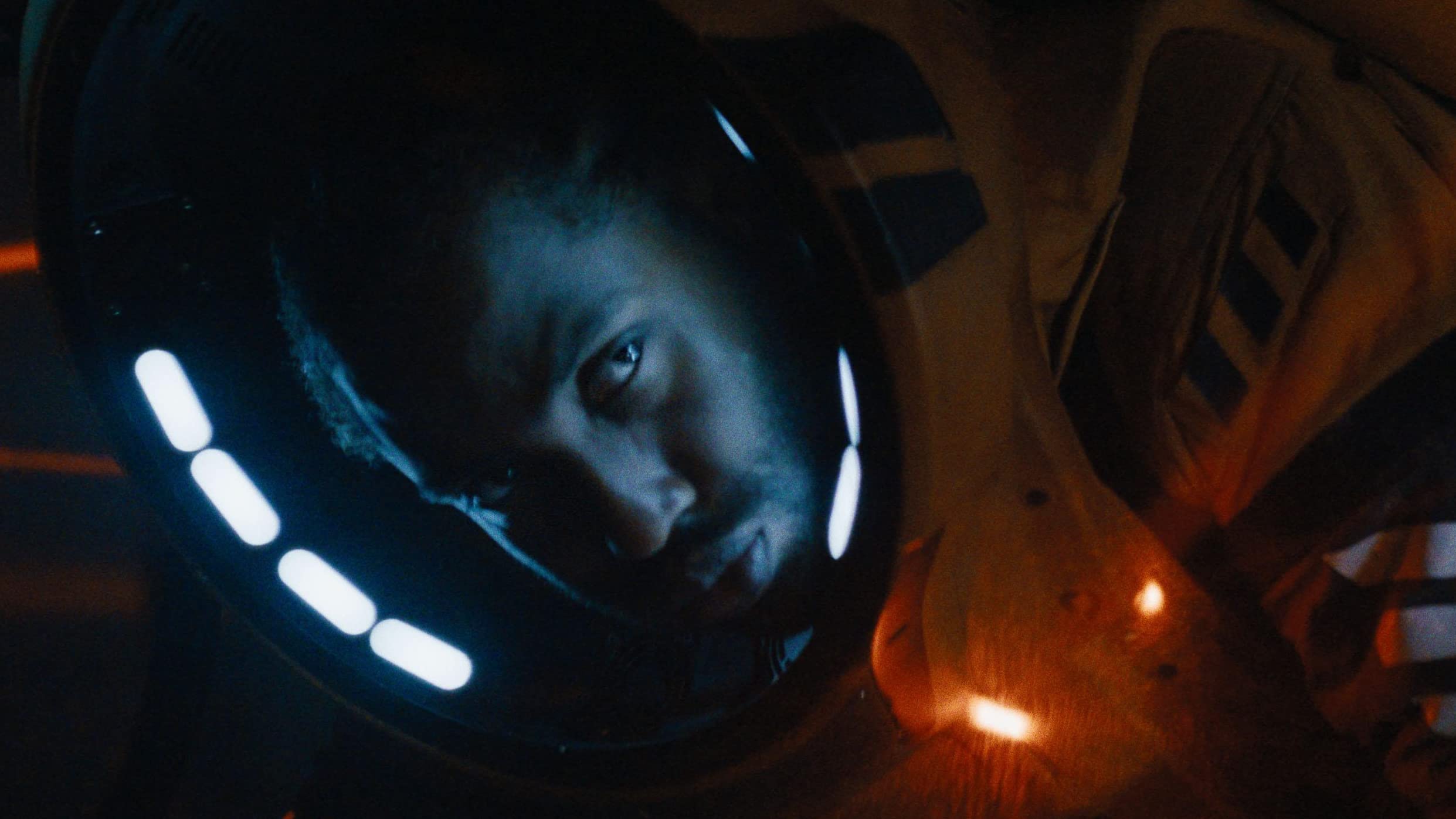
With The Creator (2023), Gareth Edwards and his talented production and effects team have invented a continually innovative futuristic look based around Artificially Intelligent robots and technologically modified humans. Indeed, based on all his directorial works, jaw-dropping visuals and themes of humans overcoming machines and monsters are always very much to the fore. But in The Creator (2023) one of the major themes poses the question – who are the real monsters? The humans or their computerised creations? As the narrative begins, in 2055, with the machines detonating a nuclear attack on Los Angeles the Americans declare war on the robots. More specifically, Southeast Asia, who still utilise A: I technology. Fast forward several years and John David Washington’s Joshua, remains part of the U.S. military plans, as they attempt to finish off the A: I threat for once and for all.

As Joshua is manipulated by the US Government, through a past romantic connection with Gemma Chan’s Maya, he is dropped behind “enemy” lines in Asia to destroy the A: I’s secret weapon called, “Alpha-O.” Along, with a paper-thin characterised group of U.S soldiers, Joshua finds the mission going south and ultimately goes on the run with “Alpha-O.” Edwards and his writers humanize the dangerous processor by giving it the body of a young girl portrayed by Madeleine Yuna Voyles. Despite the powerful visuals of the film, I found The Creator (2023) buckling under the wright of over-used ideas from other films. The cute “genius” kid being just one of those.

It’s The Terminator (1984) meets Artificial: Intelligence (2001) meets Avatar (2009) meets any number of action-hero-saves-young-child narratives. I mean can at least one film TRY and make the American warmongers more nuanced? Yes, the action, cinematography and sound design are especially impressive and thrilling and there is certain emotion on screen. However, I personally did not feel much emotion in my heart, unfortunately. Watch it on the biggest screen you can, because what The Creator (2023) lacks in original narrative and character elements, it more than makes up in nifty robotic concepts and visual cinematic grandeur.

Mark: 7 out of 11


MY CINEMATIC ROMANCE #25: BURT LANCASTER

MY CINEMATIC ROMANCE #25: BURT LANCASTER

Without planning it I watched a number of Burt Lancaster films over the last few months. It gave me a chance to reflect and re-evaluate this giant of the screen. I say “giant” because not only was Burt Stephen Lancaster physically a big guy, he also had a giant of an acting career. One which spanned fifty years in the business.

From his memorable first screen appearance in noir-classic The Killers (1946) to final performance in Field of Dreams (1989) he appeared in seventy films, as well as many television roles. Lancaster was a formidable actor, film star, producer and political activist. His fierce personality, intelligence and passion often explodes on the screen in so many classic films. But he was also capable of quiet and subtle power too. In keeping with the rules of the ‘My Cinematic Romance’ remit, here are just five of those said memorable acting performances.

** CONTAINS FILM SPOILERS **


SWEET SMELL OF SUCCESS (1957)

While this is not based around actual gangsters or career criminals you won’t find a bleaker or more cynical film noir. Morals are in short supply as Tony Curtis’ pushy press agent attempts to work his way up the greasy media pole in New York. His and many a character’s nemesis is Lancaster’s media kingpin, J.J. Hunsecker, who can make or break a career with the click of a finger. Hunsecker’s unhealthy obsession with his sister drives the downfall of all the characters where no one gets what they want. Lancaster is never afraid to play a flawed and complex personality. Razor-sharp dialogue and James Wong Howe’s stark photography, allied with Lancaster’s dominant presence, the Sweet Smell of Success (1957) is a striking morality tale warning of the perils of greed, fame and ambition.


ELMER GANTRY (1960)

Wow! I’d never seen this incendiary film adaptation of the Sinclair Lewis’s 1927 novel. Starring Lancaster, Jean Simmons, Arthur Kennedy, Shirley Jones and Patti Page, Lancaster is electric as the eponymous anti-hero. Gantry is a travelling salesmen-turned evangelist, who is down-on-his knees when he sees a golden opportunity to sell God instead of vacuum cleaners. Jean Simmons has never been better, but Lancaster delivers a devilishly complex characterisation of a man seeking wealth, sex, and adulation but without true belief. His firebrand sermons are powerful but without substance, and Gantry soon realises he cannot escape the emptiness of his soul. He preaches God without soul in a scathing damnation of organised religion set during the depression. Lancaster unsurprisingly won an Academy award for best actor in a risky role and intelligent film that rarely gets made these days.


BIRDMAN OF ALCATRAZ (1962)

I recall watching Birdman of Alcatraz (1962) when a teenager with my dad and being entranced by Burt Lancaster’s thoughtful, yet powerful performance of dangerous prisoner, turned ornithologist, Robert Stroud. Off-screen Lancaster rallied against the death penalty and argued for rehabilitation over eye-for-an-eye punishment. Thus, this story of a complex, rebellious personality who attempted personal absolution via education certainly would have had creative and thematic merit in Lancaster’s mind. From research the actual Robert Stroud was reported to be a brutal psychopath and beyond redemption. Yet, it’s a noteworthy film and stirring performance from Lancaster about a human paradox. Indeed, when did Hollywood ever let the truth get in the way of a great story. What is the truth anyway?


THE SWIMMER (1968)

Well, this was something of a surprise. I had never watched this adaptation of John Cheever’s short story, The Swimmer (1968) until I recorded it on Talking Pictures TV last month. At fifty-five, Lancaster is in incredible shape as middle-class American alpha-male, and seemingly popular, Ned Merrill. He decides one day he can “swim” across a series of Connecticut pools and back home to his wife and children. It’s certainly an original premise and peculiar take on the road movie subgenre. Merrill’s journey is peppered with both friendly and unenthusiastic meetings with his neighbours, friends and former lovers. Although it soon becomes apparent that something, despite his carefree confidence, isn’t quite right with Merrill. A progenitor to John Hamm’s Don Draper, Merrill is such a nuanced iceberg of a soul; charismatic yet with dubious ‘of-the-era’ morals. I think this could be Lancaster’s finest performance in a truly memorable masculinity-in-crisis cult character study. It’s an odd film, but worth staying with until the incredible ending.


ATLANTIC CITY (1980)

As he aged, Lancaster’s continued working with abandon. He wasn’t averse to taking a paycheck in B-movies such as The Cassandra Crossing (1977) and The Island of Dr Moreau (1979), but he also struck critical gold in Louis Malle’s romantic crime drama, Atlantic City (1980). Both Lancaster and Susan Sarandon are impressive. They have an intense chemistry in this ‘May to December’ love story, as two characters thrown together amidst the malfeasant underbelly of the gambler and gangster strewn ocean city. It’s a morally ambiguous, powerful and complex story of two characters fighting their way out of a dangerous place. Again, Lancaster proved he wasn’t fearful of taking risky roles, even in the latter stages of his career. Atlantic City (1980) would deservedly receive several Oscar nominations, including Lancaster for Best Actor.


CINEMA FIX SEPTEMBER FILM REVIEWS including: A HAUNTING IN VENICE (2023), DUNGEONS AND DRAGONS (2023), NO ONE WILL SAVE YOU (2023) and more. . . .

CINEMA FIX SEPTEMBER FILM REVIEWS

Life and work have been extremely positive and busy of late, but I have still found time to watch a number of films during September. Here are some quick reviews of just a few of the ones I have seen.

** MAY CONTAIN SPOILERS **


65 (2023)

How could a sci-fi-creature film with Adam Driver battling dinosaurs sixty-five million years ago be so uninspired? This probably would have been amazing with Arnold Schwarzenegger in the lead and John McTiernan directing in the nineties, but the limp father-daughter narrative propellent and severe lack of dinosaur carnage left me feeling disappointed.

Mark: 5 out of 11


CINEMA REVIEW: A HAUNTING IN VENICE (2023)

I love Agatha Christie and I love Poirot. The recent renditions from Kenneth Branagh have been mixed. Murder on the Orient Express (2017) was fantastic, especially for a very familiar murder mystery, while Death on the Nile (2022) was overcooked with a number of miscasts. A Haunting in Venice (2023) is a return to form and a real Halloween treat. The murder mystery isn’t the most interesting part as the plot points, apart from one decent twist, are mostly obvious. But the spooky lighting, eerie sound, imaginative use of lenses and camera angles, plus the claustrophobic and spooky atmosphere created within the Venetian palazzo are extremely impressive. I actually wanted more supernatural scares. The cast are great, although Tina Fey was glamorously miscast as the author, Ariadne Oliver. The ITV/David Suchet version was more faithful and had a better story, but I really enjoyed this excellent piece of comfort cinema.

Mark: 8 out of 11


APPLE TV REVIEW: CAUSEWAY (2022)

Jennifer Lawrence produces and stars as a U.S. soldier/engineer blown up in Afghanistan who, while suffering from PTSD, struggles to get her life back together in New Orleans. A lower-budget and lower key drama that clearly gave Lawrence a change of pace from the blockbusters she has been starring in for years. Causeway (2022) reminded me how great an actress Lawrence is and also, how brilliant Bryan Tyree Henry is. But the character study meanders with a lack of narrative drive, clarity and dynamism Lawrence showed in Silver Linings Playbook (2012). Indeed, while a worthy advocate for a soldier’s suffering, there wasn’t much Joy (2015) to be found here.

Mark: 6.5 out of 11


SKY CINEMA REVIEW: DUNGEONS AND DRAGONS: HONOR AMONGST THIEVES (2023)

I missed this at the cinema as I was probably washing my hair at the time; what there is of it. However, this latest uber-budgeted attempt to breathe life into the table-top-dice-throwing Dungeons and Dragons game is actually really entertaining. Chris Pine, Michelle Rodriguez and Hugh Grant lead the energetic cast in a series of fantastically funny and frenetic action set-pieces involving magic, monsters, wizards, castles, stolen booty and of course, dragons. Pine and Grant are always very watchable, but Michelle Rodriguez steals the film with smashing physicality and deadpan humour as the barbarian, Holga Kilgore. The script has many fine gags throughout, as the likeable characters and pacey heist plot rip along wonderfully. You cannot go wrong with a ragtag group of outsiders finding community while fighting against a pernicious foe. Well, actually you can. But, Dungeons & Dragons: Honor Among Thieves (2023) does not!

Mark: 8 out of 11


DISNEY+ REVIEW: NO ONE WILL SAVE YOU (2023)

Kaitlyn Dever’s Brynn exists in a town where no one seems to speak to her or each other. But suddenly the place is overrun with aliens and Brynn must fight for her life while still not uttering a word. Hmmmm. . . in between the no dialogue cinematic contrivance becoming a bit of a bore, Brian Duffield’s excellent B-movie has some terrific action and a committed lead performance from the sensational Kaitlyn Dever. Since her breakthrough appearance in Short Term 12 (2013), she has gone from strength-to-strength as a performer. As a work of pure suspense cinema the film works mostly because of a weaponised Dever, the dynamic camerawork and the cracking sound and editing. However, the story has a number of holes, especially toward the end, which is frankly ridiculous. But Brian Duffield is a very talented writer and director and it is great that he strived for some formal originality in a familiar genre. Even though there was (yes I know it raises the tension) no organic narrative reason for the lack of speech throughout.

Mark: 7.5 out of 11


31st RAINDANCE FILM FESTIVAL PREVIEW – ACTORS-TURNED-DIRECTORS!

31st RAINDANCE FILM FESTIVAL PREVIEW – ACTORS-TURNED-DIRECTORS!

As the Office Manager for the Raindance Film School, it is always exciting when the Raindance Film Festival is about to start. This year it runs from Wednesday 25 October 2023 to Saturday 4th November 2023 in Central London. All the amazing details can be found here: https://raindance.org/festival/

There are so many brilliant films to choose from, so it can be an impossibly difficult decision to narrow down one’s choice. If you have the time I recommend you buy a Festival Pass and go and watch everything. If you’re not fortunate enough to be able to do this you could thematically link your cinema choices.

I am always interested in following the careers of actors who become directors. The well-respected director, Dan Attias once said that,
“. . . the best training he had for directing was being an actor.” Indeed, there are many great actors who have become fine film directors, including: Clint Eastwood, Jordan Peele, Jodie Foster, George Clooney, Greta Gerwig, Denzel Washington and Ben Affleck. So, here are four brilliant actors-turned-directors who have films screening at the 31st Raindance Film Festival.


DAY OF THE FIGHT (2023)

The opening gala film is written directed by Jack Huston and promises to be an incendiary drama of power and redemption.


EMBERS (2023)

Directed by Christian Cooke, this film is a controversial and gripping drama about incarceration and sexual rehabilitation.


PARACHUTE (2023)

Pitch Perfect franchise actor, Brittany Snow, heads behind the camera with a gritty exploration of addiction and cathartic romance.


WARHOL (2023)

Okay, the ultra-talented Adam Ethan Crow was not specifically an actor. Yet, he was certainly a prominent presence on the stand-up comedy scene, before turning his abundant skills to filmmaking. His latest film, Warhol, is a multi-stranded drama that connects various characters to powerful effect.


Paul Laight is a screenwriter, filmmaker, and blogger. In 2005, he formed Fix Films and has written and produced many shorts and other promos. Many of his films have been screened all over the world at various film festivals. Paul is currently working on feature and short film scripts for future productions. His work can be found here: 

https://www.youtube.com/c/FixFilmsLtd

https://thecinemafix.com/


MUBI REVIEW: AFTERSUN (2022)

MUBI REVIEW: AFTERSUN (2022)

Directed by: Charlotte Wells

Written by: Charlotte Wells


Produced by: Adele Romanski, Amy Jackson, Barry Jenkins & Mark Ceryak.

Main cast: Paul Mescal, Frankie Corio, Celia Rowlson-Hall, etc.

Cinematography: Gregory Oke

Edited by: Blair McClendon

Music by: Oliver Coates

***CONTAINS SPOILERS ***


The invisible mist that envelops many human beings and imperceptibly cannot be treated in conventional ways like that of a broken bone, headache or a skin rash. It can be experiential, dependent on one’s life situation or genetically sewn into the mind, blood and persona with often no evident cure. Sure, medicine can be used to push back the fog. However, it’s hit and hope treatment to a chastening fugue that is all encompassing and never ending. According to research, depression effects around 1 in 6 people in the UK each year alone.

Aftersun (2022) is an intimate character study on film written and directed by Charlotte Wells. After creating several critically acclaimed shorts, Aftersun (2022) is Wells debut feature film. It welcomes an intelligent, perceptive and brave new visionary in world cinema. Aftersun (2022) is a hypnotic, mournful and heartbreaking exploration of depression, love, loss and family which quietly pushes the viewer into a beautiful pain that makes it difficult to breathe at times.


This artful drama features Paul Mescal as Calum and Frankie Corio as his 11-year-old daughter, Sophie. It follows their holiday at a Turkish resort on the eve of his 31st birthday. Together, the actors performances and Wells’ subtle direction effortlessly builds emotional power in the father and daughter relationship on screen. Mescal especially is as magnetic as a modern-day Brando, with many soulful scenes of him trying to handle his invisible pain. Sophie is unaware of Calum’s clouding moods as he battles to keep it from her. Holidays are meant to be fun and the father does his best to ensure his daughter is protected from the existential despair. Wells hints at what may happen to Calum in the future, juxtaposing an adult Sophie recalling key moments from the holiday that play out like a raw home movie of haunting reminiscence.

Attempting to portray depression visually is a challenge for any filmmaker. Yet, Wells and their cinematographer, Gregory Oke, use a number of styles to propel the internal conflict of the characters. Sophie often sees her father through the eyes of a camcorder lens and mini-screen. Calum is also framed from behind and through the mirrored distance of a television screen. On occasions, Wells overdoes the artiness of such photographic choices. Mainly because Mescal’s portrayal of Calum is so good, I wanted even more direct focus on his character acting. Yet, one cannot argue with the creative power of Wells’ dialectic choices, notably in the contrast between the sunny Turkish landscapes and pulsating strobe-lit nightclub scenes linking older Sophie and Calum’s internal mindscapes.

Aftersun (2022) has rightfully received critical acclaim and accolades from BAFTA, BIFA and the Oscars. It is a slow burning film which takes patience to connect to. But once you get into the film’s rhythm there are an abundance of cerebral and emotional rewards. As an arthouse genre film Wells combines rites of passage with a deep analysis of grief. Sophie’s family holiday in Turkey is not without humour and joy as she finds real affection and love with her brave father. The tragedy is the not-knowing that this is the last time she will ever spend time with him. Sophie has her home movies and memories of Calum. But it is no substitute for her father being alive. If only he hadn’t stayed forever in life’s departure lounge.

Mark: 9.5 out of 11


CINEMA REVIEW: OPPENHEIMER (2023)

CINEMA REVIEW: OPPENHEIMER (2023)

Directed by: Christopher Nolan

Screenplay by: Christopher Nolan

Based on: American Prometheus by Kai Bird and Martin J. Sherwin

Produced by: Emma Thomas, Charles Roven, Christopher Nolan

Cast: Cillian Murphy, Emily Blunt, Matt Damon, Robert Downey Jr., Florence Pugh, Josh Hartnett, Casey Affleck, Rami Malek, Kenneth Branagh, Tom Conti and many more.

Cinematography: Hoyte van Hoytema

*** MAY CONTAIN SPOILERS ***


One wonders if Christopher Nolan sees himself reflected, on some subconscious level, in the character of J. Robert Oppenheimer. Both are geniuses within their chosen field, and both have had their critics who do not always agree with their choices. The intrinsic difference is that the work of Oppenheimer and his team of scientists created one of the most expensive and deadly weapons the world has even seen. His actions led to destruction and death on a mass scale. Christopher Nolan, on the other hand, merely creates expensive drama and destruction on a cinema screen for our entertainment.

J. Robert Oppenheimer is clearly a complex character to bring to life on the screen. Indeed, scientists are not always the most riveting of characters, nor particularly cinematic. Especially since they spend their days in laboratories, classrooms and have their heads buried in books. Thus, visually speaking it is a constant challenge for filmmakers to present such biopic narratives. Moreover, thematically, and philosophically there is much internal conflict to wrestle with. Especially someone as (in)famous as Oppenheimer. I mean, how does a man overcome the guilt of being responsible for the deaths of so many people?

Having said that, Oppenheimer, as the leader of the ‘Manhattan Project’ at Los Alamos, could also be interpreted as the saviour of lives. The invention of nuclear weapons is an act of aggression, but paradoxically also a shield of peace. Such is the fear generated by such a devastating tool we will never know how many lives the existence of nuclear bombs has saved. Unfortunately, human beings find other ways to kill each other. That sadly will never stop. Does Nolan explore these themes within the intense three hours of cinematic propulsion, Oppenheimer (2023)? It is certainly there in the subtext, but perhaps not as pronounced as I would have hoped.


Adapting American Prometheus by Kai Bird and Martin J. Sherwin, Christopher Nolan’s screenplay is highly intelligent and clearly professionally researched. It is also, when compared with the often-baffling Tenet (2020), simply structured. Events from Oppenheimer’s early life, post-war troubles with the United States government and the key stages of the ‘Manhattan Project’ are cut together in juxtaposing timelines throughout the lengthy running time. Nolan builds from the Senate and court hearings Oppenheimer faces after the war, where his security status is threatened with revocation due to his alleged association with the Communist party before the war.

That McCarthyistic-Red-Scare-paranoia was vilifying genuine heroes such as Oppenheimer is quite incredible, but unsurprising. I mean, here is a man, who served his country to personal cost and his own mental degradation. It is therefore a measure of his character, as presented via Cillian Murphy’s formidable portrayal, that he refuses to break in the face of constant questioning of his patriotism and commitment to America. I felt that the constant jolts from the Senate hearings, where Robert Downey Jnr’s, Lewis Strauss, is seeking election, to Oppenheimer’s security status “trial,” brought about an overly repetitive and talky series of scenes which bogged down the emotions for me.

Where the film truly blooms is when Oppenheimer makes his scientific breakthrough, builds his team of geniuses and the construction and testing of the nuclear weapons at Los Alamos. There is palpable suspense (even though we know what happens) in the race with the Germans to make the bomb first. Imagine if the Germans had won the race? It does not bear thinking about. The history of the world would have been irrevocably altered beyond comprehension. Nolan also does an effective job of keeping the scientific language at an understandable level, as he promotes personalities over jargon. Indeed, Nolan’s ultra-talented ensemble cast including Matt Damon, Rami Malek, Josh Hartnett, Dane DeHaan, Jason Clarke, Florence Pugh and the best of the lot, Robert Downey Jnr, are all superbly marshalled by the director.


As well as being rich in history and thematic power, Oppenheimer’s (2023) visuals, allied with Hoyte Van Hoytema’s pristine cinematography, are unsurprisingly impressive. Nolan makes the choice to switch between black-and-white and colour photography. This is initially jarring but works with the shifting character perspectives it is intended to denote. On the other hand, I would say the pulsating sound design and score felt overbearing at times. Similarly, one could argue the overload of cutting, aural battering and switching of film colour stock combine to overload the viewer and remove emotional and dramatic resonance.

Oppenheimer (2023) is another Nolan masterwork as he and Cillian Murphy will surely get Oscar nominations. Lastly, the film works best as a bullet-pointed history lesson, a fine tribute to a complex and flawed genius, and a powerful damnation of United States paranoid politics. However, the solipsist nature of Oppenheimer’s character study and crowd of talking heads often becomes dizzying, watering down the drama and emotion of this immaculate and nuclear work of cinema.

Mark: 9 out of 11


CINEMA REVIEW: ASTEROID CITY (2023)

CINEMA REVIEW: ASTEROID CITY (2023)

Directed by Wes Anderson

Screenplay by Wes Anderson

Story by: Wes Anderson and Roman Coppola

Produced by: Wes Anderson, Steven Rales, Jeremy Dawson

Ensemble Cast: Jason Schwartzman, Scarlett Johansson, Tom Hanks, Jeffrey Wright, Tilda Swinton, Bryan Cranston, Edward Norton, Adrien Brody, Liev Schreiber, Hope Davis, Stephen Park, Rupert Friend, Maya Hawke, Steve Carell, Matt Dillon, Hong Chau, Willem Dafoe etc.

Cinematography Robert Yeoman

*** MAY CONTAIN SPOILERS ***


Wes Anderson is a phenomenal filmmaker with an imaginative set of style and narrative conceits. Everyone one of his releases is a rich tapestry containing memorable ensemble casts, adjacent framing, effervescent use of colour, geographical pertinence, intellectual humour and subjects situated in the far-left field of genre cinema. Yet, I do not enjoy ALL his films. Often, they veer too far into eccentric pretentiousness. Indeed, I found The French Dispatch (2021), frustrating and, other than the tremendous story set in the asylum with the mad artist (Benicio Del Toro), disconnected with it overall. While it was another admirable work of cinema, I did not enjoy it as a paying punter.

Asteroid City (2023), however, is a film I enjoyed greatly. The famous actors immersed within the ensemble, the cinematic artifice, the clever meta-narrative structure, symmetrical shot composition, beautiful use of colour, offbeat characters, specific era and geographical setting, imaginative props and costume design, and witty humour are all present as per Anderson’s impressive body of work. But Asteroid City (2023) had a larger emotional heart than his recent films, and is my favourite since the superb, The Grand Budapest Hotel (2014).


A heady combination of genres, one could describe, Asteroid City (2023), as a hyper-sci-fi-Western-retro-romantic-futuristic-comedy and study of grief set in 1950s, America. Despite filming taking place in Spain. Anyway, Anderson establishes the characters through the structure of a film within a play. Bryan Cranston’s narrator introduces us to the various middle-class, working class, military and scientific personalities who become trapped in the town of Asteroid City by a series of unlikely but hilarious misfortunes. Throughout the chapter inter-titles the scenes return us to our narrator as Anderson cleverly comments on the process of creating a story while delivering the narrative events.

Anderson delves into familiar themes of grief via the story of war photographer, Augie Steenbeck (Jason Schwartzmann) and his four kids, one of whom is a genius, Woodrow (Jake Ryan). He is there for a Junior Stargazer competition amidst the setting of the gigantic meteorite bunker. Again, the theme of prodigious children is mined for great humour and intellectual wit by Anderson. The futuristic inventions created by the children are especially fantastic. The plot strand of the science geniuses being exploited by the military and corporate sharks is deftly done. Yet, the main emotional heft is delivered within Augie and Hollywood actress, Midge Palmer’s (Scarlett Johansson) budding relationship. Johansson is especially compelling in the role, anchoring the film in welcome pathos, amidst the flurry of idiosyncratic absurdities Anderson throws at us. His framing of Augie and Midge between the their chalets is aesthetically memorable, visually augmenting their growing human connection.

Asteroid City (2023) proves once again Wes Anderson is one of the most original filmmakers of this generation. Will he gain some more converts to his particular set of cinematic bag of tricks? Who knows. What I do know is that I was completely immersed in the colour, movement, pace, humour, aesthetics, performances and themes with the film. I must say though, while it was necessary, the “Area 51” style — and I don’t want to give it away — absurd plot-turn halfway through was not my favourite aspect of the piece. But I realise it was narratively integral to the story. The meta-framing also seemed to get in the way at times of the main action effecting the occupants of Asteroid City. But these are minor gripes at a thoroughly artistic, beautifully immersive, and technically impressive cinematic achievement.

Mark: 9 out of 11


MY CINEMATIC ROMANCE #24 – DENIS VILLENEUVE

MY CINEMATIC ROMANCE #24 – DENIS VILLENEUVE

With the release of Dune: Part Two (2023) on the horizon for November 2023, I thought it may be worth appraising some of Canadian filmmaker, Denis Villeneuve’s amazing directorial work in this occasional strand, My Cinematic Romance. Note, I discipline my choices to only five films.

If you’re interested, I really wanted to like Dune (2021) more. One won’t see a more attractive and technically perfect rendition of a sci-fi world in the cinema in years. But, I could not connect with the narrative or lead protagonist. Seeing the big worms which made me want to watch Tremors (1990); a far superior and shorter version of a hero’s journey.

Nonetheless, award-winning Villeneuve is one of cinema’s surest hands when it comes to intelligent and compelling genre cinema. He has the touch of a film artist and takes certain risks, but not without resorting to indulgences which alienate the audience (take note Ari Aster!) Thus, I consider and list five of his great works, which I recommend wholly if you have not seen them.

*** MAY CONTAIN SPOILERS ***


POLYTECHNIQUE (2009)

This is a harsh watch. Any film about mass shootings is never going to be an easy experience to stomach. Still, it’s nothing compared to the sadness of those whose lives were struck from existence. The 1989 École Polytechnique massacre (also known as the “Montreal Massacre”) is re-enacted here in stark black and white film stock. The wintry setting and the cold-blooded murder of the events combine to create a heightened vision of anxiety cinema. Villeneuve objectively documents the massacre with a distance that paradoxically raises the emotions as opposed to lessening them. A film which you makes us confront the horror of humanity.


NEXT FLOOR (2010) – short film

Created by producer Phoebe Greenberg and directed by Villeneuve during a break from making feature film Polytechnique (2009), this devastating short film with its commentary on the horror of greed, is most likely an influence on grisly Spanish prison film The Platform (2019). One wishes Villeneuve would make a horror feature. I’d prefer to see how that might turn out than Dune.


INCENDIES (2010)

Incendies (2010) is the probably the best film you haven’t seen. If you have seen it then tell more people to see it. Spread the word on this incredible film. Villeneuve directs in an intelligent way, retaining empathy and emotion for both protagonists and antagonists devoured by war. Nawal Marwan’s story is especially heart-breaking and she is given a moving portrayal by Lubna Azabal. Nawal’s story is one of astounding power as the character experiences the hell of loss, war, torture and death. One which will shake you to the core for days and weeks and maybe even years!


PRISONERS (2013)

A superlative crime script written by Aaron Guzilowski has one of the best ensemble casts seen on screen in years, notably: Hugh Jackman, Jake Gyllenhaal, Viola Davis, Maria Bello, Terrence Howard, Melissa Leo, and Paul Dano. The story is absolutely compelling with a plot so tightly wound, you’re almost throttled throughout by the mystery and suspense. Jackman is especially truthful, playing a flawed everyman who obsessively, quite understandably, searches for his missing child. Dano plays another convincing outsider as the main suspect, while Gyllenhaal is, as always, brilliant as dogged cop, Detective Loki. Villeneuve proves once again he is one of the best directors of actors working today. Prisoners (2013) is a masterpiece of crime genre cinema.


ARRIVAL (2016)

The intriguing premise, brilliant script, ambient score, stylish effects, subtle cinematography and purposeful direction make this one of the best science fiction films of recent years. It is an intelligent and emotional science-fiction drama with a beautifully constructed narrative which constantly surprised and moved me.  It also asks big questions on the nature of time, existence and love; informing us that not all extra-terrestrial life in movies has to be monstrous and deadly. Above all else Villeneuve, Amy Adams and screenwriter Eric Heisserer gain sheer kudos for creating a beautiful and moving love story.