Screenplay by Will Tracy – Based on Save the Green Planet! (2003) by Jang Joon-hwan Produced by Ed Guiney, Andrew Lowe, Yorgos Lanthimos, Emma Stone, Ari Aster, Lars Knudsen, Miky Lee, Jerry Kyoungboum Ko
Main Cast: Emma Stone, Jesse Plemons, Aidan Delbis, Stavros Halkias, Alicia Silverstone, etc.
Cinematography by Robbie Ryan
*** MAY CONTAIN SPOILERS ***
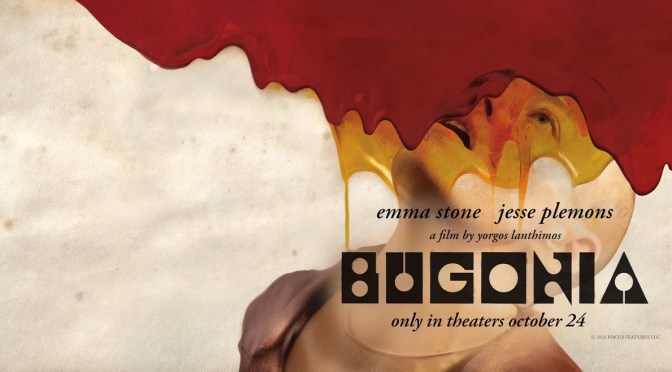
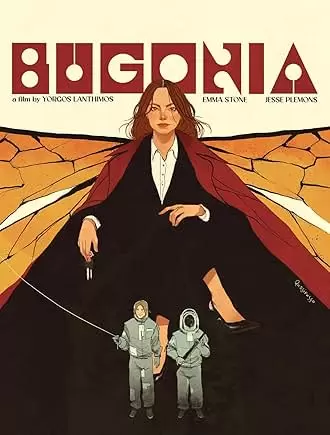
Yorgos Lanthimos has once again sneaked out of his uncanny terrarium and unleashed another piece of beautifully deranged cinema. Bugonia(2025)—a remake of Jang Joon-hwan’s cult classic Save the Green Planet!—is part sci-fi fever dream, part hostage farce, and part spiritual meltdown. It’s like Ruthless People (1986) got trapped in a socio-political, beekeeping suit and force-fed ayahuasca.
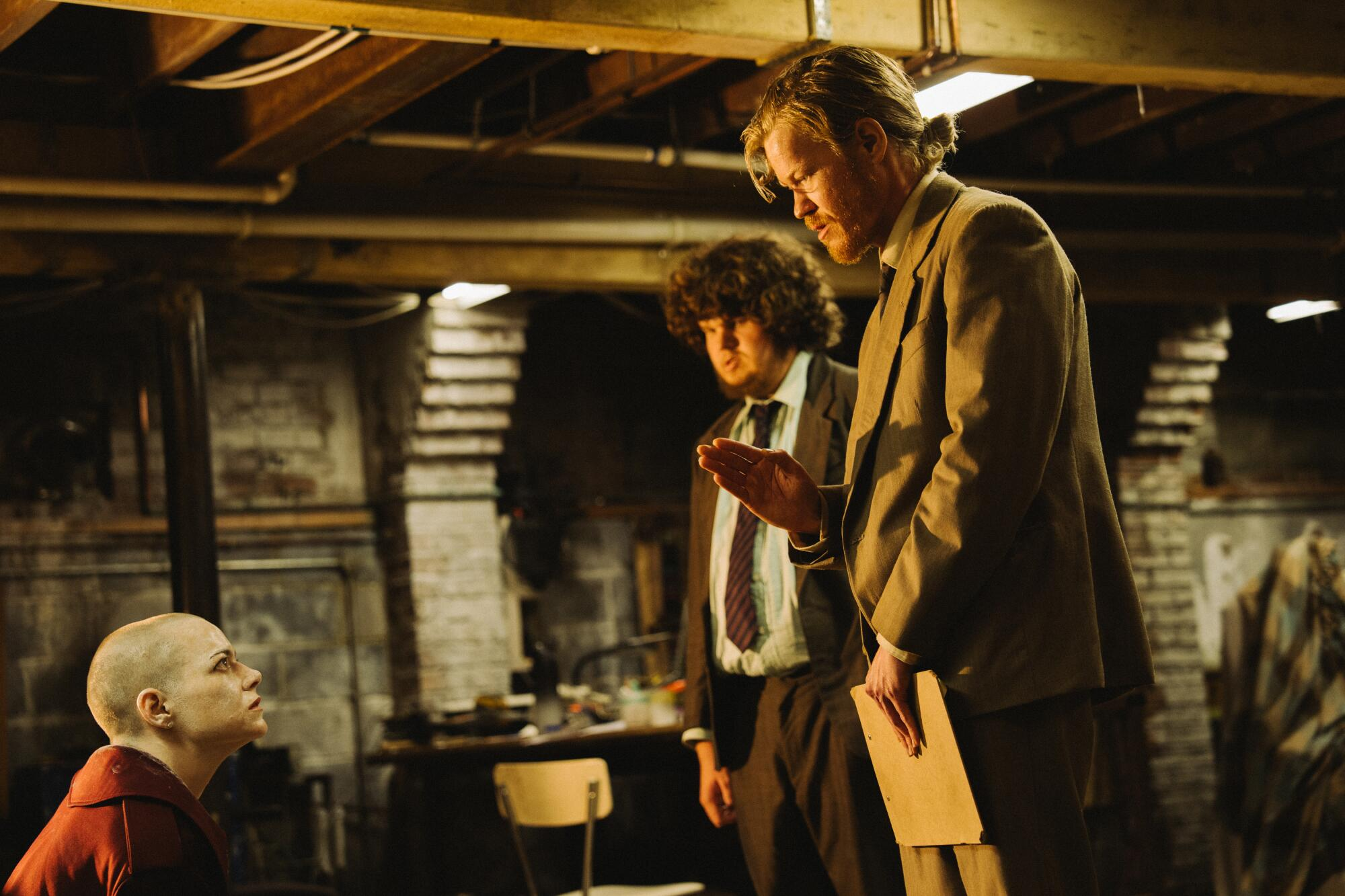
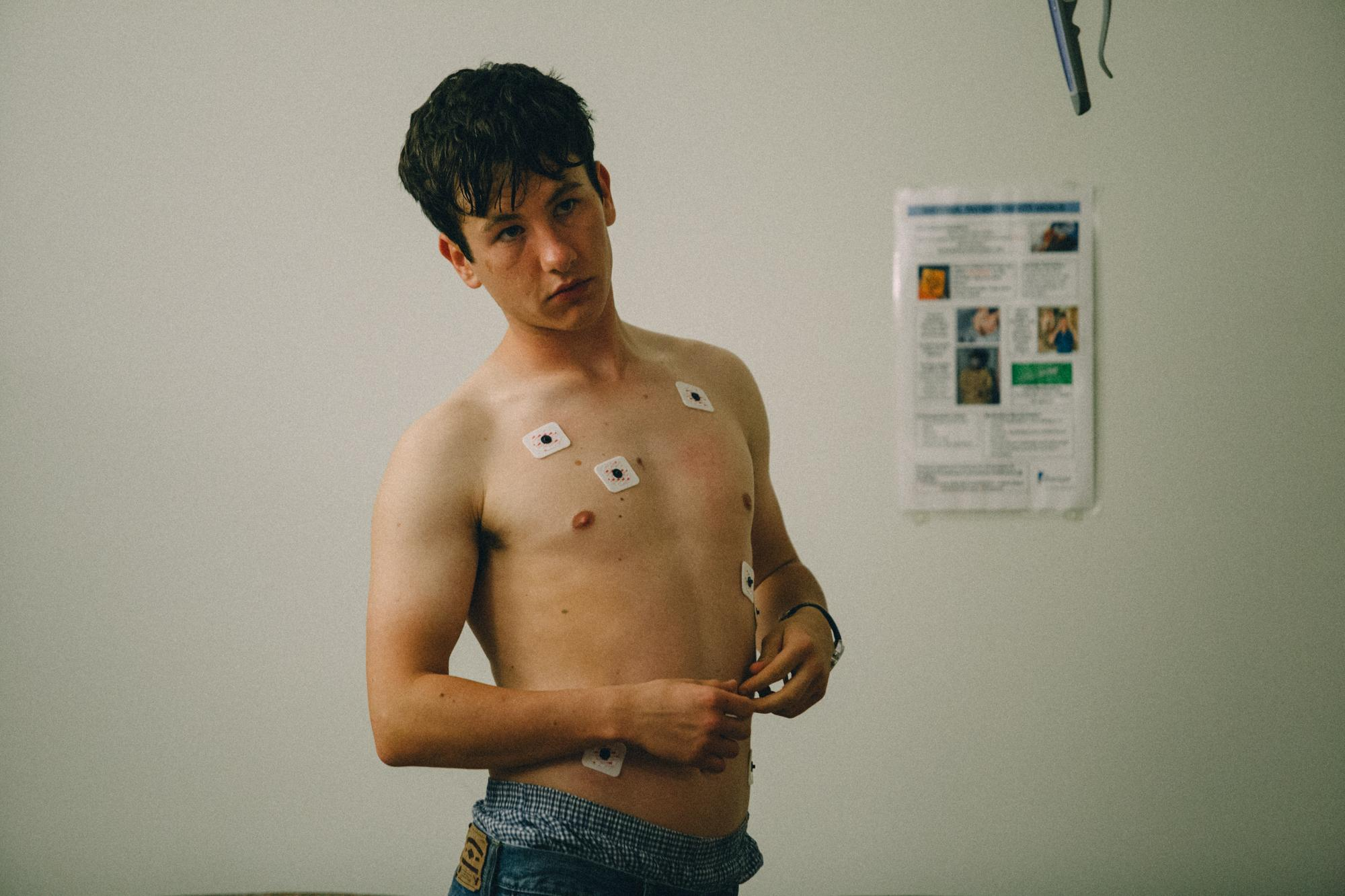
Will Tracy’s script hums with the manic energy of someone who’s read too many conspiracy subreddits and decided to turn it into Oscar bait. The film pairs Jesse Plemons (whose face seems genetically engineered for moral unease) with Alden Delbis (playing his twitchy, Kool-Aid-eyed partner in cosmic delusion) as two eco-anarchist truthers who kidnap a pharma/tech CEO, played with imperial chill by Emma Stone. Their reasoning? Well, just wait and see. It is incredibly crazy with some severe plot turns. Yet, somehow Lanthimos and his terrific cast maintain verisimilitude within the setting and just about hang onto emotional connection for the characters.
What follows is a deranged pas de trois of torture, empathy, and total philosophical collapse. Plemons and Delbis interrogate Stone with the intensity of people who’ve seen too many YouTube conspiracy documentaries, while Lanthimos and cinematographer, Robbie Ryan shoot it with the intensity of a nature documentary directed by Lucifer. There are bees. There is honey. There are monologues about pollution, pharmaceutical company threat and environmental collapse. Further, Stone, who has now fully ascended into Lanthimos’ personal pantheon of holy weirdness, plays her role like a woman being both worshipped and flayed at the same time. She’s terrifyingly serene—like she’s founded a doomsday cult and smiled through the apocalypse.
It’s all utterly ridiculous, but Bugonia (2025) thrives in that space between laughter and dread. Lanthimos once again proves that absurdism isn’t about nonsense—it’s that nonsense is the only sane response to the modern world. I enjoyed this film way more than the obtuseKinds of Kindness (2024). It has more akin, although not as devastatingly memorable, as his earlier Greek-language classics or The Killing of a Sacred Deer (2017). Moreover, ifThe Favourite (2018) was about power, and Poor Things (2024) was about rebirth, Bugonia (2025) is bleak, fatalistic morality tale about environmental apocalypse.
By the time the film’s final shots roll I was equal parts horrified, moved, and deeply amused. It’s an eco-horror-comedy that gorily plays likeSaw (2004) meets famous beekeeping philosopher, Aristotle. Overall, Bugonia (2025) proves once again that Yorgos Lanthimos is cinema’s reigning apiarist of absurdity—and his audience are all his buzzing little drones.
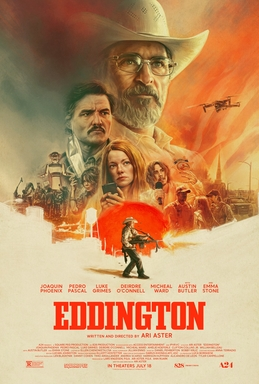
Main Cast: Joaquin Phoenix, Pedro Pascal, Luke Grimes, Deirdre O’Connell, Micheal Ward, Austin Butler and Emma Stone. Cinematography by Darius Khondji
*** MAY CONTAIN SPOILERS ***
Ari Aster’s first two horror films, Hereditary (2018) and Midsommar (2019) were rightly critically acclaimed and delivered at the box office too. His third film Beau is Afraid (2023) was a flop when compared and in my view not surprising. The film was arguably, depending on your view, a hilarious, risk-taking arthouse tragi-comedy or a self-indulgent act of egregious career self-sabotage. Safe to say I did not enjoy it, so approached the latest A24-produced film of Aster’s,Eddington (2025), with emotional caution.
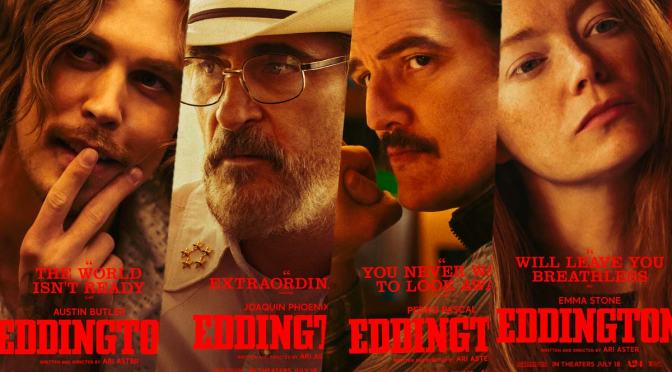
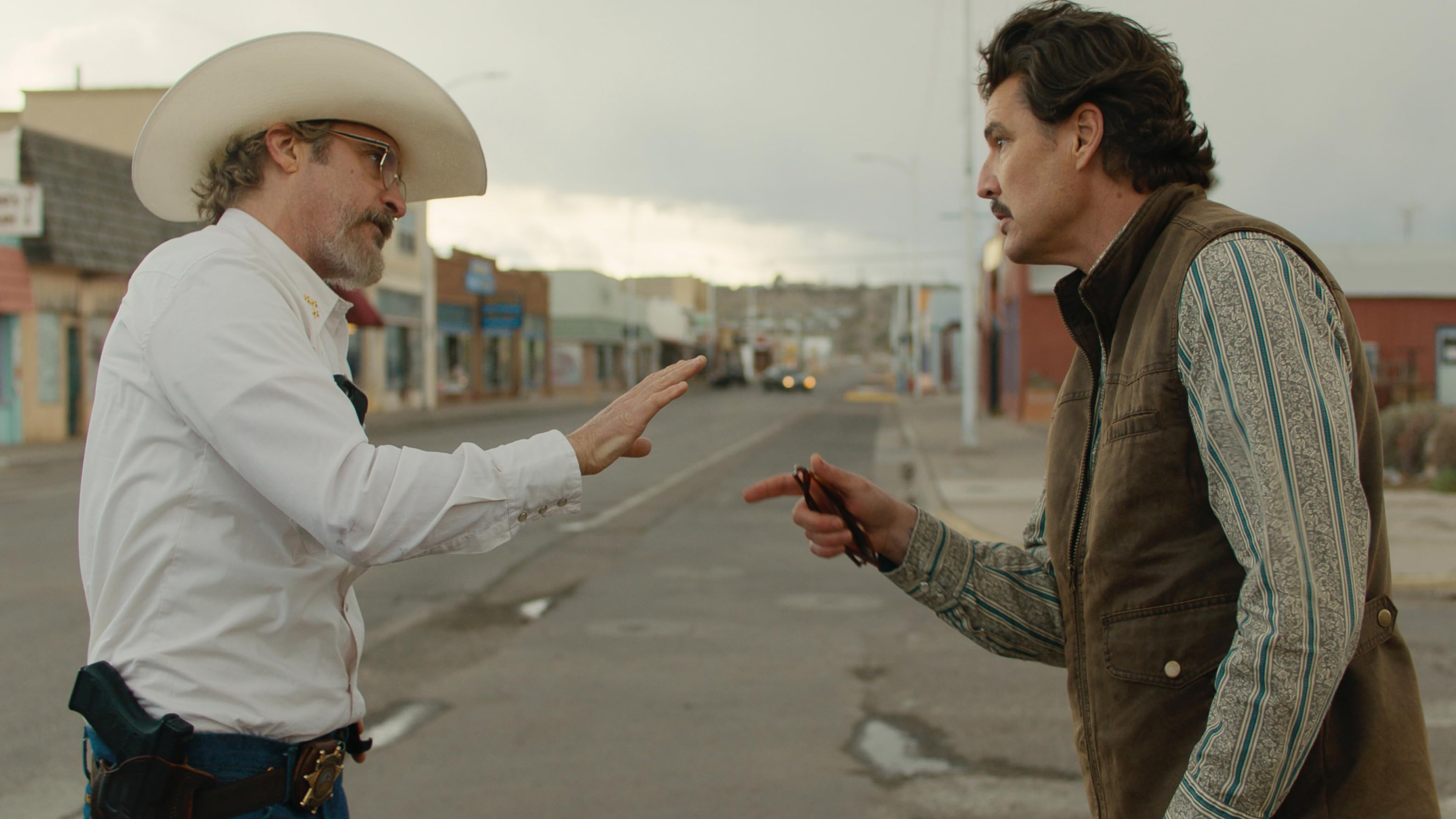
Thankfully Aster’s screenplay, characters and all-round production of Eddington (2025), are far more accessible and focused than his third feature. Pedro Pascal and Joaquin Phoenix anchor Eddington (2025) superbly, as Aster delivers a blistering small-town allegory that uses a public health crisis as the spark for something far larger. What begins with Mayor Ted Garcia (Pascal) dutifully following the Governor’s lockdown orders quickly escalates when Sheriff Joe Cross (Phoenix) refuses to comply and runs for Mayor himself. This casts the town and people into a conflict that mirrors America’s own political division.
Phoenix brings his trademark intensity to Sheriff Cross, whose defiance feels equal parts principled and unhinged, while Pascal’s Mayor, revealed to be a corporate puppet, balances him as a leader losing grip on his authority. Thus, Eddington (2025) is a powerful film whose strength lies in the performances and a brave, intelligent screenplay which asks many questions. The main issues I had were under-developed character arcs for Emma Stone’s and Austin Butler’s characters. Further, as in previous films Aster relies heavily on left-field plot turns, which go more for shock, rather than understandable character development. Indeed, the final act Western-style shootout, while incredibly exciting, seems out-of-sync with the thoughtful build-up and drama established in the first hour.
Ultimately, Director Ari Aster resists turning Eddington (2025) into just a COVID-era-morality tale; instead, the film confidently threads together a powerful mix of left and right-wing US politics, toxic masculinity, historical sexual abuse, conspiracy and alternative theories, cultish religious fervour, white saviour virtue-signalling, homegrown terrorism, algorithmic influence of social media, and the creeping threat of corporate greed. Each theme and subplot fold back into the central question: who really controls the narrative in modern America or is it a nation spiraling out of control toward inevitable civil war? The result is a tense, unsettling portrait of a town—and a country—at war with itself.
Based on Poor Things: Episodes from the Early Life of Archibald McCandless M.D., Scottish Public Health Officer by Alasdair Gray
Produced by Ed Guiney, Andrew Lowe, Yorgos Lanthimos and Emma Stone
Main cast: Emma Stone, Mark Ruffalo, Willem Dafoe, Ramy Youssef, Christopher Abbott, Kathryn Hunter and Jerrod Carmichael.
Cinematography by Robbie Ryan
*** MAY CONTAIN SPOILERS ***
I have now seen all of Greek filmmaker Yorgos Lanthimos’ most recent directorial works, namely: Dogtooth (2009), Alps (2011), The Lobster (2015), The Killing of a Sacred Deer (2017), and The Favourite (2018). Collectively they defy conventional film styles and tropes to deliver absurd, surreal, funny, disturbing, thought-provoking, erotic and imaginative visions of human behaviour. Also, let’s not forget the writers too; so kudos to his writing partner Efthymis Filippou, and latterly Tony McNamara, who have combined with Lanthimos to create such memorable cinematic offerings.
The director’s early lower-budget dysfunctional comedy-dramas such as Dogtooth (2009), andAlps (2011) are unforgettably strange films to experience. They feature uncomfortable depictions of family, sex, death and relationships. While offbeat, you sense they are from the mind of a filmmaker seeking to provoke thought rather than exploit. While equally dark and strange The Lobster (2015) is clearly more comedic, even though it probes strange love, fascism and violence within romantic relationships. Further, in The Killing of a Sacred Deer (2017), Lanthimos and Filippou, in Godardian fashion, constantly called attention to cinema form; especially with a strangely effective form of anti-acting within the arguably more conventional revenge narrative. Whereas in The Favourite (2018), Lanthimos’ delivered a unique period satire, with the language and behaviour of the characters often crude and shocking. His visual choices are always fascinating, with his use of the fish-eye lens creating a distorted effect that made the characters seem trapped by their surroundings and circumstances.
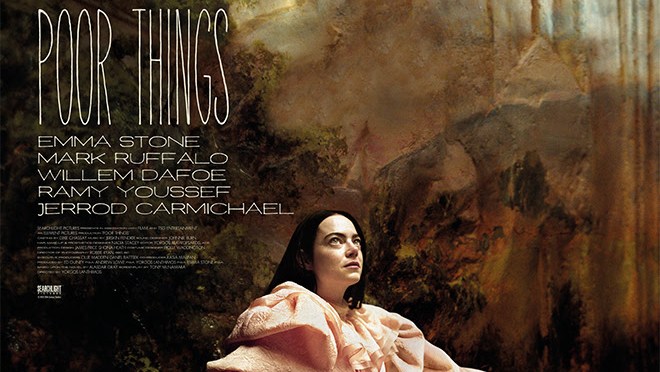
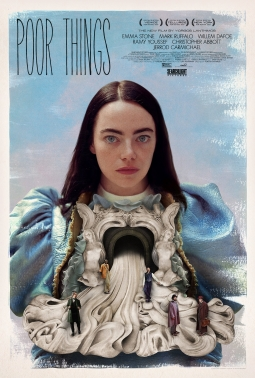
With the success of The Favourite (2018), both critically and commercially, Lanthimos has of late been given an increased budget, reported as $35 million. His bold choice, along with screenwriter Tony McNamara is to adapt award-winning novel, Poor Things: Episodes from the Early Life of Archibald McCandless M.D., Scottish Public Health Officer by Alasdair Gray has produced by far the most originally conceived and fantastic genre-bending comedy, drama, horror, rites of passage and salacious film of many a year. If there is a more bizarre, enthralling and enjoyable film of 2024, than Poor Things (2023) then this will be a most excellent year for cinema releases.
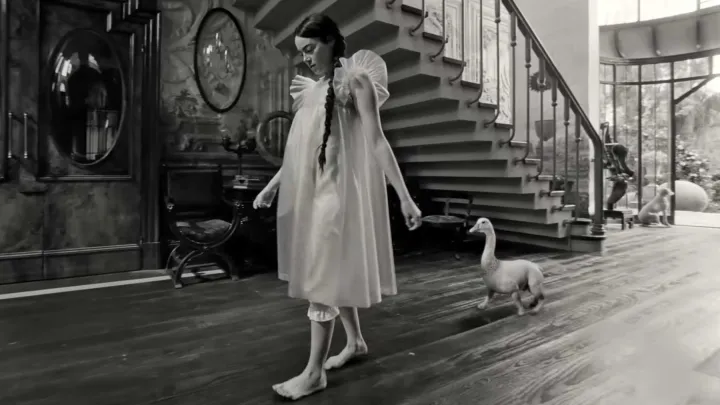
Set in Victorian London, we are introduced to the rather eccentric household of Dr Godwin “God” Baxter, an expert but secretive surgeon whose home hides bizarre animal experiments, and the beautiful but frankly odd human specimen, Bella Baxter (Emma Stone). Entering this weird abode of pig-hens and goose-dogs, comes innocent medical student, Max McCandless (Remy Youseef). “God” asks Max to assist with the childlike Bella’s development, charting her daily physical, speech and mental growth. Now, if you think the chimeric beast experiments are disturbing then brace yourself for the events of Bella’s ‘Frankensteinesque’ happenstance. I am not going to spoil it here, but it truly is a fantastic concept as invented by the author, Alasdair Gray, to contemplate. I was teetering on the fence with the film until this stunning reveal was given, but then I was committed to this medical oddity.
The first act finds Bella developing her speech, emotions and intelligence, as if a young child growing within this woman’s body. Bella also locates her libido and begins experimenting with her lust to great pleasure. Here Lanthimos continues exploring the themes of previous films with sex not only a natural expression of humans, but also an act used to control and drive people mad. Enter Mark Ruffalo’s caddish lawyer, Duncan Wedderburn who spirits a willing and rebellious Bella on a European trip. One where she truly discovers and satisfies her continual carnal desire or “furious jumping” as she hilariously calls it. Bella’s rites of passage, frankness and rapid growth threatens Duncan’s masculine insecurities and he finds it difficult to control her. Here the hilarious screenplay shows Bella and Duncan becoming more and more fraught until she craves further independence from his cloying envy. The central theme of Bella overcoming the chains of controlling masculinity dominates right up until the extremely dark final act.
While there is a lot of sex and nudity in this film, I felt that Lanthimos balances the exploitative nature of such material by contextualising it within Bella’s fascinating character arc. Emma Stone also provides a complex performance, funny and moving, as the woman-child discovering her mind, body, soul and the world. Ruffalo is particularly over-the-top as the sneaky but pathetic reprobate, Wedderburn. While Remy Youssef’s young medical student adds some compassionate balance within the ensemble, Willem Dafoe gives his customary brilliant turn as the tragic man of science. He himself had his childhood tainted by a father determined to use Godwin Baxter as a human guinea pig.
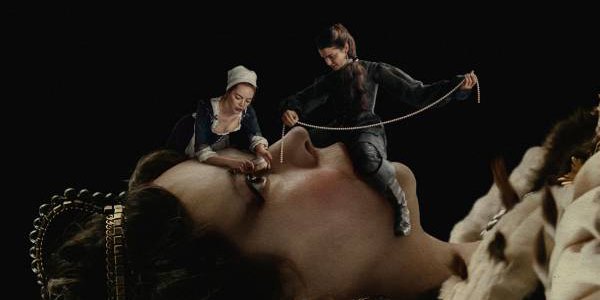
With a spectacular production design that employs a rich palette of colours, sets, lighting and immaculately furnished rooms, Lanthimos, stamps his authorial style along with genius cinematographer Robbie and his array of lens. Such creative choices evolve a spectacularly hyper-real vision of Victoriana. Indeed, the form and style coalesce with the content and themes in Poor Things (2023) to create what could already be the favourite film of my year. The screenplay dares to provoke the audience with gender political, sociological, historical and hysterical analysis as Yorgos Lanthimos again proves himself to be one of the most original filmmakers of his generation. Owing much to the imagination of Alasdair Gray’s source book, this is a shocking and explicit Frankenstein’s monster of a film. Lastly, it had me consistently thinking and laughing throughout, testifying to the power of family, however dysfunctional that Victorian household may be.
Based on: Maniac by Espen PA Lervaag, Håakon Bast Mossige, Kjetil Indregard, Ole Marius Araldsen
Developed by: Cary Joji Fukunaga & Patrick Somerville for Netflix
Directed by: Cary Joji Fukunaga
Starring: Emma Stone, Jonah Hill, Justin Theroux, Sonoya Mizuno, Gabriel Byrne, Sally Field
**MAY CONTAIN SPOILERS**
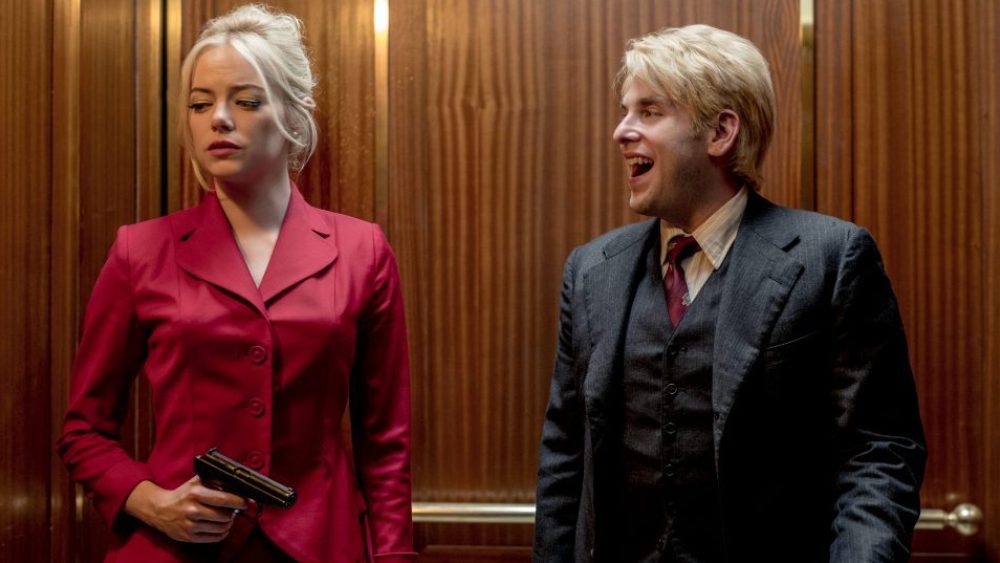
Maniac
What’s your view on striving for originality in storytelling and entertainment? It could be argued that there is no such thing and creators are simply moving creative chess pieces around the same board; or playing the same musical notes but in a different order. One perspective is that you prefer a writer or director to be bold and aim for originality; with the potential risk they alienate the audience. Some creators actually don’t care about the audience but many others do, preferring to connect emotionally within the casing of genre conventions. Personally, I prefer to be moved emotionally firstly and if the filmmaker or writer has presented their story in an impressive style then this serves to enhance the enjoyment of the narrative.
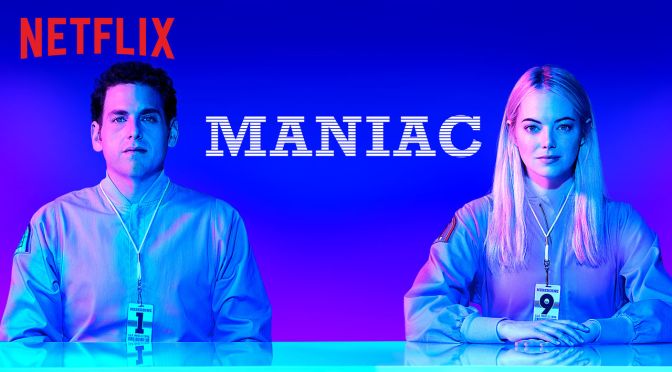
Cary Joji Fukunaga is a genre filmmaker who has established himself capable of developing impressive genre works such as: Jane Eyre (2011), True Detective (2014), and the brilliant film Beasts of No Nation (2015). Recently, he has also been involved in bringing It (2017) and The Alienist (2018) to the screen; although he did not serve as final director on such products. His latest directorial offering is an adaptation of a Norwegian comedy drama called Maniac. Over ten hit-and-miss episodes we follow the misadventures of a depressive and unstable Owen (Jonah Hill), and grieving pill-addict Annie (Emma Stone), as they enter a medical trial run by the secretive Neberdine Pharmaceutical organisation.
The trial itself involves taking a series of pills and the participants’ cerebral responses being recorded on a sentient artificially intelligent computer called GRTA. Here, Owen and Annie’s lives and minds become internally entwined as the story enables us to visualise their mental anxieties and re-enact their fears during the trial. Owen’s angst is caused by a family issue involving his brother, while Annie still blames herself for a family tragedy. The bizarre surrealist events are very effectively established, however, over the dizzying spectrum of several genre-crossing episodes we essentially get told the same two stories within the: crime, romance, gangster, fantasy and spy genres.
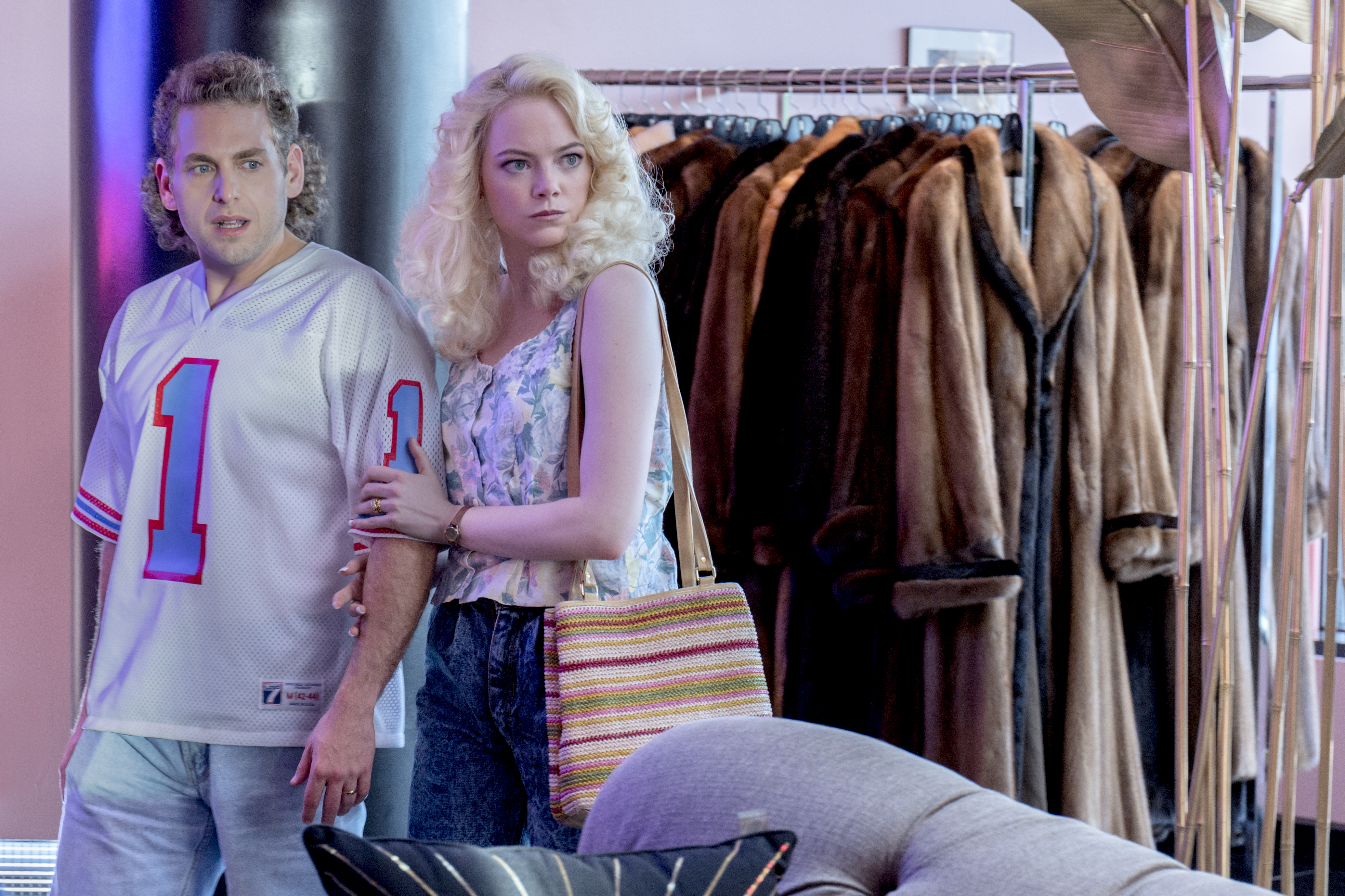
The performances are interesting. Fukunaga has created a world that exists somewhere in between the real and surreal and the future, past and current times. Because of this there’s a sense he has freed the actors from naturalism and at times created a stylistic distanciation. Conversely, Emma Stone was brilliant as always and she is skilled enough to make the strangeness resonate emotionally. However, I felt Jonah Hill, while giving a fine and committed performance, was miscast. Interestingly, Justin Theroux features in a curious turn as a Doctor on the edge of a nervous breakdown. Theroux is a fascinating actor who I think is sabotaging his career and could be the next George Clooney but continues to choose weirdo roles which serve his career no benefit. But hey what do I know!? Maybe he’s having a lot of fun.
Ultimately, the postmodern stylings cloaked a pretty conventional love story and once again, with a Netflix show, I felt that ten episodes were stretching the narrative a tad. Fukunaga’s combination of different genres and eccentric characters plus a smattering a bloody violence and techno-humour is always interesting. Moreover, much fun is to be had from the references to One Flew Over The Cuckoo’s Nest (1975), 2001: A Space Odyssey (1968), Lord of the Rings and many more films. Nowhere near as brilliant as True Detective or Beasts of No Nation, Cary Fukunaga still impresses as a director even if Maniac is arguably style over content. Nonetheless, Fukunaga should still be commended for striving for a semblance of originality and ambition, rather than just go for an big payday on a franchise studio genre film.
LONDON FILM FESTIVAL REVIEW – THE FAVOURITE (2018)
Directed by: Yorgos Lanthimos
Produced by: Ceci Dempsey, Ed Guiney, Lee Magiday, Yorgos Lanthimos
Written by: Deborah Davis, Tony McNamara
Cast: Olivia Colman, Emma Stone, Rachel Weisz, Nicholas Hoult, Joe Alwyn
Cinematography: Robbie Ryan
**SPOILER FREE REVIEW**
The London Film Festival organisers were very keen to impress we keep our phones off during the screening of The Favourite. Thus, I infer that the filmmakers are also keen that no spoilers are given away; something I will respect during this review. From the marketing blurb I have culled online, The Favourite: “sees Yorgos Lanthimos (The Lobster (2015), The Killing of a Sacred Deer (2017)) on rollicking, virtuoso form with Olivia Colman, Emma Stone and Rachel Weisz revelling in the wit of his 18th century royal court life.”
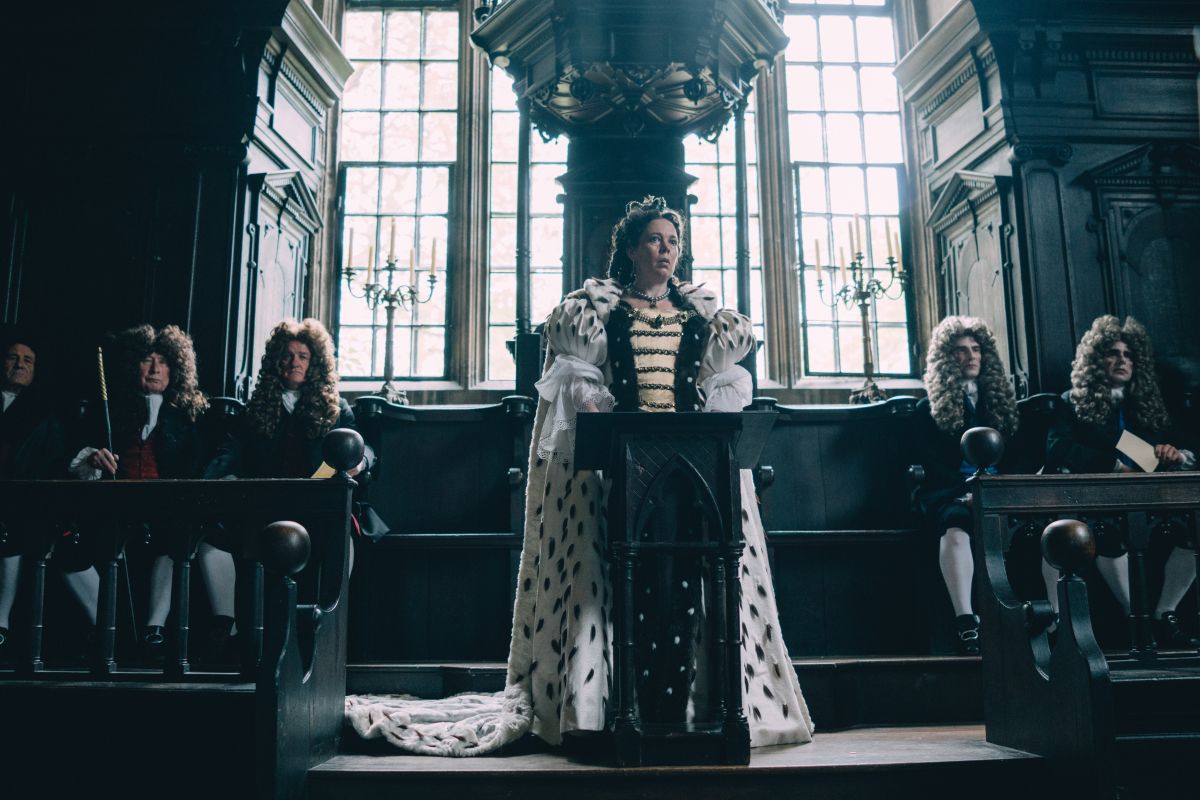
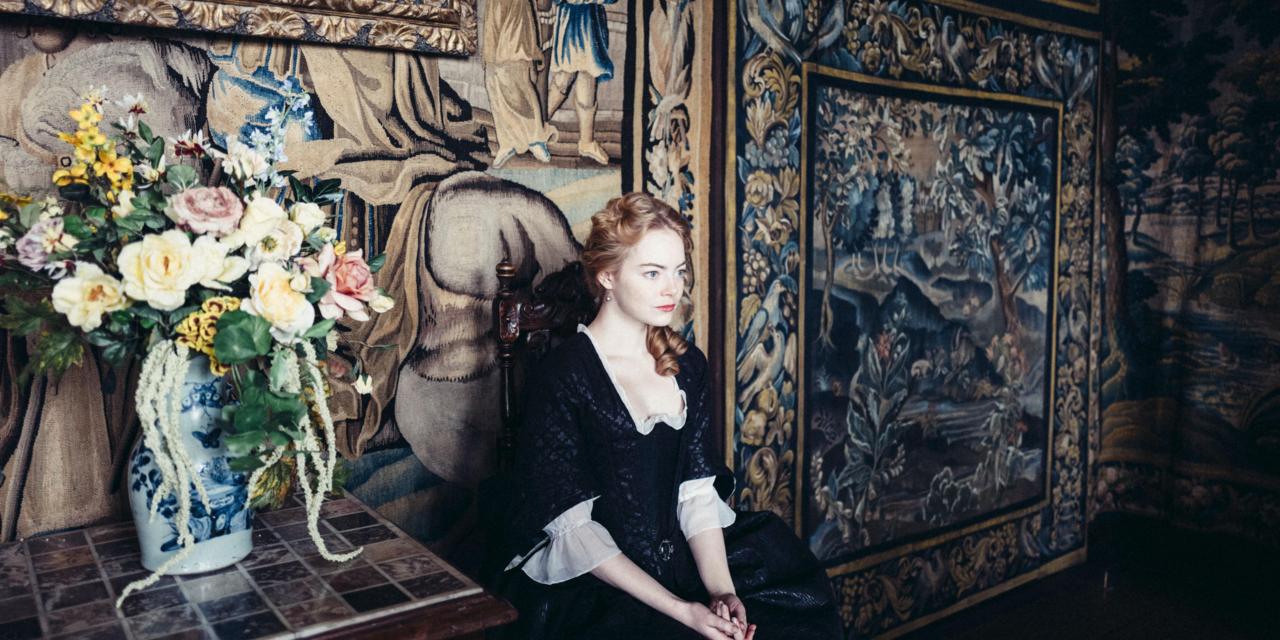
Unlike The Lobster and The Killing of a Sacred Deer, Lanthimos is not working from an original screenplay he wrote with Efthymis Filippou; instead he’s taken an adaptation by Tony McNamara and Deborah Davis. Conversely, it is not as eccentric a premise as those previous films and structurally it is actually quite conventional. The story itself sets Rachel Weisz’ Duchess of Marlborough as advisor to Olivia Colman’s Queen Anne in the early 1700s; while Emma Stone’s fallen “Lady” enters the fray and attempts to gain the Queen’s favour while usurping Weisz’ character.
Historical films relating to Machiavellian scheming, sexual misadventure and political intrigue are legion. Dangerous Liaisons (1988), A Royal Affair (2012) and the recent Love and Friendship (2016) are but a few examples; however, none of them are as absurd, surprising, funny, moving and as crazy as The Favourite. But, this is not a parody of period dramas. Instead, Lanthimos brings his own directorial vision to the story with his often ludicrous switches in tone, while skilfully maintaining a strong emotional balance and intrigue throughout. His use of the fish-eye lens creates a distorted effect making the characters seem trapped by their surroundings and circumstances. Furthermore, the lighting is quite wonderful too with natural and candle light dominating the proceedings.
Lanthimos’ direction of his three stellar leading actors is superb; with Olivia Colman delivering one of the most memorable performances of the year. Her Queen Anne is both pathetic and empathetic at the same time. Anne is to be pitied, laughed at and laughed with throughout. While I genuinely have little sympathy for royal figures, Anne is humanized with great power by the performance. Preying and manipulating her are Weisz’ and Stone’s characters. Weisz’ is, in particular, quite brilliant as we never quite know if her decisions regarding the war against Spain and the increased taxes are to benefit her or the Queen. Moreover, I know Stone won an Oscar for La La Land (2016), but she is even better in this film. Her eyes light up at each devilish choice her character makes; revelling in the skulduggery as ambition fuels her desires. I must add that Nicholas Hoult is quite brilliant too in a supporting role.
Overall, The Favourite (2018) may not be appreciated by those who prefer their period dramas to be played straight, as it were. The language and behaviour of the characters is often foul and crude but while seeming anachronistic it is paradoxically authentic too. Lanthimos’ interpretation of the screenplay is rather complex. He seeks to humanize, satirize and ridicule life in the Royal Court but without us ever hating the characters. The narrative asks for understanding but also critiques their choices. You kind of wish Weisz and Stone would show some solidarity but ultimately they are narcissistic players craving power, much to the detriment of their sickly Queen — portrayed by the astounding Olivia Colman.
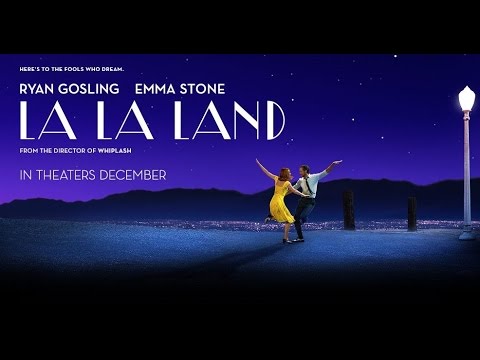
In light of the FOURTEEN Oscar nominations from the Academy who am I to go against the tide of musical loveliness that is La La Land. Indeed, while I dislike all kinds of award ceremonies per se it does deserve most of the accolades coming its way. Because as the Trump puppet rears his huge, ugly head in the United States and Brexit looms large in the UK we all need something feel-good and nostalgic to lift us; especially amidst the bitter cold of winter.
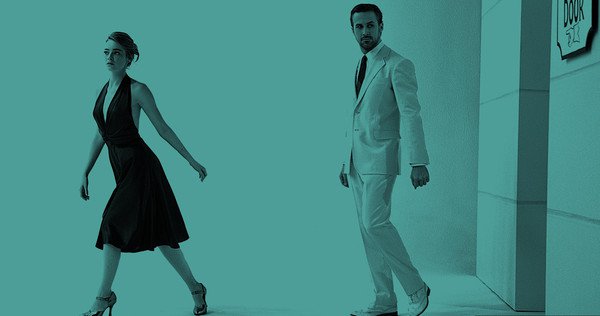
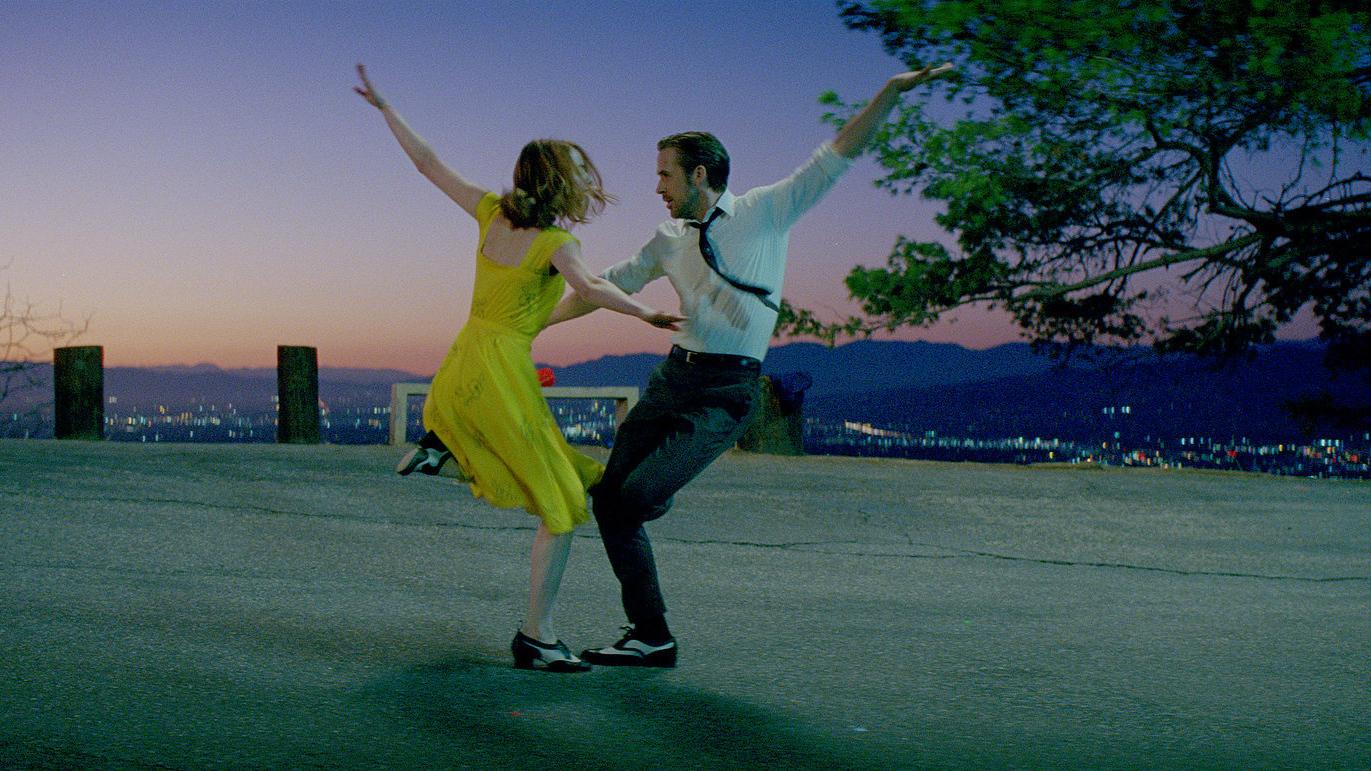
Damian Chazelle, who wrote and directed the exceptional drama Whiplash (2014), has sculpted a sunny post-modern musical which soars throughout paying tribute to both Los Angeles and Hollywood. The movie stars Ryan Gosling as an uncompromising jazz pianist and Emma Stone as a sensitive, budding actress who meet in a contemporary yet somehow old-fashioned vision of LA; where magic and love are in the air and the potentialities of dreams are a palpable force.
Stone and Gosling are a stunning couple and while Chazelle’s leads may not have the strongest voices they serve the songs exceptionally well with an ordinary wonder. The chemistry between the two sparkles as the story entwines their characters within a “follow your dream” narrative. Arguably there could’ve been slightly more differences between the two than the “I hate jazz” tension; but as in the romantic comedy Crazy, Stupid, Love (2011), Stone and Gosling sail through the film with confidence and profound likeability.
Chazelle throws everything at the story employing jazz, 80s pop, old band numbers, R and B, and ballads. Moreover, all manner of parody, pastiche and cinematic devices are employed to echo the classic Hollywood musicals of yesteryear; the formidable work of Jacques Demy; plus the more modern pop promos of recent times. The opening Another Day of Sun traffic sequence is a real showstopper as Fame-like dancing and singing on motors in an LA highway jam brilliantly establishes the hyper-real and fantastical elements to come.
It seems obvious to say that the music in La La Land is to the fore, but Chazelle and the ultra-talented composer Justin Hurwitz commit a verve and soul to the songs and direction. Clearly the characters and lyrics reflect their own personal emotions, dreams and desire to escape everyday existence. While much of the film skims a stylish surface of colour and verve, numbers such as City of Stars and The Fools Who Dream really touch the heartstrings and draw out the internal emotions of the characters.
It’s hard to criticize such a funny, feel-good movie and as a musical it is probably a masterpiece, however, while the love story served the musical structure really well, I felt that, compared to say Funny Girl (1968), Grease (1977) and Half-A-Sixpence (1967) it arguably lacked a bit of dramatic tension. Indeed, the break-up itself was under-baked and latterly covered by a have-your-cake-and-eat-it “what could have been” fantasy flashback. Yet, this is a minor critique of an incredibly well realised escapist joy.
So, roll on the Oscars where the film will almost certainly win best film and direction, plus accolades, no doubt, for the musical and technical achievements. The wonderful Ryan Gosling and Emma Stone are certain to be in the fray too. However, while I have seen other more dramatically impactful films such as: Arrival (2016), Manchester by the Sea (2016) and Silence (2016) (not even nominated!!), this remains one terrific musical that will lift the spirits even on the darkest day.
I’m a bit behind with my film reviews presently because I was busy preparing and performing in my comedy show ROCK N DROLL at the Brighton Fringe Festival. Thus, because I was wowing an army of fans over three nights (77 people total approx.) on the South Coast I am now playing a bit of catch-up on the reviews. Overall, Brighton Fringe Festival was fantastic and I am grateful to Laughing Horse Comedy, The Hobgoblin and the 77 people (and the dog at Sunday’s show) for the helping make it a success. From small victories BIG battles are won.
Talking of big battles there aren’t quite enough of them for my liking in THE AMAZING SPIDERMAN 2. There is a tremendous opening sequence with Peter Parker/Spiderman fighting what I thought would be one of the main villains — Paul Giamatti’s criminally underused Aleksei Sytsevich — while desperately attempting to get to his graduation ceremony. If it all feels a little familiar the ghost of Sam Raimi’s Millenium Spiderman series hangs heavy like the Reaper’s scythe over this and Marc Webb’s previous Spiderman film. The imaginary blade waits there in my mind comparing and contrasting ready to swing the final blow where I just say, “Nah! Sam Raimi’s films were much better! Thumb down! Off with its’ head.”
I must say though that this is high quality filmmaking of the blockbuster kind and it’s very hard not to like it. Perhaps, I’m asking too much but despite all the stellar work from the whole cast and technical crew I just didn’t connect with this one totally. I mean, I like Andrew Garfield as an actor but feel he’s better as a dramatic actor than cheeky superhero. My choice would’ve been Joseph Gordon Levitt but perhaps he’s too old now. Anyway, Emma Stone is stunning and so good in this while Dane DeHaan, Paul Giamatti and Jamie Foxx are all excellent but spread far too thin across the narrative. DeHaan and Foxx especially deserved much better for their respective energies and ability. Foxx is an Oscar winner goddamit!! And if you want to see what DeHaan can do then please watch Chronicle (2012) an amazingly good anti-superhero film and the best found-footage film I’ve ever seen.
There’s a lot of story in this sequel dubbed The Rise of Electro. In fact it has more lines than Tony Montana’s big mahogany desk at the end of Scarface. We have Peter Parker’s on-off romance (yawn!) with gorgeous Gwen Stacy; the mysterious disappearance of his parents (again); his reconnection with school friend Harry Osborn; attempting to keep his Spiderman identity secret from Aunt May (again); and the main foe — lowly Max Dillon — Electro causing New York an energy bill that would make Bill Gates weep. Alas, the romantic stuff takes a huge chunk out of the other more interesting stories and the action I craved.
I cannot fault the screenwriting team for their effort by trying to entertain the audience but at times I felt overwhelmed as each storyline was elbowed out of the way by the next one; with the narrative jigsaw not quite joining together satisfactorily as a whole. I really wanted to get involved in Max Dillon’s story as a lowly downtrodden OsCorp operative but his origins story isn’t given much time. As a villain there isn’t much focus other than he idolises Spiderman. I mean what happened to the vengeful employee as motivation? I really wanted this humble man to cause even more havoc than he does but he’s imprisoned for some time after his capture.
Another storyline which is dealt with too briskly is Harry Osborn’s relationship with his father Norman (Chris Cooper) which feels like it has fallen straight out of Paul Thomas Anderson’s superlative Magnolia (1998). Nonetheless, I thought oh, this is interesting, how will this pan out? He’s dead. Okay? Did Harry kill him in anger? No. Norman Osborn just died. Oh. We’re now back to Parker and Stacy’s on-off relationship. I DON’T CARE! It’s been half-an-hour since some stuff was blown up. Get back to that please?!?!?!?!
Marc Webb is a fine and dandy director as he proved with the brilliant bittersweet anti-rom-com 500 Day’s of Summer but personally I don’t feel he was the right choice for the Spiderman reboots. His Spiderman films feel too mature and not fun enough. They feel like have TOO much humanity and feelings. His camera is not kinetic enough and the beautiful wide vistas painted on screen don’t get us into the action quickly enough for me. I mean to get this kind of gig after a successful debut film is pretty amazing but he’s certainly a filmmaker to watch and perhaps his risk-taking and stylistic hands are somewhat tied by a big studio picture such as this. Arguably, perhaps he’s TOO GOOD an artist for this kind of movie. Just a thought.
I feel like I am being very critical of what is a very decent piece of entertainment but it’s only because I was disappointed that I pretty much had to sit through what was another Spiderman “origins” film. Because let’s face it the The Amazing Spiderman (2012) wasn’t great. But The Amazing Spiderman 2 has some incredible action notably the Times Square battle between Electro and Spiderman and an absolute spell-binding ending which pulled the dramatic rug from out under my feet. Moreover, in establishing Dane DeHaan’s devilish Green Goblin the third film promises to be pretty sweet. I just hope they put the family and romance stuff a bit more to the fringes and concentrate on all-out action. He is the AMAZING Spiderman after all!! I’m greedy I want to be more AMAZED for my money! If I want more young-adult romance from ridiculously attractive people I’ll watch Gossip Girl or god forbid Hollyoaks! Then again the dramatic unexpected ending does redeem much of this and for the wonderful cast, cracking musical score (Hans Zimmer et al take a bow) and a couple of (not enough though) superb set-pieces the entry fee was worth my hard-earned cash.








 The Cinema Fix presents