Tag Archives: Fame

Films that Got Away #18 – Star 80 (1983)

Films that Got Away #18 – Star 80 (1983)

Directed by Bob Fosse

Written by Bob Fosse – Based on Village Voice article, “Death of a Playmate” by Teresa Carpenter

Produced by Wolfgang Glattes & Kenneth Utt

Main cast: Mariel Hemingway, Eric Roberts, Cliff Robertson, Carroll Baker, Roger Rees, David Clennon, etc.

Cinematography by Sven Nykvist

*** CONTAINS SPOILERS ***
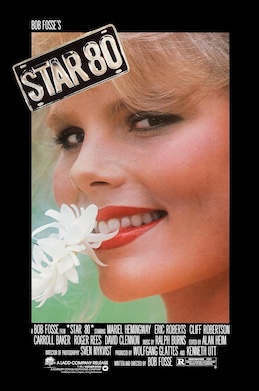


Bob Fosse remains one of the most singular figures in American entertainment — a director and choreographer whose style fused seduction, cynicism, theatrical precision, and emotional exhaustion into something instantly recognizable. Emerging from Broadway before conquering Hollywood, Fosse developed a visual language built around angular movements, tilted hats, snapping fingers, smoky jazz-club sensuality, and a relentless awareness of performance as both liberation and self-destruction.

Films like Cabaret (1972), Lenny (1974), and especially All That Jazz (1979) transformed the movie musical into something darker and psychologically raw, stripping away optimism in favour of obsession, ego, mortality, and the corrosive cost of show business. His influence can still be felt across modern cinema, music videos, and stage choreography, from contemporary Broadway revivals to filmmakers drawn to stylized performance and fractured antiheroes.

His final film, Star 80 (1983), stands as perhaps the bleakest expression of that worldview. Based on the true-crime murder of Playboy model Dorothy Stratten by her estranged husband Paul Snider, the film abandons glamour almost entirely in favour of a grim examination of exploitation, fame, misogyny, and possessive violence. Despite strong performances and critical admiration over the years, Star 80 remains comparatively difficult to encounter on television or major streaming platforms, partly because of the film’s emotionally punishing tone and its frank, lascivious depiction of the exploitation surrounding Stratten’s rise and death.

Unlike nostalgic Hollywood biographies that soften tragedy into inspiration, Fosse offers no comforting catharsis. The film ends not with redemption, but with the crushing inevitability of a young woman destroyed by the appetites of the men around her. That uncompromising darkness has contributed to the film’s lingering reputation as both a major work and an uncomfortable one — admired more often than it is revisited. So, thanks to the Nickel Cinema in London for screening this dark 1970’s based cult classic.


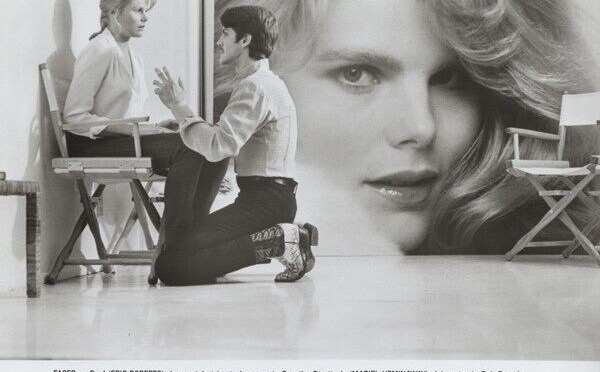
In Star 80 (1983), Mariel Hemingway gives an emotionally vulnerable performance of as Dorothy Stratten. Hemingway captures Stratten not as a caricature of Playboy fantasy, but as a genuinely sweet, almost painfully open young woman whose natural beauty and modest charm made her seem like the quintessential girl-next-door suddenly thrust into the machinery of adult celebrity. There is an innocence in Hemingway’s performance that never feels naïve or artificial; she understands Dorothy as someone eager to please, hungry for affection, and slowly awakening to her own independence just as the forces around her become more dangerous. Fosse frames her as both radiant and tragically exposed — a woman transformed into an object of desire by an industry that sees glamour as currency and vulnerability as weakness.

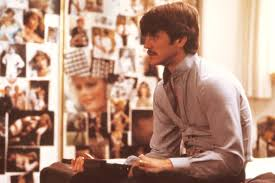
Opposite her, Eric Roberts delivers a frighteningly intense performance as Paul Snider, one that avoids simple imitation in favour of total embodiment. Roberts plays Snider as a man consumed by insecurity, narcissism, and desperate possessiveness, turning toxic masculinity into something sweaty, twitching, and deeply pathetic. He is not charismatic in the conventional movie sense; instead, Roberts makes him volatile and emotionally ravenous, a man whose entire identity depends on controlling the woman he helped “discover.” The performance becomes increasingly difficult to watch because of how recognizable the psychology feels — jealousy mutating into resentment, then humiliation, then violence.

Fosse refuses to sensationalize that descent in Star 80 (1983). The naked glamour of the Playboy world, the pornographic undercurrent of the entertainment industry, and the seductive surfaces of Los Angeles all become drenched in sordid, emotional decay. There is nudity and a sense of exploitative lingering on the feminine form, but there is understandable context. Cliff Robertson’s appearance as Hugh Hefner is not simply a caricature, but rather a caring, avuncular figure, despite building an empire out of, arguably, the exploitation of women. Further, Aram Nicholas (a thinly veiled, Peter Bogdanovich ) is a film director who tries to make Dorothy Stratten a movie star, but begins an affair too, sending Snider over the edge. Thus Stratten’s body and soul pinballs between these dominating men.

Overall, Star 80 (1983) lingers long after it ends. Fosse, Hemingway, Roberts and Sven Nykist’s cinematography contribute memorable work. Beneath its glossy imagery lies an overwhelming feeling of bleakness — the sense that every flashbulb, every photo shoot, and every promise of fame is shadowed by exploitation, stolen innocence, and inevitable tragedy.

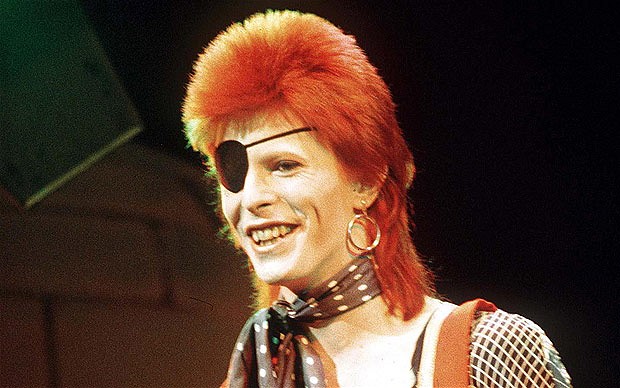

GLOBAL MOURNING: DEATH AND THE ANTI-SOCIAL MEDIA by PAUL LAIGHT

GLOBAL MOURNING: DEATH AND THE (ANTI) SOCIAL MEDIA by PAUL LAIGHT

“All that live must die, passing through nature to eternity.”
William Shakespeare

Death: the final frontier.  The long anorexic finger of the reaper hangs over all of us and the annoying thing is we can do nothing about this. We are cold hard truth Cassandra.  We know we are going to die; we just don’t know when. The cruel irony of life is we don’t know why we are here or where we are going when it ends. Today alone – according to Google – the utter bastard that is death has taken approximately 150,000 people worldwide due to: illness, war, old age, murder, accidents, suicide, natural disaster and so on.  Of course we cannot grieve everyone but death is always magnified when we lose a famous or esteemed person. Recently we have lost musical genius David Bowie, acting gentleman Alan Rickman and hard-rocker Lemmy.

Of course these are sad losses to the art and entertainment worlds as all were esteemed entertainers who seemingly lived their lives to the full.  Bowie especially had a phenomenal talent for Phoenix-from-the-flames-like reinvention and for me remains one of the greatest songwriters this country has ever produced; while Rickman was a fine acting talent who always brought gravitas to every role. Lemmy was well, Lemmy: a hard-drinking-hard-playing-hard-drug-taking-mad-man!

21_bowie3_g_w

What I have observed is the various approaches to mourning across the world, media and more specifically the Internet, which generally explodes with a combination of emotions. More often than not humans also attack each other with Facebook and YouTube being especially brilliant for hilarious rows which quickly descend into personal attacks on parentage, religion, sexual preference; or whether someone’s Gran is a Nazi or not.

Ultimately, we all know death is a prick and people handle it in a variety of different ways, including:

  1. Overwhelming outpouring of emotion for the life lost.
  2. Praise and celebration of the artists’ work.
  3. Irreverent comments where people say “I didn’t know them so why be upset?”
  4. Aggressive comments which accuse people of “grief tourism”!
  5. Humorous retorts such as, “Bowie is dead at 69. Rickman is dead at 69. Donald Trump is NOT DEAD at 69!”
  6. Angry comments such as:   “I hate you God – you took Bowie and Rickman but Rupert Murdoch is still living and now getting married!”

Personally I prefer the silent contemplative response and the people who are overly negative and criticise people for “grief tourism” irk me a bit. Indeed, it especially annoys me when the whole “you did not know them — so why are you grieving” statements come out.  Well, I disagree with that because you do “know” them through their art and knowledge one has of their songs, acting, product and performances.

Surely, it’s instinctive to react to someone’s death?  Are people really using a famous persons’ death to gain attention for themselves?  Maybe they are; nothing surprises me with human beings. But to be honest, if they are holidaying in death and they’re not harming me then who cares!   Let’s face it even the “grief-trolls” or “haters” or whatever-you –want-to-call them are scared of death and their defensive, satirical or ironic approach is a valid way of dealing with death and grief. Therefore, I respect their reaction as that is how THEY are grieving.

social_icons

Ultimately, we’re all animals who get scared when illness and death comes a knocking and when a hero or an artist or someone famous dies we are all confronted with our OWN mortality and I suspect that is what we are most upset about.  I mean who actually thought David Bowie would die – the guy is immortal surely?!  But he has passed away and that is sad; but we should celebrate a wonderful life of creativity. We should also respect how a person chooses to grieve however over-the-top or emotional or irreverent or negative it may be. We are all human. Let’s just try and get on as we’re all in the same sinking boat. You win some – you lose some.  Nothing lasts forever; apart from death that is.

BOOK OF MORMON – MUSICAL THEATRE REVIEW

BOOK OF MORMON – THEATRE REVIEW

**YO!  SPOILERS!”

“Hey – Paul!  Do you want to see Book of Mormon? It’s a musical!”

“Oh – I can’t stand musicals! Apart from Grease maybe. Or a Sondheim one I can’t remember the name of.”

“But it’s made by the guys who did South Park!”

“Really? I love South Park. How much are tickets?”

“HOW MUCH?!”

So on a cheaper Wednesday matinee showing myself and a friend ventured to the Prince of Wales Theatre to see Trey Parker and Matt Stone’s wonderfully irreverent and offensive (depending on your point-of-view) musical The Book Of Mormon. And a great time was had by all. It was funny, energetic and warm and of course very rude but strangely uplifting and like all great art (high or low) it got me thinking about my own values and spirituality.

I have never been what you would call a religious person.  I am not a believer or associate myself with a particular faith.  In fact since I was young I always held a staunch antagonism toward doctrines which remove free-thinking in the individual from birth.  Furthermore much of the world’s conflicts over history have been caused in the name of religion; that and greed and money and power.

BOM2

Having said that over the years my approach to religion has matured and I have become less didactic in my thoughts. Because you know what: religion or faith can be a positive thing and give people a true set of values with which to live their life. It’s not God’s fault that human beings use his or her name to commit acts of war and spread intolerance.  In fact, in recent times the move toward Atheistic and Scientific Fundamentalism (led by the Grand Wizard Richard Hawkins) itself has also caused intolerance to rear its ugly head too.

I prefer to believe in nothing; not a void as such but no particular deity or belief system. They provide great comfort for many but it’s not something I feel I need.  I believe in freedom of choice and speech and the basic human principle of just be tolerant of, and good to others.  Because as the song says: “Religion don’t kill people – humans do!”    Of course I just made that lyric up for humorous effect and that is precisely what occurs in the wonderful, hilarious and uplifting theatrical musical Book of Mormon.

The backstory tells us of Joseph Smith who “found” the sacred eponymous text on the gold plates of Nephi. After which he gave birth to a new religion in 1830 which went viral, spreading quicker than a dancing cat video on YouTube.   Flash forward loads of years and the Church of Latter Day Saints is one of the World’s largest cults; sorry, organised religions. And this is the starting point for the story.

BOM1

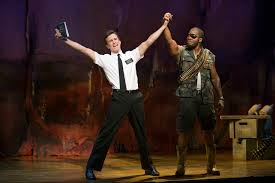
Our two main protagonists are Elder Price (Billy Harrigan Tighe) — a handsome, young go-getter — and Elder Cunningham (A.J. Holmes) who is, of course, his nerdier, less confident and insecure counterpart.  Cunningham is also a compulsive liar which gives the story an essential characteristic and running theme. Together they are sent from the Missionary Training Centre in Utah to of all places, Uganda to spread the word of Mormon. But Uganda is a godless place full of famine, disease and war and hardship so religion is a hard thing to see to those with no hope.

Humour is mined from the clashes between the two wildly different cultures as the songs compare the upbeat door-knocking optimism of the Mormons with the downtrodden, hungry, maggot-balled, AIDS-ridden, clitoris-castrated Africans; who are war-lorded over by hilariously named General Butt-Fucking Naked. As with South Park the writers use all manner of stereotypes with which to cram as many offensive jokes in as possible.

BOM3

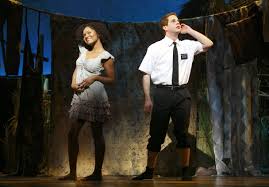
However, there is heart to the story too as it is revealed that Elder Cunningham has joined the Mormons to try and fit in and find his place in the world and most importantly: friends.  He is particularly taken with the preening narcissistic Elder Price despite the latter’s obvious discouragement and dislike of Cunningham. It’s no surprise then that while Price is clearly the more talented “salesperson” yet it is Cunningham who becomes a hit with the natives.  Having said that he does so having “made-up” loads of stories from the Book of Mormon incorporating tales from Star Wars, Star Trek and Lord Of The Rings.  From his distortions from the text plus bravery in standing up to the General Cunningham becomes a beacon of hope in the village.

Stories and faith are at the core of the satire here as Book of Mormon both lampoons and deep-down admires the Missionaries. While what Elder Cunningham says seems completely stupid and ridiculous it gives the villagers hope and faith for the future. Overall, the word of Joseph Smith is arguably “fictional” yet the message is a positive one with togetherness being the way forward.  The show asks us: if something gives hope in a hopeless world does it matter if it’s real or not?

BOM4

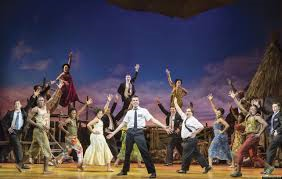
I have no frame of reference with regard to musicals. The only one I’ve seen outside the movies was Fame – The Musical starring ‘H’ from Steps.  But this was an absolute joy with an incredible cast and songs to boot.  My personal favourites were: Two By Two, Making Thing’s Up Again and Spooky Mormon Hell Dream.   The shifting of sets, movement and pace were fast yet controlled and the show was clearly the result of a culmination of an incredible amount of creativity, rehearsal and hard work.  As a dynamite new season of South Park currently runs on Comedy Central – I can certainly say Matt Stone and Trey Parker have another work of genius to add to their incredibly offensive yet hilarious CV.  Thank God, Allah, Ganesh, Buddha, Jesus, Mohammed, Nephi, Joseph Smith et al  for them I say!

southpark_god