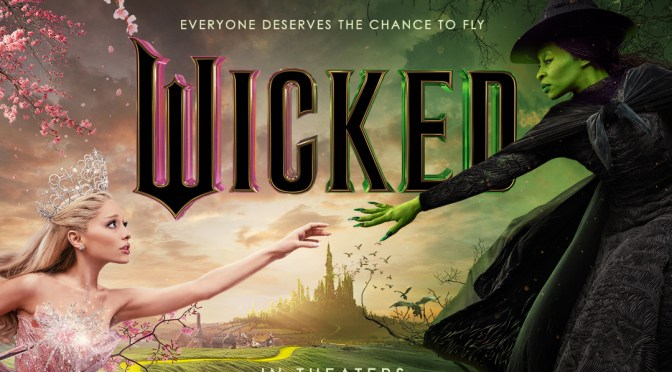
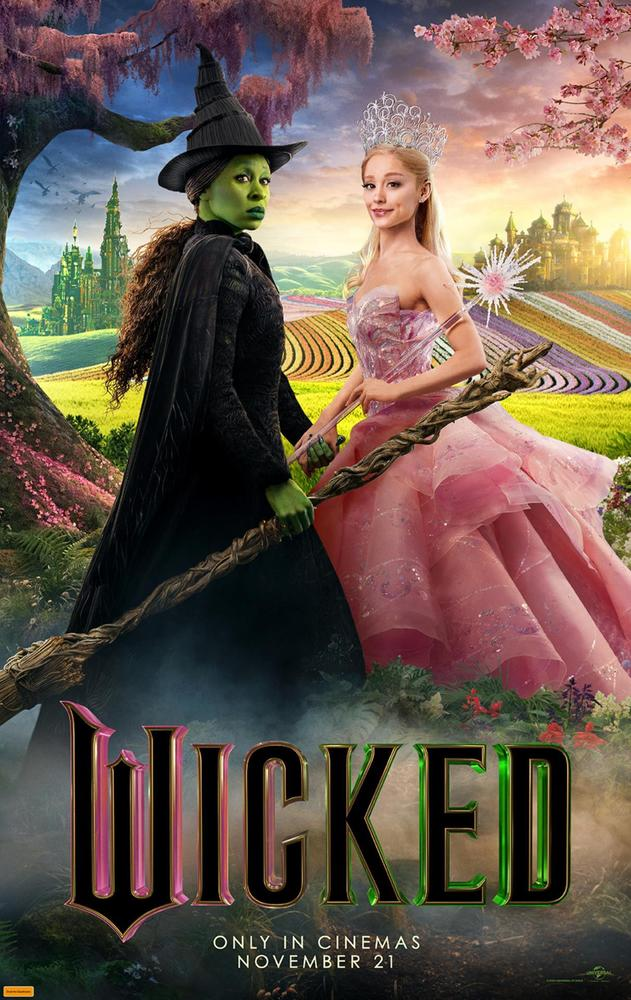
Based on the musical, Wicked by Stephen Schwartz & Winnie Holzman and novel by Gregory Maguire.
Produced by Marc Platt and David Stone
Main Cast: Cynthia Erivo, Ariana Grande-Buter, Jonathan Bailey, Ethan Slater, Bowen Yang, Marissa Bode, Peter Dinklage, Michelle Yeoh and Jeff Goldblum etc.
Cinematography by Alice Brooks
Edited by Myron Kerstein
Music by John Powell (score) and Stephen Schwartz (score and songs)
*** MAY CONTAIN SPOILERS ***
I truly believe my love of cinema began when I was aged five. Or was it six? Picture the scene. Christmas Day circa 1976 and the living room of a Battersea tower block. A television emits a classic musical fantasy called The Wizard of Oz (1939). Shades of grey with a flickering light and shadow, drew me into its spell. I sat wide-eyed, cradled by the screen’s soft glow, unaware that something wondrous lay just beyond the monochrome.
And then it happened—like a magician’s flourish, the black and white world I had known melted away. Dorothy opened that door, and the screen burst into life, a kaleidoscope of impossible hues. Emerald greens, ruby reds, a yellow road that glowed with the promise of adventure. My eyes widened. Hang on! It was black and white and NOW the images are in colour! This was magic. This was film. This was Oz!
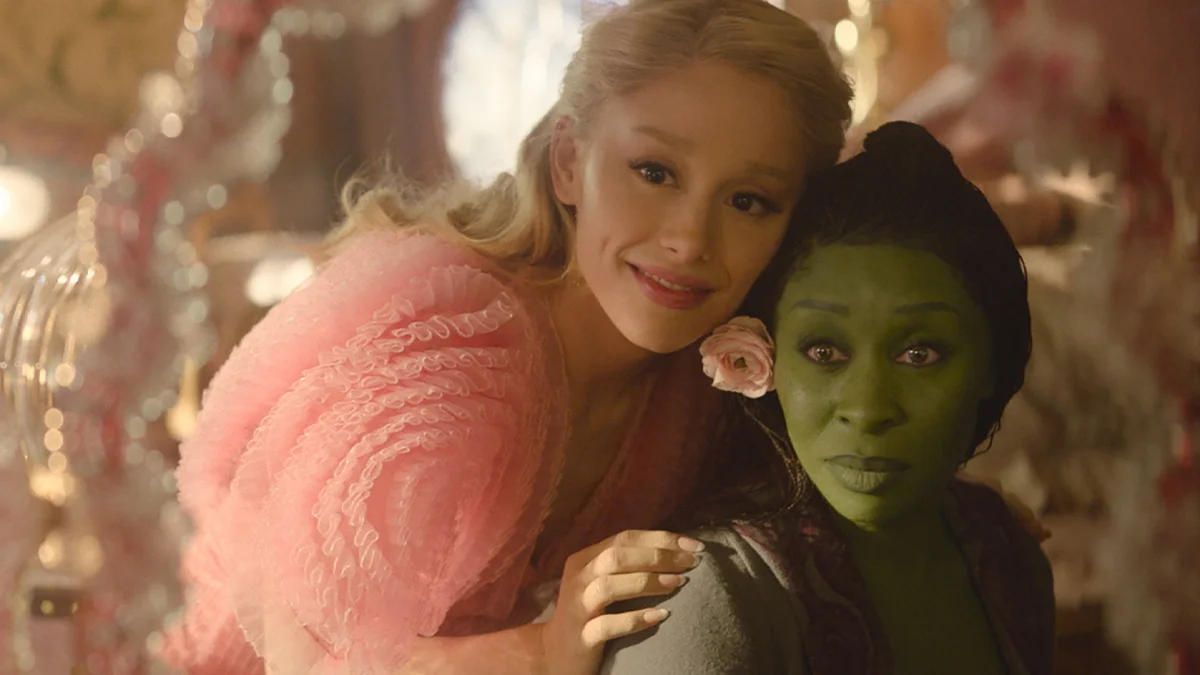
Forty-eight years later and back to the present. In 2024, I am sat in the cinema intrigued to watch the musical prequel, Wicked (2024). Based on a successful novel, then a spectacularly successful stage musical and now a big-budget Christmas cinema extravaganza indulgently split into a two-parter, does Wicked (2024) capture the cinematic sorcery I experienced in my youth? Of course it possibly cannot live up to my warm and fuzzy childhood memories, but it is a well-crafted, superbly choreographed and energetically performed Hollywood product with Cynthia Erivo and Ariana Grande on majestic form.
The film, based on Wicked: The Life and Times of the Wicked Witch of the West by Gregory Maguire, is a brilliant twist on the “what if” storytelling lens—a speculative reimagining that turns a villain into a deeply human, complex protagonist. The novel takes the flat archetype of the Wicked Witch and asks: What if we misunderstood her? What if the “wickedness” she’s condemned for is not inherent, but the result of a life shaped by prejudice, politics, and pain? Indeed, the journey of Elphaba Thropp (Cynthia Erivo) powerfully drives the story, and in some fashion Wicked(2024) works brilliantly as a Breaking Bad-meets-Mean Girls-type-rites-of-passage musical.
Unfortunately, such strong narrative bones with weighty themes of identity, morality, and the price of power are adorned in a dazzling, over-the-top spectacle. While its core narrative explores profound questions about destiny and the nature of “wickedness,” these ideas often get buried under an excessive parade of well-designed production numbers that stretch the running time and tested one’s patience. The powerful emotional arcs of Elphaba and Glinda, rich with potential, are interrupted by TOO MANY songs that (Dancing Through Life is one such culprit), while entertaining in isolation, often feel like detours from the story’s heart.
By the final curtain, the spectacular musical embellishments, though undeniably crowd-pleasing, can leave the story feeling bloated. I am probably the wrong demographic for the production, given the cinema was full of children and parents. So, while there is much to enjoy in comparison with the original film’s genius, notably the invention of the flying monkeys, Wicked(2024), for all its glitter and showmanship, finds the greedy desire for a two-parter ultimately draining Oz of pace and magic.
Life and work have been extremely positive and busy of late, but I have still found time to watch a number of films during September. Here are some quick reviews of just a few of the ones I have seen.
** MAY CONTAIN SPOILERS **
65 (2023)
How could a sci-fi-creature film with Adam Driver battling dinosaurs sixty-five million years ago be so uninspired? This probably would have been amazing with Arnold Schwarzenegger in the lead and John McTiernan directing in the nineties, but the limp father-daughter narrative propellent and severe lack of dinosaur carnage left me feeling disappointed.
Mark: 5 out of 11
CINEMA REVIEW: A HAUNTING IN VENICE (2023)
I love Agatha Christie and I love Poirot. The recent renditions from Kenneth Branagh have been mixed. Murder on the Orient Express (2017) was fantastic, especially for a very familiar murder mystery, while Death on the Nile (2022)was overcooked with a number of miscasts. A Haunting in Venice (2023) is a return to form and a real Halloween treat. The murder mystery isn’t the most interesting part as the plot points, apart from one decent twist, are mostly obvious. But the spooky lighting, eerie sound, imaginative use of lenses and camera angles, plus the claustrophobic and spooky atmosphere created within the Venetian palazzo are extremely impressive. I actually wanted more supernatural scares. The cast are great, although Tina Fey was glamorously miscast as the author, Ariadne Oliver. The ITV/David Suchet version was more faithful and had a better story, but I really enjoyed this excellent piece of comfort cinema.
Mark: 8 out of 11
APPLE TV REVIEW: CAUSEWAY (2022)
Jennifer Lawrence produces and stars as a U.S. soldier/engineer blown up in Afghanistan who, while suffering from PTSD, struggles to get her life back together in New Orleans. A lower-budget and lower key drama that clearly gave Lawrence a change of pace from the blockbusters she has been starring in for years. Causeway (2022) reminded me how great an actress Lawrence is and also, how brilliant Bryan Tyree Henry is. But the character study meanders with a lack of narrative drive, clarity and dynamism Lawrence showed inSilver Linings Playbook (2012). Indeed, while a worthy advocate for a soldier’s suffering, there wasn’t muchJoy (2015) to be found here.
Mark: 6.5 out of 11
SKY CINEMA REVIEW: DUNGEONS AND DRAGONS: HONOR AMONGST THIEVES (2023)
I missed this at the cinema as I was probably washing my hair at the time; what there is of it. However, this latest uber-budgeted attempt to breathe life into the table-top-dice-throwing Dungeons and Dragons game is actually really entertaining. Chris Pine, Michelle Rodriguez and Hugh Grant lead the energetic cast in a series of fantastically funny and frenetic action set-pieces involving magic, monsters, wizards, castles, stolen booty and of course, dragons. Pine and Grant are always very watchable, but Michelle Rodriguez steals the film with smashing physicality and deadpan humour as the barbarian, Holga Kilgore. The script has many fine gags throughout, as the likeable characters and pacey heist plot rip along wonderfully. You cannot go wrong with a ragtag group of outsiders finding community while fighting against a pernicious foe. Well, actually you can. But, Dungeons & Dragons: Honor Among Thieves (2023) does not!
Mark: 8 out of 11
DISNEY+ REVIEW: NO ONE WILL SAVE YOU (2023)
Kaitlyn Dever’s Brynn exists in a town where no one seems to speak to her or each other. But suddenly the place is overrun with aliens and Brynn must fight for her life while still not uttering a word. Hmmmm. . . in between the no dialogue cinematic contrivance becoming a bit of a bore, Brian Duffield’s excellent B-movie has some terrific action and a committed lead performance from the sensational Kaitlyn Dever. Since her breakthrough appearance in Short Term 12 (2013), she has gone from strength-to-strength as a performer. As a work of pure suspense cinema the film works mostly because of a weaponised Dever, the dynamic camerawork and the cracking sound and editing. However, the story has a number of holes, especially toward the end, which is frankly ridiculous. But Brian Duffield is a very talented writer and director and it is great that he strived for some formal originality in a familiar genre. Even though there was (yes I know it raises the tension) no organic narrative reason for the lack of speech throughout.
CINEMA REVIEW: DOCTOR STRANGE IN THE MULTIVERSE OF MADNESS (2022)
Directed by Sam Raimi
Written by Michael Waldron – Based on the Marvel Comics
Produced by Kevin Feige
Cast: Benedict Cumberbatch, Elizabeth Olsen, Chiwetel Ejiofor, Benedict Wong, Xochitl Gomez, Michael Stuhlbarg, Rachel McAdams, etc.
Cinematography John Mathieson
***MAY CONTAIN SPOILERS ***
I have to admit, and fully conceding my opinion counts for zero, that Disney’s Marvel and Star Wars bandwagons have reached a zenith of saturation. Too much of a good thing is definitely not a good thing. The Disney cinema and streaming products released over the last year or so, since the Avengers hit their endgame has been, just obscene. So much so I now have a powerful fatigue when it comes to watching said releases. They may be of excellent quality, but I’m not really sure I give a damn, darling.
While I am yet to see Shang-Chi and the Legend of the Ten Rings(2021) or Spider-Man: No Way Home (2021), I did have the misfortune to slog through the stodgy and nonsensical Eternals (2021) on Disney+. Having said that I did enjoy the meta-textual invention of Wandavision (2021). Aside from the conventional ending it tried to do something different with the character of Wanda Maximoff, dealing powerfully with the theme of grief in an imaginative and thoughtful way.
But it would take a hell of a hook to drag me to the cinema again to watch a Marvel film. I’m happy squeezing the value out of my Disney+ subscription thank you very much. But, what was this? Sam Raimi has directed Doctor Strange in the Multiverse of Madness (2022)? One of my favourite directors entered the Marvel creative team. A bona fide horror and fantasy auteur returned to the superhero genre he inhabited so tremendously in his millennial Spiderman trilogy. Okay Disney – you’ve pulled me back in. I’m tired of your high quality entertainment but here’s my cinema cash.
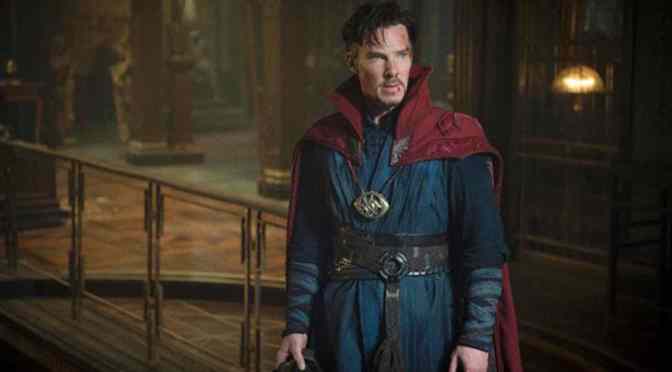
Doctor Strange in the Multiverse of Madness (2022) is a big, dumb, fast-paced, scary, fantastic, mystical, surprising and funny chunk of visually stunning fantasy cinema. After unluckily being denied the Oscar for his subtle, yet brilliant performance in The Power of the Dog (2021), Benedict Cumberbatch is on superb hand-waving, cape-throwing, shape-shifting, death-defying, hair-flicking, multiverse-jumping, father-figuring form as Dr Stephen Strange. His hypnotic character finds himself haunted by weird dreams. But are they dreams? Are they instead visions of other worlds? Other lives. Other deaths.
Enter Xochitl Gomez as America Chavez a dimension jumping teenager who, as a “human” plot device, drags Strange into devilish conflict with another powerful magician from the Avengers team. Namely, Wanda Maximoff (Elizabeth Olsen). Wanda is still struggling with her losses before and during the crazy events that occurred in the small town of Westview. Anyway, multiverse films are like buses it would seem. You wait ages and three or more come along at the same time. Indeed, with the time-travel narrative arguably becoming exhausted or rested, multiverse plots provide the writers the ability to introduce and reinvent characters and rules of the world within the Marvel canon.
So you’ve got to see the middle act of Doctor Strange in the Multiverse of Madness (2022), where America and Doctor crash into an alternative-Earth that contains some startlingly fun casting and unexpected character reveals. Add to that the dark arts delivered by Wanda’s continued obsession with getting America’s dimension-jumping powers light up and darken the screen. This allows Raimi to splatter the walls with a dazzling array of colour amidst the spellbinding set-pieces.
The end battle isn’t half bad either with Strange confronting Maximoff’s sorcery via a deathly conduit and ghoulish switching of identity. While I would have preferred Wanda not to have been cast as the nemesis, Olsen gives a fine performance of some depth amidst the mercurial madness. Overall though, this is Raimi’s film. He pulls out all the stops and magic tricks from his cinematic repertoire making Doctor Strange in the Multiverse of Madness (2022) more his film than just another generic release in whatever-phase-of-Disney’s plot to take over the universe this may be.
THE HORROR OF IDENTITY: DOUBLE BILL FILM REVIEWS – DEERSKIN (2019) & POSSESSOR (2020)
“Be yourself; everyone else is already taken.”-Oscar Wilde
We’ve all wanted to exist outside our own skin. Or perhaps inhabit someone else’s? Or, maybe even change our own identity, both literally and psychologically. Or is that just me? At the least we have all thought about it. Even losing weight and going down the gym or giving up alcohol or changing our hairstyle is a means of basic transformation. We may make a more defiant change and leave that job we hate or break out from a negative relationship. Arguably though, personality, attitude and mental changes in one’s life are the most difficult. After all, it is incredibly difficult to change the very fabric of one’s personality or character.
We can find an alternative source of transformation in a vicarious sense through storytelling mediums such as literature, television and cinema. The horror genre especially is replete with monstrous visions of identity switches, psychotic breakdowns and physical transmogrification. I personally take great pleasure in seeing altered identities occur on the screen and am especially drawn to characters who experience mental and corporeal metamorphosis. That simply isn’t because I cannot change who I am or what I do on a daily basis, but it’s quite scary to attempt to reshape one’s existence and identity. It’s bloody hard work without much guarantee of success. Horror films, while also frightening when done well, are far more satisfying and give a more immediate hit than the grind of reality.
Two films I have seen recently both relate to mid-life crises and exhibit themes that illustrate two characters changing their appearance to bring about a shift in identity, behaviour and personality. They also show characters spiralling out of control in incredibly violent, bizarre and entertaining ways. Those films are Deerskin (2019) and Possessor (2020) and here are my reviews.
*** MAY CONTAIN SPOILERS ***
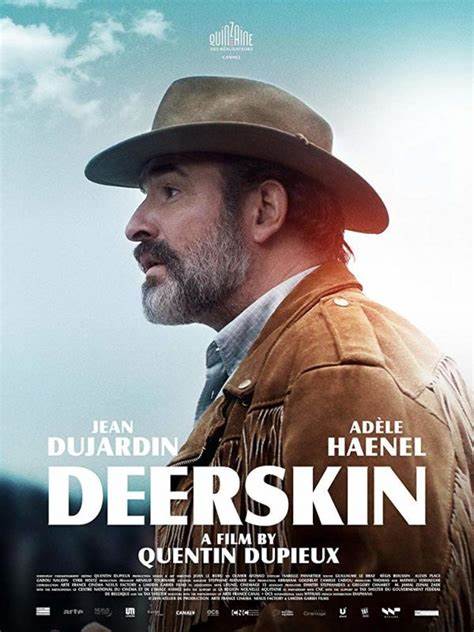
DEERSKIN (2019)
Directed and written by Quentin Dupieux
Main Cast: Jean Dujardin, Adele Haenel
Have you ever seen the film Rubber (2010)? It is a gonzo horror-comedy about a murderous-tyre called Robert killing birds and people with telekinetic powers. Beneath the insanity of the pitch there is in fact a subtextual satire on the nature of Hollywood filmmaking and an audience starved of originality; I think!It came from the mind of Quentin Dupieux, so I was intrigued that he had nabbed for a subsequent production the grand talents of Jean Dujardin and Adele Haenel for the obsidian killer comedy, Deerskin (2019).
Dujardin is Georges, a middle-aged loner, recently dumped by his wife whose only aim now it appears is to purchase a deerskin jacket. Buoyed by the confidence the jacket has given him, and armed with a video camera thrown in with the deal, George plots up at a rural hotel and befriends Adele Haenel’s bar server and enthusiastic film editor. Their budding friendship threatens to turn this into a relatively conventional love story, however, a series of twisted turns tip the story into a hilarious series of murderous set-pieces, with Georges determined to get money to make a movie, but most importantly buy deerskin trousers, hat and gloves.
The story of a middle-aged man altering his outer look in order to transform his life and fortune is a staple of Hollywood comedies and romance films. Deerskin (2019) is that kind of film on the surface. Yet when filtered through Dupieux’s iconoclastic imagination the premise is an altogether different kind of demented animal. Ultimately, it is a low-budget gem of a black comedy with some fantastic ideas and fascinating character study of a man attempting to shift skin, but falling deeper and deeper into psychopathy. It’s a wacky journey with committed performances, yet, it felt like the ending was just too sudden, as if the filmmaker either ran our of money or just wanted to screw with audience expectations right up until the final sudden frame.
MARK: 7.5 out of 11
POSSESSOR (2020)
Directed and written by Brandon Cronenberg
Main Cast: Andrea Riseborough, Christopher Abbott, Sean Bean, Tuppence Middleton etc.
Whereas Deerskin (2019) finds a literal and figurative metamorphosis when a character buys a jacket, Brandon Cronenberg’s vicious horror film, Possessor (2020), is an altogether more cerebral, violent and psychologically stunning journey. Andrea Riseborough is as intense as ever portraying an assassin named, Tasya Vox, who through some incredible technology is able to inhabit the mind and body of another individual and use them as a human puppet to commit murder. It’s a perfect set-up for the assassination agency led by Jennifer Jason Leigh’s handler, Girder. Yet such murder by scientific proxy comes at a cost to Vox’s family life and mental stability.
After a glorious opening scene featuring an astoundingly brutal stabbing, Vox attempts to reconnect with her partner and son, but finds herself becoming ever more disconnected. The pressure of taking over another individual’s identity is causing Vox to discombobulate as her mind begins to fracture. Despite this she takes the next job, a contract to kill John Parse (Sean Bean), using Christopher Abbott’s Colin Tate as a conduit. As Vox struggles with her splitting psyche, Tate himself is having personal issues also and this leads to some mind-bending and psychedelic montage scenes as the two battle within Tate’s brain. If this all sounds a bit weird, it is and it isn’t because the filmmaking is of such a high quality one believes the process. Further, the director never loses his grip on the narrative and Cronenberg gets a compelling performance from Abbott as his character confronts the invasion into his soul.
Overall, Possessor (2020) has a stunning concept at its heart but I just kept wondering how a genre filmmaker like Leigh Whannell may have handled the idea. He certainly would have made the characters more empathetic because it is so tough to warm to either Vox or Tate. Indeed, Tate’s character should have been developed more at the beginning in my view as he would have made an ideal “innocent/wrong man” type character so often used by Hitchcock. Nonetheless, Brandon Cronenberg has crafted one of the most visually impressive and shocking psychological horror films I have seen in a long time. Like Whannell’s Upgrade (2018), it contains some memorable gore and violence. It is also very intelligent as the fantastic ideas explore what it means to not only inhabit another person’s skin, but rip through their very soul.
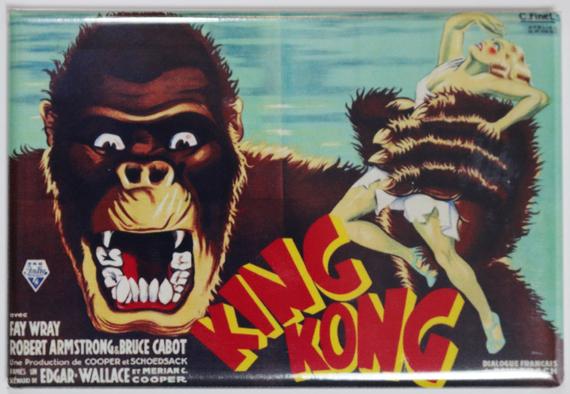
In the second of this series which looks at great film characters, I want to explore one of the most memorable monsters of all time: King Kong! In this short piece I will consider the original classic film creation in RKO’s King Kong (1933). It’s fascinating to examine the technical feats required to bring the character to the screen, the characterisation and narrative aspects which make Kong so memorable; and finally, the sociological and cultural impact of the film.
Working with a story by mystery writer Edgar Wallace and co-director Merian C. Cooper, the script was developed in 1932 by James Creelman and Ruth Rose. They structured this big adventure around filmmaker, Carl Denham, and his obsessive desire to shoot the legendary Kong on the ominously named Skull Island. What follows is a film of spectacular power and great innovation. In order to create Kong and the other prehistoric creatures the production team developed groundbreaking techniques such as stop-motion, rear projection, matte painting and miniatures. To this day the effects are breathtaking and still more emotionally engaging than most modern CGI.
As well as the incredible stop-motion photography painstakingly rendered by Willis O’Brien and Buzz Gibson’s team, the character of Kong is quite unique. Here is a monster in a horror B-movie who is in fact the most sympathetic character of the whole film. Moreover, the script builds suspense and dread with a long wait before we even see Kong. And what a sight it is! At first it would seem he is a merely a large ape, but he is revered as a god and protector. However, it is the humans who are the actual monsters. They steal Kong from his natural habitat and proceed to shackle him and treat him like an exhibit. But this exhibit has teeth and is about to bite back.
On release and in more recent years King Kong (1933) has rightly received much critical praise. It’s often ranked in the top horror films and all-time favourite 100 films of all time. More importantly, it’s actually gained attention as a film that subtextually reflects notions of colonialism, racism and the slave trade. In Quentin Tarantino’s superb revisionist war film, Inglourious Basterds (2009), a Nazi Officer reflects on this issue with specific reference to Kong. Similarly in this fantastic article, From Spectacle to Elegy: The Cinematic Myth of King Kong, Ross Langager, opines eloquently on the power of King Kong (1933) even now. Thus, while he may be a model made from clay, paint and metal, rendered real by the magic of cinema, Kong’s character is so much more than the sum of his parts. He is not simply a monster, but the ultimate tragic hero.
Executive Producers: Michael Schur, David Miner, Morgan Sackett, Drew Goddard
Producers: David Hyman, Joe Mande, Megan Amram
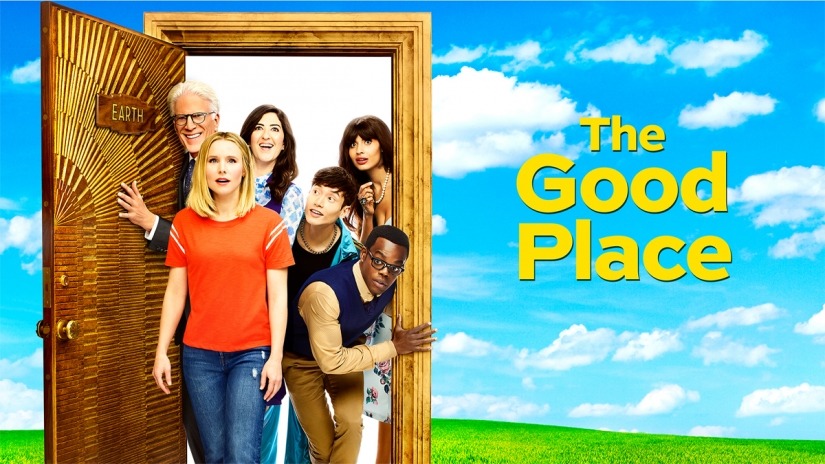
Starring: Kristen Bell, Wiliam Jackson Harper, Jameela Jamil, D’Arcy Carden, Manny Jacinto and Ted Danson
US Network: NBC / UK Platform: Netflix
**SPOILER FREE REVIEW**
“Hell is other people.” Jean Paul Sartre
So I started watching The Good Place with expectations of it being another slickly written and performed, shiny, sparkly and goofy American sitcom. I figured I would check it out, give it a season, enjoy and then allow it to slide into viewing obscurity. However, little did I realise it was going to be one of the funniest, intelligent, imaginative, philosophical, slick, shiny, goofy and densely plotted television shows I had seen in years.
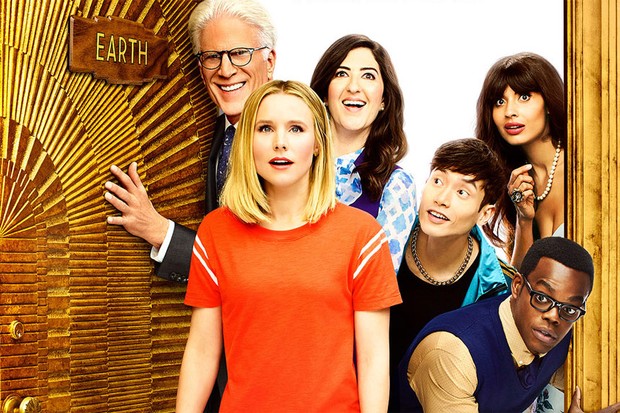
Created by uber-comedy-producer Michael Schur, The Good Place, has an immediately fascinating high-concept premise. Set in the ‘after-life’, it deals with the lives and deaths of four disparate characters, namely: Eleanor (Kristen Bell), Chidi (William Jackson Harper), Tahani (Jameela Jamil) and Jason (Manny Jacinto). They have all died and gone to a version of heaven, but there’s been a mistake. Eleanor is the snag. Due to a cosmic confusion she should not be there. Her behaviour ratings on Earth are so low she should have gone to ‘The Bad Place’ instead.
Frantically attempting to cover up this hellish mistake, the immoral, selfish and petualnt Eleanor enlists the indecisive but very moral Chidi to teach her how to be good. Thus, begins one of the major themes of the show: what does it mean to be a good person? As a moral philosophy professor when alive, Chidi, reluctantly agrees to train Eleanor. However, she is so inherently selfish it proves a tough task, and much humour comes from Chidi and Eleanor’s life perspectives clashing. Overseeing the “guests'” everyday lives are the architect/angel (arch-angel geddit!), Michael, played with the usual comic brilliance by Ted Danson; and super enthusiastic, Janet (D’Arcy Carden), a personified, sentient, artificially-intelligent computer.
The Good Place starts strong with a brilliant premise and then cascades into a series of incredible events, flashbacks and character reveals, culminating in some hilarious and ingenious narrative twists. Michael Schur is a past master of ensemble comedy, having worked on the The Office (U.S.) and Parks and Recreation; and here his army of writers, actors, designers and effects team serve his fantastic vision superbly. Moreover, the cast zing out the screwball-comedy paced dialogue and gags with laser-sharp comedy timing, with Kristen Bell the pick of the lot. The flashback scenes which show Eleanor back on Earth illustrating why she should go to hell are particularly hilarious. Of course, she’s not precisely evil but very human; she’s just not very good at being human.
Thus, if you want a television show which is shiny on the outside but actually quite dark on the inside then this is for you. The Good Place makes you both laugh and think. It deals with death, religion, heaven, hell, human behaviour and also gives insight into basic philosophy. I mean, it’s educational too; you learn about Camus, Sartre, Kant, Mill and many more! Overall, all three seasons zip along full of zinging one-liners that had me breathless from start to finish and it has heart too. You get to love these characters, despite their faults, and the show certainly leaves you in a very good place.
Produced by: Nina Bisgaard, Peter Gustafsson, Petra Jonsson
Screenplay by: Ali Abbasi, Isabella Eklöf, John Ajvide Lindqvist
Based on: Border by John Ajvide Lindqvist
Starring: Eva Melander, Jorgen Thorsson, Ann Petrén, Sten Ljunggren
Music by: Christoffer Berg, Martin Derkov
Cinematography: Nadim Carlsen
**SPOILER FREE REVIEW**
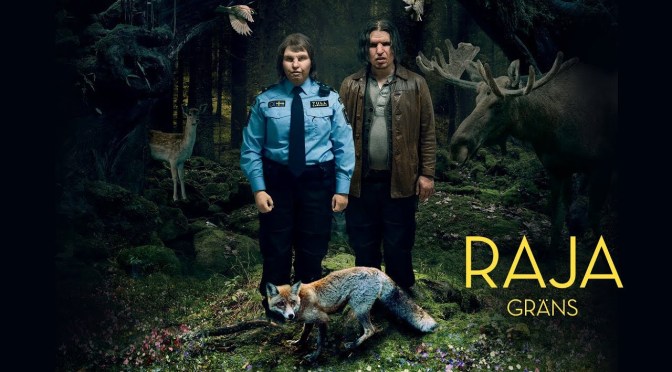
If you go down to the woods today you’re sure of a big surprise. Indeed, one of Border’s many strengths is the constant way co-writer and director Ali Abbasi invokes the strangeness of John Ajvide Lindqvist’s original short story to constantly shock and move us. Because while linear in structure and reliant on structural beats from the rites of passage, romance, fantasy and crime genres, Border, is one of the most original and interesting films you could see all year.
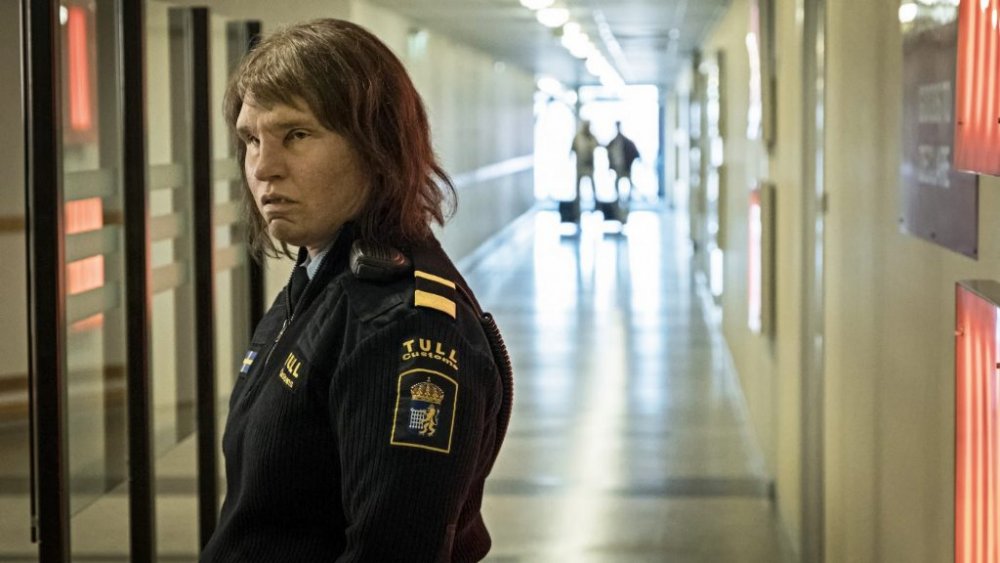
We open with the lead protagonist, Tina, working for the Swedish Border Agency. She is a seemingly sad and isolated individual with, what she believes is, a chromosome deficiency in her genetics. Her features leave her open to cruel ridicule from members of the public. However, she is excellent at her job. In fact, her hook is the ability to literally smell fear or guilt on the people coming through customs. Subsequently, Tina’s superiors start to use her to investigate more serious crimes.
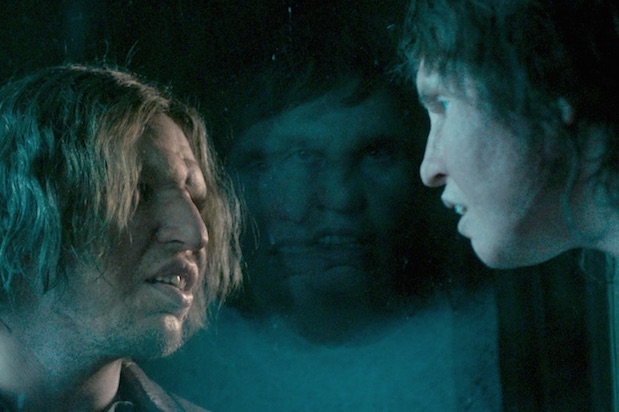
As this is occurring Tina meets Vore, a man with a similar “condition” to her and this is when her life really begins to spiral into very dark and exciting places. Similar to another film I saw called Beast (2017) the film is, at its heart, about sexual awakening and breaking free of the constrictions of society and family. Eva Melander, beneath the very convincing prosthetics, gives an outstanding performance of a woman finding out an incredible truth about herself and her past.
As a character study this film is very powerful. Tina’s world is turned upside down and she is faced with some horrific choices at the end. Arguably, the crime element of the story doesn’t quite meld with her rites of passage journey. Moreover, some of the fantasy elements from Scandinavian folklore required further research after the fade out. Yet, this remains very brave filmmaking with fascinating themes relating to: ritual and child abuse; nature versus nurture; good versus evil; and how those humanity believes to be outsiders should not be treated as monsters but instead with respect and love.
FAMILIARITY AND NOSTALGIA IN THE FANTASY FILM GENRE
“Here you leave today and enter the world of yesterday, tomorrow, and fantasy.”
― Walt Disney Company
Once upon a Time. . . four simple words which immediately conjure a whole host of possibilities and eventualities in literature and by extension, cinema. In her book A Once Upon a Time: A Short History of Fairy Tale, Marina Warner attests that fairy tales are “Stories that try to find the truth and give us glimpses of greater things. . . this is the principle that underlies their growing presence in writing, art and cinema.” My own personal experience growing up was of reading fairy tales, myths and legends. Indeed, such stories formed a narrative backbone to my childhood and opened my mind to all manner of worlds of monsters, magicians, Kings, Queens, dragons, spiders, ghosts, gold-haired heroines, muscular heroes, acts of love and war, epic journeys; as well as breath-taking battles and feats of unimaginable compassion and bravery.
Such an education conditioned my young mind for an array of imaginative potentialities and in later life my love of fairy tales and stories would bleed through into my love of cinema. But how does one make the leap off the page onto the screen, making that which is fantastic believable to our eyes, hearts and minds? In this article I would like to consider certain ways we have been conditioned and how storytellers develop their narratives in the fantasy genre. How does the unbelievable become believable in our minds? There are many ways in which this is achieved but I would like to focus on two methods which are familiarity and nostalgia.
How does one define fantasy cinema? One could certainly posit the notion that the fantasy genre deals with fantastic themes including: magic, the supernatural, myth, folklore, exotic worlds, and fairy tales; and for the benefit of this article can encapsulate science fiction, horror and superhero movie genres. Essentially, fantasy is that which is not of our perceived rendition of reality, enabling escape into the extraordinary. Fantasy cinema is not simply dragons and wizards but more far-reaching as their stories cast their magic from childhood to adulthood. I myself recall the day when I first saw The Wizard of Oz (1939) as Dorothy’s journey from Oz literally took my breath away. Moreover, only recently I marvelled at the fantastic images and comedy of Thor: Ragnarok (2017) on the big screen.
Lew Hunter’s book Screenwriting 434 is a fine research tool for all budding writers. He opines, “You have to make the audience care about your on-screen people and their dilemmas, and when that occurs you’ve created believable unbelievabilty. Audiences will not just get with a film that starts with what they perceive as unbelievable unbelievability.” Thus, this is an integral rule in getting the audience to suspend disbelief and come into a fantastic world. I mean for every Lord of the Rings Trilogy, which in my view brilliantly brought to life J. R. R. Tolkien’s incredible literary behemoth, you get many films which fail to achieve this. Peter Jackson obviously used, at the time, state of the art special effects to achieve his vision of the book but more important, in my view, is establishing the world and characters in the audience’s psychology and making the unbelievable believable.
As aforementioned there are many other movies which do not arguably work as fantasy films. Of course these are subjective choices but offerings such as: The Island of Dr Moreau (1996), Judge Dredd (1995), Batman and Robin (1997), Van Helsing (2004), Cat Woman (2004) The Lady in the Water (2006), Eragon (2008), Foodfight (2012), Terminator: Genisys (2015), Death-Note (2017), to name a few, could all be argued to have failed to make the unbelievable believable. Be it the poor writing, bad production choices or a lack of cogency in the presentation of the rules of their respective worlds, these are a few examples of movies which arguably did not work. But what of the films that successfully connect with our imagination. How do they achieve that?
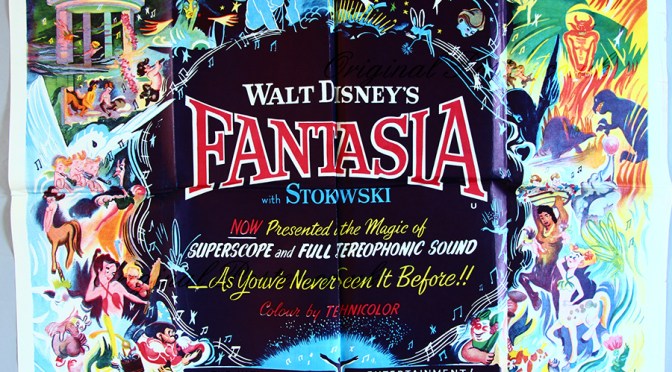
Disney Studios has been presenting animated and live action films for close to a century now. As well as developing short animated films centred on iconic characters such as Mickey Mouse, Disney Studios used established texts too. Their first short was Little Red Riding Hood (1922) and subsequently they would win an Oscar for The Three Little Pigs (1933). Thus, the Disney template of utilising familiar stories from folklore or fairy tales was born and since then they have produced many, many such short and feature length productions such as: Snow White and the Seven Dwarfs (1937), Sleeping Beauty (1959) and The Little Mermaid (1989). The suspension of narrative disbelief is achieved because innately we are accustomed to the idea of talking animals or wicked witches or half-woman-half-fish characters as they were familiarised to us in infancy. Indeed, as famous fantasy writer Neil Gaiman confirms, “We encounter fairy tales as kids, in retellings or panto. We breathe them. We know how they go.” Thus, believable unbelievability is achieved due to conditioning as children with the extraordinary. Likewise, our acclimatization with commercial products when growing up, including toys such as: Lego, Transformers, Barbie and the Pixar’s ingenious Toy Story trilogy tap into this familiarity model and the child’s dream that perhaps our toys can actually come to life.
As we grow older though many of us can become cynical and lose the innocence and imagination we had when younger. Thus, the challenge for filmmakers is to make not only children but also adults believe in the fantastic and the unbelievable. One way of doing this is through nostalgia or harking back to narrative conventions established from yesteryear. Academic Frederick Jameson wrote in his seminal essay Postmodernism and Consumer Society, that society entered a key cultural period from around the 1960s onwards where modernism had given rise to postmodernism and that originality per se was being replaced by emulation; more specifically satire, parody and pastiche. He goes on to suggest “. . . individualism and personal identity is a thing of the past. . . stylistic innovation is no longer possible and all that is left is the imitate dead styles.” A cinematic element of pastiche he argues is the “nostalgia film” which consists, not of original narrative, but of film moments and narratives from the previous films.
Indeed, one of the most successful cinema franchises of all time is George Lucas’ series which began with, Star Wars (1977). While containing many original elements in regard to the fictional monsters, creatures, planets, space ships, weapons, heroes and villains it’s structurally very familiar, featuring the archetypal hero rescuing a “Princess in a Tower” narrative. Even the “Once Upon a Time. . .” like beginning is echoed in the now classic opening text: “A long time ago in a galaxy far, far away. . .” Moreover, the expositional crawl which then follows is inspired by the early Saturday cinema sci-fi adventures such as: Flash Gordon. Lucas’ genius in using such nostalgic devices creates a clear pattern of familiarity and mental preparation for the fantasy elements yet to come in the story. Lastly, and less obvious, Star Wars also draws heavily, in terms of structure and characters, from Akira Kurosawa’s classic film Hidden Fortress (1958).
Similarly, J.K. Rowling’s Harry Potter series is equally adept at creating a magical world out of nostalgia and familiarity. The films are all structured around the school year and generally begin with an opening set-piece set in a mundane suburban area before slowly introducing the fantasy elements. Of course, some of us may not be so nostalgic for our school years but we are familiar with the educational structure. The Harry Potter books and films are a creative stroke of genius creating both emotional connections for children and adults. Children see the characters of Harry, Hermione and Ron as reflection and wish to emulate such characters; while adults can look back on their school days nostalgically and perhaps also enjoy the magical adventures from a position of halcyon positivity. What Star Wars and Harry Potter both offer is a means to project some incredibly fantastical elements but make it believable by setting their worlds in a recognizable environment such as school or through the stylistic signifiers like the opening Star Wars text.
Ultimately, most of us love reading or going to the cinema in order to be entertained and escape from our reality. However, if the writer or filmmakers have not successfully created a suspension of disbelief we as an audience will fail to enter their fantasy world. Quality writing, production design, costumes, make-up, performance are of course integral to ensuring we believe what we read and see on the screen. However, as I have attested films also work on a more psychological level of drawing us in using methods such as familiarity and nostalgia to tell their stories. We may not even be aware of this but to make the unbelievable believable it paradoxically must connect with our prior knowledge and experiences, especially those we had as children.
GAME OF THRONES – SEASON 7 REVIEW & RANDOM THOUGHTS
**ABSOLUTELY NO SPOILERS**
I’ll be honest: in my younger days of arrogance or confidence or know-it-all-prideful-youth – whatever you want to call it – I used to be an ultra-critical, negative and a bit of a spoilt moaner. But, as my time ticks away ever so slowly and I crawl closer to death, I believe I have grown more mature and reasonable. I remain analytical and active in my viewing and while I am someone who mildly obsesses about certain movies, TV shows, sports and other cultural stuff, I still recoil with embarrassment at the negative hysteria you get online and in social media in regard to life, politics, celebrities, pop videos and more specifically TV programmes or films.
Of late the fury of the Internet “haters” or “trolls” was aimed with fundamental ire at the all-female-led-cast Ghostbusters movie. Who really cared?!? It was an okay film; not great. My main problem was that it was not particularly well written or directed despite the excellent efforts of the cast. In another sexist tirade the online public hacks also attacked the casting of excellent actress Jodie Whittaker as the new Doctor Who. I mean the Doctor is a shape-shifting alien who changes bodies and heaven forbid that, after thirteen men (including John Hurt’s War Doctor) in the role, a woman suddenly be cast!
Why are people so over-the-top with their reactions I ask myself? Maybe they are channelling their life disappointments or existential anger by way of dissociative behaviour. Criticizing these casting decisions could be a way of distancing themselves from the pain of life. Or perhaps the more socially-charged analysts could argue that filmmakers and TV showrunners are cowering to the liberal left and changing such roles to be more PC! Or maybe they are simply just nuts!?
I guess everyone is entitled to an opinion and the Internet, for better or worse, has given power to those opinions. I just don’t understand why people get so angry though! I mean some of the criticisms aimed at the latest season of Game of Thrones were admittedly erudite and thoughtful; however, much of the wrath toward the writers ranged from the silly to the furious to nit-picking pedantry of the highest order. It’s as if the online villagers of YouTube, Facebook and Twitter had been sharpening their pitchforks and lighting their torches before the show had even aired.
My view of Game of Thrones is simple. The first six seasons gave me some of the greatest televisual enjoyment I have ever experienced. In terms of character, plotting, dialogue, action, reversals, twists, shocks, romance, performance, political intrigue, editing, direction and jaw-dropping-heart-pounding-tension it is ONE OF THE GREATEST TV SHOWS EVER!
Thus, Season 7 had a lot to live up to and in some ways it has been a victim of its own success. When you raise the bar that high it is of no surprise if such heights dip on occasions. Having said that I thought Season 7 was fantastic TV; and I’m not the only one. It was seven episodes of brilliant entertainment with too many wonderful moments to mention. But the online village hordes were quick to complain with vehement cries of “Burn the Writers!” Moans included:
The writing’s not as good as the earlier Seasons!
George R. R. Martin’s careful characterisation and plots have gone!
The pace is TOO quick compared to the prior Seasons!
Too many character reunions!
The map has been compressed and characters seem to teleport!
Too many plot-holes and character inconsistencies.
The White Walkers / Night King enemy are too one-dimensional.
It’s just not as good as the books!
It’s become too predictable!
Show-runners D.B. Weiss and David Benioff are the Anti-Christ!
While I agree in regard to the geographical shifts of characters and speeding up of the plot points is different to the previous Seasons, I don’t believe the entertainment value has been lost; in fact it has been heightened. I also don’t agree that the writing is bad. The show, having built up much good faith in the earlier more politically charged Seasons has now shifted to a faster more cinematic pace rather than the steady literary tread of George R. R. Martin’s work. Of course, the book is ALWAYS better than the film or show as a rule but it’s a different medium altogether. We’re reaching the end of the show and the characters’ arcs are peaking toward denouement so the increased pace is understandable. In regard to predictability, well, there’s only one way the whole show was going and the battle between Ice and Fire has been on the cards since the first episode! WINTER IS HERE!! I realise many are disappointed in this shift having committed many hours to watching the show; but I honestly think the show remains as powerful as ever.
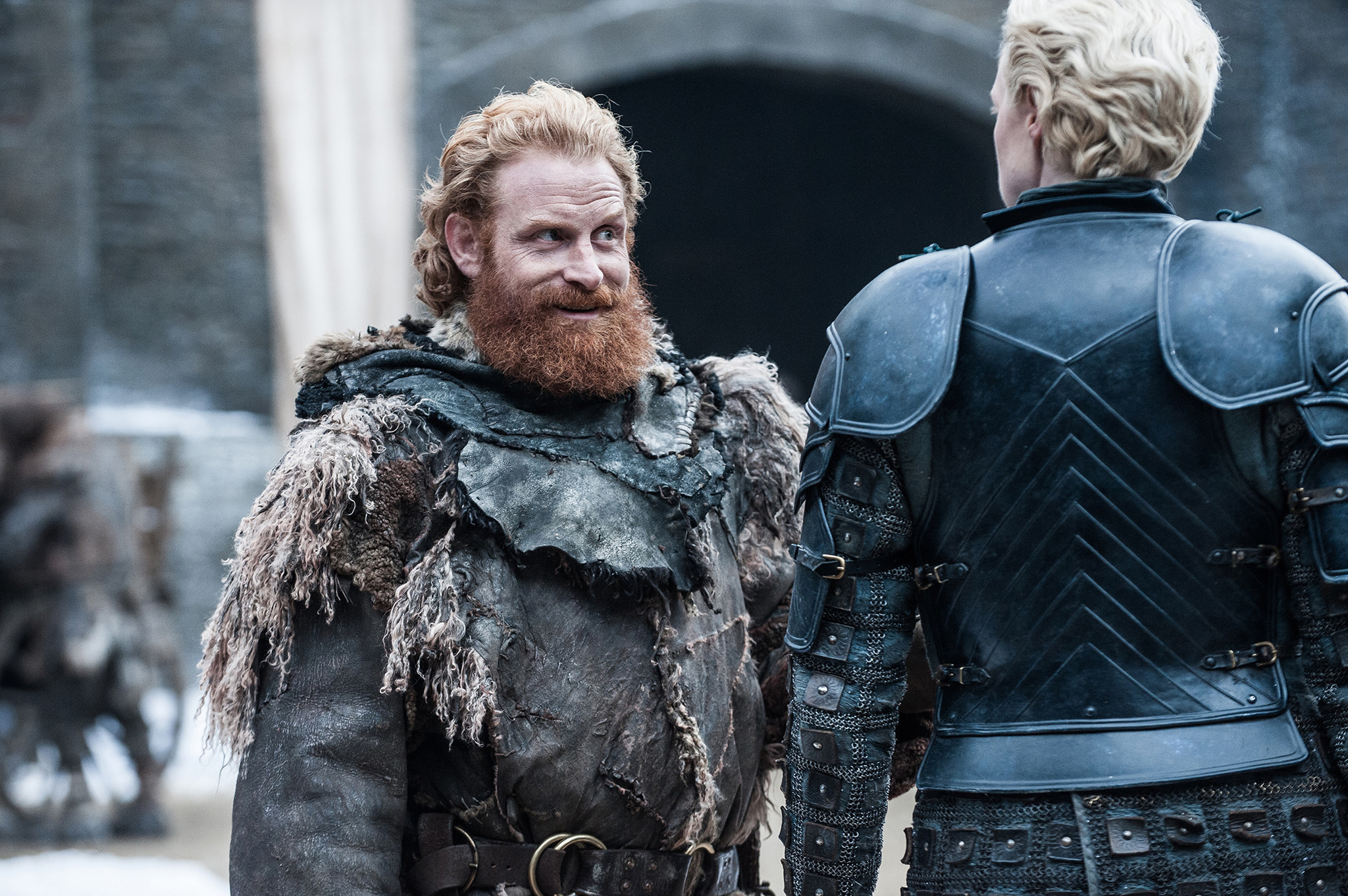
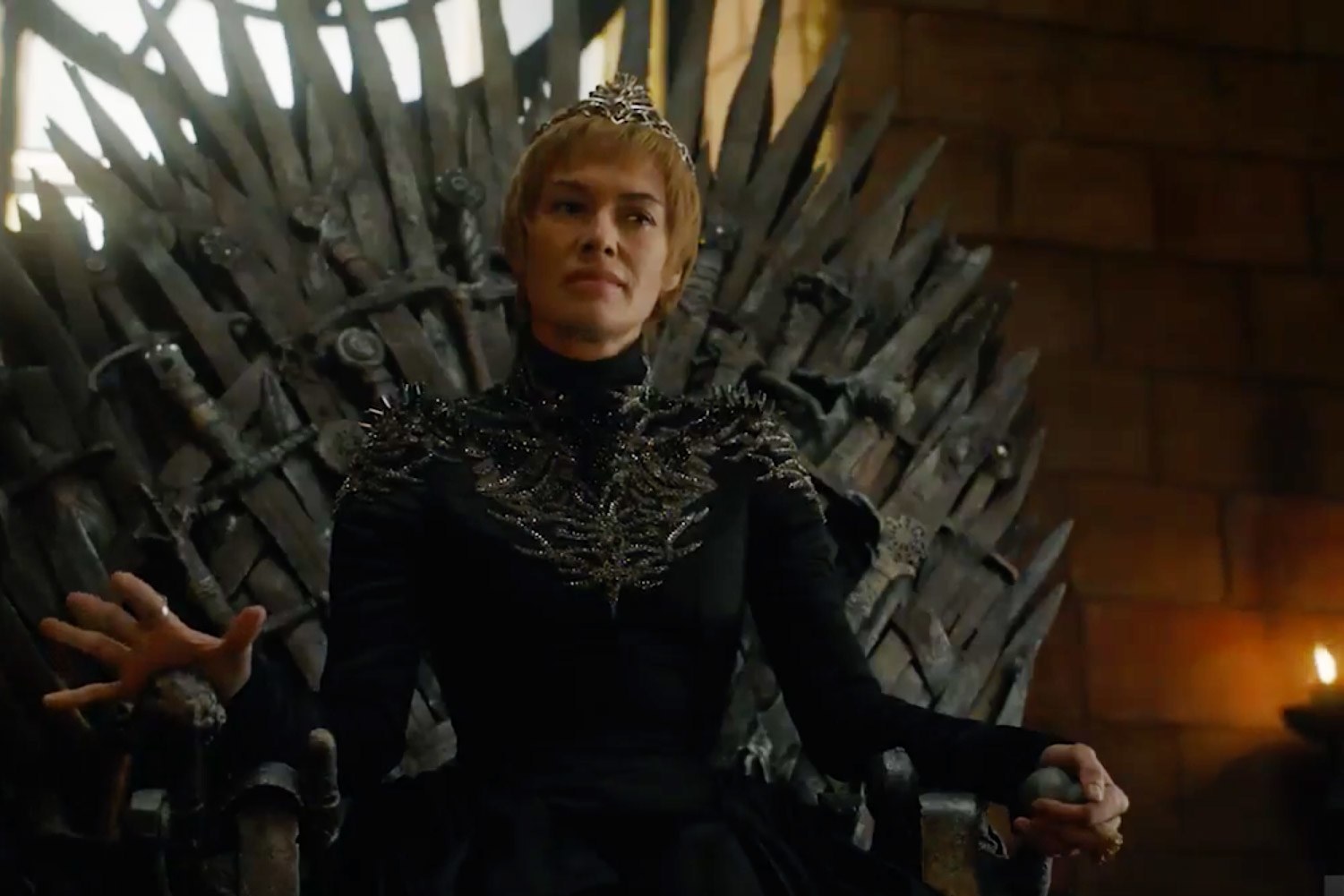
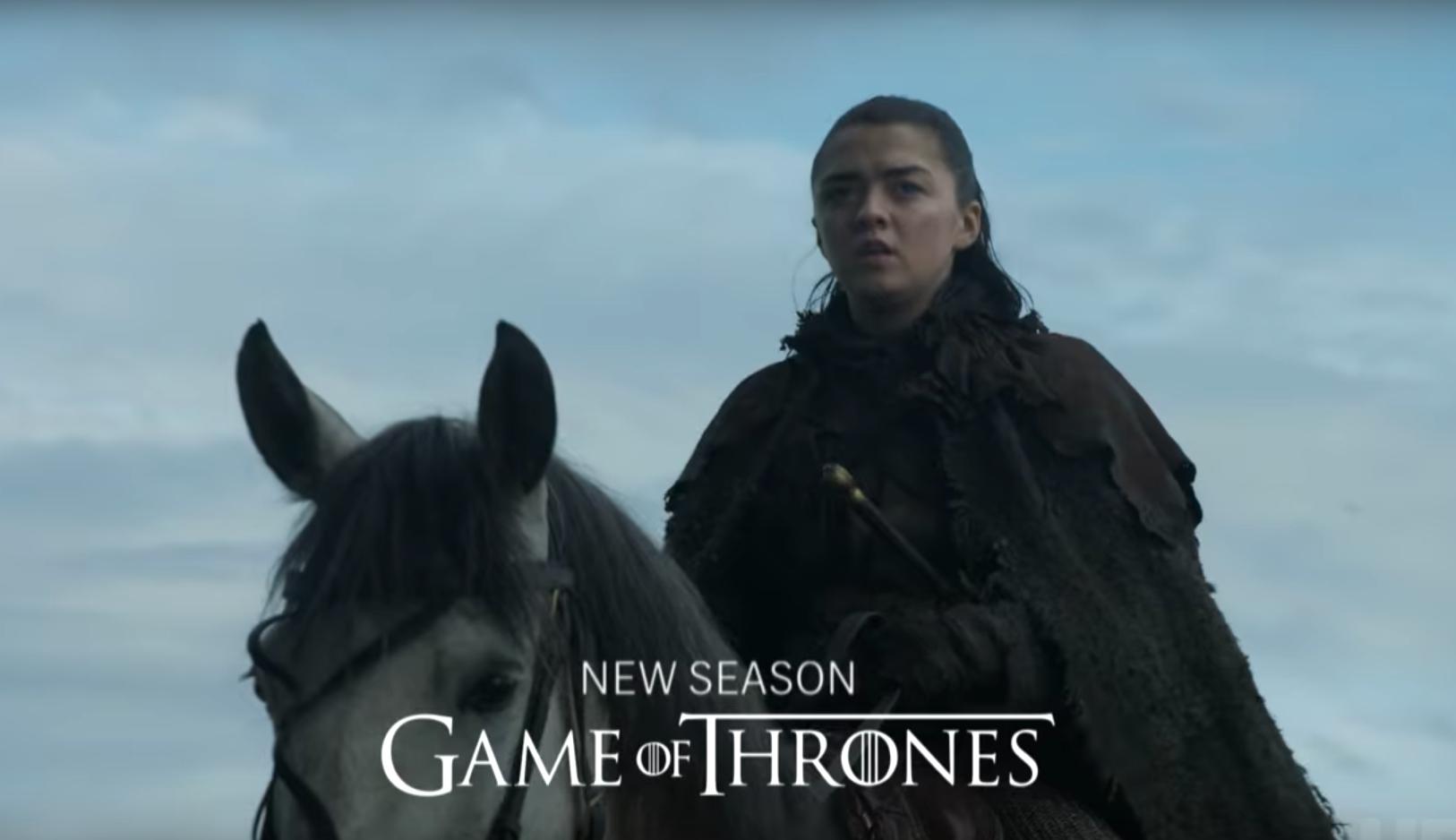
EVERYONE is now a screenwriter and while it is much fun to decide how you want the characters you love to behave, just because they do something slightly different to what you, or George R.R. Martin would do, it doesn’t mean it is bad writing or illogical. On the contrary Season 7 contained some exciting writing and an incredible amount of memorable moments. These included: Daenerys’ dragons wreaking havoc; the magnificent masculine mission beyond the Wall; Oleanna and Jamie’s words; Cersei’s continued despotic mania; a summit meeting between many of our major characters; the Hound; Jorah’s redemption; Arya’s special set of skills;the Night King and his horde; Jamie’s doubts; Brienne’s loyalty; the weirdo Bran; and all manner of incredible battle scenes on sea, air, ice and land.
These sequences plus many more and the great direction, acting, design and character twists throughout meant that I was transfixed from start to finish. I do agree that at times it felt rushed in places and ten episodes would have fleshed out some of the more temporal issues. But hey, it was still amazing from my perspective.
Game of Thrones, ultimately is a TV programmes with dragons and zombies and in between human beings attempting to out-plot and out-kill each other. I agree there was a more Shakespearean feel to the earlier episodes and we have experienced a shift from a literary style to the cinematic. However, I couldn’t care less and would advise the armchair screenwriters, clickbait critics and online trolls to cease bitching and stop watching the show if you don’t enjoy it any more. Because unlike this highly entertaining show YOU ARE GETTING VERY BORING!
I love Doctor Who and have written many times about it on this blog with reviews and articles. I think what I love about it most is that within the genre structure of a Time Lord and companions doing battle against foes is the fact that you can end up anywhere in time and space; in scientific reality and magical fantasy. Each episode contains surprise and mystery and imaginative ideas which draw you in again and again. So, here I go with a review of the at times completely genius, occasionally so-so, but mainly brilliant entertainment that is Season 10. If you also wish to read last season’s review please do so here.
SPOILERS AHEAD, DARLING
Couple of minor gripes before I start! Please stop with the preview spoilers BBC! There were too many dramatic surprises within the series given away across the TV screens and T’internet. Firstly Capaldi’s departure from the show AND John Simm would be coming back as The Master. Oh, and the origins of the Mondasian Cybermen was revealed too giving away another surprise from the exceptional double-headed finale. Lastly, now Chris Chibnall is to take over from Steven Moffat as showrunner, I hope he’ll dispense with the incessant characters dying and coming back to life trope. This has now literally been done to death. However, putting these minor grumbles aside I was very entertained by the season overall.
WHAT’S IN THE VAULT?
When the commanding character actor, musician, director and writer Peter Capaldi was announced as the new Doctor Who a few years ago, I was very excited. Here was an experienced actor full of gravitas, energy, wit, light and dark humour, who would no doubt bring his own vision to the role of the ancient Gallefreyan. And I was not disappointed at all! I really loved Capaldi’s Doctor because he was very rounded and in his face you could see the years of time-travelling experience. And wow – can he deliver a grandstanding monologue too!
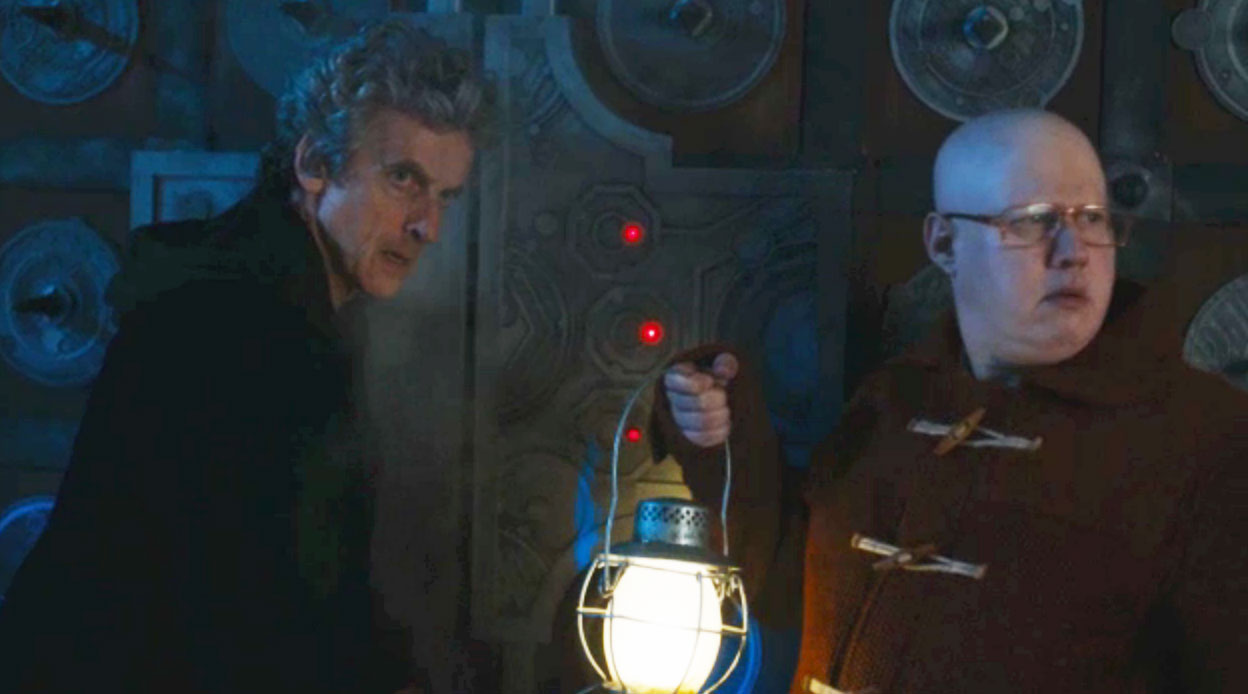
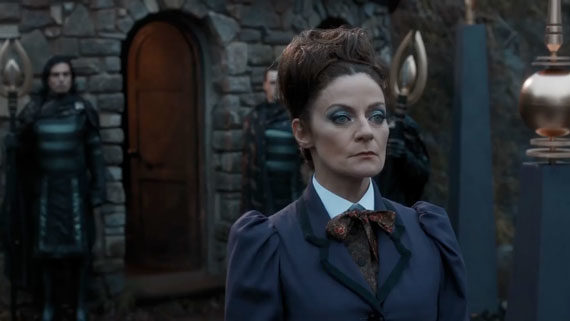
In Season 10, he was meant to be anchored to Earth guarding the Vault, having taken an oath to ensure Missy/The Master does not escape. Instead he attempted to redeem Missy – portrayed with devilish brio – by Michelle Gomez. Did he succeed? Well, it’s open to interpretation. Nonetheless, this story arc was way more convincing and emotional than Season 9’s confusing “Hybrid” arc. In fact, I’d say Steven Moffatt nailed the dramatic arc and emotion on this one.
THE NEW FACES
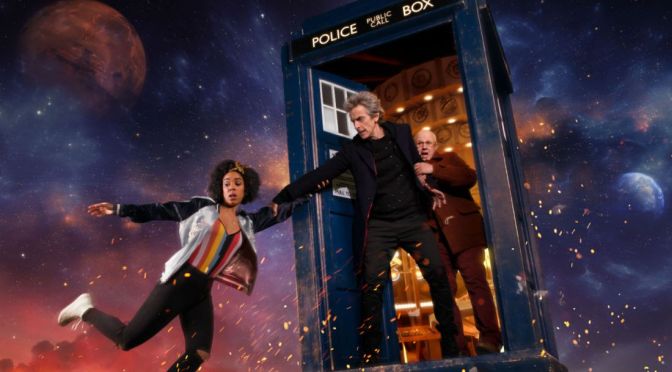
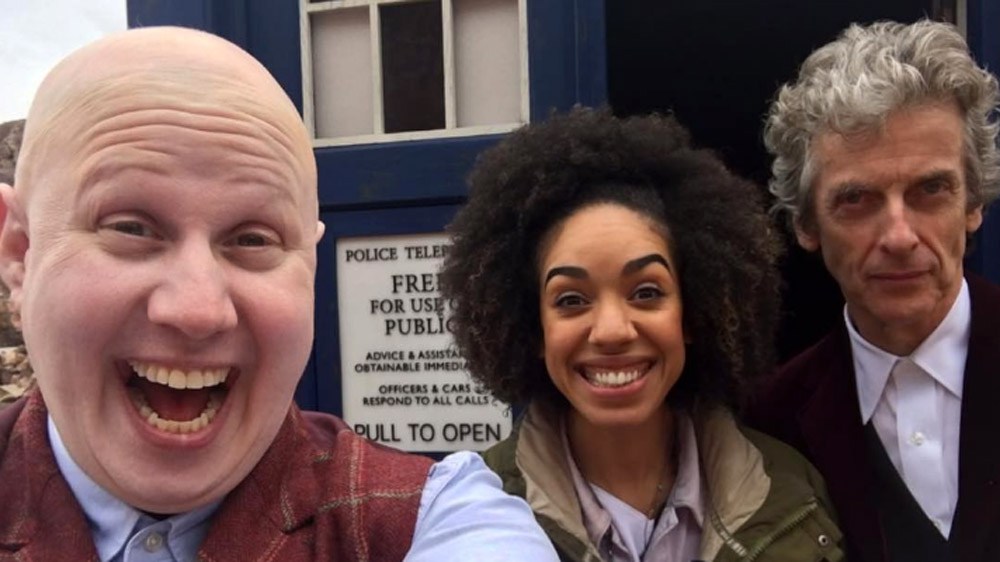
The Doctor, as well as looking after the Vault, found two new companions in tow. They were Bill Potts, played with a wide-eyed and naïve charm by Pearl Mackie. We also had a former rogue-but-now-kinda-sweet cyborg called Nardole, portrayed by the brilliant comedic actor Matt Lucas. In a terrific meta-gag from Steven Moffat, during World Enough and Time, Missy called them “Exposition” and “Comic Relief”; however, I think they were a bit more than that.
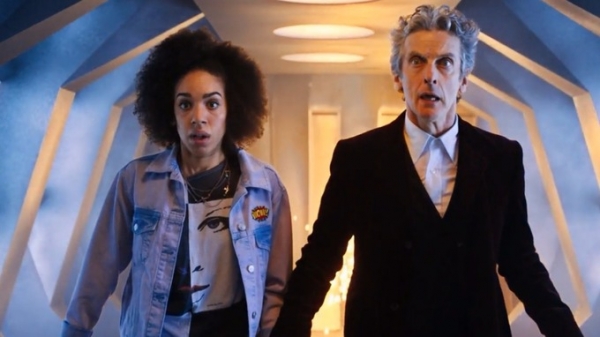
As usual the audience were reflected in Bill’s character as her initial wide-eyed and open-mouthed awe at the Doctor and the Tardis’ capabilities gave way to an awe and wonderment at the space adventures that ensued. Bill proved herself a valuable sidekick to the Doctor. She had a kind soul and there were some emotional pull to her due her being an orphan, plus being gay created an extra dynamic in the storylines as well as some humour too.
Nardole, on the other hand, was mainly played for laughs as he had some fantastic banter with the Doctor. Lucas did not go over-the-top wacky though and gave Nardole a world-weary trudge and set of grumpy looks and fine one-liners. At the same time he remained very loyal to the Doctor and really came into his own in the latter episodes when his hacking skills were used to combat the Cybermen.
THEMES
Thematically this season of Doctor Who was very strong. Of course the Doctor remained stalwart in his world view of protecting the oppressed against evil. But he also had a redemptive plan where Nardole and Missy were concerned. Reading between the lines it appeared Nardole had a shady past so the Doctor employs him to do right by his oath to guard Missy in the Vault. Missy however, was a more difficult proposition and during Extremis it is revealed the Doctor saves her from death, with a view to redeeming her soul. This theme plays out really well within the individual episodes, especially in the wonderful denouement of The Doctor Falls where Missy and her older self, The Master (fiendishly portrayed by John Simm) join forces against the Doctor; only for Missy to kind of atone and attempt to join the Doctor in the fight against the Cybermen.
Love was another powerful emotion and theme to pervade the season. The Doctor’s love for, or at least yearning for the childhood friendship he had with Missy/Master shone through during those final episodes. Bill’s love for her deceased Mother was palpable too, playing a big part in defeating the Monks in The Lie of the Land. Also, it was Bill’s love for Heather during the The Pilot episode which eventually saved her and the Doctor from certain death during The Doctor Falls. It was a big leap of faith in the storyline to believe this substantive narrative call-back, but I think it really worked and I was pleased Bill survived. What becomes of the Doctor we shall see?
The episodes generally were very strong and Doctor Who also gave some terrific social commentary in between the monsters, robots and general temporal trickery. Thin Ice critiqued racism, while Oxygen did the same with corporate greed. Rogue landlords and the student life were satirized in Knock Knock and most powerfully religious, medical and military control were examined and disparaged during the trilogy episodes: Extremis, Pyramid at the End of the World and Lie of the Land. Visually the show was also very striking with agricultural, urban and futuristic locales merging with some wonderful beasts, humanoids, robots and space zombie foes. Thus, overall, in my humble opinion, it was a very impressive and rich raft of Doctor Who episodes.
EPISODE REVIEW AND RATINGS (with more SPOLIERS)
THE PILOT – Steven Moffat
This was a terrific opening episode full of fine sci-fi and fantasy concepts which established a melancholic desire for belonging and love across the stars. Bill meets the Doctor and is pursued by a strange alien force in oil form and we see the Vault for the first time. (Mark: 8 out of 10)
SMILE – Frank Cottrell Bryce
Bill and The Doctor visit an Earth colony run by Emoji-faced robots which somehow had been programmed to treat grief and depression as a disease. A beautifully designed other world setting mixing future and agricultural landscapes is the strength of this episode. The Bill and Doctor dynamic also developed very nicely too. (Mark: 7.5 out of 10)
THIN ICE – Sarah Dollard
Set in London 1814, the story found a nasty English Toff exploiting a beast below the iced river of the Thames for super-fuel. Bill discovers the Doctor is not a stranger to death and as a critique of the racist and prejudicial nature of the upper classes the episode works very well. (Mark: 8 out of 10)
KNOCK-KNOCK – Mike Bartlett
Strange landlords, cockroaches and a house that eats people are the dangers that face Bill and her flatmates in this episode. David Suchet is on excellent form as the antagonist compelled to keep his Mother alive in a touching reveal at the story end. Capaldi’s Doctor is kind of in the background but, of course, comes to the fore when danger strikes. (Mark: 8 out of 10)
OXYGEN – Jamie Mathieson
This was a terrific episode set on a space station where the air is literally paid for by the breath. Space zombies run amok as the Doctor, Bill and Nardole join a panicked crew into battling both monsters and a capitalist algorithm hell-bent on increasing profits. It’s full of great space mechanics, plot twists and race-against-the-clock excitement. Plus, the biggest gut-kicker is the Doctor goes blind; and the ramifications are very dramatic in later episodes. (Mark: 8.5 out of 10)
EXTREMIS – Steve Moffat
This was a tricksy episode because, amidst the Doctor’s blindness, we also got the Doctor saving Missy from a fate worse than a fate worse than death. We also got The Monks who, similar to the skull-faced Silence were a religious baddie determined to take over Earth. It was wonderfully crafted with a fine Monty Python “Killing Joke” homage and convincing critique of organised religion and suicide cults. Arguably the simulacra-twist at the end undermined the drama a tad, but on second watch it was a very clever and well-written episode. (Mark: 8.5 out of 10)
THE PYRAMID AT THE END OF THE WORLD – Peter Harkness and Steven Moffat
Following on from the religion heavy previous episode here the writers took a swipe at the military and the scientific folly of humanity. The Monks now reveal themselves openly and clearly to the world and that they will save the Earth from a biochemical catastrophe. The most powerful aspect of this episode is Bill’s decision to save the Doctor’s sight even though it means the Monks gaining control. Here the emotional power of the script was impressive and Capaldi was awesome in both wit and gravitas. (Mark: 8 out of 10)
THE LIE OF THE LAND – Toby Whithouse
The Monks trilogy came to an end with the world plunged into a dystopic Big Brother style mind-controlling of stupid and gullible human beings. The Doctor has sided with the Monks and Bill and Nardole must track him down to attempt a reversal of fortune. Again Bill is at the centre of the emotion here as Pearl Mackie delivers a fine dramatic performance. Safe to say the Doctor and Bill’s love for her mother defeat the Monks somewhat fantastically but a strong denouement nonetheless. (Mark: 7.5 out of 10)
EMPRESS OF MARS – Mark Gatiss
A meta-mish-mash episode from Mark Gatiss, as Zulu meets the Icemen of Mars! This fast-paced episode was reminiscent of old Doctor Who as the British Empire soldiers find they are no match for the Icemen and their recently awoken Empress. A direct cousin to the Gatiss-penned episode Cold War, what it lacked in emotion it made up with in humour and derring-do. (Mark: 7 out of 10)
THE EATERS OF LIGHT – Rona Munro
More soldiers but this time the episode features the Picts and legendary 9th Roman Legion which mysteriously went missing in 2nd century Scotland. There was a lilting Celtic vibe to the music and cold landscape as a vicious beast feeds on the light and any humans in its way. I enjoyed the witty script and mix of historical and science fantasy made it very watchable indeed. (Mark: 7.5 out of 10)
WORLD ENOUGH AND TIME – Steve Moffat
This was my favourite episode of the season; only spoilt by the BBC ridiculous policy of giving away plot details in the trailers. Here the Doctor, Nardole and Bill land on a humungous space-ship over 400 miles high which is perilously close to a black hole. The Doctor gives Missy a chance to shine as er… The Doctor and much hilarity ensues. Michelle Gomez owns this episode and the moment she meets her past Master is a wonderful twist. I loved the duality of evil theme and the ship with different temporal states was just a brilliant concept from Moffat. Bill’s slow transition into a Mondasian Cyberman is directed with creepy imagery and fear-inducing dread; while Capaldi’s face when he realises he’s too late is damned heart-breaking. (Mark: 10 out of 10)
THE DOCTOR FALLS – Steven Moffat
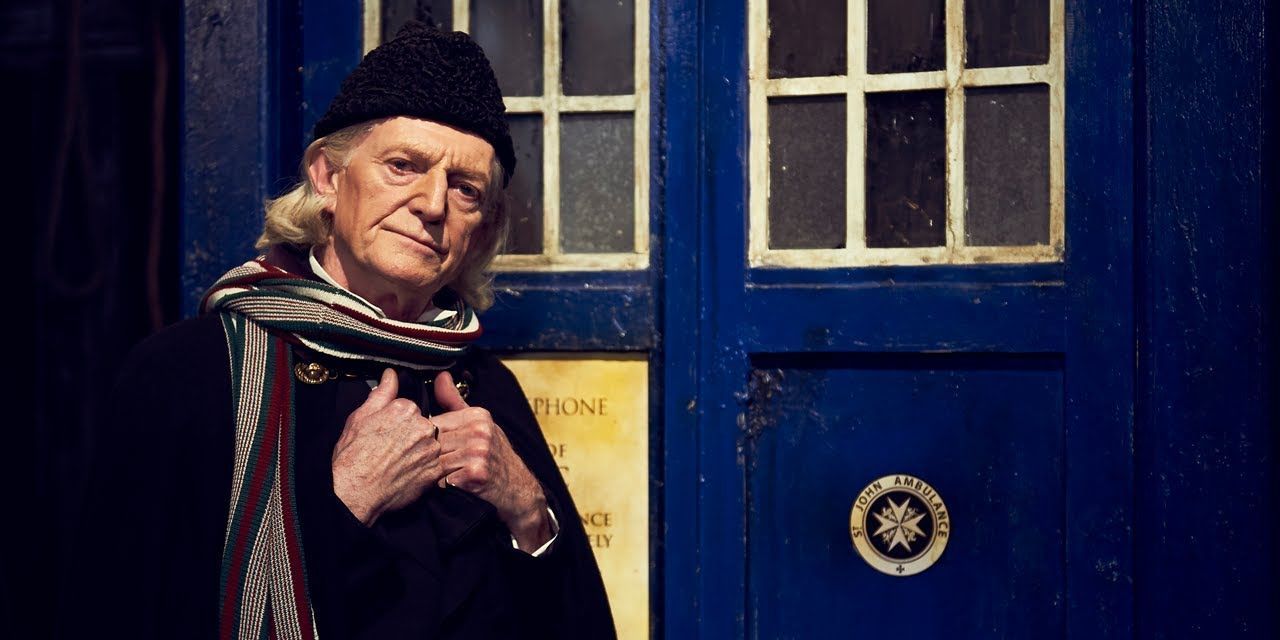
The Doctor, Nardole and Cyber-Bill join together to battle the gathering Cybernetic storm. In their way though are the old Master and an on-the-fence-good-bad Missy. Bill’s realisation that she is a Cyber-person adds real pathos, while the Missy/Master axis of evil contains some dark wit between the action. The Doctor stands strong, until even he cannot sustain life amidst the beatings, electrocutions and explosions he suffers. With the Doctor and Bill virtually dead, and the Master and Missy killing each other, it is left to Heather (from The Pilot) to save the day. It was a big narrative pill to swallow but I loved the sentiment of love conquering space and time. Lastly, the final image of the Doctor, dying in the snow, being found by his original self was a wonderful payoff to lead into the Capaldi’s regeneration episode.(Mark: 9 out of 10)
THE FUTURE
I read on the social media forums a lot that, amidst the more level-headed Dr Who fans, people are very critical of how the show has gone under Steven Moffat. Like a football supporter unhappy with their manager they have been complaining that Moffat’s writing is not very good and episodes have become stale and repetitive or even worse boring. Everyone is entitled to their opinion but I say to those people to stop watching.
Having viewed all of the rebooted Dr Who seasons many times I think, for a science-fiction family show screened at teatime on a Saturday it is actually on the main brilliant. Some of Moffat’s over-elaborate timey-wimey arcs have probably been too complex and fantastical, however, he has tried to be imaginative and experimental and for that should be congratulated. He has done great service to the grand Time Lord and he, the production crew, actors and writers should be proud of their wonderful efforts.
We await a new Doctor and a regenerating writing team led by Chris Chibnall of Broadchurch fame. Broadchurch was a brilliant police show set in a coastal community and if he can bring the emotion and depth of character to Doctor Who, I believe the show will be in safe hands. And who will be the next Doctor! Well, my choice would be the superb actor Reece Shearsmith and if they so happen to make the character female then I would go for Olivia Colman. Who it will be only time (and space) will tell.









 The Cinema Fix presents