The Cinema Fix presents: 12 Favourite Films of 2025!
Happy 2026! I feel like I have watched even more films last year at the cinema and the many streaming platforms.
My instinct is it’s been a decent year overall of quality films, especially from independent or what one would class as indie-minded filmmakers. The bigger budgeted films or traditional blockbusters have been mainly not great or I just didn’t enjoy them. Aside from perhaps the entertaining Mission: Impossible finale.
Of all the genres, horror has really risen to the top in terms of overall quality the last few years, doing big box office and being recognised at awards ceremonies too. Having said that, and this could be my age and is nostalgia-driven, I find myself enjoying older, cult and more obscure film releases than the today’s modern film releases.
Anyway, here my my 12 FAVOURITE films of 2025. Not the BEST films, but the ones I enjoyed the most. There’s a few high quality, critically acclaimed films which do not make the list including Train Dreams (2025), Sorry, Baby (2025), Eddington (2025), Warfare (2025), Good Boy (2025), The Brutalist (2024) andI’m Still Here (2024), but remember these are my FAVOURITE films of the year.
For reference my favourite films of 2024 are below and here.
ALL OF US STRANGERS (2023) AMERICAN FICTION (2023) HERETIC (2024) THE HOLDOVERS (2023) THE IRON CLAW (2023) LATE NIGHT WITH THE DEVIL (2023) MONSTER (2023) POOR THINGS (2023) THE QUIET GIRL (2023) SPEAK NO EVIL (2024) THE SUBSTANCE (2024) THE ZONE OF INTEREST (2023)
Netflix’s auteur-driven cinema push has seen the platform hand enormous creative freedom—and budgets—to filmmakers like Noah Baumbach, Rian Johnson, Kathryn Bigelow, Edward Berger, and Guillermo del Toro, pairing them with world-class casts and top-tier crews to produce works of unmistakably cinematic ambition.
The paradox is that many of these films—designed with theatrical scale, craft, and seriousness—ultimately premiere to mass audiences via Netflix’s online platform rather than traditional movie theatres, reflecting a fundamental shift in how prestige cinema is financed, distributed, and culturally consumed in the streaming era.
What can you do? Well, pay the Netflix subscription and watch them from the comfort of one’s living room. Here are my reviews with usual marks out of eleven. Happy 2026!
A House of Dynamite (2025)
Kathryn Bigelow’s A House of Dynamite (2025) is an expertly directed and intriguingly structured disaster movie, unfolding across three interlocking chapters that chart a nuclear attack on the United States by an unknown enemy. Each section reframes the same escalating crisis through a different lens—the White House intelligence apparatus, the military response, and the political sphere—culminating in the perspective of the President, played with sensitivity and gravitas by Idris Elba.
As events overlap and repeat, the script cleverly ratchets up tension, revealing new information through subtle shifts in context, while Bigelow’s command of pacing and scale, combined with sterling filmmaking and a who’s-who ensemble cast, keeps the film gripping on a moment-to-moment level. Yet for all its craft, the film ultimately plays like a fear-mongering piece of propaganda and an implicit recruitment advert for the U.S. government and military. Its refusal to name a perpetrator suggest the U.S. has many enemies thus justifying huge spending on defence and weapons. The abrupt ending could be interpreted as brave storytelling, but for me it undercut the suspense, leaving the experience feeling oddly hollow and non-plussed rather than provocatively unresolved.
Mark: 6 out of 11
Ballad of a Small Player (2025)
The Ballad of a Small Player (2025) follows Lord Doyle, played by a magnetic Colin Farrell, as he lies low in Macau, numbing himself on casino floors with deep debt, bad bets, and the stubborn hope that the next hand will fix everything. Farrell is phenomenal here, turning compulsive gambling into a form of slow self-harm, his performance layered with exhaustion, bravado, and quiet panic. When he’s offered a fragile lifeline by the enigmatic Dao Ming, played with poised restraint by Fala Chen, the film hints at redemption.
Director Edward Berger and his production team deliver a ravishingly beautiful film, capturing Macau’s neon glow and claustrophobic interiors as both seduction and trap. At its best, the film is a melancholy character study about addiction for a protagonist who is often deeply annoying and morally bankrupt. However, the final act falters, introducing fuzzy, unearned twists that soften the film’s harder truths and dilute its emotional impact. While the journey is engrossing and Farrell’s performance alone makes the film worth seeing, the conclusion ultimately cheats the audience out of a powerful Uncut Gems (2019)-style denouement.
Mark: 7 out of 11
Frankenstein (2025)
Is Guillermo Del Toro’s big budget adaptation of Mary Shelley’s classic gothic novel really necessary? There are much better versions out there, yet, Netflix and Del Toro certainly thought so. Oscar Isaac is a great actor but miscast or misdirected here for me. Then again, even in Shelley’s seminal novel Dr Frankenstein is a colossal whinger! Thankfully, Jacob Elordi gives a hearty and emotional rendition of the tragic creature, who again is the most interesting character. Safe to say the majestic production values provide a visual and aural feast, but, aside from a scintillating opening in the North Pole, Del Toro’s slog of a script ultimately fails to bring Shelley’s story to life in a sustained enjoyable fashion. Don’t get me wrong, the production and design is of the highest order but I just didn’t connect emotionally or philosophically or even as a horror fan.
Mark: 6 out of 11
Jay Kelly (2025)
Jay Kelly (2025) is a mild, reflective comedy drama that sees George Clooney doing what he’s long perfected: playing a famous film star grappling with past and present relationships while barely appearing to break a sweat. As Kelly travels to Tuscany to collect a lifetime achievement award, the film drifts between memories, regrets, and professional compromises, offering Clooney ample opportunity to deploy his trademark charm—stretching his range (not), but doing so with effortless ease. The more grounded emotional texture comes from Adam Sandler, who is quietly excellent as Kelly’s long-suffering manager, bringing a lived-in, humane quality that feels more emotionally honest.
Director Noah Baumbach has delivered far sharper and more incisive work and Jay Kelly (2025) never quite pushes its Hollywood satire of spoiled first-world creatives as far as it could. Still, there’s an undeniable pleasure in Baumbach’s dialogue and structure, with clear echoes of Wild Strawberries (1957) and 8½ (1963) filtering through in its introspective, memory-haunted moments. The film ultimately has its cake and eats it—content to indulge its characters rather than interrogate them—but it remains a very pleasant cake all the same: soft, well-made, and easy to enjoy.
Mark: 7 out of 11
Wake Up Dead Man: A Knives Out Mystery (2025)
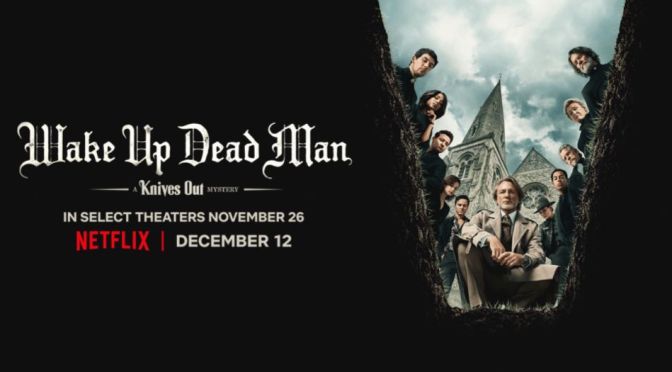
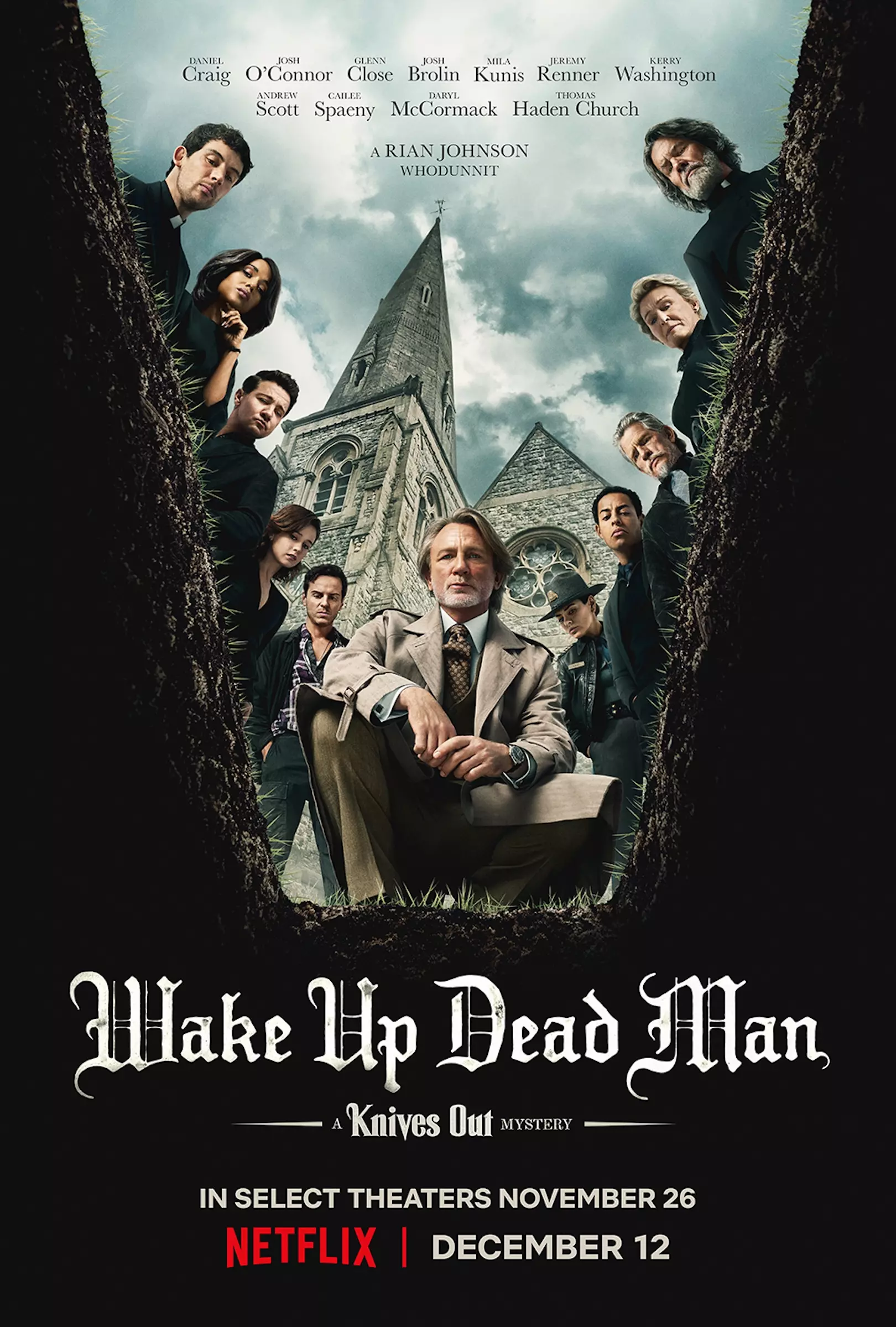
Wake Up Dead Man (2025) stands as the clear high point of Netflix’s auteur-driven releases from November and December 2025, confirming Rian Johnson as a post-modern master of the classical whodunnit. Once again drawing from the elegant clockwork of Agatha Christie’s works, Johnson constructs a devilishly complicated mystery centred on the murder of the tyrannical Monsignor Wicks, played with thunderous menace by Josh Brolin. The suspect list is gloriously stacked—church staff and parishioners portrayed by Glenn Close, Jeremy Renner, Kerry Washington, Andrew Scott, Cailee Spaeny, Daryl McCormack, Thomas Haden Church, and a young visiting priest, Jud Duplenticy (Josh O’Connor)—each performance feeding into a puzzle that’s as playful as it is precise.
What elevates the film beyond genre excellence is its sharply observed character work, particularly in the portrayal of Wicks as a Trump-like authoritarian figure ruling his congregation through fear and humiliation. Johnson smartly frames the mystery as a moral clash between Old Testament wrath and New Testament compassion, allowing the film to interrogate power, faith, and hypocrisy without ever losing its entertainment value. The script crackles with brilliant one-liners and sly, witty exchanges, especially when Daniel Craig’s Poirot-style detective peels back layers of deceit with theatrical relish. Among the ensemble, Josh O’Connor delivers a superbly nuanced performance, injecting emotional specificity and intelligence that rise above what could have been more generic material. Clever, funny, thematically sharp, and immaculately engineered, Wake Up Dead Man isn’t just Netflix’s best auteur offering of the season—it’s one of Johnson’s most satisfying achievements to date.
In the languid drift of autumn, when Halloween’s shadow lengthens and winter begins its slow, expectant inhale, the world seems to slip into a more suggestive register—one where every rustling leaf feels like a whispered omen. It is, of course, the most appropriate season to surrender to the year’s latest horror releases, as though communing with these cinematic phantoms might prepare us—spiritually, aesthetically—for the deeper darkness to come.
Which basically means I have been catching up with some 2025 horror film releases I missed at the cinema during autumn. A couple of these probably warrant more in depth solo reviews, but as I edge closer to old age and the reaper’s scythe, I am economizing somewhat.
*** MAY CONTAIN SPOILERS ***
Black Phone 2 (2025)
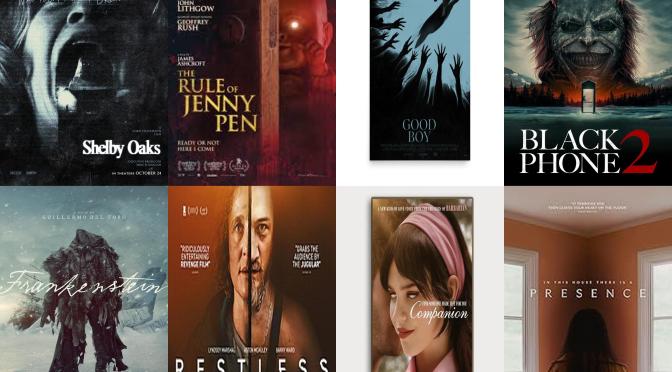
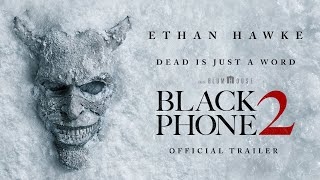
Scott Derrickson and co-writer C. Robert Cargill deliver a sequel to The Black Phone (2021) with Mason Thames, Madeleine McGraw, Jeremy Davies, and Ethan Hawke reprising their roles from the first chiller. I actually enjoyed this one more than the original, which despite the clunky set-up, finds the siblings and others trapped in a teen camp hit by a blizzard. They find themselves hunted and haunted by both The Grabber (Hawke) and other ghostly spirits haunting the area. Derrikson throws a lot of horror tropes and the characters (literally in certain scenes) at the walls, and much of it sticks. Having said that, I still don’t think The Grabber is the scariest villain ever committed to screen, despite Hawke’s presence. (Mark: 7.5 out of 11)
Companion (2025)
Companion (2025) feels like Garland’s Ex Machina (2014) colliding elegantly with Fargeat’s feral Revenge (2017)—a sunny day-horror fable that hides its nastiest surprises in plain sight. Its twists are sharp, its aesthetic confident, and its ideas far more ambitious than its modest surface first suggests. I would have admired it even more were it not, on occasions, completely dumb. Plus, the occasional drift into a comedic register undercuts its more incisive moments. The beautiful Sophie Thatcher once again commands the screen with the same riveting presence she brought to Heretic (2024). Mark: 8 out of 11.
Graduation Day (1981)
Thanks to Bobby Carroll’s site for reminding me about slasher film, Graduation Day (1981), as I had completely forgotten about it. High quality kills and gore mask a screenplay which has more nudity than character development. Yet, I am a sucker for these 1980’s exploitation flicks and this is a watchable one. Mark: 6 out of 11
Good Boy (2025)
An low-budget horror film triumph with Ben Leonberg directing his own dog, Indy, a Nova Scotia Duck Tolling Retriever, as the only witness to nasty spirits threatening his owner. The film emerges as a formal tour-de-force, whose meticulous composition and deliberate pacing elevate its simple premise into something unexpectedly resonant. Its visual precision and rhythmic control shape an atmosphere of dread that feels more sculpted than sensational, grounding the film in an emotionally impactful narrative about loyalty, vulnerability, and the unsettling spaces between trust and fear. For all its craft, and impressive animal direction, the film doesn’t quite sustain a relentless menace throughout. But, it remains a memorable feature debut from Leonberg and Indy the dog. Mark: 8.5 out of 11.
Presence (2025)
In Presence (2024), David Koepp and Steven Soderbergh demonstrate just how potent a one-location horror film can be when discipline and imagination converge. The entire piece unfolds like a controlled exhale: a slow-build structure that trusts the audience to lean in, and a drifting, almost contemplative camera that adopts the ghost’s POV to quietly—sometimes imperceptibly—reveal fragments of the story. Instead of overplaying its hand, the film slow-drips its plot elements with an elegance that keeps tension suspended in the air, letting unease pool in the corners of an otherwise ordinary space. By the time it reaches its finale, Presence (2024) delivers not only a surge of emotional and thematic clarity but two genuinely surprising twists—earned, unsettling, and executed with the kind of precision that affirms both writer and directors’ mastery of the form. Mark: 8.5 out of 11.
Restless (2024)
Really good independent British thriller with Lyndsey Marshal as a nurse, Nicky, who finds herself terrorized by 24-hour partying thug neighbours. Writer-director Jed Hart creates great empathy and identification with the situation and it’s a shame decent British films like this get short shrift at the multiplexes. Nicky’s spiral into insomnia-driven madness is compelling as her desperate attempts to sleep give way to vengeance. But the film’s final act tonal turn denies us a full-on descent into suburban hell, for something amenable but unfortunately less twisted. Mark: 7.5 out of 11
The Rule of Jenny Pen (2025)
The Rule of Jenny Pen is an original, weird, and powerful shock of a film — a mash-up of psychological thriller and nursing-home horror that lands far more often than it stumbles. Its greatest strength is, without question, the towering performances at its centre. Geoffrey Rush and John Lithgow, two masters of calibrated gravitas, turn the film’s cat-and-mouse mind game into a gripping acting showcase. Together, they elevate the film’s themes of aging, vulnerability, and institutional neglect into something both unsettling and strangely beautiful. The plotting, however, does get a bit sticky toward the end. The final act jars slightly, causing me confusion in an otherwise tight psychological narrative. Still, even as the story wobbles a tad, the film’s originality, eerie tone, and powerhouse acting keep it compelling. Mark: 8 out of 11
The Woman in the Yard (2025)
The Woman in the Yard (2025) rises on the strength of Danielle Deadwyler’s commanding lead performance. As a mother trying to protect her two children from a funereal spirit lingering in their backyard, Deadwyler grounds the supernatural dread with raw emotional honesty. The child actors match her with a believable, lived-in family dynamic that makes the haunting feel all the more personal. Where the film falters is in its structure. The script leans heavily on crow-barred flashbacks that interrupt rather than enrich the unfolding tension. A more linear approach could have built a stronger emotional momentum, allowing the story’s grief, guilt, and mental illness to accumulate naturally instead of stuttering backward at key moments. (Mark: 6 out of 11)
Together (2025)
Together (2025) gets an immediate boost from the casting of real-life couple Alison Brie and Dave Franco, whose natural chemistry gives the film an authentic emotional core. As a pair trying to rebuild their relationship after moving from the city to a rural small town, they convincingly inhabit the tensions, resentments, and unspoken fears that surface long before the horror does. Their incompatible expectations feel lived-in — and once they tumble into a sinkhole and the strange bodily transformations begin, that emotional groundwork makes the nightmare hit harder.
I loved the trailer for this film, which promised a truly skin-crawling descent into body-horror chaos. The final product, while atmospheric and often engrossing, doesn’t fully deliver on that promise. It pulls back when it could push further, leaving some of the more disgusting, surreal possibilities off-screen. But the ending — bold, surprising and unexpectedly poignant — is a fantastic payoff. Even if the film doesn’t always reach the extremes it teases, Together still manages to leave a memorably twisted impression. Mark: 8.5 out of 11
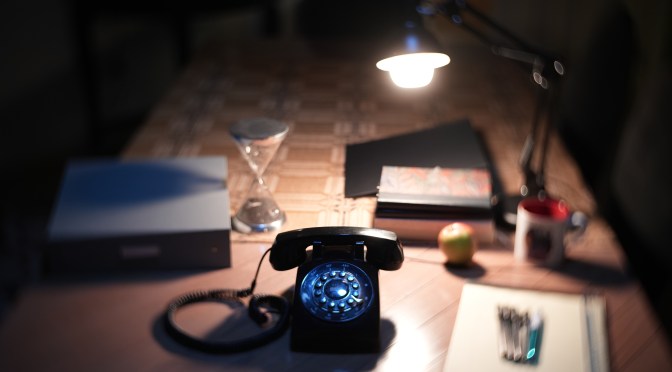
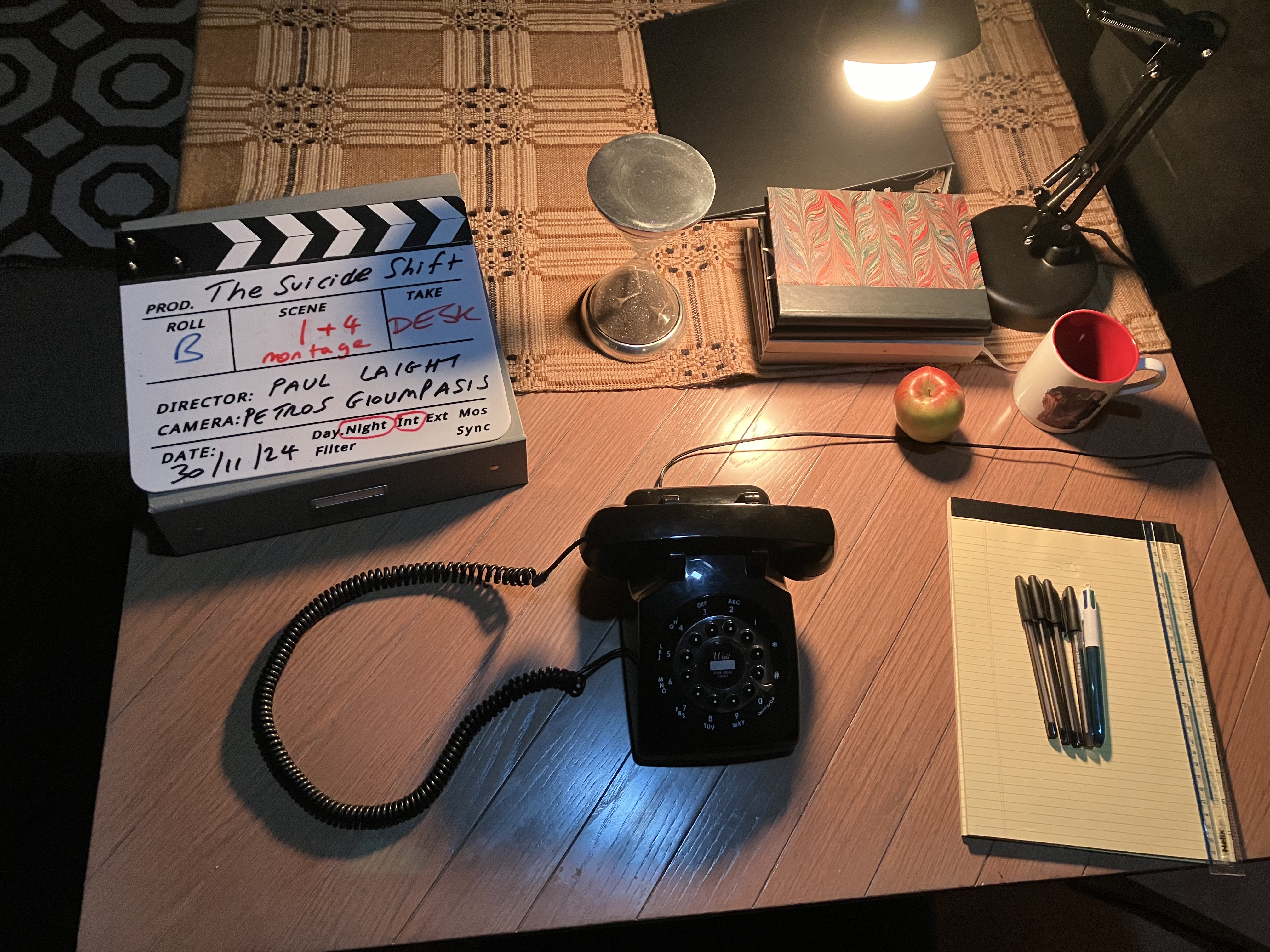
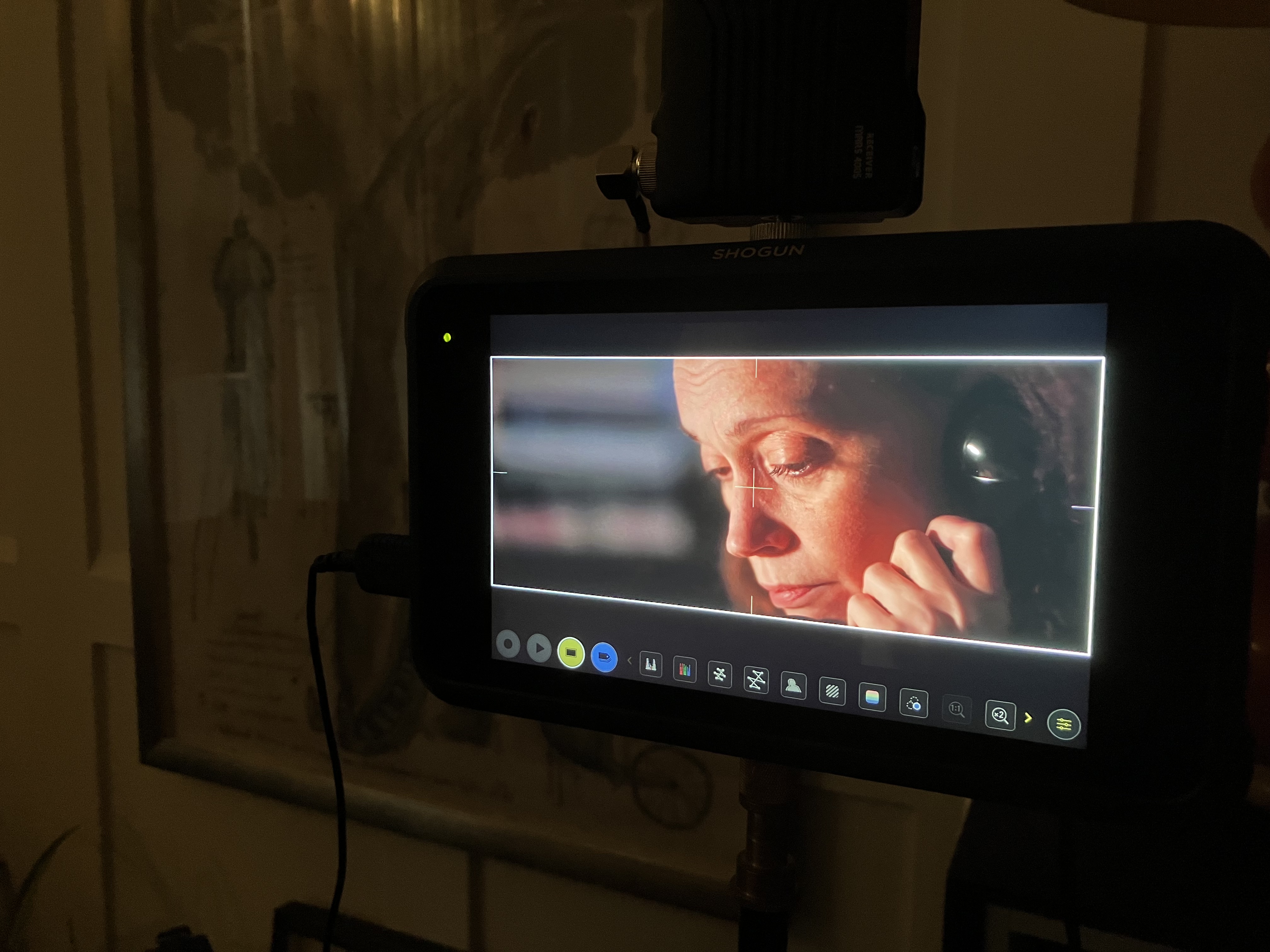
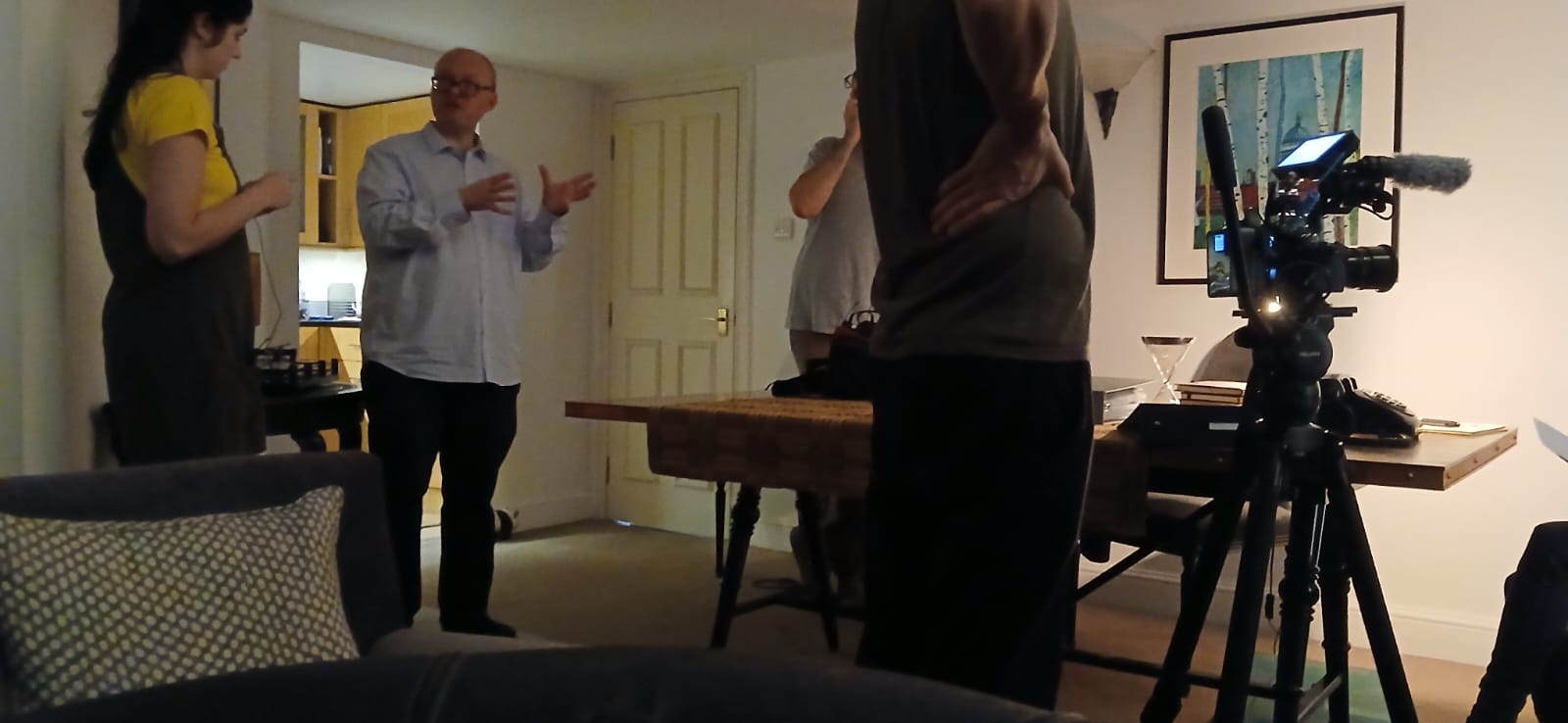
During 2024 I began planning a new short film and was keen to springboard a new horror idea from something simple around the flat I live in. I decided therefore to check out the various props I had and found an old black phone and an hourglass. From those props I began thinking about how the passing of time and communication could be used as a means of creating emotional conflict for the characters and elicit a sense of dread and fear from the audience. From these thoughts I began writing a script that eventually became called The Suicide Shift (2025).
Pre-production for the film took place during 2024 and I put together a really talented cast and crew all with a very low budget. The filming took place at the end of November 2024 over two extremely productive days of shooting. The Suicide Shift (2025) is now in post-production with a release planned for 2025!
Theme and genre
The Suicide Shift (2025) further develops themes of hell, work and being trapped, previously explored in short films, Hell Is. . . (2013) and Inferis (2024). I was inspired to write a film which dealt with suicide. Mainly due to my own personal experience of losing two close friends who took their own life. I am using the film to highlight the tragedy of people who take their life and meditate on the possible reasons such events take place. I am classing the film as emotional horror.
I have set the film in the genre of psychological, supernatural horror as the horror film allows a filmmaker to explore deep themes while also raising emotion and suspense with the audience. The low-budget production relies heavily on performance, actor reaction, silence, and sound, aiming to be both powerfully dramatic and disturbing. It is set in a few locations but was filmed in one place with limited props and cast.
Logline
Banished to the “suicide shift” for breaking spirit call centre regulations, CARMILLA FERRY, now deals with the most tortured of souls moving from this world to the next. After being blasted by her line manager on the phone, Russell, Carmilla is feeling even more isolated and demoralised than usual. After a series of heart-crushing calls, culminating in a particularly stressful shift, Carmilla is then faced with the most heart-wrenching call of all.
Pitch Outline
In mythical days past, the souls of the dead were carried to the other side by Charon the Ferryman. In the present, the handling of souls has now been modernised and is managed by call centres run by managerial bureaucrats and office workers who exist in limbo, somewhere between heaven, hell and the mortal world.
It is the spirit call centre’s job to manage the dying as they pass into the next world. The employees are not allowed to intervene. Only coordinate, process and record death. The workers communicate via a supernatural telecom system which is heard in the mind of the dying. Any worker who intervenes risks having to work alone in ‘Limbo’.
Banished to the ‘Suicide Shift’ for breaking spirit call centre regulations, CARMILLA FERRY, now deals with the most tortured of souls moving from this world to the next. After being blasted by her manager, RUSSELL, on the phone, Carmilla is feeling even more bullied, isolated, and demoralised than usual. Especially because Russell will not let her see her teenage daughter, a mortal named, Lucy. Russell controls everything and watches Carmilla via a CCTV camera and screens.
During a particularly stressful shift, Carmilla has had to deal with a whole night of heart-crushing calls from the dying. Then, in the early hours of the morning Lucy is suddenly put through to Carmilla having taken an overdose at a party. Carmilla must listen as her frightened daughter’s life slowly drifts away, powerless to intervene. The true horror of work and existence dawns on her.
Looking for something horrifying to watch during Halloween. Well you could do far worse than getting a Shudder subscription.
A few months a year I sign up and binge bloody disgusting and scary films as my previous reviews testify. Check them out here!
This year I have done the same and watched some really good, terribly bad and hideously ugly horror films via Shudder. Peruse my short reviews below. In alphabetical order with marks out of eleven.
Host (2020)
A terrific low-budget British indie film that explores the dangers of angering ghosts during a Zoom call. While the mildly irritating characters don’t realize they can simply end the online séance, it’s still a spooky, suspenseful, and fast-paced horror flick. I’m not usually a fan of the found footage genre, but this was very well made and highly creepy. Mark: 8 out of 11
In A Violent Nature (2024)
This director will probably have an amazing career. But this film was, despite some wonderful practical-effect driven gore, SO slow and boring. The film satirizes classic horror tropes, mocking their clichés with a heavy hand. The director’s pretentious style and inflated sense of artistic ego drain the audience of any real suspense or tension. The attempt at highbrow genre obfuscation creates a hollow spectacle. Shot from behind, the killer stalks twenty-somethings in the woods in the style of Son of Saul (2015) meets every slasher film ever. Ultimately, suffering from atrocious dialogue, bad plotting and weak characterization, the visual flair fails to save a film which feels more like an exercise in intellectual vanity than a gripping thriller. Mark: 5 out of 11
With echoes of the recent Inside No. 9 (3×3 quiz show episode) and BBC show Ghostwatch (1992), and of course The Exorcist (1973), Late Night With the Devil (2023) is one of the most enjoyable and imaginative horror films I have seen in sometime. One of the best horror films of the decade. Check out my longer review here. Mark: 9 out of 11
Pyewacket (2017)
Nicole Munoz’ isolated teenager summons a witch via a ritual and unleashes something not particularly scary or even present. All set-up and no catharsis! A waste of everyone’s time. Mark: 4 out of 11
Revealer (2022)
One of the best pitches I have read in a while – “A stripper and religious protester are trapped together in a peep show booth and must come together to survive the apocalypse in 1980’s Chicago!” does not unfortunately live up to expectations. However, there’s a decent female buddy dynamic and some imaginative gore which channels early Raimi, Jackson and Carpenter. Mark: 6 out of 11
Room 237 (2012)
For Stanley Kubrick completists, this fascinating documentary is divided into nine sections, with each one exploring a different aspect of The Shining (1980). Hidden theories buried under the surface relate to faked moon landings, Native American genocide and the holocaust are some of the ideas chucked at the wall. While some may stick and some don’t, it’s lovingly made and always fascinating. Mark: 8 out of 11
Skinamarink (2022)
Skinamarink was a major letdown for me, especially given the high expectations after its impressive financial success. With a $15,000 budget, it garnered over $2.1 million at the box office, creating a buzz around its unconventional style and promise of fresh horror. But despite its atmospheric tension and experimental approach, I felt the film didn’t live up to the hype. The slow pacing, abstract narrative, and reliance on ambient sounds and shadows left me unmoved. It’s an original, art-house horror so surprised it crossed over. Filmmaker, Kyle Edward Ball, clearly has a distinctive voice though. Mark: 6 out of 11
Stop Motion (2023)
The animation in Stopmotion (2023) showcases Robert Morgan’s genius, with his signature blend of hauntingly detailed stop-motion work that creates an eerie, tactile atmosphere. His craftsmanship brings a nightmarish quality to life, adding unsettling textures and depth that pull the audience into a world of psychological horror. However, while the animation excels, the plot—reminiscent of Repulsion—struggles to connect on a human level. The surreal visuals overshadow the character’s psychological journey, making it hard for viewers to engage with the protagonist’s inner turmoil, leaving the story feeling more distant and abstract than compelling. Mark: 6.5 out of 11
Superdeep (2020)
The Russian horror film Superdeep feels like a patchwork of borrowed elements from better-known sci-fi and horror movies, but without their finesse or originality. It mimics the claustrophobic tension of The Thing, the body horror of Alien, and the descent into madness of Event Horizon, yet fails to capture the essence that made those films effective. Derivative and ineffective, it at least has some ridiculously bad monster effects at the end that had me laughing. Mark: 4 out of 11
The Coffee Table (2022)
The Coffee Table is a twisted and darkly humorous horror film that pushes the boundaries of discomfort while delivering a sharp, satirical take on the horrors of parenthood. The film’s sick sense of humor blends with its unsettling premise, as it uses a seemingly mundane object—a coffee table—as the catalyst for an absurd but terrifying chain of events. Its pitch-black comedy amplifies the tension, making the film both deeply disturbing and strangely cathartic for those who understand the pressures of raising children. It’s a fearless examination of the darker side of family life, where humor and horror collide to expose the anxieties and struggles that often go unspoken. Mark: 8 out of 11
We All Went to the World’s Fair (2021)
We All Went to the World’s Fair (2021) falls short both as a horror film and as a rites of passage story. Its eerie, slow-burn approach creates an unsettling atmosphere, but the lack of a clear, escalating threat leaves it feeling aimless. Switching protagonists at the end does not work, and despite an excellent performance from Anna Cobb, the film spoils an intriguing premise. Mark: 5.5 out of 11
Where Evil Lurks (2023)
Where Evil Lurks(2023) skillfully employs well-known horror tropes—such as viral infection and monstrous transformations of humans—to deliver a fresh and intense experience. The film taps into the fear of contagion, using the idea of a mysterious, spreading evil that corrupts and distorts its victims. This viral-like menace is combined with disturbing body horror, as infected humans gradually turn into something grotesque and monstrous, making the familiar threat feel visceral and terrifying. The gradual, creeping transformation of people into monstrous figures is done with chilling precision, playing on the fear of losing control of one’s body and mind. By grounding these tropes in a strong narrative and unsettling atmosphere, the film elevates the horror elements, using them to amplify its emotional and psychological impact. Mark: 8.5 out of 11
As regular readers of my blog will know I am a massive fan of horror films. So much so I will often theme my monthly viewing around the genre, then consolidate the reviews in one post. Here are two of the most recent posts:
For the month of June and bleeding into July, I solely focused on horror films streaming on Netflix. So, here are short reviews of the many films I watched that are currently available on Netflix!
*** CONTAINS PLOT SPOILERS ***
A CLASSIC HORROR STORY (2021)
Italian shocker that echoes Midsommar (2019), Scream 3 (2000) and The Ritual (2017). The script is meta-clever and there’s some decent gore, but overall it lacks emotional empathy for the characters. More of a knowing film satire rather than being proper scary. Mark: 6.5 out of 11
BAGHEAD (2023)
Suffers in comparison to the far more energetic and thrillingTalk to Me (2022)– which is also on Netflix. Aside from the opening with the always brilliant Peter Mullan, who sets the scene, monster and horror rules, the film contains slight characterization and low stakes when the lead protagonists enter the shadowed fray. Mark: 5.5 out of 11
BLOODY NEW YEAR (1987)
Genuinely one of the worst horror films EVER made, that somehow still has some memorably crazy moments and monsters. Watch and cry with laughter about how bad this Brit-shocker is though! Mark: 2 out of 11
CAM (2018)
Madeline Brewer is fantastic as the narcissistic Cam-Girl who finds her identity is cloned, with the added stress of a killer being on her trail. Cleverly and wittily plotted, this brilliantly directed satire rises above its exploitative material to deliver a thematically rich horror film full of suspense and shocks. Mark: 8.5 out of 11
CREEP 2 (2017)
Mark Duplass gives another strikingly weird performance as the serial killer who loves the slow-burn taunting of his victims. Both this and Creep (2015) actually make the found footage filming trope work really well. Mark: 7.5 out of 11
EMELIE (2016)
What if your babysitter isn’t the person you think they are? An incredibly chilling character study designed to give every parent sleepless nights. With a committed performance from Sarah Bolger, this has so many twisted scenes involving the kids that disturbed me and feared for their safety. A horror film that really burrows under your skin throughout. Mark: 7.5 out of 11.
FANTASY ISLAND (2020)
Taking a 1970’s high-concept drama series and turning it into a horror film is not the worst idea, especially as the original series had its darker episodes often involving cautionary tales of morality. However, the script they delivered for this misfire feels as though many, many writers have tried desperately to resuscitate it from within the cold morgue draw. There’s some drive and energy from the cast and I actually enjoyed some of the set-pieces, but it feels ultimately like over-stuffed mush. Mark: 5 out of 11.
HAUNT (2019)
An incredibly generic set-up finds a group of teenagers drawn to a haunted house at Halloween, only for crazed killers to lock them in a slash them down. Benefits from some imaginative villains and kills, plus an empathetic lead characterization by Katie Stevens as the grieving Harper. Lastly, directors Scott Beck and Bryan Woods show excellent control over tone, style and suspense. Mark: 7.5 out of 11.
RED STATE (2011)
Kevin Smith goes ‘Grindhouse’ with this gnarly horror film where a group of horny teenagers are lured into a deadly trap that threatens their existence. Starts strongly exploring themes of religious mania and family values culminating in an incredible monologue delivered by Michael Park’s charismatic church leader. Latterly descends into a chaotic siege thriller shoot-em-up with crazy cultists versus the American authorities led by the always excellent, John Goodman. Smith’s trademark chitty-chatter dialogue is good, but kind of gets in the way (monologue aside) of the drama and humanity-as-horror of the piece. Mark: 7 out of 11.
THERE’S SOMEONE IN YOUR HOUSE (2021)
Extremely well written, directed and acted film which gets stuck between the rites-of-passage and slasher tropes, serving neither of these genres satisfactorily. There’s some alright kills, but overall feels like an inferior photocopy of Scream (2000) with little of the wit or meta-brilliance. Mark: 6 out of 11.
TIN & TINA (2023)
Featuring motifs relating to religion, fascism and family values, this interesting chiller ticks all the themes present in many Spanish horror films. As Lola (Milena Smit) and Adolfo (Jaime Lorente) suffer the tragedy of a lost child, they try to redeem their grief with the adoption of two blonde, shock-haired orphans raised by nuns. Driven by their naivete and religious fervour, Tin and Tina end up committing many questionable acts which threaten to send Lola over the edge. Beautifully filmed and scored, the director also builds an impressive sense of dread throughout, yet the film is ultimately denied a higher mark by the glacial pace and disappointing ending. Nonetheless, it is thought provoking with both the creepy kids and Christianity contributing to nail-biting scenes of high anxiety. Mark: 7 out of 11
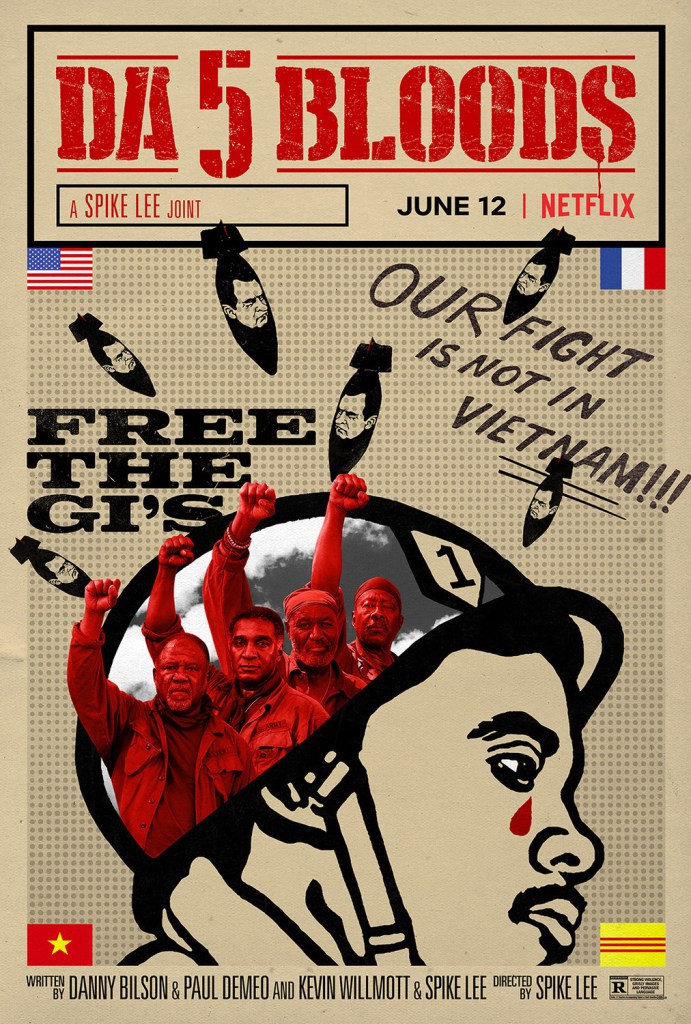
Produced by: Jon Kilik, Spike Lee, Beatriz Levin, Lloyd Levin
Written by: Danny Bilson, Paul De Meo, Spike Lee, Kevin Willmott
Cast: Delroy Lindo, Jonathan Majors, Clarke Peters, Norm Lewis, Isiah Whitlock Jr., Mélanie Thierry, Paul Walter Hauser, Jasper Pääkkönen, Jean Reno, Chadwick Boseman etc.
Music by: Terence Blanchard, Marvin Gaye
Cinematography: Newton Thomas Sigel
Distribution: Netflix
***MAY CONTAIN SPOILERS***
Shelton Jackson “Spike” Lee has been a prolific actor, director, producer and polemicist for some time now. An ultra-talented and outspoken cinematic artist, he has directed thirty fiction and documentary films since his debut feature film She’s Gotta Have It (1986). Plus, all manner of promos, commercials, music videos, short films and television series. An energetic firebrand of a director he has made films in many genres and is a risk-taker in subject, theme and style. Whether you agree with what he has to say he is a filmmaker who is always creating situations and characters who must be heard.
His latest film, Da 5 Bloods (2020), is a timely Netflix film release which encapsulates crime, heist, political, war, drama, Blaxploitation, comedy, documentary, love and experimental film genres. Lee has never been afraid of taking risks and sometimes his films have not worked because of it. However, with BlacKKKlansman (2018) he succeeded in making one of the best films of 2018 and should have won Best Film Oscar in my view. Da 5 Bloods (2020) grabs the power baton of Lee’s prior film and runs with it, delivering an entertaining, funny, thought-provoking, stylish and brilliant genre-blending story full of sustainable socio-political arguments in the era of the Black Lives Matter movement.
The narrative begins by establishing four aging Vietnam veterans, portrayed by the magnetic ensemble of Delroy Lindo, Clarke Peters, Norm Lewis and Isiah Whitlock Jr. They meet in Ho Chi Minh City in order to venture into the jungle and locate the remains of their squad leader. During some very stylised, richly colour-saturated and impactful flashbacks, it is revealed their friend, “Stormin Norman” (the charismatic, Chadwick Boseman), was killed in combat. Furthermore, and this is the money reason they are back in ‘Nam – there is army gold in those hills. Thus, the comrades set out to locate their friend’s body, and the gold, in order to find reparation and hopefully some form of redemption.
The film begins warmly as we enjoy the company of these great actors portraying reunited friends on an old boys outing. However, the film, as it introduces further subplots involving Jean Reno’s suspicious businessmen, Desroche and Delroy Lindo’s Paul crumbling mental state, moves into far darker territory the further the men get into the jungle. Lindo himself gives arguably the best performance of his career as a soldier grieving for his lost friend and desperate to get compensation for the unjust loss of so many lives in Vietnam. His character’s downward mental trajectory is one of the most powerful elements of Da 5 Bloods (2020). No doubt Lindo will be nominated come awards time and so he should be.
The cinematic excellence on show too from Spike Lee and his production crew is to be applauded too. Lee’s box of magic tricks includes: jump cuts, aspect ratio switches, colour saturation, Shakespearean soliloquies, documentary footage, flashbacks, conveyor-belt camera tracks, stills photography, slow-motion, direct address and many other devices. The exceptional cinematography is drenched in an opulent score from Terence Blanchard and the incredible voice of Marvin Gaye. I guess my main reservations about the film would be the elongated running time, with some scenes indulgently over-running. Moreover, there were also a couple of convenient plot coincidences which could have been ironed out. Nonetheless, with Da 5 Bloods (2020), Spike Lee has delivered another bravura mix of genre and socio-political filmmaking which, like classics such as The Treasure of Sierra Madre (1948) and Apocalypse Now (1979), stare into the dark heart of humanity and find greed, war and death there. Unlike those two films though, Da 5 Bloods (2020), also contains hope, light in the tunnel, and the idea that togetherness brings strength in the face of adversity.
Cast: Florence Pugh, Jack Reynor, William Jackson Harper, Vilhelm Blomgren, Will Poulter etc.
Music: The Haxen Cloak
Cinematography: Pawel Pogorzelski
**MAY CONTAIN SPOILERS**
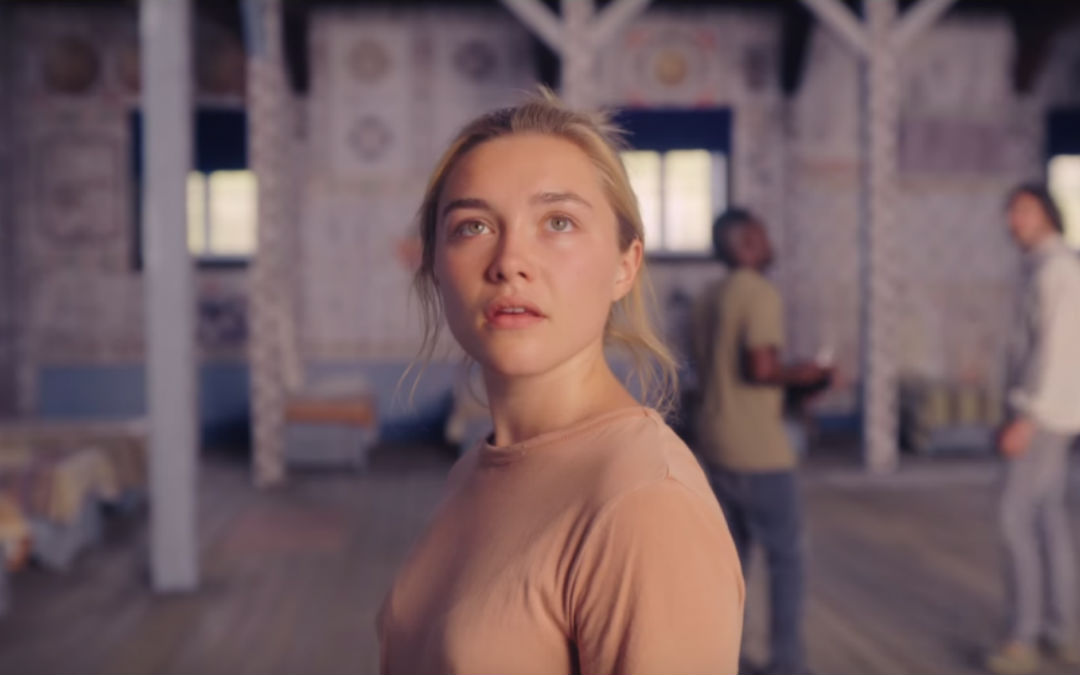
Midsommar (2019), is ultra-talented filmmaker Ari Aster’s second feature film. His first Hereditary (2018), was two-thirds domestic horror masterpiece and one-third insane, symbolic, nonsensical and demonic denouement. Both films have a lot in common. Both have communes or cults at the centre led by strong matriarchal figures. Both find seemingly innocent characters suffering from grief being lured to a fateful demise. Both have incredibly rich visual systems full of striking imagery, sudden violence and mythological folklore. Both, especially Midsommar (2019), are overlong, pretentious and indulgent B-movie stories masquerading as art.
I have to say, and I am not coming from simply a mainstream perspective, Ari Aster is a film artist. However, unlike many great film artists he has, in my opinion, not managed to marry his vision with coherent and emotionally powerful storytelling. Midsommar, for example, takes an age to kick its narrative into gear and when it finally gets started it drags and drags and drags. How many long, drifting tracking master shots can you abide? How many drawn-out-so-pleased-with-myself takes do you have the patience for? Well, get a strong coffee because when the story cries out for pace, Aster puts the brakes on, marvelling in his own indulgent genius. I might add that a plethora of characters screaming and crying does not make good drama either, unless there is sufficient context.
The narrative is very simple. In a nutshell, it’s Eli Roth’s Hostel (2005) meets British horror classic The Wicker Man (1973). Florence Pugh, Jack Reynor, William Jackson Harper and Will Poulter are college students who take a summer break to experience a communal pageant in rural Sweden. While they are PHD students they are not particularly intelligent given the choices they make later in the film.
Moreover, aside from Pugh’s grief-stricken Dani, the script doesn’t particularly imbue them with much in the way of empathetic characterisation. Indeed, the film relies on Pugh’s dominant performance to create emotion for our protagonists. Aside from providing some comic relief there is no actual point to Will Poulter’s character at all. Lastly, there is some absolutely terrible dialogue throughout this film too.
As the film crawls along slowly, it’s reliant on the music to inform us we’re meant to be scared. Then when the gore does kick in during a particularly shocking ritual, I was almost falling asleep. Don’t get me wrong the production design is flawless with an amazing setting and incredible concepts from Aster. The death and torture scenes are particularly memorable. However, the overall pace and rhythm of the film is so bloody slow I just did not care about anyone by the end.
I don’t mind methodical films establishing dread and psychological fear, but I think Aster has been watching too many Kubrick films. Aster seems to believe slow equals art. What Kubrick did though was usually to have characters that were engaging. They may not have been likeable, but Kubrick’s characters hit you in the heart and mind. Not since The Blair Witch Project (1999) have I wanted such dumb characters (Pugh aside) to die so painfully in a horror film. Likewise, the characters in the Swedish commune are mere ciphers of Aster’s fantasy horror and two-dimensional at best.
Visually stunning Midsommar (2019), will no doubt impress critics and other reviewers. However, at nearly two-and-a-half hours it’s an indulgent-arty-collage-of-film-masquerading-as-therapy. The ending was so loopy that the audience I was with were laughing at how ridiculous it was. Perhaps that was the filmmakers’ aim, but I’m not so sure. Yes, I get that this is meant to be allegorical and symbolic about grief and guilt and religion and a relationship break-up and fate and cultural differences. Furthermore, I get the intellectual depth of the themes on show, but Aster tortures the audience as much as his characters. Mostly, it just doesn’t take so long to tell this kind of derivative narrative, however beautiful and artistic the film is presented.
Story by: John Lasseter, Rashida Jones, Will McCormack, Josh Cooley, Valerie LaPointe, Martin Hynes, Stephany Folsom, Andrew Stanton
Cast: Tom Hanks, Tim Allen, Annie Potts, Tony Hales, Keegan Michael-Key, Jordan Peele, Madeleine McGraw, Christina Hendricks, Keanu Reeves, Joan Cusack, John Ratzenberger, Timothy Dalton etc.
Production company(s): Walt Disney, Pixar Animation
**MAY CONTAIN SPOILERS**
I almost don’t feel qualified any more to review a sequel that was neither expected or necessary. After all, it’s a sequel to a film trilogy which was almost perfect in its’ delivery and execution. But, having paid big bucks for Pixar in 2006, I doubt Toy Story 4 will be the last unnecessary sequel of their products. After all, Disney are in show BUSINESS!!
I also don’t feel qualified as I am so cynical and jaded that the characters of Toy Story do not interest me anymore. In my mind their story is done. Plus, it’s really for kids, isn’t it? However, that isn’t to say that Pixar/Disney have not, once again, created an incredible technical tapestry of some genius. The colour, texture and attention to detail on show are incredible as usual. Similarly, the ultra-talented voice acting of Tom Hanks, Tim Allen, Wallace Shawn, John Ratzenberger, Annie Potts etc. are joined by the brilliant Key and Peele, Christina Hendricks and Tony Hales for the latest release.
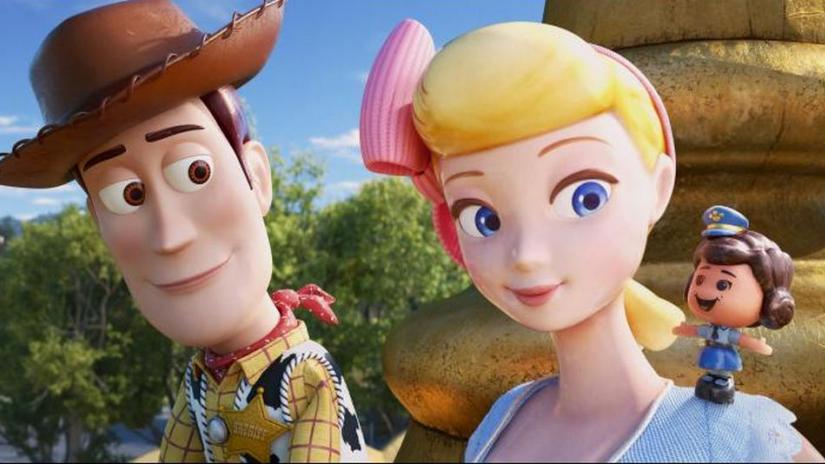
Hales offers the voice of potentially one of the worst characters Pixar have ever created: Forky. In fact I think they set out to invent one of the worst characters as a challenge to see if they could make it work. You know what? I think they did make it work. Forky is something the toys’ owner, Bonnie, creates on her first day of kindergarten and with the magic of make-believe he becomes, unknown to her, sentient. We then get the experience of watching a fictitious plastic spork suffering an existential crisis and attempting suicide-by-trash. That’s when good old Woody then tries to teach him his worth.
The sheer goofiness of all this strange plotting works for and against the film. It’s so surreal I thought David Lynch had a hand in the story. Having said that the writer and story credits almost number a football team, so the Frankensteinesque patchwork nature of the screenplay is unsurprisingly. The stitching that holds it all together is Woody’s character. Many of the other toys, including Buzz, are almost sidelined for Woody’s hysterical attempts to control everything around him.
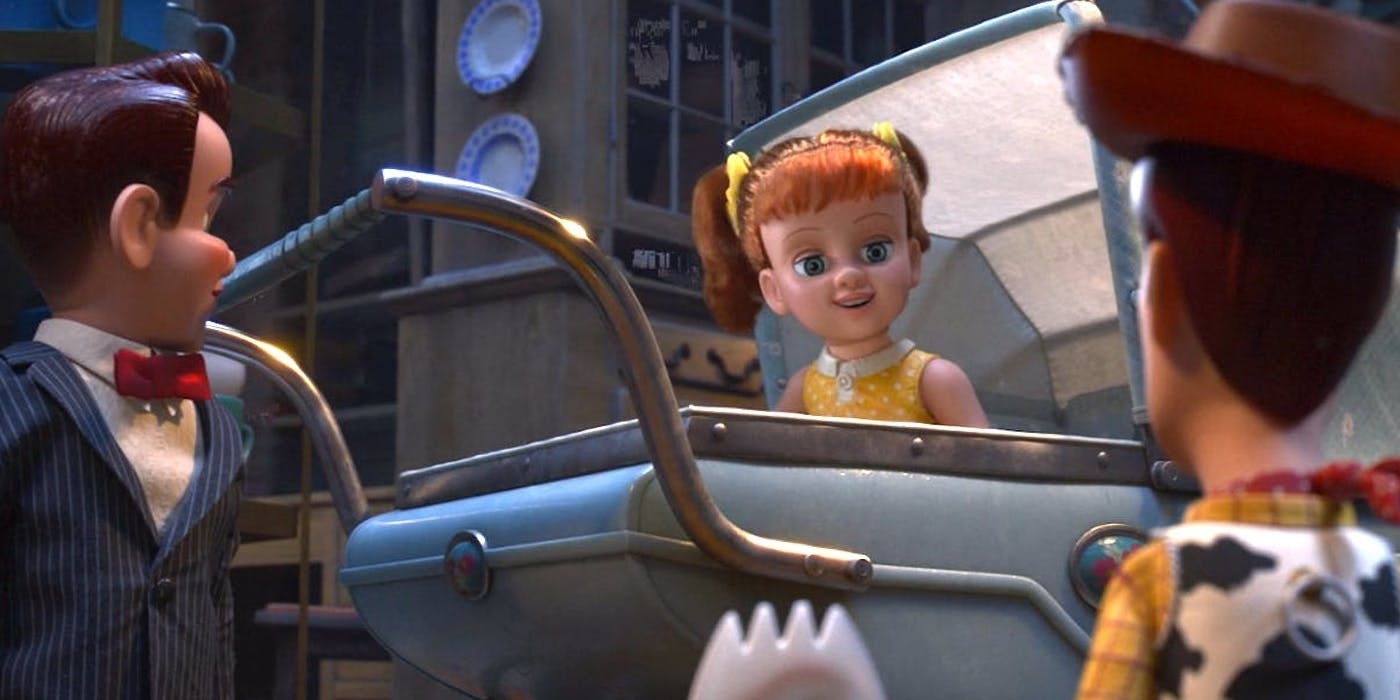
There were a myriad of plots strangling the narrative of Toy Story 4, but the character of Gabby Gabby, voiced by Christina Hendricks, was arguably the most interesting. Echoing the villainy and bitterness of Lotso from the previous sequel, her ventriloquist dummy hench-toys were very creepy and her character added a dark heart amidst the kaleidoscope of wondrous colours. I could take or leave Bo Peep’s, Bonnie’s and Forky’s escapades, but Woody’s encounter with Gabby Gabby was my favourite. Oh, not to forget, Keanu Reeves hilarious little cameo as stunt-toy, Duke Caboom.
Overall, Pixar and Disney do this kind of film amazingly well. Once again one marvels at the technical quality of the animation on show. The story, themes and characters, however, felt a bit recycled and if they do more of these films I think they probably need to jump the shark and allow the toys to finally be seen and heard. How many times can the same joke work? I’m not sure. What is certain though, as long as it makes money Disney will have no issues selling it to the kids. I’m just so old and jaded I’m ready for the attic with all the other discarded and tired toys.
Cast: Elizabeth Banks, David Denman, Jackson A. Dunn, Matt Jones, Meredith Hagner, Gregory Alan Williams etc.
**MAY CONTAIN SPOILERS**
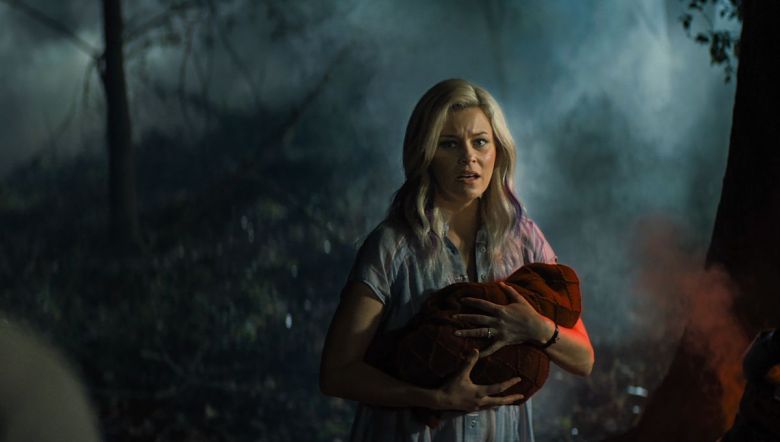
What if Superman was evil? As concepts go Brightburn (2019) has a simple but highly impressive one. The trailer too was brilliant and it was only when I saw a few negative reviews did I baulk at going to see the brisk B-movie-super-hero-horror-film. So, does a great pitch, and cool trailer lead to a great movie? In part yes; and in part no!
With the indie-turned-blockbuster director, James Gunn, in the wings producing the film, Brightburn clearly has a pedigree in superhero, comedy and horror film-making. I loved his low budget gem Super (2010) and his work helming the Guardians of the Galaxy films is also impressive. One wonders if Brightburn may have worked better with James Gunn directing but we will never know.
Set, unsurprisingly in Brightburn, Kansas, the story completely steals the Superman origin narrative and twists it in a fun and gory way. Farming couple Tori and Kyle Breyer are desperate for a kid and have failed to conceive naturally. Fortunately, or so it seems at first, a child falls from the skies, and rather than tell the authorities they adopt the kid as their own.
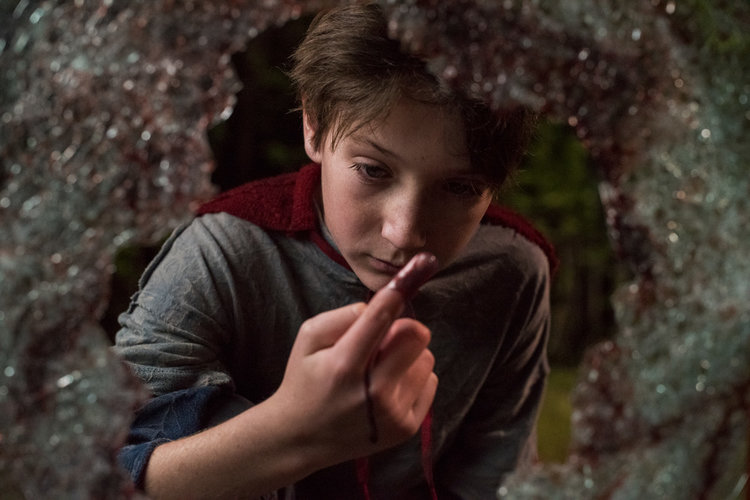
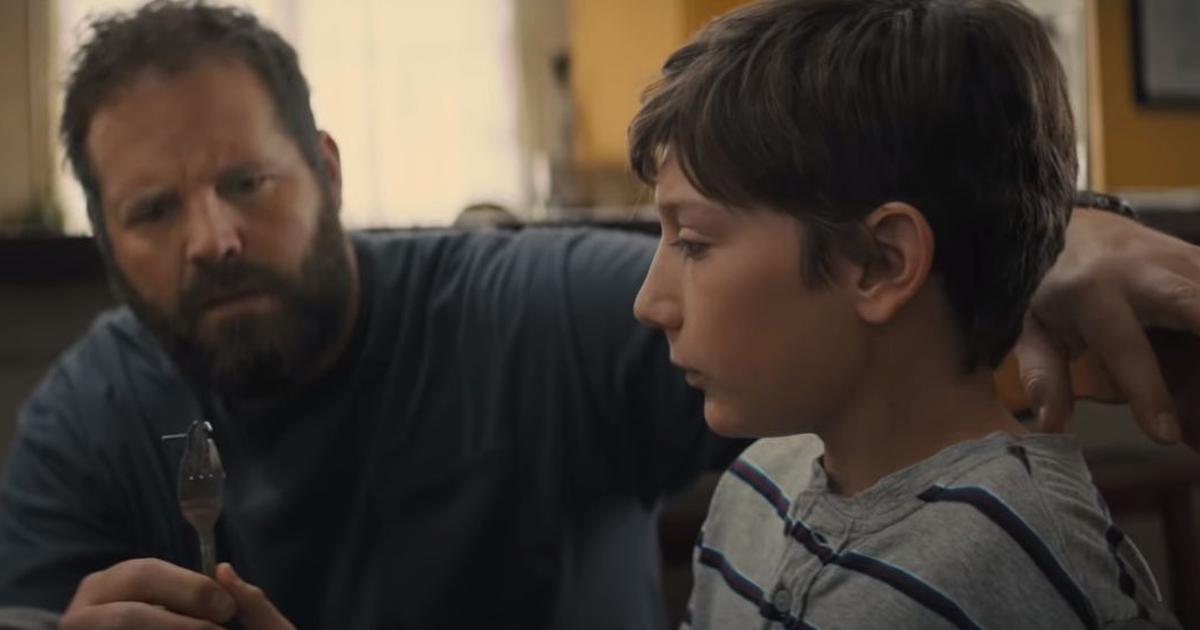
Flash-forward and Brandon is now twelve years old and puberty is fast approaching; cue bodily changes but not the kind his parents were expecting. As Brandon deals with school bullies and his first crush he suddenly begins going into trances and attempting to unlock that red glowy thing in the barn. What could it all mean? Mayhem! Bloody mayhem is what it means!
I really enjoyed Brightburn. It’s script is a bit dumb and some of the character choices are pretty ridiculous, especially when Brandon starts behaving violently at school and around the house. However, I loved the fast-pace, the concept, the dark horror, the red-masked image system, and the gore. Moreover, while many were given away in the trailer, there are some brilliant set-pieces and scares throughout.
Some of the negative reviews I have seen may have come from the wrong angle on Brightburn. Its not really meant to be taken seriously despite the compelling and dramatic performance from Elizabeth Banks. For me it’s to be watched as an imaginative low-budget B-movie feature, somewhat reminiscent of those “kids-go-bad” 1980’s horrors I used to rent from local video store.
There’s an element of depth as it touches on themes relating to puberty, adoption and the trials of parenthood; ultimately though it’s about the rise of an evil anti-hero in a gas mask with glowing red eyes!! In a nutshell, Brightburn is one for B-movie horror fans everywhere and I definitely want them to expand the universe.








 The Cinema Fix presents