Category Archives: Cinema

IF BEALE STREET COULD TALK (2018) – CINEMA REVIEW

IF BEALE STREET COULD TALK (2018) – CINEMA REVIEW

Directed by: Barry Jenkins

Produced by: Megan Ellison, Dede Gardner, Jeremy Kleiner, Adele Romanski, Sara Murphy, Barry Jenkins

Based on: If Beale Street Could Talk by James Baldwin

Starring: Kiki Layne, Stephan James, Colman Domingo, Regina King, Teyonah Parris, Michael Beach, Pedro Pascal etc.

Cinematography: James Laxton

Music: Nicholas Britell

**MAY CONTAIN SPOILERS** 

Barry Jenkins is clearly a talented filmmaker who is striving to transcend the boundaries between art and craft where cinema is concerned. His second feature film Moonlight (2016), was a critical smash and a sleeper box office hit, subsequently going on the win the Best Film nod at the Academy Awards. Whether it was worthy of such as award is another matter, but it was certainly a tremendous work of cinema. The rites of passage story was delivered by Jenkins with imaginative choices in casting, structure, look, music and all-round filmic endeavour.

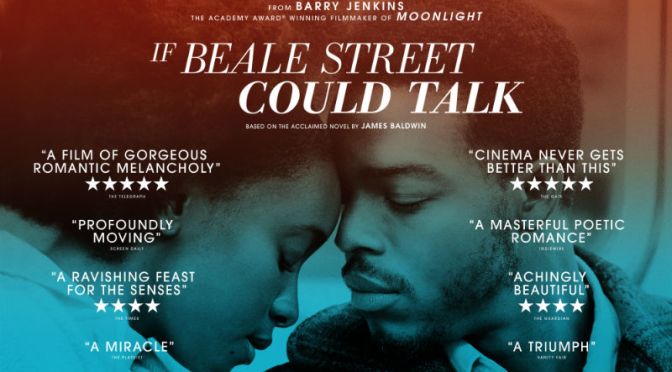
His latest film, If Beale Street Could Talk, is equally stylish and artfully rendered, but not as emotionally impactful as Moonlight. Indeed, while this is in fact his third feature, Beale Street seems to suffer from classic “2nd album syndrome”, inasmuch as Moonlight set the bar so high, it was going to be a difficult act to follow. Moonlight felt like years of heart and passion thrusted upon the screen, as Beale Street struggles to maintain that said peak. That isn’t to say that the film is not without its virtues as Jenkins once again proves himself a brilliant director.

Barry Jenkins’ IF BEALE STREET COULD TALK, an Annapurna Pictures release.

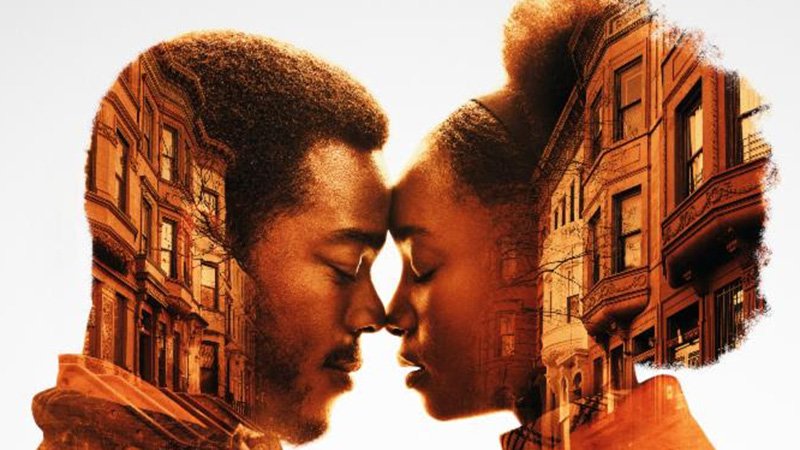
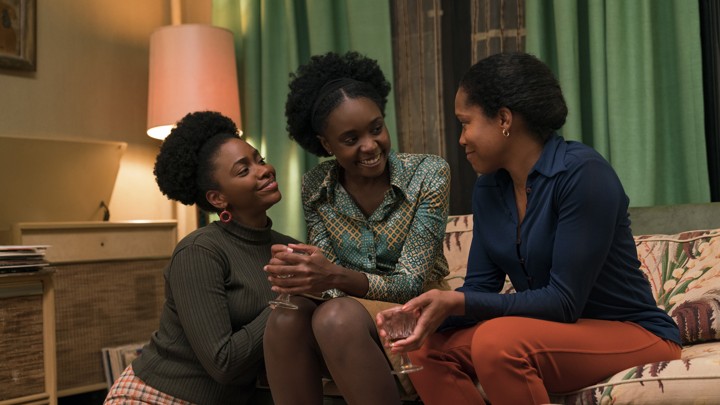
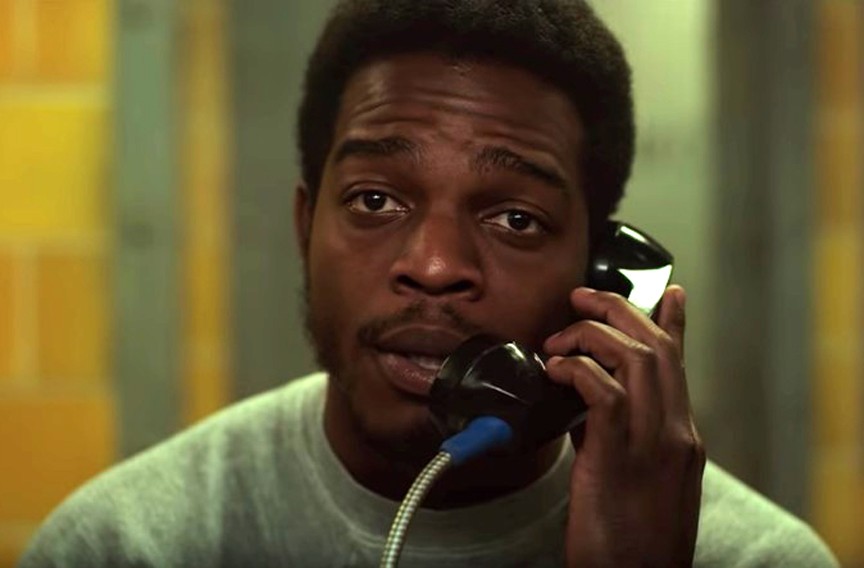
Set in 1970s, Harlem, New York and based on James Baldwin’s novel, the main protagonists are young working class couple Tish (Kiki Layne) and Fonny (Stephen James). Very much in love we open with Tish’s poignant voiceover and a wonderfully lush score supporting the urban and industrial, yet beautifully shot, imagery. Immediately, we realise Jenkins, while basing his story in realism, is presenting his film poetically. Further, Tish’s voiceover lilts and glues the elliptical, non-linear narrative together.

As with Moonlight, Jenkins uses direct address, the characters looking straight back at us drawing us into their emotional core. One may argue the device is over-used and at times distances us from the pace of the story. As Tish recounts events of her and Fonny’s relationship from childhood friends to their currently plight, you really feel a palpable sense of love, but sometimes it moves so painfully slow. Furthermore, the non-linear structure and stylistic devices also undermined the drama of the piece. Indeed, the best scene of the film in my opinion is near the beginning when Tish and Fonny’s family clash over her pregnancy. In this scene the insults spark and spit off the screen; but alas this conflict is sadly under-developed and not revisited later in the film.

Overall, there is a great story here involving: love, romance, social unrest, police brutality, unlawful arrest and injustice, racism, family strife, hope and loyalty; however, Jenkins artistic desires build the narrative in a way that diverts emotion into the cinema style, more so than the characters. Having said that, he is a filmmaker of some brilliance and he gets fantastic performances from the fine ensemble cast, notably the magnetic Regina King. Ultimately, while the story is told slightly pretentiously for my liking,
If Beale Street Could Talk, is a finely tuned work of poetic realism. 

Mark: 8 out of 11

GREEN BOOK (2018) – CINEMA REVIEW & OSCAR BINGO #4

GREEN BOOK (2018) – CINEMA REVIEW

Directed by: Peter Farrelly

Produced by: Jim Burke, Brian Hayes Currie, Peter Farrelly, Nick Vallelonga, Charles B. Wessler

Written by: Nick Vallelonga, Brian Hayes Currie, Peter Farrelly

Starring: Viggo Mortensen, Mahershala Ali, Linda Cardellini

**MAY CONTAIN SPOILERS**

I have to be honest I am getting very tired of racism and racists, so lord knows how the people who it affects deal with it on a day to day basis. To judge and attack people because they have a different race, background or skin colour is, and has always been, the height of stupidity. We are all humans and should be judged on our actions and behaviour and NOT our physical appearance, social background, sexuality or gender. Furthermore, we must not treat someone a certain way based on general experience of how others behave too. I subscribe to individualistic judgement and the desire for peaceful attempts to resolve conflict and differences. Those that attack and bully and abuse any other human being are wrong and their minds must be changed.

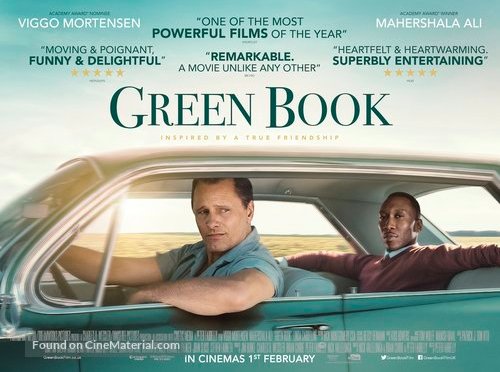
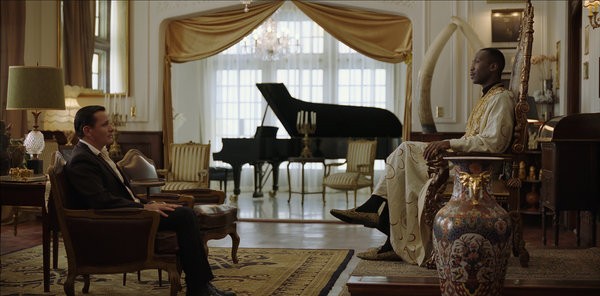
If a feel-good film such as Green Book (2018) can at the very least change one person’s negative attitude then it will be a success. It makes very broad points in regard to race relations and while arguably simplistic, in the very fabric of its story remains a heartwarming call for tolerance, understanding and friendship. Directed by Peter Farrelly, Green Book is based on the true story of Dr Don Shirley, a genius musician, and his brave trip across the deep South of America in 1962 with working class Italian driver, Tony “Lip” Vallelonga. Safe to say the road tour is not without its ups and downs and the men, after initial differences, find common ground, loyalty and friendship.

BEST PICTURE CHANCES – 8/10

As aforementioned in a previous review I would say Roma (2018) will probably win best film at the Academy Awards. Green Book has a decent chance based on the sheer energy and persuasion of the story. Moreover, it attempts to marry comedy with social drama and on the whole succeeds. Peter Farrelly directs with skilled aplomb and the guy is a past-master of the road movie genre with films such as: Dumb and Dumber (1994), Kingpin (1996), There’s Something About Mary (1998) and Me Myself and Irene (2000), all comedies which adhered to road movie genre tropes. I guess that’s one thing that holds Green Book back and that is it’s very “by-the-numbers”, however, that’s also one of the joys of the story in that it hits the heights of genre expectations so well. Finally, Farrelly marshals the road trip, musical gigs and period setting really impressively and film made me feel all glowy by the end.

ACTOR IN A LEADING ROLE CHANCES – 8/10

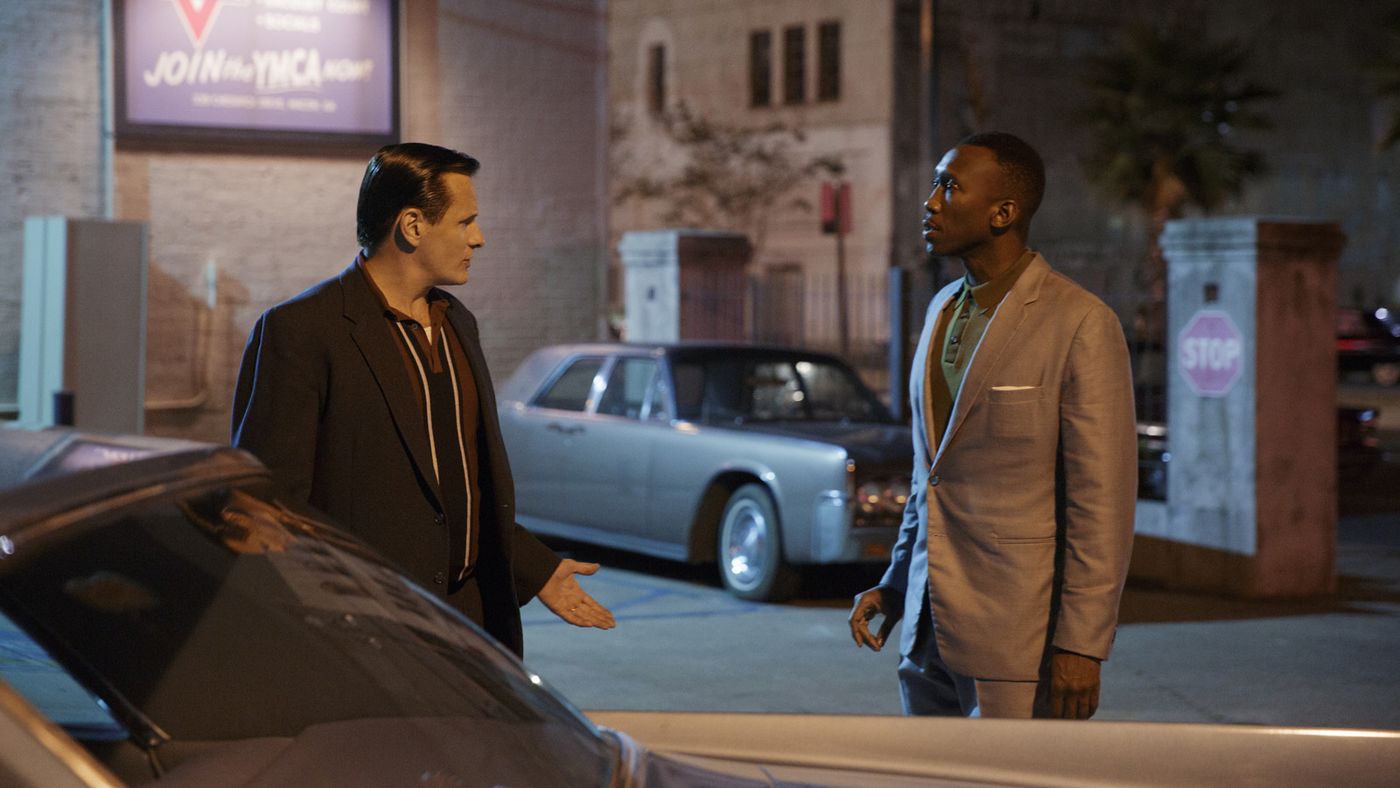
Viggo Mortensen is such an intelligent actor and has often been cast in intense roles which require much internal conflict. Here, his Tony Lip, is a larger-than-life Italian tough guy, handy with the bullshit and his fists. He eats like a horse and loves his family. Further, he’s stand-up guy who won’t be dragged into the Mafia underworld no matter how broke he is. The character verges on the Italian stereotype we have seen many times before but Mortensen imbues the lovable rogue with a humanity, humour and a do-the-right-thing spirit throughout. It’s his journey we follow as he moves from prejedicial jerk to something more socially acceptable. Lastly, Mortensen’s scenes with Ali are just brilliantly acted; the two bouncing off each other with wit and perfect timing.

ACTOR IN A SUPPORTING ROLE CHANCES – 10/10

Mahershala Ali should win this. He is absolutely outstanding. While Mortensen’s character is big and splashed across the screen in ebullient effervescence, Don Shirley quietly steals the show. His erudite, intellectual and refined exterior hides a pained and lonely soul who just does not fit in to society anywhere. While his music is loved and his genius revered he just cannot find inner peace. I mean I know nothing about playing the piano but Ali impresses here too with his conveyance of the musicianship of the character. Lastly, Ali’s performance is one of the best of the year, and while he won previously for Moonlight (2016), this performance is so good he should be on the list of leading actor role nominations.

BEST SCREENPLAY CHANCES – 8/10

The structure of the screenplay adheres to the classic Hollywood model to a tee. There are few surprises as the set-up of two opposite characters meet and go through a literal and figurative journey of discovery and change. Along with the lead performances, what raises the story though, is a fizzing script full of conflict and comedy. We get set-up-punchline, set-up-drama, set-up punchline, set-up feelgood moment throughout, making it a metronomically impressive piece of writing. The letter-writing running gag, for example, is pure comedic gold. Moreover, the script is littered with tremendous dialogue exchanges between the lead roles and ensemble characters which had me laughing and emoting throughout. Perhaps, historical and political accuracy could be queried by some and there is a reliance on familiar archetypes, but that doesn’t interfere with a zinging story.

CONCLUSION

Green Book is a film that has its chicken and eats it. It is full of life, food, music, family, friendship while making important points about racial issues. It also raises many laughs with heartwarming poignancy, highlighting the inequalities of 1960s with a broad hand. While these issues are not as intriguingly addressed as in BlacKKKlansman (2018), they elevate the generic road-movie-opposites-buddy-bromance tropes and structure. More than anything this is a story about friendship and while it treads a well worn road, mirroring films such as Planes, Trains and Automobiles (1987) and Midnight Run (1988), it does so with verve, humour and heart.

Mark: 9 out of 11

VELVET BUZZSAW (2019) – NETFLIX FILM REVIEW

VELVET BUZZSAW (2019) – NETFLIX FILM REVIEW

Written and directed by: Dan Gilroy

Produced by: Jennifer Fox

Starring: Jake Gyllenhaal, Rene Russo, Toni Collette, Tom Sturridge, John Malcovich, Zawe Ashton, Daveed Diggs, Billy Magnussen, Natalia Dyer etc.

Picture the scene: a starving child in Africa passively stares at a camera while a fly irritates their big sad eyes, and they do not know when their next meal is coming from. Meanwhile, in a New York auction house a painting by Cezanne or Gauguin or Picasso is selling for over $200 million dollars! What the fuck is wrong with the world?!  I’m not saying these paintings aren’t great art it’s just that there is NO WAY that amount of money should be paid for a painting when there is starvation, disease, and poverty in the world. It’s just an indictment of the sickness of humanity, that we place such value on what effectively amounts to canvas and paint placed in a particular manner by some dead person. It’s utter madness!!

DON’T GET ME STARTED ON SO-CALLED MODERN ART!!

Yeah, sure, maybe I DON’T GET IT!! Maybe one should be allowed to express themselves from a creative and emotional perspective but THEY ALSO WANT PRAISE FOR IT!!! And MONEY! And adulation! Of course, certain painters, sculptors and creative types expressing themselves can become a transcendental experience but mostly it’s a bunch of pretentious wankers conning us into thinking what they are doing is important. Come the fictitious revolution occuring in my imagination, most modern artists will be on the hypothetical spikes adorning the made-up barricades.

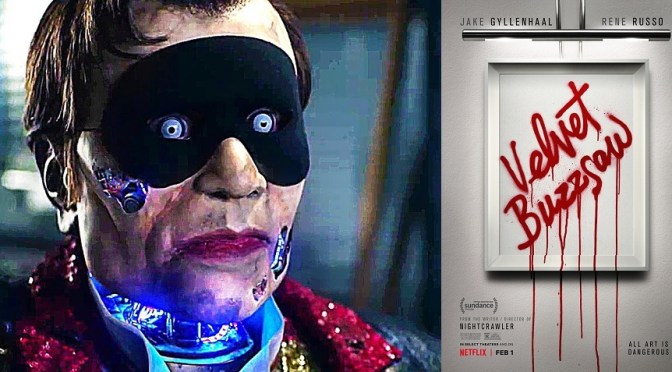
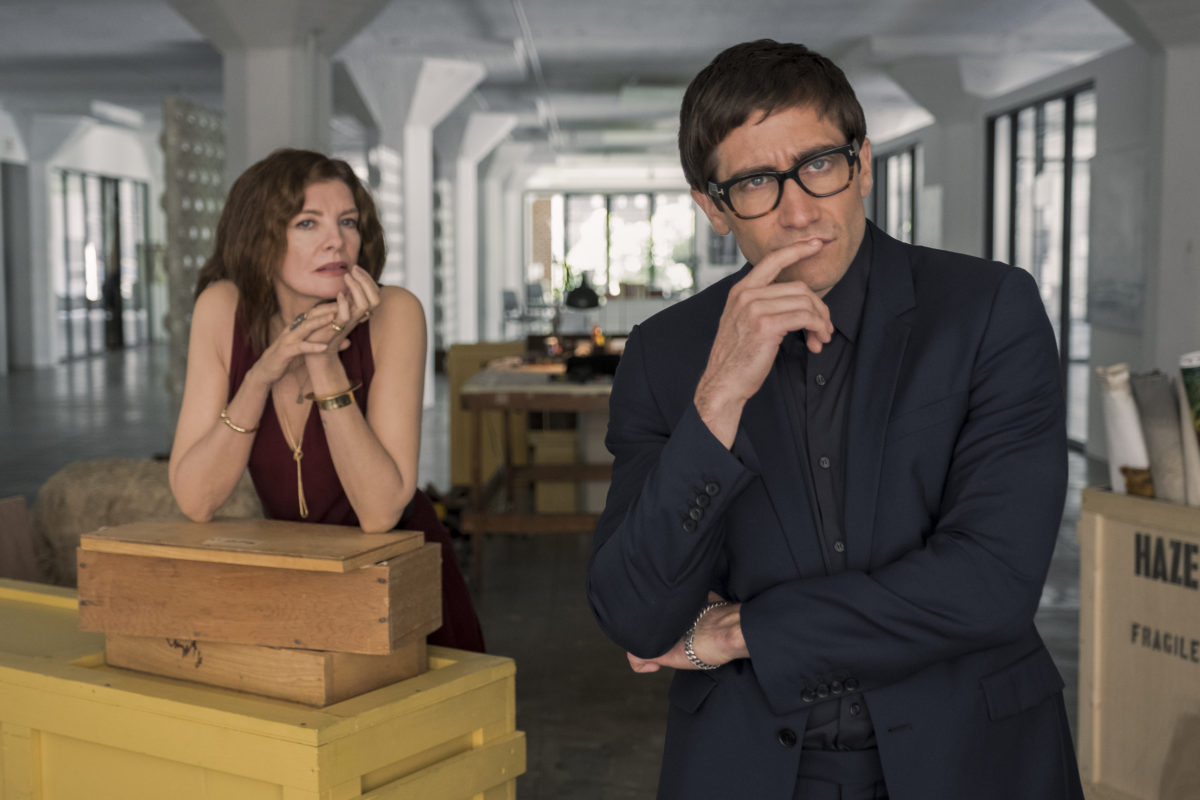
Tony Gilroy’s third film Velvet Buzzsaw (2019) taps into some of the ire I feel for the art world. It’s full of fake plastic and unlikable characters who spend their days stabbing and fucking each other in the back, all trying to sell us the next big fat artistic lie. When a never-famous painter dies his work becomes a cause celebre and further in-fighting ensues in an attempt to monetize his apparent genius. Jake Gyllenhaal leads an impressive ensemble cast as arsehole critic, Morf Vandewalt; while Rene Russo, Toni Collette, Tom Sturridge, John Malcovich and Zawe Ashton revel in their narcissitic and parasitic roles as agents, artists and art-whores.

Ultimately, this is a very broad comedic satire with some decent horror deaths thrown in. At times I felt like it should have been shot with a cast of unknowns on 16mm film, rather than the A-list hi-definition gloss presented. Firmly in the B-movie territory of say Final Destination and Driller Killer, it’s neither scary or bloody enough to make a convincing horror or gorefest. Having said that there are some fantastic deaths, very witty dialogue and memorable images throughout. Lastly, Gilroy’s work has kind of gone backwards since his phenomenal debut Nightcrawler, and this, without wishing to sound like a pretentious critic, is certainly a very minor work. Overall, though I enjoyed the coruscating digs at the modern art-world and all the arseholes who inhabit it; so that made it well worth a watch.

Mark: 7.5 out of 11

VICE (2018) – CINEMA REVIEW & OSCAR BINGO #3

VICE (2018) – CINEMA REVIEW

Directed by: Adam McKay

Produced by: Brad Pitt, Dede Gardner, Jeremy Kleiner, Kevin J. Messick, Will Ferrell, Adam Mckay

Written by: Adam McKay

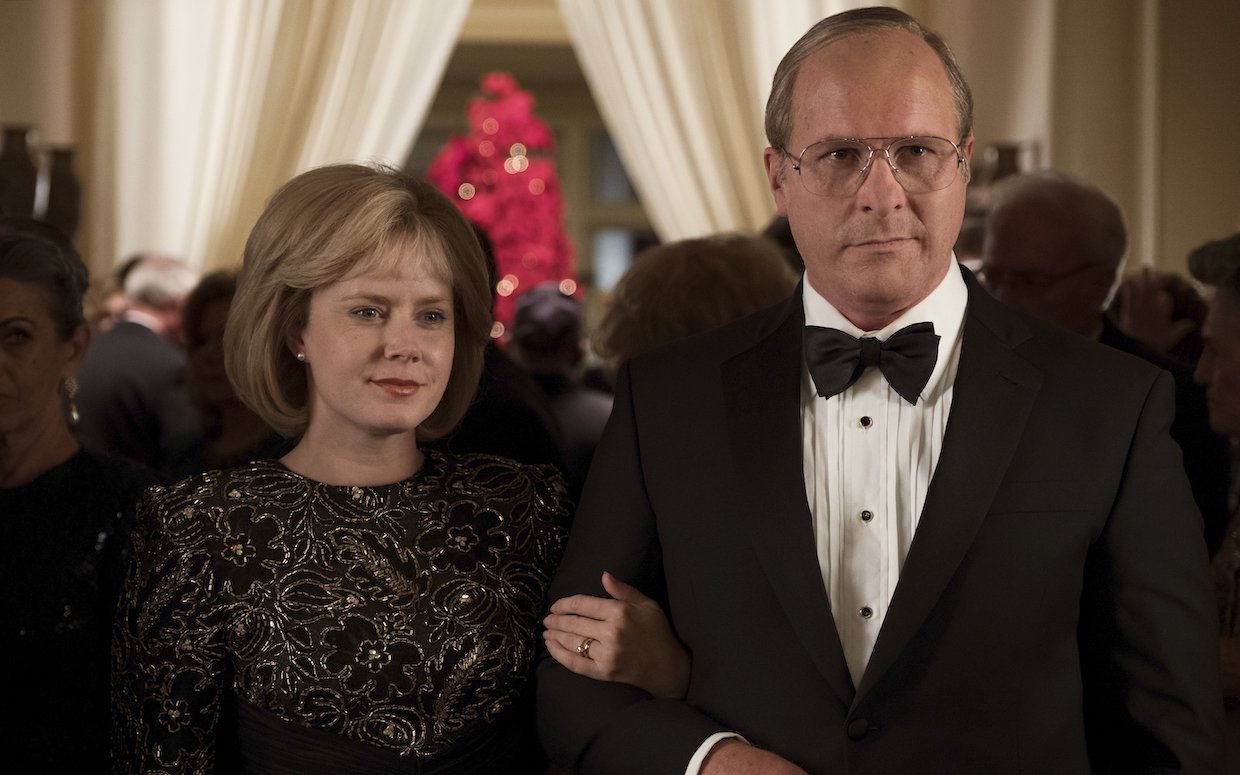
Starring: Christian Bale, Amy Adams, Steve Carell, Sam Rockwell, Tyler Perry, Alison Pill, Lily Rabe, Jesse Plemons

**CONTAINS HISTORICAL SPOILERS**

Unlike the previous Oscar Bingo attempts for A Star Is Born (2018) and First Man (2018), this review has full knowledge of the nomonations. So, rather than be guess work this review of Vice (2018) is intended to be based on more constructive critiques of the Oscar nominated films I have seen.

BEST FILM CHANCES – 8/10

For starters, Vice is certainly worthy of its award nominations. I have seen some criticisms that it is cartoonish and simplistic and while I actually agree with this, it is also a brilliant and scabrous work of satire. Yes, it’s preaching to the liberal and left-winged Hollywood choir, but it definitely presents a fascinating snapshot of Dick Cheney’s rise from alcoholic wastrel to powerful political figure.

While I believe Roma (2018) will win the Best Film, I enjoyed Vice more from a stylistic, educational and emotional perspective. I was drawn into the murky world of American politics by McKay and his fantastic ensemble cast, and was compelled by the machinations of Cheney’s manipulative puppet-master to Bush’s marionette President. McKay’s film, while certainly one-tracked, powers along picking apart and satirising one of the most shadowy political figures of recent years.

BEST DIRECTOR CHANCES – 8/10

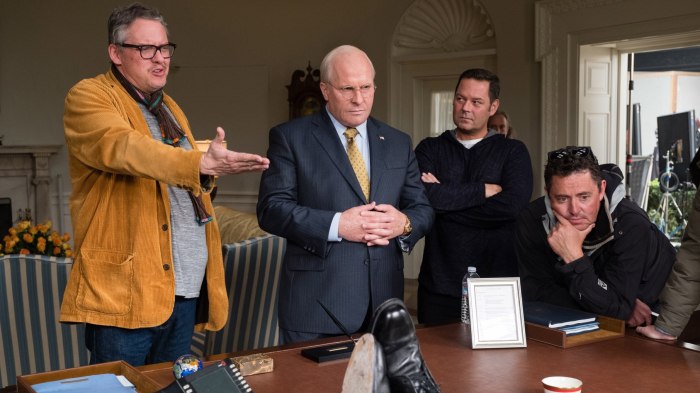
In terms of tone and narrative, McKay’s The Big Short (2015) was arguably a more cohesive film. Indeed, Vice is presented more as a non-linear monatge and sketch style recreation of key events in Cheney’s life. But I loved the style and McKay should be praised for his editing choices. He throws the veritable formalistic kitchen sink at the film using: direct address, Shakepearean monologue, cross-cutting montage, fake credits, voiceover, freeze frames, fake footage, stock footage, flashbacks, flash forwards, inter-titles, third-party narrator and many more stylised tropes. In my view his directorial bag of tricks are utilised without losing emotional impact too. While Alfonso Cuaron will probably win McKay certainly deserves kudos for enlivening his subject matter with such storytelling choices.

ACTOR IN A LEADING ROLE CHANCES – 10/10

Christian Bale should win. I have not seen Rami Malek, Viggo Mortensen or Willem Dafoe’s acting in their respective roles but Christian Bale is astonishing. Fair enough, he has taken a real person and delivered an emulation performance, but he also brings to Cheney to life with formidable cinematic style. Of course, the physical transformation could take the headlines but in terms of emotion and mentality he really raises the perfomance bar. Cheney may be an enigmatic character but Bale brings quiet menace, whispers and manipulation to the role. There is also a sly humour there too which makes Bale’s Cheney another memorable acting monster he’s created.

ACTRESS IN A SUPPORTING ROLE CHANCES – 8/10

Amy Adams is one of my favourite actors. Not quite a Lady Macbeth character, her Lynn Cheney pushes Dick forward mercilessly to make a better man of himself. She is the foundation and rock of their relationship and glues his life together when he faces health issues and political setbacks. Adams nails the role, and while Rachel Weisz will probably win for The Favourite (2018), Adams may finally get the Oscar she deserves.

ACTOR IN A SUPPORTING ROLE CHANCES – 5/10

Sam Rockwell is excellent in emulating George W. Bush but he only has a few scenes. While Rockwell dumbs down with the best of them I would have nominated Steve Carell instead. His Donald Rumsfeld, was a creeping, neurotic and conniving joy and definitely deserved the nomination in this category.

ORIGINAL SCREENPLAY CHANCES – 7/10

The film benefits from a sparky screenplay which keeps a potentially dull subject spinning along in an entertaining fashion. It takes a complex set of characters and scenarios, and despite simplifying to fit a leftist agenda, still constructs intelligent analyses of Cheney and Washington at large. Ultimately, Cheney is shown to be an opportunist and dangerous person who manipulated information and policy to finagle the USA and allies into a war for profit. Even worse he did so from the position of Vice President – boo Cheney! Boo! While McKay deserves praise for his brave creative choices, I would go for Paul Schrader’s exceptional First Reformed (2018) in the original screenplay category; Schrader deserves it more.

CONCLUSION

I am a big fan of satirical works such as: Private Eye, Yes Minister, Spitting Image, The Thick Of It, Veep and South Park. They seek to undermine and take critical shots at our leaders, illustrating the danger, absurdity and stupidity of those in power. They also, in an entertaining way, carry a message that those serving their country are often serving themselves more. Conversely, a film like Vice, however cartoonish or broad, still has the power to highlight the corruption and horror of a man like Cheney. While the script and direction are tonally scatter-gun, Bale’s incredible rendition, and the marvellous supporting cast, anchor the film and ensure this satirical ship rarely hits the rocks.

Mark: 9.5 out of 11

GLASS (2019) – MOVIE REVIEW

GLASS (2019) – MOVIE REVIEW

Directed by: M. Night Shyamalan

Produced by: M. Night Shyamalan, Jason Blum, Marc Bienstock, Ashwin Rajan

Written by: M. Night Shyamalan

Starring: James McAvoy, Bruce Willis, Anya Taylor-Joy, Sarah Paulson, Samuel L. Jackson

Music by: West Dylan Thordson

**CONTAINS SPOILERS FROM SHYAMALAN’S PRIOR FILMS**

M. Night Shyamalan is arguably one of the most critically divisive directors working today. Not because his films are particularly controversial, but mainly because he is a risk-taker that tests the boundaries of genre expectations. He has so many different ideas and concepts that quite often his movies have back-fired spectacularly, however, when he gets it right his genre films are highly entertaining and compelling. Films such as: The Sixth Sense (1999), Unbreakable (2000), Signs (2002), and The Village (2004), were for me, brilliant genre films full of invention, suspense and wicked twists. Many people felt The Village stretched the limits of suspending disbelief, but it was a masterpiece compared to his filmic failures like: The Lady in the Water (2006), The Happening (2008) and The Last Airbender (2010).

I missed seeing the apparent disaster that was After Earth (2013), yet it was opined that Shyamalan returned to some essence of form with the horror film The Visit (2015). However, I still felt there were some dodgy creative decisions in that, such as the story-filler-white-middle-class-rapping kid in amidst a creepy thriller. Yet, with Split (2016), Shyamalan was back to his best, weaving an exploitational B-movie kidnap-plot with a searing psycho-performance from James McAvoy. The ending, which found Anya Taylor-Joy’s ultra resilient Casey fighting back against McAvoy’s twenty-plus split-personality maniac, then brilliantly linked the film to Shyamalan’s Unbreakable (2000). Therefore Glass (2019), becomes the third part of an unlikely trilogy; three films where Shyamalan strives to create his own universe and mythology within a more realistic superhero and super-villain world.

Glass starts three weeks after the end of Split  and opens with a terrific and bruising encounter between McEvoy’s dominant “Beast” personality and David Dunn’s (Bruce Willis) vigilante, daubed “The Overseer” by the media. Captured by authorities, the two are locked up and analyzed by Sarah Paulson’s seemingly sympathetic psychiatrist, Dr Ellie Staple. Enter Samuel L. Jackon’s Elijah Price, who is ALSO being held at the same mental health facility. I mean what could go wrong? Does the catatonic Price have villainous plans for The Horde and The Overseer? What do you think?

What I love about Shyamalan’s screenwriting, and this is something which he could equally be criticized for, is you can hear the cogs of contrivance creaking with every plot turn. Yet his ideas really capture your imagination and you genuinely want to know what happens next. Personally, as a fan of say Agatha Christie, I love theatrical exposition and clear “rules-of-the-world” mechanics. Shyamalan gets his three big-hitters in the same place and cinematic fireworks, however unlikely and full of plot-holes it may be, ensue. Woven within the fights, monologues and narrative misdirections are very clever meta-textual references to comic-book structures. This adds a welcome context to the denouement, which contains at least two incredible revealing twists.

Ultimately, I feel, unlike certain critics, that Glass is a fun and entertaining end to the trilogy. Yes, it tests the believability grid but Shyamalan must be applauded for striving, once again, toward some form of originality within his chosen genre.  It arguably goes down a deep rabbit hole at the end which is hard to get out of; but the impressive cast keep you in the light for the most part. James McAvoy is simply, once again, outstanding. Why hasn’t he been nominated for an Oscar? Who knows! Jackson and Willis are always solid performers, although I felt that Dunn’s character was slightly thrown away at the end. Anya Taylor-Joy also stood out and she is going to be a big star if she carries on delivering wide-eyed and steely performances such as these. Thus, Shyamalan gives us another big hit and something very different from the Marvel and DC superhero universes; something altogether more human.

Mark: 8.5 out of 11

STAN AND OLLIE (2018) – CINEMA REVIEW

STAN AND OLLIE (2018) – CINEMA REVIEW

Directed by: Jon S. Baird

Produced by: Faye Ward

Written by: Jeff Pope

Cast: Steve Coogan, John C. Reilly, Shirley Henderson, Nina Arianda, Rufus Jones, Danny Huston etc.

**CONTAINS HISTORICAL SPOILERS**

There are very few things as warming and pleasant as taking a trip down memory lane, recalling the fuzzy thoughts of a bygone childhood time when everything was laughter and escape. Escape in this instance came in the form of a black and white television box; while laughter came from watching arguably the greatest comedy double act in movie history on TV every early evening after school on BBC2. To be sure, my youth would have been a lot more depressing without Laurel and Hardy’s comedies to divert my mind away from family strife, school bullies and grey council estate existence.

Watching Stan Laurel and Oliver Hardy’s comedies was a formative part of my early years and I have continued to be a fan of there work to this day. It’s incredible that, when I was a kid, films made nearly forty years before had me in uncontrollable fits of laughter. Even now classics such as: Laughing Gravy (1931), Way Out West (1937), The Music Box (1932), Sons of the Desert (1933), County Hospital (1932), Busy Bodies (1933), Our Relations (1933), The Flying Deuces (1939) etc. to name just a few of their incredible output, retain the power to have me in stitches. Laurel’s skinny dumb man-child perfectly contrasted Hardy’s larger more confident, yet deluded leader of the two. Their comedy derived from their hapless misadventures, usually involving some new business venture or fish-out-of-water situation which resulted in anarchic chaos and silliness all round. But the comedy was not simple pratfalls but carefully constructed sight-gags, complex slap-stick set-pieces and constant battles with wives, girlfriends or authority figures.

After briefly establishing the characters of Stan and Ollie in Hollywood during 1937, the Jeff Pope scripted film moves to the United Kingdom in 1953. Here Laurel and Hardy’s star is on the wane and they have taken a music hall tour to try and make a few quid, while potentially getting a Robin Hood movie off the ground. With their health suffering, especially Hardy’s, due to excessive alcohol and food intake, the two begrudgingly go on tour while bitter acrimony simmers underneath. On top of that the tour is struggling due to a lack of promotion by Bernard Delfont and the whole thing looks like it could be a disaster. I must admit the film is not really that dramatic and stands more as a nostalgic tribute to the power of Stan and Ollie’s friendship and comedic relationship. Laurel is the workaholic always cracking wise and looking for the next gag, while Hardy is the more sociable and relaxed with an eye for the ladies and horses.

Jon S. Baird directs with a deft hand, yet he has two incredible actors in the lead roles. Steve Coogan and John C. Reilly are absolutely perfect as Stan and Ollie. Their mannerisms and comic timing in capturing the comedy duo are a joy to watch. Moreover, there’s a wistful pathos in the fact a great life journey is about to come to an end. Here, Coogan and Reilly bring a real warmth to the roles and as they resolve their tensions the over-riding emotion ultimately is love. As the tour continues they are joined by their wives, portrayed by Shirley Henderson and the scene-stealing, Nina Arianda. Their relationships at times reflects the hen-pecking women Stan and Ollie would find themselves chained to in their movies, but there’s clearly a lot of love on screen too. Lastly, despite their health issues Stan and Ollie are born entertainers, fully committed to the ethos that the show must go on.

Overall, Stan and Ollie is a wonderful paean to two of the greatest comedic actors that ever lived. It’s gentle in pace and drama but anchored by two mesmerising performances by Coogan and Reilly. Despite the low budget, the period locations and costumes are brilliantly designed, and I especially enjoyed seeing many recognizable London locations. The biggest highlight though throughout is the hilarious re-enactments of many of Laurel and Hardy’s famous sketches, songs and movie moments. These took me back to my youth and days of watching Stan and Ollie on that small black and white box at home, laughing my silly head off without a care in the world.

Mark: 8.5 out of 11

COLETTE (2018) – CINEMA REVIEW

COLETTE (2018) – CINEMA REVIEW


Directed by: Wash Washmoreland

Produced by: Elizabeth Karlsen, Pamela Koffler, Michel Litvak and Christine Vachon.

Screenplay by: Richard Glatzer, Rebecca Lenkiewicz and Wash Washmoreland

Cast: Keira Knightley, Dominic West, Eleanor Tomlinson, Denise Gough etc.

**CONTAINS HISTORICAL SPOILERS**

In a coincidental twist of cultural fate I only recently became aware of turn-of-the-century novelist, libertine, bohemian and society trailblazer that was Sidonie-Gabrielle Colette. I’d been listening to a brilliant audio-documentary by Adam Roche, which was about Audrey Hepburn’s early life prior to becoming a Hollywood star. Interestingly, it was an elderly Colette who spotted the then unknown Helpburn filming a supporting role in Monte Carlo. Furthermore, it was Colette who insisted Hepburn was, despite her lack of stage experience, the ideal person to portray her famous creation Gigi on Broadway. Thus, even in later life Colette was to the fore of the cultural aesthetic; both a major talent and celebrity ripe for respect and admiration.

From her Claudine (1900) novels, to La Vagabond (1910) to Gigi (1944), Colette was a prolific writer of many books and short stories. She was also an actor, dancer and mime, who seemingly delighted in confronting the stuffy middle and upper classes of French society. Unashamed by on-stage nudity and choice of sexual parters, Colette had love affairs with both men and women. Not only did she break down sexual taboos, she also furthered gender equality and would be nominated for the Nobel Prize for Literature in 1948.

Denise Gough stars as Missy and Keira Knightley as Colette in COLETTE
Credit: Robert Viglasky/Bleecker Street

The cinematic version of her life finds Keira Knightley portraying the titular character with a committed energy, verve and magnetism. Knightley has never been the most nuanced of actors but she is a striking movie star, delivering a fine performance here. Likewise, the ever reliable Dominic West is on excellent form as Henry Gaulthier-Villars – AKA ‘Willy’ – Colette’s first husband. West represents him as a charismatic cad with an insatiable lust for women, gambling and booze. While able to wow publishers with his sales pitches he relies on others to do the writing, while happily wasting the advances and royalties.

Willy sweeps the naive country girl Colette off her feet and introduces her to the artistic and literary circles of Paris. As such it is his connections which enable Colette to gain her first publishing success. However, it is Willy who takes all the plaudits, publishing under his own name. This authorial switch inevitably creates a dramatic schism as Colette fights for her name to be on the books. Willy refuses, highlighting both his own egomania and the sexist prejudice of the day. Like the similarly plotted biopic Big Eyes (2014), this film illustrates the nefarious nature of dominant masculinity; however, it also made me consider whether the artists would have been successful if it HADN’T been for these dastardly blokes. Who can tell? One would hope the talent of said artists would shine through come what may.

Structurally, Colette is very linear representing a “greatest hits” of how Colette progresses creatively, romantically and sexually. As aforementioned Knightly gives a fearless performance and the period setting is beautifully evoked within an excellently directed production. My only criticism is a fair amount of time was spent on Colette’s sexual exploits when I would have preferred more drama relating to her authorship battles with feckless Willy. Nonetheless, as period biopics go the film stands as a stylish and admiral tribute to a trailblazing feminist and literary icon.

Mark: 8 out of 11

TOLERANCE (2019) – short film trailer release

TOLERANCE (2019)

Last year I produced and directed by second solo short film called Tolerance. It was shot over two days and post-production was completed in November. I have subsequently commissioned artwork and have now produced the trailer below.

WHAT’S IT ABOUT?

Tolerance is a story of obsession, revenge and murder. It concerns a dinner “date” which takes a wicked turn. Inspired by narratives by Hitchcock, Tales of the Unexpected and Inside No. 9, it suspensefully examines both personal and societal issues when a relationship breaks down. On the surface it can be essentially enjoyed as a suspenseful thriller, but within the subtext I attempt to examine the harm people can cause each other with their relationship choices.

TRAILER

CAST & CREDITS

Written and directed by Paul Laight
Starring: Georgia Kerr and Patrick Tolan
Sound: Marina Fusella
Camera: Edward Lomas
Lighting: Kato Murphy
Make-up: Camille Nava
Music: James Wedlock
Editor: Jodie Williams
Set Designer: Melissa Zajk

Website: www.fixfilms.co.uk

A Fix Films Production © 2019

THE CINEMA FIX: TWELVE FAVOURITE FILMS OF 2018

TWELVE FAVOURITE FILMS OF 2018

Hello 2019! So, here are my favourite twelve films of last year. It was a very decent and enjoyable year across cinema and streaming platforms and these are, not necessarily the best, but the ones I enjoyed the most that were released in the last twelve months. I obviously may have missed some films so please do point must see movies if I have. For the record I have taken into account all cinema, Netflix and film festival releases I have seen. Lastly, for comparison I also include 2017’s list first.

Favourite films of 2017!

A GHOST STORY (2017)
BABY DRIVER (2017)
BLADERUNNER 2049 (2017)
BRAWL IN CELL BLOCK 99 (2017)
COLOSSAL (2016)

THE DISASTER ARTIST (2017)
DUNKIRK (2017)
FENCES (2016)
INGRID GOES WEST (2017)
SILENCE (2016)
THREE BILLBOARDS OUTSIDE EBBING, MISSOURI (2017
WAR FOR THE PLANET OF THE APES (2017)

Favourite films of 2018!

A QUIET PLACE (2018)

Image result for a quiet place photos

A STAR IS BORN (2018)

Image result for A STAR IS BORN

BLACKKKLANSMAN (2018)

THE FAVOURITE (2018)

FIRST REFORMED (2018)

Image result for FIRST REFORMED

FIRST MAN (2018)

Image result for FIRST MAN

GAME NIGHT (2018)

Image result for GAME NIGHT

PETERLOO (2018)

Related image

PHANTOM THREAD (2017)

Image result for PHANTOM THREAD FILM POSTER

SORRY TO BOTHER YOU (2018)

THE SHAPE OF WATER (2017)

Image result for SHAPE OF WATER FILM POSTER

UPGRADE (2018)

Image result for UPGRADE FILM POSTER

BIRD BOX (2018) and ROMA (2018) – NETFLIX “CINEMA” REVIEWS 

BIRD BOX (2018) & ROMA (2018) – NETFLIX “CINEMA” REVIEWS

Firstly, may I wish you all a happy holiday season and thank all the people who have visited and read my reviews and articles this year. There are a lot of film review sites out there so it’s great so get so many visitors in a saturated online market.

For my final reviews of the year I have decided to double-up two Netflix releases. I watched them pretty much back-to-back in the hope, on top of enjoying them for entertainment purposes; I may be able to add them to my 2018 favourites.

So, here are my quick and concise reviews of Birdbox (2018) and Roma (2018) with the usual marks out of eleven. By the way, if you’re interested my favourite films and TV show lists of 2018 will appear early in January. Happy 2019 in advance!

**MAY CONTAIN SPOILERS**

BIRD BOX (2018)

Directed by: Susanne Bier

Produced by: Chris Morgan, Scott Stuber, Dylan Clark, Clayton Townsend

Screenplay by: Eric Heisserer / Based on: Bird Box by Josh Malerman

Starring: Sandra Bullock, Trevante Rhodes, John Malkovich, Danielle Macdonald etc.

It’s the end of the world as we know it: AGAIN!  I’d say that many of us may be getting apocalypse fatigue by now. So much so that if the end of the world does happen we’ll be mentally ready. Thus, any genre film about the end of the world must fight against the tide of similar films and TV shows released in the last decade or so to gain our attention or praise. Bird Box, for me, was a very entertaining and thrilling addition to the sub-genre. It benefits from an excellent ensemble cast and sterling lead performances from Sandra Bullock and Trevante Rhodes. Moreover, John Malkovich steals every scene he’s in as a cynical and obnoxious lawyer.

The story involves an invisible alien or natural force which infects the world’s population once they look; seeing it is deadly. It grips an individuals’ mind and then forces them to do horrific acts of violence to themselves. The film establishes Bullock’s character, blindfolded, with her two children just about surviving in the wilderness. After which we flash back five years and find Bullock’s pregnant character thrown into a memorably gripping set-piece. After which anyone familiar with George A. Romero’s zombie-film template will recognise many of the twists and turns in the story. Indeed, Bird Box is not that original because the superior, A Quiet Place (2018), also had a very similar premise but used sound rather than vision as the danger. Nonetheless, as a genre film Bird box rips along compellingly and Suzanne Bier has created some intense horror moments throughout.  

Mark: 8 out of 11

ROMA (2018)

Directed by: Alfonso Cuarón

Produced by: Alfonso Cuarón, Gabriela Rodriguez, Nicolas Celis

Written by: Alfonso Cuarón

Starring: Yalitza Aparicio, Marina de Tavira

Alfonso Cuarón writes, directs, edits and shoots a clear love and hate letter to his Mexican childhood. It contains the love he feels for his mother and the maid who helped raise him; and ire towards the men that negatively affected his young life and his country of birth. Set in the 1970s it covers around a year in the life of one middle-class family living in Mexico City; the main focus being the young help, Cleo. We follow her as she carries out her mundane tasks on a daily basis in an Upstairs Downstairs thematic structure. She is committed to her work and it is clear that she dotes and loves the children as if they are her own. As a historical film the era aesthetics are incredibly realistic and Cuaron’s cinematography, presented in crisp black and white imagery, is virtually perfect. You feel like you are there with the characters in 1970s Mexico. Historically too, the film evokes between the lines the politically charged danger of the era; however, Roma is more of a personal film than determinedly socio-political.

Cuarón is an auteur at the height of his powers. His direction on both Children of Men (2006) and Gravity (2013) was phenomenal; utilising technological brilliance with fierce storytelling acumen. Likewise, in Roma his stylistic choices are fascinating, although I think it actually works against the themes and content at times. The long take pans and tracking shots, while expertly done, slow the pace of the story and in my humble opinion are repetitive and overdone. Moreover, Cuaron the editor has fallen in love with own work and to me would have been a masterpiece if trimmed to two hours. There are at least four incredible standout cinematic scenes – that I won’t spoil – which all linger long in the memory. Furthermore, the characters, led by the humble Cleo are empathetic and at times tragically formed against the backdrop of political unrest. Yet, despite evoking the Italian neo-realist era of post-war filmmaking, Cuaron’s film feels padded at times, lacking the economy of Rossellini’s and De Sica’s work. Overall, it’s a touching work of cinema about birth, life and death, which arguably did not need the stylistic flourishes to tell such a simple, slice-of-life story.                                           

Mark: 8.5 out of 11