CINEMA REVIEW: THE BIKERIDERS (2023)

CINEMA REVIEW: THE BIKERIDERS (2023)

Directed by Jeff Nichols

Screenplay by Jeff Nichols (Based on The Bikeriders by Danny Lyon)

Produced by Sarah Green, Brian Kavanaugh-Jones and Arnon Milchan

Main Cast: Jodie Comer, Austin Butler, Tom Hardy, Michael Shannon, Mike Faist, Norman Reedus, Boydf Holbrook etc.

Cinematography by Adam Stone

*** MAY CONTAIN SPOILERS ***


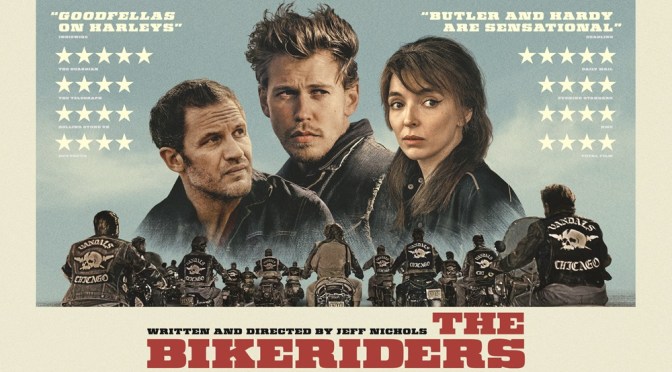
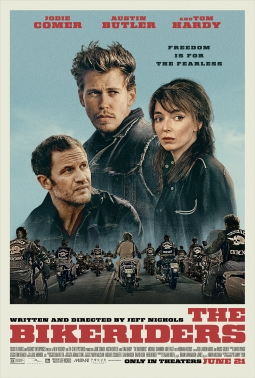
Set in the mid-sixties, the biopic The Bikeriders (2023), centres on a bike club (or what we could be considered a ‘Hell’s Angel’ gang of the era) called ‘The Vandals.’ Started by Tom Hardy’s, leader Johnny, as a motorbike racing club, it develops into a social place for men to meet and play and look cool and party and fight. More significantly, ‘The Vandals’ club allows the men to gain a sense of authority and identity within the shifting state of America during the 1960’s. The terrific ensemble cast includes Austin Butler as moody Benny, plus his sparky narrator wife, Jodie Comer, as Kathy. All are very good, yet there is something lacking thematically and in terms of plot.

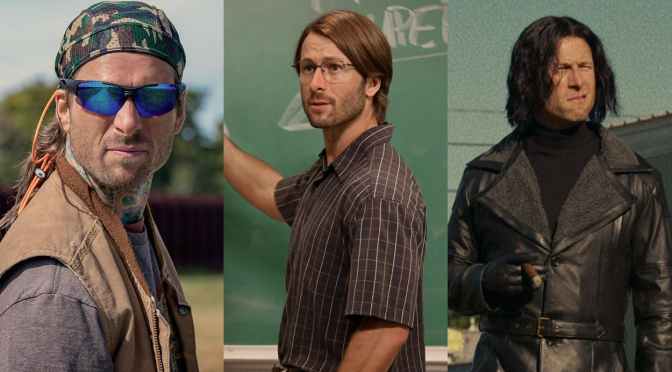
Story-wise The Bikeriders (2023), is more like a verbal and pictorial diary with Comer’s affected Chicago accent gluing the various events together without reaching a height of dramatic satisfaction. Butler and Hardy are really cool and moody, echoing visitations of James Dean and Marlon Brando, respectively. But there needed to be more differentiation in their characters as TWO strong and silent types created a dramatic vacuum for me. Classic scene stealers such as Michael Shannon, Boyd Holbrook and Norman Reedus do add colour and charisma. I kind of wanted more of those guys because they had strong personalities, and actually spoke! Meanwhile, the props, costumes, production design and cinematography are all brilliantly rendered, clothing the film in an authentic and gritty sense of style.

Ultimately, the nostalgic, “anti-hero” driven period drama, so well delivered by Martin Scorsese over the years gets another solid run-out in The Bikeriders (2023) from the talented filmmaker, Jeff Nichols. Whereas Scorsese brings incendiary cinematic fireworks and complex tales of morality to your face, mind and heart, Nichols is a more under-stated director. He presents his stories and characters without too much push, with the audience having to lean in to catch the whispers of drama. That isn’t to say The Bikeriders (2023) doesn’t have action, racing, fighting, crashes, and blood, but the characters are lacking a powerful narrative engine to drive the strong performances forward. Plus, the themes of loss, war, and masculinity in crisis needed more gas. The film motors along just fine, but without ever getting into fifth, let alone sixth gear.

Mark: 7 out of 11

NETFLIX REVIEWS: HORROR!

NETFLIX REVIEWS: HORROR!

As regular readers of my blog will know I am a massive fan of horror films. So much so I will often theme my monthly viewing around the genre, then consolidate the reviews in one post. Here are two of the most recent posts:


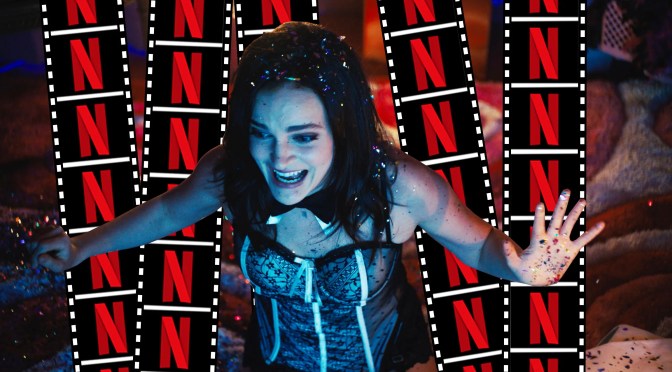
For the month of June and bleeding into July, I solely focused on horror films streaming on Netflix. So, here are short reviews of the many films I watched that are currently available on Netflix!

*** CONTAINS PLOT SPOILERS ***


A CLASSIC HORROR STORY (2021)

Italian shocker that echoes Midsommar (2019), Scream 3 (2000) and The Ritual (2017). The script is meta-clever and there’s some decent gore, but overall it lacks emotional empathy for the characters. More of a knowing film satire rather than being proper scary. Mark: 6.5 out of 11


BAGHEAD (2023)

Suffers in comparison to the far more energetic and thrilling Talk to Me (2022) – which is also on Netflix. Aside from the opening with the always brilliant Peter Mullan, who sets the scene, monster and horror rules, the film contains slight characterization and low stakes when the lead protagonists enter the shadowed fray. Mark: 5.5 out of 11


BLOODY NEW YEAR (1987)

Genuinely one of the worst horror films EVER made, that somehow still has some memorably crazy moments and monsters. Watch and cry with laughter about how bad this Brit-shocker is though! Mark: 2 out of 11


CAM (2018)

Madeline Brewer is fantastic as the narcissistic Cam-Girl who finds her identity is cloned, with the added stress of a killer being on her trail. Cleverly and wittily plotted, this brilliantly directed satire rises above its exploitative material to deliver a thematically rich horror film full of suspense and shocks. Mark: 8.5 out of 11


CREEP 2 (2017)

Mark Duplass gives another strikingly weird performance as the serial killer who loves the slow-burn taunting of his victims. Both this and Creep (2015) actually make the found footage filming trope work really well. Mark: 7.5 out of 11


EMELIE (2016)

What if your babysitter isn’t the person you think they are? An incredibly chilling character study designed to give every parent sleepless nights. With a committed performance from Sarah Bolger, this has so many twisted scenes involving the kids that disturbed me and feared for their safety. A horror film that really burrows under your skin throughout. Mark: 7.5 out of 11.


FANTASY ISLAND (2020)

Taking a 1970’s high-concept drama series and turning it into a horror film is not the worst idea, especially as the original series had its darker episodes often involving cautionary tales of morality. However, the script they delivered for this misfire feels as though many, many writers have tried desperately to resuscitate it from within the cold morgue draw. There’s some drive and energy from the cast and I actually enjoyed some of the set-pieces, but it feels ultimately like over-stuffed mush. Mark: 5 out of 11.


HAUNT (2019)

An incredibly generic set-up finds a group of teenagers drawn to a haunted house at Halloween, only for crazed killers to lock them in a slash them down. Benefits from some imaginative villains and kills, plus an empathetic lead characterization by Katie Stevens as the grieving Harper. Lastly, directors Scott Beck and Bryan Woods show excellent control over tone, style and suspense. Mark: 7.5 out of 11.


RED STATE (2011)

Kevin Smith goes ‘Grindhouse’ with this gnarly horror film where a group of horny teenagers are lured into a deadly trap that threatens their existence. Starts strongly exploring themes of religious mania and family values culminating in an incredible monologue delivered by Michael Park’s charismatic church leader. Latterly descends into a chaotic siege thriller shoot-em-up with crazy cultists versus the American authorities led by the always excellent, John Goodman. Smith’s trademark chitty-chatter dialogue is good, but kind of gets in the way (monologue aside) of the drama and humanity-as-horror of the piece. Mark: 7 out of 11.


THERE’S SOMEONE IN YOUR HOUSE (2021)

Extremely well written, directed and acted film which gets stuck between the rites-of-passage and slasher tropes, serving neither of these genres satisfactorily. There’s some alright kills, but overall feels like an inferior photocopy of Scream (2000) with little of the wit or meta-brilliance. Mark: 6 out of 11.


TIN & TINA (2023)

Featuring motifs relating to religion, fascism and family values, this interesting chiller ticks all the themes present in many Spanish horror films. As Lola (Milena Smit) and Adolfo (Jaime Lorente) suffer the tragedy of a lost child, they try to redeem their grief with the adoption of two blonde, shock-haired orphans raised by nuns. Driven by their naivete and religious fervour, Tin and Tina end up committing many questionable acts which threaten to send Lola over the edge. Beautifully filmed and scored, the director also builds an impressive sense of dread throughout, yet the film is ultimately denied a higher mark by the glacial pace and disappointing ending. Nonetheless, it is thought provoking with both the creepy kids and Christianity contributing to nail-biting scenes of high anxiety. Mark: 7 out of 11

FIX FILMS PRESENTS: SIN – EPISODES 4 – 7

SIN – EPISODES 4

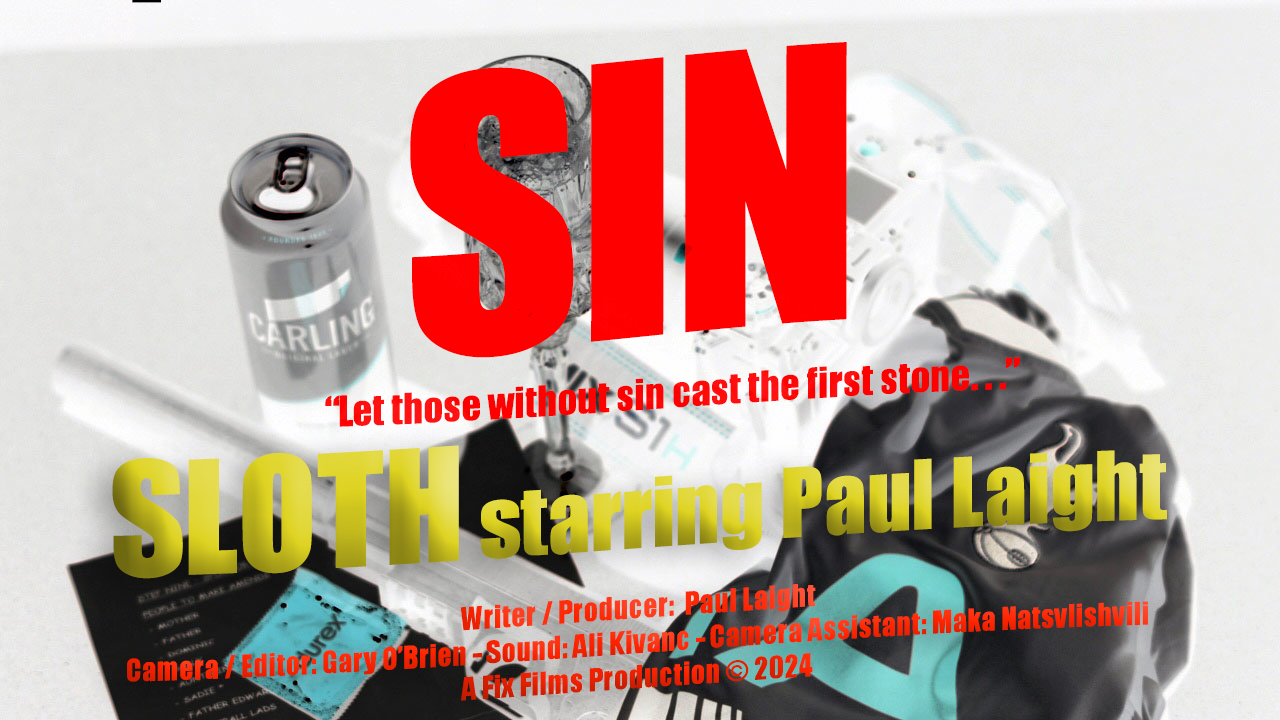
Last year I wrote and produced seven monologues inspired by the deadly sins. With careful planning, myself and a quality cast and crew shot them all in one day at Raindance Film School. I’m now releasing them online via YouTube. They are in essence a proof of concept project with an aim for myself to develop them into a feature film screenplay. Below are episodes 4 to 7!


PITCH

“Let those without sin cast the first stone.”

An anthology of 7 monologues based around the seven deadly sins. Moments, drama, humour, character studies and themes exploring the darker side of human nature. Influenced by: Alan Bennett’s Talking Heads, Inside No. 9, Tales of the Unexpected and Amicus/Hammer horror film anthologies.


PRIDE starring Myles Horgan

Bishop, a retired spy with a gun in his face, delivers a powerful monologue as he attempts to deduce the identity of the assassin that faces him.


LUST starring Tom Cavendish

Danny, a police officer racked with guilt, confesses as to why he thinks he cheated on his beloved fiancé with her sister.


ENVY starring Malcolm Jeffries

Len, a covert photographer, reveals how his obsession with a client’s wife brings back haunting memories from his past.


WRATH starring Julia Florimo

Sadie describes in detail how and why she plotted revenge by poisoning her cheating ex-boyfriend, Stephen.


CREDITS

Writer and Producer: Paul Laight
Camera and Post-Production: Gary O’Brien
Sound: Ali Kivanc
Camera Assistant: Maka Natsvlishvili

Music by: Epic Violin Music NO Copyright royalty free music  
Special thanks: Raindance Film School and Universal Video


FIX FILMS PRESENTS: SIN – EPISODES 1 – 3

SIN – EPISODES 1 – 3

Last year I wrote and produced seven monologues inspired by the deadly sins. With careful planning, myself and a quality cast and crew shot them all in one day at Raindance Film School. I’m now releasing them online via YouTube. They are in essence a proof of concept project with an aim for myself to develop them into a feature film screenplay. Below are episodes 1 to 3, with episodes 4 to 7 to come soon.


PITCH

“Let those without sin cast the first stone.”

An anthology of 7 monologues based around the seven deadly sins. Moments, drama, humour, character studies and themes exploring the darker side of human nature. Influenced by: Alan Bennett’s Talking Heads, Inside No. 9, Tales of the Unexpected and Amicus/Hammer horror film anthologies.


SLOTH starring Paul Laight

Sloth, features Kevin, a Spurs fan, recounting how he took revenge on one of the laziest people he has ever met.


GREED starring Sydney Curtis

This moving monologue features, Gary, at an AA meeting, sharing how he believes greed has contributed to a close friend’s death.


GLUTTONY starring Antigone Duchesne

Kate Briggs serves up a monologue, via a video will, enacting a grudge-driven, but sweet revenge against her gluttonous pig of a brother.


CREDITS

Writer and Producer: Paul Laight
Camera and Post-Production: Gary O’Brien
Sound: Ali Kivanc
Camera Assistant: Maka Natsvlishvili

Music by: Epic Violin Music NO Copyright royalty free music  
Special thanks: Raindance Film School and Universal Video


© 2024 Fix Films Ltd


CINEMA REVIEW: FURIOSA – A MAD MAX SAGA (2024)

CINEMA REVIEW: FURIOSA – A MAD MAX SAGA (2024)

Directed by George Miller

Written by George Miller & Nico Lathouris

Based on characters by George Miller & Byron Kennedy

Produced by: Doug Mitchell & George Miller

Main Cast: Anya Taylor-Joy, Chris Hemsworth, Tom Burke, Alyla Browne, Lachy Hulme, Angus Sampson, etc.

Cinematography by Simon Duggan

*** CONTAINS SPOILERS ***


George Miller’s fifth entry of the Mad Max series is Furiosa: A Mad Max Saga (2024). Given the meaning of the word ‘saga’ is defined as, “a long story of heroic achievement, especially a medieval prose narrative in Old Norse,” it’s an attempt by Miller to connect the Mad Max films to mythical storytelling and folk lore, yet paradoxically set such ye olde yarns in the future. Conversely, while being part of the post-apocalyptic sci-fi sub-genre, there is certainly more than a suggestion of marauding and pillaging Vikings within the freakish characters of the radioactive Aussie wasteland.

Of course, the hi-tech and vehicular monsters smashing up and down the ‘Fury Road’ render the action far from the medieval, replacing long boats for super-charged two, three and four-and-more-wheel souped-up demons driven by mutated future humans. The gigantic rock, bullet, fuel, and scrap metal designed bases of ‘The Citadel,’ ‘Bullet Farm’ and ‘Gas Town’ inhabited by these tattooed ravagers, while rough in exterior represent humanity’s industrial survival and base-building instincts par excellence. So much for the imperious nature of Miller’s world-building, what of the narrative?

If one is honest, the screenplays for all four of the previous Mad Max films are the exercises in economy, with hard-cut structures, granite-boiled dialogue often spat out via twisted one-liners, and poetically yelled slang-speak. Introduced as a maverick cop, but loving family man in Mad Max (1979), Max Rockatansky (Mel Gibson) is essentially a cops-versus-gangs-meets-revenge exploitation thriller. By the time gangs have killed his family and nuclear war has destroyed the world, Max has become the Road Warrior (1981), in what is one of the greatest action films and sequels of all time. However well regarded the mayhem of Fury Road (2015), and it is incredible, The Road Warrior remains one of my favourite films ever.


Beyond Thunderdome (1985) was the slicker third film, and while the action was terrific, there was too much money and sheen in there, reminiscent of what they did with the glamoured cast in the last season of Game of Thrones. Plus, the script was broken in half, with an amazing first section set in Bartertown with Tina and crew, before giving way to a more philosophical, but less exciting kids-in-a-commune driven story. In comparison Furiosa: A Mad Max Saga (2024) is certainly the most ambitious of all the narratives. It is set over several years, from the moment Furiosa (Alya Browne) witnesses her mother killed by Dementus (Chris Hemsworth) and his nasty marauders, to her rites of passage ascent toward gaining a vicious revenge.

Keeping the literary theme, the film is set over five chapters replete with headings to let the audience know what is about to occur. Easily the most impressive is – Chapter III – The Stowaway – where Furiosa comes of age in action during a brutal and mind-blowing action set-piece as the Octoboss, goes rogue and launches an air assault on the “War Rig” as it races along the ‘Fury Road.’ Here Furiosa also bonds with Praetorian Jack (Tom Burke) and the two become partners, with George Miller throwing in an under-cooked romance amidst the petrol, dust, blood and fire.

It is great that Miller and his co-writer Nico Lathouris have strived for more emotional depth and epic storytelling within Furiosa: A Mad Max Saga (2024). However, I felt that at times the rapid pacing and ramped-up action crushed any feelings I may have had about the characters of Furiosa and Jack. Plus, the film suffers a serious case of “prequelitis” where one is joining the dots of Furiosa’s backstory to connect with Charlize Theron’s characterisation in Fury Road. Yes, of course, we find out how she had her arm torn from her body, her drives and motivations, plus how she became a kick-ass future road warrior.  

Taylor-Joy is striking in the all-action role of Furiosa, but a little anorexic on screen to really dominate. Gibson and Hardy are a hard act to follow! Tom Burke stands out amidst the support ensemble, while Chris Hemsworth treats us to another revved-up messianic lunatic. With the character of Mad Max on hiatus, the true stars of this show are Miller and his impressive production, camera, editing, driving, effects and stunt teams. They have once again produced cinematic carnage of the highest order.

Mark: 8.5 out of 11


SIX OF THE BEST #38 – ROGER CORMAN

SIX OF THE BEST #38 – ROGER CORMAN

Sadly, the uber-filmmaker, Roger Corman passed away on May 9th 2024. But given the longevity of his life and career in films it’s really time to celebrate his life in cinema. To me Roger Corman is a hero because he is a true independent filmmaker, working outside of the Hollywood system producing hundreds of films, many of which were extremely successful financially.

Of course, for a man known as the “King of the B-Movies” not all of the films were the height of artistic merit, however, they were NEVER boring. So many of his films have real invention and a crazy energy. What separates Corman from say Ed Wood is he knew how to tell a proper story on a low budget. Indeed, films such as Little Shop of Horrors (1960) and Death Race 2000 (1976) would latterly get the big-budget Hollywood remake treatment. Further, without Corman’s The Wild Angels (1966) starring Peter Fonda, Hopper and Fonda’s counter-cultural phenomenon Easy Rider (1969) may not have existed.

As well as boosting the careers of Peter Fonda and Dennis Hopper, as a producer Corman also gave starts to Francis Ford Coppola, Jonathan Demme, James Cameron, Sandra Bullock, Robert DeNiro, Jack Nicholson, Martin Scorsese, Pam Grier and many more. Corman did not just have a keen eye for talent, he was canny because he knew that such hungry filmmakers and actors could be “exploited” at a lower cost than bigger Hollywood names.

So, as a mini-tribute I have selected six of the best Corman films I have seen. Rest in peace, Mr Corman – you were a true cult and cinema legend!


LITTLE SHOP OF HORRORS (1960)

Incredibly, this film was shot in three days for $28,000 and would become a cult hit after initially struggling to find distribution. Amazingly, Corman did not expect the film to be successful so he didn’t bother to copyright it. It is therefore in the public domain! I myself saw it recently on Talking Pictures and it is a so entertaining. Look out for a hilarious early performance from Jack Nicholson.


THE INTRUDER (1962)

This is perhaps the most seriously raw and challenging film of Corman’s career. William Shatner portrays charismatic racist, Adam Cramer, a travelling salesman, who becomes hellbent on preventing racial desegregation in a Southern town. It was a landmark film for Corman who decided, “It was more of a lecture. From that moment on I thought my films should be entertainment on the surface and I should deliver any theme or idea or concept beneath the surface.”


MASQUE OF THE RED DEATH (1964)

Three masters of horror for the price of one with Edgar Allen Poe, Corman and Vincent Price, combining to chilling effect in this beautifully filmed period ghost story. Arguably the most artfully directed film of Corman’s career, the cinematography was by one Nicolas Roeg, proving once again Corman was an expert at spotting film talent way ahead of time.


BLOODY MAMA (1970)

Cashing in on the success of period gangster film, Bonnie and Clyde (1967), Bloody Mama (1970) is a gloriously over-the-top chase thriller, with Shelley Winters eating the scenery in a brilliant performance. Robert DeNiro appears at Ma Barkers drug addicted son, Lloyd, showing glimpses of the acting talent that would lead to so many incredible performances. But it is Winters’ film as the “loving” and gun-toting mother who leaves a lot to be desired as a positive parental role model.


DEATH RACE 2000 (1975)

The epitome of a high concept cult movie, directed by Paul Bartel, this features the brilliantly sick idea of racing drivers killing members of the public for entertainment. Full of terrific gore and gallows humour, this is one of those Corman produced films where a bigger budget would have served the action so much better. It was still a massive hit though. The imaginative deaths, cutting satire and demented characterisations from the likes of Sylvester Stallone, Martin Kove and deadpan David Carradine are memorably fantastic. I cannot help thinking Death Race 2000 must have been an influence on The Purge franchise too.


BATTLE BEYOND THE STARS (1980)

Corman’s biggest budgeted film at the time of release at $2 million, this film is both a rip-off of Star Wars and homage to The Seven Samurai, or it is the other way round? The massive budget was essentially due to George Peppard’s and Robert Vaughan’s salaries, both of whom would become stars of The A-Team. If you didn’t know many of the inventive practical special effects were supervised and created by a certain James Cameron, who got his big break as the lead production designer and art director on Battle Beyond the Stars.

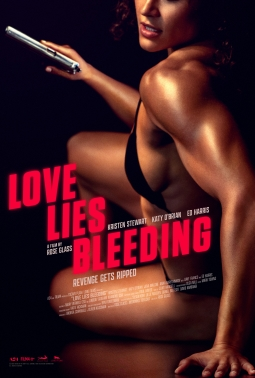
CINEMA REVIEW: LOVE LIES BLEEDING (2024)

CINEMA REVIEW: LOVE LIES BLEEDING (2024)

Directed by Rose Glass

Written by Rose Glass & Weronika Tofilska

Produced by Andrea Cornwell & Oliver Kassman

Main Cast: Kristen Stewart, Katy O’Brian, Jena Malone, Anna Baryshnikov, Dave Franco, Ed Harris, etc.

Cinematography by Ben Fordesman

*** MAY CONTAIN SPOILERS ***


Rose Glass’ debut feature film Saint Maud (2019), was one of my films of the year when released a few years ago. It was such a haunting horror and character study of one woman’s ascent into heavenly insanity. If Saint Maud (2019) borrowed heavily from Paul Schrader’s scripts such as Taxi Driver (1976), and First Reformed (2017), Glass’ second “difficult” feature film, Love Lies Bleeding (2024) owes much to the Coen Brothers darker feature films, dashes of David Lynch and the gritty bite of Jim Thompson’s noir stories.

Set in 1989, Kristen Stewart, portrays mulleted-Lou, a gym manager who kind of drifts along without a plan. Estranged from her gangster father, also named, Lou (Ed Harris), their connected past haunts her as she strives to escape his criminal influence. Into Lou’s humdrum existence comes the muscular chaos of Jackie (Katy O’Brian). Seeking her fortune as a competitive bodybuilder, a broke and homeless Jackie, attaches herself to Lou and they begin a lusty relationship. This passion and the constant sex consequently twists into what one could even call love.


As their alliance pulses on screen, Lou has further family woes to deal with because her sister, Beth, (Jena Malone) lives in constant fear of domestic violence from her husband, J.J. (Dave Franco). Further, Lou strives to help Jackie’s muscle dream by feeding her steroids from the gym dealer. But this backfires when a drug-induced Jackie commits a violent crime which Lou feels bound to try and cover up. Here the various narrative elements and characters, Glass and co-writer, Weronika Tofilska, establish begin to flail for me. While Jackie has a clear narrative goal, Lou’s character is reactive in dealing with the bloody mess created by others. This creates a divergent split of psychologies in the plotting, that Glass’s energetic direction cannot coalesce.

In terms of genre elements involving same-sex romance, brutal violence and crime, Love Lies Bleeding (2024) also owes much to the far superior, Bound (1996) directed by The Wachowskis. That is not to say Glass’ film is without merit. It is just a bit of a hot mess of plot and themes and tonal lurches which do not work as a whole. Indeed, it feels at times there are two scripts pulped together which constantly push back against each other. I would have gone with the bodybuilding story as the main focus. Plus, so many characters makes dumb decisions in, Love Lies Bleeding (2024), I just gave up caring. Still, there is some decent violence, a smattering of gallows humour, and magnetic work from Stewart and Harris (of course). Finally, the ultra-talented Rose Glass gives us some fantastically directed visuals which deserved a less smudgy and more coherent screenplay.

Mark: 7 out of 11


UNDER-RATED CLASSIC #11 – THE SCORE (2021)

UNDER-RATED CLASSIC #11 – THE SCORE (2021)

Directed by Malachi Smyth

Written by Malachi Smyth

Produced by Matthew James Wilkinson & Ben Pullen

Cast: Johnny Flynn, Will Poulter, Naomi Ackie and Lydia Wilson

Cinematography by Darran Bragg

Music by Johnny Flynn

*** MAY CONTAIN SPOILERS ***


I’m not sure enough people have seen The Score (2021) to even rate it, let alone under-rate it. Because this crime-thriller-musical is a genuine curio and cult classic in my book. The reviews online are very mixed and many of them are correct in saying the film doesn’t work as either a crime film or musical or even a love story. But for some reason I have watched it twice now and really enjoyed it both times. So, for me, it is very much an under-rated classic.

For the record, for me, an under-rated classic can be a film I love, plus satisfy the following criteria:

  1. Must not have won an Oscar.
  2. Must not have won a BAFTA.
  3. Must not appear in the AFI Top 100 list.
  4. Must not appear in the IMDB Top 250 list.
  5. Must not appear in the BFI 100 Great British films.
  6. Must not appear in the all-time highest grossing movies of list.


So, being a massive fan of Johnny Flynn helps to enjoy this film. He wrote and sings, with Will Poulter and Naomi Ackie, the songs from the soundtrack. Plus, he is one of the main leads, portraying a low-level career criminal, not-as-clever-as-he-thinks, Mike. He is planning a “big job” in cahoots with, not-as-stupid-as-he-acts-sidekick, Troy (Poulter) that involves a big score. That is twenty-grand (£) from a previous job Troy’s imprisoned brother hid. Exponential growth is promised from a meet with some proper gangsters for what may or may not be a drug deal. Anyway, nothing is what it seems in this predominantly one-location thriller.

Two misfits waiting for someone who may never arrive, plus the swinging banter between Mike and Troy has vague elements of Waiting for Godot, however, there is an actual crime plot slowly burning here. As they wait impatiently at a remote cafe writer-director, Malachi Smyth, throws in some eccentric visitors plus a supporting romance plot, with Troy connecting awkwardly at first, then touchingly with cafe employee, Gloria (Naomi Ackie). Indeed, their attraction and subsequent connection virtually becomes the main narrative thrust of The Score (2021), before the final crime twist brings the action to a violent head.

Oh, do not forget the singing too. Dennis Potter had his characters lip-sync to old musical classics to reveal their emotions, and was proclaimed as genius for it. Here Malachi Smyth uses Flynn’s fantastic compositions to do a similar job. I admit it is a bit weird and jarring at first, but Flynn, Poulter and Ackie carry the tunes well for me and it adds another element to an unusual film experience. Ultimately if someone watched The Score (2021) and said it does not work at all, I couldn’t argue with them. However, I really loved it and constantly listen to the soundtrack I downloaded. I also have a soft spot for indie filmmakers, daring to fail while trying something different.


CINEMA REVIEW: CIVIL WAR (2024)

CINEMA REVIEW: CIVIL WAR (2024)

Directed by Alex Garland

Written by Alex Garland

Produced by Andrew Macdonald, Allon Reich, Gregory Goodman

Main Cast: Kirsten Dunst, Wagner Moura, Cailee Spaeny, Stephen McKinley Henderson, Sonoya Mizuno, Nick Offerman, etc.

Cinematography by Rob Hardy

*** MAY CONTAIN SPOILERS ***


Alex Garland has an impressive literary, cinema and televisual curriculum vitae. He gained acclaim as the writer of the novel, The Beach, before moving onto screenwriting duties with fine films such as: 28 Days Later (2002), Sunshine (2007), Never Let Me Go (2010), and under-rated Dredd (2012). He made his directorial debut with Ex Machina (2014), which earned him an Academy Award nomination for Best Original Screenplay. His second film, Annihilation (2018), garnered further acclaim, so much so, FX bypassed a pilot and went straight to series for his science fiction TV narrative, Devs (2020).

While I am a massive fan of Garland’s work, I wasn’t too enamoured of Annihilation (2018). I found it brilliantly made with some fantastic concepts and incredible moments, yet overall it was too slowly paced. With eight superlative episodes of Devs (2020), Garland delivered a story which really connected with me by merging a compelling technological espionage plot to an intelligent exploration of philosophical thought and human behaviour. Where Devs (2020) presciently examined the impact of artificial intelligence, Garland’s new political thriller, Civil War (2024), prophetically imagines an apocalyptic America in the throes of war between combined California and Texas state rebel forces and the current President’s (Nick Offerman) retreating army.

With the ‘January 6 United States Capitol attack’ in mind, Garland opens up a “what if” narrative where the whole of America is conflicted and consuming itself from within. At the heart of the violence is the war photographer, represented by Lee Smith (Kirsten Dunst) and Reuters journalist, Joel (Wagner Moura). Their journey to Washington to photograph the President reveals confusion, destruction and further bloodshed. Generically speaking, a road movie meets dystopian thriller, Civil War (2024) contains thought-provoking themes and incredible cinematography, but with shaky writing in places.


Films about war photographers and/or journalists can be problematic for me. Such characters lend themselves to heroic and the anti-heroic. The writing has to be right because I can lose empathy between such crusading journos and the narcissistic adrenaline junkies looking to deflect their own loathing and self-destructive tendencies. Civil War (2024) struggled to get me onside with the lead characters, although Dunst’s characterisation of Lee Smith is superb. However, her mentor-apprentice relationship with Cailee Spaeny, Jessie Cullen, was under-developed. Spaeny’s “innocent” being used more as a suspense device as opposed to learning the true horrors of humanity and war. Perhaps Garland intended for her to be a sociopath without depth just looking for blood? She finds it!

Moreover, Jessie’s journey from a political perspective was weak as there was no real sense of development in her character. That’s where the decision not to overtly take political sides causes a lack of sociological depth. War films such as Salvador (1986) and The Killing Fields (1984) are more successful as Civil War (2024) loses political impact by not choosing precise sides. But I guess whether they are Democratic or Republican is the whole point. Garland is saying that political parties are all as bad as each other, with human beings their own worst enemy. Politics, like football, gender, sexuality, and religion, are propellants for humans to fight each other.

For a film about photographers, the images on show are incredible and Rob Hardy’s work is genius. Fire, blood and war have never looked so brutal and aesthetically impressive. As well as Dunst, Wagner Moura and Stephen McKinlay Henderson are terrific in their respective roles. Further, there are some nail-biting and suspenseful scenes, notably one involving a film-stealing performance from Jesse Plemons. However, many of the characters’ decisions were weakly written for me. This is surprising given Garland’s prodigious literary and screenwriting talent. Civil War (2024), however, remains another stunning addition to his oeuvre and for all my perceived script weaknesses, the hell of war has never been so artistic and artful.

Mark: 8 out of 11


SHUDDER REVIEW: LATE NIGHT WITH THE DEVIL (2023)

SHUDDER REVIEW: LATE NIGHT WITH THE DEVIL (2023)

Written and directed by Colin Cairnes and Cameron Cairnes

Produced by Mat Govoni, Adam White, John Molloy, Roy Lee, Steven Schneider and Derek Dauchy

Cast: David Dastmalchian, Laura Gordon, Ian Bliss, Fayssal Bazzi, Ingrid Torelli, Rhys Auteri, Georgina Haig, and Josh Quong Tart

Cinematography: Matthew Temple

*** MAY CONTAIN SPOILERS ***


Some years ago I wrote an article about how I dislike the found footage sub-genre and that article can be found here. Occasionally, found footage is used well such as in Creep (2014) with Mark Duplass or REC (2007) or Chronicle (2012). Now you can add Colin Cairnes and Cameron Cairnes, Late Night With the Devil (2023) to that list of found footage films I actually enjoyed.

Technically, one could argue it isn’t really found footage and it negates such films often “amateurish” filming methods, with a truly stylish rendition of 1970’s television chat shows. However, we are asked by the narrator to view “never-before-seen” images and sounds from a previously unreleased and infamous TV chat show presented by ‘Night Owls’ host, Jack Delroy (David Dastmalchian). So, found footage it is!


David Dastmalchian is absolutely fantastic in his role as ambitious but desperate to be number-one chat show host, Jack Delroy. Often cast in supporting roles he now grabs the chance to become much more than that scene-stealing character actor. Delroy is not unlikable, but his arrogance and ambition dominate his personality. So much so, and despite his grief at losing his wife to cancer, he is prepared to allow all sorts of creepy and inappropriate situations unfold in his desperate search for TV ratings.

Delroy pits a dubious psychic Christou (Fayssal Bazzi) against skeptical former magician Carmichael the Conjurer (Ian Bliss), before asking parapsychologist author June Ross-Mitchell (Laura Gordon), and her subject Lilly D’Abo (Ingrid Torelli) to contact a demonic presence called ‘Mr Wriggles,’ live on television. Even after Christou is rushed to the hospital and Lilly contorts and spits out growling obscenities, Delroy decrees the show must go on. The Cairnes Brothers then continue to ratchet up the tension and horror to a deadly and shocking ‘Night Owls’ televisual denouement.

With echoes of the recent Inside No. 9 (3×3 quiz show episode) and BBC show Ghostwatch (1992), and of course The Exorcist (1973), Late Night With the Devil (2023) is one of the most enjoyable horror films I have seen in sometime. The 1970’s period setting and TV studio location is impressively recreated by the fantastic production team, especially on a relatively low budget. Arguably, the plot, once you dig down into it lacks emotional depth, however, the pacy and darkly funny screenplay more than compensates for this. Overall, the film’s style, design, direction and a commanding performance from Dastmalchian ensure Late Night With the Devil (2023) is essential viewing for all horror fans.

Mark: 9 out of 11


Thoughts on Cinema and Filmmaking