Tag Archives: Netflix

NETFLIX FILM REVIEW: BLONDE (2022)

NETFLIX FILM REVIEW: BLONDE (2022)

Directed and written by: Andrew Dominik

Based on: Blonde by Joyce Carol Oates

Produced by: Brad Pitt, Dede Gardner, Jeremy Kleiner, Tracey Landon, Scott Robertson

Main cast: Ana de Armas, Adrien Brody, Bobby Cannavale, Xavier Samuel, Julianne Nicholson, Evan Williams, Toby Huss, David Warshofsky, Caspar Phillipson, etc.

Cinematography: Chayse Irvin

*** CONTAINS HISTORICAL SPOILERS ***


Aside from expertly directing episodes of the Netflix drama, Mindhunter and the documentary One More Time with Feeling (2016), filmmaker Andrew Dominik’s directorial output has been sparse of late. Indeed, he hasn’t released a feature film since quirky gangster drama, Killing Them Softly (2012). I imagine this is due to many reasons including: slow-gestating methodology, several unrealized projects failing to see a greenlight, and the dreaded COVID-19. It’s a shame as I believe he is one of the most compelling filmmakers around at present. Chopper (2000) remains one of my favourite cult stories about a charismatic, larger-than-life criminal anti-hero. Similarly, The Assassination of Jesse James by the Coward Robert Ford (2007) is one of the best films I have seen from the last twenty years.  It was pretty much a box-office flop but everything about it screamed greatness to me: stunning cinematography; brilliant cast; and resonating themes regarding celebrity and legend in the Wild West.

After Chopper Read and Jesse James, once again Dominik explores the iconic life of a real person in Blonde (2022). You may have heard of her, Norma Jean Mortenson/Baker, or as she was more famously known: Marilyn Monroe. Using Joyce Carol Oates’ book as a springboard, plus no doubt many other written, visual and media sources available, Dominik has crafted a stylish and singular vision of the peroxide icon’s life and career. In no doubt should a viewer believe this to be a “true” story in the documentary-drama style, but rather an impressionistic, poetic and compelling imagining of Marilyn’s short, yet tumultuous, existence on this planet.

For me, Marilyn Monroe was one of the most stunning movie stars who ever existed. She lit up the screen and was a mightily under-rated actor also. In her heyday she was the biggest star in the world. Her role as Sugar in Some Like it Hot (1959), is one of the most gorgeously funny, beautiful and vulnerable performances ever committed to celluloid. Enter Ana De Armas as Marilyn in Blonde (2022). De Armas is a revelation on-screen in terms of her looks, movement, body language and the nuanced depth she brings to the screen siren. It’s a brave role too as the script demands much of her. Throughout many exquisitely filmed and edited scenes lies the ugly degradation of Marilyn’s body and soul. De Armas gives her all in these vignettes of domestic abuse, sexual assault, rape, abortions, overdoses, miscarriages, mental breakdowns and further sexual gaslighting at the hands of people she believed were friends.



So, why should you want to watch Blonde (2022), you may ask yourself. Well, De Armas’s performance alone is worth enduring much of the emotionally draining misery. Moreover, Dominik again proves himself to be a director of the highest quality. He’s a maverick and iconoclast who has an impressive and intelligent cinematic eye. The opening sequence where Norma, as a young child, is driven by her unwell mother through Los Angeles forest fires is a frightening and imperious interpretation of mental health, full of fear, heat, and portentous symbolism. Such fire and trauma foreshadows the distress and torment that is to come to young Norma throughout her life. A schizophrenic Mother also echoes the schism of persona that impacts Norma the individual, and Marilyn the movie star. The division of personalities is a theme which the screenplay sensitively explores, despite being buried in the more lurid and shocking events of Marilyn’s sad life.

Overall, Blonde (2022) is a startling and shocking rendition of Marilyn Monroe. Of course, hers was an existence full of drama, intensity, darkness and tragedy. But you have to think there was some light in there, some happiness, humour and joy. On some fleeting occasions during Blonde (2022), Dominik presents this, but ultimately this is a beautifully filmed yet ugly-hearted cinematic tragedy. On the surface the film genre is biopic, but it really is a horror film, as Marilyn’s exploitation by the men in her life is laid bare on the screen. I’ve read some critics describe the film as exploitational, however, this is a film ABOUT exploitation. Marilyn was exploited by agents, photographers, directors, producers, the press, the Hollywood system, the audience, her doctors, her lovers, her husbands and a President of the United States.

Dominik is perhaps suggesting Monroe did not kill herself, but was disintegrated by those who should have loved and cared for her. The ultimate tragedy is that Norma/Marilyn could not find the love and mental strength inside herself to survive those who perpetually sought to profit from this beautiful shining star. If the events realised in Blonde (2022) are to be believed, what person could?

Mark: 8 out of 11


[BOOK REVIEW] Directing Great Television: Inside TV’s New Golden Age – by Dan Attias

Directing Great Television: Inside TV’s New Golden Age – by Dan Attias  – Review by Paul Laight

The opening quotes of praise from a myriad of industry colleagues will make my little review pale into insignificance, as there is no doubt that Dan Attias is a director of some repute, expertise, and experience. Here is an Emmy-nominated director who has worked on an incredible list of amazing television shows such as: Miami Vice, Beauty and the Beast, Wolf, It’s Always Sunny in Philadelphia, The Sopranos, The Wire, House, Homeland, Witness (Peter Weir), Northern Exposure, Penny Dreadful: City of Angels, The Americans, The Killing, The Boys, Six Feet Under, The Wire, Marvellous Mrs Maisel, Friday Night Lights, etc.

With such a breath of experience Dan Attias therefore offers much to those seeking insight into the world of directing high quality TV. Moreover, it will also give priceless advice to those seeking a career in directing for all forms of creative media. It is structured and presented eloquently in a language that doesn’t blind the reader with techno-speak either.

The author began as an actor before moving into directing. In fact he states that the best training he had for directing was being an actor. Dan Attias moved from in front of the camera to behind it as assistant director for Steven Spielberg and Francis Ford Coppola before directing the feature film Silver Bullet (1985). After which he moved into directing episodic television. 

Throughout the book, the author shares his wealth of experiences, highs, lows, and scars got from directing many great TV shows of recent years. Dan Attias does not glamorise the industry but illustrates that the craft of television production is all about the hard work and harder knocks. He advises honing one’s craft through being prepared, with collaboration also being vital. It’s a fast-paced endeavour where choices can often go wrong. But learning from those mistakes builds one’s directorial nous. Preparation is invaluable. Even if episodic television does not always allow it. The director will often arrive late to the party as it were with the showrunners, writers, actors, and pre-production crew having worked months developing a project.


I was seriously inspired by many of Dan Attias’ informative anecdotes. Having worked in both drama and comedy it is clear he is not just a point-and-shoot director. One senses a burning desire on his part to tell stories an imaginative, creative, and emotionally interesting style. Moreover, the book provides key insight into the rehearsal process, positioning actors, use of lenses, shifting points-of-view within scenes, framing, background mise-en-scene and of course lighting. For Attias, above all else, engaging with the environment is imperative as, “Each scene is staging a journey.”

As well as the technical knowledge delivered, the author continually promotes the idea that coordinating positively with showrunners and writers is integral when creating the best work. That does not mean there won’t be disagreements or having to overcome material which appears dramatically unpromising. It is the director’s job to be creative and collaborative while breathing new life into well-known characters within long running shows. 

The final chapters share excellent scene breakdowns from the author’s experience of working on three different TV shows, Snowfall, Manhattan, and Good Girls Revolt. Here he delivers a fine perspective of a director’s vision, using the camera and stylistic choices to tell the story, both following and breaking the rules. If you’re breaking the rules you may face conflict from certain crew members, but it is all about staying confident in one’s vision for the storytelling. Overall, Attias’ honesty in overcoming difficult creative moments is to be admired.

Some may think that television was always the lesser cousin, locked in the artistic attic when compared to the noble art of cinema. No more though as programmes such as Game of Thrones, The Wire, The Sopranos, Homeland, Breaking Bad, and many more have proved. Such classic television finds the writing, cinematography, acting and increased production values, elevating their status to the cinematic. The old-school image of a 1970’s TV director shouting at a bank of monitors giving orders to the beleaguered floor manager and cast in a studio is now gone. Dan Attias and his book are testament to that.

This image has an empty alt attribute; its file name is image.png


Buy the book from here:

Publication from https://mwp.com/product/directing-great-television-inside-tvs-new-golden-age/  

Michael Wiese Productions (MWP) was launched in San Francisco in 1976 primarily to produce films. Today, the company is known worldwide having published some 200 books. Some of the bestsellers have been translated into 18 languages, are used in over 700 film courses, in the Hollywood studios and by emerging filmmakers.

Paul Laight is a screenwriter, filmmaker, and blogger. In 2005, he formed Fix Films and has written and produced many shorts and other promos. Many of his films have been screened all over the world at various film festivals.

Paul is currently working on feature and short film scripts for future productions. His work can be found here: 

https://www.youtube.com/c/FixFilmsLtd 

https://thecinemafix.com/

HAIL BRITISH CINEMA! REVIEWS OF: AFTER LOVE (2020), BOILING POINT (2021), CALIBRE (2018), COUNTY LINES (2019) & ROSE PLAYS JULIE (2019)

HAIL BRITISH CINEMA!

Tired of watching big-budget homogeneous Hollywood product dominated by superheroes, sequels, remakes, prequels and remakes of prequels to sequels? I kind of am. Not that I don’t love a genre blockbuster when it’s done well. However, from time to time it’s good to diversify and watch films with more depth.

BFI Player has some terrific new and classic releases from all over the world. So, of late I have concentrated on watching some of the newer releases made by British filmmakers. My homeland has always been rich in talented people both in front and behind the camera. This has meant an incredible array of actors, filmmaking artists and technicians being poached by Hollywood. This is not just an artistic decision but an economic one. There just isn’t the money here to make big budget films, however, that doesn’t mean there isn’t some cinematic gold coming out of Britain.

While there have been some very successful film studios in the past, the British film industry has the air of an independently driven environment now. Film Four, the BFI, Aardman, BBC films, Heyday, Baby Cow, Salon Pictures, Marv Films and Number 9 films are all production companies which inhabit the industry. However, it is difficult competing with the gigantic corporate film companies, especially those that dominate distribution at the cinemas.

Yet, here are several brilliant British films I have watched on BFI Player, Netflix and Amazon lately. They are low-budget, mostly independently produced and highly recommended. Check them out as they certainly offer a divergent and absorbing change from the standard generic product at the multiplexes. With marks out of the usual eleven.

*** MAY CONTAIN SPOILERS ***


AFTER LOVE (2020) – BFI PLAYER

Written and directed by: Aleem Khan

Main cast: Joanna Scanlan, Natalie Richard, Talid Arliss etc.

Joanna Scanlan is mesmerising as a Western woman, Mary Hussain, who converted to Islam when she married her childhood sweetheart. In the present, her husband dies suddenly and she discovers he had a secret history. Dealing with both grief and shock at this news, this beautifully acted and directed character study is quietly devastating and moving. Covering themes relating to family, religion, love and fidelity After Love (2020), deservedly won best film at the British Independent film awards. Scanlan, more synonymous with comedic roles, is outstanding and Aleem Khan is a filmmaker who is definitely going places.

Mark: 9 out of 11


BOILING POINT (2021)

Written by: Philip Barandini, James Cummings

Directed by: Philip Barandini

Main cast: Stephen Graham, Vinette Robinson, Ray Panthaki etc.

I’m not a big fan of one-take films generally as it is kind of an unnecessary gimmick, yet this fantastic restaurant-set drama makes full dramatic use of the technique. Stephen Graham is the Head Chef at a Dalston eatery and has to navigate a stressful shift with environmental health, marital, staffing, customer, financial and culinary issues all mounting up around him. There’s even a food critic in the venue. It is brilliantly acted and directed and extremely tense throughout. Graham is always a cracking watch, but Vinette Robinson, as his over-worked deputy, really brings the soup to a boil, serving up a tasty performance amidst the fine ensemble.

Mark: 9 out of 11


CALIBRE (2019) – NETFLIX

Written and directed by: Matt Palmer

Main cast: Jack Lowden, Martin McCann, Tony Curran etc.

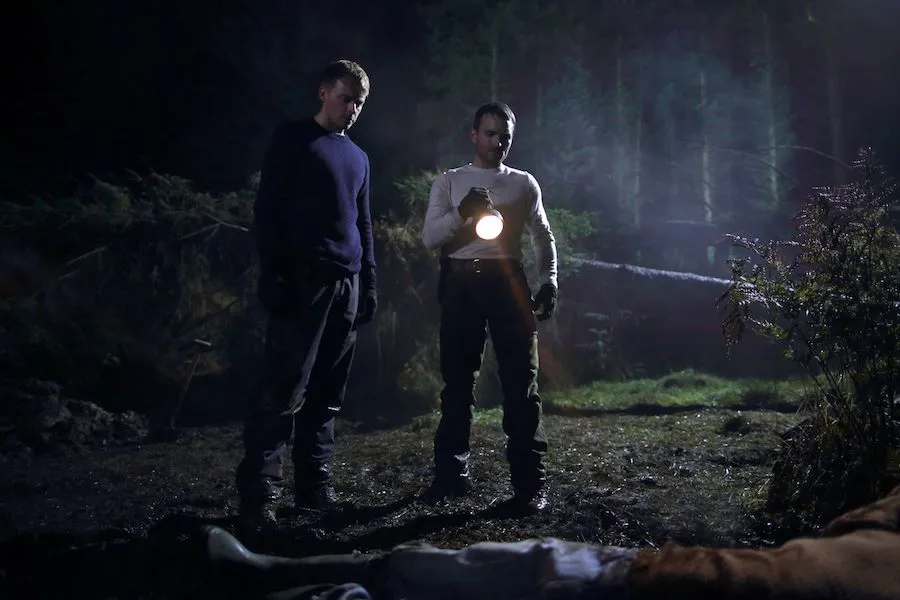
This nerve-wracking thriller takes two former boarding-school friends, Vaughn and Marcus, portrayed by Lowden and McCann, on a shooting trip to the Highlands of Scotland and throws them into the pits of despair when tragedy strikes. Taut is not the word when a fateful shooting incident occurs, as a series of bad decisions places their fractious relationship at the mercy of the angry locals. Further conflict derives as Vaughn’s attempts to mature are countered by the reckless Marcus’ aggressive behaviour. Meanwhile, the film also pointedly comments on the corporate invasion of Scottish nature. Overall, Calibre (2019), had me on the edge-of-my-seat, not wasting a moment to raise the pulse. Finally, Lowden is superb, giving a nuanced performance in an impressively directed feature film debut.

Mark: 8.5 out of 11


COUNTY LINES (2019) – BFI PLAYER

Written and directed by: Henry Blake

Main cast: Conrad Khan, Ashley Madekwe, Harris Dickinson etc.

If you didn’t know ‘County Lines’ is the practice of trafficking drugs into rural areas and small towns, away from bigger cities. Traffickers often recruit vulnerable children, including those who have been excluded from school, as drug dealers. Part-thriller and part-cautionary tale, Henry Blake’s gritty and impactful film draws on his own experiences working in a pupil referral unit. Lead character, teenager Tyler (Conrad Khan), is groomed and drawn into a murky world of drugs, only to learn some harsh life lessons. Ashley Madekwe gives a fighting performance as the mother who fears her son is lost to the mean streets of London and Harris Dickinson’s charismatic dealer.

Mark: 8 out of 11


ROSE PLAYS JULIE (2019) – BFI PLAYER

Written and directed by: Christine Molloy and Joe Lawlor

Main cast: Ann Skelly, Orla Brady, Aiden Gillen etc.

Similar in style and tone to Lynn Ramsay’s intense You Were Never Really Here (2018), this poetic thriller takes a generic revenge narrative and delivers an eerie experience through haunting performances, direction, editing and musical composition. While the story moves at a glacial pace it retains power and purpose, as Ann Skelly portrays adoptee, Rose/Julie, a veterinarian student searching for her biological parents. Her detective work unearths devastating secrets which then precipitate twisted turns into thematically dark territory. Skelly gives a subtle but intelligent performance, while Orla Brady and Aiden Gillen also give emotional depth to their respective roles. Ultimately, despite the film delivering certain plot points too enigmatically, one cannot fail to be moved by Rose’s shocking journey of discovery.

Mark: 8 out of 11


Lest we forget. . .

SAINT MAUD (2019) – AMAZON PRIME

Written and directed by: Rose Glass

Main cast: Morfydd Clark, Jennifer Ehle etc.

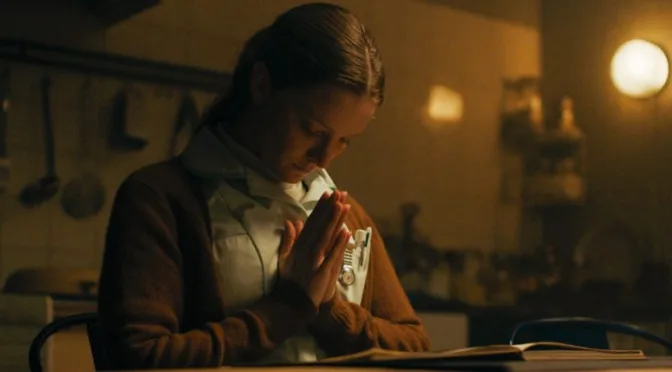
The film is more than just a calling card for the extremely talented director, Rose Glass. Her grasp of the material is superb and the cinematography and shot composition support her dark vision brilliantly. The film may disappoint those who prefer conventional supernatural films, as it is more arthouse than classic horror. Moreover, it has much in common with searing character studies by Paul Schrader, such as Taxi Driver (1976), and the more recent, First Reformed (2017). Indeed, Maud’s voiceover permeates like a prayer to an empty sky bleeding into the powerful imagery to compelling effect. The true horror of Saint Maud (2019) is not in jump scares or one-dimensional monsters, but rather the slow descent into hell by a character who strives to be a saviour. Tragically though, Maud is a self-appointed Angel, whose mental fragility disintegrates under the weight of holy desire and biblical fervour.

Mark: 9 out of 11


NETFLIX FILM REVIEW: DON’T LOOK UP (2021)

NETFLIX FILM REVIEW: DON’T LOOK UP (2021)

Directed by: Adam McKay

Screenplay by: Adam McKay

Story by: Adam McKay, David Sirota

Produced by: Adam McKay and Kevin Messick

Cast: Leonardo DiCaprio, Jennifer Lawrence, Meryl Streep, Cate Blanchett, Rob Morgan, Jonah Hill, Mark Rylance, Tyler Perry, Timothée Chalamet, Ron Perlman, Ariana Grande etc.

Cinematography: Linus Sandgren

*** MAY CONTAIN SPOILERS ***


Adam McKay has had an interesting filmmaking career. He was a head writer on Saturday Night Live for two seasons before moving into cinema comedy by writing and directing gag-heavy comedies such as Anchorman: The Legend of Ron Burgundy (2004) plus the sequel, Talladega Nights: The Ballad of Ricky Bobby (2006), Step Brothers (2008), and The Other Guys (2010). While one could see these films as silly and knockabout Will Ferrell clown vehicles, certain films contained explorations of social issues relating to sexism in the workplace and big corporation fraud. Nevertheless, it was still surprising when McKay shifted toward more dramatic work full of barbed satire and social commentary. While both The Big Short (2015) and Vice (2018) certainly had humour, they also impressively dissected the mortgage crash and the political rise of Dick Cheney, respectively.

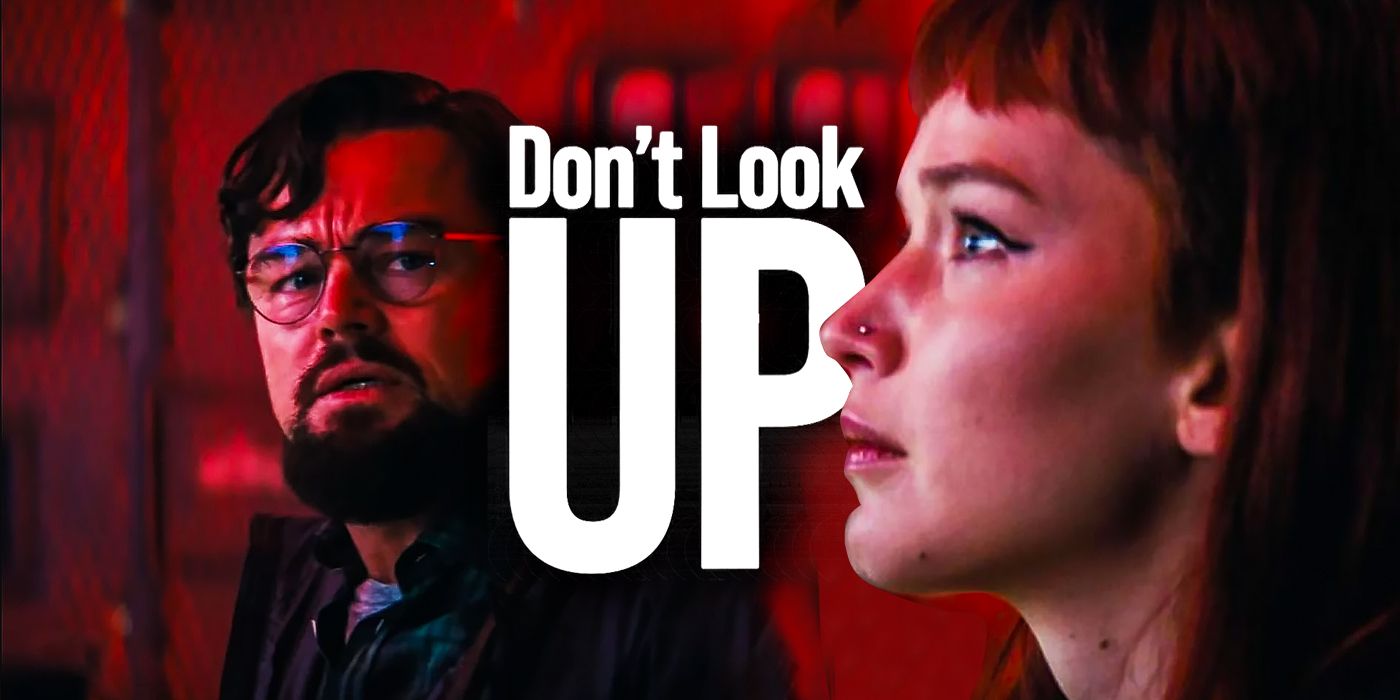
His latest film is the Netflix produced Don’t Look Up (2021). It is a disaster movie in genre, that also mixes in comedy, political satire and drama. The story concerns Kate Dibiasky (Jennifer Lawrence), an astronomy Ph.D. candidate, discovers a previously unknown comet. Kate’s professor Dr. Randall Mindy (Leonardo DiCaprio) work together and find that it is an extinction event which will destroy all life on Earth. Only having presented their findings to NASA and the White House do they find themselves dealing with indifference, administrative incompetence and corporate neglect lead by insane financial greed. As news of the impending doom hits society, the population become split between believers and naysayers leading to division and chaos.


Don’t Look Up (2021) is arguably less serious in tone compared to Adam McKay’s previous two films, but the message is ultimately more damning of the U.S. Presidency and humanity as a whole. Because the gigantic comet heading for Earth is very much a metaphor for climate change. Here Meryl Streep’s President is dizzyingly dismissive of the science and only begins to act when it is politically and financially beneficial. Her Chief of Staff son, a brilliant Jonah Hill, is a sycophantic numbskull more interested in Lawrence’s raging scientist, rather than saving the world. Indeed, Dibiasky and Mindy get side-tracked by glamour, celebrity and the toxicity of social media. DiCaprio’s arc is amusing as he goes from nervous mouse to confident commentator in the middle act, only to experience a costly personal comeuppance.

Rich in fast-paced gags at the expense of pop, media, political, corporate and dumb human personalities, Don’t Look Up (2021), is a highly entertaining disaster movie with a terrific ensemble cast. I felt Leonardo DiCaprio, one of my favourite actors, was a tad miscast as the science everyman, but he still gives a great performance. Lawrence provides the most grounded and empathetic character playing it straight amidst the all-round insanity. The White House “vending” machine running gag is the best in a film full of funny lines. Mark Rylance is craftily good as the social media megalomaniac manipulating the catastrophic narrative to his own means, but as aforementioned Jonah Hill steals the comedy show. Lastly, Adam McKay probably over-reaches with the poignant family-driven ending. However, I did feel a true sense of loss for the characters and our planet as a whole. The Earth may be full of idiots who don’t want to look up, but thankfully there are storytellers trying to turn their minds in an amusing, silly and intelligent fashion.

Mark: 8.5 out of 11


NETFLIX FILM REVIEW: THE POWER OF THE DOG (2021)

NETFLIX REVIEW: THE POWER OF THE DOG (2021)

Directed by: Jane Campion

Screenplay by: Jane Campion

Based on: The Power of the Dog by Thomas Savage

Produced by: Emile Sherman, Iain Canning, Roger Frappier, Jane Campion, Tanya Seghatchian

Cast: Benedict Cumberbatch, Kirsten Dunst, Jesse Plemons, Kodi Smit-McPhee, Thomasin McKenzie, Genevieve Lemon, Keith Carradine, Frances Conroy etc.

Cinematography: Ari Wegner

*** MAY CONTAIN SPOILERS ***


Set in 1925 amidst the spectacular terrain of Montana, The Power of the Dog (2021), centres around a ranching family’s everyday relationships, romances, hatreds and choices. Two brothers run the Burbank ranch, Phil (Benedict Cumberbatch) and George (Jesse Plemons). George is the kinder man who leans more toward progress and business. Phil is more of the land and the traditional cowboy. However, he is incredibly intelligent and could have made more of his education. Instead, he is driven to follow in his hero and mentor, Bronco Henry’s wake, work the ranch and command men.

While hiding a deep secret, Phil is absorbed by the cowboy lifestyle and thrives on controlling those around him. But when George meets Rose (Kirsten Dunst) at a cattle drive inn, he falls for her. Soon they marry and George agrees to provide for Rose and her son Peter (Kodi Smit-McPhee). Phil immediately becomes upset by the intruder to the family equilibrium. Soon Rose and Peter fall foul of his bullying and superiority complex. Thus, begins a series of subtle and ambiguous clashes where Phil and Rose clash, before the bright, androgynous Peter manoeuvres to protect his beloved mother.


The stunning cinematography and vistas of, The Power of the Dog (2021), are more luminous dressing when compared to the compelling characterisation and incredible performances delivered via Jane Campion’s confident direction. Indeed, Benedict Cumberbatch, Kirsten Dunst and Kodi Smit-McPhee are so good you could have set the story on an empty soundstage (like Dogville (2003) and the searing properties of the drama would have been carried just as potently. Cumberbatch is exceptional. This is an Oscar winning performance. His bitter and envious alpha male broods and hides behind violence and biting words. Every now and then he threatens to burst, but is pulled back. Phil wants to love but is so trapped by social expectations and prejudices that he is trapped tragically by the era. The sensitive Peter doesn’t care what people think and that sadly makes him a victim. But still waters run very deep. Peter has a plan.

This film will give you heartburn. It’s subtle and bubbles like acid, reaches the throat before scarring the pit of your stomach. Now, I’m not always a fan of oblique and poetic cinema, especially within a narrative presented as a quasi-Western. Mostly I like to be punched in the gut, not branded slowly from the inside out. Yet Jane Campion’s expert adaptation of Thomas Savage’s novel, The Power of the Dog (2021), contains some bite. You just don’t see when and how it happens. Expect awards galore for this fine drama.

Mark: 8.5 out of 11

UNDER-RATED CLASSICS #9 – WILD BILL (2011)

UNDER-RATED CLASSICS #9 – WILD BILL (2011)

Directed by: Dexter Fletcher

Produced by: Tim Cole & Sam Tromans

Written by: Dexter Fletcher, Danny King

Cast: Charlie Creed-Miles, Will Poulter, Liz White, Sammy Williams, Charlotte Spencer, Leo Gregory, Neil Maskell, Iwan Rheon, Olivia Williams, Andy Serkis etc.

Music by: Christian Henson

Cinematography: George Richmond

***MAY CONTAIN SPOILERS ***


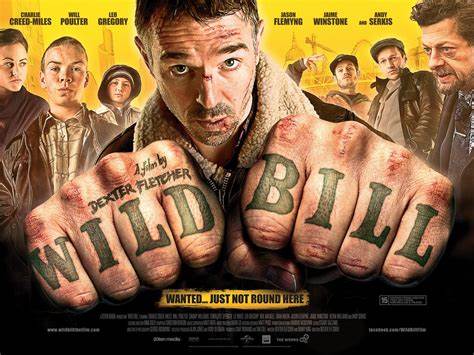
With so much British filmmaking talent behind and in front of the camera being absorbed by the big film and television studios in America, and the lack of cash within the British film industry too, it’s rare that a British film gets made and then distributed properly. Even if a film such as the earthy London-set crime drama, Wild Bill (2011), does find its way to British cinemas it can be cruelly enveloped by the Hollywood film behemoth, swallowed up at the multiplexes and seen by very few popcorn guzzlers. Which is a damn shame as Wild Bill (2011) is a tidy, low-budget, and extremely under-rated classic in my book. Made for just £700,000 and directed by the now in-demand actor-turned-filmmaker, Dexter Fletcher, the film marries family conflict, humour, violence, South London gangsters all in a moving tale of redemption.

For the record, for me, an under-rated classic can be a film I love, plus satisfy the following criteria:

  1. Must not have won an Oscar.
  2. Must not have won a BAFTA.
  3. Must not appear in the AFI Top 100 list.
  4. Must not appear in the IMDB Top 250 list.
  5. Must not appear in the BFI 100 Great British films.
  6. Must not appear in the all-time highest grossing movies of list.

Unfortunately, Wild Bill (2011), does not meet any of these criteria. In fact, not many people have even heard of the film, let alone seen it. But it’s on Netflix so do try and catch it. Read on for some reasons why.


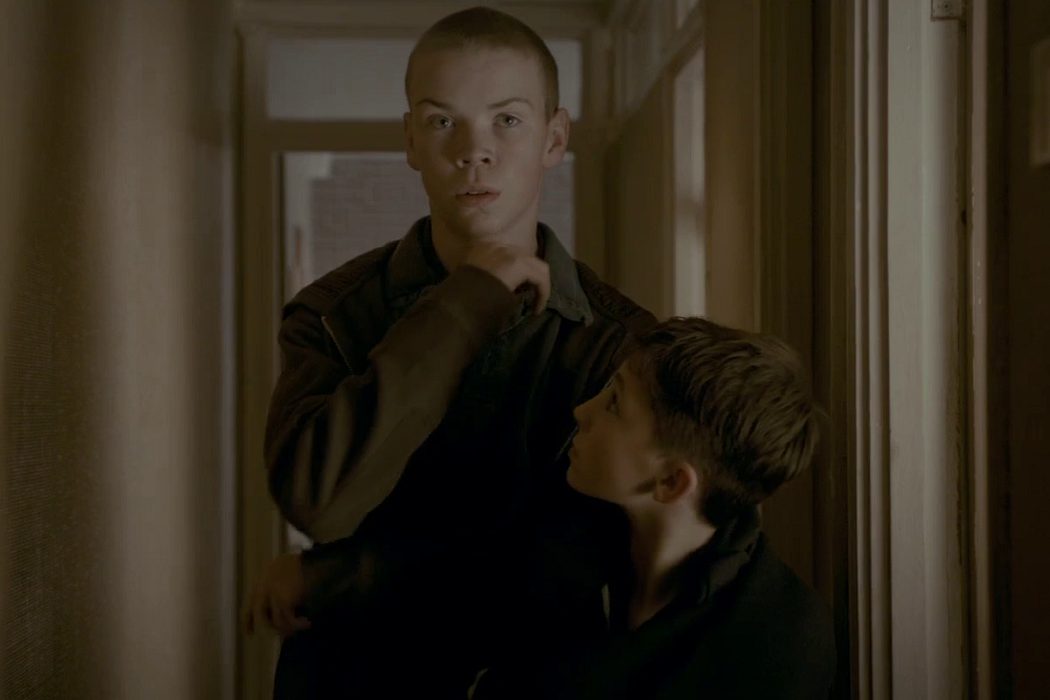
The main character nicknamed, portrayed by the excellent character actor, Charlie Creed-Miles, is the titular “Wild Bill”. He has just been released from prison having been a dealer and fighter and general menace to society. There is immediately tension because you wonder if the man will return to his bad old ways. Surprised to find his wife has buggered off to Spain, Bill is hardly given a warm welcome by his older son, Dean, as Will Poulter give another very mature performance. Indeed, Dean hates Bill, and while he is only fifteen, he has been the breadwinner looking after his young brother, Jimmy (Sammy Williams). Forced to stay together by Social Services, much of the film finds the father and son resisting, then attempting to find some common ground. The attempts at family harmony are not aided by the career thugs, including Leo Gregory and Neil Maskell’s characters, attempting to get Bill back on their crack dealing crew. It’s during such struggles that Bill strives to be positive and not return to his violent ways. However, there is only so far a man can be pushed.

Wild Bill (2011) is beautifully filmed with some fantastic London vistas as well as some gritty, urban locations to savour. Sure, the film also has a familiar set of character archetypes and narrative tropes. These include the ex-con trying to go straight, the tart with a heart, the local drug dealers terrorizing the estate, a teenage mum, estate kids getting pulled into crime, the white dealer who thinks he’s black; and the “Mr Big” crime boss played with threatening glee by Andy Serkis. Yet, the characters never become stereotypes as the writing and narrative avoid most of the cliches usually present in plain bad cockney gangster films. Ultimately, the writers, director and actors really make us care about Bill and his boys. I mean, after many false starts he really tries to make a go of it as a father. Bill may not have always made the best decisions in life, but he has guts and heart; very much like Wild Bill (2011) as a whole.


NETFLIX FILM REVIEW: PIECES OF A WOMAN (2020)

NETFLIX FILM REVIEW: PIECES OF A WOMAN (2020)

Directed by: Kornél Mundruczó

Produced by: Kevin Turen, Ashley Levinson, Aaron Ryder

Screenplay by: Kata Wéber

Based on the play: Pieces of a Woman by Kornél Mundruczó and Kata Wéber

Cast: Vanessa Kirby, Shia LaBeouf, Ellen Burstyn, Molly Parker, Sarah Snook, Iliza Shlesinger, Benny Safdie, Jimmie Fails etc.

***THIS REVIEW CONTAINS SPOILERS***


Every human being has been present at one birth at least – namely their own. Not that one can remember or recall the experience, however, it is something all of us have in common. Many more people, either as parents, or life partners, or medical staff, or relatives and friends have also witnessed a child being born into the world. Birth is both a magnificent and tumultuous wonder of nature. Moreover, it can, while delivering a miracle into the world, be extremely painful for the person giving birth. The incredible progress of medical science means that it has never been safer. However, as my partner experienced when our son was born, it can be traumatic if the procedure has issues. Thankfully, our son was fine after the birth, but almost eighteen-hours in labour on an under-staffed and chaotic maternity ward was stressful. Thus, I was able to identify very much with the characters in the searing grief drama, PIECES OF A WOMAN (2020).

When I say identify, I mean I felt like I was really with the couple, Martha (Vanessa Kirby) and Sean (Shia LaBeouf) as prospective parents. Martha is heavily pregnant and when Sean returns from work as an engineer she goes into labour. Sean works on building huge bridges. Yet, as events unfold within Pieces of a Woman (2020), bridges are the last thing built metaphorically and emotionally. The opening scene is a cinematic tour-de-force which portrays the couple’s home birth in one long moving and harrowing take. Brilliantly filmed and acted, by Kirby and LaBeouf, the one-take device is employed to devastating effect as it impacts emotional power rather being a filmic gimmick. When their first-choice midwife cannot attend, the replacement, Eva (Molly Parker) arrives. The birth is not without problems and the sequence is both intense and suspenseful. The filmmakers really put you in the heart of the trauma. Quickly concern for the new-born child becomes relief when it is born alive. Alas, Martha and Sean’s joy suddenly turns to misery when nature deals the couple a fateful blow.


After the relentless tension of the opening act, Pieces of a Woman (2020), along with Sean and Martha, enters a redoubtable period of grieving. Martha’s personality prior to the event seemed outgoing and confident. After the death of her child she, unsurprisingly, transitions into an insular and hollow shell. Sean, on the other hand, is more explosive. He openly cries and shouts and self-harms by relapsing back into drug and alcohol addiction. Sean, more than Martha, attempts to fix their broken relationship, but Martha’s pain is too great and the distance between them only increases. Martha’s mother, Elizabeth Weiss (Ellen Burstyn), attempts to get some control back by taking court action again the midwife, Eva. Further, she desperately attempts to thwart her daughter from allowing the child’s body to be donated to medical science. In such moments Ellen Burstyn’s performance is absolutely formidable. Indeed, the scenes she shares with Vanessa Kirby are some of the best in the film.

Based on the play of the same name, Pieces of a Woman (2020), is overall an utterly gruelling emotional experience. I must admit I found it difficult to reach Martha’s character as she was so isolated for much of the film. However, that is exactly what the writer, Kata Wéber, and director, Kornél Mundruczó want you to feel. The loss of a child is never going to be an easy experience and it is something an individual will never get over. As I followed Martha’s journey intensely the smallest incremental shift in her personality is felt massively. Personally, I would have preferred more focus on Molly Parker’s character during the second act and more outwardly emotional scenes. Because those within the film featuring LaBeouf, Kirby and Burstyn are so compelling. Vanessa Kirby, in particular, is stunning as a woman cut-off from the world by this devastating grief, making Pieces of a Woman (2020) a memorable human drama that makes you feel fortunate to be alive.

Mark: 9 out of 11


AMAZON FILM REVIEW – I CARE A LOT (2020)

AMAZON FILM REVIEW – I CARE A LOT (2020)

Directed by: J Blakeson

Produced by: Teddy Schwarzman, Ben Stillman, Michael Heimler, J Blakeson

Written by: J Blakeson

Cast: Rosamund Pike, Peter Dinklage, Eiza González, Chris Messina, Macon Blair, Alicia Witt, Damian Young, Isiah Whitlock Jr., Dianne Wiest, etc.

Music by: Marc Canham

**MAY CONTAIN SPOILERS**


Strange that this highly entertaining and acid-humoured thriller should be a Netflix release overseas, but in the U.K. released via Amazon Prime. Anyway, streaming platform aside was I Care A Lot (2020) any good? Firstly, let’s talk about genre. Do you enjoy watching films without any redeemable or essentially heroic characters? Do you enjoy spending time with criminals? Whether they are the charismatic kind like those in Goodfellas (1990) or Layercake (2004), or romantic kind in Drive (2011), or ultra-ambitious types such as Lou Bloom in neo-noir masterpiece, Nightcrawler (2014). If you do, then you will both love and hate Rosamund Pike’s confident sociopath, Marla Grayson!

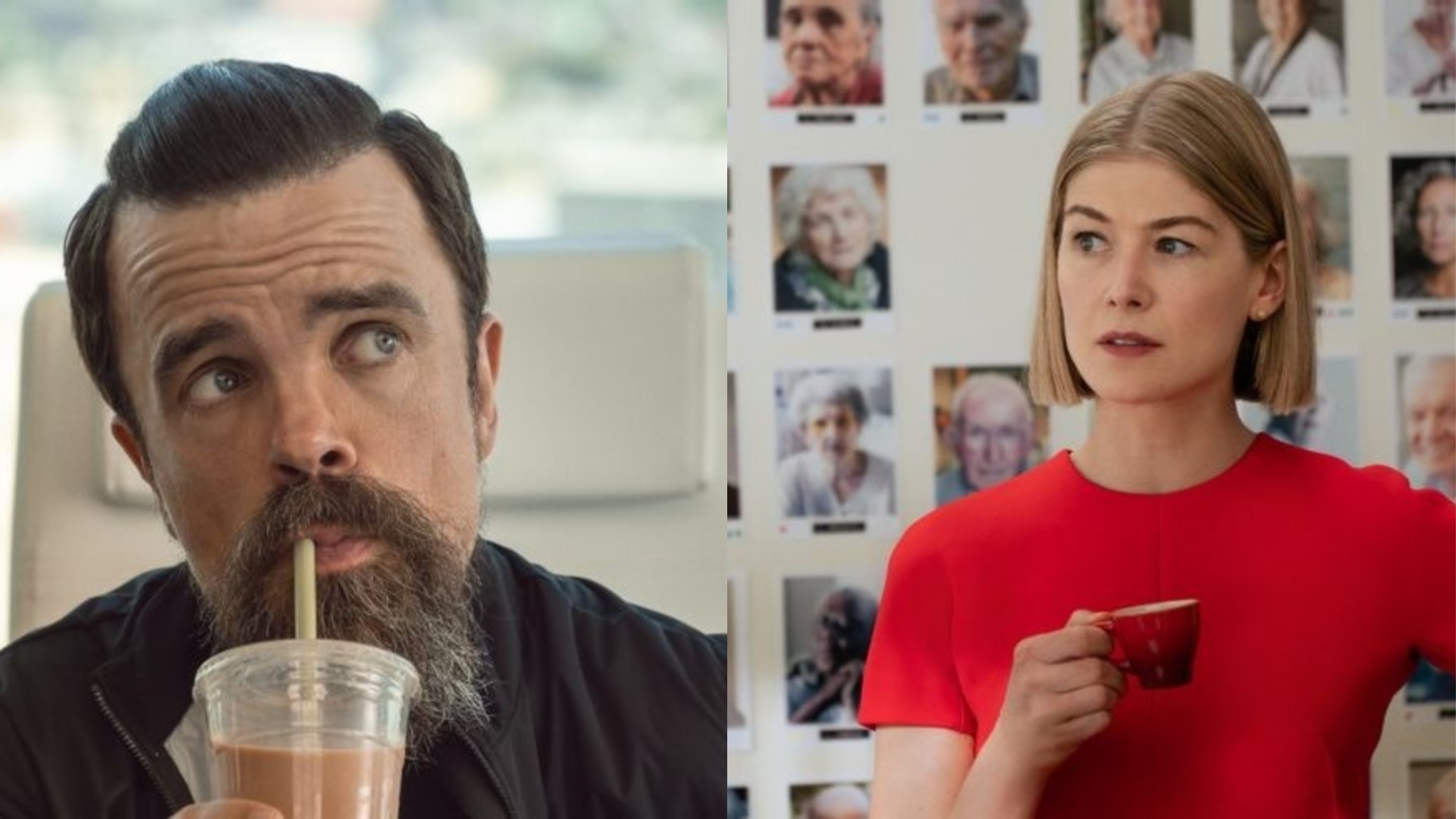
J Blakeson’s razor-sharp and barb-cracking screenplay opens with Marla’s brutally honest statement of intent. She wants it all and doesn’t care who she crushes to get it. Unlike, Lou Bloom, who was on his knees broke when we meet him, Marla already has a successful, legal but morally repugnant business going on. Marla and her associate and partner, Fran (Eiza Gonzalez) run a successful ‘Guardian Angel’ corporation. Their modus operandi is to exploit the elderly and tie them up in legal knots to asset-strip their money, properties and belongings. Complicit Doctors and retirement home directors are also in on the con, while the most frightening thing is that the American justice system assists the process. If I had had a gun, I would have shot the television after forty minutes, such was my anger toward Marla and her sordid business practices. Then she inadvertently makes a fatal mistake in choosing her next mark, Dianne Wiest’s wealthy “cherry,” Jennifer Peterson. That is a rich retiree with NO relatives or children. Marla thinks it is Christmas come early – it has not!


See the source image

Without wishing to give away too much away, Peter Dinklage’s rich businessman, Roman, enters the narrative and Marla’s devious planning suddenly comes under threat. Here the film moves from spot-on satire into extremely generic territory losing the dynamism of the first half of the film. Indeed, the first hour of I Care A Lot (2020) was a fantastic critique of the care system in the USA, and no doubt across the world. In blood-boiling fashion the film tells us that getting old is extremely expensive. One can work all one’s life and then see your savings and properties ripped away by expensive health care, homes for the elderly, pharmaceutical companies jacking up their products, greedy carers and pernicious lawyers. Marla Grayson is a grinning symbol of this corrupt system and nothing will get in her way – not even Roman and his associates. This is perfectly encapsulated in a fine scene where Marla ruthlessly negotiates with Chris Messina’s slippery lawyer. But the suited shark is just the starter as Roman is now on the warpath.

Peter Dinklage again proves what a brilliant actor he is as Roman. He is extremely good at rage in many scenes. His and Marla’s ongoing battle comes to a head in the final act, and when he turns the tables on her I was so happy that she would get her comeuppance. I felt maybe the direction lost some focus in the second half of the film as J Blakeson arguably felt the audience should somehow side with Marla as she finds her life under threat. I can safely say that I wanted her to die in the most painful way possible. Because unlike the ‘Driver’ (Ryan Gosling) in Drive (2011), Marla Grayson is utterly beyond redemption. Not that she would care what anybody else thought! Overall, that’s why I found the film incredibly entertaining. It may have lost sharpness when it moved from socio-political tubthumping into more standard crime film territory, it continually made me feel proper emotion, anger mainly. Sure, it may be slightly overlong, but J Blakeson crams a lot of twists and shocks into into, I Care A Lot (2020).

Mark: 8.5 out of 11


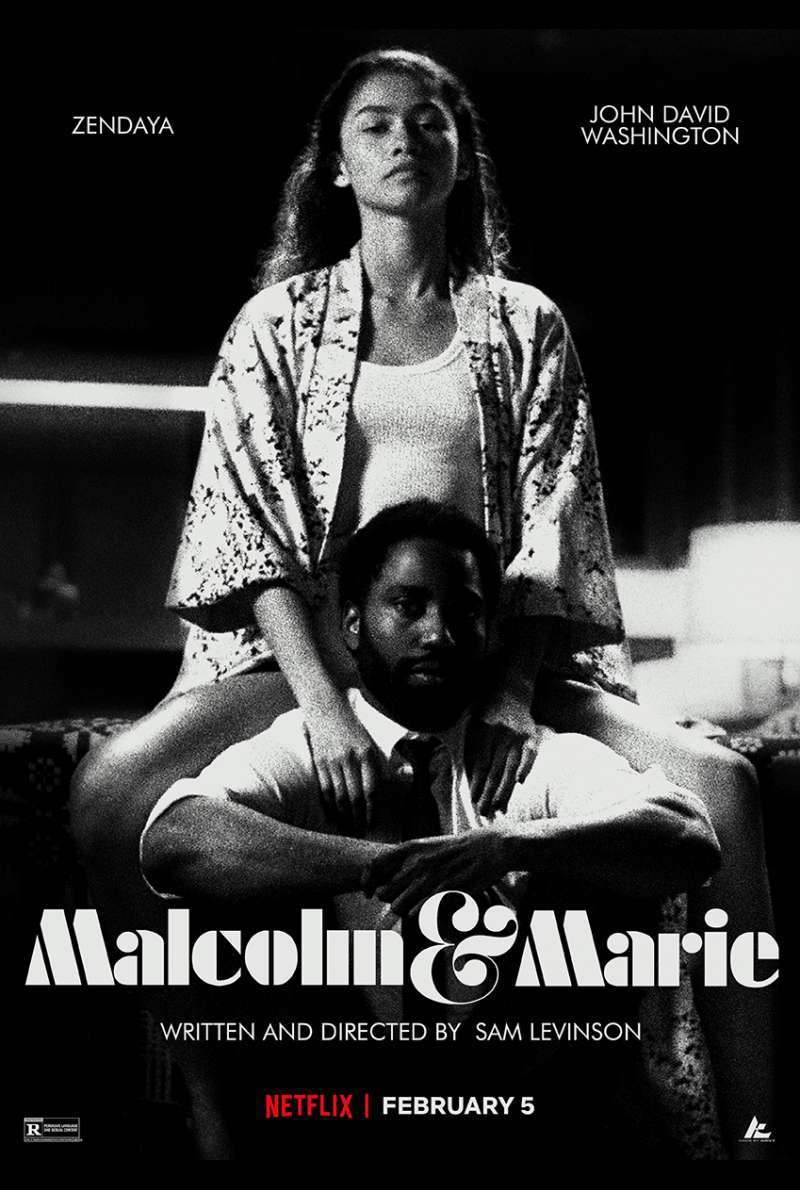
NETFLIX FILM REVIEW: MALCOLM AND MARIE (2021)

NETFLIX FILM REVIEW: MALCOLM AND MARIE (2021)

Directed by: Sam Levinson

Produced by:  Kevin Turen, Ashley Levinson, Sam Levinson, Zendaya, John David Washington

Written by: Sam Levinson

Cast: Zendaya, John David Washington

Music by: Labrinth

Cinematography: Marcell Rév

*** MAY CONTAIN SPOILERS ***


The Oscar nominations came out this week and due to the ongoing pandemic situation and consequent lockdowns, there are a number of films on the esteemed list which have yet to reach these shores, either at the cinema or via streaming platforms. Having said that, and I am aware space for nominees are limited and it has been a pretty strange year for cinema, but I was extremely surprised that Delroy Lindo did not receive an acting nomination in lead or supporting category. Similarly, I was also bewildered that Sam Levinson’s striking romantic drama, Malcolm and Marie (2021), had not received nominations in either screenplay or acting categories. Further, I was utterly shocked that critic’s reviews for the intense two-hander had been pretty mixed. Hey, it’s just opinions but I was really gripped by this highly theatrical and gorgeously cinematic two-hour argument in black-and-white. Personally, I think most of the deriders are wrong. But that’s just my view.

Maybe the film wasn’t liked because John David Washington’s, Malcolm, an up-and-coming filmmaker celebrating a successful premiere that evening, launches into a wonderfully eloquent rant about a review which he feels pigeonholes and patronises his film in purely political terms. I mean it’s actually a positive review, but who doesn’t enjoy ire toward professional critics. I mean, everyone has an opinion, or a view and the Internet has caused a mass proliferation and gaping spew of words and views and brain-thoughts in extremis. But Levinson’s script and Washington’s grandstanding acting spits that if you earn a living as a critic then you are essentially Satan! Perhaps some reviewers took umbrage with this? I loved the whole scene’s energy and Malcolm’s savage attack had me applauding throughout.


But Malcolm and Marie (2021) is more than Levinson getting back at those individuals who gave him bad reviews. It’s a sharp, funny, sexy and poignant exploration of a relationship close to breaking point. Malcolm and Marie may be different fighting weights, but they both punch hard and often. He is on a high after his film premiere success, but Marie is upset because he did not thank her during his speech. From there the conflict rises from light sparring to harsh emotional knockout blows. Both Malcolm and Marie tear at each other’s skin and flesh and figurative organs in an attempt to resolve the ever-increasing divide between them. Malcolm and Marie (2021), may not be for everyone, but any person who has been in a heated war of words with a partner or spouse, will identify with the inescapable tension on display. Levinson’s expert screenplay rides a rollercoaster journey of emotions as one moment you side with Marie and the next you’re with Malcolm. Yet, before you know it, you’re disliking both these complex, narcissistic, egotistical and infuriating humans.

Both Zendaya and John David Washington deserve so much praise for their performances in, Malcolm and Marie (2021). Washington has already demonstrated his massive talent in BlacKkKlansman (2018), while Zendaya excelled in recent HBO drama, Euphoria (2019). Levinson too directs with a deft skill. I was especially impressed by the way he balances the comedy and drama of these flailing humans, poking and picking at the scabs of each other’s past behaviour. Indeed, as well as containing some brilliant dialogue, the erudite script really sang to me. At times the coruscating repartee reminded me of Edward Albee’s acclaimed play, Who’s Afraid of Virginia Wolf. Nonetheless, for a dialogue and performance driven film, the precise framing and sumptuous black-and-white photography by Marcell Rév render the visuals wholly cinematic.

Sure, by the end of Malcolm and Marie (2021) is anything really resolved? And who is ultimately interested in this couple’s first world problems? Well, I’ve witnessed my parents fighting and also experienced such exhausting relationship arguments before. So, I must say that overall, I thoroughly enjoyed witnessing Malcolm and Marie’s nocturnal battle. Especially because I watched it all from the safety, warmth and comfort of my own home.

Mark: 8.5 out of 11


NETFLIX FILM REVIEW – MA RAINEY’S BLACK BOTTOM (2020)

NETFLIX FILM REVIEW – MA RAINEY’S BLACK BOTTOM (2020)

Directed by: George C. Wolfe

Produced by: Denzel Washington, Todd Black, Dany Wolf

Screenplay by: Ruben Santiago-Hudson

Based on: Ma Rainey’s Black Bottom by August Wilson

Cast: Viola Davis, Chadwick Boseman, Glynn Turman, Colman Domingo, Michael Potts etc.

Music by: Branford Marsalis

Cinematography: Tobias A. Schliessler

*** MAY CONTAIN SPOILERS ***


The spectre of death hangs over us all as time effortlessly drains the life from us. It is an unstoppable force that will quicken on occasion to take a human being way before they deserve. What if said individual has knowledge of their end? Aside from the fear they must be feeling, there is clearly a moment of clarity and strong focus. Something that makes their work gather an altogether unique power. Both player and audience feel such power palpably. This is most certainly the case where Chadwick Boseman’s acting performance is concerned in the screen adaptation of August Wilson’s powerful play, Ma Rainey’s Black Bottom (2020). As talented, hustling and arrogant musician and songwriter, Levee Green, Boseman is a charismatic vision of drive, confidence, energy and naivety, ready to take on the world, not quite knowing the odds are stacked against him.

Boseman steals the film from under the lungs of the formidable Viola Davis as the titular blues legend, Ma Rainey. Her laconic singer with a voice that stops the clocks is being paid to record a series of songs at a Chicago recording studio in the year 1927. Much conflict is derived from Levee Green’s desire to spice up Ma Rainey’s more traditional blues arrangements. Ma Rainey will not give in to what she perceives as ideas of populism and selling out to white producers who want to water down the blues for a white audience. As Ma Rainey, Viola Davis, excels as this irascible and world-weary diva, fighting off her exploitative manager and record producer. Rainey and the other band members try to dampen Levee Green’s enthusiastic ardour, however, the younger trumpeter will not listen to the advice of more experienced musicians. This eventually comes at a grave cost to those within the play.


Events of Ma Rainey’s Black Bottom (2020) are set mainly within a day and in the confines of the recording studio. The mix of a hot day, tempestuous characters and colliding personalities all combine in the enclosed space to create much dramatic tension. Given the screenplay is based on August Wilson’s acclaimed play, what the film loses in cinematic visuals, it more than makes up with sensational dialogue and stellar acting performances. Indeed, the supporting cast including: Colman Domingo as Cutler, Glynn Thurman as Toledo and Michael Potts as Slow Drag provide sterling contributions as Ma Rainey’s band. They banter and battle and spar, especially with the argumentative Levee, desiring to simply play the music and get paid. Safe to say therefore the wonderful blues songs performed are beautifully played. They fill the screen with humour and pathos, puncturing the fizzing dialogue of Wilson’s many fine soliloquys with poignant joy.

Amidst the conflict and music, August Wilson’s original text also contains great thematic power within the words. At the heart of the drama and eventual tragedy there is the underlying critique of the black musicians’ songs and style being stripped away from them by unscrupulous record producers. Ma Rainey stands strong rejecting attempts to assimilate her work and personality and voice into the mainstream. Those songs are her lifeblood, and she refuses to entirely sell her soul. Levee Green does not see the bigger picture and is sucked in by the promise of money, women and fame. He is blinded by the bright city lights and the closer he gets to them the easier it is for the record producers to pick his pocket. In such a tragic character August Wilson has created a memorably complex persona, perfectly rendered by the acting genius, Chadwick Boseman.

Mark 9 out of 11