Tag Archives: Thriller

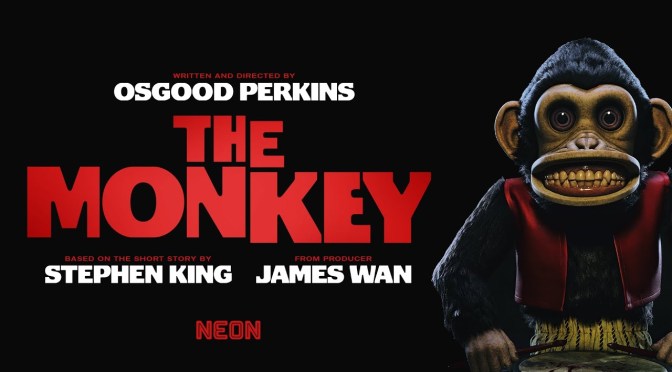
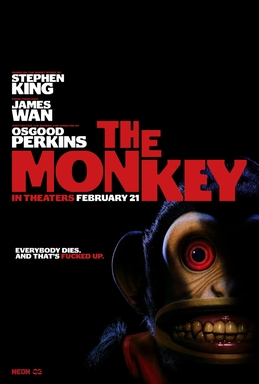
Cinema Review: The Monkey (2025) – a hilarious horror sketch-show with gore masking an inconsistent totemic tale!

Cinema Review: The Monkey (2025)

Directed by Osgood Perkins

Written by Osgood Perkins

Based on “The Monkey” by Stephen King

Produced by James Wan, Dave Caplan, Brian Kavanaugh-Jones, Chris Ferguson, etc.

Main Cast: Theo James, Tatiana Maslany, Christian Convery, Colin O’Brien, Rohan Campbell, Sarah Levy, Adam Scott and Elijah Wood.

Cinematography by Nico Aguilar


Following the financial success of his 2024 psychological thriller Longlegs (2024), Osgood Perkins has recently embarked on adapting Stephen King’s short story, The Monkey, into a feature film. While I didn’t quite connect with it Longlegs (2024) it had many impressed with its strange, atmospheric tension as well as Nic Cage’s crazy look and performance. The Monkey (2025), differs in tone though as it this adaptation with a blends horror and dark comedy, allowing Perkins to showcase his versatility as a filmmaker.

The narrative of The Monkey (2025) centres on twin brothers, portrayed by Theo James, who encounter a cursed toy monkey linked to a series of gruesome deaths. Perkins expands upon King’s original short story, infusing it with themes of family, fatherhood, reconciliation and a litany of grisly sudden deaths. Having found the simian death totem as teenagers, Hal and Bill Shelburn find their lives and those around them impacted in the most bloody explosive of ways. Indeed, there is much thought and planning given to these Saw and Final Destination franchise influenced on-screen set-pieces. In fact, the exquisite surprise and laugh-out-loud hilarity which occur throughout somewhat overpowers any emotional connection with the thinly-written protagonists.


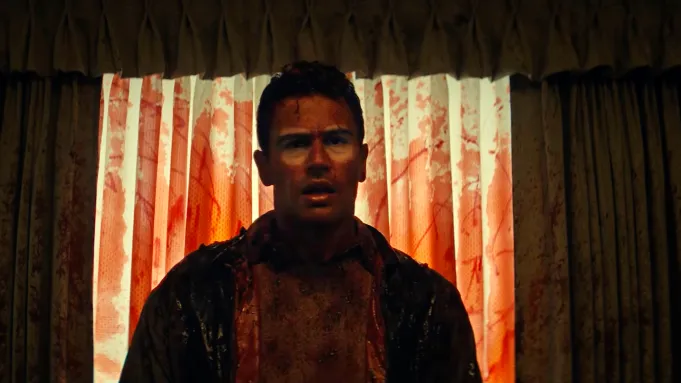
The film’s gore and relentless pace are undeniably its strongest assets — the kills are extreme, inventive, and staged with a gleeful disregard for realism, echoing the chaotic energy of ’80s horror comedies. Each death sequence feels like a miniature horror short, packed with practical effects and over-the-top carnage. Perkins crafts these moments with a twisted sense of humour, making the film feel like a sketch-show carousel of nightmarish vignettes, each more outrageous than the last.

However, despite the visceral fun, The Monkey (2025) struggles to leave a lasting impression. Unlike the original Saw (2004) by James Wan and Leigh Whannell — a film that balanced its brutal horror with sharp social commentary and tightly woven mythology — Perkins’ adaptation lacks a deeper foundation. The cursed toy monkey serves as a simple harbinger of death, but the film never establishes consistent rules for how the curse operates or why it escalates the way it does. Without clear internal logic or meaningful subtext, the horror loses weight, and the emotional stakes fizzle.

While The Monkey (2025) succeeds as a frenetic, blood-soaked thrill ride, it ultimately feels ephemeral. The film’s surface-level scares and comedic flair make for an entertaining watch, but the absence of narrative substance or thematic resonance leaves it as little more than a fleeting novelty — a film you enjoy in the moment, but rarely think about after the credits roll.

Mark: 6.5 out of 11


Cinema Review: I’m Still Here (2024) – A searing portrait of resistance in the face of military tyranny!

Cinema Review: I’m Still Here (2024)

Directed by Walter Salles

Screenplay by Murilo Hauser and Heitor Loreg

Based on I’m Still Here by Marcelo Rubens Paiva

Produced by Maria Carlota Bruno, Rodrigo Teixeira and Martine de Clermont-Tonnerre

Main cast: Fernanda Torres, Selton Mello, Fernanda Montenegro, Valentina Herszage, Luiza Kosovski, Barbara Luz, etc.

Cinematography by Adrian Teijido

*** MAY CONTAIN SPOILERS ***


On March 31, 1964, the Brazilian military, with support from the United States and segments of the civilian population, overthrew the government of President João Goulart in a coup d’état. Goulart, a left-wing president who had been in power since 1961, faced rising opposition due to his policies that included land reforms and more progressive labour laws. These policies alarmed conservative sectors of society, including the military, business elites, and parts of the middle class, who for many feared the spread of communism in the context of the Cold War. From reports I have read, the military’s move was framed as a necessity to prevent Brazil from descending into a left-wing revolution, but the coup marked the beginning of a brutal 21-year period of military dictatorship. Be careful what you wish for.

Under the military regime (1964–1985), Brazil saw widespread censorship, repression of political dissidents, the establishment of a climate of fear, and the use of torture against suspected leftist militants and activists. The military government justified its actions as necessary to combat communist insurgency, but its reign was characterised by systematic violations of human rights. The regime implemented institutional acts that curtailed democratic freedoms, silenced political opposition, and controlled the media, all while claiming to defend the country from Marxism. The dictatorship lasted until 1985, ending when the military handed power back to a civilian government, but the effects of this period are still deeply felt in Brazilian society, as many families continue to search for the truth about the victims of torture and forced disappearances during the dictatorship.


Yet, while the film may not explicitly focus on the 1964 coup or the military dictatorship. I’m Still Here (2024) addresses the aftermath and themes of identity, resistance, and survival in the face of oppressive systems. Director, Walter Salles, uses the personal as a lens through which broader social and political issues are explored. One could consider how the legacy of fear, control, and the impact of a regime still reverberates in contemporary Brazil.

In I’m Still Here (2024), the filmmakers take a distinctive approach to the thriller genre by moving away from the typical tropes associated with suspense-driven narratives. Instead of focusing primarily on action or a series of dramatic plot twists, the film shifts its attention toward a more intimate, personal, and familial story. There is suspense and tension, but it is more under-stated and subtle. This departure from overt political thriller conventions allows the film to delve into the emotional and psychological terrain of its characters, with a particular focus on the matriarch, Eunice Paiva, played by the powerhouse Fernanda Torres.

Rather than relying on external action or traditional thrills, I’m Still Here (2024), centres around Eunice’s emotional journey and the impact of her environment on her family when her husband, Rubens Paiva (Selton Mello) is taken away by what may-or-not-be the military. The film positions Eunice as the central figure whose personal evolution drives the narrative, illustrating the profound effects of her choices and relationships on her family. Salles skilfully weaves family celebrations, events, and home movie footage to create a swell of warmth amidst the fear and paranoia created when Rubens disappears.


Eunice Paiva’s character is given a powerful depth in I’m Still Here (2024), with Fernanda Torres delivering a standout performance. Rather than positioning Eunice as a victim or a purely heroic figure, the film complicates her character, showing her as a multifaceted individual. Eunice’s actions are driven not by external thrills or pressures, but by the emotional and psychological burdens she carries as a matriarch, dealing with familial responsibility and navigating the complexities of her relationships with her children, spouse, and extended family.

Torres’s portrayal emphasises Eunice’s inner conflict—her desire to protect her loved ones, while also grappling with personal loss, regret, and the external societal forces that shape her world. Constantly denied answers and closure by the authorities, Eunice refuses to give in and continues to fight for decades, even when the military rule is over. The emotional intensity of Eunice’s character arc is one of the most compelling aspects of the film, as Torres’s performance brings a deep authenticity to the role, grounding the story in real, human struggles rather than sensationalised action.

By moving away from traditional thriller tropes, I’m Still Here (2024) creates a more reflective and intimate cinematic experience. Rather than simply delivering suspense through external action, the film explores the internal tensions of its characters and their relationships, magnifying the quiet, profound impact that such personal struggles can have on a family. Having lived through such adversity the Paiva family would stand proud in the face of this evil regime, overcoming all that is thrown at it. I mean, there is so much evil in this world and throughout history, that Eunice Paiva and similar quiet heroes are to be cherished. In short: why can’t such admirable individuals run the often horrible world we live in.

Mark: 8.5 out of 11


Cinema Review: September 5th (2024) – an inside-out snapshot of tragedy at the 1972 Munich Olympics!

Directed by Tim Fehlbaum

Written by Moritz Binder, Tim Fehlbaum and Alex David

Produced by Philipp Trauer, Thomas Wöbke, Tim Fehlbaum, Sean Penn, John Ira Palmer and John Wildermuth

Main cast: Peter Sarsgaard, John Magaro, Ben Chaplin, Leonie Benesch, Jim Mckay (archival footage), Zinedine Soualem, etc.

Cinematography by Markus Förderer

Edited by Hansjörg Weißbrich

*** MAY CONTAIN SPOILERS ***


The events of September 5th, 1972, during the Munich Olympics are deeply connected to the tragic and harrowing story of the attack by the Palestinian group ‘Black September’, which targeted the Israeli Olympic team. This day is crucial in understanding the impact of the attack, as it marks the beginning of what became known as the ‘Munich Massacre’. The documentary One Day in September (2000) directed by Kevin Macdonald, offered a detailed account of the events providing chilling footage, interviews with survivors, and insights from those who witnessed the attack and as a moment that deeply altered the course of history, influencing global politics, the perception of terrorism, and the nature of security at international events.

Steven Spielberg’s fictionalised film Munich (2005) dramatized the aftermath of the ‘Munich Massacre’, focusing on Israel’s covert response to the attack. The film based on the book Vengeance by George Jonas, told the story of a team of Israeli agents tasked with assassinating those involved in the planning of the massacre. The plot of Munich (2005) unfolds as these agents track down and kill individuals connected to ‘Black September’. The film, criticized for a series of inaccuracies, portrayed the moral complexities and psychological toll of vengeance, showing the personal conflict faced by the agents as they carry out their mission. Now, covering the same event, we have September 5th (2024), a drama-documentary that snapshots the conflict from the perspective of the ABC Sports crew and their coverage of the events.


Director, Tim Fehlbaum, and his talented production team effectively utilize constraints in geography, time, space, and structure to craft a highly claustrophobic thriller, drawing viewers into the escalating crisis as it unfolds. From the moment the athletes are taken hostage the ABC media team headed by Peter Sarsgaard as Roone Arledge, the president of ABC Sports, John Magaro as Geoffrey Mason, the head of the control room in Munich and Ben Chaplin as Marvin Bader, the head of operation at ABC Sports are on red alert striving to capture the story and prevent it being taken from them by the ABC News team. Fehlbaum makes use of limited settings, “real-time” structure, and confined spaces expertly as the audience find out information of the hostages plight and subsequent runway killings at precisely the same time as the crew do.

The films’ use of psychological space, close-ups, shadows and screens, creates a claustrophobic atmosphere, starving the audience of air and making them feel the increasing emotional pressure on each character. Like the world’s population today witnessing the brutal events unfold between Israel and Palestine on the news, they ultimately have little power over the situation as news of tragedy bleeds through to them. Further, the cast are uniformly compelling with Peter Sarsgaard, John Magaro and Leonie Benesch, as a translator for the ABC crew, stand out amongst an impressive ensemble. Lastly, special mention for the editing team led by Hansjörg Weißbrich, who skilfully weaved in actual footage from the ABC archive, creating a seamless and powerful cinematic experience.

Mark: 8 out of 11


The Cinema Fix presents: 12 Favourite Films of 2024!

The Cinema Fix presents: 12 Favourite Films of 2024!

Good day and I hope you are well. I am slightly late to the party with these but happy new year nonetheless.

Here are my favourite films of 2024 that I watched at the cinema and on streaming platforms. The majority would have been released last year, however there were quite a few that crossed the last eighteen months or so. I cheated slightly with The Quiet Girl, but I watched in 2024, so there you go.

If I have missed any films then please let me know in the comments. I have either NOT seen them or did not enjoy them as much as you. Remember these are my FAVOURITE films seen in 2024 of new(ish) releases. So all purely subjective and am happy if you agree or disagree. Have a wonderful 2025!

Oh, for control and interest, I include my favourite films of 2023!


Ten Favourite Films of 2023

https://wordpress.com/post/thecinemafix.com/77015

ANATOMY OF A FALL (2023)
ASTEROID CITY (2023)
BROKER (2022)
MAY DECEMBER (2023)
OPPENHEIMER (2023)
PAST LIVES (2023)
SALTBURN (2023)
TAR (2022)
TOTALLY KILLER (2023)
THE WONDER (2022)


Twelve Favourite Films of 2024

ALL OF US STRANGERS (2023)


AMERICAN FICTION (2023)


HERETIC (2024)


THE HOLDOVERS (2023)


THE IRON CLAW (2023)


LATE NIGHT WITH THE DEVIL (2023)


MONSTER (2023)


POOR THINGS (2023)


THE QUIET GIRL (2023)


SPEAK NO EVIL (2024)


THE SUBSTANCE (2024)


THE ZONE OF INTEREST (2023)

Apple TV+ Film Review: Blitz (2024) – A fine testament to the Human Spirit during Wartime!

Apple TV+ Review: Blitz (2024)

Directed by Steve McQueen

Written by Steve McQueen

Produced by Tim Bevan, Eric Fellner, Steve McQueen, Anita Overland, Adam Somner, Arnon Milchan, Yariv Milchan, Michael Schaefer

Main Cast: Saoirse Ronan, Elliott Heffernan, Harris Dickinson, Benjamin Clementine, Kathy Burke, Paul Weller, Stephen Graham etc.

Cinematography by Yorick Le Saux

*** MAY CONTAIN SPOILERS ***


Officially classed as acclaimed filmmaker Steve McQueen’s first feature since the release of Widows (2018), Blitz (2024) is a WW2 drama of extremely high quality. But before I get into the review, lest we forget the series of films Steve McQueen delivered to the BBC a few years. The ‘Small Axe’ anthology should and shall be revisited as one of the most important documents of British history, such is its searing power, dramatic drive and the stunning rich tapestry of characterful moments. So, I urge you to watch, if you haven’t, what I consider to be Steve McQueen’s masterworks. I have reviewed the first one Mangrove (2020) here and the remaining of the collection here:


Blitz (2024) is a bigger budgeted production when compared to the ‘Small Axe’ anthology. But, similarly, it is a period piece, focusing on the working class and Black experience, this time set during the brutal bombing of London in 1940. McQueen shoots very much from the perspective of George (Elliot Heffernan), his mother, Rita (Saoirse Ronan) and grandfather, Gerald (Paul Weller). George, like many war children, is packed on a train to the relative safety of the countryside, while parents live in the hope of surviving the incessant German bombs.

After establishing the close family bond between the Hanways, and the wrenching emotion of sending her son away, Rita continues working in a munitions factory and sings beautifully on a national radio show. At the same time, George, finds trouble with a gang of child bullies on the train, before fighting back and jumping off. A tough and resourceful boy, George, makes the perilous choice to return to battered and burning London to reunite with his mother. The city, scarred by the relentless ‘Blitzkrieg’, is a treacherous labyrinth of collapsing buildings and choking smoke, but George’s determination burns brighter than the fires raging across the skyline.


Like a modern Oliver Twist, Blitz (2024) George’s journey through the devastated capital is both a physical and moral odyssey, with each encounter shaping his understanding of loyalty, survival, and the fragile threads that bind people together in times of crisis. George becomes trapped by his own choices, the bombs, bricks, buildings and characters he meets on the way. Some are friendly, but others exploit George preventing his return home. McQueen’s script also finds time to flashback to show Rita meeting George’s father, providing significant context to his mixed race background. Indeed, through George, McQueen explores themes relating to race and his emotional journey to find his place in the world as a person of colour.

Blitz (2024) is a superbly shot and designed film, with Yorick Le Saux’s cinematography rendering war torn London with an almost mythical beauty. However, Hans Zimmer’s overblown soundtrack is too much for me. Further, Steve McQueen’s hagiographic and episodic approach does somewhat diminish the raw drama and bloody horror of war. Notably, the under-use of Kathy Burke and Stephen Graham’s gutter snipe thieves. Plus a thrilling action set-piece during a flooded tube station that cuts away from George’s almost-demise, denying us suspense and dramatic catharsis. Thus, at times, the film sacrifices potential complexity during George’s journey, making his survival seem almost predestined rather than hard-fought. Still, Steve McQueen remains one of the country’s most important cinematic artists and Blitz (2024) is yet another fine testament to the strength and resilience of the human spirit.

Mark: 8 out of 11


Netflix Film Review: Emilia Perez (2024) – A Trans-formative song of Risk and Redemption!

NETFLIX FILM REVIEW: EMILIA PEREZ (2024)

Directed by Jacques Audiard

Screenplay by Jacques Audiard

Based on Écoute by Boris Razon

Produced by Jacques Audiard, Pascal Caucheteux, Valérie Schermann, Anthony Vaccarello

Main Cast: Zoe Saldaña, Karla Sofía Gascón, Selena Gomez, Adriana Paz, Mark Ivanir, Édgar Ramírez etc.

Cinematography by Paul Guilhaume

*** MAY CONTAIN SPOILERS ***


There’s such a thing as having too much going on.” Howard Moon from The Mighty Boosh.

I am a big champion of the films of Jacques Audiard. When his eccentric Western, The Sisters Brothers (2018), was released I wrote a positive review and tribute to several other fine films he has directed here. Audiard likes to take risks representing human beings on the edge of society and perhaps struggling with life; people who often make left-field decisions to improve or escape their existential plight. With his latest film Emilia Perez (2024) the filmmaking master challenges the audience again with a multi-blended genre film that also contains powerful themes of transformation, redemption, violence, crime and family values. Oh and there are songs too.

The narrative begins strongly as Rita Mora Castro (Zoe Saldana), a fiercely talented yet overlooked lawyer in Mexico City, finds herself thrust into the spotlight when she defends the wife of a prominent media mogul in a controversial murder trial. Despite her misgivings, Rita crafts a chillingly persuasive argument that frames the death as a suicide, securing an unexpected victory in the case—one that leaves her both celebrated and haunted.

As the dust settles, Rita’s restless dissatisfaction with her life grows louder. Then comes an anonymous phone call: an enigmatic voice offers her a chance at something extraordinary—and extraordinarily dangerous. Intrigued and desperate for change, she agrees to a clandestine meeting. The mysterious client turns out to be none other than Juan “Manitas” Del Monte (Karla Sofía Gascón), a ruthless and feared cartel kingpin. But the request they make isn’t what Rita expects from a crime-lord. Manitas dreams of living authentically by undergoing gender-affirming surgery and becoming a woman. Rita must decide: will she help Manitas rewrite their story, or will she risk becoming the next chapter in a tale of betrayal and bloodshed?


This fascinating set-up draws you in and I believe if Audiard’s narrative had concentrated mostly on the relationship between Rita, the transitioned, Emilia, then the film would have retained much emotional and thematic power. Yet, after Emilia’s operation the screenplay introduces several other story strands and characters to take in, including Selena Gomez’ feisty Jessi Del Monte, Manitas’ ex-wife who thinks “he’s” dead. This development works initially but then Audiard hurls so many more ideas and genres at the audience wall, not all of them sticking.

Admittedly, the film’s audacious blend of melodrama, crime, thriller, musical, and comedy creates an unpredictable and frenetic narrative that keeps viewers on their toes. However, this constant genre-shifting can undermine the weight of its core themes—gender and identity—by overshadowing them with spectacle and tonal inconsistency. The story’s rapid turns and refusal to settle into a single emotional or narrative groove risk, arguably trivializing the profound struggles and triumphs of its trans-protagonist. Moments that could serve as deeply reflective or cathartic explorations of gender identity are sometimes undercut by abrupt pivots into slapstick humor or hyper-stylized action. While these shifts might aim to reflect the disarray and fluidity of identity in a chaotic world, they can also dilute the thematic resonance.

At the same time, it’s clear Audiard is deliberately embracing this chaos and analysis of human flaws. The fractured tone might symbolize a world where stability and clarity are illusions, mirroring the internal and external conflicts of someone navigating personal transformation in an unyielding environment. This approach, while conceptually intriguing, can feel alienating. Nonetheless, the cast’s stellar performances anchor the film, ensuring that the characters remain compelling even when the story spirals into excess. Lastly, Emilia Perez‘ (2024) relentless energy often leaves little room for introspection, and whether this genre-chaos enriches or undermines the narrative depends largely on the viewer’s tolerance for Audiard’s embrace of choral disorder in a world seemingly allergic to calm and pattern.

Mark: 7.5 out of 11


Cinema Review: Heretic (2024) – A Devilish Twist on Religious Horror

Heretic (2024)

Directed by Scott Beck & Bryan Woods

Written by Scott Beck & Bryan Woods

Produced by Stacey Sher, Scott Beck, Bryan Woods, Julia Glausi and Jeanette Volturno

Main cast: Hugh Grant, Sophie Thatcher, Chloe East and Topher Grace.

Cinematography by Chung Chung-hoon


Hugh Grant has been leaning into edgier, more complex roles in recent years, breaking away from the charming, rom-com archetype that first made him famous in films like Notting Hill (1999) and Four Weddings and a Funeral (1994). His performance as the scheming Fletcher in The Gentlemen (2019) showcased his versatility and willingness to play morally ambiguous, darker characters, a notable shift from his earlier, more likeable characters. Additionally, his involvement in projects like Heretic (2024) demonstrates a continued exploration of grittier, layered personas, signaling a reinvention of his career as he embraces unconventional, often villainous roles that display a new level of depth and unpredictability.

In the theologically-driven horror thriller, Heretic (2024), he portrays a certain Mr Reed, who is door-stepped by two Mormon missionary’s, Sister Barnes (Sophie Thatcher) and Sister Paxton (Chloe East). After the opening scenes which establish empathy for the Mormons, despite some slightly risque dialogue, they knock on the door of Mr Reed and soon the tension begins to rise as he clearly has ulterior motives. But what could they be?


The excellent script by Scott Beck and Bryan Woods truly comes alive in the second act, diving into a sharp, intelligent critique on the nature of religion and faith. The narrative shifts into thought-provoking territory, dissecting the contradictions and complexities of belief systems with nuance and wit. Hugh Grant, delivers these lines with palpable relish, embodying a character that’s both captivating and unsettling. His performance amplifies the script’s incisive commentary, bringing a darkly charismatic edge to the film’s anti-treatise that leaves a lasting impression on the viewer. There’s some great humour in there too, even name-checking South Park and The Book of Mormon during a thrilling game of verbal cat-and-mouse as Mr Reed challenges the sweet missionaries’ whole doctrine. Which, let’s face it, as invented by Joseph Smith, is arguably founded on many ridiculous ideas.

Heretic loses some of its originality toward the end as it leans into familiar horror and “final girl” tropes, diluting the impact of its earlier, more mazy, twisted and thought-provoking narrative. After building a layered critique on religion and faith, the climax reverts to predictable genre conventions, somewhat undermining the complexity established in the second act. This shift might feel like a missed opportunity, as the nuanced themes give way to traditional horror cliches that prioritize shocks over substance. While still entertaining, the reliance on these tropes makes the conclusion feel less daring compared to the film’s more intellectually ambitious setup. Still, Hugh Grant’s devilish Mr Reed and a fantastic soundtrack, make it well worth the admission fee. Meanwhile Woods and Beck again prove themselves as genre filmmakers worth keeping faith with.

Mark: 8.5 out of 11


BFI Film Review: Scala (2023) – At the Altar of Nostalgia for the Scala Cinema!

BFI Film Review: Scala!!! (2023)

Directed by Ali Catterall & Jane Giles

Produced by Andrew Starke, Alan Marke & Jim Reid

Cinematography by Sarah Appleton

Edited by Andrew Starke and Edward Mills

Music by Barry Adamson


The Scala Cinema, nestled in the heart of London, was more than just a film theatre; it was a refuge, a haven for anyone with a passion for films that didn’t fit into the mainstream mold. I can still feel the sticky floors, the cats in the dark, hear the muffled sounds of the trains passing overhead, and see the hazy red glow that filled the theater. In the 1980s and 1990s, going to the Scala wasn’t just about watching a film; it was about being part of a community that celebrated the bizarre, the boundary-pushing, and the boldly artistic.

During those years, the Scala felt like my second home. It was where I could disappear into films that I couldn’t find anywhere else – obscure horror flicks, campy B-movies, gonzo-pornos, arthouse selections, and controversial classics from around the globe. It was my church. Films by David Lynch, John Waters, Yuen Woo-ping, Derek Jarman, Werner Herzog, Sam Raimi, Lucio Fulci, Russ Meyer, Kathryn Bigelow, Alex Cox, John Woo, Stanley Kubrick, Jane Campion, Orson Welles, Dario Argento, Alejandro Jodorowsky and many more – each screening felt like a small rebellion, a discovery that I’d carry with me. The Scala didn’t just show movies; it curated experiences. All-night marathons, double bills, and surprise screenings became a staple of my weekends, filling my mind with scenes that blurred the line between reality and the outrageous.


When I watched the Scala documentary on BFI Player, a flood of memories came rushing back. It was as though I’d been given a ticket back to those wild, late nights. I remembered how Scala regulars would shout lines at the screen or break into laughter at inopportune moments, making each viewing unique and unpredictable. The documentary captured not only the films but the spirit of the place – the staff who loved cinema as much as the patrons did, the strange but welcoming crowd, and the sense that Scala wasn’t just a venue but a movement. Watching it felt like reconnecting with a part of myself, an era when cinema was raw, thrilling, and unpolished.

The Scala in King’s Cross is a legend, and for those of us who were lucky enough to experience it, it’s a chapter we’ll always cherish. I was even there when they showed A Clockwork Orange (illegally), which led to the ill-fated court case which forced it to close. This documentary is both a valuable historical document and a joyous sharing of stories from those who worked there and attended the films shown, including: Mark Moore, Mary Harron, Isaac Julien, John Waters, Ben Wheatley; Barry Adamson, Matt Johnson, Adam Buxton, James O’Brien, Stewart Lee, Lisa Power and Graham Humphreys. Overall, the Scala Cinema wasn’t just about the films we watched; it was about finding a place where film became more than entertainment – they were a way of life.

Mark: 9 out of 11


Must-See Horror Films on SHUDDER. . . Mostly!

SHUDDER HORROR FILM REVIEWS (2024)

Looking for something horrifying to watch during Halloween. Well you could do far worse than getting a Shudder subscription.

A few months a year I sign up and binge bloody disgusting and scary films as my previous reviews testify. Check them out here!

This year I have done the same and watched some really good, terribly bad and hideously ugly horror films via Shudder. Peruse my short reviews below. In alphabetical order with marks out of eleven.


Host (2020)

A terrific low-budget British indie film that explores the dangers of angering ghosts during a Zoom call. While the mildly irritating characters don’t realize they can simply end the online séance, it’s still a spooky, suspenseful, and fast-paced horror flick. I’m not usually a fan of the found footage genre, but this was very well made and highly creepy. Mark: 8 out of 11


In A Violent Nature (2024)

This director will probably have an amazing career. But this film was, despite some wonderful practical-effect driven gore, SO slow and boring. The film satirizes classic horror tropes, mocking their clichés with a heavy hand. The director’s pretentious style and inflated sense of artistic ego drain the audience of any real suspense or tension. The attempt at highbrow genre obfuscation creates a hollow spectacle. Shot from behind, the killer stalks twenty-somethings in the woods in the style of Son of Saul (2015) meets every slasher film ever. Ultimately, suffering from atrocious dialogue, bad plotting and weak characterization, the visual flair fails to save a film which feels more like an exercise in intellectual vanity than a gripping thriller. Mark: 5 out of 11


Late Night With The Devil (2023)

With echoes of the recent Inside No. 9 (3×3 quiz show episode) and BBC show Ghostwatch (1992), and of course The Exorcist (1973)Late Night With the Devil (2023) is one of the most enjoyable and imaginative horror films I have seen in sometime.  One of the best horror films of the decade. Check out my longer review here. Mark: 9 out of 11


Pyewacket (2017)

Nicole Munoz’ isolated teenager summons a witch via a ritual and unleashes something not particularly scary or even present. All set-up and no catharsis! A waste of everyone’s time. Mark: 4 out of 11


Revealer (2022)

One of the best pitches I have read in a while – “A stripper and religious protester are trapped together in a peep show booth and must come together to survive the apocalypse in 1980’s Chicago!” does not unfortunately live up to expectations. However, there’s a decent female buddy dynamic and some imaginative gore which channels early Raimi, Jackson and Carpenter. Mark: 6 out of 11


Room 237 (2012)

For Stanley Kubrick completists, this fascinating documentary is divided into nine sections, with each one exploring a different aspect of The Shining (1980). Hidden theories buried under the surface relate to faked moon landings, Native American genocide and the holocaust are some of the ideas chucked at the wall. While some may stick and some don’t, it’s lovingly made and always fascinating. Mark: 8 out of 11


Skinamarink (2022)

Skinamarink was a major letdown for me, especially given the high expectations after its impressive financial success. With a $15,000 budget, it garnered over $2.1 million at the box office, creating a buzz around its unconventional style and promise of fresh horror. But despite its atmospheric tension and experimental approach, I felt the film didn’t live up to the hype. The slow pacing, abstract narrative, and reliance on ambient sounds and shadows left me unmoved. It’s an original, art-house horror so surprised it crossed over. Filmmaker, Kyle Edward Ball, clearly has a distinctive voice though. Mark: 6 out of 11


Stop Motion (2023)

The animation in Stopmotion (2023) showcases Robert Morgan’s genius, with his signature blend of hauntingly detailed stop-motion work that creates an eerie, tactile atmosphere. His craftsmanship brings a nightmarish quality to life, adding unsettling textures and depth that pull the audience into a world of psychological horror. However, while the animation excels, the plot—reminiscent of Repulsion—struggles to connect on a human level. The surreal visuals overshadow the character’s psychological journey, making it hard for viewers to engage with the protagonist’s inner turmoil, leaving the story feeling more distant and abstract than compelling. Mark: 6.5 out of 11


Superdeep (2020)

The Russian horror film Superdeep feels like a patchwork of borrowed elements from better-known sci-fi and horror movies, but without their finesse or originality. It mimics the claustrophobic tension of The Thing, the body horror of Alien, and the descent into madness of Event Horizon, yet fails to capture the essence that made those films effective. Derivative and ineffective, it at least has some ridiculously bad monster effects at the end that had me laughing. Mark: 4 out of 11


The Coffee Table (2022)

The Coffee Table is a twisted and darkly humorous horror film that pushes the boundaries of discomfort while delivering a sharp, satirical take on the horrors of parenthood. The film’s sick sense of humor blends with its unsettling premise, as it uses a seemingly mundane object—a coffee table—as the catalyst for an absurd but terrifying chain of events. Its pitch-black comedy amplifies the tension, making the film both deeply disturbing and strangely cathartic for those who understand the pressures of raising children. It’s a fearless examination of the darker side of family life, where humor and horror collide to expose the anxieties and struggles that often go unspoken. Mark: 8 out of 11


We All Went to the World’s Fair (2021)

We All Went to the World’s Fair (2021) falls short both as a horror film and as a rites of passage story. Its eerie, slow-burn approach creates an unsettling atmosphere, but the lack of a clear, escalating threat leaves it feeling aimless. Switching protagonists at the end does not work, and despite an excellent performance from Anna Cobb, the film spoils an intriguing premise. Mark: 5.5 out of 11


Where Evil Lurks (2023)

Where Evil Lurks (2023) skillfully employs well-known horror tropes—such as viral infection and monstrous transformations of humans—to deliver a fresh and intense experience. The film taps into the fear of contagion, using the idea of a mysterious, spreading evil that corrupts and distorts its victims. This viral-like menace is combined with disturbing body horror, as infected humans gradually turn into something grotesque and monstrous, making the familiar threat feel visceral and terrifying. The gradual, creeping transformation of people into monstrous figures is done with chilling precision, playing on the fear of losing control of one’s body and mind. By grounding these tropes in a strong narrative and unsettling atmosphere, the film elevates the horror elements, using them to amplify its emotional and psychological impact. Mark: 8.5 out of 11

Cinema Review – Exploring Music and Madness in Joker: Folie à Deux (2024)

Cinema Review: Joker: Folie à Deux (2024)

Directed by Todd Phillips

Written by Scott Silver and Todd Phillips (Based on Characters by DC Comics)

Produced byTodd Phillips, Emma Tillinger Koskoff & Joseph Garner


Main cast: Joaquin Phoenix, Lady Gaga, Brendan Gleeson, Catherine Keener and Zazie Beetz etc.

Cinematography by Lawrence Sher

Music by Hildur Guðnadóttir

*** MAY CONTAIN SPOILERS ***


In 2019, Todd Phillips and Joaquin Phoenix, as director and lead actor, unleashed Joker (2019) on the cinema public. It became an enormous critical and commercial hit, with Phoenix winning the ‘Best Actor’ award at the Academy Awards. Unsurprisingly, a sequel now reaches us. While the original 1980’s set period drama worked superbly, echoing the structure and themes of Scorsese’s King of Comedy (1982) and Taxi Driver (1976), the follow-up Joker: Folie à Deux (2024) is altogether different. In fact, given it experiments with musical, romance, crime, court-room and psychological horror genres, it is an altogether riskier film, which while compelling and fascinating, doesn’t always connect to a satisfactory whole. But perhaps that is the point. It is intended to reflect an inconsistent mind and unreliable narrator, a fractured soul in Arthur Fleck.

For me, in Joker: Folie à Deux (2024), Todd Phillips masterfully employs cinematic techniques of fragmentation and ambiguity to deepen the exploration of mental illness, echoing the disorienting and fractured experience of his protagonists. The film, much like its predecessor, blurs the lines between reality and delusion, but this time the ambiguity is intensified through musical elements, dreamlike sequences, and multiple perspectives. Phillips’ use of disjointed timelines and unreliable narratives immerses the audience in the chaos of Arthur Fleck’s (Phoenix) and Harley Quinn’s (Lady Gaga) unraveling psyches.


The musical numbers, set against stark, gritty environments, feel both fantastical and unnerving, reinforcing the characters’ distorted perceptions of the world. Moments of quiet introspection are suddenly broken by violent outbursts or surreal interludes, mimicking the unpredictability of their mental states. The film’s visual style shifts between stark realism and surreal imagery, reflecting the internal fragmentation of Arthur and Harley’s minds, keeping viewers on edge and questioning what is real.

Phillips’ direction ensures that the story remains rooted in ambiguity—much like the first film—inviting viewers to interpret the characters’ mental states without offering clear answers. This cracked narrative style doesn’t just illustrate their mental illness; it pulls the audience into it, making Joker: Folie à Deux a bold and unsettling exploration of madness through form as much as story. As such there isn’t much plot to speak of as Arthur’s journey essentially follows him from Arkham Asylum to court, with episodic splashes of song and dance in between, before we get to the climactic court room scenes.

As aforementioned, in Joker (2019), Todd Phillips drew heavily from Martin Scorsese’s The King of Comedy (1982), particularly in its portrayal of a lonely, unstable man seeking fame and validation in a world that cruelly rejects him. Arthur Fleck’s obsession with talk show host Murray Franklin mirrors Rupert Pupkin’s fixation on becoming a comedy star, and both films explore the dangerous consequences of societal alienation and delusional aspirations. The gritty, urban backdrop and character-driven narrative made Joker a powerful homage to Scorsese’s psychological explorations of fame and madness.


With Joker: Folie à Deux (2024), Phillips shifts toward a different Scorsese film for inspiration: New York, New York (1977). Much like Scorsese’s semi-musical about a turbulent romance between two performers, Folie à Deux integrates musical elements and centres on the chaotic relationship between Arthur and Harley Quinn (Lady Gaga). The film’s blending of harsh realism with the stylized, dreamlike sequences of musical numbers echoes New York, New York’s mix of glitzy performance and dark personal struggle. Thematically, both films explore how dreams of stardom can clash with mental instability, but Folie à Deux takes it a step further by embedding this conflict within its characters’ delusions, making the musical sequences feel like an escape from—or reflection of—their psychotic minds. This potential homage to New York, New York allows Phillips to expand Joker‘s cinematic language, fusing psychological drama with surreal musical spectacle.

Joker: Folie à Deux (2024), at time of writing, has polarized critics and cinema-goers. As someone who watches a lot of “art-house” and European cinema, I can see why this film is dividing opinion. This is what happens if Jacques Demy, by way of Bergman, were given $200 million to make a DC comic-book film. Todd Phillips takes many risks in form and structure, most notably denying the audience catharsis at the bleak finale. It is truly downbeat and it felt like Phillips and Phoenix were finally done with this clownish killer and anti-hero.

As a cinematic experience the musical score is striking. Moreover, the production is grey and oppressive and claustrophobic, set in enclosed cells and shadowed court rooms. There is little light in this film nor even a shadow at the end of the tunnel for Arthur and Harley. Phoenix is fantastic again, while Gaga’s romantic partner-in-crime is under-cooked as a character. Nonetheless, Gaga still sparkles amidst this gloomy, musical, existential journey into the mouth and down the throat of madness.

Mark: 8.5 out of 11