Produced by: Tim Bevan, Lisa Bruce, Eric Fellner, Anthony McCarten, Douglas
Written by: Anthony McCarten
Starring: Gary Oldman, Kristin Scott Thomas, Lily James, Stephen Dillane, Ben Mendelsohn
What makes human beings want to go to war? What is it that determines thoughts and actions which will lead to the death of another human being? Is it: a genetic trait; a tribal desire; a psychological defect; financial gain; jealousy; boredom; passion; political chicanery; religion; greed; anger; revenge; or quite simply madness. Taking a life is something I have never understood. I mean, unless you are forced to defend yourself against a foe hell-bent on your destruction why would you wish to harm anyone else?
So, Adolf Hitler has a lot to answer for because, even accepting the political and social reasons for the rise of the Nazi party and his desire to repair national pride after the first World War, what the hell gives a nation the right to invade and conquer other countries. If you choose to go down that road you are signing the death certificate of a generation men and women and children. It’s not just Germany either. The British Empire, Roman Empire, Vikings, Mongols, United States of America, France and many more have waged war against humanity down the years. Will it ever stop? Sadly, I doubt it.
In times of war what is needed is obviously bravery, steel, fight, intelligence and more than a little luck. You need hearty human beings to stand and be counted and to die on the battlefields and in the air and in the sea. You also need leaders; figureheads who can rally the troops and galvanise that last ounce of fight in order to repel the enemy. During World War II, with the country on its knees and backs to the walls we had many leaders, but Winston Churchill, above all else, became synonymous with victory.
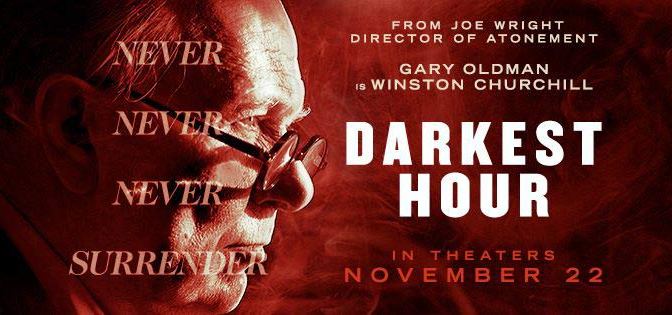
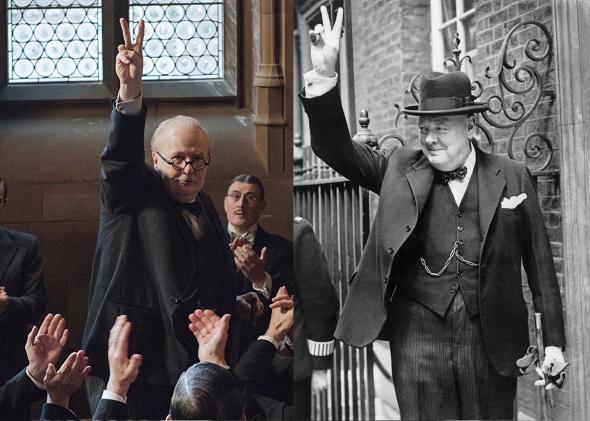
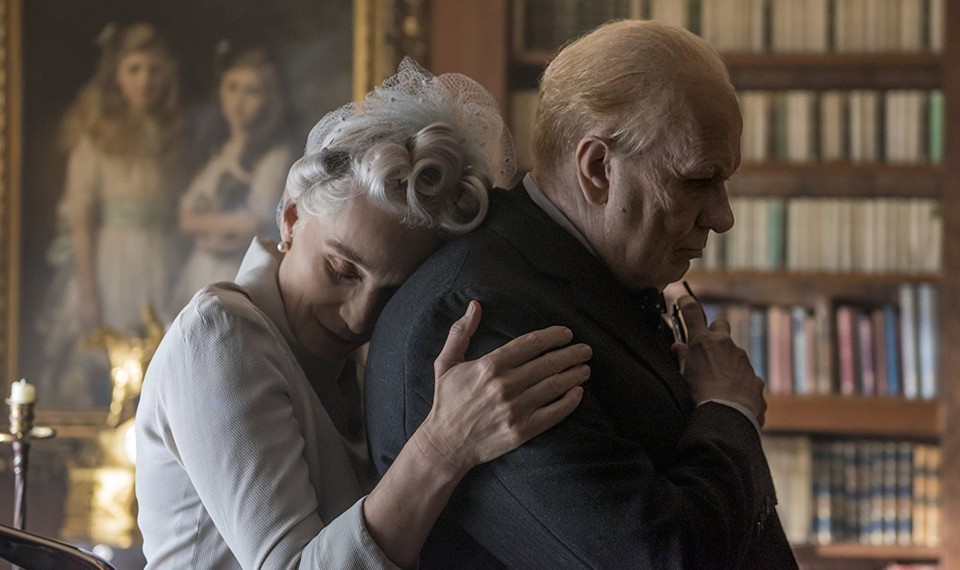
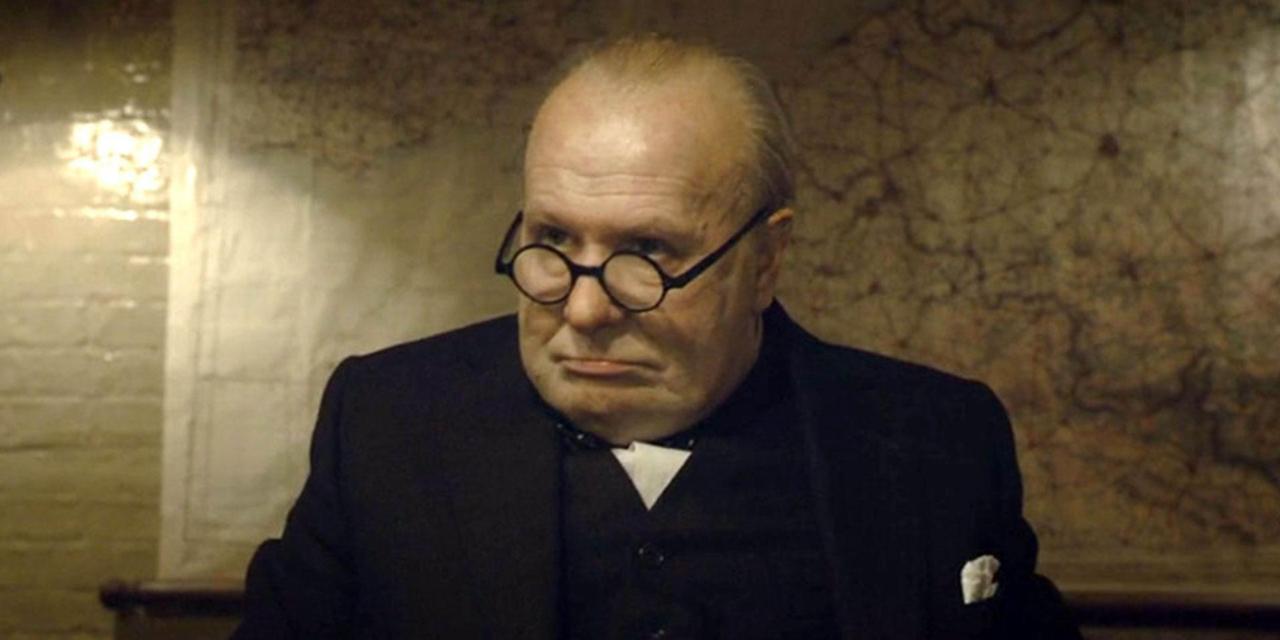
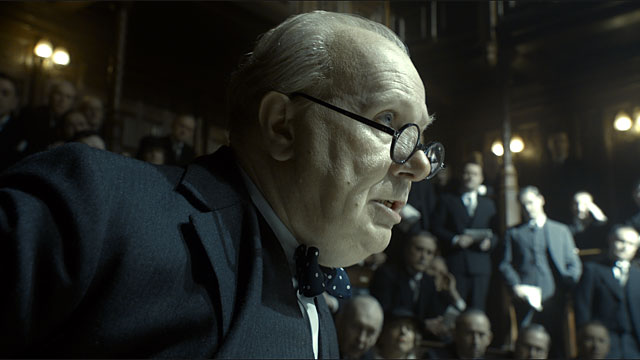
As portrayed in Joe Wright’s beautifully shot microcosmic epic, Darkest Hour, Churchill is presented as a flawed-pink-pyjama’d-cigar-chuffing-blustering-iconoclastic-functioning-alcholic prone to fits of rage, melancholy and depression. He also happens to be devilishly intelligent, full of energy, with a wicked tongue and talent for brilliant oration. Much of the plaudits must go to Gary Oldman, and his make-up team, for creating such a wonderfully human portrait. Indeed, Oldman owns the screen with his damned-near perfect impression.
Anthony McCarten’s fine script centres on a finite number of days during World War II when Churchill became Prime Minister. Aside from one emotionally effective yet historically grating symbolic scene on the London underground, is it well written with fantastic one-liners and Churchill’s greatest verbal ‘hits’. Joe Wright is a talented director (the mis-guided Pan (2015) aside) and he evocatively conveys the shadow of looming defeat. Wright traps Churchill and ensemble in cars, lifts and in underground chambers. Shafts of light also pin the characters to the corners of the screen; pushing them toward the darkness. But through the spirit of Churchill’s never-say-die attitude we fought back against the Nazis and eventually stole victory from the jaws of defeat. War is hell. War is madness. But sometimes it is unfortunately a necessity to prevent the bullies from winning.
THREE BILLBOARDS OUTSIDE EBBING, MISSOURI (2017) – CINEMA REVIEW
Directed by: Martin McDonagh
Produced by: Graham Broadbent, Pete Czernin, Martin McDonagh
Written by: Martin McDonagh
Cast: Frances McDormand, Woody Harrelson, Sam Rockwell, John Hawkes, Peter Dinklage
Marvel and DC comics continue to punt their wares in cinemas and on TV providing us with comforting visions of super-people and alien heroes guarding Earth and galaxies far, far away. We need these characters and events to, amidst the fighting and explosions, make us feel safe by providing neat, happy, ribbon-tied endings which find the evil-doers crushed and our spirits raised as we return to reality. However, there are also writers and filmmakers who challenge our perception of reality, presenting it not as black and white; good and bad; with justice and redemption prevailing. No, certain filmmakers present a muddied view of the world; an unjust and angry vision of humanity; a complex perspective where there aren’t necessarily good people doing good things but rather good people doing bad and bad people, sometimes, just sometimes, trying to be good.
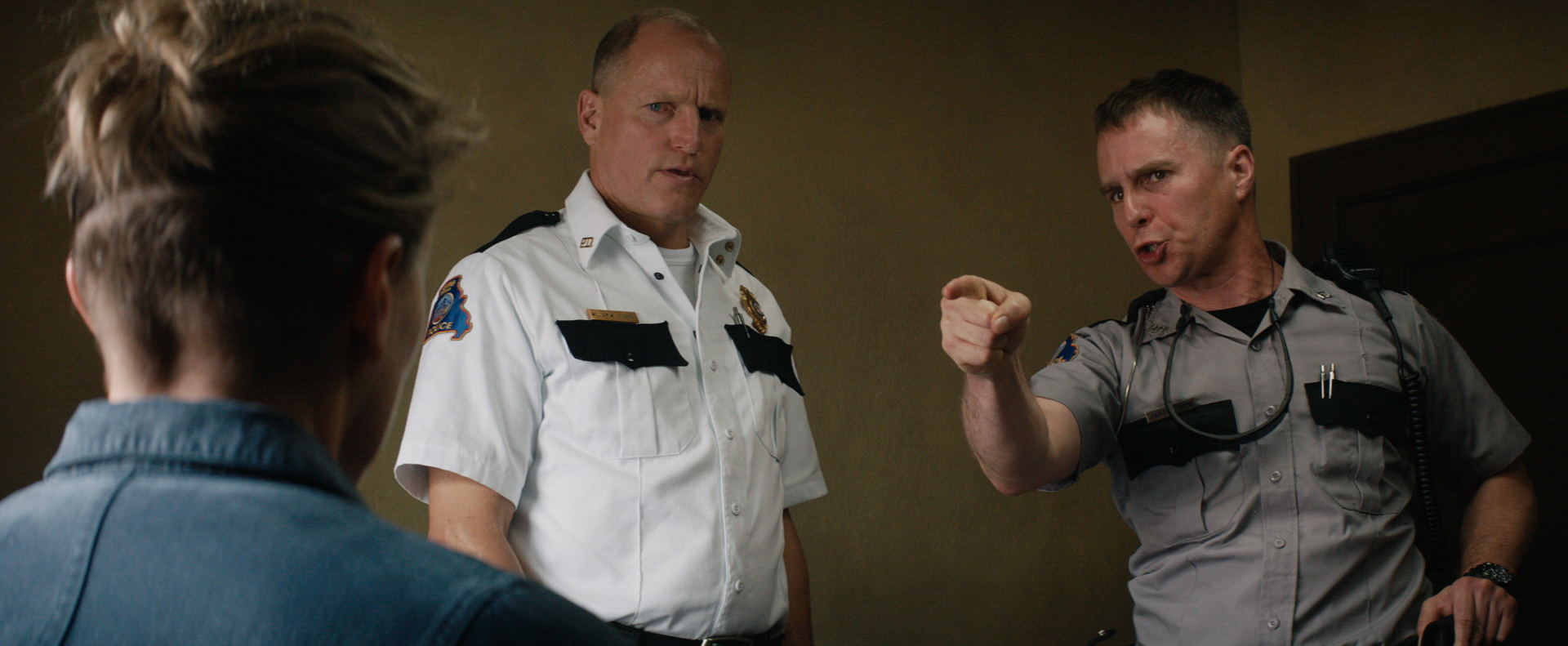
Screenwriter (and director) Martin McDonagh has, in Three Billboards Outside Ebbing, Missouri constructed one of most challenging screenplays of the year. It does not hold up to any politically correct agenda as it paints the world as a cancerous, racist and vicious place where murder and rape crimes go unsolved and grief-stricken vigilantism seems to be the only means of gaining some movement toward closure. As a playwright Martin McDonagh was always drawn to violence and dark humour. His first film, In Bruges (2008), was a darkly hilarious existential comedy-drama. His follow-up Seven Psychopaths (2012) was a heady mix of criminals versus writers in a meta-fictional Hollywood-based narrative; yet with Three Billboards, McDonagh has delivered his best film to date. With its’ singing and stinging script we have a highly emotional drama brimming with incredible characterization, dialogue and zinging one-liners.
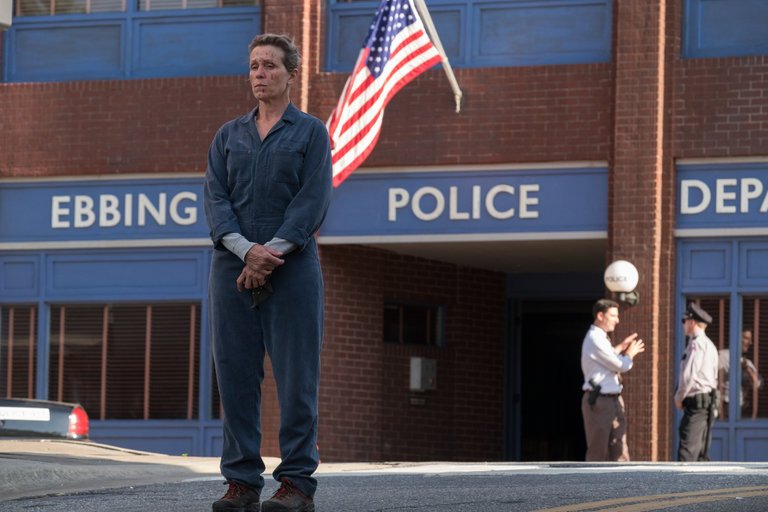
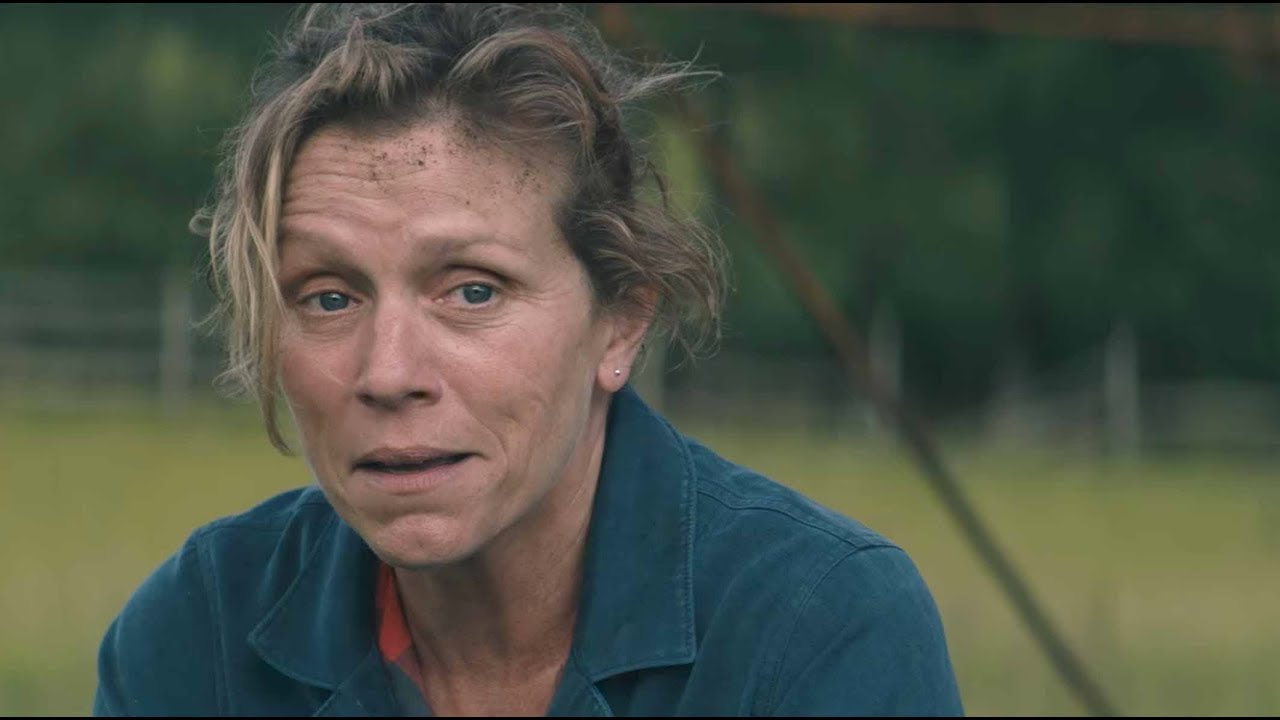
Following the murder of her daughter Mildred Hayes, portrayed with an iron veneer by the remarkable Frances McDormand, no longer prepared to sit by and wait for her daughter’s killers to be found. Firing a rocket into the patriarchal-dominated police department ran by Chief Bill Willoughby (a brilliant Woody Harrelson) she sets in motion a series of unforgettably tragic, violent and blackly comedic scenes. In using the three billboards to question Willoughby’s investigation she utilises physical media as a larger form of the ‘Scarlet Letter’; an old fashioned “name and shame” device. Because Mildred, is refreshingly traditional and old-fashioned and in rural, small-town America the Internet just won’t hack it for her. She is about direct, in-your-face and ballsy action.
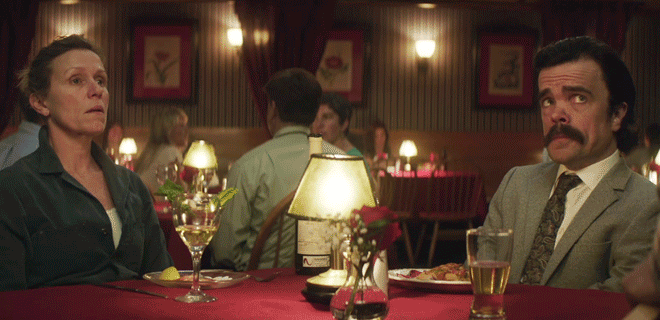
Supporting McDormand is phenomenal ensemble cast including: Harrelson, Peter Dinklage, John Hawkes, Lucas Hedges, and Abbie Cornish etc. Sam Rockwell is especially memorable as the immature, inept and thuggish mother’s boy, Jason Dixon. His scenes with both Frances McDormand and his on-screen Mother, played with deadpan gusto by Sandy Martin, crack with complex emotion and humour. Collectively they portray imperfect characters whose lives have not just been dealt a bum hand but their situation is exacerbated by poor decisions based on grief and frustration with life and the world. Rockwell’s Dixon is arguably the most controversial character as he is essentially a racist man-child and a terrible cop who, via Mildred’s violent actions, awakes from his moronic coma to strive for redemption.
McDonagh script is fantastically dark as he imbues each of the characters with a flawed, yet rounded humanity. He takes risks by making his main protagonist, despite her loss, kind of unlikeable. Yet we are always with Mildred because she is righteous and swimming against the tide of authority. Below the tough exterior though there is also a vulnerability which makes us love her too and empathise fully with her loss. Ultimately, this is an excellent cinematic experience funny, shocking and moving; only possible because of the expert script from a great writer.
Produced by: Mark Gordon, Amy Pascal, Matt Jackson
Screenplay by: Aaron Sorkin
Based on: Molly’s Game by Molly Bloom
Starring: Jessica Chastain, Idris Elba, Kevin Costner, Michael Cera, Jeremy Strong, Bill Camp
As a species we like to have fun. It makes us feel good to manufacture a chemical reaction in our minds and body to create a high and distance ourselves from our own mortality. One such means of fun is gambling. It is fun right: placing bets on the outcome of a game be it chance or skill? I mean it must be fun because so many humans do it, right? Nothing bad comes of fun surely! Nothing bad comes of gambling? Wrong! Of course it does.
Gambling is one of the stupidest things a human being can do. You are willingly handing your money to a bookie or competitor or casino in a game of chance in the hope of winning money. Your hard earned cash is at the mercy of: the turn of a card; the roll of a dice; the kick of a ball; the speed of a horse; and the spin of a wheel. To me THAT is crazy. I know because I used to gamble on the horses and loved it but not when I lost. That high soon dissipated and fun twisted and dug and before you know it you’re in a low-hole and light is getting further and further away the deeper you go.
There are many players out there who will say poker is not a game of chance. It is a keen game of skill relying on intelligence, guts and psychological warfare. I would go along with that but it is, unless fixed, always reliant on major elements of fate. There are a plethora of multi-millionaires out there who have got rich playing poker no doubt. Yet, I bet there are some sob stories too of players who have lost everything at the table.
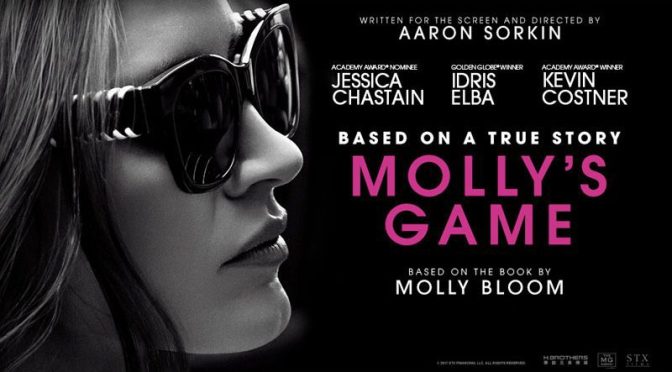
Such characters litter Aaron Sorkin’s excellent biopic of poker “madam” Molly Bloom. You’ve got the bankers, hedge-funders, cowboys, sporting legends, A-list actors and gangsters; all co-mingling around a green baize table facing off over the turn of a card. For me it’s an ostentatious representation of hedonistic narcissism. I mean: that money could be used for good but instead is being used for pointless card games which only serve to boost egos and satisfy bottomless, black-hole addictions. Nonetheless, that doesn’t mean the film is not entertaining because it is.
Sorkin asks us to, at times, empathise for a criminal in Molly Bloom, however, she must be admired for her ballsy attitude, intelligence and organisational skills. Much of the kudos for the film goes to Sorkin’s fantastic script and the sterling performance from Jessica Chastain; who possesses a magnetic on-screen aura reminiscent of the Hollywood stars of yesteryear. Couple of reservations in that with a story about a powerful woman it was disappointing that Costner’s father and Idris Elba’s lawyer got the best speeches at the end of the film. Moreover, at no point did I REALLY care about anyone, aside from Molly when she gets in too deep. But that’s the point: the professional poker world is a shark pool full of predators and Bloom’s story is a complex one, raised above that of your standard crime drama by a zinging screenplay and Jessica Chastain’s nuanced acting.
Starring: Christian Bale, Rosamund Pike, Wes Studi, Adam Beach
Music by: Max Richter
Death and America seem to go hand in hand down the realms of history; entwined bedfellows with society, industry and apparent civilisation being watered by blood and bone and marrow of humanity. The coagulation of Native American lives spread to the dust could be argued to be one of the most despicable genocidal acts ever perpetrated against a generation. And what was it all for? So, human beings from one side of a huge ocean can take what essentially belonged to the indigenous men, women and children of what we now know is called the United States of America. Red dust scorches that land and people and it’s a stain which will never ever be removed.
Even in the last one hundred years and more the Neo-Americans have militarized and invaded many other countries borne, on occasion for the greater good but generally to colonize, re-politicize and scavenge the goods of those said lands. Thus, it is never surprising when the natives choose to repel their invaders as they’d prefer their land to remain their own. For the price of defending their land history has named them savages and other cruel labels in an attempt to differentiate their culture and make them the enemy. Of course, there are good people within the U.S.A who oppose such invasions but the truth remains even they live on blooded ground.
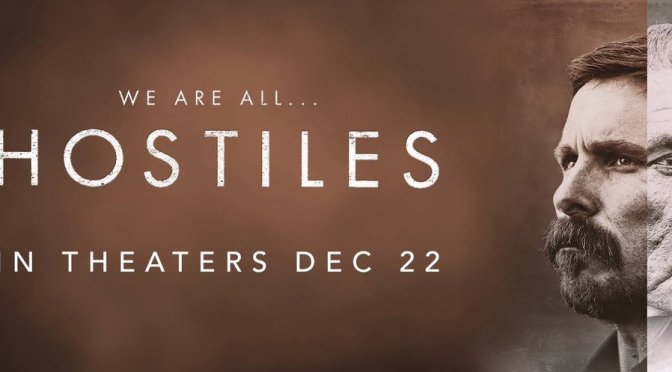
The weight of guilt and pain and death hang heavy in Scott Cooper’s slow-moving and elegant Western. It’s a character driven piece with Christian Bale, Rosamund Pike, Wes Studi and Rory Cochrane putting in dominant performances which convey the depressing murderous times borne out of the heinous and greedy need for progress. White man / woman’s guilt drives the narrative as at first Bale’s soldier refuses to accompany his enemy back to his homeland. Is it more because of the deaths of his own men on the battlefield or because he does not want to face up to his own crimes against the Native Americans?
There are no easy solutions in this glacial paced, beautifully shot Western. The audience is required to analyse the characters actions and make up one’s own mind. There are no black hats or white hats save for the denouement involving the four horsemen that drift over the horizon with death in their eyes. Even the Comanche horde who perpetrate the wicked attack on Pike’s family at the beginning, while unsympathetic, are a product of the barbarity committed by the American army. Overall, this is a genre-defying Western built more on character rather than all-out action. Each slow plot turn went against my expectations and that was a positive. It’s a rich, deep and heavy film which benefits from great performances and an incredible Max Richter score.
“Just because you want it doesn’t mean it can happen.”
DIRECTOR(S): James Franco / Tommy Wiseau
WRITERS: Screenplay by Scott Neustadter & Michael H. Weber (Based on: The Disaster Artist: My Life Inside The Room, the Greatest Bad Film Ever Made by Greg Sestero & Tom Bissell
CAST: James Franco, Dave Franco, Seth Rogen, Ari Graynor, Jackie Weaver, Alison Brie, Hannibal Buress etc.
**CONTAINS MINIMAL SPOILERS**
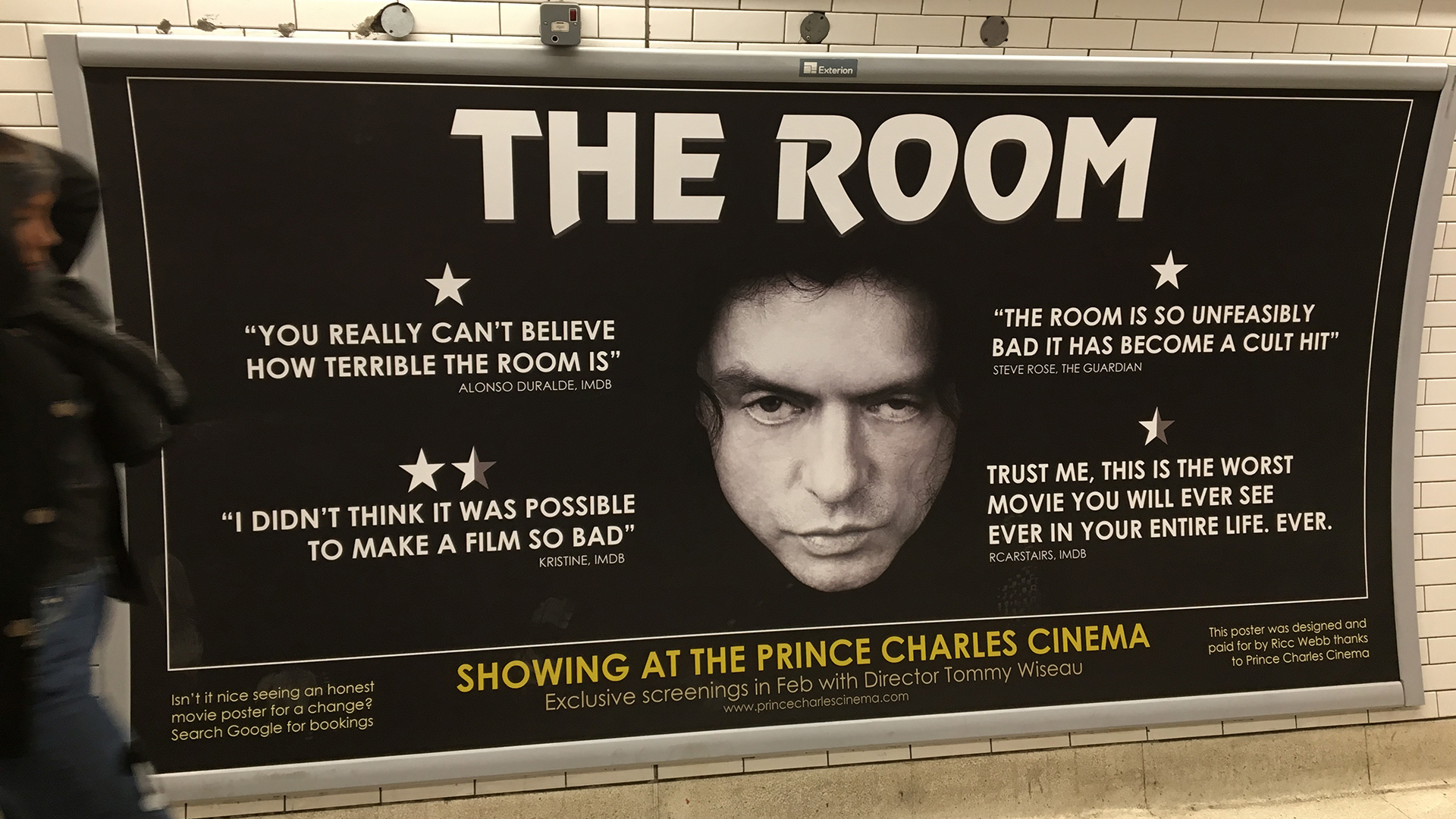
I’d never seen the cult “bad” movie, The Room (2003). I’d seen clips on YouTube of actor, producer and director, Tommy Wiseau’s magnum opus drama, and not only found it excruciatingly painful to watch but, like a car crash I couldn’t take my eyes of it, transfixed at the creative carnage on show. From the initial limited release in 2003, The Room has subsequently become celebrated as a paean to bad filmmaking as armies of hipsters and millennials laugh and quote-along to agonising performances and dialogue on the silver screen. Even during the showing of The Disaster Artist (2017) I was at, a couple of audience members quoted along to some of fantastically simulated scenes from The Room.
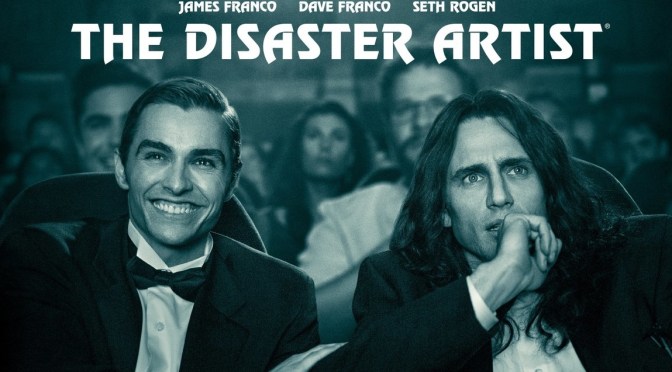
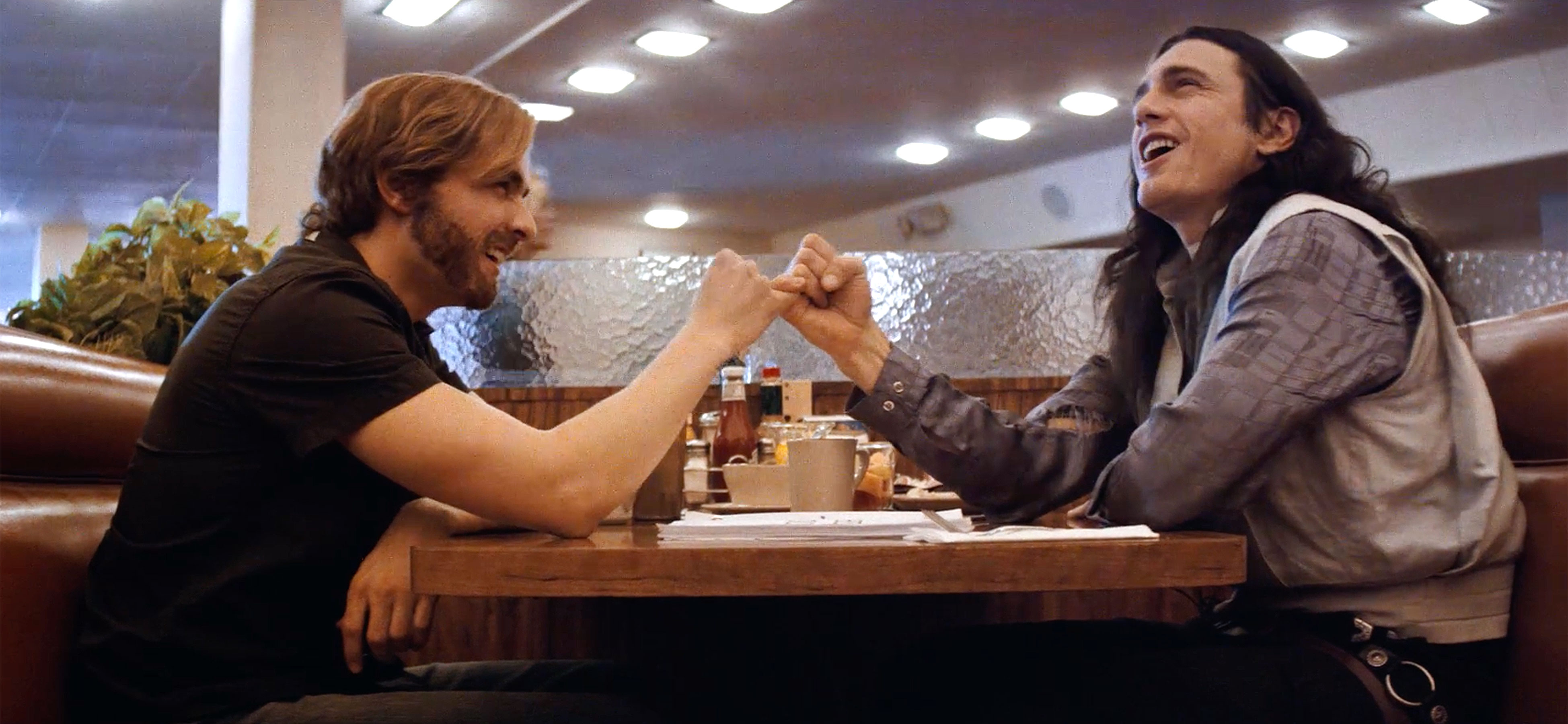
Films within films and the movie-making process have provided, down the years, a rich vein of comedic and dramatic output from: Singing in the Rain (1952), Living in Oblivion (1995), The Player (1992), State and Main (2000); plus, the film The Disaster Artist most reminds me of, Tim Burton’s glorious tribute to the hopeless, yet determined, director called Ed Wood (1994). Structured around two struggling actors in Tommy Wiseau and Gregg Sestero this hilariously skewed yet somehow likeable buddy movie is propelled by the Franco brothers’ brilliant performances as European eccentric Wiseau and the younger, naïve, and ever-smiling Sestero.
Wiseau’s character is an actors’ gift as he exists in some delusional yet over-confident Neverland. We do not know Wiseau’s age, background and how he managed to become so wealthy, yet Sestero is drawn to his outrageously up-to-eleven acting performance during a class, and the two soon become inseparable. Moving to Hollywood they valiantly try to make it as actors and the film lurches from one desperately funny scene to another. Despite their apparent lack of ability they won’t be deterred and decide if Hollywood won’t come to them then they will come to Hollywood. They will make their own movie!
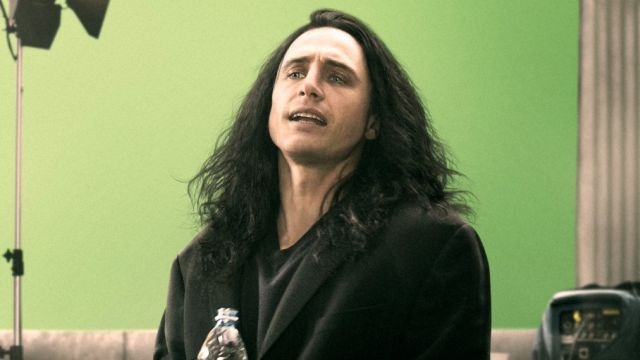
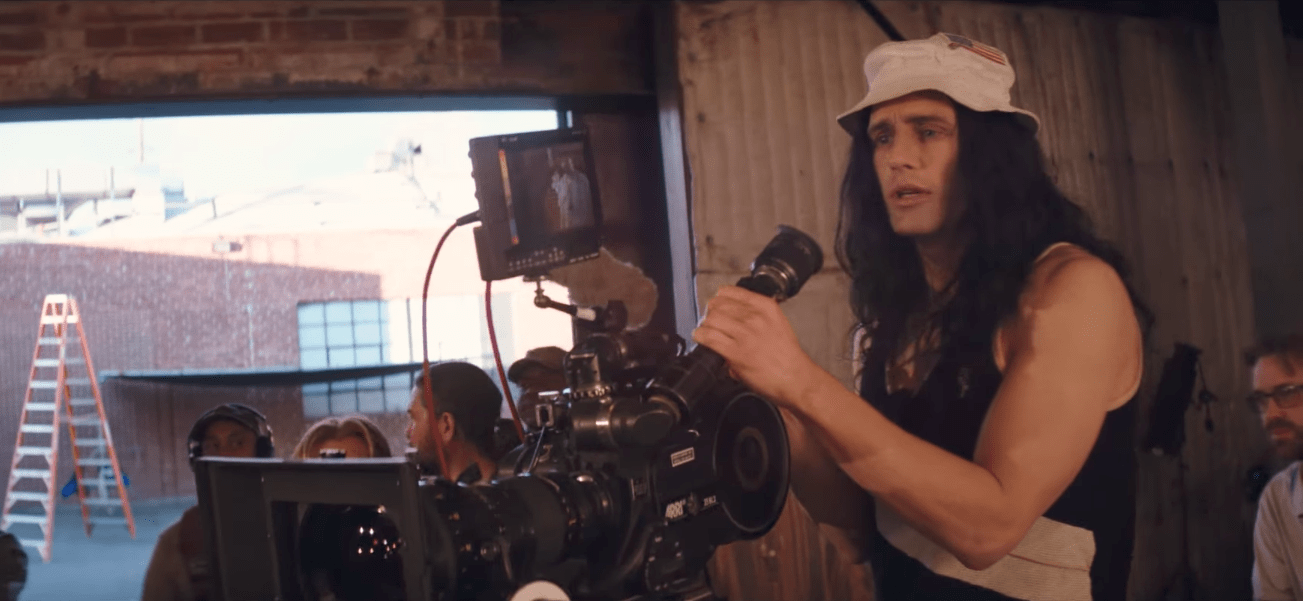
Here The Disaster Artist really becomes a wonderful comedy of filmmaking flaws as we get scene after scene where all manner of rookie errors are committed by Wiseau. James Franco really excels as Wiseau; as the production is clearly beyond him his deluded power and determination will not yield, despite run-ins with the script supervisor (Seth Rogen) and various cast members who have no idea what the hell The Room is about. Here the story becomes compelling as Wiseau’s mania and lack of discipline flies in the face of established filmmaking conventions. During the making of the The Room, Wiseau is genuinely funny, monstrous, and yet somehow sympathetic. He is a true outsider’s outsider; he is a bona fide Hollywood version of Frankenstein’s monster.
James Franco has an odd career trajectory and has kind of stamped himself as a scattergun jack-of-all-trades, giving impressive performances in such films as: Spiderman (2002), 127 Hours (2010) and Rise of the Planet of the Apes (2011); but also starring in some haphazard comedies of which the hilarious This is the End (2013) was the best. Amidst his prodigious work ethic he has also produced some turkeys (i.e. Your Highness (2011); as well as pretentious adaptations of literary classics by William Faulkner. If pushed I would say that his faithful recreation of the cult of Wiseau is his greatest performance to date. The fact he directed the film too is also remarkable as he got the pitch of parody and drama just perfectly.
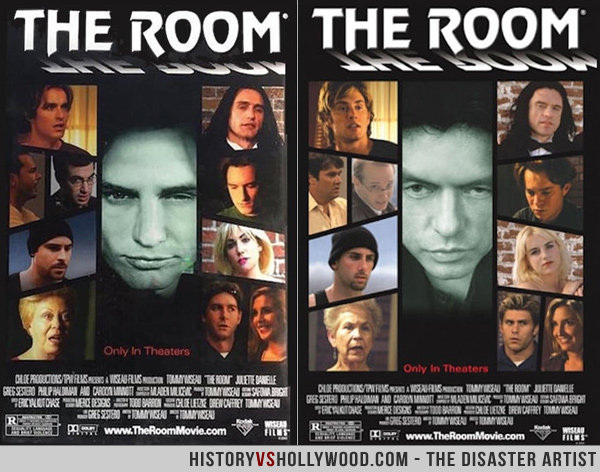
Meta-textually, comedically and entertainment-wise this film is a highly satisfying cinematic experience. As the credits roll the sequence which compares scenes from The Room and Franco’s faithful simulacrum is a joy to behold. I can certainly recommend The Disaster Artist to anyone who enjoys seeing massive fails in the creative process of filmmaking. Having said that though this is a film which also pays tribute to the deluded fools trying to make it in Hollywood. I mean, however impossible it may seem Wiseau and Sestero, refuse to buckle in light of insurmountable odds. Their reward is one of the worst films ever made in The Room; but paradoxically it is a success as it has given so much joy to people at the same time. It’s this joie de vivre that the Franco’s bring forth and the underlying message is that without friendship, dreams and hopes you are nothing in Hollywood or life.
CAST: Aubrey Plaza, Elizabeth Olsen, Billy Magnussen, O’Shea Jackson Jr., Wyatt Russell, Pom Klementieff,
**CONTAINS MINIMAL SPOILERS**
Grief is something which we will, or have already experienced, and given the dramatic possibilities, death and overcoming the death of a loved one propels many narratives in the cinema, literature and music etc. Ingrid Knows Best is one such narrative and while much is made of the plague that is social media and Instagram culture, this is ultimately a story of how our anti-hero deals with the loss of her mother and, in some ways, her own identity. In short: she doesn’t handle it very well, but rather disassociates her grief and fixates on so-called on-line celebrities in order to distract herself and escape the pain.
Aubrey Plaza is brilliant as Ingrid and she is fast becoming one of my favourite actors. I loved her in Office-influenced sitcom, Parks and Recreation and the brilliant lo-fi-sci-fi-rom-com Safety Not Guaranteed (2012). However, in this film and the mind-bending science fiction series Legion (2017), she completely owns the show. Plaza has a rare skill for vulnerable insanity where she does crazy stuff but at the same time you really empathise with her character.
In the opening scene she commits an act of pretty despicable revenge but once you see her living arrangements and family situation you really gain understanding of her character. Even when Ingrid heads west and begins stalking her next obsession, Plaza’s doe-eyed-butter-wouldn’t-melt façade and crumbling inner humanity ensure you never lose empathy for her. The writing is excellent as the script creates humour, drama and skilful satire of the facile, narcissistic and selfie-obsessed culture we live in today. Elizabeth Olsen too is impressive as the “Instagram Queen” and object of Ingrid’s obsession.
Overall, this was just #brilliant #dark #funny #sad! I was really satisfied with this film and while the slightly off-kilter crime-plot-turn near the end slightly unhinged the character study, the touching and thematically perfect ending was a brilliant pay-off for Ingrid’s character. Plaza though is the shining light of the film as she imbues Ingrid with not only the pathos of a zeitgeist Travis Bickle, but also a comedic mania which really brings the satire home.
The Marvel Franchise bus shows no sign of slowing down and the number of Superhero passengers and routes its taking increases every year. Indeed, I’m wondering which driver (i.e. director) will be the first to get a puncture and crash their respective bus, because even though we are well past saturation point the successful formulae is still sweetly cruising along without the threat of breaking down. Even slightly lesser known heroes such as Dr Strange (2016), Guardians of the Galaxy (2014) and Ant-Man (2015) have all made loads of money, and corny vehicular metaphors aside, surely it is only a matter of time before Marvel’s monopoly on Superhero movie success flails. However, Thor: Ragnarok (2017) is most certainly NOT the film that causes the decline.
The crafty Marvel bosses have kept their products fresh by often changing directors because where DC failed artistically, in my view, was they allowed the hyperbolic effects-driven blockbuster style of Zach Snyder — until the impressive Wonder Woman (2017) that is — to dominate their bombastic releases. Marvel Studios, on the other hand have given reign to arguably more quirky, indie-flavoured filmmakers such as: Joss Whedon, James Gunn and now Taika Waititi to drive their movies forward. Thus, along with the standard heroes-versus-villains-end-of-the-world storylines, massive battle set-pieces and fantastical worlds and characters on show, such directors add an element of humour and characterization to proceedings.
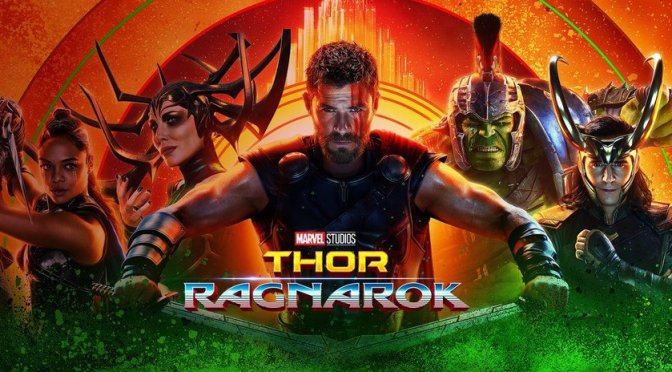
Humour, more than anything, is what Waititi brings to Thor: Ragnarok. This is essentially the first all-out Marvel comedy pitched an octave funnier than Guardians of the Galaxy on the comedic scale; as punchline after punchline reigns down with the power of Thor’s lightning bolts. The opening scene is a case in point where Chris Hemsworth’s sly comic timing is utilised to great impact when facing the demonic Sutur. Hanging upside down and chained, Thor’s momentum swings him around and away as the fiery devil delivers his monologue, only for Thor to ask him to wait until he comes back round again. While covering the exposition in a very funny way the gag also satirizes the clichéd villains’ plot while serving as a wonderful taster for the events to come.
The witty screenplay and lightning pace covers up the familiarity of the story as once again Asgard comes under attack from a hellish force, this time in the guise of the beautiful evil of Hela (Thor’s older sister) portrayed with tremendous gusto by the ultra-talented Cate Blanchett. Usually seen in more serious dramatic roles Blanchett excels as Hela, and arguably is a touch underused until the incredible battle scene at the end. Anthony Hopkins and Tom Hiddleston once again reprise their roles as Odin and Loki respectively; Loki, as usual, getting some great moments to show his dupliticity and mischief. Both Hopkins and Hiddleston take great pleasure to also parody their characters compared to the pitch black seriousness of Thor: The Dark World (2013).
Waititi, the writers and production crew deserve much credit for not only delivering some familiar faces and worlds to the film but also some new ones to freshen it up. I must admit I wish the trailer hadn’t spoilt the appearance halfway through of the “Big Guy” because if I had not known that I would have been amazed at such a twist. Nonetheless, the Hulk does appear and via Mark Ruffalo’s neurotically bemused turn as Bruce Banner we get, amidst all the gladiatorial mayhem, a cracking buddy story too. Moreover, Tessa Thompson as a hard-drinking-hard-fighting “Scrapper 142” (with a hidden past) is another sterling addition to the ensemble and the visuals which derive from her backstory via flashback are the some of the most impressive I have seen all year. Jeff Goldblum as a wacky but dangerous Space Dictator and the hilarious Taika Waititi as a wise-cracking Kronan (a rock-looking dude!?) almost steal the show too.
As he showed with Eagle versus Shark (2007), What We Do In the Shadows (2013) and the exceptionally funny and touching, The Hunt for the Wilderpeople (2016), Waititi is a very talented filmmaker and he has brought his love of eccentric characterization and comedic ability to great effect within the Marvel Universe. Thor: Ragnarok is a riotous mix of stunning visuals, booming rock music, huge battles, family wars, smashing punchlines and hilarious performances. Arguably the comedy sidelines the drama and tonally the film is uneven in places and compared to the magical and hallucinatory world of Dr Strange it is not as satisfying in terms of the whole world and vision created. Nonetheless, as comic book adaptations go it is one of the most entertaining Marvel sequels to date.
Philip K. Dick’s dense, dystopic and futuristic novel, Do Androids Dream of Electric Sheep (1968), is an ugly, beautiful, depressing, obtuse, hypnotic wade-through-treacle read full of incredible concepts relating to: Artificial Intelligence; robot technology; android simulacra; animal husbandry; apocalyptic disease; virtual reality/empathy mood tech; extinguished humanity; and ultimately, of course, mortality and death. The fact that Hampton Fancher and David Webb Peoples were able to fashion a workable screenplay for Ridley Scott to direct is a creative miracle in itself. Moreover, it is testament to the writing and Scott’s incredible production team that Bladerunner (1982) is held in such high esteem among cinema fans now.
The original Bladerunner, despite bombing at the box office and subsequently going through a number of cuts, re-cuts, final cuts and re-re-re-releases, has become a bona fide science fiction cinema classic. I watched the original theatrical version recently and despite the deadpan Harrison Ford voiceover and spurious, tacked on “happy” ending, it actually has a lot going for it. Obviously the ‘Unicorn Dream’ re-edits released under the guidance of Ridley Scott are the purer versions but the film holds up notably because of Ford’s gruff, depressive and world-weary performance as Rick Deckard; the imperious psychopathy of Rutger Hauer as android assassin Roy Batty; Scott’s glorious tech noir rendition of our desecrated future; as well as the evocation of Philip K Dick’s thematic existential power.
Thus, to offer up a near three-hour sequel to a box office bomb of an almost unfilmable novel was something I thought extremely brave from a creative and business perspective. However, as soon as I saw the director Denis Villeneuve was attached, I immediately knew that Bladerunner 2049 was a must-see! This filmmaker has elevated himself to the higher echelons of Hollywood directors with superlative work such as: Incendies (2010), Prisoners (2013), Enemy (2014), Sicario (2016) and Arrival (2016). In such films he was able to meld story, style, character and performance to create very accessible genre films which encapsulate the pain and drama of the human condition adroitly.
In Bladerunner 2049, the future’s orange but, like the original novel and film adaptation, it’s definitely not bright! We are in a sick, unforgiving and murderous world where a dying Earth, specifically California, is inhabited by killer replicants, pleasure models, and totalitarian law enforcement and overseen by the venal, profit driven capitalist oligarchic Wallace Corporation. In this vision of Earth, men, women, children, animals and robots are all slaves to be bought and sold to the highest bidder. I have seen some critique that the film is exploitative in its female representations but the films reflects much that is wrong with our world today and the original novel’s dystopic and misanthropic themes.
Both male and females are objectified and deemed commodities and alas that is true too of the sick world we live in today, yet perhaps just not as blatant? Bladerunner 2049, I does not offer solutions but depressingly mirrors society’s desire to sexualise and exploit others. Our “hero” the replicant cop ‘K’ (Ryan Gosling) is a victim of such exploitation in his touching relationship with A: I hologram Joi (Ana De Armas). Ultimately, he learns that they’re all being faked by the horrific technological nightmare they call existence. I think it extremely interesting that K’s wry smile when he realises he has been exploited by the Wallace Corp. product Joi; and paradoxically this demonstrates his humanity.
Villeneuve, aided with startling artistry by cinematographer Roger Deakins directs from a screenplay written by original writer Hampton Fancher, plus Michael Green. One could argue that the original Bladerunner is style over content, as the story was distilled to that of Deckard basically hunting down a bunch of outlaw robots. However, the style WAS the content along with the dense richness of the themes. Similarly, Bladerunner 2049 does not have a particularly complex plot, save for one fantastic thematic reversal, yet at its heart it explores the powerful question of what it means to be human? I think all intriguing narratives should ask this and explore important notions of existence. I mean, it’s not surprise Gosling’s character is called ‘K’ – because the story echoes Kafka’s The Trial in many ways. Indeed, is his seemingly futile search for meaning or humanity just a pointless pursuit or is it reward enough to delude oneself with the possibility of hope or love? Life and the decision whether to carry on regardless is therefore very much on trial.
I think this is a film which will benefit from further viewings. I felt like I was watching a Tarkovsky or Bergman film on a massive budget. It’s like Denis Villeneuve managed to combine, with the writers and designers, an indie-Hollywood-art film installation. I would say this is a character and theme led narrative rather than purely plot driven. Even Niander Wallace’s (Jared Leto) weirdness, while not essential for the plot, added to the depth of character and surface emotion. He felt like a Colonel Kurtz figure trapped in his own insane delusion and obsession. Could he have been a replicant too? Likewise, Harrison Ford’s reappearance as Deckard adds great flavour to a wonderful sci-fi broth. Yet, his aging persona is integral to the plot and not simply a meta-textual nod to the original film.
Ultimately, we mere mortals are arguably not worthy to critique this fantastic work of genre art cinema. I understand it was slow but that almost increased the joy for me. It moved glacially but with high confidence and in Ryan Gosling it had a bona fide star to guide us through this sick yet beautiful world. Moreover, the sound design and music from Hans Zimmer and Benjamin Wallfisch was a powerful force which heightened the suspense and paranoia. While the visuals are absolutely breath-taking I was also drawn in by the existential intrigue of the themes. Technically, within the story, the replicants are not living people but we empathise with their plight nonetheless because THEY are US. There lies the paradox and beauty of this film, in that I cared and was fascinated by what happened to actors playing robots on the cinema screen.
SCREENWASH CINEMA REVIEWS – SEPTEMBER 2017 – including: IT, WIND RIVER and KINGSMAN 2
**MINIMAL SPOILERS**
I’m a tad tardy on my cinema reviews for last month mainly because I have been writing a couple of short script projects to be filmed. One is a sharp little horror story called Flatmates and I’m looking to shoot in November. The casting has been going well, after which I will rehearse and film on HD video. The other is a follow-up to our Star Trek fan film Chance Encounter (2017) released earlier this year online, which has now has over 40,000 views on YouTube!! Not quite Gangnam Style or dancing cats on a piano but pretty good nonetheless to have one’s work viewed that much.
Anyway, enough of the filmmaking hobby momentarily to switch back to the film reviewing pastime. Below are reviews of three excellent genre films, plus a little reprise of my opinions on Aronofsky’s two hours of hell that was Mother (2017). As usual they are marked out of eleven in tribute to This is Spinal Tap!
IT (2017)
Stephen King is clearly a genius. To be able to maintain creativity and longevity as a writer, plus give birth, as it were, to any number of iconic narratives, characters and events is a testament to his massive energy and talent. When I was young one of the scariest things I ever saw on TV was the horror serial Salem’s Lot (1979), which was about vampires taking over a small town. His book Carrie (1976) was also adapted into one of the best horror films of the seventies too. Moreover, the ‘80s TV and cinema screens were peppered with King’s work notably: The Shining (1980), Stand by Me (1986) and the under-rated Pet Semetary (1989). In 1990, Tommy Lee Wallace directed a mini-series of IT, with the terrifying Tim Curry as Pennywise the Clown. IT proved to be an excellent horror story until the – faithfully sticking to the novel of course – ridiculously silly ending.
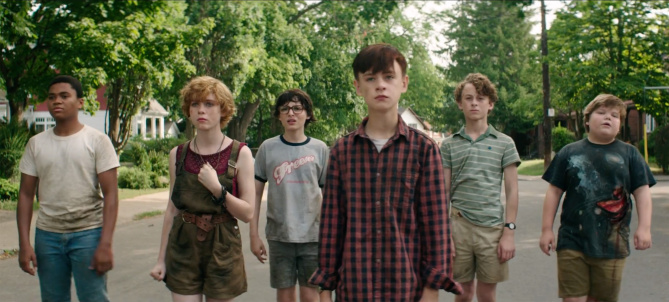
Flash forward twenty-seven years and Pennywise is back to haunt the dreams, drains and sewer pipes of Derry, Maine, using manipulation and fear to lure teenagers to their death. Developed by, among others Cary Fukunaga, the film was eventually directed by Andy Muschietti and has deservedly become a big box office hit. I say deservedly because, while it is not a particularly amazing cinema offering, it is a highly entertaining genre horror film. As an experienced Stephen King cinema and TV viewer all the staples are there such as: geeky-small-town-outsider-kids; abusive tough-guy-bully types; negligent parents or appropriate adult; monstrous beings hidden in the shadows; plus coming-of-age teenage friendship and love.
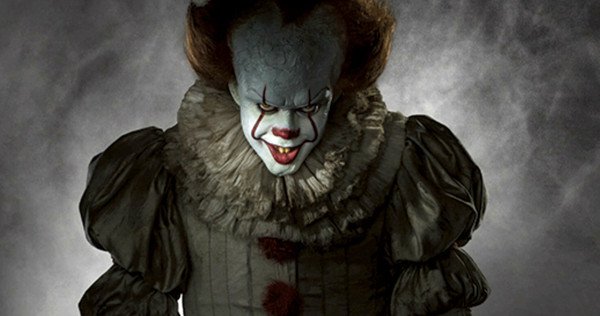
The clown in this case is portrayed with fiendish joy by Bill Skarsgard and there are some fantastic stand-out scares. My only criticism is, and this is my fault being over-familiar with King’s work, is that with the recent Super 8 (2011) and over-hyped Stranger Things (2016), I felt as if I had seen it all this before. I also felt they crammed too much into the two hours and some of the character emotion was lost at times. However, the cast of kids are excellent in their respective roles, the horror set-pieces are brilliantly staged and King’s iconic bad guy Pennywise makes it well worth the cinema admission fee alone.
(Mark: 8 out of 11)
KINGSMAN: THE GOLDEN CIRCLE (2017)
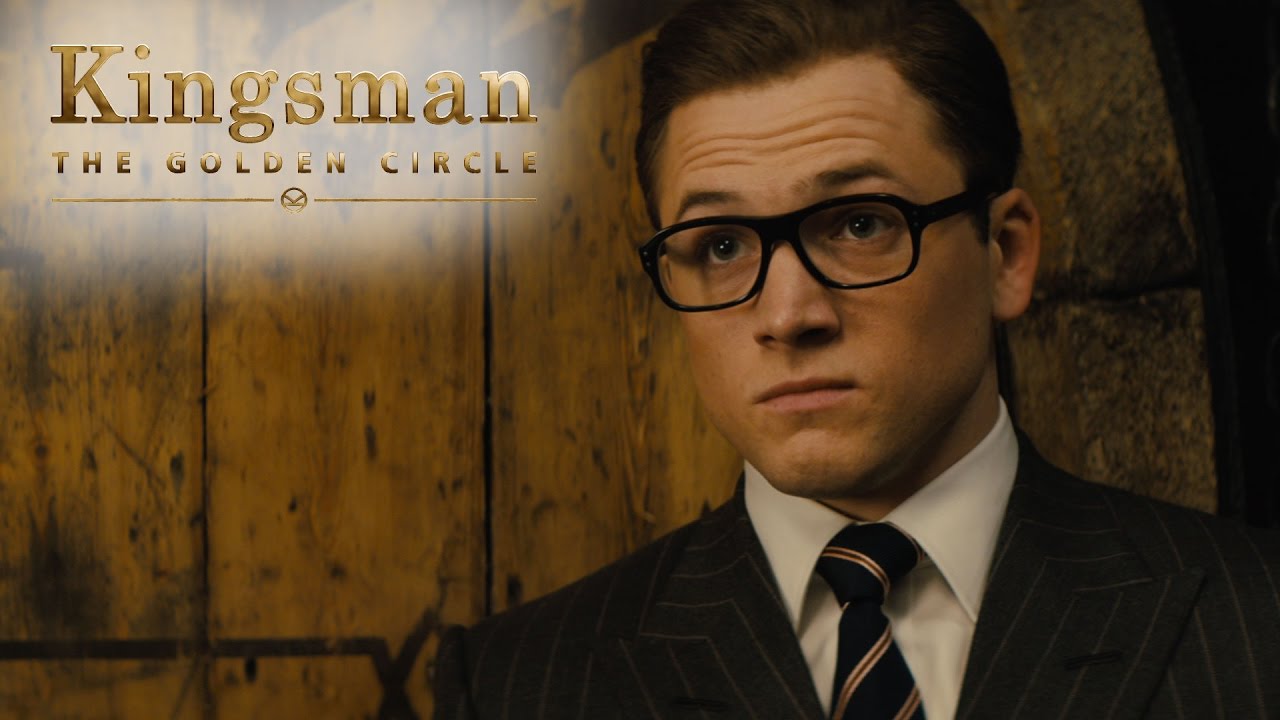
The first Kingsman: The Secret Service (2014) film was one of my favourite genre films of the past couple of years. It showed a clean pair of spy heels to the, occasionally brilliant but overlong Bond disappointment Spectre (2015); while at the same time confirming Taron Egerton as an actor with great star potential. Having done the business at the box office then Jane Goldman and Matthew Vaughan have once again written and directed an explosive, funny, pacey and adrenaline-filled spy spoof sequel.
In this story, Eggsy / Galahad is back with Merlin (Mark Strong), battling with the United States counterparts The Statesmen, against Julianne Moore’s perky, yet deranged, Americana obsessed drug baroness. The Statesmen are represented by such heavyweight acting talent in Jeff Bridges and a cracking turn from Pedro Pascal as the hilariously named Jack Daniels. Channing Tatum pops up too but he is lightweight compared to the effervescent Pascal. Poppy’s fiendish plot is actually quite a decent motivation for the story and the subplot involving a Lazarus-type-return from a major character from the first film is well developed.
To be honest the story is just the bare bones to hang a series of fantastic set-pieces, car chases, shoot-outs and fights, as Eggsy and his kick-ass team once again attempt to thwart the end-of-civilisation as we know it. My main criticism is the film is probably too long with an unnecessary gratuitous sex-driven sequence set in the Glastonbury Festival. It also lacks that sense of characterisation from the first film which had the working class underdog Eggsy battling the upper-class sneers of the over-privileged. Nonetheless, Matthew Vaughan is a great gag-heavy-action-director and the plot has some decent twists and turns throughout making it well worth a watch.
(Mark: 8 out of 11)
MOTHER (2017)
While Darren Aronofsky is a cinematic artist of the highest level, I connected badly with this two-hours-of-hell-excuse-for-entertainment. My full review can be found here but, in a nutshell, this is what I thought of it:
“It was an awful, pretentious heap of a film which exists as an entertainment void both nihilistic and dull. Because this film abuses the privilege and patience of the audience delivering a technically brilliant but overall clichéd, first-world-problems-poet-with-writer’s-block-world-murdering-art-fan-hating two hours I will never get back.”
Mark: 5 out of 11 (for the film) Mark: 9.5 out of 11 (for Darren Aronofsky)
WIND RIVER (2017)
Taylor Sheridan has carved himself a fine reputation for writing very solid character driven genre films such as Sicario (2015) and Hell or High Water (2016). Wind River (2017) is his first writer-director effort and it is a fascinating study of: grief, murder, racial tension and dark humanity. Sheridan is adept at choosing specific areas of America with which to place his stories. Sicario reflected on the war on drugs, located betwixt the violent border of Mexico and the U.S.A. Hell and High Water illustrated the financial ruin of the sub-prime mortgage crash and its effect on West Texas. In his latest screenplay Sheridan focusses on the Indian Reservation territories of Wyoming and the people who inhabit the stark wintry landscapes.
The quietly impressive Jeremy Renner, as Cory Lambert, takes most of the acting plaudits as the respected, expert tracker and estranged family man. He is an individual who, while in perpetual control on the external Reservations and snowy terrain, finds himself crumbling internally due a horrific event from his past. Renner is ably supported by his Avengers co-star, Elizabeth Olsen, who imbues the rookie FBI agent with a steely determination, despite her lack of experience and confidence. The portrayal of the Native Americans I feel was sensitively presented as their lives are further marginalized by corporate America as its venal greed destroys the environment and humanity within the area. While this is a beautifully looking film there is a dark murderous heart within the stunning vistas and natural beauty.
Sheridan again confirms he is adept at combining social commentary with an impressive crime plot. Moreover, throughout the film he also bleeds in a compelling study of grief as well as a subtle critique of patriarchal capitalism and its’ destruction of the Native American’s land and people. Yet, the message could arguably have gone further in its criticism; however, as he proved with his prior screenplays Sheridan prefers subtext and a rising tension rather than polemics. Quietly, Sheridan is building an impressive filmic body of work and Wind River manages to be a thrilling police procedural drama, empathetic character study and socio-political examination of American corruption; all amidst the cold, harsh and white-washed landscapes of Wyoming.
CAST: JENNIFER LAWRENCE, JAVIER BARDEM, ED HARRIS, MICHELLE PFEIFFER
**GENERALLY SPOILER FREE**
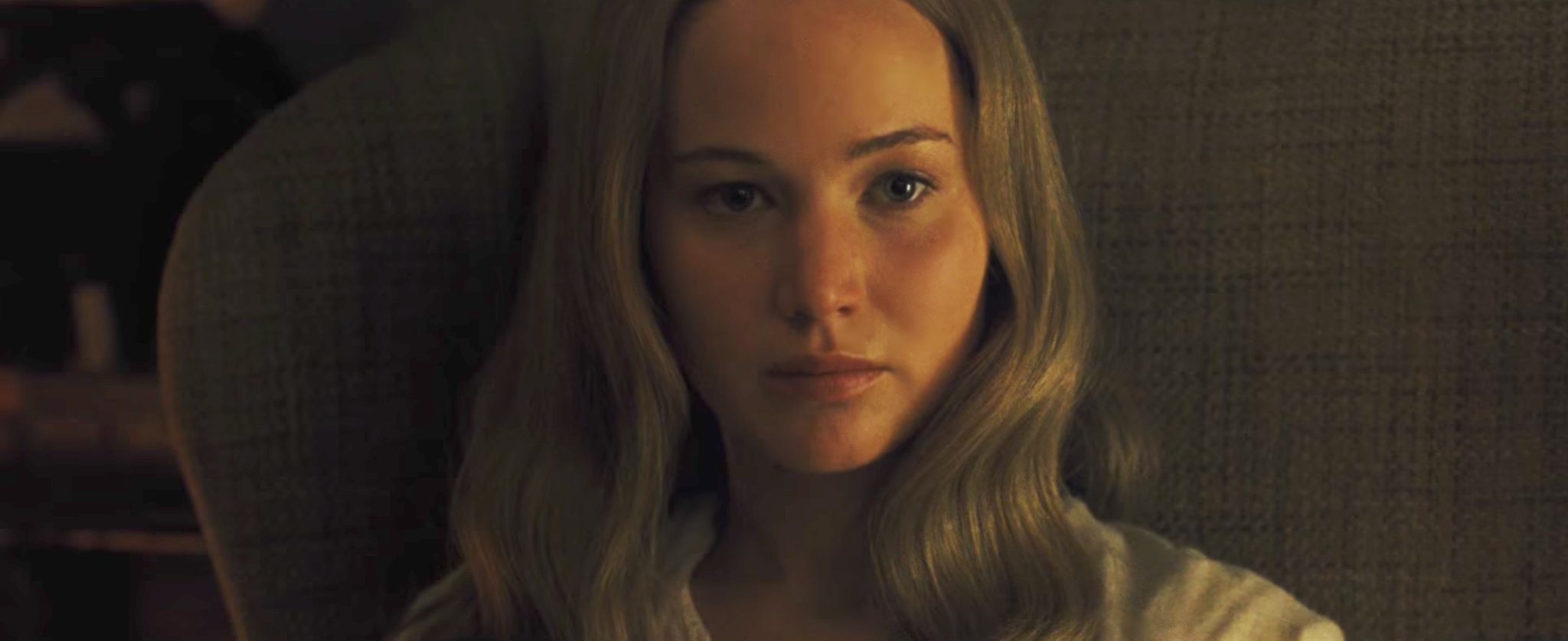
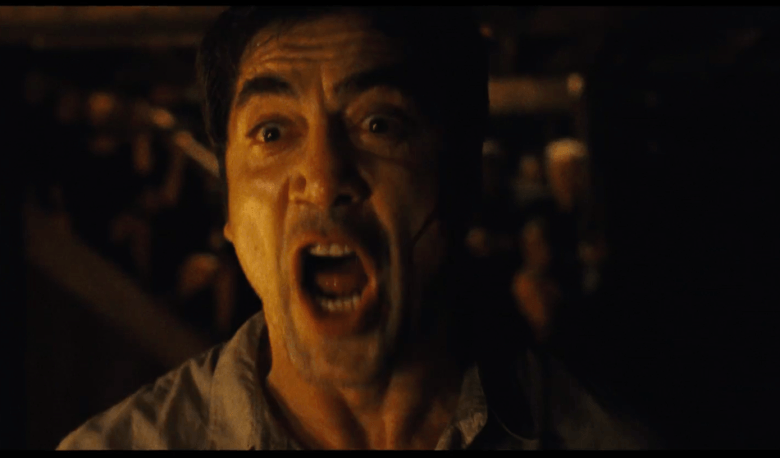
Darren Aronofsky’s psychological horror stars Jennifer Lawrence and Javier Bardem as a couple in not so much a narrative but a descent into what-the-fuck? They portray conduits of hellish pursuit dictated by a filmmaker on the edge of a nervous breakdown, vengefully striking out at his ego, superego and the world around him. I mean, you know when someone tells you their dreams in nightmarish details and it’s more interesting to them than you: well, this is two hours of that.
While this is technically a bravura tour-de-force in design, composition, cinematic experimentation and delivery I was utterly bored by, what is essentially, an indulgent, pretentious and nihilistic void of a film. Darren Aronofsky’s prior work such as Requiem for a Dream (2000), Pi (1998), The Wrestler (2008) and Black Swan (2010) combined cinematic style and protagonist emotion superbly. Mother, in its critiques of Hollywood, fame and some kind of biblical allegory stuff wildly missed the mark for me. I wasn’t even shocked by the horrific denouement as it all happened in a surreal vacuum where I could not care less about any person or anything.
Christopher Nolan used cinematic form to powerful effect in Dunkirk (2017) and moved me immensely but Mother just bludgeoned me into dull submission. I wonder if Aronofsky’s experience on Noah (2014) had somehow warped his mind and the film is a creative and therapeutic cry for help, while at the same time damning the executives who possibly killed his film baby. He certainly throws a lot of toys from his pram in this violent, bloody, fiery, misogynistic and misanthropic misfire!
Lawrence was incredible as the battered lead while Bardem just felt confused and off-the-pace-at-times to me. While it is the work of a filmmaker I would certainly call an artist and generally I love the surrealist films of Luis Bunuel and David Lynch, the nightmarish logic narrative did not work for me as the cyclical parlour trick in closing the story is mere sleight-of-hand to fool the audience into thinking the film is deeper than it is.
Ultimately, Darren Aronofsky, based on his prior films, is a risk-taking, boundary-pushing genius and some will adore this brave and courageous misadventure. However, for me it was an awful, pretentious heap of a film which exists as an entertainment void both nihilistic and dull. I mean I’m just a lowly office drone but I paid my money and earned my opinion. Because this film abuses the privilege and patience of the audience delivering a technically brilliant but overall clichéd, first-world-problems-poet-with-writer’s-block-world-murdering-art-fan-hating two hours I will never get back.








/cdn.vox-cdn.com/uploads/chorus_image/image/55991485/Screen_Shot_2017_07_28_at_3.44.06_PM.0.png)











 The Cinema Fix presents