VELVET BUZZSAW (2019) – NETFLIX FILM REVIEW

VELVET BUZZSAW (2019) – NETFLIX FILM REVIEW

Written and directed by: Dan Gilroy

Produced by: Jennifer Fox

Starring: Jake Gyllenhaal, Rene Russo, Toni Collette, Tom Sturridge, John Malcovich, Zawe Ashton, Daveed Diggs, Billy Magnussen, Natalia Dyer etc.
Picture the scene: a starving child in Africa passively stares at a camera while a fly irritates their big sad eyes, and they do not know when their next meal is coming from. Meanwhile, in a New York auction house a painting by Cezanne or Gauguin or Picasso is selling for over $200 million dollars! What the fuck is wrong with the world?!  I’m not saying these paintings aren’t great art it’s just that there is NO WAY that amount of money should be paid for a painting when there is starvation, disease, and poverty in the world. It’s just an indictment of the sickness of humanity, that we place such value on what effectively amounts to canvas and paint placed in a particular manner by some dead person. It’s utter madness!!

DON’T GET ME STARTED ON SO-CALLED MODERN ART!!

Yeah, sure, maybe I DON’T GET IT!! Maybe one should be allowed to express themselves from a creative and emotional perspective but THEY ALSO WANT PRAISE FOR IT!!! And MONEY! And adulation! Of course, certain painters, sculptors and creative types expressing themselves can become a transcendental experience but mostly it’s a bunch of pretentious wankers conning us into thinking what they are doing is important. Come the fictitious revolution occuring in my imagination, most modern artists will be on the hypothetical spikes adorning the made-up barricades.
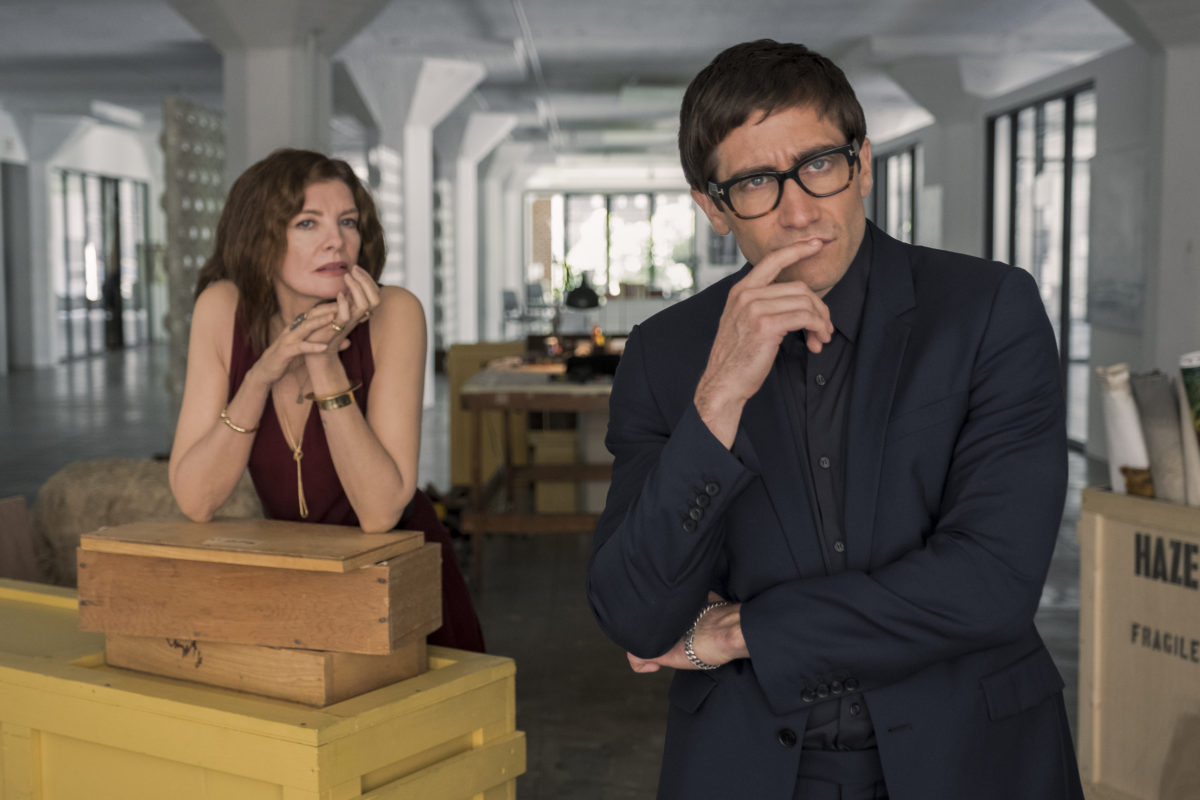
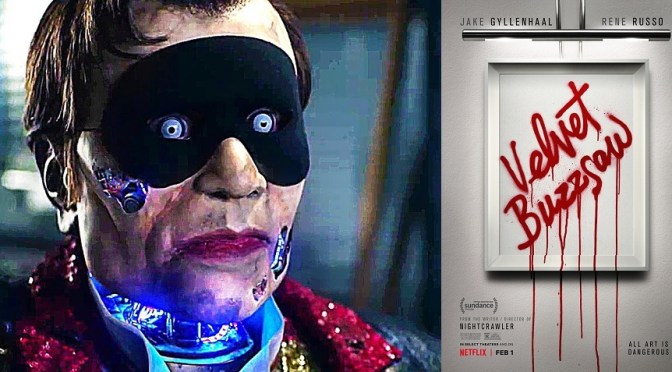
Tony Gilroy’s third film Velvet Buzzsaw (2019) taps into some of the ire I feel for the art world. It’s full of fake plastic and unlikable characters who spend their days stabbing and fucking each other in the back, all trying to sell us the next big fat artistic lie. When a never-famous painter dies his work becomes a cause celebre and further in-fighting ensues in an attempt to monetize his apparent genius. Jake Gyllenhaal leads an impressive ensemble cast as arsehole critic, Morf Vandewalt; while Rene Russo, Toni Collette, Tom Sturridge, John Malcovich and Zawe Ashton revel in their narcissitic and parasitic roles as agents, artists and art-whores.

Ultimately, this is a very broad comedic satire with some decent horror deaths thrown in. At times I felt like it should have been shot with a cast of unknowns on 16mm film, rather than the A-list hi-definition gloss presented. Firmly in the B-movie territory of say Final Destination and Driller Killer, it’s neither scary or bloody enough to make a convincing horror or gorefest. Having said that there are some fantastic deaths, very witty dialogue and memorable images throughout. Lastly, Gilroy’s work has kind of gone backwards since his phenomenal debut Nightcrawler, and this, without wishing to sound like a pretentious critic, is certainly a very minor work. Overall, though I enjoyed the coruscating digs at the modern art-world and all the arseholes who inhabit it; so that made it well worth a watch.

Mark: 7.5 out of 11

IT’S ALWAYS SUNNY IN PHILADELPHIA – SEASON 13 REVIEW

IT’S ALWAYS SUNNY IN PHILADELPHIA – S13 REVIEW

Created by: Rob McElhenney

Developed by: Rob McElhenney and Glenn Howerton

CAST

Charlie Day as Charlie Kelly
Glenn Howerton as Dennis Reynolds
Rob McElhenny as Mac
Kaitlin Olson as Dee Reynolds
Danny DeVito as Frank Reynolds

**MAY CONTAIN SPOILERS, BITCHES!**

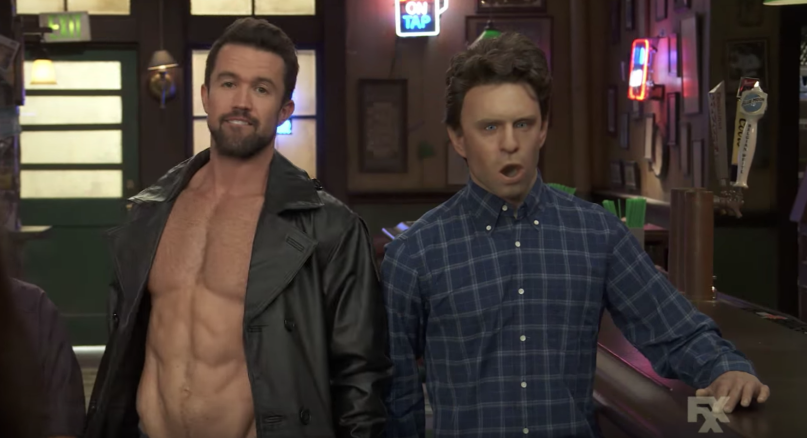
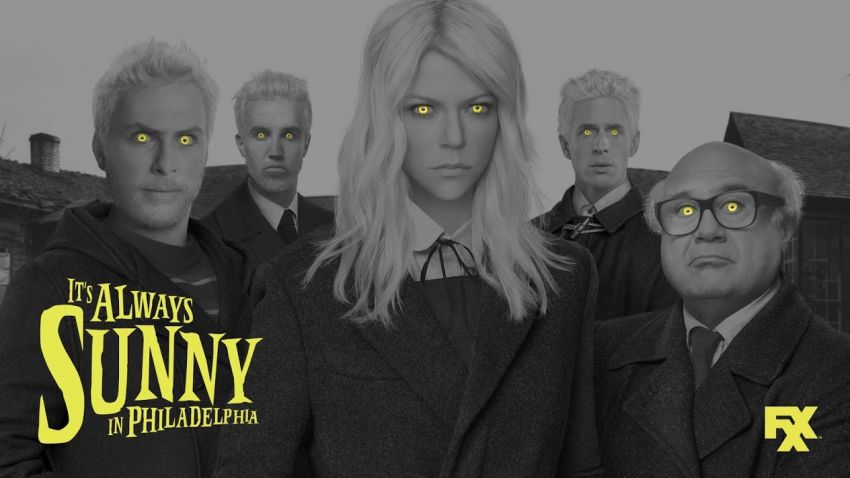
The thirteenth season of one of my favourite sitcoms arrived on Netflix in early January. With a mixture of joy and sadness I eagerly binged another ten episodes of the most scurrilous and offensive comedy shows of recent years. The sadness was mainly due to the fact that Glenn Howerton’s Ted Bundyesque character, Dennis, had seemingly been written out of the show. However, it turned out he was in many of the episodes so joy soon prevailed.

If you haven’t seen It’s Always Sunny in Philadelphia – THEN WHAT IS WRONG WITH YOU! No, seriously, it is one of the darkest, funny and absurd shows I ever seen. It is the anti-christ of sitcoms and a black anathema to the Friends template. It concerns five individuals who congregate a bar in Philadelphia called Paddy’s and basically follows them as they fuck each other and those around them over. It may not sound like it but it is comedy gold. Further, it’s also pretty smart in satirising zeitgeist issues relating to race, gender, politics, friendships, sport, addiction, crime family and sexuality. It is quite often shocking but not just for shock’s sake. There is a mean streak of intelligence running throughout the show.

I would have to say that Season 13 did not hit the heights of prior seasons. The main reason is that Glenn Howerton’s appearances, while very funny, seemed to impact the consistency of the show. There was an uncertainty and feeling he was only available for a certain time during filming and this was felt in the season as a whole. Also, one could argue the writing was not as sharp as prior seasons. Nonetheless, the show had some brilliant and pointed episodes. My favourites were: The Gang Beats Boggs: Ladies Reboot which both called back to a prior “drinking game on a plane” episode and satirised the drive by Hollywood for all-female ensemble remakes such as Ghostbusters. The Gang Gets New Wheels episode was also brilliant. Here the status symbol of car ownership was mocked as Dee finds herself elevated socially due to her new vehicle. Safe to say her new found popularity is ruined by her own narcissistic and obnoxious character choices.

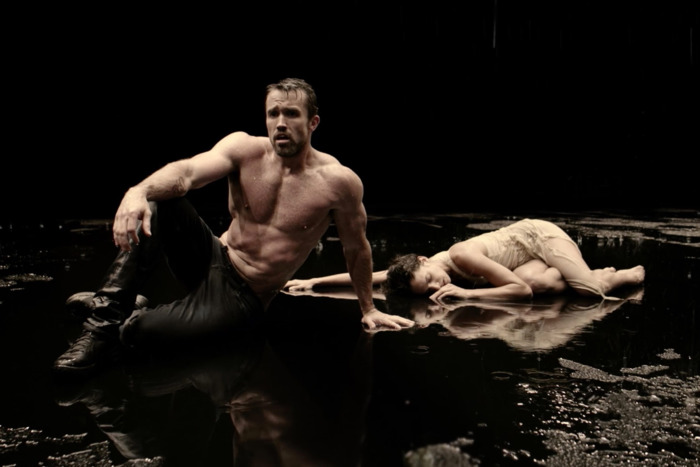
The season takes joy in referencing the #MeToo and Time’s Up furore, the Eagles Superbowl win, Gay Pride, Escape Rooms, Sex Dolls and lampooning films such as: Home Alone and Inception. The latter becoming a hilarious meta-textual delight in the episode, The Gang Does a Clip Show. By the thirteenth episode, Mac Finds His Pride, I had thoroughly enjoyed the scatter-gun chaos of the season. Yet it was still not enough to prepare me for the incredible final sequence, which found Rob McElhenney performing a contemporary dance sequence of some skill and beauty. While it did not necessarily make me laugh it, like the show as a whole, kept me hooked and surprised throughout.

Mark: 9 out of 11

VICE (2018) – CINEMA REVIEW & OSCAR BINGO #3

VICE (2018) – CINEMA REVIEW

Directed by: Adam McKay

Produced by: Brad Pitt, Dede Gardner, Jeremy Kleiner, Kevin J. Messick, Will Ferrell, Adam Mckay

Written by: Adam McKay

Starring: Christian Bale, Amy Adams, Steve Carell, Sam Rockwell, Tyler Perry, Alison Pill, Lily Rabe, Jesse Plemons

**CONTAINS HISTORICAL SPOILERS**

Unlike the previous Oscar Bingo attempts for A Star Is Born (2018) and First Man (2018), this review has full knowledge of the nomonations. So, rather than be guess work this review of Vice (2018) is intended to be based on more constructive critiques of the Oscar nominated films I have seen.

BEST FILM CHANCES – 8/10

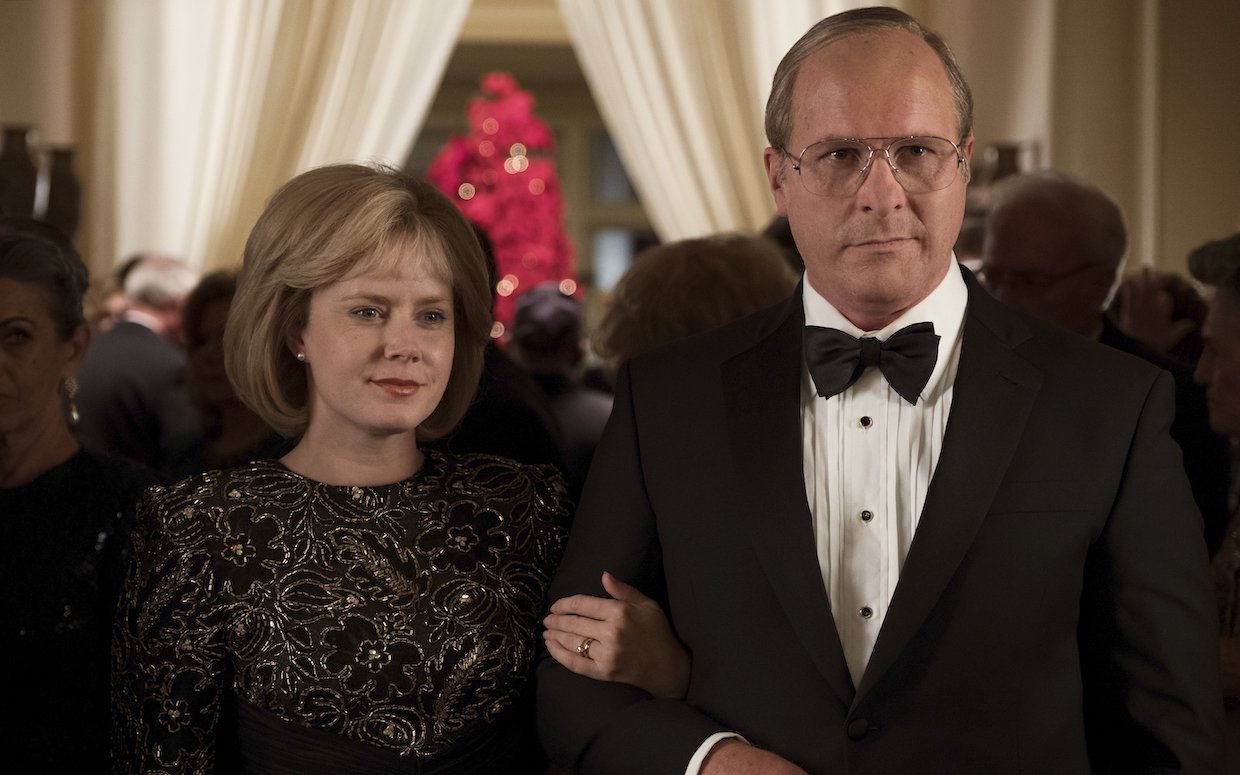
For starters, Vice is certainly worthy of its award nominations. I have seen some criticisms that it is cartoonish and simplistic and while I actually agree with this, it is also a brilliant and scabrous work of satire. Yes, it’s preaching to the liberal and left-winged Hollywood choir, but it definitely presents a fascinating snapshot of Dick Cheney’s rise from alcoholic wastrel to powerful political figure.

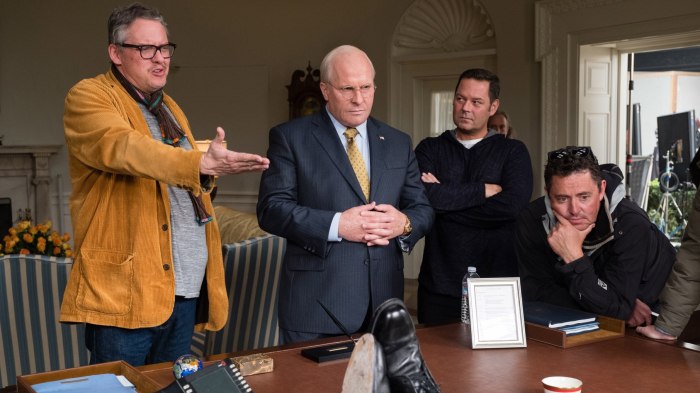
While I believe Roma (2018) will win the Best Film, I enjoyed Vice more from a stylistic, educational and emotional perspective. I was drawn into the murky world of American politics by McKay and his fantastic ensemble cast, and was compelled by the machinations of Cheney’s manipulative puppet-master to Bush’s marionette President. McKay’s film, while certainly one-tracked, powers along picking apart and satirising one of the most shadowy political figures of recent years.

BEST DIRECTOR CHANCES – 8/10

In terms of tone and narrative, McKay’s The Big Short (2015) was arguably a more cohesive film. Indeed, Vice is presented more as a non-linear monatge and sketch style recreation of key events in Cheney’s life. But I loved the style and McKay should be praised for his editing choices. He throws the veritable formalistic kitchen sink at the film using: direct address, Shakepearean monologue, cross-cutting montage, fake credits, voiceover, freeze frames, fake footage, stock footage, flashbacks, flash forwards, inter-titles, third-party narrator and many more stylised tropes. In my view his directorial bag of tricks are utilised without losing emotional impact too. While Alfonso Cuaron will probably win McKay certainly deserves kudos for enlivening his subject matter with such storytelling choices.

ACTOR IN A LEADING ROLE CHANCES – 10/10

Christian Bale should win. I have not seen Rami Malek, Viggo Mortensen or Willem Dafoe’s acting in their respective roles but Christian Bale is astonishing. Fair enough, he has taken a real person and delivered an emulation performance, but he also brings to Cheney to life with formidable cinematic style. Of course, the physical transformation could take the headlines but in terms of emotion and mentality he really raises the perfomance bar. Cheney may be an enigmatic character but Bale brings quiet menace, whispers and manipulation to the role. There is also a sly humour there too which makes Bale’s Cheney another memorable acting monster he’s created.

ACTRESS IN A SUPPORTING ROLE CHANCES – 8/10

Amy Adams is one of my favourite actors. Not quite a Lady Macbeth character, her Lynn Cheney pushes Dick forward mercilessly to make a better man of himself. She is the foundation and rock of their relationship and glues his life together when he faces health issues and political setbacks. Adams nails the role, and while Rachel Weisz will probably win for The Favourite (2018), Adams may finally get the Oscar she deserves.

ACTOR IN A SUPPORTING ROLE CHANCES – 5/10

Sam Rockwell is excellent in emulating George W. Bush but he only has a few scenes. While Rockwell dumbs down with the best of them I would have nominated Steve Carell instead. His Donald Rumsfeld, was a creeping, neurotic and conniving joy and definitely deserved the nomination in this category.

ORIGINAL SCREENPLAY CHANCES – 7/10

The film benefits from a sparky screenplay which keeps a potentially dull subject spinning along in an entertaining fashion. It takes a complex set of characters and scenarios, and despite simplifying to fit a leftist agenda, still constructs intelligent analyses of Cheney and Washington at large. Ultimately, Cheney is shown to be an opportunist and dangerous person who manipulated information and policy to finagle the USA and allies into a war for profit. Even worse he did so from the position of Vice President – boo Cheney! Boo! While McKay deserves praise for his brave creative choices, I would go for Paul Schrader’s exceptional First Reformed (2018) in the original screenplay category; Schrader deserves it more.

CONCLUSION

I am a big fan of satirical works such as: Private Eye, Yes Minister, Spitting Image, The Thick Of It, Veep and South Park. They seek to undermine and take critical shots at our leaders, illustrating the danger, absurdity and stupidity of those in power. They also, in an entertaining way, carry a message that those serving their country are often serving themselves more. Conversely, a film like Vice, however cartoonish or broad, still has the power to highlight the corruption and horror of a man like Cheney. While the script and direction are tonally scatter-gun, Bale’s incredible rendition, and the marvellous supporting cast, anchor the film and ensure this satirical ship rarely hits the rocks.

Mark: 9.5 out of 11

TO BOLDLY REVIEW #4 – STAR TREK – THE ANIMATED SERIES

STAR TREK – THE ANIMATED SERIES (1973 – 1974)

Created by: Gene Roddenberry

Directed by: Hal Sutherland (S1) and Bill Reed (S2)

Starring voices of: William Shatner, Leonard Nimoy, DeForest Kelley, James Doohan, Nichelle Nichols, George Takei, Majel Barrett

Executive producers: Gene Roddenberry, D.C. Fontana

Production: Filmnation Norway, Paramount TV Service

**MAY CONTAIN SPOILERS**

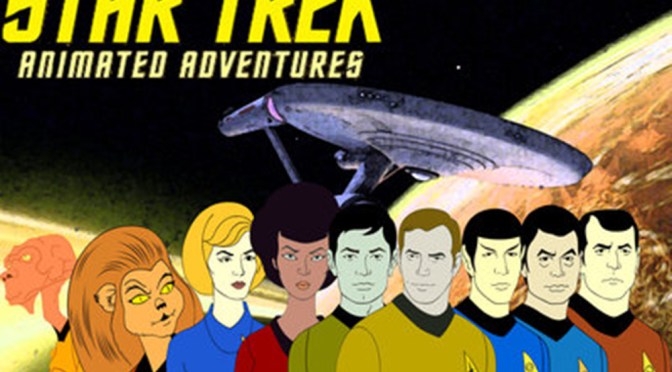
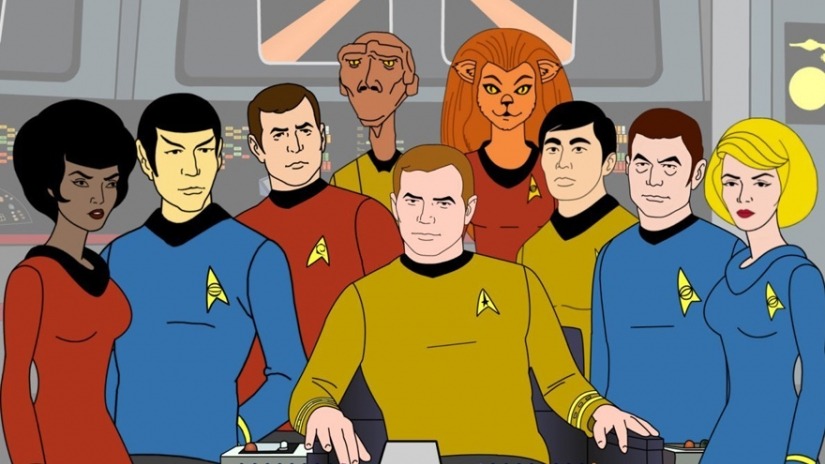
Running for a mere 22 episodes four years after the original Star Trek series was cancelled, the animated series can be seen as an unofficial fourth season to the live action show. While the animation was cartoon-like and rudimentary compared to the incredible CGI animation we have today, the scripts and stories were actually very sound. Many of the original cast members lend their voices too, so the show is not a mere cheap cash-in. Moreover, the stories featured the U.S.S. Enterprise boldly exploring space and beyond, capturing the dramatic essence of the original show.

While it was short-lived there some fantastic episodes in the animated series. The animation allowed for more expansive and weird-looking alien creatures, especially as the make-up and effects budgets would not be stretched as on the live action show. Some curiosities I noticed while watching were the inclusion in one episode of the “holodeck” or rec room. Plus, Kirk also referred to himself, rather weirdly, by his full name James Tiberius Kirk.

Many of the episodes had strong emotional and science fiction concepts. Although, given the twenty-four minute running time of each they often felt rushed to conclusion. Indeed, some of the stories could fit a feature film no problem and perhaps the recent reboot could have looked at some as a starting point; perhaps they did? Overall, I enjoyed the show but was surprised to read it won an Emmy in 1975 for Outstanding Entertainment – Children’s Series. Then again, it was certainly smarter than your average Hanna Barbera cartoon.

Of the twenty-two episodes I would say my favourite FOUR were:

Yesteryear (S1 – Ep. 2)

Spock must travel to the past to rescue his younger self from danger.

The Time Trap (S1 – Ep. 12)

The Enterprise and a Klingon battlecruiser are drawn into a space vortex and end up in a timeless dimension.

The Jihad (S1 – Ep. 16)

Kirk and Spock are summoned to retrieve a holy artefact which could ignite a galactic war.

The Counter Clock Incident (S2 – Ep. 6)

An unusual spaceship pulls the Enterpirse into a negative universe where time flows backwards.

GLASS (2019) – MOVIE REVIEW

GLASS (2019) – MOVIE REVIEW

Directed by: M. Night Shyamalan

Produced by: M. Night Shyamalan, Jason Blum, Marc Bienstock, Ashwin Rajan

Written by: M. Night Shyamalan

Starring: James McAvoy, Bruce Willis, Anya Taylor-Joy, Sarah Paulson, Samuel L. Jackson

Music by: West Dylan Thordson

**CONTAINS SPOILERS FROM SHYAMALAN’S PRIOR FILMS**

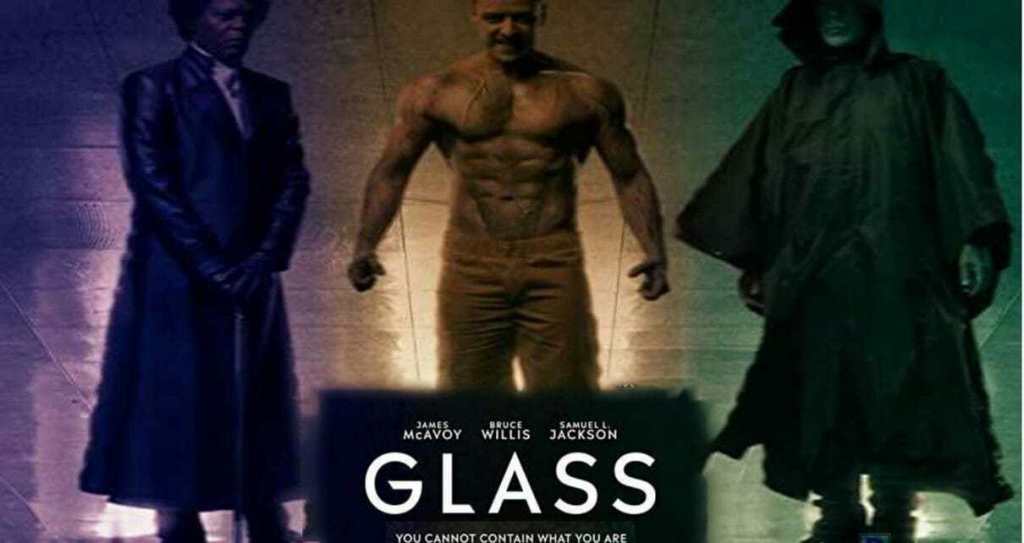
M. Night Shyamalan is arguably one of the most critically divisive directors working today. Not because his films are particularly controversial, but mainly because he is a risk-taker that tests the boundaries of genre expectations. He has so many different ideas and concepts that quite often his movies have back-fired spectacularly, however, when he gets it right his genre films are highly entertaining and compelling. Films such as: The Sixth Sense (1999), Unbreakable (2000), Signs (2002), and The Village (2004), were for me, brilliant genre films full of invention, suspense and wicked twists. Many people felt The Village stretched the limits of suspending disbelief, but it was a masterpiece compared to his filmic failures like: The Lady in the Water (2006), The Happening (2008) and The Last Airbender (2010).

I missed seeing the apparent disaster that was After Earth (2013), yet it was opined that Shyamalan returned to some essence of form with the horror film The Visit (2015). However, I still felt there were some dodgy creative decisions in that, such as the story-filler-white-middle-class-rapping kid in amidst a creepy thriller. Yet, with Split (2016), Shyamalan was back to his best, weaving an exploitational B-movie kidnap-plot with a searing psycho-performance from James McAvoy. The ending, which found Anya Taylor-Joy’s ultra resilient Casey fighting back against McAvoy’s twenty-plus split-personality maniac, then brilliantly linked the film to Shyamalan’s Unbreakable (2000). Therefore Glass (2019), becomes the third part of an unlikely trilogy; three films where Shyamalan strives to create his own universe and mythology within a more realistic superhero and super-villain world.

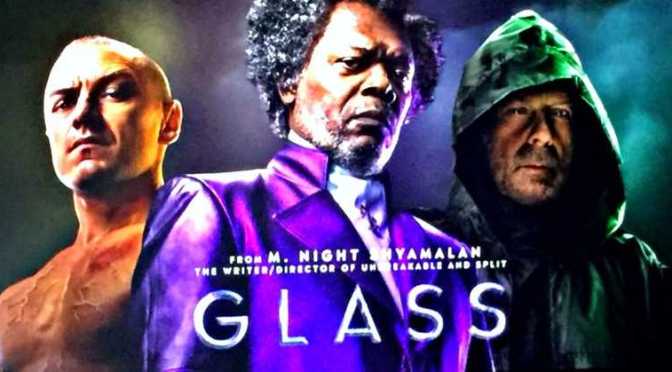
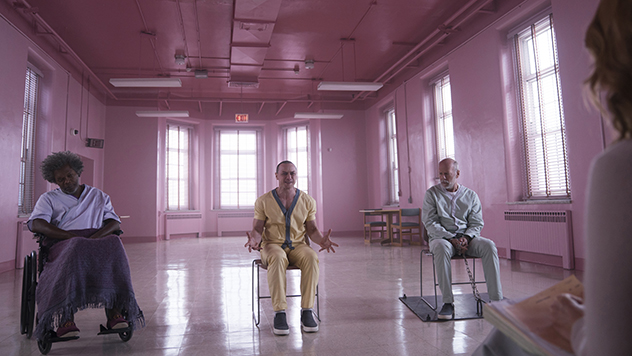
Glass starts three weeks after the end of Split  and opens with a terrific and bruising encounter between McEvoy’s dominant “Beast” personality and David Dunn’s (Bruce Willis) vigilante, daubed “The Overseer” by the media. Captured by authorities, the two are locked up and analyzed by Sarah Paulson’s seemingly sympathetic psychiatrist, Dr Ellie Staple. Enter Samuel L. Jackon’s Elijah Price, who is ALSO being held at the same mental health facility. I mean what could go wrong? Does the catatonic Price have villainous plans for The Horde and The Overseer? What do you think?

What I love about Shyamalan’s screenwriting, and this is something which he could equally be criticized for, is you can hear the cogs of contrivance creaking with every plot turn. Yet his ideas really capture your imagination and you genuinely want to know what happens next. Personally, as a fan of say Agatha Christie, I love theatrical exposition and clear “rules-of-the-world” mechanics. Shyamalan gets his three big-hitters in the same place and cinematic fireworks, however unlikely and full of plot-holes it may be, ensue. Woven within the fights, monologues and narrative misdirections are very clever meta-textual references to comic-book structures. This adds a welcome context to the denouement, which contains at least two incredible revealing twists.

Ultimately, I feel, unlike certain critics, that Glass is a fun and entertaining end to the trilogy. Yes, it tests the believability grid but Shyamalan must be applauded for striving, once again, toward some form of originality within his chosen genre.  It arguably goes down a deep rabbit hole at the end which is hard to get out of; but the impressive cast keep you in the light for the most part. James McAvoy is simply, once again, outstanding. Why hasn’t he been nominated for an Oscar? Who knows! Jackson and Willis are always solid performers, although I felt that Dunn’s character was slightly thrown away at the end. Anya Taylor-Joy also stood out and she is going to be a big star if she carries on delivering wide-eyed and steely performances such as these. Thus, Shyamalan gives us another big hit and something very different from the Marvel and DC superhero universes; something altogether more human.

Mark: 8.5 out of 11

STAN AND OLLIE (2018) – CINEMA REVIEW

STAN AND OLLIE (2018) – CINEMA REVIEW

Directed by: Jon S. Baird

Produced by: Faye Ward

Written by: Jeff Pope

Cast: Steve Coogan, John C. Reilly, Shirley Henderson, Nina Arianda, Rufus Jones, Danny Huston etc.

**CONTAINS HISTORICAL SPOILERS**

There are very few things as warming and pleasant as taking a trip down memory lane, recalling the fuzzy thoughts of a bygone childhood time when everything was laughter and escape. Escape in this instance came in the form of a black and white television box; while laughter came from watching arguably the greatest comedy double act in movie history on TV every early evening after school on BBC2. To be sure, my youth would have been a lot more depressing without Laurel and Hardy’s comedies to divert my mind away from family strife, school bullies and grey council estate existence.

Watching Stan Laurel and Oliver Hardy’s comedies was a formative part of my early years and I have continued to be a fan of there work to this day. It’s incredible that, when I was a kid, films made nearly forty years before had me in uncontrollable fits of laughter. Even now classics such as: Laughing Gravy (1931), Way Out West (1937), The Music Box (1932), Sons of the Desert (1933), County Hospital (1932), Busy Bodies (1933), Our Relations (1933), The Flying Deuces (1939) etc. to name just a few of their incredible output, retain the power to have me in stitches. Laurel’s skinny dumb man-child perfectly contrasted Hardy’s larger more confident, yet deluded leader of the two. Their comedy derived from their hapless misadventures, usually involving some new business venture or fish-out-of-water situation which resulted in anarchic chaos and silliness all round. But the comedy was not simple pratfalls but carefully constructed sight-gags, complex slap-stick set-pieces and constant battles with wives, girlfriends or authority figures.

After briefly establishing the characters of Stan and Ollie in Hollywood during 1937, the Jeff Pope scripted film moves to the United Kingdom in 1953. Here Laurel and Hardy’s star is on the wane and they have taken a music hall tour to try and make a few quid, while potentially getting a Robin Hood movie off the ground. With their health suffering, especially Hardy’s, due to excessive alcohol and food intake, the two begrudgingly go on tour while bitter acrimony simmers underneath. On top of that the tour is struggling due to a lack of promotion by Bernard Delfont and the whole thing looks like it could be a disaster. I must admit the film is not really that dramatic and stands more as a nostalgic tribute to the power of Stan and Ollie’s friendship and comedic relationship. Laurel is the workaholic always cracking wise and looking for the next gag, while Hardy is the more sociable and relaxed with an eye for the ladies and horses.

Jon S. Baird directs with a deft hand, yet he has two incredible actors in the lead roles. Steve Coogan and John C. Reilly are absolutely perfect as Stan and Ollie. Their mannerisms and comic timing in capturing the comedy duo are a joy to watch. Moreover, there’s a wistful pathos in the fact a great life journey is about to come to an end. Here, Coogan and Reilly bring a real warmth to the roles and as they resolve their tensions the over-riding emotion ultimately is love. As the tour continues they are joined by their wives, portrayed by Shirley Henderson and the scene-stealing, Nina Arianda. Their relationships at times reflects the hen-pecking women Stan and Ollie would find themselves chained to in their movies, but there’s clearly a lot of love on screen too. Lastly, despite their health issues Stan and Ollie are born entertainers, fully committed to the ethos that the show must go on.

Overall, Stan and Ollie is a wonderful paean to two of the greatest comedic actors that ever lived. It’s gentle in pace and drama but anchored by two mesmerising performances by Coogan and Reilly. Despite the low budget, the period locations and costumes are brilliantly designed, and I especially enjoyed seeing many recognizable London locations. The biggest highlight though throughout is the hilarious re-enactments of many of Laurel and Hardy’s famous sketches, songs and movie moments. These took me back to my youth and days of watching Stan and Ollie on that small black and white box at home, laughing my silly head off without a care in the world.

Mark: 8.5 out of 11

COLETTE (2018) – CINEMA REVIEW

COLETTE (2018) – CINEMA REVIEW


Directed by: Wash Washmoreland

Produced by: Elizabeth Karlsen, Pamela Koffler, Michel Litvak and Christine Vachon.

Screenplay by: Richard Glatzer, Rebecca Lenkiewicz and Wash Washmoreland

Cast: Keira Knightley, Dominic West, Eleanor Tomlinson, Denise Gough etc.

**CONTAINS HISTORICAL SPOILERS**

In a coincidental twist of cultural fate I only recently became aware of turn-of-the-century novelist, libertine, bohemian and society trailblazer that was Sidonie-Gabrielle Colette. I’d been listening to a brilliant audio-documentary by Adam Roche, which was about Audrey Hepburn’s early life prior to becoming a Hollywood star. Interestingly, it was an elderly Colette who spotted the then unknown Helpburn filming a supporting role in Monte Carlo. Furthermore, it was Colette who insisted Hepburn was, despite her lack of stage experience, the ideal person to portray her famous creation Gigi on Broadway. Thus, even in later life Colette was to the fore of the cultural aesthetic; both a major talent and celebrity ripe for respect and admiration.

From her Claudine (1900) novels, to La Vagabond (1910) to Gigi (1944), Colette was a prolific writer of many books and short stories. She was also an actor, dancer and mime, who seemingly delighted in confronting the stuffy middle and upper classes of French society. Unashamed by on-stage nudity and choice of sexual parters, Colette had love affairs with both men and women. Not only did she break down sexual taboos, she also furthered gender equality and would be nominated for the Nobel Prize for Literature in 1948.

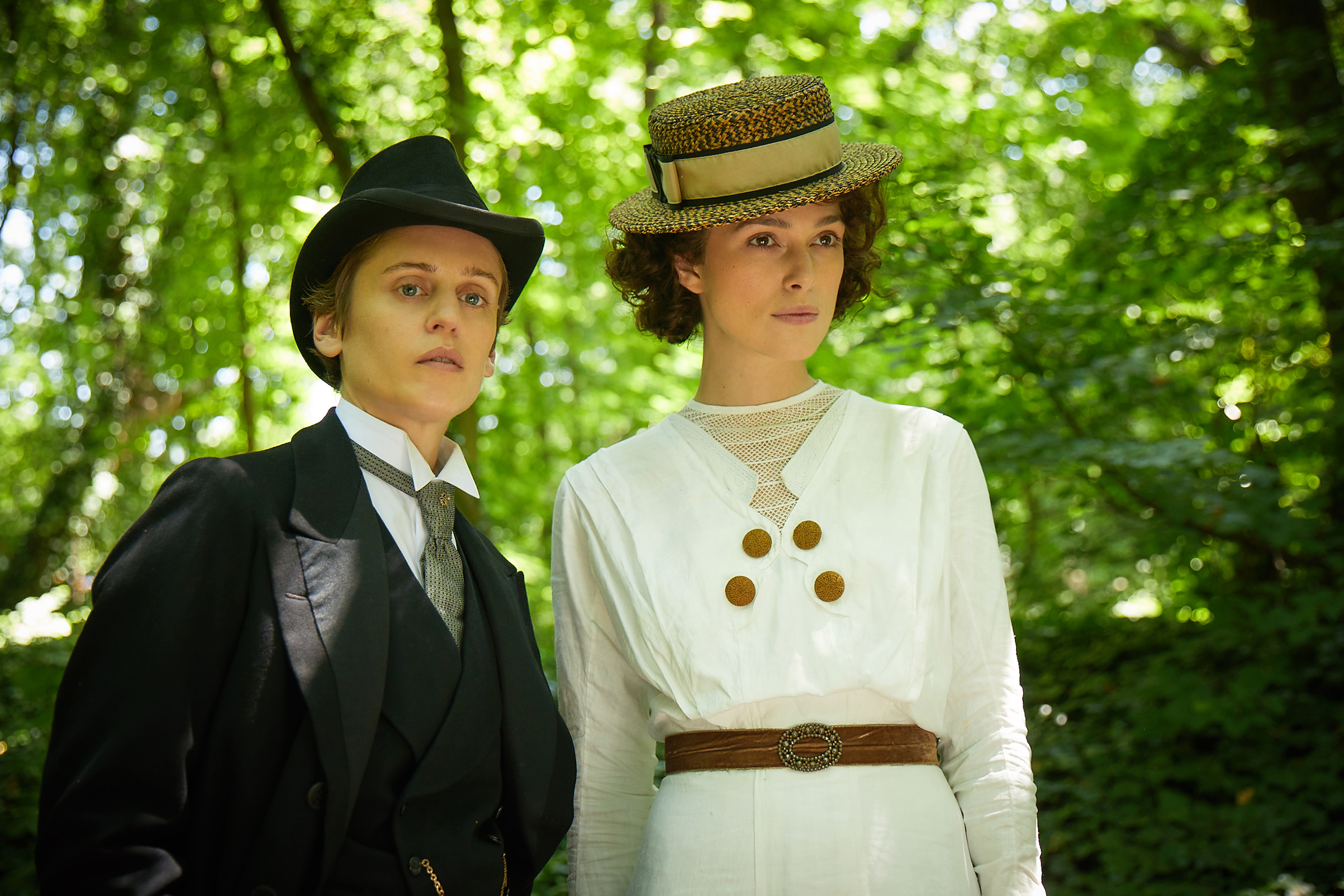
Denise Gough stars as Missy and Keira Knightley as Colette in COLETTE
Credit: Robert Viglasky/Bleecker Street

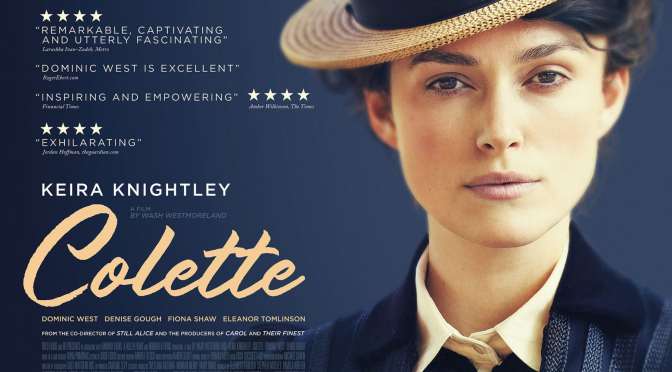
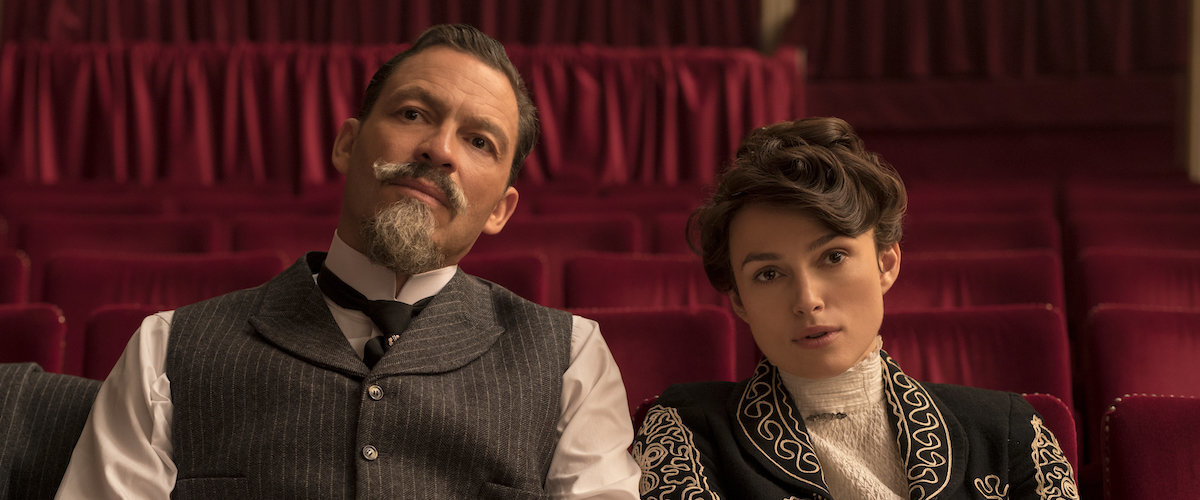
The cinematic version of her life finds Keira Knightley portraying the titular character with a committed energy, verve and magnetism. Knightley has never been the most nuanced of actors but she is a striking movie star, delivering a fine performance here. Likewise, the ever reliable Dominic West is on excellent form as Henry Gaulthier-Villars – AKA ‘Willy’ – Colette’s first husband. West represents him as a charismatic cad with an insatiable lust for women, gambling and booze. While able to wow publishers with his sales pitches he relies on others to do the writing, while happily wasting the advances and royalties.

Willy sweeps the naive country girl Colette off her feet and introduces her to the artistic and literary circles of Paris. As such it is his connections which enable Colette to gain her first publishing success. However, it is Willy who takes all the plaudits, publishing under his own name. This authorial switch inevitably creates a dramatic schism as Colette fights for her name to be on the books. Willy refuses, highlighting both his own egomania and the sexist prejudice of the day. Like the similarly plotted biopic Big Eyes (2014), this film illustrates the nefarious nature of dominant masculinity; however, it also made me consider whether the artists would have been successful if it HADN’T been for these dastardly blokes. Who can tell? One would hope the talent of said artists would shine through come what may.

Structurally, Colette is very linear representing a “greatest hits” of how Colette progresses creatively, romantically and sexually. As aforementioned Knightly gives a fearless performance and the period setting is beautifully evoked within an excellently directed production. My only criticism is a fair amount of time was spent on Colette’s sexual exploits when I would have preferred more drama relating to her authorship battles with feckless Willy. Nonetheless, as period biopics go the film stands as a stylish and admiral tribute to a trailblazing feminist and literary icon.

Mark: 8 out of 11

MY BRILLIANT FRIEND (2018) – HBO / SKY TV REVIEW

MY BRILLIANT FRIEND (2018) REVIEW

Based on: My Brilliant Friend by Elena Ferrante

Directed by: Saverio Costanzo

Written by: Elena Ferrante, Francesco Piccolo, Laura Paolucci, Saverio Costanzo

Starring: Elisa Del Genio, Ludovica Nasti, Gaia Girace, Margherita Mazzucco, Anna Rita Vitolo, Luca Gallone, Imma Villa, Antonio Milo, Alessio Gallo etc.

**MAY CONTAIN SPOILERS**

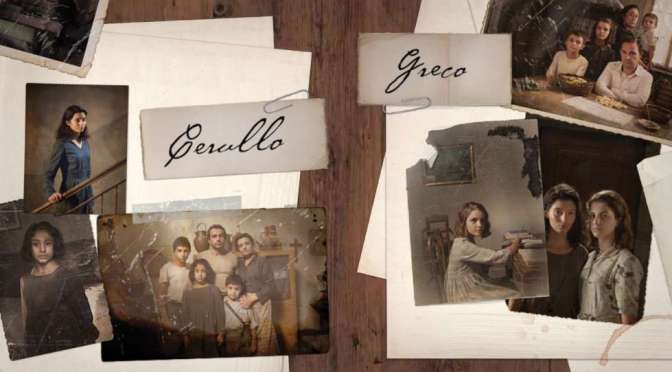
Image result for my brilliant friend

The quality of Italian produced TV dramas in recent years has been spectacularly high. I devoured three bloody seasons of the macho-gangster brutality of Gomorrah (2014 – 2017) with both shock and enthusiasm. I subsequently imbibed avidly the magisterial and philosophical depth of Paulo Sorrentino’s The Young Pope (2016). Thus, expectations were equally raised by HBO’s production of My Brilliant Friend; my confidence eventually rewarded with a moving, fiery, sensual, violent and intelligent drama about friendship and family rivalries.

Based on the first of four Neapolitan novels written by Elena Ferrante, the drama charts the lives of various families who inhabit a 1950s Naples neighbourhood. It’s a traditionally working class environment, set amongst run down blocks with cars travelling along dusty roads which lead to the city, country or sea. While encompassing a large ensembel cast, the story focusses on two specific characters: “Lenu” Greco and “Lilu” Cerullo. Forging a powerful friendship in their primary school years, the narrative unfolds over a ten-year period until they are sixteen. Their lives become entwined in family dramas, fights, romances and death, as both characters rival and connect with each other and those in the neighbourhood.

Image result for my brilliant friend

Class differences underpin the various plots and sub-plots with Lilu displaying incredible academic acumen but held back as her family are too poor to send her to school. Galvanised by competition Lenu pushes herself to get ahead of her friend and despite such division the two are drawn together when facing seemingly insurmountable emotional odds. As such, their friendship and loyalty toward each other drives the story powerfully. Lilu, while contrary and irritating at times, is passionate and principled, while Lenu is more passive and demure. Yet, together they form a resilient whole.

The performances from the cast are brilliant, while the production overall is a thing of beauty. Max Richter’s score is sumptuous and haunting, with the era, setting and locations all wonderfully evoked. But it’s not nostalgia for happier times, rather an honest examination of humanity and rites of passage struggle through puberty and into adulthood. While the sun shines brightly in Naples, these are ultimately hard times. The many stories unfold in sand-hit tenement blocks where men, women and children struggle to make ends meet. Moreover, the show prefaces sisterhood as a means to overcome the misogyny and sexual exploitation of the era.

Toxic masculinity dominates throughout, with men represented as either: sexual predators, gangsters, wife-beaters and Catholic Priests. There are some positive male role models and there is a whiff of solidarity in the air as Communist doctrine is presented; however, there is no escape for the working classes other than to die or struggle onwards. Lastly, the only way out for Lenu and Lilu is sticking and fighting together; educating themselves academically and emotionally to grow and gain the experience necessary to cope with the slings and arrows of Neapolitan life.

Mark: 9 out of 11

BANDERSNATCH (2019) – BLACK MIRROR / NETFLIX REVIEW

BANDERSNATCH (2019) – BLACK MIRROR REVIEW

Directed by: David Slade

Produced by: Russell McLean

Written by: Charlie Brooker

Cast: Fionn Whitehead, Will Poulter, Asim Chaudhry, Craig Parkinson, Alice Lowe etc.

**SPOILER FREE**

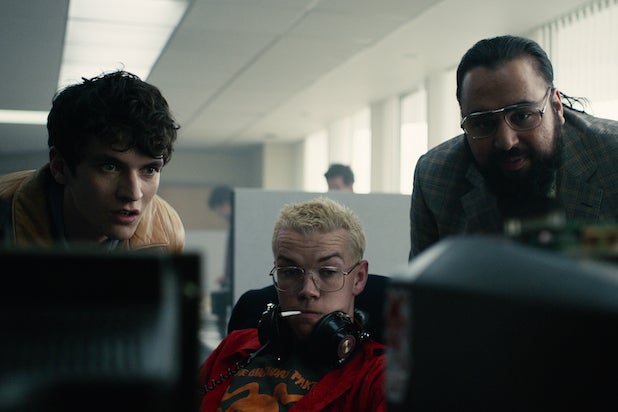
Image result for bandersnatch

Choices, choices, choices! We all have so many choices to make every day. Some simple; some much tougher. We didn’t have any choice over whether we were born, but now we are here there’s a myriad of daily selections we get to make. Do we get out of bed? Do we eat? Do we wash? Do we find the strength to get in our car or on the train and face the horrors of employment? Do we engage with violent abandon by calling the driver who cut us up at a roundabout, “a wanker!” Do we wear our clean underwear today or re-use yesterdays? Do we have a salad or burger for lunch? Do we start smoking again? Do we regret having children? Do we tell our partner we love them? Do we have the last beer in the fridge? Do we try and change our life? Do we just give up? Do we watch the new drama box-set or a Netflix special by Black Mirror creator Charlie Brooker. So many tough choices!

Thus, you’ve had a shitty day with so many choices made and you sit down in front of the television in the hope you can switch off your brain. But that darned Brooker won’t let you. The televisual provocateur and his production team are cruelly requesting, for your entertainment, that you make MORE choices. If you’re young enough to remember those: “Go to page 47 to see if your spell vanquished the demon – or go back to page 666 to find out if you are the conqueror of the Universe”, type books, then Bandersnatch is THAT in television form. You may also be used to multiple choice computer games the likes of which I played myself as a kid on the Spectrum 128k computer. This is also the inspiration for Brooker’s twisted vision. But is it any good? I would choose YES! Bandersnatch is dark, hallucinatory and involving “fun”.

Image result for bandersnatch

The story/stories are set rather aptly in 1984. Our main protagonist is a grieving and troubled teenager, Stefan Butler (Fionn Whitehead). Stefan is obsessed by a “choose your adventure” book called Bandersnatch.  Inspired to turn it into a computer game, he soon descends down a veritable black hole mentally, physically and emotionally. The fact that we are vicariously responsible for the characters’ journey create a real sense of dread, doubt and suspense. It’s very clever and immersive and no doubt the writing of it must have been a tortuous process.

While it may not be for some I was engrossed by the show as it felt at times I was living in a Philip K. Dick story. Dick’s novels are often hallucinatory and dream-like with simple yet devastating prose. They deal with reality, alternative reality and beyond reality. You’re often in a place with unreliable narrators or confused protagonists who are existing in some real world, imagined or manufactured nightmare. Paranoia, anxiety and depression infect Dick’s world and Brooker captures that vibe brilliantly in Bandersnatch. However, it’s not also without humour too, albeit incredibly dark sarcastic humour.

Brooker and his filmmaking team achieve a style over substance triumph with Bandersnatch. I have only gone through Stefan’s narrative once but it gripped me from start to finish as an experience. The drained, urban and suburban 1980s colour and council-estate-grey look suited the psychotic breakdown of the main character. Nonetheless, at times, the dizzying twist of choices did take away from the emotional journey of the character. At one point I was so in the meta-hole the whole trip made me feel quite queasy. Having said that, I will be going back into this meta-adventure again; after all, the choices like in life seem endless.

Mark: 9 out of 11

RESOLUTION (2019): DR WHO NEW YEAR’S SPECIAL REVIEW

RESOLUTION (2019): DR WHO SPECIAL TV REVIEW

Directed by: Wayne Yip

Written by:  Chris Chibnall

Cast: Jodie Whittaker, Mandip Gill, Bradley Walsh, Tosin Cole, Charlotte Ritchie, Nikesh Patel etc.

Produced by: Nikki Wilson

Executive producer(s): Chris Chibnall, Matt Strevens, Sam Hoyle

Music composer: Segun Akinola

**SPOILER WARNING**

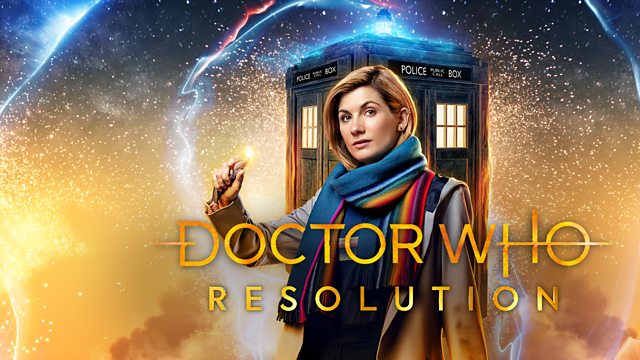
Image result for DOCTOR WHO RESOLUTION

And so Jodie Whittaker’s first raft of television adventures as the Gallifreyan Time Lord / Lady came to an end with this New Year’s Day Special. Aptly entitled Resolution it offered lots of intrigue and action and invention and one of the worst kept TV trailer secrets of recent times.

Opening with an impressive battle sequence involving humans defeating some unknown and villainous beast in the 9th Century, we then flash forward to the present wondering whether the creature would be seen again. Of course it would! It’s a fine opening and very cinematic, creating both a sense of awe and suspense, while owing much to the Marvel, DC Universes and Lord of the Rings type fantasy genres. In the present we are then introduced to flirtatious archaeaologists Lin and Mitch, who suddenly unearth that which has been buried in the earth for centuries. So far: so Quatermass!

Image result for DOCTOR WHO RESOLUTION CHARLOTTE RITCHIE

When the archaeologists’ find brings to life a slimy, tentacled and horrific monster from the darkness, the Doctor, Tardis and ubiquitous gang are not too far behind. The monster itself is an (SPOILER WARNING) unshelled Dalek who has been woken from centuries of slumber with anything but peace and goodwill on his or her mind. I’m not sure if Dalek’s are gender specific but probably best to keep within the politically correct rules the show rightly follows and projects.

With all the back-story and exposition out of the way, what follows is essentially a Terminator: Judgment Day (1991) type pursuit plot. The Dalek gains control of Lin and envelops her mind in order to carry out its’ evil bidding. Here Charlotte Ritchie is absolutely brilliant in her role as she valiantly battles the Dalek’s nefarious battle plans. Likewise I felt that Whittaker’s Doctor was on good form in Resolution; the Dalek threat really galvanises the Doctor’s mettle, as this episode felt more like some of the classic episodes of the past.

Overall, I really enjoyed this fast-paced narrative and Chris Chibnall’s script has a lot of fun with this solo Dalek as they re-shell, re-arm and attempts to exterminate everyone in its’ path. Not so successful is the sub-plotting resolution of Ryan’s relationship with his father. It worked out but it slowed the main action story down unnecessarily and there was some right old clunky dialogue in a cafe scene which really added nothing other than some mild emotional turmoil for Ryan. However, Yas suffered even more with very little to do character wise; while Bradley Walsh again really shone as the chirpy cockney Graham. Nonetheless, overall it was great bit of Dr Who entertainment to start the New Year.

Mark: 8.5 out of 11

Thoughts on Cinema and Filmmaking