Tag Archives: 1970s

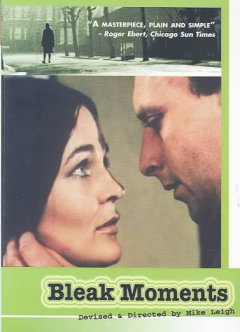
Classic Film Review: Bleak Moments (1971) plus Mike Leigh Q & A (Prince Charles Cinema, London.)

Classic Film Review: Bleak Moments (1971)

Directed by Mike Leigh

Written by Mike Leigh – Based on 1970 stage play by Mike Leigh

Produced by Leslie Blair

Cast: Anne Raitt, Sarah Stephenson, Eric Allan, Joolia Cappleman, Mike Bradwell, Donald Sumpter etc.

Cinematography by Bahram Manocheri

Camera Assistant: Roger Pratt

Edited by Leslie Blair


One of the quiet yet profound joys of cultural life is finding a creative or sporting figure—or team—whose journey you follow from an early age, growing alongside their work as it evolves. Whether it’s the cinematic brilliance of the Coen Brothers or Mike Leigh, the ever-shifting energy of Primal Scream, or the lifelong, often agonising commitment to Tottenham Hotspur FC, these long-term relationships offer a deep sense of continuity. They become personal landmarks in our emotional and cultural landscapes, threading through decades of change and grounding us with shared history, joy, and—especially in Spurs’ case—a touch of heartache.

I was born just a year before Mike Leigh’s Bleak Moments debuted in 1971, and it became a defining cultural touchstone for me. First encountering it in the early 1980’s, I was captivated by its raw honesty and quiet power—a film I returned to again and again on that solid-format VHS tape over the years. It marked the beginning of a lifelong relationship with Leigh’s work, a body of cinema that has shaped and shadowed my own personal and cultural journey. That connection endures to this day, most recently renewed with his 2025 release, Hard Truths—a testament to a career and vision that continue to evolve with undiminished integrity.


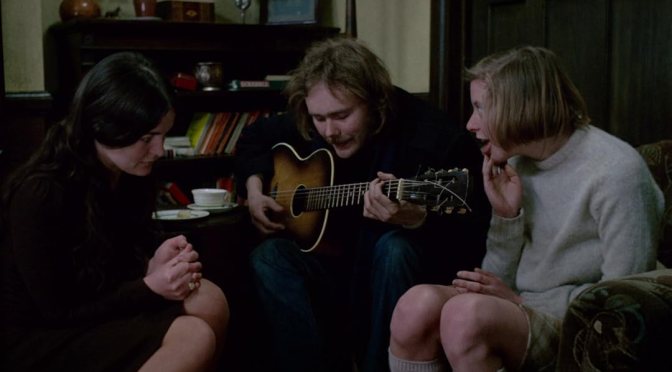
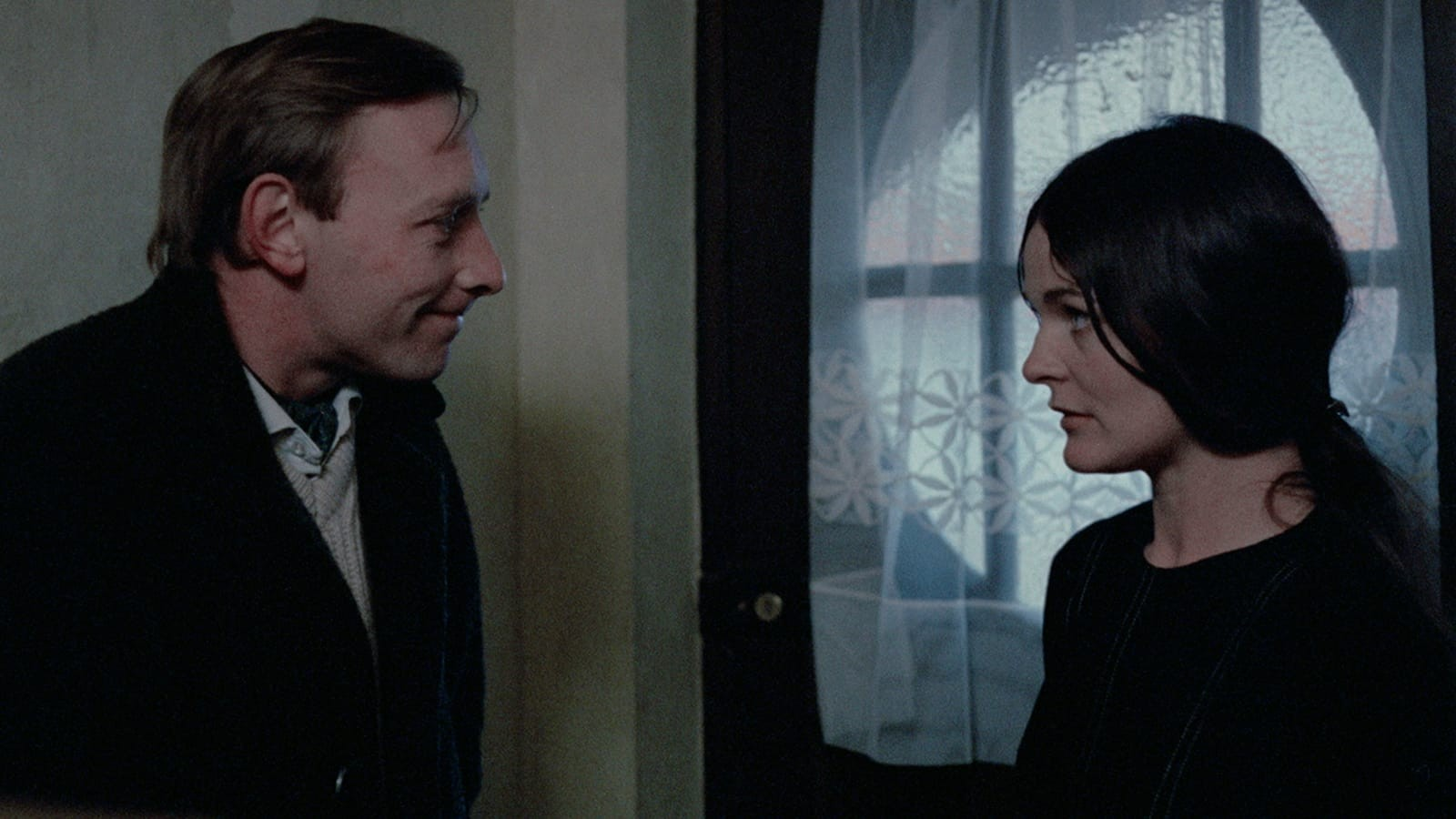
Bleak Moments centres on Sylvia (Anne Raitt), a lonely, introspective young woman navigating the quiet desolation of her suburban life while caring for her mentally challenged sister, Hilda (Sarah Stephenson). Trapped between duty and desire, Sylvia reaches tentatively toward human connection—most notably with a shy schoolteacher—yet every encounter is marked by awkward silences and emotional hesitations. Mike Leigh crafts a delicate, unflinching portrait of isolation and unmet longing, where the most powerful moments are found in what remains unsaid. Indeed, I would say it would have a powerful influence on awkward cinema or television such as Gervais and Merchant’s, seminal show The Office.

I hadn’t seen the film for twenty years and in a packed Prince Charles Cinema, what struck me was how Bleak Moments, while raw and unvarnished in style, unfolds with a beautifully episodic structure that gently accumulates emotional weight. Each scene offers a quiet vignette—moments of everyday awkwardness, tentative exchanges, and domestic stillness—that together create a deeply human portrait of loneliness and restraint. Despite its sombre tone, the film is laced with dry, observational humour and a deep sense of pathos, revealing the absurdity and ache of unspoken lives.

Mike Bradwell’s Norman and his dryly hilarious songs, and the most awkward of “romantic” dinner scenes in the Chinese restaurant just stood out to me as deeply funny. Raitt’s performance too is a masterclass of comedic understatement. Overall, these qualities—emotional nuance, character-driven storytelling, and a commitment to realism—would become defining hallmarks of Mike Leigh’s oeuvre, already fully formed in this striking debut. Finally, it was great to see and hear from Leigh, now in his eighties, answering some great questions with sharp wit and batting away some stupid ones too with his usual intelligence and droll honesty. Leigh remains a hero in my life’s cultural journey.


Cinema Review: I’m Still Here (2024) – A searing portrait of resistance in the face of military tyranny!

Cinema Review: I’m Still Here (2024)

Directed by Walter Salles

Screenplay by Murilo Hauser and Heitor Loreg

Based on I’m Still Here by Marcelo Rubens Paiva

Produced by Maria Carlota Bruno, Rodrigo Teixeira and Martine de Clermont-Tonnerre

Main cast: Fernanda Torres, Selton Mello, Fernanda Montenegro, Valentina Herszage, Luiza Kosovski, Barbara Luz, etc.

Cinematography by Adrian Teijido

*** MAY CONTAIN SPOILERS ***


On March 31, 1964, the Brazilian military, with support from the United States and segments of the civilian population, overthrew the government of President João Goulart in a coup d’état. Goulart, a left-wing president who had been in power since 1961, faced rising opposition due to his policies that included land reforms and more progressive labour laws. These policies alarmed conservative sectors of society, including the military, business elites, and parts of the middle class, who for many feared the spread of communism in the context of the Cold War. From reports I have read, the military’s move was framed as a necessity to prevent Brazil from descending into a left-wing revolution, but the coup marked the beginning of a brutal 21-year period of military dictatorship. Be careful what you wish for.

Under the military regime (1964–1985), Brazil saw widespread censorship, repression of political dissidents, the establishment of a climate of fear, and the use of torture against suspected leftist militants and activists. The military government justified its actions as necessary to combat communist insurgency, but its reign was characterised by systematic violations of human rights. The regime implemented institutional acts that curtailed democratic freedoms, silenced political opposition, and controlled the media, all while claiming to defend the country from Marxism. The dictatorship lasted until 1985, ending when the military handed power back to a civilian government, but the effects of this period are still deeply felt in Brazilian society, as many families continue to search for the truth about the victims of torture and forced disappearances during the dictatorship.


Yet, while the film may not explicitly focus on the 1964 coup or the military dictatorship. I’m Still Here (2024) addresses the aftermath and themes of identity, resistance, and survival in the face of oppressive systems. Director, Walter Salles, uses the personal as a lens through which broader social and political issues are explored. One could consider how the legacy of fear, control, and the impact of a regime still reverberates in contemporary Brazil.

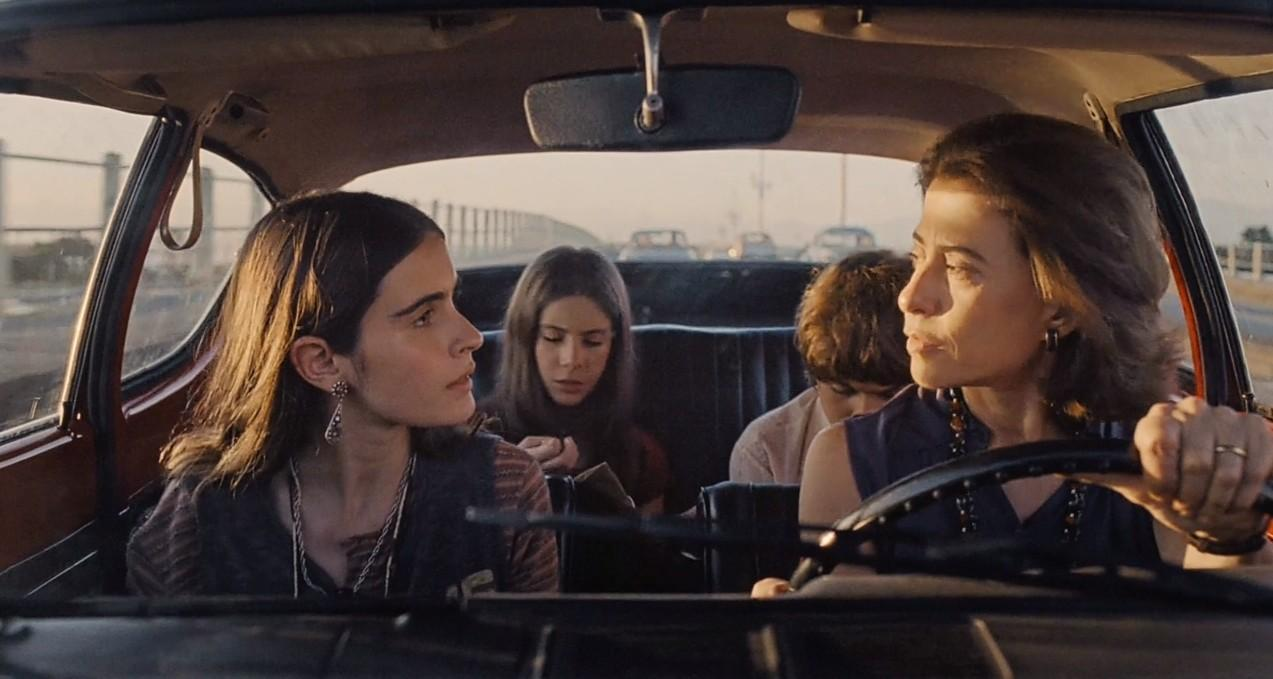
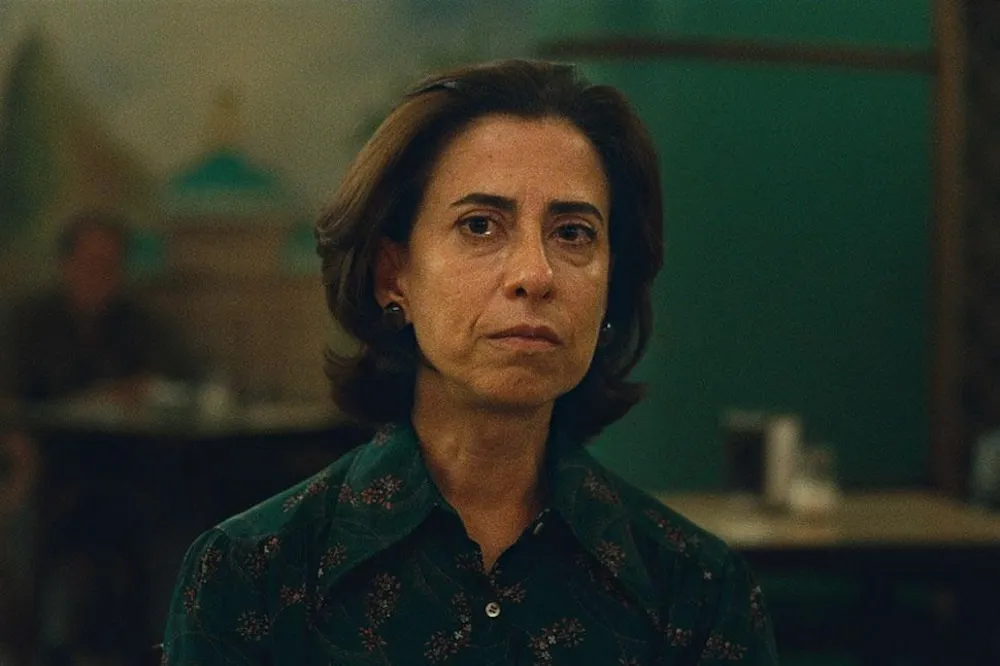
In I’m Still Here (2024), the filmmakers take a distinctive approach to the thriller genre by moving away from the typical tropes associated with suspense-driven narratives. Instead of focusing primarily on action or a series of dramatic plot twists, the film shifts its attention toward a more intimate, personal, and familial story. There is suspense and tension, but it is more under-stated and subtle. This departure from overt political thriller conventions allows the film to delve into the emotional and psychological terrain of its characters, with a particular focus on the matriarch, Eunice Paiva, played by the powerhouse Fernanda Torres.

Rather than relying on external action or traditional thrills, I’m Still Here (2024), centres around Eunice’s emotional journey and the impact of her environment on her family when her husband, Rubens Paiva (Selton Mello) is taken away by what may-or-not-be the military. The film positions Eunice as the central figure whose personal evolution drives the narrative, illustrating the profound effects of her choices and relationships on her family. Salles skilfully weaves family celebrations, events, and home movie footage to create a swell of warmth amidst the fear and paranoia created when Rubens disappears.


Eunice Paiva’s character is given a powerful depth in I’m Still Here (2024), with Fernanda Torres delivering a standout performance. Rather than positioning Eunice as a victim or a purely heroic figure, the film complicates her character, showing her as a multifaceted individual. Eunice’s actions are driven not by external thrills or pressures, but by the emotional and psychological burdens she carries as a matriarch, dealing with familial responsibility and navigating the complexities of her relationships with her children, spouse, and extended family.

Torres’s portrayal emphasises Eunice’s inner conflict—her desire to protect her loved ones, while also grappling with personal loss, regret, and the external societal forces that shape her world. Constantly denied answers and closure by the authorities, Eunice refuses to give in and continues to fight for decades, even when the military rule is over. The emotional intensity of Eunice’s character arc is one of the most compelling aspects of the film, as Torres’s performance brings a deep authenticity to the role, grounding the story in real, human struggles rather than sensationalised action.

By moving away from traditional thriller tropes, I’m Still Here (2024) creates a more reflective and intimate cinematic experience. Rather than simply delivering suspense through external action, the film explores the internal tensions of its characters and their relationships, magnifying the quiet, profound impact that such personal struggles can have on a family. Having lived through such adversity the Paiva family would stand proud in the face of this evil regime, overcoming all that is thrown at it. I mean, there is so much evil in this world and throughout history, that Eunice Paiva and similar quiet heroes are to be cherished. In short: why can’t such admirable individuals run the often horrible world we live in.

Mark: 8.5 out of 11


SHUDDER REVIEW: LATE NIGHT WITH THE DEVIL (2023)

SHUDDER REVIEW: LATE NIGHT WITH THE DEVIL (2023)

Written and directed by Colin Cairnes and Cameron Cairnes

Produced by Mat Govoni, Adam White, John Molloy, Roy Lee, Steven Schneider and Derek Dauchy

Cast: David Dastmalchian, Laura Gordon, Ian Bliss, Fayssal Bazzi, Ingrid Torelli, Rhys Auteri, Georgina Haig, and Josh Quong Tart

Cinematography: Matthew Temple

*** MAY CONTAIN SPOILERS ***


Some years ago I wrote an article about how I dislike the found footage sub-genre and that article can be found here. Occasionally, found footage is used well such as in Creep (2014) with Mark Duplass or REC (2007) or Chronicle (2012). Now you can add Colin Cairnes and Cameron Cairnes, Late Night With the Devil (2023) to that list of found footage films I actually enjoyed.

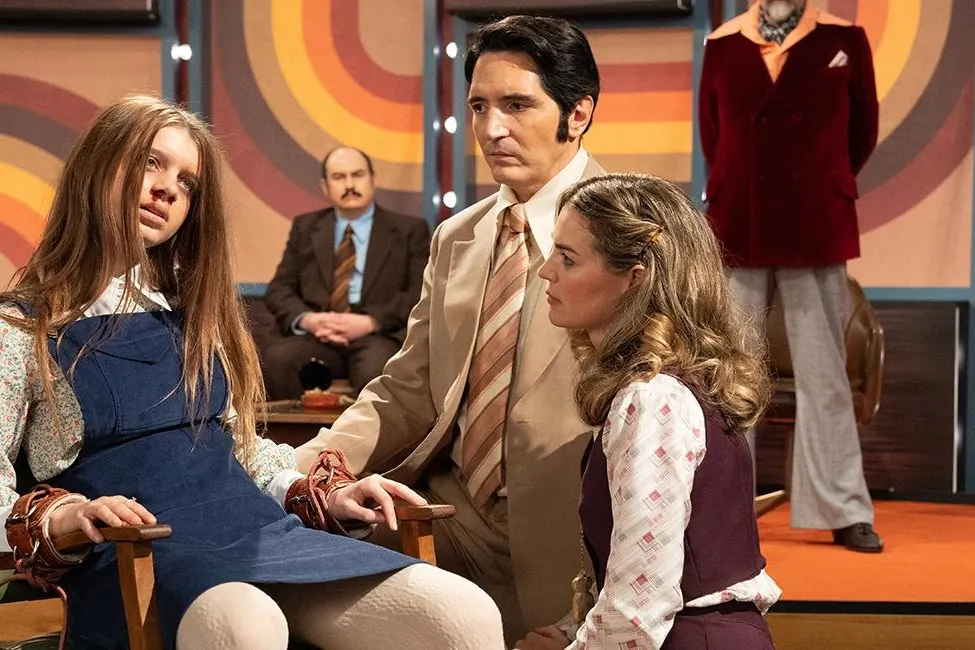
Technically, one could argue it isn’t really found footage and it negates such films often “amateurish” filming methods, with a truly stylish rendition of 1970’s television chat shows. However, we are asked by the narrator to view “never-before-seen” images and sounds from a previously unreleased and infamous TV chat show presented by ‘Night Owls’ host, Jack Delroy (David Dastmalchian). So, found footage it is!


David Dastmalchian is absolutely fantastic in his role as ambitious but desperate to be number-one chat show host, Jack Delroy. Often cast in supporting roles he now grabs the chance to become much more than that scene-stealing character actor. Delroy is not unlikable, but his arrogance and ambition dominate his personality. So much so, and despite his grief at losing his wife to cancer, he is prepared to allow all sorts of creepy and inappropriate situations unfold in his desperate search for TV ratings.

Delroy pits a dubious psychic Christou (Fayssal Bazzi) against skeptical former magician Carmichael the Conjurer (Ian Bliss), before asking parapsychologist author June Ross-Mitchell (Laura Gordon), and her subject Lilly D’Abo (Ingrid Torelli) to contact a demonic presence called ‘Mr Wriggles,’ live on television. Even after Christou is rushed to the hospital and Lilly contorts and spits out growling obscenities, Delroy decrees the show must go on. The Cairnes Brothers then continue to ratchet up the tension and horror to a deadly and shocking ‘Night Owls’ televisual denouement.

With echoes of the recent Inside No. 9 (3×3 quiz show episode) and BBC show Ghostwatch (1992), and of course The Exorcist (1973), Late Night With the Devil (2023) is one of the most enjoyable horror films I have seen in sometime. The 1970’s period setting and TV studio location is impressively recreated by the fantastic production team, especially on a relatively low budget. Arguably, the plot, once you dig down into it lacks emotional depth, however, the pacy and darkly funny screenplay more than compensates for this. Overall, the film’s style, design, direction and a commanding performance from Dastmalchian ensure Late Night With the Devil (2023) is essential viewing for all horror fans.

Mark: 9 out of 11


CINEMA REVIEW: THE IRON CLAW (2023)

CINEMA REVIEW: THE IRON CLAW (2023)

Directed by Sean Durkin

Written by Sean Durkin

Produced by: Tessa Ross, Juliette Howell, Sean Durkin, Angus Lamont, Derrin Schlesinger

Cast: Zac Efron, Jeremy Allen White, Harris Dickinson, Maura Tierney, Stanley Simons, Holt McCallany and Lily James.

Cinematography: Mátyás Erdély

*** CONTAINS SPOILERS ***


According to research on the internet the biggest killer of men in the UK under fifty-years of age is suicide. Nationally and locally seventy-five percent of those that die by suicide are men, with the highest numbers being forty-five to fifty-four years of age. In the USA, reports show suicide is the second leading cause of death among Americans ages ten to thirty-four, and the fourth leading cause of death in the thirty-five to fifty-four age group. I personally have known two close male friends who have taken their own lives in the last decade.

In addition, mortality rates for professional wrestlers are reportedly up to 2.9 times greater than the rate for men in the wider United States population. Statistics also show that the early deaths of professional wrestlers were significantly higher than that of athletes in other sports. Potentially due to the consistent mental and physical detriment as well as a proclivity toward higher rates of cardiovascular disease, depression and drug addiction. Thus, with this in mind, Sean Durkin’s film, The Iron Claw (2023), a profile of the Von Erich family, while full of exciting wrestling action, is NOT one of those generic feelgood underdog sports dramas. It is however a complex exploration of masculinity, familial pressure, sports politics, suicide, grief, religion, addiction, love, and the resilience of the human spirit.


A prologue establishes Jack “Fritz” Von Erich (Holt McCallany) as an uncompromising professional wrestler in the 1960s with a signature move called the ‘Iron Claw.’ A number of years later Von Erich Snr. is a wrestling promoter who runs successful WCCW events in Texas. His unique selling point for the shows is that he has four sons, Kevin (Zac Efron), Kerry (Jeremy Allen White), David (Harris Dickinson) and Mike (Stanley Simons), who throughout the narrative, all test themselves to the limit in the wrestling ring.

While it is certainly a strong ensemble cast, the main focus of Durkin’s compelling screenplay is Zac Efron’s, Kevin. A strong, fast and muscular athlete in the ring, Kevin, however, is not a confident personality out of it. He, and his brothers, live in the shadow of his domineering father, who controls and dictates to those around him. Jack’s resentment at not winning the NWA Worlds Heavyweight Championship during his career, and dissatisfaction at the politics of the higher-ups in wrestling, has made him a bitter, angry man. Thus, the theme of toxic masculinity bleeds throughout the story as Jack keeps his sons, and wife (Maura Tierney), under control. Therefore The Iron Claw (2023) is not just a signature wrestling move, but also the means with which the Von Erich family are treated by Jack.

There are moments of glory in the ring for the brothers, notably Kevin, Kerry and David in The Iron Claw (2023). Indeed the wrestling action is often pulsating and Durkin does include several genre-pleasing action montages. But, tragedy is never far away from the Von Erich family. Kevin even tells his wife-to-be, Pam (Lily James) that he believes the family are cursed. She dismisses this, but given what occurs during the film and the heartbreak which befalls the brothers, you begin to think he may be right. As Kevin, Zac Efron gives an incredibly moving performance as the brother seeking love, success and family community. Lastly, I truly disliked Sean Durkin’s last film The Nest (2020), as it said very little about people I did not care about. The Iron Claw (2023), on the other hand, says so much about people I was emotionally rooting for, with Kevin Von Erich in particularly admirable as he showed ultimate fighting spirit by surviving such unforgiving loss.

Mark: 9 out of 11


CINEMA REVIEW: THE BLACK PHONE (2021)

CINEMA REVIEW: THE BLACK PHONE (2021)

Directed by Scott Derrickson

Screenplay by: Scott Derrickson & C. Robert Cargill

Based on “The Black Phone” by Joe Hill

Produced by: Jason Blum, Scott Derrickson, C. Robert Cargill

Main cast: Mason Thames, Madeleine McGraw, Jeremy Davies, James Ransone, Ethan Hawke


Cinematography Brett Jutkiewicz

** MAY CONTAIN SPOILERS **


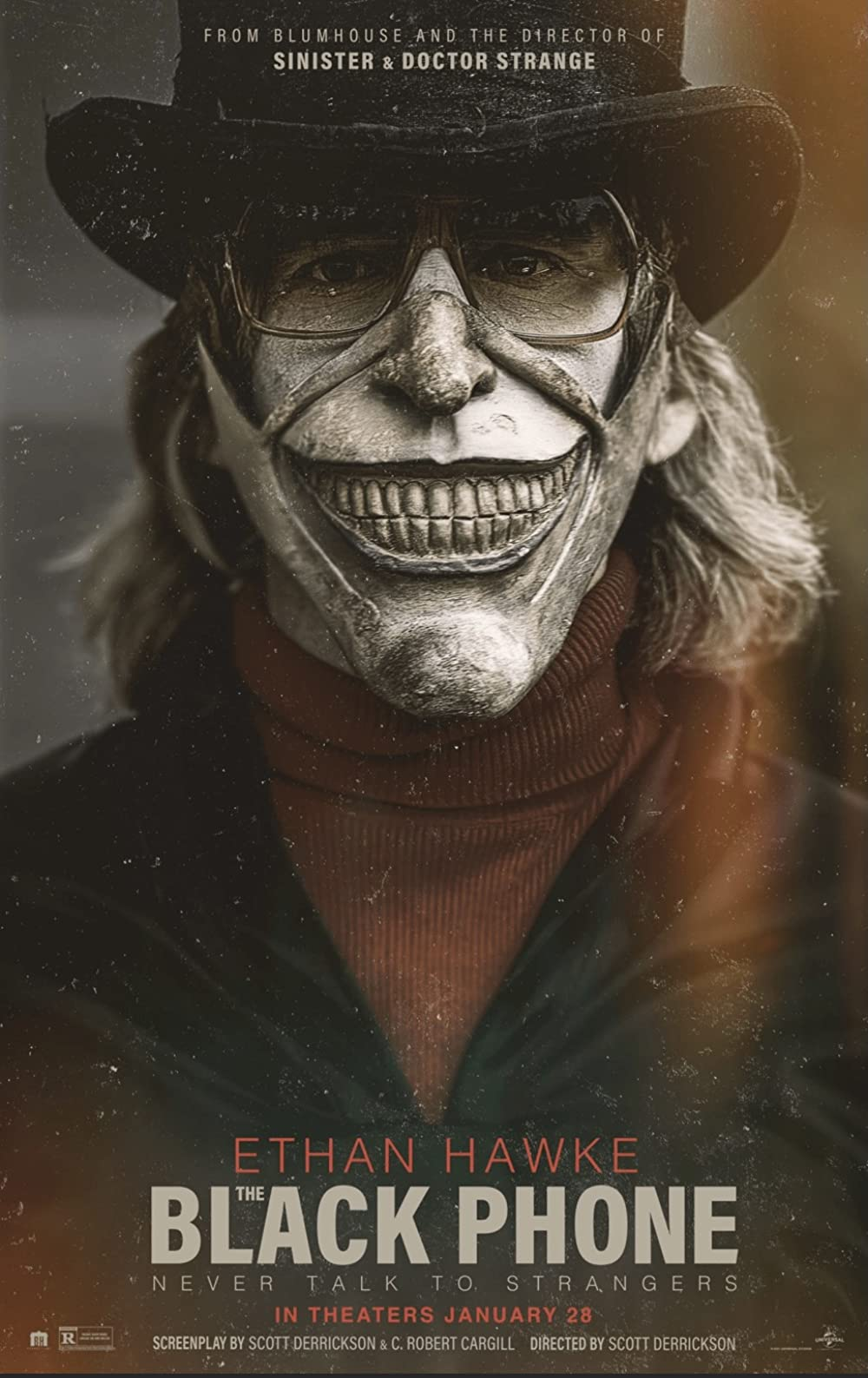
Halloween party-goers now have a new mask to wear on their faces in the guise of The Black Phone (2021) villain daubed, “The Grabber”. Although one must point out the mask is highly influenced by Japanese classic horror, Onibaba (1964). Anyway, the Grabber is a sick individual who prowls and abducts kids from the Denver suburbs in the 1970s, using black balloons and a creepy van as his signature. Portrayed by Ethan Hawke, he isn’t most subtle or interesting of killers, but his chilling behaviour drives this effective horror film from director Scott Derrickson.

The story is the essence of every parent’s living nightmare. Their child goes missing having been snatched off the street in broad daylight. The film takes the time to establish many of the children’s characterisations so we have time to bond with them and feel the horror of their plight. Central to the story are teen brother, Finney (Mason Thames), and younger sister, Gwen (Madeline McGraw). Even without the threat of the murderer, their mother has passed and they are brought up by abusive and alcoholic father (Jeremy Davies). To add further woe, Finney, finds himself bullied by older kids at school. Could things get any worse? Of course! Finney finds himself the next victim of the evil Grabber!


Plunged into a gloomy and sound-proofed basement, Finney, is trapped with no way out from the Grabber’s nefarious plans. Ah, but Finney suddenly gets assistance from, not one, but two supernatural sources. Firstly, the titular black phone which hangs on the wall of the basement and scares us half to death when it rings. Who is on the other end? Well, lets just say they are not of the living. The second magical helper for Finney is that Gwen has the second sight in her dreams. Over time she is able to conveniently assist the police at significant stages of the narrative. Much suspense is raised from Finney’s attempts to escape as time begins to run out for him. His conversations on the black phone are imaginatively delivered as he reaches some weird dimension beyond life and death.

The Black Phone (2021) is both a suspenseful and silly ride, efficiently directed by expert genre filmmaker, Scott Derrickson. The characters are nicely written and you really root for them as the kids deal with all manner of terror. Themes relating to sibling community, stranger-danger, and sticking up for yourself against bullying are intelligently explored also. However, I must say the film has, for all the emotional depth felt and evocative 1970s locations and costumes displayed, a number of serious plot-holes struck me as incredibly questionable. I also thought Ethan Hawke’s villain while visually striking, lacked intelligence and a proper characterisation. I get that he is masked symbol of evil, but a great actor like Hawke was wasted in such casting. Overall though, The Black Phone (2021) is definitely a cinematic call worth answering.

Mark: 7.5 out of 11


CINEMA REVIEW: LICORICE PIZZA (2021)

CINEMA REVIEW: LICORICE PIZZA (2021)

Written and Directed by: Paul Thomas Anderson

Produced by: Sara Murphy, Adam Somner, Paul Thomas Anderson

Cast: Alana Haim, Cooper Hoffman, Sean Penn, Tom Waits, Bradley Cooper, Benny Safdie etc.

Cinematography: Michael Bauman and Paul Thomas Anderson

Edited by Andy Jurgensen

*** MAY CONTAIN SPOILERS ***


Any film from Paul Thomas Anderson will certainly receive high critical praise and Licorice Pizza (2021) is certainly no different. Not only do I think this is his most over-rated film. I don’t even think it is a good one. Not for any technical reasons. Because as usual Anderson’s filmic skills as a director, the scintillating cinematographic style, the evocative rendition of early 1970’s Californian suburbs, plus two star-making turns within a formidable cast, ensure Licorice Pizza (2021) is deservedly going to win many plaudits. But I just did not get the story about pretty much nothing and did not connect with the lead romance.

Set in 1973, Licorice Pizza (2021), is part slice-of-life period drama and part character comedy, with a spine consisting of an odd romance between entrepreneurial fifteen-year-old, Gary Valentine (Cooper Hoffman) and twenty-five-year-old, Alana Kane (Alana Haim). While containing many brilliantly directed scenes, the film is a hot mess of indulgent rooting through Paul Thomas Anderson’s historical research and anecdotal events inspired by real-life film producer, Gary Goetzman.


Being asked to root for a relationship which is dubious on the surface and extremely complex to say the least is not beyond me. But Licorice Pizza (2021) doesn’t address the age difference, aside from a couple of moments in the script. I know Cooper Valentine is an old head on young shoulders, but why Alana doesn’t hang out with people her own age was weird for me. I’m not being politically correct or a prude, but is Anderson asking for us to root for what could end up being statutory rape. Am I over-thinking this? Well, all I can say is it impacted my emotions of a major aspect of the story.

Licorice Pizza‘s (2021) worst crime is it’s virtually plotless and I could not identify with the characters. I liked Gary to a certain extent as he ducks and dives to make a living, but what was at stake? Nothing really. Yeah, I get it is art but I found Anderson’s vision boring. Sure, the actors are great, especially the effervescent Alana Haim. Virtual cameos from Sean Penn, Bradley Cooper and Tom Waits failed for me though, with Cooper’s coke-addled and womanising impression of Jon Peters about as funny as an enema. Of course, the cinematography, period design, soundtrack and costumes are exquisitely presented, but they exist in an emotional vacuum. Finally, Licorice Pizza (2021) made me want to watch Paul Thomas Anderson’s previous 1970s masterpiece, Boogie Nights (1997). Now, that film deserved all the critical praise that came its way.

Mark: 6 out of 11


HORROR OBSCURA FILM REVIEWS – HALLOWEEN 2021 SPECIAL!

HORROR OBSCURA FILM REVIEWS

Halloween is slowly creeping out of the fog and shadows. It’s a time of the year where horror films come to the fore. Personally, I watch horror all the year round, but it’s always fun when the genre pulls focus on the cultural calendar.

Rather than concentrate on current horror film releases, I thought it would be interesting to seek out chillers that are a tad less known. So, I had a scan through Amazon and Shudder screening platforms and unearthed several cult horror gems worth catching.

Some of these films come from the 1980’s period which encompassed the “video-nasty” era in the United Kingdom. With the advent of home video technology, the government suddenly got frightened about bloody and exploitational films and desired control. Censoring seventy-two titles and banning a flurry of films actually made people want to watch them more. This caused the government’s policy to backfire as people clamoured to watch “pirate” video versions of such films. In fact, it was in the living room watching forbidden films and the old Universal black-and-white classics where my true love of horror cinema began.

The following films may not have been banned at the time, but I was intrigued by how many of the titles I missed seeing on first release. Aside from Ben (1972), When A Stranger Calls (1979) and Phantasm (1979), I hadn’t seen the other titles. Therefore, if you’re looking for obscure horror films to watch then delve deep into the Amazon library. They have a fine feast of 1970’s and 1980’s fear inducing fare, many of them which were on the infamous “video-nasty” list. Dare you watch them!?


THE CAT OF NINE TAILS (1971)

An early Dario Argento giallo finds a blind puzzle-maker (Karl Malden) and dogged reporter (James Franciscus) investigating murders at a genetics lab. Aside from a couple of scary set-pieces, notably in a graveyard, it neither works as a detective nor horror story. It is however beautifully filmed with a vibrant restoration. (Mark: 6 out of 11)

CHUD (1984)

As the Nuclear Regulatory Commission track down missing toxic waste the New York homeless population are becoming victims to something monstrous in the sewers. An energetic sci-fi-horror hybrid combining a schlocky plot with socio-environmental themes. It’s not bad and actually quite funny, with early roles for John Heard and Daniel Stern whose acting raises the overall quality. (Mark: 6 out of 11)

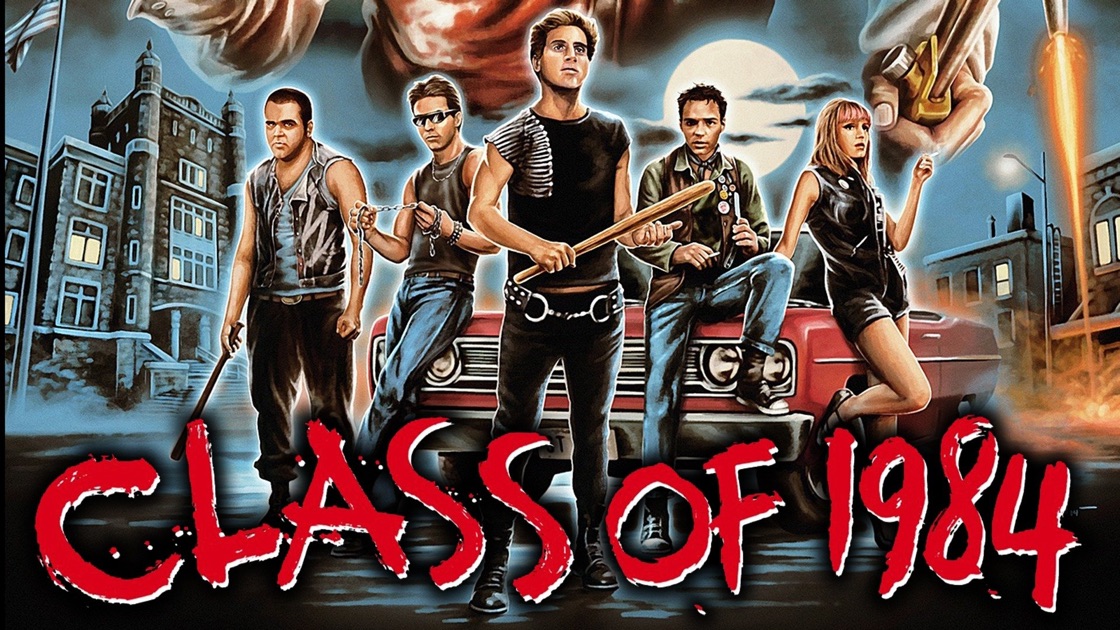
CLASS OF 1984 (1982)

I remember school kids raving about this film when I was twelve. I really wanted to see it, but could never find it in the video shop or from the “pirate” video guy. The plot merges The Blackboard Jungle (1955) with Death Wish (1974), as Perry King’s music teacher attempts to soothe the savage beast of a gang of nasty punk students. He fails and the final act revenge-driven rampage is fantastically inventive and gory. Latterly famous director, a young Tim Van Patten, portrays the psychotic, Peter Stegman, with vicious zeal. A true exploitational classic. (Mark: 8 out of 11).

HELL NIGHT (1981)

This is one of those films I had never even heard of. With a sizeable budget of $1.4 million dollars for a slasher film, it concerns four college students, including a grown-up Linda Blair, spending the night in a creepy house as part of an initiation ritual. Unfortunately, there’s a psychotic killer about hellbent on hunting them down. We’ve seen it all before, but it was nicely filmed and had decent humour. Overlong but way better than I thought it would be. (Mark: 7 out of 11)

PHANTASM II (1988)

I reviewed the remastered version of Don Coscarelli’s low-budget masterpiece here, but only just got round to watching the sequel. Phantasm II (1988) had a bigger budget and suffers from some stodgy plotting. The re-casting of Mike with James Le Gros in the role throws you. Yet, once Mike and Reggie fight with the Tall Man (inimitable Angus Scrimm), the razor-sharp spheres and the hooded monsters, the film finds real pace. Coscarelli blows-up a lot of stuff and ramps up the weaponry, but the sequel lacks the twisted magic of the original must-watch horror fantasy, Phantasm (1979). (Mark: 6.5 out of 11)


TERROR TRAIN (1980)

Another unknown mini-gem I found on Amazon. This Canadian slasher film is, you guessed it, set on a train and finds, yes you guessed it again, college students getting picked off one-by-one by a vengeful psycho. Notable for a really good plot which gives the killer empathy and understandable motivation, it also stars everyone’s favourite final girl, Jamie Lee Curtis. With disguise and magic prevalent in the themes, David Copperfield also appears in a neat role. Highly entertaining with a killer twist. (Mark: 8 out of 11)

WHEN A STRANGER CALLS (1979)

Inspired by a famous urban legend, Fred Walton’s chilling suspense thriller has one of the most nail-biting opening twenty minutes in horror cinema. Carol Kane is the babysitter terrorized by a series of tense phone calls from a mystery ringer. From that terrifying start the story falters slightly as it focusses on Charles Durning’s obsessive search for the unhinged man. Only when Kane rejoins the film some years later does the horror rise up again in a truly frightening denouement. (Mark: 8.5 out of 11)

WILLARD (1971) / BEN (1972)

This was an odd one because I knew and seen the sequel Ben (1972) when I was a younger. Little did I realise the original Willard (1971) had been released the year before and became a sleeper box-office hit. Bruce Davison is excellent as the introvert, Willard, who is bullied at work by his aggressive boss, Ernest Borgnine. Only when, and take a deep breath here, Willard trains an army of rats does he gain confidence to take on the world. It’s a weird film that actually works because of Willard’s fascinating character arc and Davison’s nuanced performance. (Mark: 8 out of 11)

The follow-up Ben (1972) focusses on Willard’s alpha rat, Ben, and his friendship with lonely kid, Danny. The sequel really raises the rat count and there appears to be thousands of them in their dirty lair. Danny is a likeable kid who suffers from a serious illness that prevents him from going out. Why he would make friends with a killer rat though is still frankly nuts! A lack of thrills and goofy premise make it difficult to recommend, and is more famous for the classic Michael Jackson hit called, surprisingly enough, Ben. (Mark: 6 out of 11)


FX/BBC TV REVIEW – MRS AMERICA (2020)

FX/BBC TV REVIEW – MRS AMERICA (2020)

Created by: Dahvi Waller

Producers: Tanya Barfield, Boo Killebrew, Sharon Hoffman

Writers: Dahvi Waller, Tanya Barfield, Boo Killebrew, Micah Schraft and April Shih, Sharon Hoffman, Joshua Allen-Griffiths, etc.

Directors: Anna Boden & Ryan Fleck, Amma Asante, Laure de Clermont-Tonnerre, Janicza Bravo,

Cast: Cate Blanchett, Rose Byrne, Uzo Aduba, Elizabeth Banks, Kayli Carter, Ari Graynor, Melanie Lynskey, Margo Martindale, John Slattery, Jeanne Tripplehorn, Tracey Ullman, Sarah Paulson, and many more.

No. of Episodes: 9

Original Network: FX on Hulu / BBC (UK)

*** CONTAINS HISTORICAL SPOILERS ***


“Feminism has never been about getting a job for one woman. It’s about making life more fair for women everywhere. It’s not about a piece of the existing pie; there are too many of us for that. It’s about baking a new pie.” — Gloria Steinem

I just won’t ever understand this world and the people in it. We are capable of wonderful moments of love and compassion and just being good to one another, but equally just as capable of negativity, division and dispute. Take for example the Equal Rights movement. First proposed by the National Woman’s political party in 1923, the Equal Rights Amendment was to provide legal equality of the sexes and prohibit sex discrimination.

Initially failing, the E.R.A. was revived in the late 1960s, and throughout the 1970s tireless work was done to get it ratified. Here was a group of people striving for gender equality and generally fighting for better working conditions. This for me is a noble cause. However, unbelievably there were women, not just men, in America who were AGAINST the Equal Rights Amendment. Of course, it is a constitutional right to freedom of speech and to protest your point of view, however, arguing against something that is looking to improve lives is hard to credit.


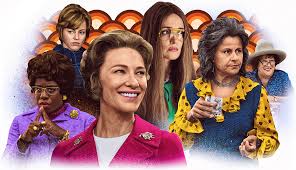
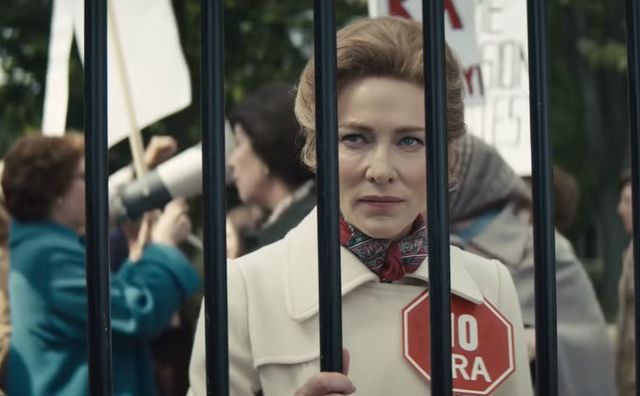
FX’s historical biopic, Mrs America (2020) is set against the backdrop of the 1970s and it dramatizes the amazing fight by those individuals and groups seeking to ratify the E.R.A. across the disunited states of America. Leading political activists such as Gloria Steinem (Rose Byrne), Betty Friedan (Tracey Ullman), Shirley Chisholm (Uzo Aduba), Bella Abzug (Margo Martindale) and Jill Ruckelshaus (Elizabeth Banks) were just a few of the people struggling to get the E.R.A. over the line. While it seems like a no-brainer to me, the 1970s was clearly another country when it came to gender roles and the treatment of women. Thus, the amendment, while slowly gathering momentum in various states, faced much opposition. The mini-series represents the major source of opposition in ultra-conservative spokesperson, Phyllis Schlafly (Cate Blanchett), an activist and lobbyist who started the No E.R.A campaign group. The battles between her group and the feminist legion gives way to much incisive drama, comedy and entertainment.

Presented in nine brilliantly written, acted and directed episodes, Mrs America (2020) is television of the highest quality. The ensemble cast is one of the finest ever assembled in my opinion and there are so many amazing performances. Cate Blanchett is magnetically charismatic as PhylIis Schlafly. Blanchett gives a complex characterisation of a formidable woman who, while striving to be taken seriously in the world of law and politics, finds she is undermined by the men she is fighting for. Sarah Paulson also gives another nuanced and exquisite rendition of a housewife on a slow journey of self-realisation. There are just too many great acting portrayals to mention, but Tracey Ullman steals every scene she is in for sure.

Overall, Mrs America (2020) takes a potentially dry subject and infuses it with the intricacies of both political intrigue and powerful personality. The script fizzes with wit, style and verve, and is supported by an amazing soundtrack and some jaw-dropping acting. No doubt many liberties have been taken with the events for dramatic purposes. But if that means bringing to prominence this important struggle then I am all for it. Rather incredibly, the E.R.A., at the time of the programme’s release this year, still had not been ratified by the number of States needed to make it law. I know it’s too complex an issue to be resolved so easily, however should this political matter still remain unratified today? It remains a sad indictment of humanity that equality for all was seen as such a negative thing in the 1970s, especially by individuals it sought to protect.

Mark: 9.5 out of 11

NETFLIX FILM REVIEW: DOLEMITE IS MY NAME (2019)

NETFLIX FILM REVIEW: DOLEMITE IS MY NAME (2019)

Directed by: Craig Brewer

Produced by: Eddie Murphy, John Davis, John Fox

Written by: Scott Alexander & Larry Karaszewski

Cast: Eddie Murphy, Da’Vine Joy Randolph, Keegan-Michael Key, Mike Epps, Wesley Snipes, Titus Burgess, Craig Robinson etc.

Music: Scott Bonnar

Distribution: Netflix

**MAY CONTAIN SPOILERS**


DOLEMITE IS MY NAME (2019)

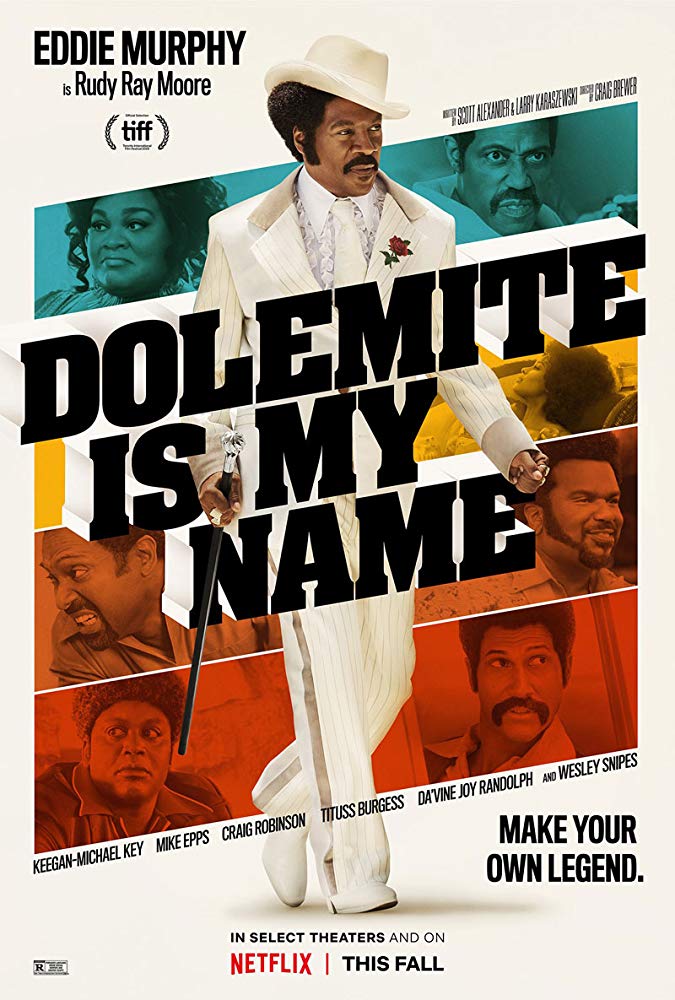
It’s obvious to say that as I, like many others, love watching films, love writing about films and love talking about films with other film lovers. But, does that mean one also loves films that are actually about making films? Yes, of course it does! I love watching and writing about films that are about filmmaking. Therefore it stands to reason I would love Eddie Murphy’s latest role as comedian/actor/filmmaker/singer, Rudy Ray Moore.

Having burst on the cinema screen in the early 1980’s in a series of classic hits, notably 48 Hrs. (1982), Trading Places (1983) and Beverley Hills Cop (1984), Murphy became one of the most bankable movie stars in the world. His talent, stamina and comedic genius have meant his career is still going strong, despite many career ups and downs. However, it’s a bit disappointing that Murphy hasn’t stuck with more dramatic roles or character driven roles, as he cast himself in more family and light comedy-oriented films. This is because Murphy is an incredible actor, as demonstrated once again in Dolemite is My Name (2019).


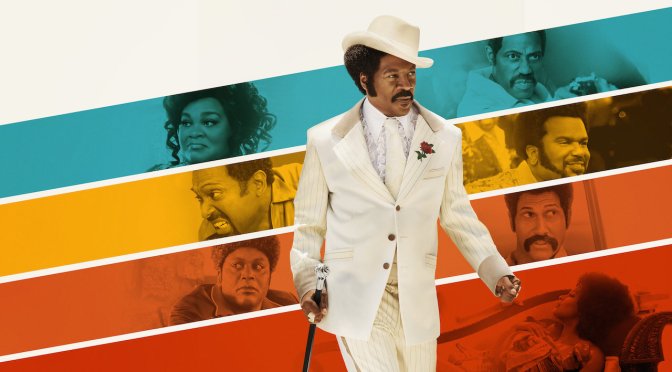
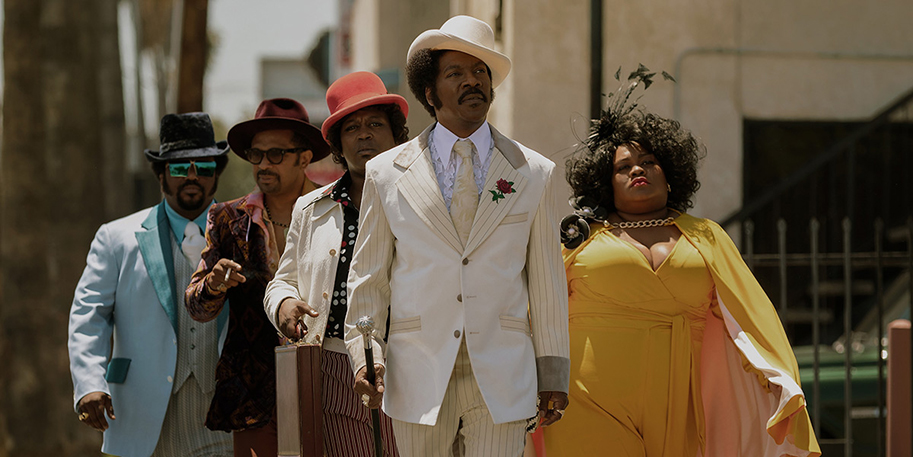
Set in 1970’s Los Angeles, Dolemite is My Name (2019) finds Rudy as a struggling comedian, compere and record shop manager still trying to crack his dream of becoming famous. Time and opportunity have knocked him back for years, but he still has the energy and drive to continue. I identified with Rudy as I have a dream of being a successful filmmaker, but if I’m honest that ship has not just sailed, it’s crashed on the rocks. But I will carry on. Because I really enjoy it.

Inspiration comes to Rudy when he creates a new character and begins rapping routines in the clubs as flamboyant pimp, “Dolemite.” Recording his own comedy albums and selling them out of the trunk of his car slowly brings dividends, and Moore becomes a cult hit. Then the fun really starts as Rudy decides he wants to make a movie. But he has no money, crew or equipment. Cue many fantastic filmmaking scenes that make fun and pay homage to Moore’s energy as a producer/actor/writer and kung-fu “artist”.


Accompanying Murphy as Moore in this delightful and hilarious film is a stellar ensemble cast that includes: Titus Burgess, Da’Voy Joy Randolph, Keegan-Michael Key and Craig Robinson. Not forgetting a scene-stealing turn by Wesley Snipes as a wide-eyed drunken movie actor-turned-director, D’Urville Martin. The cast, given energetic direction by Craig Brewer, fashion likeable characters and performances. Moreover, the funky music, colourful costumes, wicked dancing and comedy timing hit their marks constantly.

Overall, I’m a sucker for films about filmmaking and this one is highly recommended. Dolemite is My Name (2019) could have been a bit more dramatic in places and perhaps commented more on the socio-politics of the era and Blaxploitation film genre. However, as a film about Rudy Ray Moore’s energy, passion and never-say-die attitude it is a fine cinematic tribute. Above all else, it’s a testament to the ability, talent and infectiousness of Eddie Murphy. Rudy Ray Moore is a part he was born to play and he smashes it out of the park.


Mark: 9 out of 11


I’M DYING UP HERE (2017) – S1 – SHOWTIME TV REVIEW

I’M DYING UP HERE (2017) – S1 – SHOWTIME TV REVIEW

Genre: Comedy-drama

Created by: David Flebotte

Based on: I’m Dying Up Here by William Knoedelseder

Starring: Melissa Leo, Ari Graynor, Clark Duke, Michael Angarano, Andrew Santino, Stephen Guarino, Erik Griffin, RJ Cyler, Al Madrigal, Jake Lacy

Network: Showtime US / Sky Atlantic UK

im-dying-up-here-640x480

As well viewing loads of films I also block out the horrors of the world by watching lots of television too. With cable, digital, internet and terrestrial channels to choose from you will find some gems to stop you thinking about the end of the world; UNLESS, of course, it’s a show about the end of the world. Anyway, as the war-mongering governments plot and false flag and generate fear and murder innocents all around the world, comedy, as they say, can sometimes provide the best medicine.

Showtime’s1970s based comedy-drama is set in Los Angeles. It features an ensemble cast of wannabe comedians at various stages of their careers, which congregate at Goldie’s Comedy Club. Melissa Leo plays the tough-edged business woman running the show who can make a comic’s career by getting them on the Johnny Carson show. Because of economics and the desperate comedians’ desire for fame the acts will work as open spots until they get a break. Leo anchors the show with a ballsy performance, yet beneath her hard exterior there is much pain and vulnerability in her character. She fights and scratches and bites to stay ahead of her rivals as she’s consistently undermined by the sexist and patriarchy dominated show business ‘system.’

im-dying-up-here.jpg

The rest of the cast consists of an assortment of character actors, actual stand-up comedians and up-and-coming actors including: Ari Graynor, Jake Lucy, Andrew Santino, Al Madrigal, Clark Duke, Michael Angarano and RJ Cyler. Ari Graynor, as the Texan comedian fighting her way up in a male-dominated world; and, young, black comedian RJ Cyler especially stood out. I have seen Cyler in a number of shows and films now and I think he is a bona fide star in the making. The double act sparring of Clark Duke and Michael Angarano are also hilarious too as the lively, aspiring acts from out of town, so broke they have to rent a closet to live in.

The era, costumes and smoky settings of comedy clubs are fantastically evoked as is the characterisation of the comedians’ struggle. I mean these are intrinsically narcissistic individuals striving for fortune and fame yet many of them are self-hating, low-esteemed and bitter people just searching for a moment of adoration through the audiences’ laughter. Many of the characters are also deeply flawed and actually unlikeable, notably Andrew Santino’s Bill Hobbs. Moreover, while creating a sense of community with each other the comedians are also fiercely competitive and much humour is driven by their cutting barbs and scathing comments toward each other. Childish tit-for-tat battles rage too when things heat over between the acts; either because they have bombed or because they have been stitched up by another act. Lastly, the socio-politics of the era provide excellent subtext and much of the drama derives from: sexual politics; alcohol and drug addiction; comedy club rivalry; joke-theft; heckler-battles; career and actual suicide; race relations; the Vietnam War; and every day existential crises.

Episode 103

Overall, I’m Dying Up Here may not be for everyone but it was brilliant viewing for me. I love stand-up comedy and I love television drama. I also thought the writing, direction, acting, performances, soundtrack and production design were excellent. The show’s strength is in the ability to balance drama and adult-based humour over ten fascinating episodes. It reminded me, most of all, of an extended series of the film Boogie Nights (1997) and the work of Robert Altman. Finally, I myself have written and performed stand-up comedy and, while there’s been little financial or cultural success, I have absolutely loved my time on stage. As a creative pursuit it can be both exhilarating when it goes well and completely devastating when you ‘die’ and NO ONE laughs. But hey, death on stage is far more palatable than the apocalypse! Indeed, it’s NOT THE END OF THE WORLD!

(Mark: 9 out of 11)