Main cast: Mari Shirato, Junko Miyashita, Kentarō Shimizu, Jun Etō, etc.
Cinematography by Yonezou Maeda
Music by Toshiyuki Honda
*** MAY CONTAIN SPOILERS ***
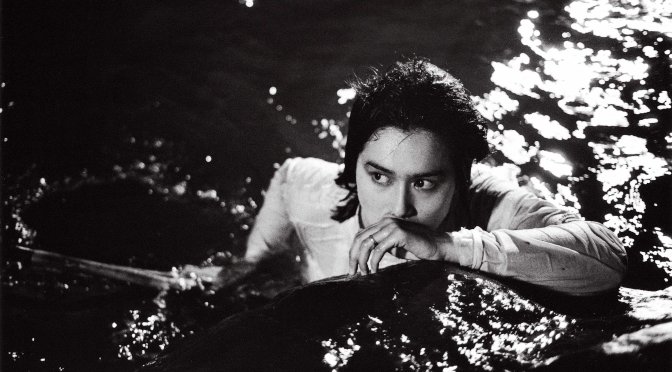
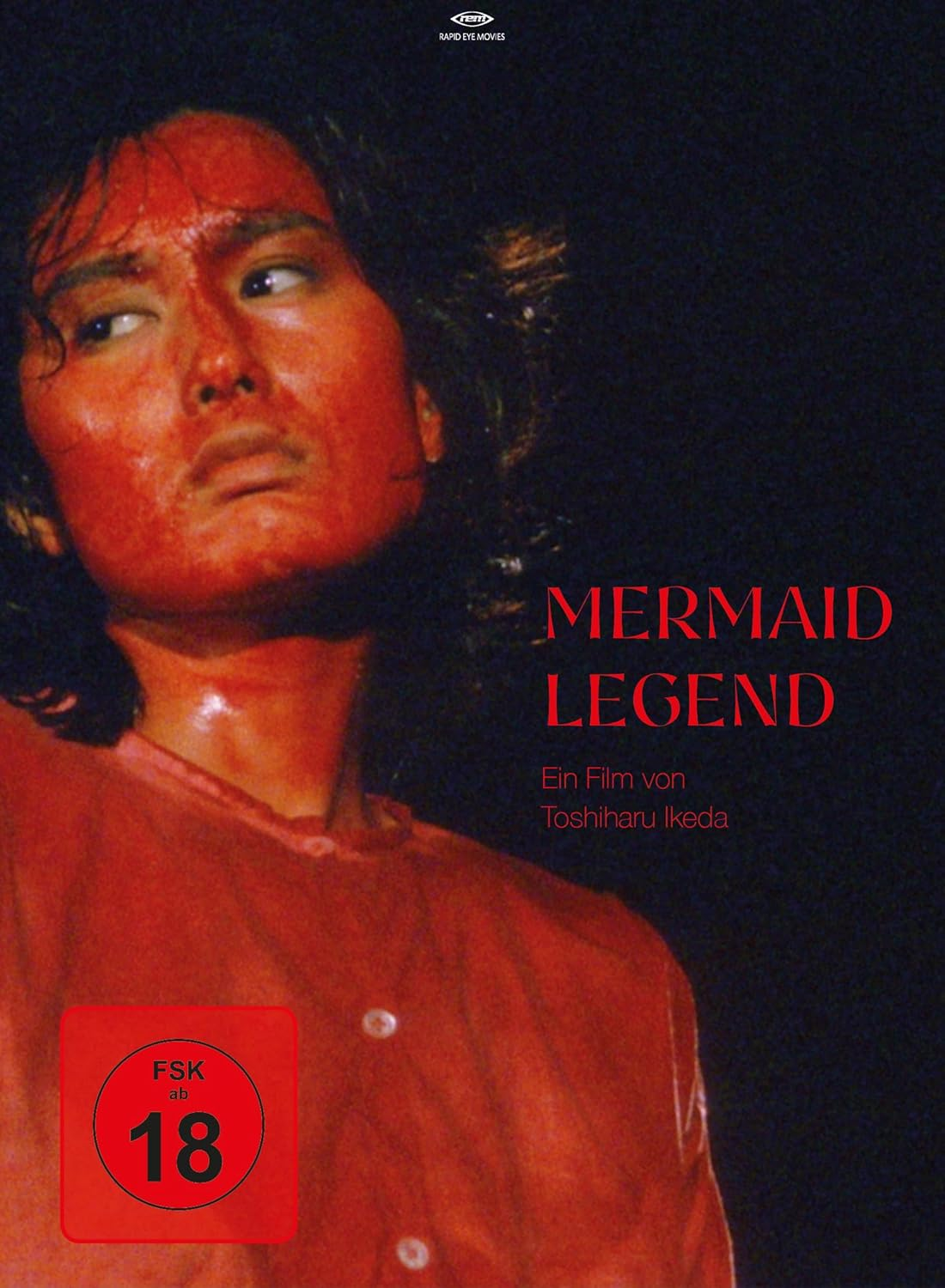
I took a gamble on an unknown Japanese film at the Nickel Cinema and walked out genuinely shaken. Mermaid Legend (1984) isn’t just a cult oddity—it’s a film that mutates before your eyes, seducing you with beauty before drowning you in blood. I was stunned by how something so lyrical could also be so brutally confrontational.
The story begins almost modestly, as a coastal drama about a fisherman and his wife, Migiwa. They bicker constantly, their marriage worn thin by poverty and exhaustion, yet there’s an undeniable bond beneath the arguments. That fragile domesticity is shattered when the fisherman stands in the way of an industrial development scheme. The business developers—faceless, polite, and utterly ruthless—have him murdered, disposing of his life as casually as industrial waste.
From there, Mermaid Legend (1984) transforms again. What starts as marital realism becomes a corporate espionage murder mystery, steeped in anger at nuclear energy, environmental destruction, and the cold machinery of corporate greed. Migiwa, a powerful-lunged pearl diver, initially hides, retreating into grief and the sea itself. But this is not a film about quiet mourning. When she decides to act, she does so with mythic force.
Played by the ethereal and astonishing Mari Shirato, Migiwa becomes something halfway between woman, avenging angel, and sea spirit. Shirato’s performance is magnetic—serene, sensual, and terrifying. As her vengeful pursuit begins, the film plunges headlong into extreme violence and explicit sexuality, reclassifying itself yet again as one of the most shocking exploitation epics I’ve seen from Japan in recent years. These scenes aren’t gratuitous in the lazy sense; they’re confrontational, weaponized, daring you to look away while refusing to let you feel comfortable for a second.
What makes Mermaid Legend (1984) so intoxicating is how its elements collide. Poetic underwater cinematography turns the ocean into a womb, a grave, and a cathedral. Religious, angelic, and environmental imagery blur together, as if Migiwa is both martyr and executioner. The music is heavenly—soaring, mournful, almost sacred—creating a surreal contrast with the carnage on screen. Beauty and brutality coexist in the same frame, each intensifying the other.
And then there’s the ending. The final, elongated pier stabbing rampage is completely off the chart—relentless, bloody, and hypnotic. It plays out like a ritual rather than an action sequence, stretching time until violence becomes abstraction, then meaning, then release. By the time the last body falls, Mermaid Legend (1984) has fully shed realism and entered the realm of legend, justifying its title in blood.
This is a film that shouldn’t work, yet does—furiously, defiantly. A genre-shifting fever dream that moves from domestic drama to political thriller to erotic exploitation to mythic revenge tragedy, Mermaid Legend (1984) is both beautiful and brutal, and I can’t stop thinking about it. Seeing it by chance at the Nickel Cinema felt like discovering a secret too powerful to stay hidden.
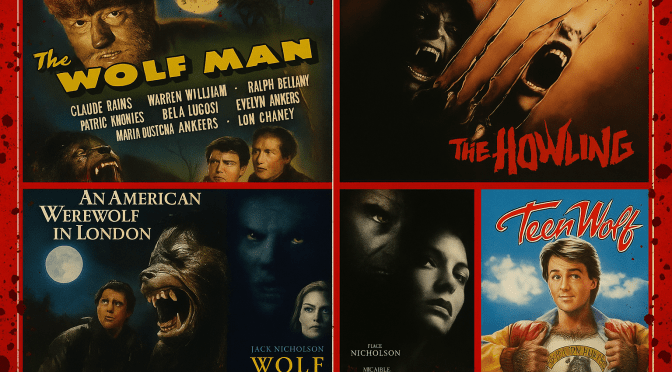
Halloween Review Special: Werewolf Films – Part #2
Happy Halloween again! Part 1 of my Werewolf film reviews can be found here on this link. So, on with Part #2 with all films marked out of 11!
*** CONTAINS SPOILERS ***
Ginger Snaps (2000)
Ginger Snaps (2000) is a rare and refreshing take on the werewolf myth, shifting the focus to the female experience with wit and bite. As the awkward Bridget, Emily Perkins gives a wonderfully grounded performance, desperately trying to save her sister Ginger after a fateful wolf attack. Cleverly linking the lunar and menstrual cycles, the film transforms body horror into a sharp coming-of-age allegory. Smart, sexy, and darkly funny, it’s packed with gallows humour, fantastic gore, and a subversive energy that makes it one of the standout horror films of its era. Mark: 9 out of 11
Howl (2015)
Howl (2015) is an underrated British werewolf gem that feels like Dog Soldiers (2002) set on a train — claustrophobic, gritty, and laced with dark humour. Ed Speleers plays a weary, beta-male guard whose routine night shift derails into a fight for survival when the train breaks down in the woods. As tensions rise among the stranded passengers, he’s forced to find his courage against something far more terrifying than “leaves on the line.” Mark: 8.5 out of 11
The Howling (1981)
Joe Dante’s The Howling (1981) may now feel almost plotless in retrospect, but it remains a deliriously inventive slice of horror cinema. The film thrives on unforgettable set-pieces and grotesque energy — from a chillingly unrecognisable Robert Picardo as the predatory Eddie Quist to Elisabeth Brooks’ hypnotic, sensual menace. Dee Wallace delivers a strong turn as the quintessential scream queen, leading to an unintentionally funny change at the end, while Rob Bottin’s groundbreaking transformation effects still stand among the genre’s finest. Mark: 8 out of 11
Red Riding Hood (2011)
A messy yet oddly entertaining blend of Twilight-style romance, fairy-tale gothic, and werewolf whodunnit. Amanda Seyfried glows at the center of the melodrama, giving the film more heart than it deserves, while Gary Oldman chews through his lines — and the scenery — with the gusto of a man earning a very comfortable Hollywood paycheck. Mark: 5.5 out of 11
Silver Bullet (1985)
Silver Bullet (1985) carries many of the familiar hallmarks of Stephen King’s storytelling — small-town paranoia, moral rot beneath the surface, and a sense of homespun Americana under siege — but lacks the sharpness of stronger King adaptations. While it holds a nostalgic charm for 1980’s horror fans, thanks to its mix of pulp, sentimentality, Gary Busey-on-butane, and Corey Haim’s spirited performance, it’s far from essential and not one of my go-to werewolf films. Mark 6.5 out of 11
Teen Wolf (1985)
I’m ashamed to admit I’d never seen Teen Wolf (1985) until now — but it’s a charming coming-of-age comedy that finds Michael J. Fox as Scott Howard, a teenager who discovers a very hairy family secret. Scott juggles puberty, romance, bullies, and basketball glory. The adults are enjoyably eccentric, but it’s James Hampton as Scott’s warm, understanding father who grounds the film with genuine heart. Mark 7 out of 11
Werewolves (2024)
Werewolves (2024) boasts an intriguing premise — scientists racing to cure humanity of a wolf-mutant virus unleashed under a supermoon — and delivers plenty of muscular action-horror energy. Frank Grillo anchors the nocturnal mayhem with his trademark grit, like a U.S. Statham. It’s entertaining, but the world-building feels rushed, as if we’ve dropped into the sequel to an origin story that doesn’t exist yet. Mark 6 out of 11
Werewolves: The Beast Amongst Us (2012)
Werewolves: The Beast Amongst Us (2012) is an entertaining but clearly made-for-TV creature feature that feels like a bargain-bin mashup of Stephen Sommers’ The Mummyand Van Helsing — all gothic flair and monster mayhem, but without the budget, stars, or polish. Still, its pulpy enthusiasm and old-school monster-hunting energy make it a mildly fun watch for fans of B-movie beast action. Mark 6 out of 11
Werewolves Within (2021)
Werewolves Within (2021) has a sharp, witty script packed with humour and clever twists, but its over-the-top direction and eccentric ensemble make it hard to fully connect with. Sam Richardson shines as the affable Forest Ranger caught amid a group of oddball townsfolk — and a monster on the loose. Fast-paced, funny, and gory, it plays like Tremors set in the snow — just without the magic that made that classic so effortlessly great. Mark 7 out of 11
Wolf (1994)
Wolf (1994) suffers from an under cooked corporate-werewolf concept that never quite decides if it wants to be a horror film, a romance, or a satire — and ends up failing at all three. Jack Nicholson and Michelle Pfeiffer, both usually magnetic, seem oddly disengaged under Mike Nichols’ overly restrained direction. The film has flashes of intrigue and style, but it lacks bite; James Spader, simmering with sleaze and menace, could have stolen the show if only he’d been let off the leash. Mark: 6 out of 11
Wolfcop (2014)
WolfCop (2014) is a gloriously bonkers B-movie romp about an alcoholic small-town cop, Lou Garou (Leo Fafard), who becomes a werewolf and stumbles into a plot of witchcraft and sacrifice. Director Lowell Dean brings wild energy and gleeful chaos to the mix, delivering gory action and sharp humor that far outshine the film’s modest budget. It’s ridiculous, rowdy, and an absolute blast from start to finish. Mark: 7.5 out of 11
The Wolf Man (2010)
The Wolfman (2010) is a stylish, brooding gothic remake elevated by Rick Baker’s stunning creature effects and an atmosphere dripping with fog, blood, and tragedy. On rewatch, it’s far more enjoyable than it first seemed, with Benicio Del Toro and Emily Blunt grounding the film’s emotional heart while Anthony Hopkins bellows through his expositional monologues with Shakespearean gravitas. The production design, lighting, and Danny Elfman’s sweeping score are all superb, but the film’s flaws are clear — studio meddling and re-shoots leave the opening character setup feeling rushed and the narrative uneven, hinting at a richer version lost to the editing room. Mark: 7 out of 11
For fans of Upgrade (2018) and The Invisible Man (2020), Wolf Man may feel like a missed opportunity. Those films balanced high-concept storytelling with sharp social commentary, whereas Leigh Whannell’s latest effort feels more like a half-formed howl in the night. See my full review here. Mark: 6.5 out of 11
The Wolf of Snow Hollow(2020)
The Wolf of Snow Hollow (2020) delivers an effective monster story filtered through Jim Cummings’ uniquely neurotic, darkly comedic lens. Cummings stars as a frazzled small-town cop juggling alcoholism, a dementia-stricken father, and a teenage daughter — all while a vicious creature tears through the community. It’s an offbeat, entertaining indie horror with sharp writing, emotional bite, and a fantastic twist buried in the chaotic narrative pile-up of its finale. Mark 8 out of 11
The Wolfman (1941) / Frankenstein meets The Wolfman (1943)
Lon Chaney Jr. has always been my favorite tragic werewolf — a figure of deep sadness and empathy rather than pure monstrosity. I grew up watching those classic Universal horror films, and his portrayal of Larry Talbot still resonates as one of cinema’s most heartbreaking depictions of the cursed outsider. There’s a weary humanity to Chaney’s performance, a sense of a man doomed to repeat his suffering under the full moon, forever torn between guilt and fate.
While the scripts in those early Wolf Man films are often simple and melodramatic, their emotional weight endures thanks to Chaney’s sincerity and Jack Pierce’s groundbreaking makeup effects. Pierce’s work transformed the genre, creating an iconic design that remains unmatched in its tactile, hand-crafted artistry. Together, Chaney and Pierce gave the werewolf myth its soul — one that was less about savagery, and more about the tragedy of being human within a cursed lunar cycle. Mark: 9 out of 11
Halloween Review Special: Werewolf Films – Part #1
Happy Halloween! As loyal readers of this blog will know I am a massive horror film fan. Therefore I have focused August’s viewing on the Werewolf sub-genre and present some short reviews of some of my favourites and some not so good. As usual all marked out of 11!
Werewolf films have long captivated both filmmakers and audiences because they tap into primal fears and psychological complexities that transcend genre. At their core, these stories explore the theme of transformation—both physical and psychological—which resonates deeply with viewers. The metamorphosis from human to beast is not just a spectacle of horror; it’s a metaphor for the loss of control, the unleashing of suppressed desires, and the tension between civilization and instinct. This duality offers rich narrative terrain for directors and screenwriters to explore identity, morality, and the boundaries of human nature.
Psychologically, the werewolf embodies the Freudian concept of the id—the raw, instinctual part of the psyche driven by aggression and desire. The human persona represents the ego, trying to mediate between the id and the constraints of society, or the superego. When the transformation occurs, the id overwhelms the ego, resulting in violent, animalistic behavior that defies social norms. This internal conflict is dramatized through the werewolf’s struggle to reconcile their human conscience with their monstrous impulses, making the character both terrifying and tragically relatable.
The tension between animal and human also reflects broader cultural anxieties. Werewolf films often surface during times of social upheaval, when questions about identity, repression, and conformity are especially potent. The creature’s split identity—man or woman by day, beast by night—mirrors the psychological fragmentation many experience in modern life. For filmmakers, this duality offers a visual and thematic playground: the grotesque transformation scenes, the haunting aftermath, and the moral ambiguity of the protagonist all contribute to a compelling cinematic experience. For audiences, the werewolf is not just a monster—it’s a mirror, reflecting the parts of ourselves we fear, repress, and sometimes secretly crave to unleash.
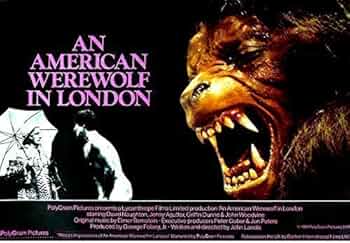
American Werewolf in London(1981)
One of the greatest lycanthrope films of all time. Full of iconic scenes, scares, gore, jokes, sex and an incredible lunar-inspired soundtrack. John Landis, in a directorial purple patch at the time, managed to combine horror, comedy, mystery and a moving love story to memorable impact. Rick Baker’s make-up effects literally transformed further the art and craft of practical special effects going forward. Mark: 10 out of 11
Bad Moon (1996)
Truly dreadful film with a script that fails on most levels, notably logic. The beast is not only the werewolf in the guise of Michael Paré’s Uncle Ted, but also toxic masculinity. Single mum, Mariel Hemingway and her son spend most of the film failing to guess who the big bad wolf is until it is nearly too late. Mark: 3 out of 11
The Beast Must Die (1974)
So bad it’s almost good! The British studio, Amicus Productions, wolf-dunnit, even has the audience take a “werewolf break” where they get 30-seconds to work out who the monster is. Calvin Lockhart, Michael Gambon, and Tom Chadbon et al chew up the scenery, washing it down with bloody terrible effects. The budget was so low they had to use German Shepherd’s with mock fur as the werewolves. Mark 6 out of 11.
The Company of Wolves (1984)
Neil Jordan’s artful adaptation of Angela Carter’s short stories is a richly atmospheric triumph of mood. Though the film’s episodic structure and bookending narrative can feel a touch uneven, Jordan’s poetic direction and Carter’s dreamlike sensibility merge into something intoxicatingly strange. An excellent ensemble of character actors brings the fable-like vignettes to life, with Angela Lansbury delivering a particularly commanding and memorable turn. Mark 8 out of 11
Cursed (2005)
Wes Craven’s 2005 film The Cursed is a case where the behind-the-scenes turmoil proves far more frightening than the movie itself. A troubled production that saw Craven effectively abandon ship midway through, and it bears the scars of hasty reshoots and studio meddling. What emerges is a patchy, uneven werewolf tale with flashes of potential buried beneath the chaos. Still, a young Jesse Eisenberg lends surprising depth to the material, offering a glimpse of quality amid the hairy dross. Mark: 4 out of 11
The Cursed (2021)
Sean Ellis’s The Cursed (2021) delivers a potent blend of gothic grandeur and visceral horror, transforming familiar werewolf and Gypsy tropes into something deeply atmospheric and unsettling. With its striking visuals, meticulous period detail, and haunting score, the film conjures an eerie, painterly world where the sins of the past literally come back to bite. Beneath the blood and fog lies a thoughtful allegory about greed and the gentry’s theft of land, lending the stylish horror a surprising moral weight and emotional resonance. Mark: 8 out of 11
The Curse of the Werewolf (1961)
Hammer’s The Curse of the Werewolf (1961), is anchored by a powerful, brooding performance from Oliver Reed in his breakout role. A staple of my childhood viewing, it’s a film that surprises with its thoughtful set-up—using its Spanish setting to critique class divisions while evoking real empathy for Reed’s tragic, cursed Wolfman. The gothic atmosphere and emotional depth elevate it above typical monster fare, and Warren Mitchell’s turn as a Spanish watchman adds an unexpected and delightful touch of humour amid the savage murders. Mark: 7.5 out of 11
Dog Soldiers(2002)
Neil Marshall’s Dog Soldiers (2002) is an absolute gem of British horror and easily one of my favourites of the genre. Set in the misty isolation of the Scottish Highlands, it combines gritty military camaraderie with ferocious werewolf mayhem to brilliant effect. Kevin McKidd, Sean Pertwee, and Liam Cunningham are all superb, grounding the film with sharp performances that balance humour, heart, and genuine terror. Funny, moving, bloody, and properly scary, Dog Soldiersis a masterclass in doing a lot with a little—its creature effects and atmosphere are astonishing given the budget. A true modern classic that respects the genre with intelligently terrifying monsters and the film still howls with lunar power. Mark: 10 out of 11
Written by Skip Bronkie, Zack Akers & Justin Tipping
Produced by Jordan Peele, Win Rosenfeld, Ian Cooper & Jamal Watson
Main cast: Marlon Wayans, Tyriq Withers, Julia Fox, Tim Heidecker, Jim Jeffries, Maurice Greene etc.
Cinematography by Kira Kelly
** MAY CONTAIN SPOILERS **
“In modern slang, “Him” is used to signify a person who is considered a standout or a “star” in their field, often in sports or entertainment.” — Google search result.
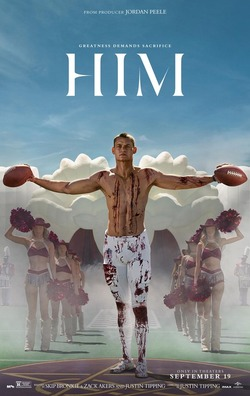
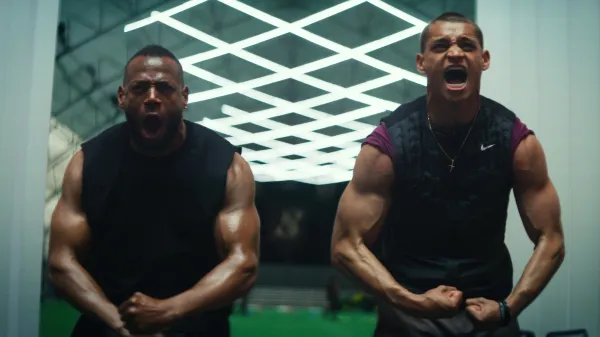
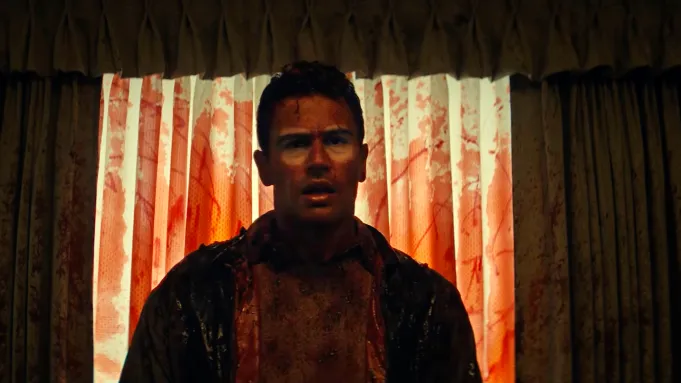
Him (2025) is a visually arresting and thematically potent descent into the underbelly of American athletic obsession — a pitch-black thriller that trades stadium lights for the strobe of psychological torment. Centered on Cameron “Cam” Cade, a young quarterback hungry to dethrone San Antonio Saviors’ reigning legend Isaiah White (a commanding Marlon Wayans), the film begins as a standard sports drama and swiftly morphs into something far darker. Director Justin Tipping captures the suffocating intensity of modern competition with a painter’s eye — sweat, blood, and neon collide in every frame, turning locker rooms and training fields into cathedrals of self-destruction.
As Cam endures Isaiah’s brutal “boot camp,” the film exposes the rot beneath the rhetoric of greatness. Fear, humiliation, and violence dominate the regimen, transforming mentorship into a form of ritualized hazing. Themes of steroid abuse, distorted masculinity, and father-son guilt weave through the story like poison veins. The omnipresence of social media — the constant surveillance, the demand for curated perfection — amplifies the claustrophobia. In its best moments, Him (2025) feels like a nightmarish hallucination of ambition, where performance and identity blur until nothing human remains.
Yet for all its kinetic power and aesthetic daring, Him (2025) stumbles when it comes to coherence. The screenplay rushes through emotional beats, failing to give its characters space to breathe or evolve. Key relationships and motivations are truncated by editing that favours rapid cuts over logic — the film’s pulse races, but its heart falters. The result is an experience that dazzles visually but feels narratively hollow, more like a hypnotic music video than a fully realized character study. Indeed, the ending drops the ball most of all. The nightmarish satire culminates in a bloodbath which, while visually powerful, feels like something more twisted and subtle would have served Cam’s character arc better.
Overall, there’s no denying Him (2025) and its impact as a cinematic spectacle, with Wayans and Withers delivering standout performances. Its imagery lingers — bodies breaking under fluorescent light, cheers warping into screams — as does its commentary on the performative nature of modern masculinity, crazy fan worship, monetization of athletes and sporting sacrifice. If only the script matched its visuals, Him (2025), might have stood shoulder to shoulder with the psychological thrillers it so clearly reveres.
Produced by Danny Boyle, Alex Garland, Andrew Macdonald, Peter Rice & Bernie Bellew
Main Cast: Jodie Comer, Aaron Taylor-Johnson, Jack O’Connell, Alfie Williams, Edvin Ryding and Ralph Fiennes
Cinematography by Anthony Dod Mantle
Edited by Jon Harris
** MAY CONTAIN SPOILERS **
We’re foot—slog—slog—slog—sloggin’ over Africa Foot—foot—foot—foot—sloggin’ over Africa — (Boots—boots—boots—boots—movin’ up and down again!) There’s no discharge in the war! — Rudyard Kipling
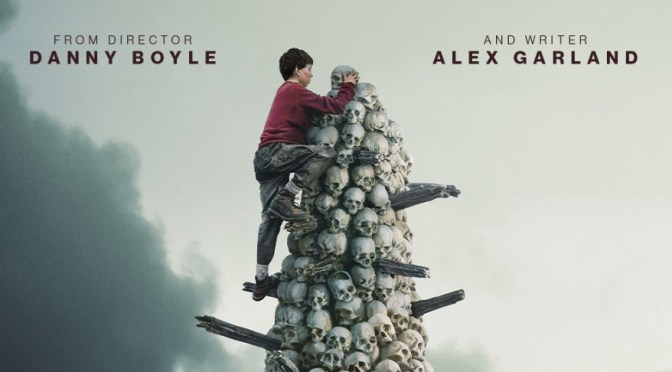
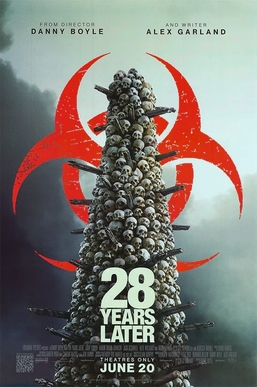
The opening sequences of28 Days Later (2002), directed by Danny Boyle and written by Alex Garland, are some of the most haunting and iconic introductions in cinema—transcending the horror genre to deliver something mythic, mournful, and terrifyingly real. They are masterclasses in mood-building, world-setting, and emotional manipulation, and redefined what the modern apocalypse could feel like on screen. From the terrifying raging simian attacks to the stunning silence of hollow streets and buildings of London as Jim (Cillian Murphy) awakes to an incredibly changed and empty planet. Here Boyle used guerrilla filmmaking as an artistic weapon with digital video blending with silence and dread, beauty and decay, loneliness and rage creating a grimy realism that no big budget blockbuster could replicate.
The opening sequence of the sequel, 28 Weeks Later (2007), was damned good as well, although what followed was not as formidable as the original. If we’re honest it was more of a high-quality straight-to-video effort, especially when compared to the incredible first film. But what of 28 Years Later (2025), which finds Boyle and Garland re-teaming with a stellar cast including: Jodie Comer, Aaron Taylor-Johnson, Ralph Fiennes and newcomer, Alfie Williams. It opens with yet another impressive opening sequence in 2002, as a family of kids are attacked in their Scottish home. Escaping on frantic foot is young Jimmy who finds his father, the local minister, in his church proclaiming the ‘end of days!’ Move forward twenty-eight years to 2031 and the film joins, interestingly enough, not Jimmy, but a survivor community living in Lindisfarne, a tidal island connected by a fortified causeway.
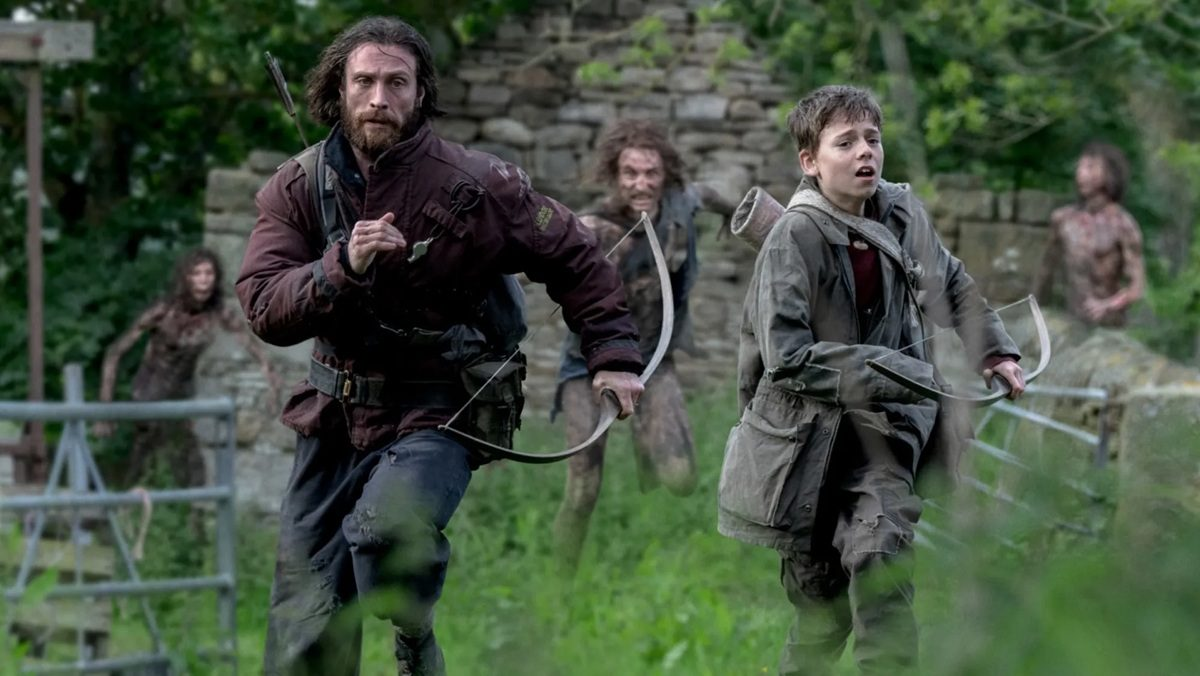
Focusing on the family unit of twelve-year-old son, Spike (Alfie Williams), and parents, Isla (Jodie Comer) plus father, Jamie (Aaron Taylor-Johnson), 28 Years Later (2025) marks a ferocious and exhilarating return to the infected-ravaged world. It is not simply a continuation, but a full-fledged reimagining that deepens, widens, and accelerates the mythology, style, and thematic power of the series. It is not just a sequel—it’s an evolution, one that pulses with the blood of Romero’s bleak social horror and the serialized depth of The Walking Dead, while forging its own cinematic identity: brutal, urgent, and conceptually masterful.
From its opening moments, 28 Years Laterplunges viewers into a world far beyond what we’ve seen before. Civilization hasn’t recovered—it has, like the zombies, mutated. The virus is no longer an outbreak or an aftermath; it is an ecosystem. What began as a confined crisis in 28 Days Later, and widened into militarized guilt and familial betrayal in 28 Weeks Later, now becomes a reckoning. Thematically, the film touches on generational trauma, hybrid immunity, rites of passage, euthanasia and the evolution of the rage undead. Jamie trains his son in the art zombie-hunting, before the middle act finds Spike attempting to save his unwell mum. At this time he both matures and overcomes several battles with mutated inhumans.
The visual grammar of 28 Years Laterstays true to the DNA of the series: raw, immediate, and grimy. But it’s also evolved. The digital grunge of 28 Days Lateris elevated with modern tools, while still embracing a handheld, documentary-style urgency. Towns and buildings aren’t just abandoned—they’re fossilized in trauma. New scenes are suffused with ash, dust, decay, blood, plasma and rusted iconography, painting a world that’s both rotting and fighting to be reborn. This is a horror film that smells like blood and diesel. It feels dirty. Every camera move, whip pan and smash cut drags you to hell and makes you feel like your life is in danger.
28 Years Laterdoesn’t just revive a franchise—it transforms it into a towering trilogy of infection, collapse, and spiritual trauma. It draws from Romero’s cynicism, The Walking Dead‘s moral complexity, and its own raw, kinetic legacy to deliver something uniquely powerful: a horror film that is both visceral and cerebral, intimate and operatic. While there are some script and pacing issues toward the end of the second act, Boyle directs superbly. Plus, the film benefits from some memorable performances, notably Comer, Fiennes and young Alfie Williams. Lastly, it has one of the most startling endings to a film I have seen in a long time. It is frankly nuts. Yet, it ensures 28 Years Later (2025) is a modern horror classic, pulsing with urgency, style, and an almost unbearable truth: that the most terrifying viruses don’t infect the body—they infect the soul. Bring on the sequel!
Produced by James Wan, Dave Caplan, Brian Kavanaugh-Jones, Chris Ferguson, etc. Main Cast: Theo James, Tatiana Maslany, Christian Convery, Colin O’Brien, Rohan Campbell, Sarah Levy, Adam Scott and Elijah Wood.
Cinematography by Nico Aguilar
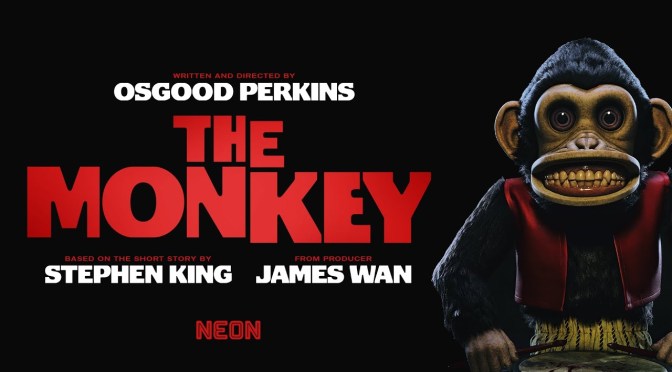
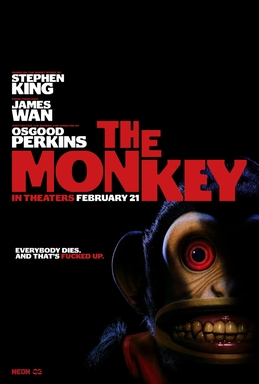
Following the financial success of his 2024 psychological thriller Longlegs (2024), Osgood Perkins has recently embarked on adapting Stephen King’s short story, The Monkey, into a feature film. While I didn’t quite connect with it Longlegs (2024) it had many impressed with its strange, atmospheric tension as well as Nic Cage’s crazy look and performance. The Monkey (2025), differs in tone though as it this adaptation with a blends horror and dark comedy, allowing Perkins to showcase his versatility as a filmmaker.
The narrative of The Monkey (2025) centres on twin brothers, portrayed by Theo James, who encounter a cursed toy monkey linked to a series of gruesome deaths. Perkins expands upon King’s original short story, infusing it with themes of family, fatherhood, reconciliation and a litany of grisly sudden deaths. Having found the simian death totem as teenagers, Hal and Bill Shelburn find their lives and those around them impacted in the most bloody explosive of ways. Indeed, there is much thought and planning given to these Saw and Final Destinationfranchise influenced on-screen set-pieces. In fact, the exquisite surprise and laugh-out-loud hilarity which occur throughout somewhat overpowers any emotional connection with the thinly-written protagonists.
The film’s gore and relentless pace are undeniably its strongest assets — the kills are extreme, inventive, and staged with a gleeful disregard for realism, echoing the chaotic energy of ’80s horror comedies. Each death sequence feels like a miniature horror short, packed with practical effects and over-the-top carnage. Perkins crafts these moments with a twisted sense of humour, making the film feel like a sketch-show carousel of nightmarish vignettes, each more outrageous than the last.
However, despite the visceral fun, The Monkey (2025) struggles to leave a lasting impression. Unlike the original Saw (2004) by James Wan and Leigh Whannell — a film that balanced its brutal horror with sharp social commentary and tightly woven mythology — Perkins’ adaptation lacks a deeper foundation. The cursed toy monkey serves as a simple harbinger of death, but the film never establishes consistent rules for how the curse operates or why it escalates the way it does. Without clear internal logic or meaningful subtext, the horror loses weight, and the emotional stakes fizzle.
While The Monkey (2025) succeeds as a frenetic, blood-soaked thrill ride, it ultimately feels ephemeral. The film’s surface-level scares and comedic flair make for an entertaining watch, but the absence of narrative substance or thematic resonance leaves it as little more than a fleeting novelty — a film you enjoy in the moment, but rarely think about after the credits roll.
Produced by Jacques Audiard, Pascal Caucheteux, Valérie Schermann, Anthony Vaccarello
Main Cast: Zoe Saldaña, Karla Sofía Gascón, Selena Gomez, Adriana Paz, Mark Ivanir, Édgar Ramírez etc.
Cinematography by Paul Guilhaume
*** MAY CONTAIN SPOILERS ***
“There’s such a thing as having too much going on.” Howard Moon from The Mighty Boosh.
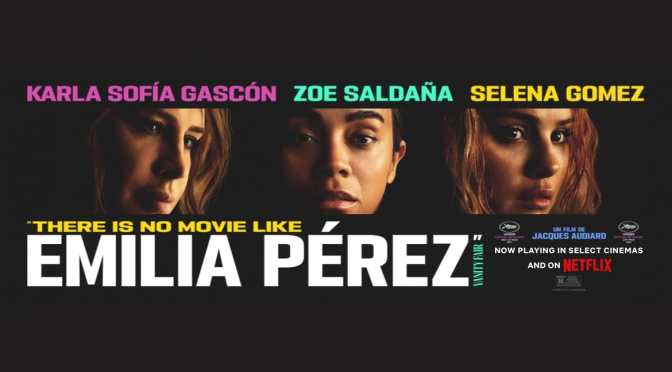
I am a big champion of the films of Jacques Audiard. When his eccentric Western, The Sisters Brothers (2018), was released I wrote a positive review and tribute to several other fine films he has directed here. Audiard likes to take risks representing human beings on the edge of society and perhaps struggling with life; people who often make left-field decisions to improve or escape their existential plight. With his latest film Emilia Perez (2024) the filmmaking master challenges the audience again with a multi-blended genre film that also contains powerful themes of transformation, redemption, violence, crime and family values. Oh and there are songs too.
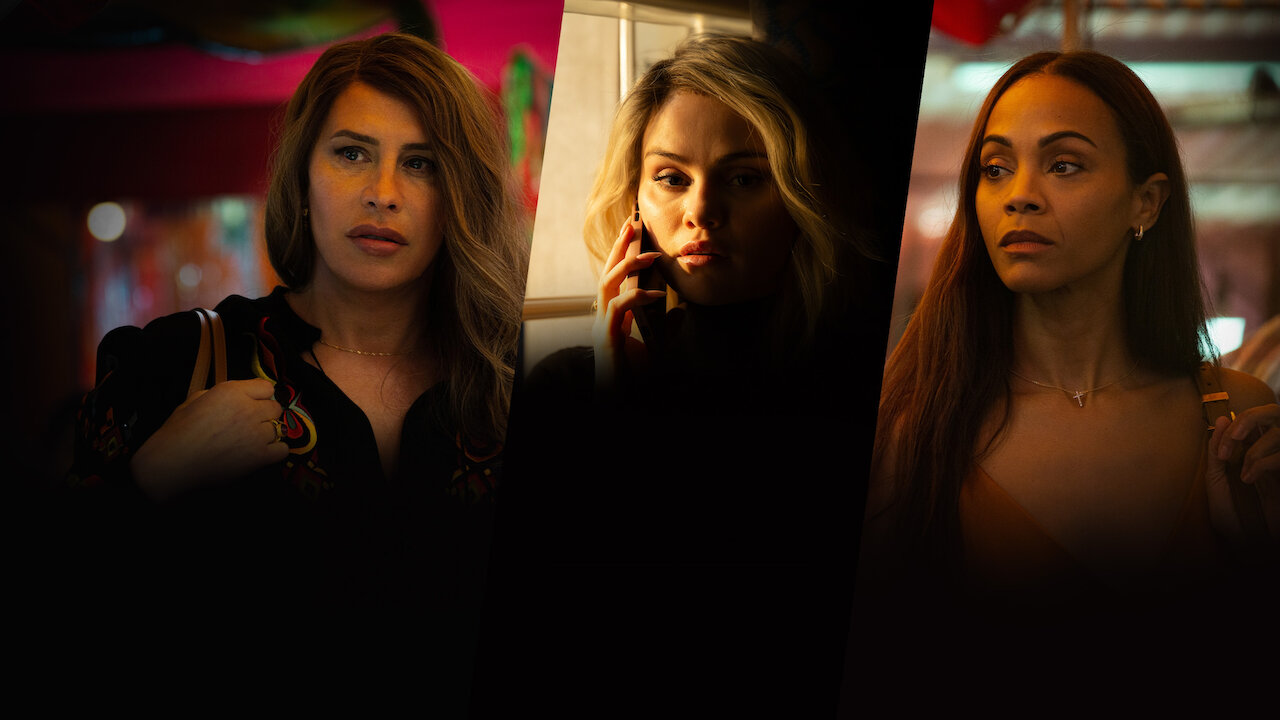
The narrative begins strongly as Rita Mora Castro (Zoe Saldana), a fiercely talented yet overlooked lawyer in Mexico City, finds herself thrust into the spotlight when she defends the wife of a prominent media mogul in a controversial murder trial. Despite her misgivings, Rita crafts a chillingly persuasive argument that frames the death as a suicide, securing an unexpected victory in the case—one that leaves her both celebrated and haunted.
As the dust settles, Rita’s restless dissatisfaction with her life grows louder. Then comes an anonymous phone call: an enigmatic voice offers her a chance at something extraordinary—and extraordinarily dangerous. Intrigued and desperate for change, she agrees to a clandestine meeting. The mysterious client turns out to be none other than Juan “Manitas” Del Monte (Karla Sofía Gascón), a ruthless and feared cartel kingpin. But the request they make isn’t what Rita expects from a crime-lord. Manitas dreams of living authentically by undergoing gender-affirming surgery and becoming a woman. Rita must decide: will she help Manitas rewrite their story, or will she risk becoming the next chapter in a tale of betrayal and bloodshed?
This fascinating set-up draws you in and I believe if Audiard’s narrative had concentrated mostly on the relationship between Rita, the transitioned, Emilia, then the film would have retained much emotional and thematic power. Yet, after Emilia’s operation the screenplay introduces several other story strands and characters to take in, including Selena Gomez’ feisty Jessi Del Monte, Manitas’ ex-wife who thinks “he’s” dead. This development works initially but then Audiard hurls so many more ideas and genres at the audience wall, not all of them sticking.
Admittedly, the film’s audacious blend of melodrama, crime, thriller, musical, and comedy creates an unpredictable and frenetic narrative that keeps viewers on their toes. However, this constant genre-shifting can undermine the weight of its core themes—gender and identity—by overshadowing them with spectacle and tonal inconsistency. The story’s rapid turns and refusal to settle into a single emotional or narrative groove risk, arguably trivializing the profound struggles and triumphs of its trans-protagonist. Moments that could serve as deeply reflective or cathartic explorations of gender identity are sometimes undercut by abrupt pivots into slapstick humor or hyper-stylized action. While these shifts might aim to reflect the disarray and fluidity of identity in a chaotic world, they can also dilute the thematic resonance.
At the same time, it’s clear Audiard is deliberately embracing this chaos and analysis of human flaws. The fractured tone might symbolize a world where stability and clarity are illusions, mirroring the internal and external conflicts of someone navigating personal transformation in an unyielding environment. This approach, while conceptually intriguing, can feel alienating. Nonetheless, the cast’s stellar performances anchor the film, ensuring that the characters remain compelling even when the story spirals into excess. Lastly, Emilia Perez‘ (2024) relentless energy often leaves little room for introspection, and whether this genre-chaos enriches or undermines the narrative depends largely on the viewer’s tolerance for Audiard’s embrace of choral disorder in a world seemingly allergic to calm and pattern.
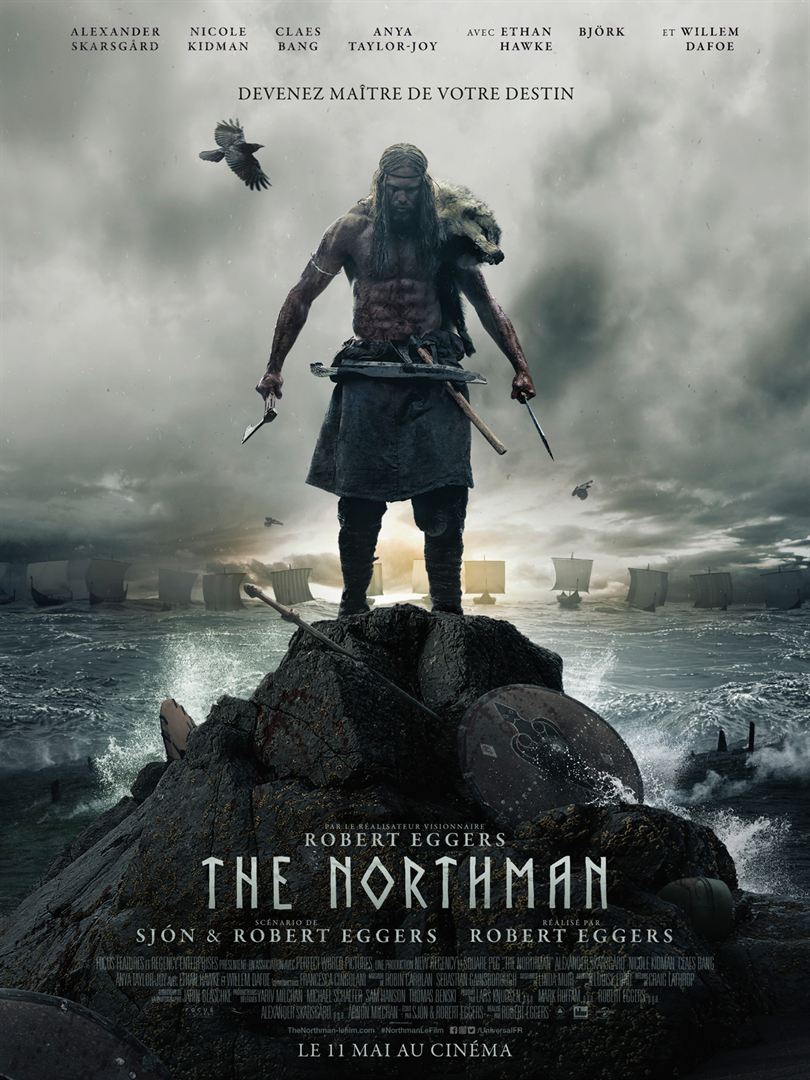
Based on: The Legend of Amleth by Saxo Grammaticus
Produced by: Mark Huffam, Lars Knudsen, Robert Eggers, Alexander Skarsgård, Arnon Milchan
Cast: Alexander Skarsgård, Nicole Kidman, Claes Bang, Anya Taylor-Joy, Ethan Hawke, Björk, Willem Dafoe, etc.
Cinematography Jarin Blaschke
*** MAY CONTAIN SPOILERS ***
Robert Eggers is a formidable cinematic talent. His dark visions of folklore and historical fable are steeped in impressive research and a striking attention to detail within his work. Artistically and thematically speaking, Eggers is a major talent, however, one could argue his narratives deny clarity preferring hazy ambiguity. His debut film The Witch (2015) is an arthouse classic, but I just did not connect with the characters, despite the filthy realistic strangeness. His follow-up, TheLighthouse (2019), is a claustrophobic, black-hearted and dirty descent into a watery hell. Both are bravura low-budget films which created two distinct periods. In both films you can almost feel the plague and scurvy in your mouth, presented as they are with such earthy authenticity.
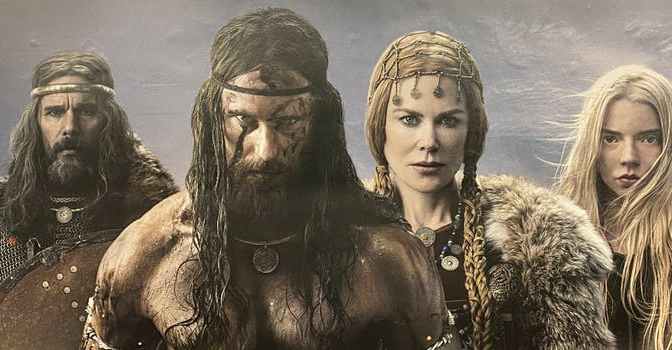
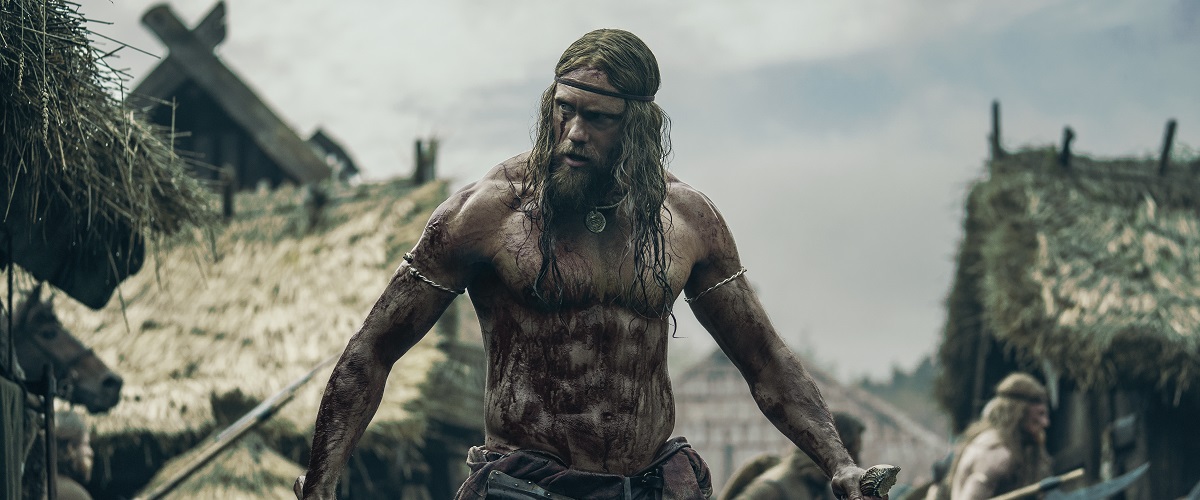
Thus, unsurprisingly, Robert Eggers latest film is NOT a romantic comedy. The Northman (2022) is another obsessively researched and realised historical drama. But because of the reported $70 million budget, his vision of Vikings and blood and revenge and muscle and familial treason and murder screams epic, more epic and even more EPIC! Eggers script and story is inspired by the historical myth, The Legend of Amleth, a narrative which in turn is said to have influenced none other than the quite well known play, Hamlet. Here Eggers has a solid structure for the thunderous battles and mystical manifestations on show. Our hero, Amleth (Alexander Skarsgård), finds his father, the King (Ethan Hawke) murdered by his uncle (Claes Bang), while he is a boy. Fleeing his village he grows into a scary, ripped and roaring Viking warrior who has never even seen a carbohydrate. A hunger for bread and a desire for revenge on his uncle propels the story powerfully. Intense Amleth must locate his kidnapped mother (Nicole Kidman) and smash the man who did his family wrong.
Eggers is a brilliant film director. In Alexander Skarsgård he also has a battering ram of a physical specimen leading the charge from deathly pillage to bloody battle to fiery hand-to-combat with impressive purpose and power. Amidst the vengeance-fuelled fight sequences and Amleth’s confrontations with the seers and magicians of the land, his journey also encompasses love and marriage to Olga of the Birch Forest, a Slavic sorceress (Anya Taylor-Joy). While Skarsgård’s character is more muscle than charisma, Taylor-Joy breathes ethereal and sensual life into the middle act. Their collaboration battling against enforced slavery gives us something to root for above the familiar revenge plot. Having said that, Amleth is not the easiest of characters to warm to. Despite Eggers genius and Skarsgård’s brutalism I wondered if I really cared about his quest.
I would argue that this story was done far more successfully from an emotional perspective by Ridley Scott’s awesome Roman epic, Gladiator (2000). Russell Crowe was just phenomenal as Maximus and his performance was one of magnetic emotion and charismatic depth. That film had amazing action married to integral character development. However, there is a violent momentum to The Northman (2022), with Amleth’s quest charging like a juggernaut toward the jugular of his foes. Eggers’ image and colour system of Viking costumes, iconography, weaponry, plus human, godly and ungodly beings provide the depth when the characterisation feels thin. And wow, does he know how to stage a battle. Bones crunch, teeth crack, blood bursts and weapons sever, scorch and devastate. As the fire burns in Amleth’s heart and across the landscape, The Northman (2022) rages from the cinema screen with dominant visual ascendancy.
Halloween is slowly creeping out of the fog and shadows. It’s a time of the year where horror films come to the fore. Personally, I watch horror all the year round, but it’s always fun when the genre pulls focus on the cultural calendar.
Rather than concentrate on current horror film releases, I thought it would be interesting to seek out chillers that are a tad less known. So, I had a scan through Amazon and Shudder screening platforms and unearthed several cult horror gems worth catching.
Some of these films come from the 1980’s period which encompassed the “video-nasty” era in the United Kingdom. With the advent of home video technology, the government suddenly got frightened about bloody and exploitational films and desired control. Censoring seventy-two titles and banning a flurry of films actually made people want to watch them more. This caused the government’s policy to backfire as people clamoured to watch “pirate” video versions of such films. In fact, it was in the living room watching forbidden films and the old Universal black-and-white classics where my true love of horror cinema began.
The following films may not have been banned at the time, but I was intrigued by how many of the titles I missed seeing on first release. Aside from Ben (1972), When A Stranger Calls (1979) and Phantasm (1979), I hadn’t seen the other titles. Therefore, if you’re looking for obscure horror films to watch then delve deep into the Amazon library. They have a fine feast of 1970’s and 1980’s fear inducing fare, many of them which were on the infamous “video-nasty” list. Dare you watch them!?
THE CAT OF NINE TAILS (1971)
An early Dario Argento giallo finds a blind puzzle-maker (Karl Malden) and dogged reporter (James Franciscus) investigating murders at a genetics lab. Aside from a couple of scary set-pieces, notably in a graveyard, it neither works as a detective nor horror story. It is however beautifully filmed with a vibrant restoration. (Mark: 6 out of 11)
CHUD (1984)
As the Nuclear Regulatory Commission track down missing toxic waste the New York homeless population are becoming victims to something monstrous in the sewers. An energetic sci-fi-horror hybrid combining a schlocky plot with socio-environmental themes. It’s not bad and actually quite funny, with early roles for John Heard and Daniel Stern whose acting raises the overall quality. (Mark: 6 out of 11)
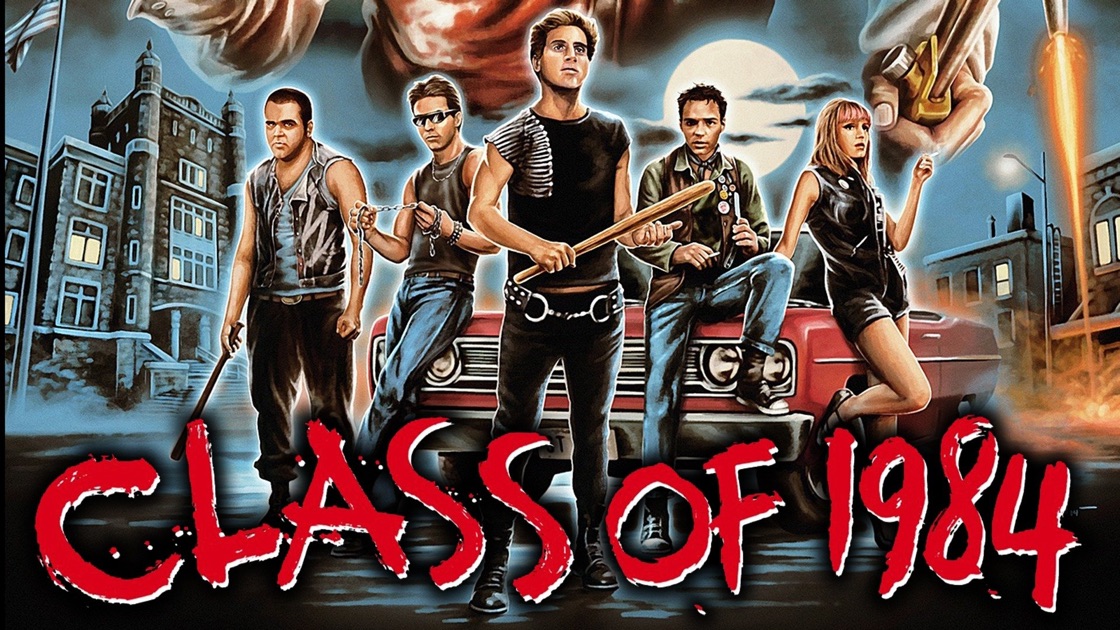
CLASS OF 1984 (1982)
I remember school kids raving about this film when I was twelve. I really wanted to see it, but could never find it in the video shop or from the “pirate” video guy. The plot merges The Blackboard Jungle (1955) with Death Wish (1974), as Perry King’s music teacher attempts to soothe the savage beast of a gang of nasty punk students. He fails and the final act revenge-driven rampage is fantastically inventive and gory. Latterly famous director, a young Tim Van Patten, portrays the psychotic, Peter Stegman, with vicious zeal. A true exploitational classic. (Mark: 8 out of 11).
HELL NIGHT (1981)
This is one of those films I had never even heard of. With a sizeable budget of $1.4 million dollars for a slasher film, it concerns four college students, including a grown-up Linda Blair, spending the night in a creepy house as part of an initiation ritual. Unfortunately, there’s a psychotic killer about hellbent on hunting them down. We’ve seen it all before, but it was nicely filmed and had decent humour. Overlong but way better than I thought it would be. (Mark: 7 out of 11)
PHANTASM II (1988)
I reviewed the remastered version of Don Coscarelli’s low-budget masterpiece here, but only just got round to watching the sequel. Phantasm II (1988) had a bigger budget and suffers from some stodgy plotting. The re-casting of Mike with James Le Gros in the role throws you. Yet, once Mike and Reggie fight with the Tall Man (inimitable Angus Scrimm), the razor-sharp spheres and the hooded monsters, the film finds real pace. Coscarelli blows-up a lot of stuff and ramps up the weaponry, but the sequel lacks the twisted magic of the original must-watch horror fantasy, Phantasm (1979). (Mark: 6.5 out of 11)
TERROR TRAIN (1980)
Another unknown mini-gem I found on Amazon. This Canadian slasher film is, you guessed it, set on a train and finds, yes you guessed it again, college students getting picked off one-by-one by a vengeful psycho. Notable for a really good plot which gives the killer empathy and understandable motivation, it also stars everyone’s favourite final girl, Jamie Lee Curtis. With disguise and magic prevalent in the themes, David Copperfield also appears in a neat role. Highly entertaining with a killer twist. (Mark: 8 out of 11)
WHEN A STRANGER CALLS (1979)
Inspired by a famous urban legend, Fred Walton’s chilling suspense thriller has one of the most nail-biting opening twenty minutes in horror cinema. Carol Kane is the babysitter terrorized by a series of tense phone calls from a mystery ringer. From that terrifying start the story falters slightly as it focusses on Charles Durning’s obsessive search for the unhinged man. Only when Kane rejoins the film some years later does the horror rise up again in a truly frightening denouement. (Mark: 8.5 out of 11)
WILLARD (1971) / BEN (1972)
This was an odd one because I knew and seen the sequelBen (1972) when I was a younger. Little did I realise the original Willard (1971) had been released the year before and became a sleeper box-office hit. Bruce Davison is excellent as the introvert, Willard, who is bullied at work by his aggressive boss, Ernest Borgnine. Only when, and take a deep breath here, Willard trains an army of rats does he gain confidence to take on the world. It’s a weird film that actually works because of Willard’s fascinating character arc and Davison’s nuanced performance. (Mark: 8 out of 11)
The follow-up Ben (1972) focusses on Willard’s alpha rat, Ben, and his friendship with lonely kid, Danny. The sequel really raises the rat count and there appears to be thousands of them in their dirty lair. Danny is a likeable kid who suffers from a serious illness that prevents him from going out. Why he would make friends with a killer rat though is still frankly nuts! A lack of thrills and goofy premise make it difficult to recommend, and is more famous for the classic Michael Jackson hit called, surprisingly enough, Ben.(Mark: 6 out of 11)
Who doesn’t like a great movie death? Well, people who abhor violence and gore on the screen. But I am not one of those people. Thus, if done right in terms of combining emotional context and cinematic imagination, there’s nothing I like more than revelling or lamenting a character’s end in fine bloody fashion. Lastly, I hear you ask why no Zahler, Scorsese, Cronenberg, Miike, Peckinpah, Jackson, Fulci, Roth, Romero, Argento etc. on this list? So much death and only six make it, so please suggest any of the thousands I have missed off in the comments.
*** CONTAINS SPOILERS ***
ALIEN (1979) – “Do these eggs taste off?”
I think it may have been something Kane (John Hurt) ate or maybe something that ate him? Anyway, one of the most spectacularly surprising scenes ever still holds amazing power to this very day.
THE FURY (1978) – Separated at death!
This under-rated tele-kinetic thriller is a spiritual sequel to Carrie (1976). Adding a spy conspiracy plot to Amy Irving’s rites of passage character arc, it has a whip-cracking-pace and classic DePalma set-pieces. None more so than the explosive end of the baddie-in-black.
PSYCHO (1960) – Take a bath next time!
What more can be written about one of the most shockingly original scenes in cinema history? Not only did Hitchcock break all narrative rules killing off the main protagonist halfway through, he did it with one of the most ingenious uses of montage, music and murder ever.
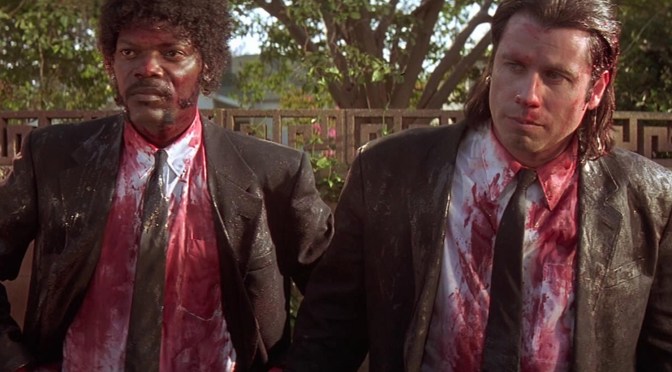
PULP FICTION (1994) – The original “face-off!”
Marvin never saw it coming. But let’s face it – none of us did!
ROBOCOP (1987) – Toxic Wasted!
Whoever designed this action scene, no doubt Paul Verhoeven had much to say, delivered one of the most excessive demises in 1980’s cinema. The vehicle crash, the toxic waste, the melting bad guy, the steam coming off his body and the final disintegration are just cinematic perfection.
WILD AT HEART (1990) – Bobby Peru loses his mind!
David Lynch’s vibrant adaptation of Barry Gifford’s romantic thriller contains many colourful characters. Willem Dafoe’s Bobby Peru is a particularly nasty piece of work and he gets his comeuppance in an incredibly visceral and disturbing way!





 The Cinema Fix presents