Tag Archives: David Lynch

BFI Film Review: Scala (2023) – At the Altar of Nostalgia for the Scala Cinema!

BFI Film Review: Scala!!! (2023)

Directed by Ali Catterall & Jane Giles

Produced by Andrew Starke, Alan Marke & Jim Reid

Cinematography by Sarah Appleton

Edited by Andrew Starke and Edward Mills

Music by Barry Adamson
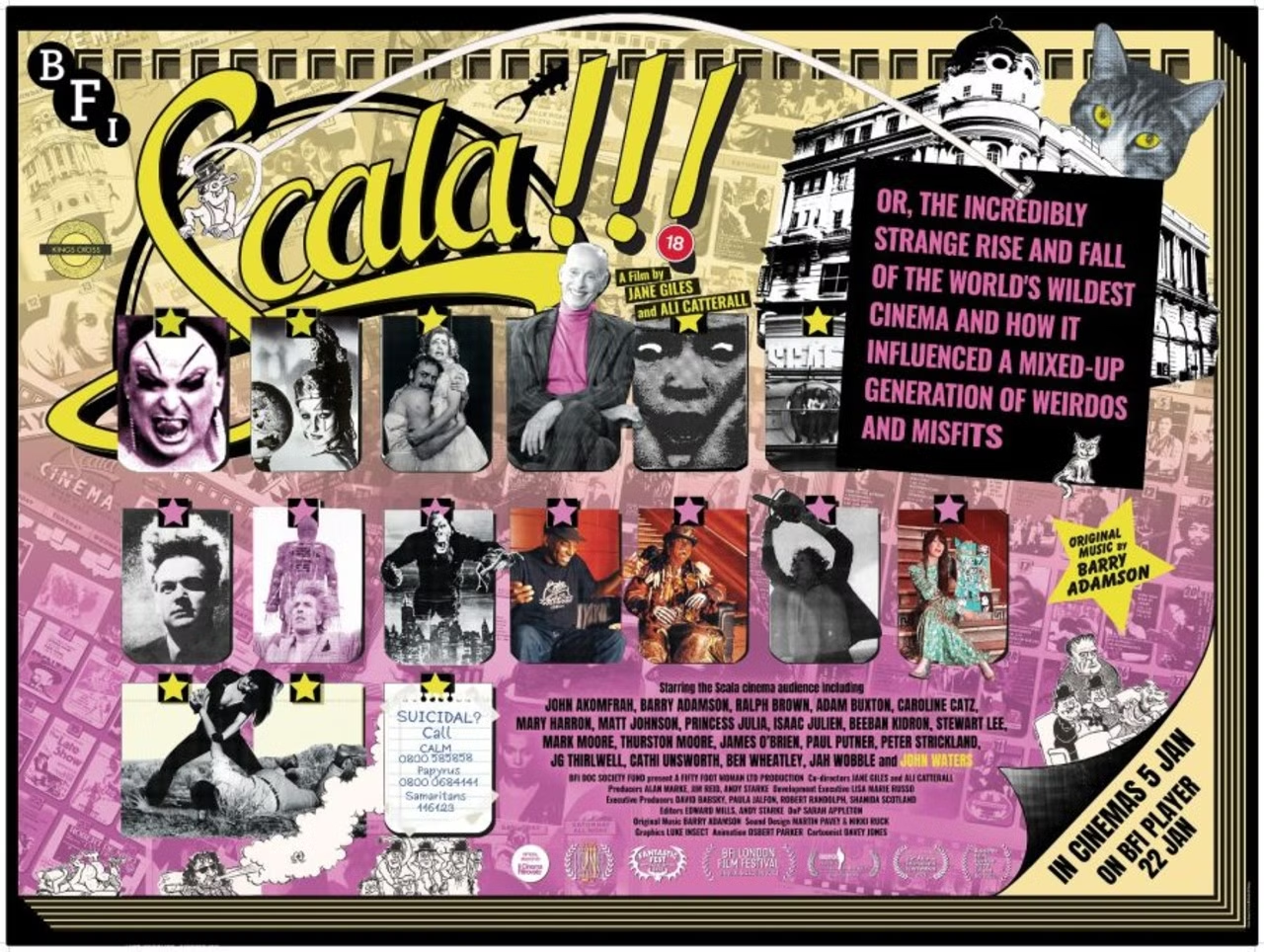

The Scala Cinema, nestled in the heart of London, was more than just a film theatre; it was a refuge, a haven for anyone with a passion for films that didn’t fit into the mainstream mold. I can still feel the sticky floors, the cats in the dark, hear the muffled sounds of the trains passing overhead, and see the hazy red glow that filled the theater. In the 1980s and 1990s, going to the Scala wasn’t just about watching a film; it was about being part of a community that celebrated the bizarre, the boundary-pushing, and the boldly artistic.

During those years, the Scala felt like my second home. It was where I could disappear into films that I couldn’t find anywhere else – obscure horror flicks, campy B-movies, gonzo-pornos, arthouse selections, and controversial classics from around the globe. It was my church. Films by David Lynch, John Waters, Yuen Woo-ping, Derek Jarman, Werner Herzog, Sam Raimi, Lucio Fulci, Russ Meyer, Kathryn Bigelow, Alex Cox, John Woo, Stanley Kubrick, Jane Campion, Orson Welles, Dario Argento, Alejandro Jodorowsky and many more – each screening felt like a small rebellion, a discovery that I’d carry with me. The Scala didn’t just show movies; it curated experiences. All-night marathons, double bills, and surprise screenings became a staple of my weekends, filling my mind with scenes that blurred the line between reality and the outrageous.


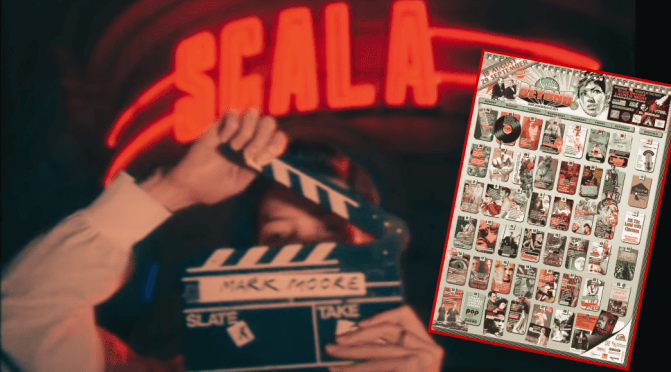
When I watched the Scala documentary on BFI Player, a flood of memories came rushing back. It was as though I’d been given a ticket back to those wild, late nights. I remembered how Scala regulars would shout lines at the screen or break into laughter at inopportune moments, making each viewing unique and unpredictable. The documentary captured not only the films but the spirit of the place – the staff who loved cinema as much as the patrons did, the strange but welcoming crowd, and the sense that Scala wasn’t just a venue but a movement. Watching it felt like reconnecting with a part of myself, an era when cinema was raw, thrilling, and unpolished.

The Scala in King’s Cross is a legend, and for those of us who were lucky enough to experience it, it’s a chapter we’ll always cherish. I was even there when they showed A Clockwork Orange (illegally), which led to the ill-fated court case which forced it to close. This documentary is both a valuable historical document and a joyous sharing of stories from those who worked there and attended the films shown, including: Mark Moore, Mary Harron, Isaac Julien, John Waters, Ben Wheatley; Barry Adamson, Matt Johnson, Adam Buxton, James O’Brien, Stewart Lee, Lisa Power and Graham Humphreys. Overall, the Scala Cinema wasn’t just about the films we watched; it was about finding a place where film became more than entertainment – they were a way of life.
Mark: 9 out of 11


Cinema Review: The Substance (2024) – A Dark Exploration of Identity

THE SUBSTANCE (2024)

Directed by Coralie Fargeat

Written by Coralie Fargeat

Produced by: Coralie Fargeat, Tim Bevan and Eric Fellner

Main Cast: Demi Moore, Margaret Qualley and Dennis Quaid

Cinematography by Benjamin Kracun

*** MAY CONTAIN SPOILERS ***


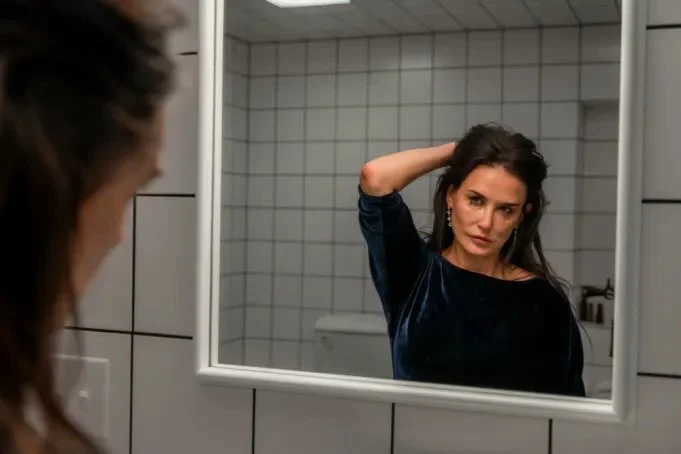
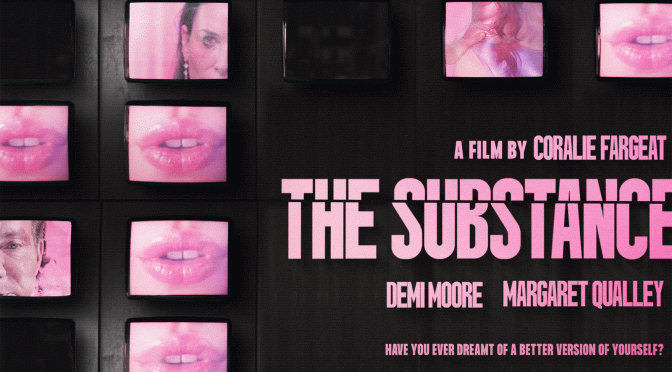
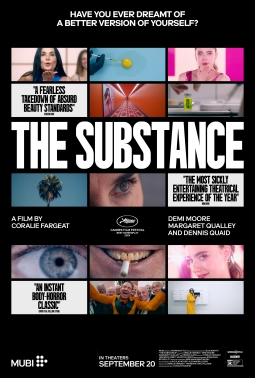
The Substance (2024), directed by Coralie Fargeat, is a visually striking and visceral film that pushes the boundaries of body horror and psychological terror. Fargeat, known for her raw and relentless style in Revenge (2017), once again delivers an unforgettable experience by weaving references to classic literature and horror cinema into a narrative that is at once familiar and entirely original.

Demi Moore portrays a former Hollywood star, Elizabeth Sparkle, now relegated to doing a mildy successful cable TV aerobics show. However, Dennis Quaid’s oily production executive is on the lookout for younger talent. Elizabeth soon finds herself on the media scrapheap. Desperate to regain her youth and career, Elizabeth is drawn to the hypnotic promise of a new product called ‘The Substance.’

Before you can say, “Dorian Gray”, Elizabeth is lured to a strange white room full of lockers and has committed to the process. Similar to Gremlins (1984), there are rules to follow. As she follows the steps and injects the potions, Elizabeth goes through a painful and incredibly impactful transformation process. She literally gives birth to a young and beautiful alter ego called, Sue (Margaret Qualley). Elizabeth and Sue then get seven days each to live their life before they have to swap back. What could go wrong?


The film’s core themes draw heavily from Robert Louis Stevenson’s Dr. Jekyll and Mr. Hyde, exploring duality, identity, and the monstrous potential hidden within human nature. Like Stevenson’s tale of inner conflict, The Substance delves into the consequences of scientific ambition. It investigates moral transgression but with a modern, feminist twist. Fargeat’s use of body horror, particularly in the transformation sequences, echoes the grotesque, unsettling work of David Cronenberg. The nightmarish atmosphere and surreal visuals are reminiscent of David Lynch’s unsettling dream logic. This is notably seen in Eraserhead (1977) and Mulholland Drive (2001).

The film also pays homage to John Carpenter’s The Thing (1982), with its transmogrifying frights, sense of creeping paranoia and rising conflict. But rather than a group of men fighting each other Elizabeth and Sue turn on each other over ownership of their physical existence and Hollywood status. The final act descends into hellish and bloody satire echoing Peter Jackson’s Braindead (1992), with gore galore. Moreover, Stanley Kubrick’s influence is palpable in the film’s meticulous framing, production design and tension-building. The climactic body-morphing scenes, however, most clearly nod to Brian Yuzna’s Society (1989), with its grotesque depictions of class and conformity, fused with Fargeat’s unique vision of female empowerment, revenge and resistance.

The Substance (2024) feels like a bigger budget film in look and style, but you soon realise the minimal number of sets used and a lack of crowd scenes, finds the narrative effectively becoming a two-hander in the middle act by focusing on Sue and Elizabeth’s internal retaliatory vindictiveness. There are some amazing framing, colour design and cinematographic choices as showers become tombs to trap the protagonists. The book-ended Hollywood star montage and returning final shots are imaginative and unforgettable. Got to say that Demi Moore, as an actress taking on a role of an aging and neurotic former star is genius casting. While Qualley delivers a sexually charged and energetic performance, it is Moore who carries the weight of the complex themes as Elizabeth’s journey dives deeper into the stuff of nightmares.

Overall, The Substance (2024) is a postmodern classic and a film that honors its influences while forging its own path. Fargeat uses these references to enrich the narrative, creating a damned ugly and beautiful satire on those seeking narcissistic perfection through unnatural means, ultimately paying the price of those seeking eternal youth and fame.

Mark: 9 out of 11


CULT FILM REVIEW: HOUSE/ハウス – (1977)

CULT FILM REVIEW: HOUSE (1977)

Directed by: Nobuhiko Obayashi

Produced by: Nobuhiko Obayashi, Yorihiko Yamada

Screenplay by: Chiho Katsura

Story by: Chigumi Obayashi

Cast: Kimiko Ikegami, Miki Jinbo, Ai Matubara, Kumiko Oba, Mieko Sato, Eriko Tanaka, Masayo Miyako, Yōko Minamida

Music by: Asei Kobayashi, Mickie Yoshino

***MAY CONTAIN SPOILERS***


This Japanese film from the late 1970s is absolutely nuts, but a riotous genre mash-up of rites-of-passage, horror, musical, martial arts, romance, fantasy, comedy and anti-war genre movie styles. If you are a fan of the work of Takashi Miike’s both energetic and often insane genre films, you can definitely see how, House (1977), may have had a major influence on his and many other Asian filmmaker’s cinematic works.

Initially receiving negative reviews, but big box office in Japan on release, House (1977), opens by introducing a set of seven teenage girls called, Gorgeous, King Fu, Prof, Melody, Fantasy, Mac and Sweet. The names give them their major characteristics too. Kung Fu for example loves martial arts, Fantasy is a daydreamer and Melody loves music etc. You get the idea. As each character is introduced in a basic fashion, the energetic performances of the actors and the quirky screenplay develops their characters beyond the initial stereotypes. Gorgeous is especially well developed as she is suffering the loss of her mother and has rejected her father’s choice of stepmother. Eschewing her kindly father’s protestations, she decides to visit her aged Aunt in the countryside.


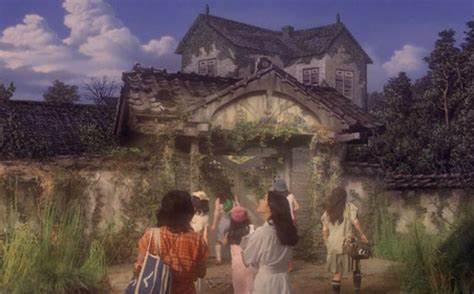
When Gorgeous’ friend’s school trip is cancelled due to several bizarre plot turns, and a couple of crazy musical numbers later, the girls join her on the visit to the creepy house. When they finally arrive Gorgeous’ aunt behaves extremely oddly. She rarely gets visitors and only has a white cat for company. When the girls begin to disappear one-by-one and Fantasy’s daydreams begin to turn to nightmares, the true horror of the situation takes shape. The house itself is a malevolent force and has trapped the girls. What appeared to be a lovely summer vacation is now the total opposite.

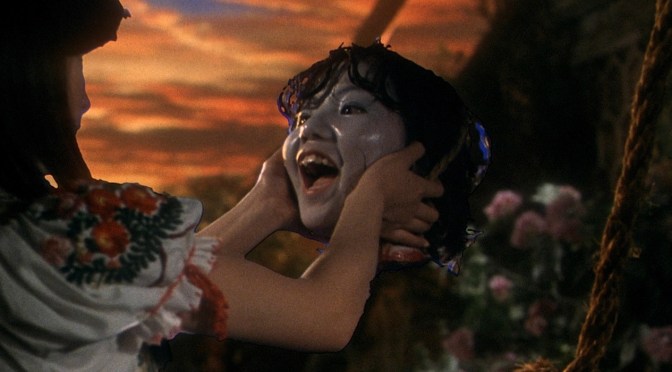
Now, what I have described actually seems quite normal in terms of the narrative content. It’s a standard horror plot of characters imprisoned by supernatural forces and trying desperately to stay alive. However, director, Nobuhiko Obayashi, who devised the story with his daughter, presents a series of images and sounds David Lynch would have been proud to have devised. These include: a mirror attacking the viewer, a watermelon being pulled out of a well appearing like a human head, a pile of futons falling on and attacking a character, a carnivorous piano with biting keys and all manner of surreal fights and deaths. Allied to this the eccentric and jolly music works against the horror and suspense, so one is both laughing and disturbed simultaneously.

Ultimately, House (1977) is one wacky viewing experience, but it also taps into themes of friendship, romance, grief, as well as drawing on the horror of destruction Japan suffered when the atomic bombs hit Nagasaki and Hiroshima. It is fast paced with an abundance of imaginative ideas, film styles and practical effects throughout. Thus, if you love the work of aforementioned Miike, Lynch and Sam Raimi, you are bound to want to stay in House (1977) for the rapid eighty-eight minutes duration.


CULT FILM REVIEW: ERASERHEAD (1977)

CULT FILM REVIEW: ERASERHEAD (1977)

Directed by: David Lynch

Produced by: David Lynch

Written by: David Lynch

Cast: Jack Nance, Charlotte Stewart, Allen Joseph, Jeanne Bates,  Judith Roberts etc.

Music by: David Lynch, Fats Waller, Peter Ivers

Cinematography: Frederick Elmes, Herbert Cardwell

***CONTAINS SPOILERS***


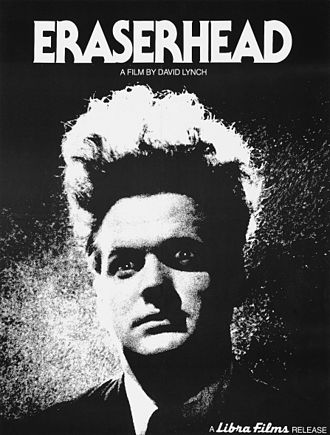
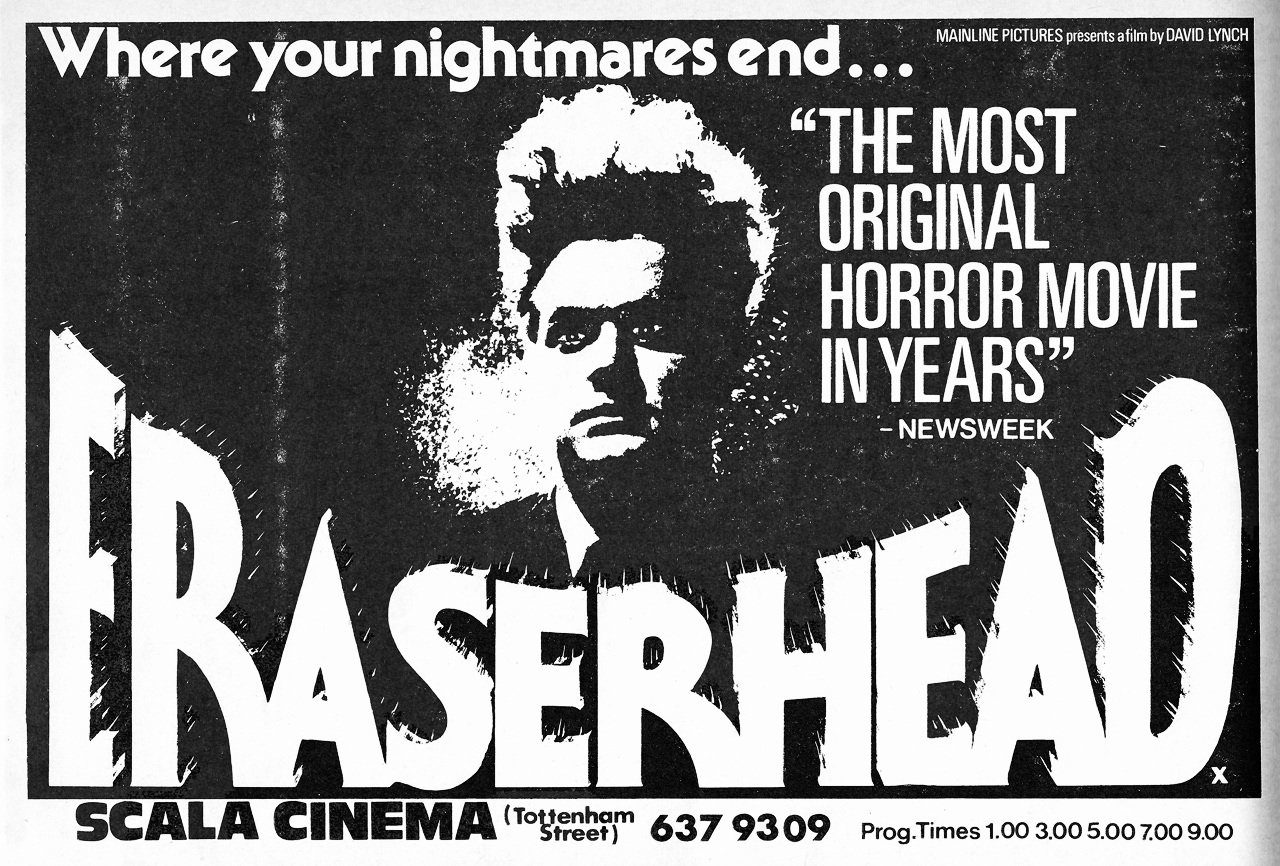
“In heaven everything is fine”, sings the ‘Lady in the Radiator’. Is it really, David, because during the course of your cinematic vision known as Eraserhead (1977), we witness all manner of things which demonstrate heaven is far from our reach. We see the scarred ‘Man in the Planet’, apparently controlling Henry Spencer’s (Jack Nance) fate with mechanical levers. There are also floating heads, blood-squirting chickens, weird alien-looking babies, an enigmatic femme-fatale, a shock-haired and shock-faced protagonist; all existing in an industrial abyss presented in bleak monochrome. If there is a heaven, no one’s getting there!

David Lynch’s debut feature film is a masterpiece of independent cinema. A surrealist, dystopian and anxiety-inducing collage of fantastic images and industrial sounds. Moreover, Eraserhead (1977) was a labour of love for the enigmatic filmmaker. Lynch took years to finish the production. So much so there is one scene where Nance’s character Henry, walks from a corridor through a door. While the edit is immediate, the filming dates were one year apart. Thankfully, Jack Nance didn’t get that famous quiff cut off. Moreover, money was tight. Lynch financed the film from doing part-time jobs, plus he received help from the American Film Institute, family members, and very good friends. There was no Kickstarter in those days.


While Eraserhead (1977) has many seemingly unconnected and bizarre images and freakish scenes, there are several powerful themes running through the film. Indeed, it is a Freudian classic with the nervous and anxious Henry, being lead from one challenging situation to another. The fear of responsibility and parenthood hangs heavy in Lynch’s psyche. Henry lacks confidence and sexual adequacy. Even when he attempts a relationship with Mary (Charlotte Stewart), his sanity is hanging on a thread. Mainly due to the fact their child is a sad, mutated monstrosity. But to Henry’s credit he attempts to love the child, even though such paternal care is doomed.

Lastly, given it had such a low-budget, took the best part of a decade to shoot and spent over a year in post-production, Lynch cinematic skills are meticulously represented in Eraserhead (1977). Kudos as well to the stark cinematography, Nance’s startling deadpan performance, plus Lynch’s incredible soundscape designed with Alan Splet. Ultimately, while it is a powerfully strange film, there is actually much method and heart in Lynch’s madness. The urban decay and freakish nature of Eraserhead (1977) taps into primal fears of bringing a child into a dark world. I, for one, can certainly identify with that.


SIX OF THE BEST #20 – FILM DOPPELGANGERS

SIX OF THE BEST #20 – FILM DOPPELGANGERS

While I haven’t seen it yet, I was slightly intrigued by the release of Will Smith’s action film, Gemini Man (2019). Any film which examines the nature of the double or doppelganger always interests me. As you may be aware the word doppelganger is of German origin. It means “double walker” or “double goer” and I just love it. I love the way it sounds and the mysterious connotations it conjures up. It kind of sounds evil as well; like nothing good can come of it.

There have been many films, books and television programmes featuring doubles. They can occur for various reasons such as: twins, clones, shape-shifters, split personalities, mental breakdown and ghostly or other fantastical elements. We must not forget time-travel or inter-connected timeline plots either. Different versions of the same character existing simultaneously in alternate or exact timelines are very prevalent in fiction also.

In this occasional ‘Six of the Best’ series, I would like to consider six “double” or doppelganger films which are definitely worth watching. To make it interesting I would like to consider the more symbolic, fantastical and unexplained kind of films out there. I cannot avoid the twin or clone plots in certain examples, but the temporal double stories have, sort of, been explored here in an article about time travel films.

***CONTAINS MASSIVE SPOILERS***


THE ARMY OF DARKNESS (1992)

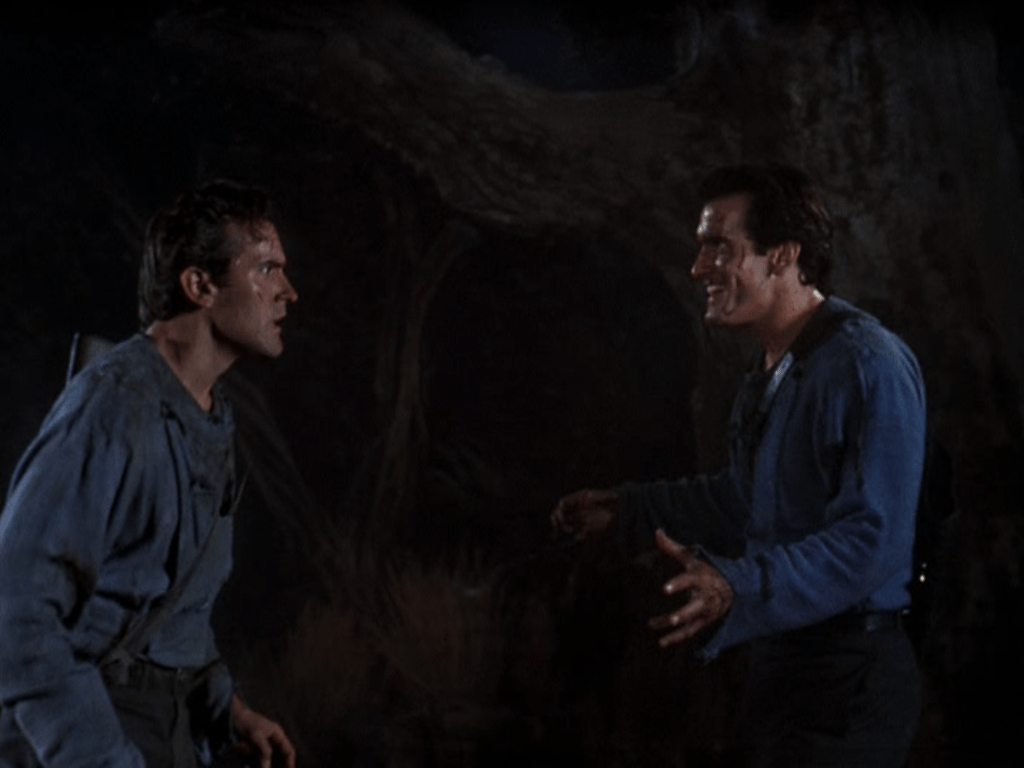
Having done some online research of films featuring doubles, Sam Raimi’s riotous Evil Dead 3: Army of Darkness (1992), is cruelly missed from many of those lists. In this gory and over-the-top medieval horror romp, Ash (Bruce Campbell), finds himself in battle against hordes of Deadites. This is all because he gets a spell wrong and splits in two. He then comes face-to-face with his vicious double, Evil Ash. I hate it when that happens – don’t you! While not the deepest of the films listed here, it’s worth watching because you get TWO Bruce Campbell’s for the price of one!


THE DOUBLE LIFE OF VERONIQUE (1991)

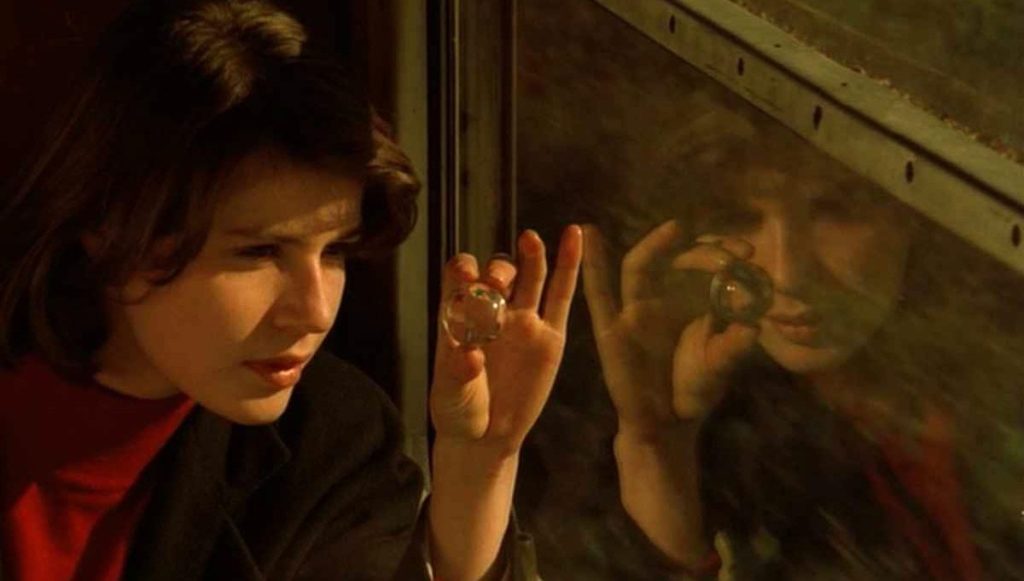
The antithesis of the genre joy that is Army of Darkness, can be found in this profound study of identity, directed by Krzysztof Kieslowski. It concerns two identical women, Weronika and Veronique (both Irene Jacob), who live in Warsaw and Paris, respectively. Aside from one fleeting moment they never meet, but somehow, telepathically, artistically and emotionally, they are connected to each other. A beautiful, yet obtuse narrative, allied with Kieslowski’s poetic style make this a difficult film to understand. However, it contains fine symbolic power and is open to a myriad of interpretations.


ENEMY (2013)

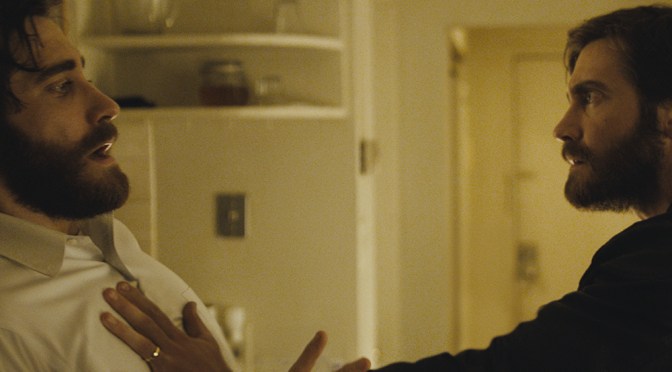
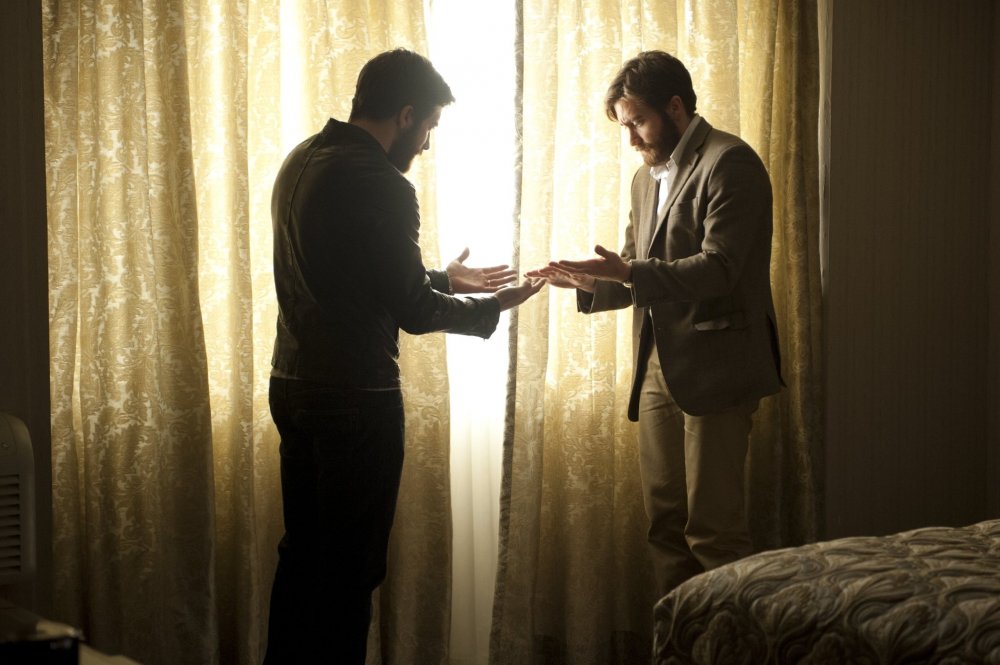
Denis Villeneuve’s directs this adaptation of Jose Saramago’s book called The Double or The Duplicated Man. In it Jake Gyllenhaal plays both a college professor, Adam Bell and his exact lookalike, actor, Anthony Claire. Their two lives become entwined and that’s not the weirdest thing about the film. Part Kafkaesque nightmare and part Freudian examination of the subconscious, this film quietly unhinges the viewer with a slow pace and collection of striking visual motifs. Gyllenhaal is as mesmerizing as ever in this existentially challenging urban horror tale.


THE PRESTIGE (2006)

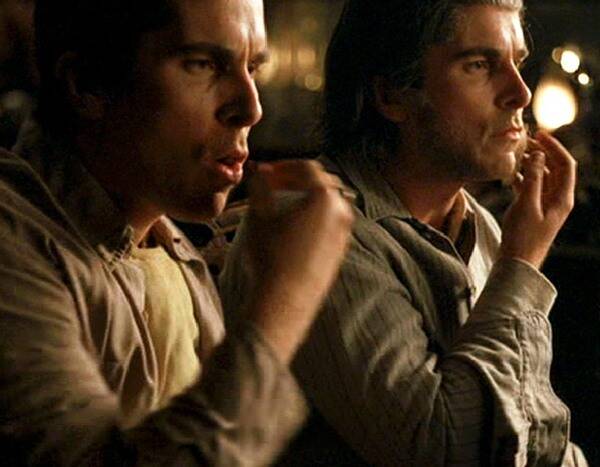
The doppelganger trope is integral to the story here and uses both twins and clones in its compelling thematic and visual system. Yet, these are not revealed until the very end, as the screenwriters Jonathan and Christopher Nolan literally dissect the characters’ souls within the fascinating world of magicians and their mysterious secrets. At the heart of the story we witness the tricks of warring magicians, portrayed by Christian Bale and Hugh Jackman, and the lengths they will go to amaze an audience. By the end, the film becomes a chilling and fantastic warning about the dangers of obsession and rivalry.


US (2019)

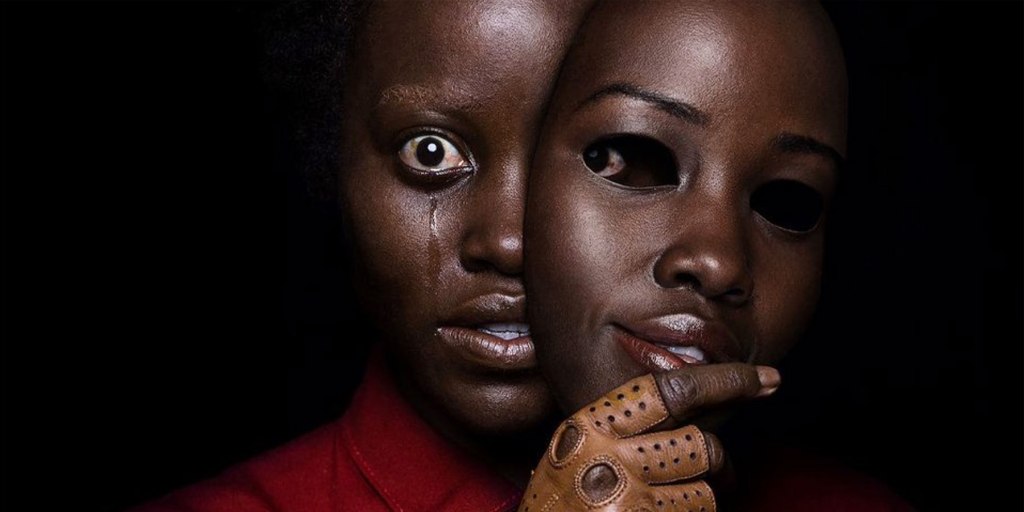
The incredibly talented Jordan Peele delivered one of my favourite films of the year. It did not contain just one (or is it two) doppelganger(s), but a whole family of them. Working in the horror genre is an ideal setting for the “double” thematic, as the fantasy elements coalesce perfectly with the psychological ones. Symbolically the film is very strong. It can be interpreted on many levels, including as a critique of the United States (U.S. = US – get it?); and a powerful exploration of split identities. Indeed, in Us (2019), the lead protagonists battle external and inner demons, both political and personal, which can plague all of us during our lives.


VERTIGO (1958)

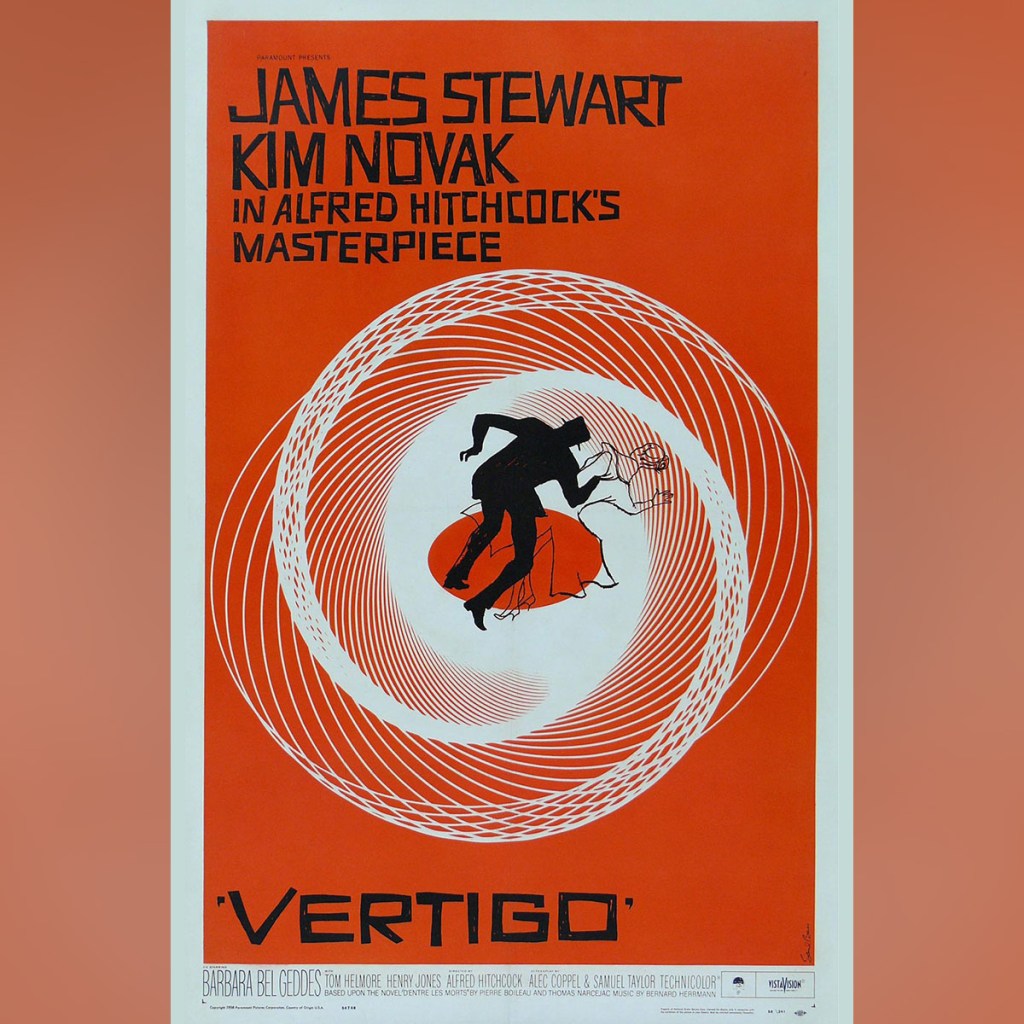
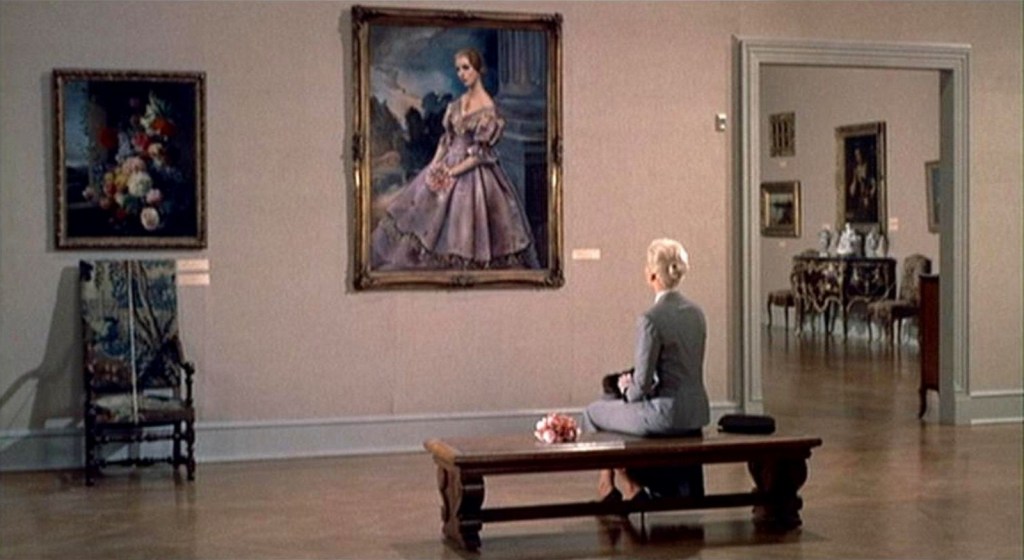
Alfred Hitchcock’s classic psychological thriller is very complex and actually reflects the directors’ obsession with the moulding of an individual to look a certain way. On the surface, the story of a burnt out cop, Scottie Ferguson (James Stewart) attempting to overcome his fear of heights, while tracking a friend’s wife, is initially quite simple. But in Hitchcock’s and his writer’s hands it become a tour-de-force of mistaken, double and theft of identity. A tragic figure, Scottie Ferguson is exploited and left bereft of love and comfort as he attempts, like Hitchcock himself, to find that perfect, yet elusive, blonde.


MANIAC (2018) – NETFLIX REVIEW

MANIAC (2018) – NETFLIX REVIEW

Created by: Patrick Somerville

Based on: Maniac by Espen PA Lervaag, Håakon Bast Mossige, Kjetil Indregard, Ole Marius Araldsen

Developed by: Cary Joji Fukunaga & Patrick Somerville for Netflix

Directed by: Cary Joji Fukunaga

Starring: Emma Stone, Jonah Hill, Justin Theroux, Sonoya Mizuno, Gabriel Byrne, Sally Field

**MAY CONTAIN SPOILERS**

Maniac

What’s your view on striving for originality in storytelling and entertainment? It could be argued that there is no such thing and creators are simply moving creative chess pieces around the same board; or playing the same musical notes but in a different order. One perspective is that you prefer a writer or director to be bold and aim for originality; with the potential risk they alienate the audience. Some creators actually don’t care about the audience but many others do, preferring to connect emotionally within the casing of genre conventions. Personally, I prefer to be moved emotionally firstly and if the filmmaker or writer has presented their story in an impressive style then this serves to enhance the enjoyment of the narrative.

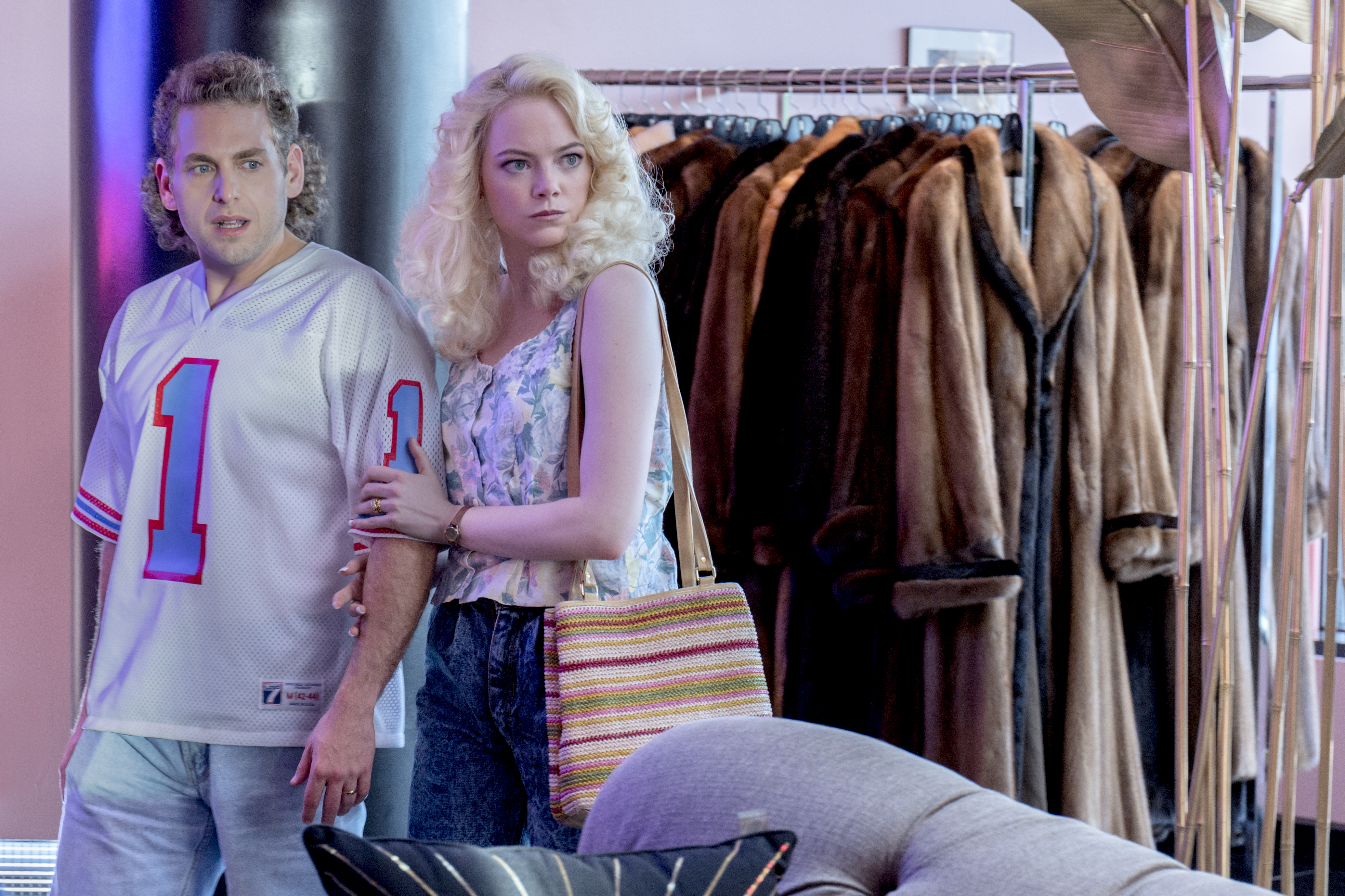
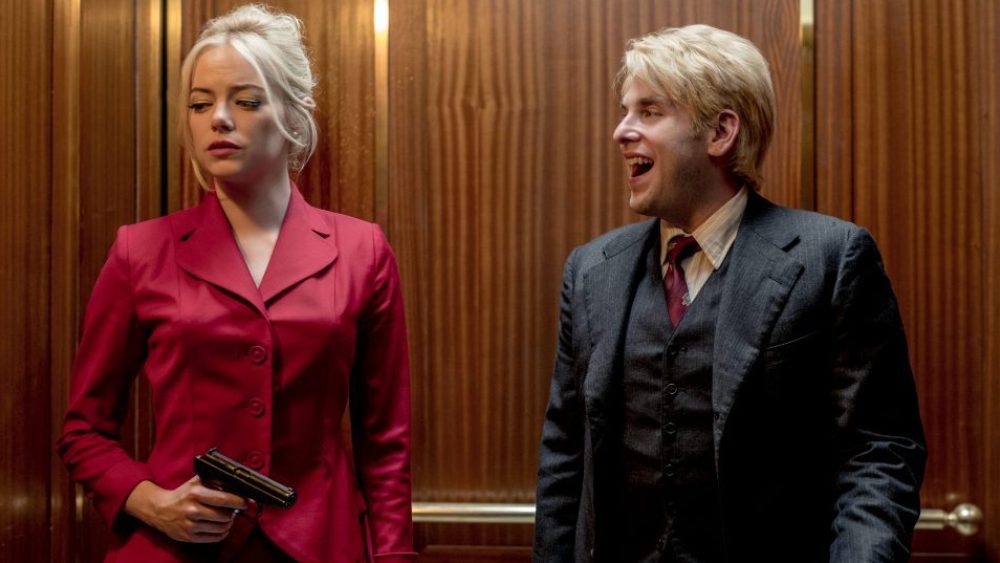
Cary Joji Fukunaga is a genre filmmaker who has established himself capable of developing impressive genre works such as: Jane Eyre (2011), True Detective (2014), and the brilliant film Beasts of No Nation (2015). Recently, he has also been involved in bringing It (2017) and The Alienist (2018) to the screen; although he did not serve as final director on such products. His latest directorial offering is an adaptation of a Norwegian comedy drama called Maniac. Over ten hit-and-miss episodes we follow the misadventures of a depressive and unstable Owen (Jonah Hill), and grieving pill-addict Annie (Emma Stone), as they enter a medical trial run by the secretive Neberdine Pharmaceutical organisation.

The trial itself involves taking a series of pills and the participants’ cerebral responses being recorded on a sentient artificially intelligent computer called GRTA. Here, Owen and Annie’s lives and minds become internally entwined as the story enables us to visualise their mental anxieties and re-enact their fears during the trial. Owen’s angst is caused by a family issue involving his brother, while Annie still blames herself for a family tragedy. The bizarre surrealist events are very effectively established, however, over the dizzying spectrum of several genre-crossing episodes we essentially get told the same two stories within the: crime, romance, gangster, fantasy and spy genres.

The performances are interesting. Fukunaga has created a world that exists somewhere in between the real and surreal and the future, past and current times. Because of this there’s a sense he has freed the actors from naturalism and at times created a stylistic distanciation. Conversely, Emma Stone was brilliant as always and she is skilled enough to make the strangeness resonate emotionally. However, I felt Jonah Hill, while giving a fine and committed performance, was miscast. Interestingly, Justin Theroux features in a curious turn as a Doctor on the edge of a nervous breakdown. Theroux is a fascinating actor who I think is sabotaging his career and could be the next George Clooney but continues to choose weirdo roles which serve his career no benefit. But hey what do I know!?  Maybe he’s having a lot of fun.

Ultimately, the postmodern stylings cloaked a pretty conventional love story and once again, with a Netflix show, I felt that ten episodes were stretching the narrative a tad. Fukunaga’s combination of different genres and eccentric characters plus a smattering a bloody violence and techno-humour is always interesting. Moreover, much fun is to be had from the references to One Flew Over The Cuckoo’s Nest (1975), 2001: A Space Odyssey (1968), Lord of the Rings and many more films.  Nowhere near as brilliant as True Detective or Beasts of No Nation, Cary Fukunaga still impresses as a director even if Maniac is arguably style over content. Nonetheless, Fukunaga should still be commended for striving for a semblance of originality and ambition, rather than just go for an big payday on a franchise studio genre film.

(Mark: 7.5 out of 11)

SIX OF THE BEST #3 – MOVIE NUTTERS

SIX OF THE BEST #3 – MOVIE NUTTERS

In the third episode of this occasional strand I have decided to have a look at some good old cinema nut-jobs. This was precipitated by a recent watch of David Lynch’s classic Blue Velvet (1986) which features an incredible performance from Dennis Hopper as Frank Booth.  He is, of course included here, along with five other movie loons.

**CONTAINS SPOILERS**

FRANK BOOTH – BLUE VELVET (1986) – DENNIS HOPPER

“Why are there people like Frank?” asks Kyle Maclachlan’s Jeffery Beaumont midway through David Lynch’s dark journey into the underbelly of small town America. Why indeed? We do not know why Frank is the way he is: he just is!  The drugs, shouting, swearing, sado-masochistic and psycho-sexual violence stem from the dark recesses of Lynch’s imagination; while Hopper’s tour-de-force performance is chilling, scary and at times, inappropriately laugh-out-loud funny.

ANTON CHIGURH – NO COUNTRY FOR OLD MEN (2007) – JAVIER BARDEM

You’d have to be a person of the highest confidence or crazy insane to sport the haircut Chigurh/Bardem does in this wonderful Coen Brothers’ adaptation of the Cormac McCarthy’s neo-Western novel. Chigurh is not just a stone-cold killer but also one with a strange amoral compass and set of rules. Also, his reliance on chance and the flip of a coin as to whether someone lives or dies is even more scarier than the deadly bolt-gun he uses to dispatch his victims.

JACK TORRANCE – THE SHINING (1980) – JACK NICHOLSON

The slow demise of the isolated writer driven to kill by the demons of the past are brilliantly captured in Stanley Kubrick’s stylish and memorable Stephen King adaptation. Nicholson cornered the market on explosive larger-than-life masculine roles but here he was far more unhinged. His performance as Jack Torrance is both scary and funny, as writer’s block, the ghosts of the Overlook Hotel plus his own depression weld to send him over the edge and into lunacy and murder.

ASAMI YAMAZAKI – AUDITION – (1999) – EIHI SHIINA

To describe Asami as a nutter is a bit harsh on nutters really. Because, cutting your victims limbs, digits and tongues off, before placing them in a hessian sack is pretty extreme. A calm psychopath, Asami literally chills to the bone; however, her victims are carefully chosen men who she enacts tortuous revenge on for historical sexual abuse. This is a scary horror film that is both stomach-churning and thematically strong, delivering a damning indictment on the casting couch culture.

MAX CADY – CAPE FEAR (1991) – ROBERT DE NIRO

Robert Mitchum’s performance in the original Cape Fear (1962) deserves a mention, as does his powerhouse and menacing turn as Harry Powell in Night of the Hunter (1955); who almost made the list too. Nonetheless, DeNiro’s Cady is a marvellous cinematic creation rooted in pure bible-belt-Southern-preacher-avenging-devil-hatred. All muscles, tattoos and a sense of violent vengeance he pursues Sam Bowden (Nick Nolte) and his family with an insane zeal; terrorizing them with unforgettable physical, sexual and murderous threat.

ANNIE WILKES – MISERY (1990) – KATHY BATES

Here is another Stephen King loon for your consideration. Kathy Bates deservedly won an Oscar for her barnstorming performance as Annie Wilkes. She is a charismatic lunatic who takes the ‘I’m your number one fan’ maxim to the extreme; with a mania stemming from a skewed understanding of the world which is not helped by her seeming isolation. When James Caan’s author kills off her favourite literary character hell hath no fury like a mad-woman scorned! Carlsberg don’t do torture: but if they did!