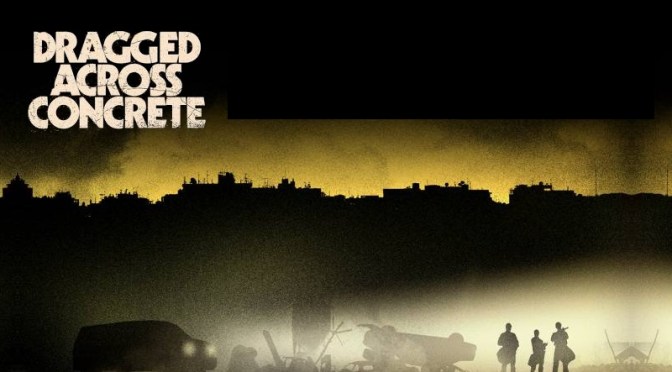
FILMS THAT GOT AWAY #8 – DRAGGED ACROSS CONCRETE (2018)
Written and directed by: S. Craig Zahler
Produced by: Sefton Fincham, Jack Heller, Tyler Jackson, Keith Kjarval, Dallas Sonnier
Cast: Vince Vaughn, Mel Gibson, Tory Kittles, Michael Jai White, Jennifer Carpenter, Laurie Holden, Don Johnson, Thomas Kretschmann etc.
Cinematography: Benji Bakshi
*** MAY CONTAIN SPOILERS ***
As a major fan of S. Craig Zahler’s first two film releases, namely Bone Tomahawk (2015) and Brawl in Cell Block 99 (2017), I was really looking forward to another example of pulpy, slow burn and hard-bitten genre filmmaking with Dragged Across Concrete (2018). Thus, I was very upset when I found out the Mel Gibson and Vince Vaughn starring cop drama was not released in UK cinemas. I finally caught up with it on Amazon Prime and, while it was probably too long, it was a hypnotically powerful crime thriller.
Set in the city of Bulwark, the film opens with a lengthy preamble which introduces disparate characters whose paths are destined to cross later in the film. These include recent parolee, Henry Johns (Tory Kittles), grizzled-long-in-the-tooth-cop, Brett Ridgeman (Mel Gibson) and his younger, but equally cynical partner, Anthony Lusaretti (Vince Vaughn). Later, Zahler throws professional criminal, Lorentz Vogelmann (Thomas Kretschmann), and his dressed-in-black crew into the dark city soup. After a glacial set-up, the plot kicks in when Ridgeman and Lusaretti are suspended for what is perceived as a racially motivated attack on a suspect. Desiring a way out of the neo-noir and industrial decay, Ridgeman sets up a plan to steal from Vogelmann’s gang. Safe to say that given this is a Zahler film, we do not end up with a soft toy and candy apple ending.
Throwing a succession of anti-heroes at the audience and a litany of cursing and politically incorrect language makes Dragged Across Concrete (2018) a morally questionable film to experience. Do not watch if you are easily offended. Nonetheless, my feeling is Zahler, like Tarantino, is reflecting the world as it is rather than how it should be. Humanity is in the gutter and the only way out of it, in his mind, is to swear and fight and steal and kill. That isn’t to say that the characters are not empathetic. As Zahler’s hard-boiled dialogue is very poetic in places it draws you to them in a way Raymond Chandler used to do. Similarly, the performances from Gibson and Vaughn are brilliant. The scenes where they just sit in the car and eat sandwiches while staking out their quarry, are both hilarious and absorbing. Ultimately, it’s the lengthy second half robbery and final act ultra-violence which makes the film a pulsating and brutally rewarding experience.
Cast: Ivan Massague, Antonia San Juan, Zorian Eguileor, Emiliano Buale Coka, Alexandra Masangkay
Cinematography: Jon D. Dominguez
Original Platform: Netflix
*** MAY CONTAIN SPOILERS ***
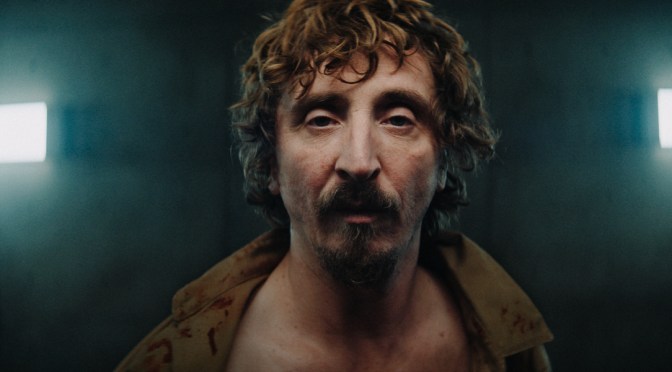
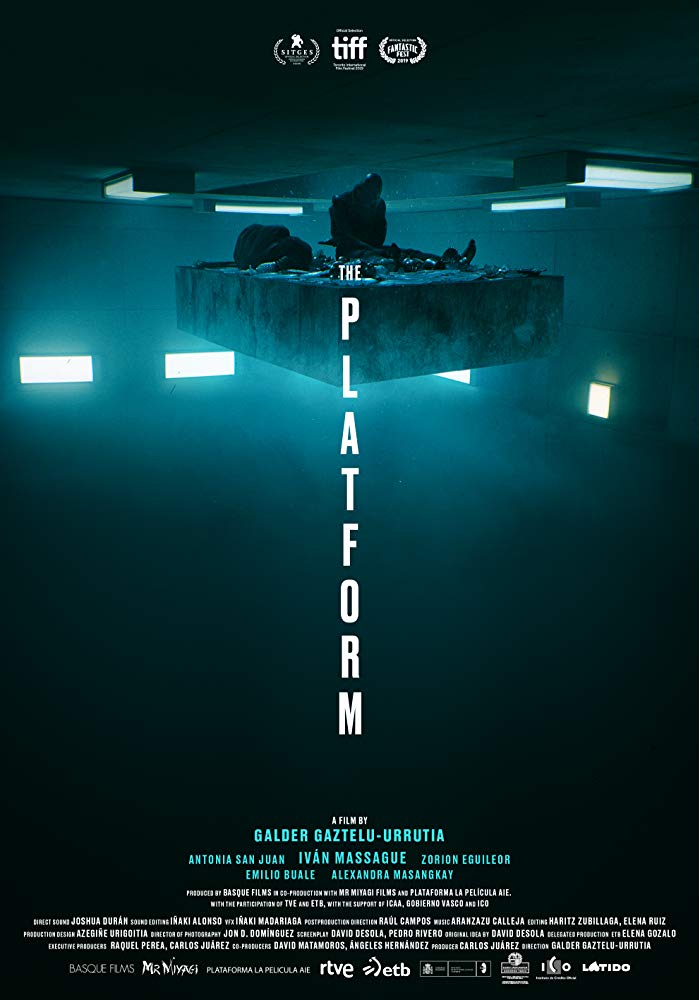
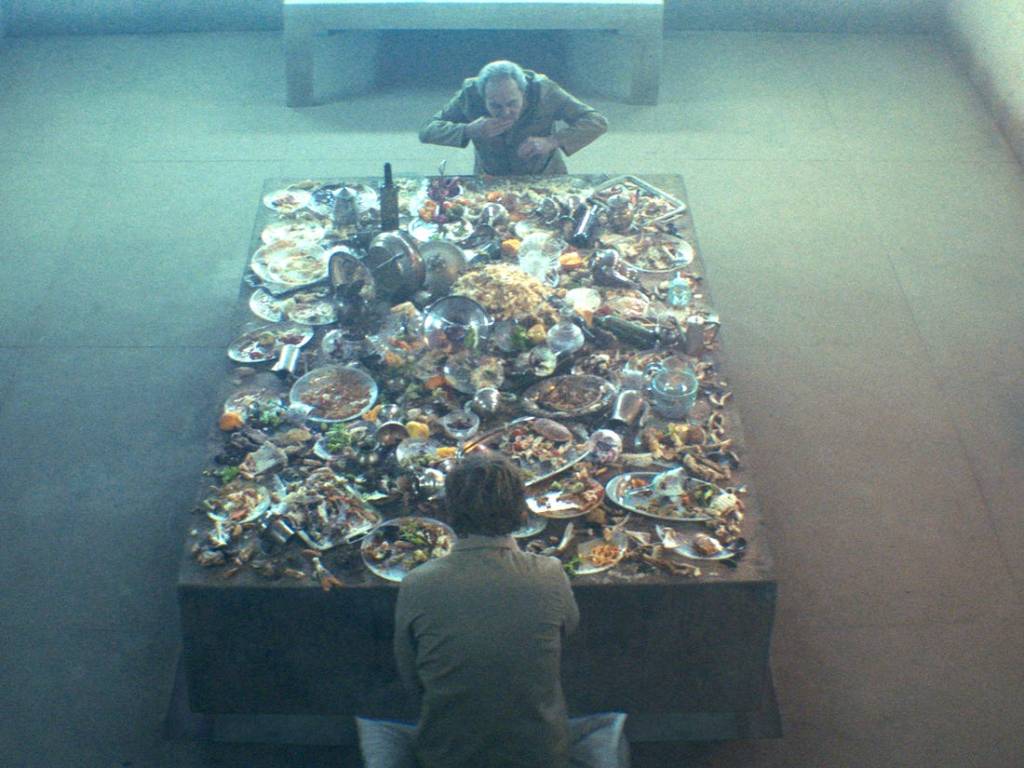
Last night, just under a week into the stricter UK social distancing procedures, I finally got pangs of withdrawal symptoms from NOT going to the cinema. Of course, my feelings or emotions at this time pale into insignificance when compared to the thousands of people affected by or those who have lost their lives to the COVID-19 virus. Moreover, while one could describe our planet as currently resembling a massive open prison, it’s nothing compared to the horrific conditions of the vertical prison in Spanish horror thriller, The Platform (2019). Be warned: do not watch this film while eating your dinner, as it could affect your appetite.
While I recently wrote an article about some films that could make you feel better in this global crisis (link here), paradoxically a horror film such as The Platform (2019) can also work to make you feel better too. Because a film where prisoners are trapped in a multi-level jail and whose food intake is based on how high they are within the prison, is an ingenious, yet terrifying concept. Knowing my life can never be as bad as the main protagonist and the prisoners he encounters made me feel somewhat relieved. Furthermore, the gore levels, plot twists and social satire on display took my mind off the reality of my own situation.
Ivan Massague, with his hangdog-Zlatan-Ibrahimovic features is Goreng, our reasonable everyman at the start. For some bizarre reason he has volunteered to be in this Kafkaesque hell for reasons I won’t spoil. His first cellmate is an older man, Trimagasi (Zorian Eguileor). He is in for committing manslaughter. Trimagasi explains how the system works in the jail. Food comes down on a platform and is meant to be shared with everyone from top to bottom. Of course, it doesn’t work like that as greed prevails. The lower down you are the less food you get. What happens when you don’t eat? You look for alternative food sources. Goreng is naive initially, while Trimagasi knows how to play this vicious game, especially because they never know what level they will be on month to month. This is no Shawshank Redemption (1994), where the mentor coaches the younger man positively. In this environment it is a dog eat dog world; and it’s every dog for him or herself.
The Platform (2019) has a brilliant script, thus is a wicked delight from start to finish. Even the ambiguous ending, which while leaving our gallant lead protagonist’s fate open to interpretation, is fitting for a constantly surprising genre film. It is both a joy as horror film and social commentary. Indeed, the film has its pound of flesh and eats it. I just have to say there is some fantastic gore and memorably crunching deaths throughout of man, woman and beast. The film doesn’t have all the answers. In fact, it is actually quite nihilistic about human behaviour and our inability to share the wealth around. But as high concept and low budget horror movies go, it’s one of the most entertaining I have seen in sometime. Anything to take one’s mind off what is really happening in this world can only be positive.
Created and written by: Steve Pemberton & Reece Shearsmith
Directors (Season5): Matt Lipsey, Guillem Morales, Steve Pemberton
Original Network: BBC (available on BBC Iplayer and Netflix)
No. of Episodes: 6
***CONTAINS PROPER SPOILERS***
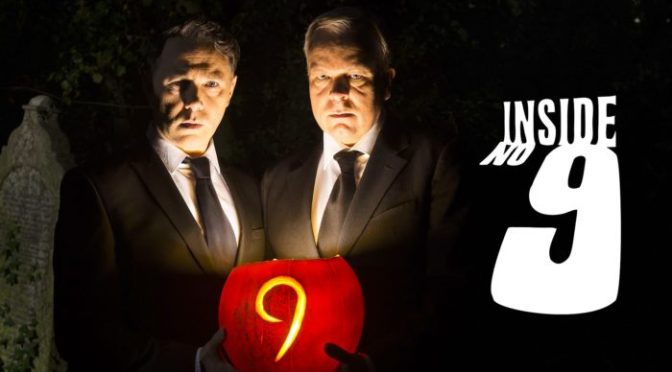
Inside No. 9is written by and stars Steve Pemberton and Reece Shearsmith. Both are brilliant comedic and dramatic actors, having appeared in many TV shows and films down the years. They are arguably most famous for beginning their careers in amazing comedic troupe The League of Gentlemen; however, their work on Inside No. 9 surpasses the ‘League’ in my view.
If you have never seen Inside No. 9 before, I urge you to do so. It is an exceptional anthology series with six standalone episodes per season. Individual episodes feature a whole host of different characters and actors each time. As per the prior seasons, the latest one is absolutely brilliant. It privileges tightly woven thirty-minute short narratives, which more often than not, feature a twist in the tale. Moroever the events usually unfold in one location with never more than a handful of characters. This makes the narratives feel more focussed, intense and intimate.
Inside No. 9 is also a surprising delight because you never know what kind of genre you will get. One week you could get comedy, horror, drama, crime, romance or musical; and sometimes a combination of all of them. They also take chances with their use of form and structure, with many episodes either paying homage or parodying different genre styles. So, here are some short reviews of each episode from Season 5. Usually, I mark my reviews out of eleven (in homage to This is Spinal Tap (1984)), however, for obvious reasons, I will be marking these reviews out of NINE.
EPISODE 1 – THE REFEREE’S A W**NKER
Cast: David Morrissey, Ralph Little, Steve Pemberton, Reece Shearsmith
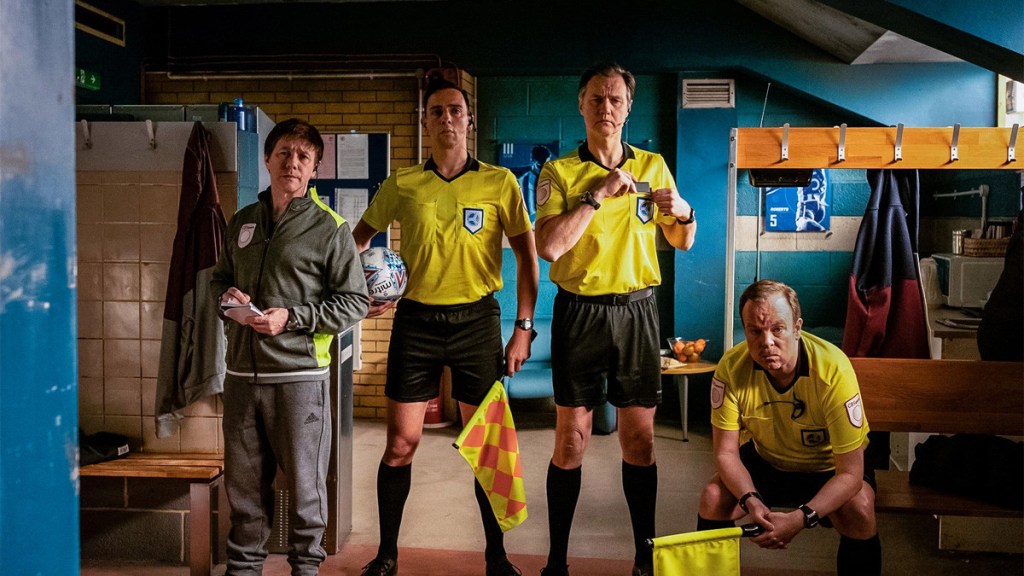
The number 9 of this episode occurs in a football referees’ changing room before, during and after a critical final game of the season. Tensions rise between players, mascots and officials in what is the referee’s last game before retirement. David Morrissey is brilliant as the ultra-professional ref attempting to keep control amidst the chaos. Ralf Little also excels as the vain referee’s assistant, with Shearsmith and Pemberton offering fine comedic support. On the main this plays out as a comedy, but there are also serious moments. Indeed, The Referee’s a Wanker explores themes of corruption, gay footballers, and the obsessive win-at-all-costs nature of football fanatics. Fast-paced, funny and containing a great twist, this episode kicked off the season very positively.
Mark: 8 out of 9
EPISODE 2 – DEATH BE NOT PROUD
Cast: Jenna Coleman, Kadiff Kirwan, Steve Pemberton, Reece Shearsmith, Sarah Solemani
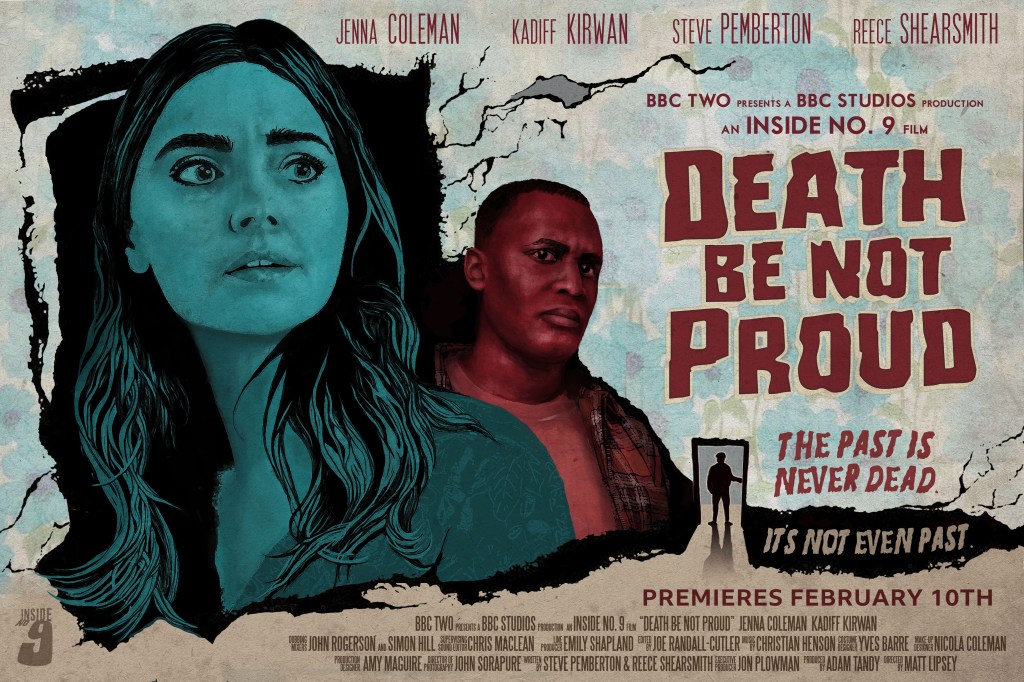
This episode was a joy on many levels. Firstly, it was a fantastic mixture of dark comedy and bloody horror. Most significantly, it contained a wonderful series of meta-cultural call backs to Shearsmith’s and Pemberton’s prior work called Psychoville. A grotesque and demented sitcom, Psychoville contained a gallery of crazed characters with many portrayed by Pemberton and Shearsmith. In Death Be Not Proud the opening is quite conventional. Young couple (Jenna Coleman and Kadiff Kirwan) get what they think is a property bargain. However, the flat was host to a grisly murder and something from beyond the grave is tormenting the new tenants. When the previous owner, David Sowerbutts returns things get even weirder. Only then do we learn about the horrific history of this murder home, to sick and hilarious effect.
Mark: 8.5 out of 9
EPISODE 3 – LOVE’S GREAT ADVENTURE
Cast: Steve Pemberton, Debbie Rush, Gaby French, Bobby Schofield, Reece Shearsmith.
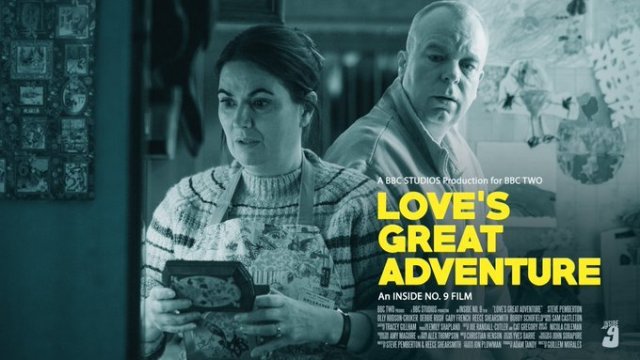
Once again displaying fine writing and actorly versatility, Love’s Great Adventure plays out as a straight family drama. It’s of such high quality and hits such emotional and dramatic peaks, TV writers like Paul Abbott, Jimmy McGovern and Jed Mercurio would have been proud to have written it. Cleverly structured around an advent calendar, the Christmas setting adds texture to the financial struggles of one working class family. Trevor (Pemberton) and Julia (Debbie Rush) are devoted to each other, their teenage daughter and grandson who lives with them. They are even prepared to forgive their self-destructive addict son. Set mainly in the kitchen on various days leading up to Christmas day, the events unfold in a subtle, but powerfully realistic manner. These are ordinary, but compelling characters, who prove there is nothing stronger than family love.
Mark: 8.5 out of 9
EPISODE 4 – MISDIRECTION
Cast: Reece Shearsmith, Steve Pemberton, Jill Halfpenny, Fionn Whitehead
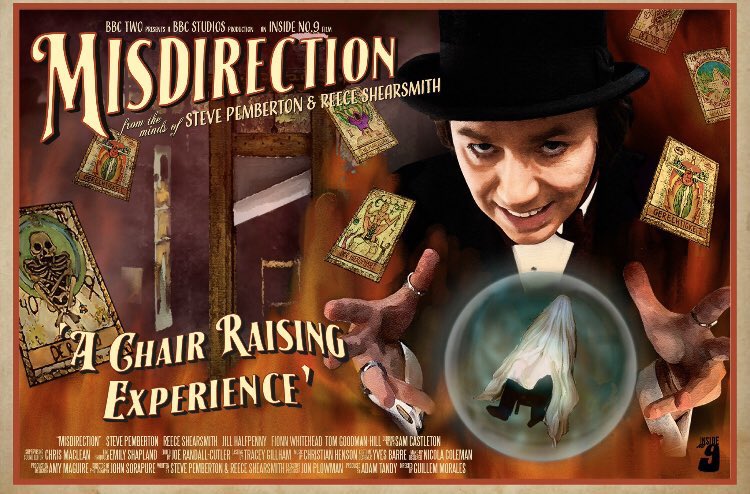
One of my favourite ever TV shows is Tales Of The Unexpected and Inside No. 9 certainly owes a debt to that series of twisted genre narratives. Misdirection is a case in point. It is up there with the best Pemberton and Shearsmith plots, as a young student journalist, Fionn Whitehead, interviews Reece Shearsmith’s famous magician. Safe to say that as this is about magic there is much in the way of tricksy turns, bluffs and diversionary tactics. Shearsmith is on brilliant form as the arrogant traditionalist with a dark secret. He criticizes the inelegance of street magicians while a battle of wits ensues with Whitehead’s seemingly naive novice. Echoing the structural and stylish dexterity of Peter Schaffer’s brilliant Sleuth (1972), Misdirection holds all the cards when it comes to being a deviously clever and totally unexpected tale.
Mark: 9 out of 9
EPISODE 5 – THINKING OUT LOUD
Cast: Maxine Peake, Phil Davis, Ionna Kimbrook, Sandra Gayer, Sara Kestelman, Reece Shearsmith, Steve Pemberton
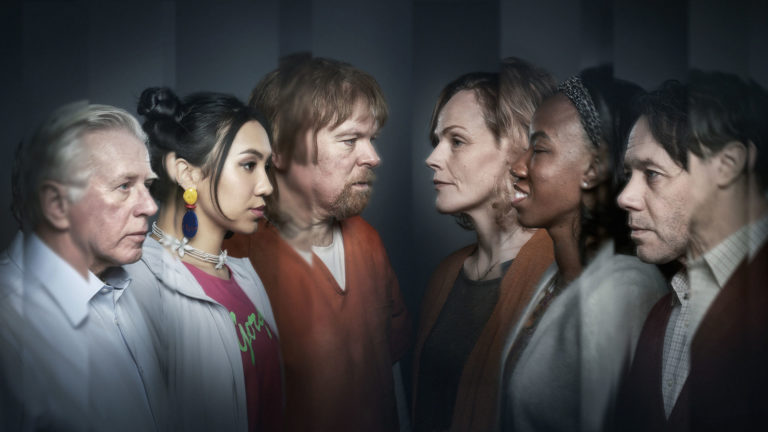
Before reviewing this season, I watched every episode twice. I’m glad I did because Inside No. 9 can be complex and pack a lot in thirty minutes. So, it proves in Thinking Out Loud, as we get seven seemingly disparate characters all unconnected. Or so we are led to believe. The episode uses the video diary format, which was something of a popular phenomenon in the 1990s, plus it echoes the “talking heads” style of Alan Bennett. Thus, we get a character in therapy, her therapist, a criminal on death row, a singer, a man suffering from cancer, a man looking for love and an Instagram influencer. All directly address the camera and as we cut between them, their connection slowly filters through until the incredible reveal. Owing much to films like Identity (2003) and Split (2017), this psychological thriller is very crafty with many chilling moments that bear up to multiple viewings.
Mark: 8 out of 9
EPISODE 6 – THE STAKEOUT
Cast: Steve Pemberton and Reece Shearsmith
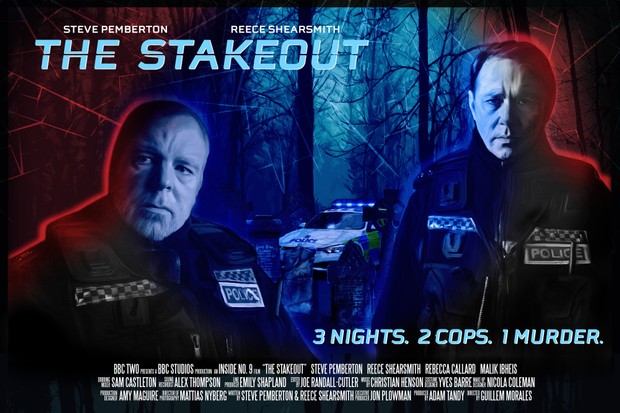
This virtual two-hander concentrates all of the action within the confines of a police car. Steve Pemberton portrays the jaded and experienced police officer obsessed with finding out who killed his partner. Joining him in the vehicle is new partner, played by Shearsmith. The latter’s character is a Special Constable who seeks to follow the book causing tension on a stakeout during a literal graveyard shift. The two clash over diet, riddles, word-games and police procedure, but over three nights they eventually find mutual respect. The bulk of the episode’s enjoyment comes from Pemberton and Shearsmith’s sparring and their performances are exemplary. The writing is also impressive as it plays with the tropes of the police procedural genre. Finally, it also sets up a suspenseful opening only to confound us by the bloody fiendish denouement.
Developed by Richard Price – based on Stephen King’s novel
Writers: Dennis Lehane, Jessie Nickson-Lopez, Richard Price
Directors: Jason Bateman, Andrew Bernstein, Igor Martinovic, Karyn Kusama, Daina Reid, J.D. Dillard, Charlotte Brandstrom
Cast: Ben Mendelsohn, Bill Camp, Cynthia Erivo, Jason Bateman, Jeremy Bobb, Julianne Nicholson, Mare Winningham, Paddy Considine, Marc Menchaca, Max Beesley, Derek Cecil, Yul Vazquez etc.
Original Network: HBO
No. of Episodes: 10
*** MAY CONTAIN SPOILERS ***
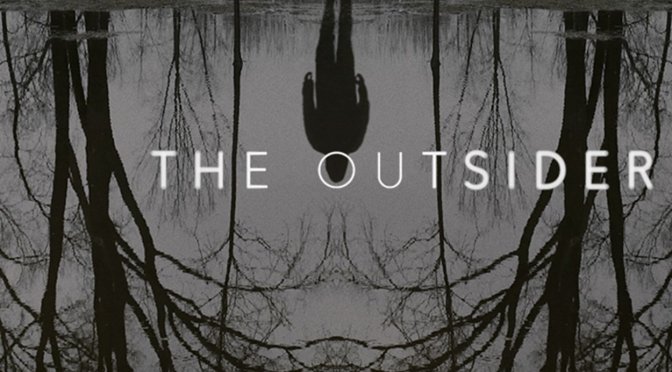
When I first saw this advertised, I thought finally, someone has adapted Albert Camus’ classic existential novel, The Outsider. When I saw it was from HBO, I was even more stoked. However, I then realised it was actually a story developed from a recent novel by uber-writer, Stephen King. Nonetheless, my enthusiasm was not curbed or curtailed. Because lord does King certainly know his way around a crime and horror tale. Moreover, with character actors such as Ben Mendelsohn, Bill Camp, Paddy Considine, Mare Winningham and Jason Bateman in the cast, plus star-in-the-making Cynthia Erivo also in the mix, I knew this had to be good. Thus, it proved.
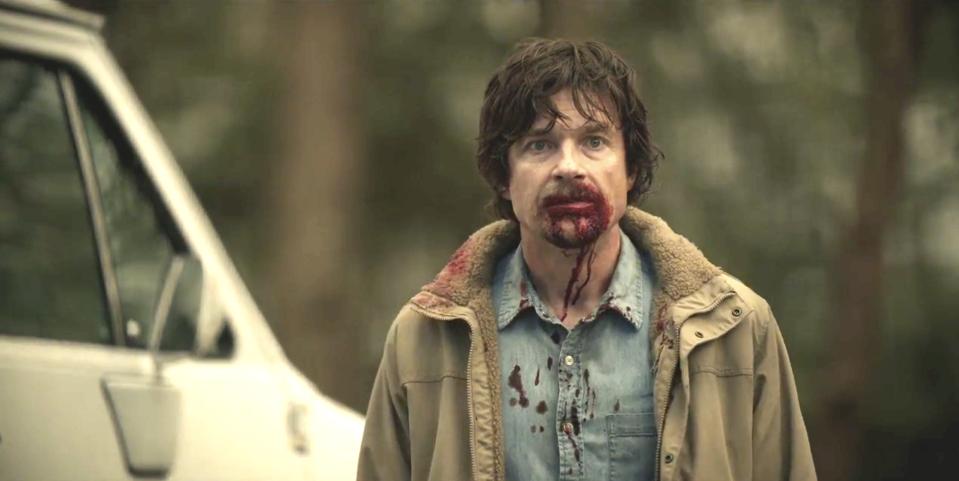
It goes without saying that being a HBO production this is a high quality rendition of Stephen King’s novel. The director of the first two episodes, Jason Bateman, brings the dark finish, tone and experience garnered from his superlative work on Netflix’s brilliant series, Ozark. Bateman is also cast as the main murder suspect, Terry Maitland, and he so metronomically good in the role. In a gripping opening episode Maitland is arrested for the murder of a local boy, Frank Peterson. The investigation is lead by Cherokee City detective, Ralph Anderson; an emotionally hollowed cop superbly portrayed by Ben Mendelsohn. Maitland protests his innocence, and when his ebullient attorney — the ever-impressive Bill Camp — shows he has a cast iron alibi, the narrative takes a decidedly strange turn.
Firstly, as I have alluded to, this must be one of the best casts assembled in a television show since, well, the last HBO series produced. Further, grandmaster screenwriter, Richard Price — who also co-adapted the superb The Night Of (2016) for HBO — has spring boarded King’s original brilliantly. Price and his co-writers fully flesh out a series of fascinating characters and a community ripped apart by a black monster lurking in the shadows. Indeed, grief and heartache stain the eye of this drama as death hangs heavy over the humans of this closeknit town.
The Outsider (2020) is so confident, we are not even introduced to another of the major assets of the series in Cynthia Erivo’s investigator, Holly Gibney, until the third episode. While the ‘Outsider’ of the title could be referring to the killer, Gibney’s character is very much an idiosyncratic loner too. Whether she is on the spectrum, it is not revealed. However, irrespective of her lack of social skills, she has an incredible memory, powerful determination and prodigious logic. Erivo, as Gibney, gives a masterclass of a performance radiating empathy, heart and fierce intelligence throughout.
Finally, some may feel the HBO series moves too slowly in the middle episodes, following the thrilling opening ones. However, I was engrossed in the methodical unravelling of the exposition to the audience. As Gibney discovers the true horror of the mystery then so do we. Stephen King has always been a genius at creating eerie suspense and this story is no different. I was pleased that this vision avoided the more hysterical supernatural elements which have blighted lesser King adaptations. Yet, while it is subtle in delivery, the show isn’t without a number of explosive moments, especially during a bullet-fest of a shootout in the final episode. Overall though it’s the creeping dread I felt while watching The Outsider (2020), that I’ll remember most. It’s the stuff of nightmares you see; and at times I was seeing more than double.
Created by Harlan Coben – based on The Stranger by Harlan Coben
Writers: Harlan Coben, Danny Brocklehurst, Charlotte Coben, Karla Crome, Mick Ford etc.
Directors: Daniel O’Hara, Hannah Quinn
Cast: Richard Armitage, Siobhan Finneran, Jennifer Saunders, Shaun Dooley, Paul Kaye, Dervla Kirwan, Kadiff Kirwan, Jacob Dudman, Ella-Rae Smith, Brandon Fellows, Anthony Head, Stephen Rea, Hannah John-Kamen etc.
No. of Episodes 8
Network release: Netflix
***MAY CONTAIN SPOILERS***
Imagine sitting in a bar or restaurant or at the gym or in a coffee shop minding your own business. A stranger approaches you and tells you something that your spouse or partner or relative was hiding from you. This is a secret which rips apart your life and turns everything upside down in the process. This is the basic premise of Harlan Coben’s adaptation of his own novel, The Stranger. Over eight gripping episodes the drama hooks you in from this point forth. Secrets, lies, violence, corruption, blackmail, betrayal and murder drive the narrative in a compelling and serpentine plot.
In what is the TV equivalent of a right page-turner, the main protagonist, Adam Price (Richard Armitage), is the first person to be approached by the titular Stranger. He is given information regarding his wife (Dervla Kirwan) and this threatens to tear his whole family apart. This is just the tip of the iceberg though in regards to the plotting. Other individuals are being targeted too by the Stranger. At the same time a teenager has been comatosed following a woodland rave. It’s not long before Siobhan Finneran’s DS Johanna Griffin investigates this crime, the bizarre beheading of a llama, plus murder, extortion and abduction.
At first, I thought it may be a metaphysical figure revealing guilty secrets to the cast of characters in a Stephen King supernatural-style narrative. However, Harlan Coben’s contemporary crime thriller is firmly set in reality, as it privileges familial and police procedural drama compellingly. Over the eight episodes I was glued to what happens next, as we get so many cat-and-mouse chases and character surprises throughout. Richard Armitage is excellent as the lead protagonist, desperately trying to keep his family together. The teenage character subplots are not so successful as the some of their acting is pretty dire. However, the likes of Siobhan Finneran, Jennifer Saunders, Paul Kaye and Stephen Rea add real quality to what is a conventional, but always watchable genre production.
THE NETFLIX PROCLAMATION – FILM REVIEW CATCH-UP MARCH 2020
With COVID-19 threatening the world’s population, it is a time to remain calm and, if required, stay indoors out of the way of potential infection. As long as the Internet holds then there are thousands of films and TV shows to watch online to keep us all occupied. Obviously, one must also take a deep breath and pray that aside from the illness affecting the world, society manages to keep it’s social, financial and medical structures in place too.
Clearly, we need distractions at this difficult time. Films may not be the solution, but they can offer diversion at least. Thankfully, I love staying in and watching movies as it is a major hobby of mine. Indeed, I have been busy lately catching up on some of the latest releases Netflix has to offer. Thus, I present some quick reviews of films currently on the streaming platform, all with the usual marks out of eleven.
***MAY CONTAIN SPOILERS***
A PRIVATE WAR (2019)
Rosamund Pike is absolutely enthralling as the brave war correspondent, Marie Colvin. Putting her life and sanity on the line to report the terrors of conflict in Sri Lanka, Libya and Syria, to name a few, Colvin was both fearless and crazy in equal measures, but remains an incredibly powerful voice. This fine biopic feels haphazard and structurally chaotic but is certainly an impressive tribute to an iconic journalist. (Mark: 8 out of 11)
DESTROYER (2018)
Nicole Kidman gives another excellent performance in this gritty neo-noir-cop-procedural drama. The clever structure — which tracks back and forth between Kidman’s burnt out character in the present and her violent past going undercover in a crime gang — arguably works against the emotional power of the film. However, director Karyn Kusama and Kidman make a formidable team in delivering a moody, bruising and bitter revenge thriller. (Mark: 8 out of 11)
EARTHQUAKE BIRD (2019)
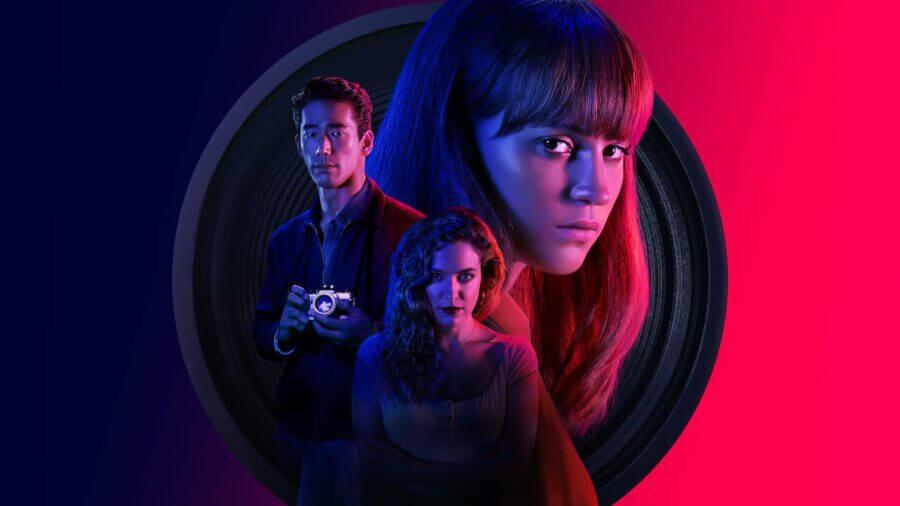
I really loved director Wash Washmoreland’s previous film, Colette (2018), because it was such a vibrant. colourful and sparkling biopic of a fascinating character. I was thus surprised to see he had followed it up with an under-cooked thriller like Earthquake Bird (2019). Alicia Vikander portrays a dour ex-patriot in Japan who gets drawn into a love triangle involving the effervescent, Riley Keough, and photographer, Naoki Kobayashi. The film felt, like Vikander’s protagonist, depressed; ultimately drifting toward a tepid denouement. (Mark: 6 out of 11)
ENTEBBE (2019)
Rosamund Pike again! Here she is cast alongside Daniel Bruhl as they portray two Germans who joined a Palestinian military group that hijacked an Air France Flight in 1976. While the politics of the Israelis versus the Palestinians is explored to some extent, I felt more could have been done during the hostage situation to examine such complex issues. Instead, we get something more generic from director Jose Padiha, who inexplicably uses dance troupe montage to convey nebulous emotion and meaning. (Mark: 6 out of 11)
I LOST MY BODY (2019) – (Contains spoilers)
Both original and generic in terms of story, this romantic drama contains some of the most wonderful animation concepts I have seen in a long time. Brilliantly rendered and directed by Jeremy Chaupin, the narrative has two major strands. A severed hand – yes, a hand – seeks to unite with its body. Simultaneously, flashbacks reveal young Naoufel attempting to romance the girl he loves, Gabrielle. I really wanted to enjoy this more as the filmmaking is stunning. But, the final act of the film was too poetic, and it left me feeling cold and confused. (Mark: 7 out of 11)
THE KING (2019)
David Michod has been a filmmaker worth keeping tabs on since the release of brutal Australian crime film, Animal Kingdom (2010). After the big budget military satire War Machine (2017), failed, in my view, to hit the target, Michod has gone with another big production in The King(2019). Adapting Shakespeare’s Henry V trilogy (co-writer with Joel Edgerton) is no easy task and they deliver a film full of bravura cinematic moments. Timothee Chalamet is impressive in the lead role as the reluctant, but strong-of-heart young Prince Hal/King Henry. Lastly, Sean Harris, Robert Pattinson, Edgerton (as Falstaff) and Thomasin Mackenzie provide excellent acting support in a stirring period epic. (Mark: 8 out of 11)
THE LAUNDROMAT (2019)
Filmmakers Scott Z. Burns and Steven Soderbergh are usually so reliable in their cinematic endeavours. However, a star-studded cast including: Meryl Streep, Gary Oldman, Sharon Stone, Antonio Banderas, Matthias Schoenaerts and Jeffrey Wright cannot save this misguided comedy-drama about the Panama Papers scandal. I’m sure there is a great film in such financial crimes, but this was not it. (Mark: 5.5 out of 11)
MID 90s (2019)
Jonah Hill adds director to his already very successful acting, writing and producing curriculum vitae. Mid 90s (2019) owes much to the low-budget, improvisational and gritty style of filmmakers like Harmony Korine and Larry Clark, however, Hill’s approach is less extreme. The loose and episodic rites-of-passage narrative centres on Los Angeles based skater gangs and specifically Stevie (Sunny Suljic). He longs to grow up too fast and his experiences reminded me of an American version of Shane Meadow’s This is England (2006). While it’s a solid work of cinema, full of heart and believable performances, it’s ultimately quite underwhelming from an emotional perspective. (Mark: 7 out of 11)
THE TWO POPES (2019)
Fernando Merielles directs this adaptation of Anthony McCarten’s play featuring two giants of the acting world in Anthony Hopkins and Jonathan Pryce. The two heavyweight actors portray the real-life Pope Benedict XVI (Hopkins) and future Pope Francis, Cardinal Jorge Mario Bergoglio (Pryce). The duo conflict, debate and laugh about serious matters related to the history of the Catholic Church; plus, some not-so serious matters such as pizza and football. Having sat through Paulo Sorrentino’s uber-pretentious TV series The New Pope (2020) recently, I was not in the mood for more theological drama. However, the two leads are excellent, especially Pryce; and while the film is very dialogue driven, the flashbacks of Argentine history from Cardinal Bergoglio’s early years were powerfully evoked. (Mark: 8 out of 11).
HORSE GIRL (2020) + THUNDER ROAD (2018) FILM REVIEWS
Having seen both these fascinating character studies, Horse Girl (2020) and Thunder Road (2018) recently, I was compelled to write a double bill review because similarly they feature: lower budgeted production values, a singularly powerful lead acting performance, characters who have recently lost their mothers, very uncomfortable emotionally charged scenes; as well as both exploring themes relating to mental illness. Thus, I thought it interesting to review the films with these elements in mind.
In regard to mental health, it is quite rightly being addressed more and more in society in a respectful manner. The barriers and prejudices of the past are being eroded and people are talking about it more openly. I have first-hand family experience of someone who has suffered with mental illness. Plus, I have experienced the loss of a close friend to suicide due to debilitating anxiety and have other friends on anti-depressants. I have tried to be of assistance to those people, but it is incredibly difficult to help anyone. Likewise, medical professionals seek various ways of attempting to assist, treat and counsel individuals with mental health problems.
Ultimately, it so tough to deal with such illnesses as they are powerful and invisible. I have utmost empathy for anyone suffering from anxiety, depression and serious mental health problems. It’s such a shame that I feel kind of helpless when it comes to helping people I am close to. It is not always enough to listen and understand, thus professional medical help should be sought and sometimes even that is not enough. It is not surprising therefore that cinema is also exploring such stories and themes.
With Joker (2019), mental illness was examined in a comic book genre setting in a powerful way for me. Some critics felt it trivialised mental illness. I felt that it was, while stylised and theatrical, actually accurate in the disturbing disintegration of Arthur Fleck’s downward mental spiral. Horse Girl (2020) and Thunder Road (2018) are two very different films in terms of genre, but with similar thematic trajectories as Joker (2019). Indeed, while they are independently produced and smaller in scale, they feature two frightening renditions of characters on the verge of a mental breakdown.
***THESE REVIEWS CONTAIN SPOILERS***
HORSE GIRL (2020)
Directed by: Jeff Baena
Written by: Jeff Baena and Alison Brie
Cast: Alison Brie, Molly Shannon, John Reynolds, John Ortiz etc.
Depicting mental illness accurately is a very tricky thing on film in my view. Obviously, we have over the years had all manner of psychotics and mad people chasing and killing others in horror films and thrillers. There have also been many films centred around characters in mental institutions. Some are respectful examinations, but many more could be seen as exploitation films. Horse Girl (2020) is not exploitational, but rather an oddity that falls somewhere between the gaps of arthouse drama and weird character study. Such films are difficult to assess as, however impressive the technical aspects of the production are, the strange events of the film could alienate an audience in terms of entertainment.
Despite Alison Brie’s exceptionally brave performance as Sarah, the narrative consistently disengages you emotionally, taking you to very dark and weird places. Sometimes you have to wonder whether the actor is holidaying in weirdness for the sake of it, or is genuinely drawn to characters who exist with mental issues. Given Brie is an intelligent and highly talented actor, plus she co-wrote the script, you cannot help but feel this is a very personal project. Her portrayal of a shy loner dealing with the suicide of her mother, sleepwalking, day delusions, fragmented time loss and nightmares makes Horse Girl (2020) a disorientating experience. However, in conveying the chaos and frightening nature of mental illness, the film is commendable but tough to recommend.
Mark: 7 out of 11
THUNDER ROAD (2018)
Written and directed by: Jim Cummings
Cast: Jim Cummings, Kendal Farr, Nican Robinson, Macon Blair etc.
Talking of films that are difficult to recommend, Jim Cummings self-produced, written, directed and acted film Thunder Road (2018) is another. Rather than giving us, like Horse Girl (2020), an unreliable narrator and escalating series of surreal events seemingly separated from reality, Cummings film deliver very real feelings of embarrassment and anxiety to the audience. Advertised on certain film sites as a comedy-drama, neither the comedy nor drama are conventionally enacted. The film is based around a series of hysterical monologues and stream of consciousness dialogues from Cummings grieving and soon-to-be-divorced troubled cop, Jim Arnaud.
Arnaud’s mental issue is not psychosis, but rather a circumstantial and emotional nervous breakdown precipitated by grief and a personality disorder. The opening scene at a funeral for Arnaud’s mother, is a case in point. Based on his original short film of the same name, Cummings produces a tour-de-force acting exercise in both awkward comedy and distanciation. Subsequently, the film’s narrative events find Arnaud attempting to be a good father, friend and police officer, however, he is constantly on the edge of an angry outburst or outpouring of emotional honesty. His character makes us empathise as he is in grief, but at the same time he’s very difficult to like due to his extreme reactions. Ultimately, as a low budget feature for Jim Cummings acting abilities, Thunder Road (2018) is a compelling character study. However, it’s tough to watch and the slightly misogynistic ending left a sour taste in what was a fascinating emotional exploration of grief and mental instability.
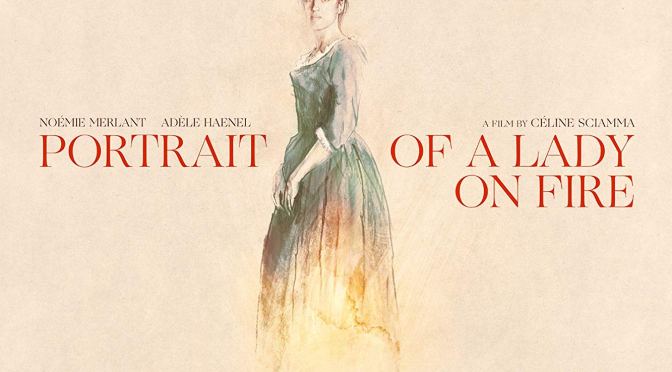
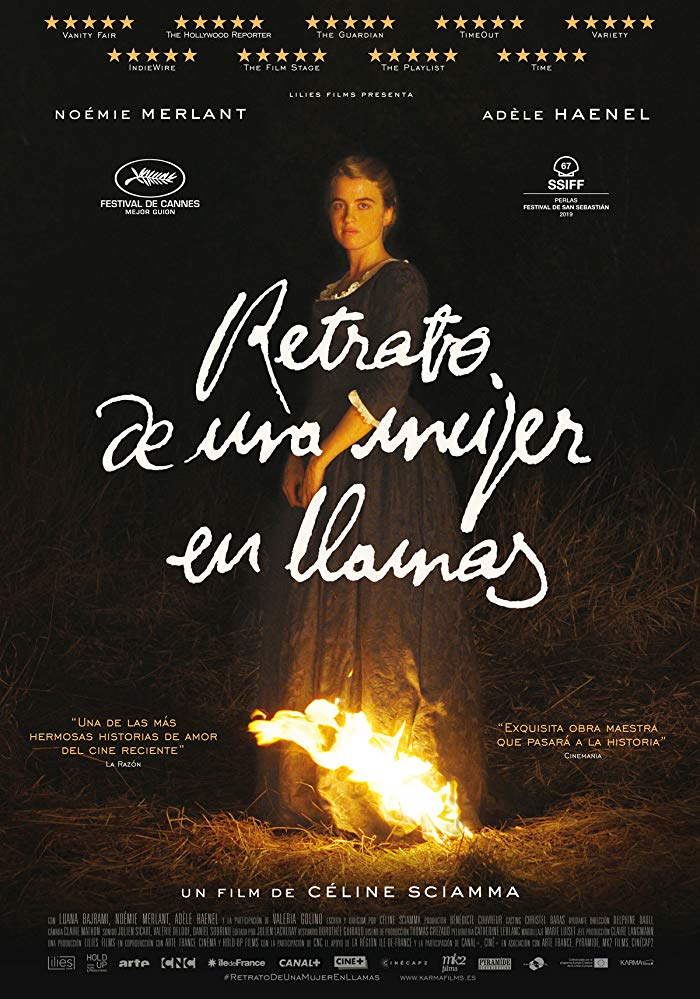
I haven’t seen any of Celine Sciamma’s previous films, but based on the romantic drama, Portrait of a Lady on Fire (2019), she is a filmmaker of formidable power and vision. I believe this is her fourth feature film directorial release and it is as sumptuous, moving, exquisitely shot and constructed a love story as you are going to witness. Moreover, it is proof that the art of screenwriting, compared to many by-the-numbers Hollywood film productions, is NOT dead.
The story is very simple. At the end of the 18th century, a young painter, Marianne, (Noemie Merlant) is commissioned to create a portrait of a young woman, Heloise (Adele Haenel). Heloise is, as is the tradition of the time, required by her mother (Valeria Golino), to marry a Milanese nobleman. He needs to see the portrait in advance in order to agree to the wedding. The only catch is, the insular Heloise, does not want to be painted for all manner of understandable reasons. What this establishes is two very intriguing characters, both with different emotions and desires.
Following the beautifully rendered story foundation, what follows is a magnetic series of scenes which subtly push these two empathetic characters together. Marianne is the artist who, at first keeps her distance, spying and analysing Heloise. Heloise is cool, sensitive and a prisoner on the Brittany island, trapped by the waves of the sea and her mother’s insistence on a society wedding. Over the space of a few days the walking companions become drawn to each other both artistically and emotionally. But, it’s no sordid desire for lust, rather a respectful and honest joining in romance. We, as the audience, literally see love grow before us thanks to some incredible acting from the leads.
Often the cinema critics will heap praise on a film and I will wonder what they have been watching. However, in regard to both Parasite (2019) and Portrait of a Lady on Fire (2019), the plaudits are so well deserved. Both are brilliantly written and shot works of cinema, that in the past may have been consigned to just the arthouse circuit. Further, given the film is about painting, it is unsurprisingly Portrait of a Lady on Fire (2019) is framed, lit and composed with an eye for the artistic. Yet, it isn’t just the look and colour of the film that impresses. Sciamma and her cinematographer, Claire Mathon, also create a series of haunting shots which will be indelibly scorched on my mind.
In terms of the themes, the film is very powerful too. As well the notion of art as a means of representing love, the narrative explores concepts of female equality and solidarity. There is an interesting subplot involving a member of the household staff, which adds to the thematic texture. Furthermore, the performances by all the actresses are superb too as Sciamma directs with such confidence. I also liked that the critique of patriarchal society was implicit rather than didactic. Also subtly realised are the tasteful love scenes, which never feel exploitational. My only minor criticism is that the opening hour could, arguably, have been trimmed slightly. However, what do you leave out of a film as beautifully composed, delicately written and emotionally compelling as Portrait of a Lady on Fire (2019)? I, a mere mortal, am not qualified to say in the face of such mesmerizing cinema.
Based on: Tell Me Who I Am by Joanna Hodgkin, Alex Lewis and Marcus Lewis
Cinematography: Erik Alexander Wilson
***SPOILER FREE***
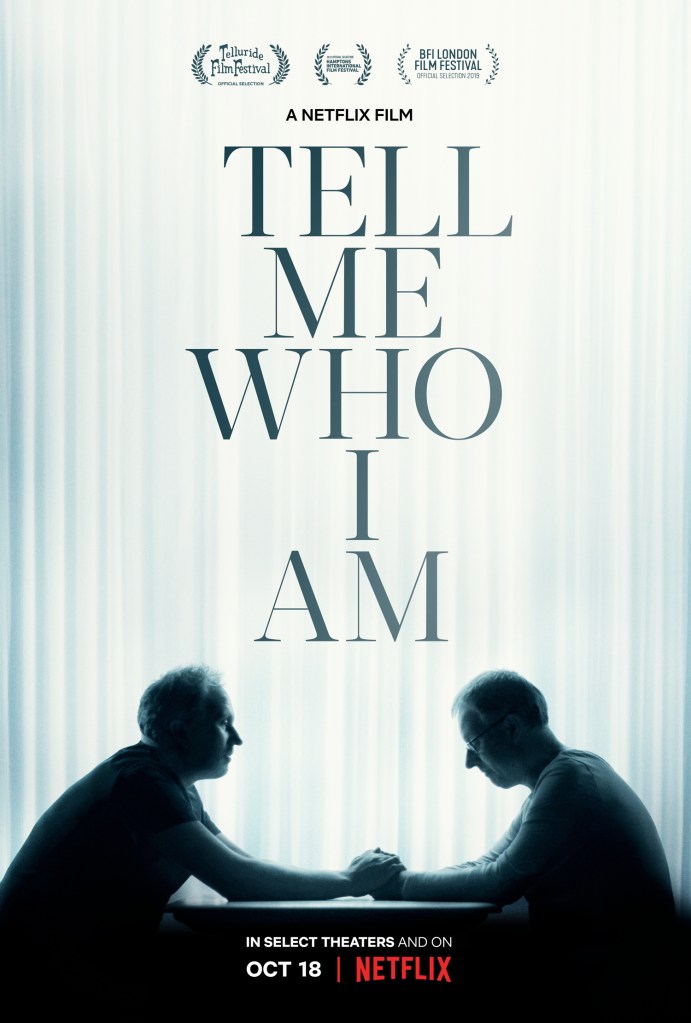
I recently reviewed a number of documentaries here, but it was only during a catch-up of Netflix films did I watch the harrowing family drama, Tell Me Who I Am (2019). Now, in my younger days I was naive enough to think documentaries were a representation of the whole truth and not a mediated version of events. There was fiction on one side and documentaries on the other. It’s a documentary so it must be true and must not be questioned.
That isn’t to say that the events of this incredible story are not true. No, my point is that Tell Me Who I Am (2019) is, while based on a true story, structured like a classic Hollywood thriller akin to something Hitchcock may have produced. Conversely, I was gripped throughout by the mystery, suspense and a gut-kicking reveal halfway through. Do not read anything about this moving family story beforehand, as going in with NO knowledge will make it all the more powerful.
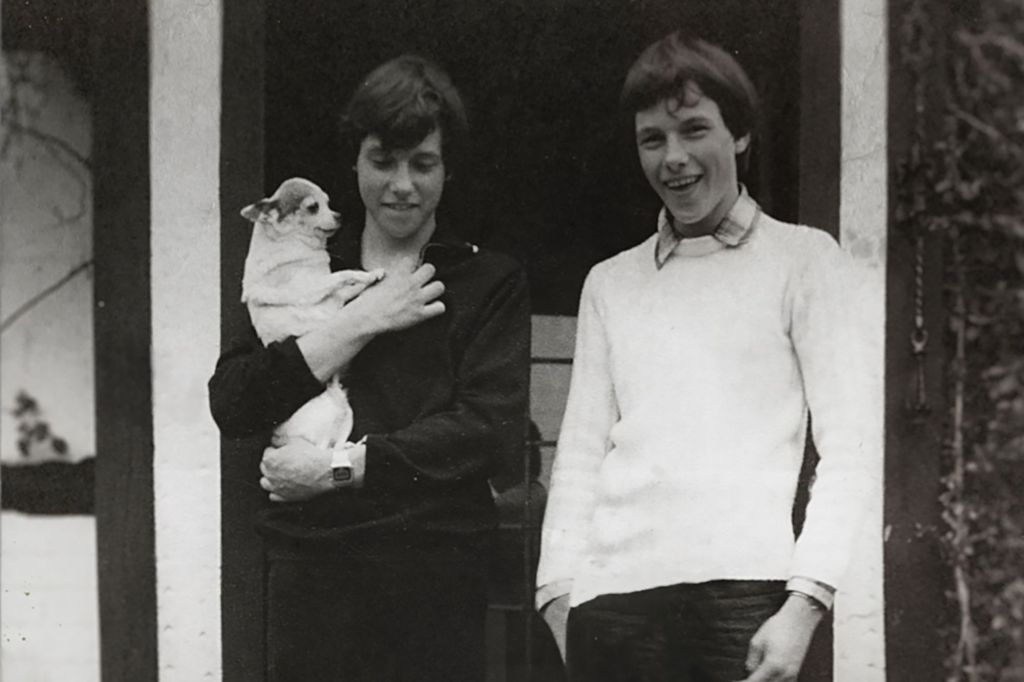
The film is structured in the classic three act fashion. Firstly, we find Alex Lewis describing events of an accident he had when 18. The incident led to him totally losing his memory. The only thing he remembered was he had a twin brother, Marcus. His mother, father, friends, their farmhouse, the privileged background and their dogs were all forgotten. Like a film noir protagonist he was left in the dark as to his whole history. With the help of Marcus, he slowly begins to learn about his past and rehabilitate for the future. Thus, at first one feels this is a story of an individual overcoming near-tragedy and rebuilding their life moment by moment. However, it becomes something much more than that. I shall say no more.
Shot through talking heads, photo montage and reconstruction, this is an exquisitely edited and filmed documentary. The twins, Alex and Marcus are framed in close-ups, with pale backgrounds and shadowed foregrounds. As we move back and forth between their respective sides of the story, one is slowly pulled into the incredible events that confirm truth is more horrifying than fiction. By the resolution I was shook and deeply affected by the film, with still some questions left unanswered. Ultimately though, Tell Me Who I Am (2019) is a satisfying and very emotionally charged story about searching for truth amidst familial conflict, betrayal and a longing for redemption.
Produced by: Mark Ruffalo, Christine Vachon, Pamela Koffler
Screenplay: Mario Correa, Matthew Michael Carnahan
Based on “The Lawyer Who Became DuPont’s Worst Nightmare” by Nathaniel Rich
Cast: Mark Ruffalo, Anne Hathaway, Tim Robbins, Bill Camp, Victor Garber, Bill Pullman, William Jackson Harper, Mare Winningham etc.
Cinematography: Edward Lachman
**MAY CONTAIN SPOILERS**
Every now and then one watches a film you kind of wish you hadn’t. Not because it is bad, quite the contrary with director’s Todd Haynes’ legal drama, Dark Waters (2019). No, you wish you hadn’t watched it because it unveils a tragic series of events relating to environmental, corporate, chemical, legal and human corruption. I prefer to possess hope that human beings can be trusted to do the right thing. However, based on this story that is definitely not the case. Moreover, given the information revealed about huge corporation, DuPont, and their environmental procedures, it’s a damning indictment against corporate greed and community murder.
A two-hour film is certainly not long enough to do justice to a story which has taken decades to unfold and cost the lives of many people and animals, while irreparably damaging the environment in the process. However, it effectively bullet points the crimes of the DuPont conglomeration in a riveting fashion. At the heart of it is corporate lawyer, Robert Bilott, here portrayed by the always excellent, Mark Ruffalo. Beginning circa 1998, Bilott, is approached by farmer Wilbur Tennant (Bill Camp) whose livestock have died or been culled due to tumours and other cancerous illnesses. Bilott who is usually employed to act as a lawyer FOR the big companies, investigates further. Subsequently he uncovers something rotten in the state of West Virginia.
Mark Ruffalo as Bilott inhabits an intelligent, caring and dogged man, driven by his desire to see justice for Wilbur Tennant and the people of Parkersburg. It’s often remarked Ruffalo would make a great Columbo; and like that famous fictional TV detective, Bilott never ever gives up. This is even in the face of years and years of environmental tests, litigation, DuPont’s dirty legal tactics and hundreds of court appearances. Anne Hathaway as his wife Sarah Bilott is also good, although her role is slightly underwritten. Bill Camp impresses though in his turn as the exasperated farmer whose life and livestock has been destroyed by synthetic chemical waste dumped into adjacent land.
Like A Class Action (1991), A Civil Action (1998) and Erin Brockovich (2000), this film rarely transcends the genre conventions of the legal drama. There are moments where it leans toward the conspiracy thriller elements of say, The Insider (1999). Bilott’s family life almost crumbles and he becomes paranoid that their lives are in danger from chemicals and DuPont. Overall though, the film’s strength is in the conveyance of the legal proceedings and agony of a community impacted by corporate negligence. Moreover, I was seriously in awe at the diligence Bilott showed in wading through the reams of legal paperwork.
Ultimately, this is a consistently solid narrative with Bilott’s resolute determination providing a sturdy spine throughout. It was slightly surprising to see the film was directed by American arthouse auteur, Todd Haynes. Nonetheless, it is not about making poetic cinema, but rather presenting a powerful environmental message that highlights the murderous avarice of DuPont. Haynes and his cinematographer inject some creative technique in the lighting style. Murky, shadowed and opaque, the cinematography match the dark recesses of the system Bilott fights against. Lastly, Ruffalo, as he did inFoxcatcher (2014) wrestles with the DuPont family, only this time with a wholly different conclusion.












 The Cinema Fix presents