SHUDDER HORROR CLASSIC REVIEW – THE CHANGELING (1980)
Directed by: Peter Medak
Produced by: Joel B. Michaels, Garth H. Drabinsky
Screenplay by: William Gray, Diana Maddox
Story by: Russell Hunter
Cast: George C. Scott, Trish Van Devere, Melvyn Douglas, John Colicos, Jean Marsh, Helen Burns, Madeleine Sherwood,
Cinematography: John Coquillon
***MAY CONTAIN SPOILERS***
If, teenagers being stalked and slashed by a crazed non-speaking maniac are your preference, then you probably would not enjoy the classic ghost story, The Changeling (1980). However, if you are rivetted and chilled by expertly crafted cinematic horror, built on a compelling screenplay, excellent performances and fine cinematography, then this is a film for you.
Not to be confused with the kidnapping thriller, Changeling (2008). The Changeling (1980) feels like one of those older films which created the mould for many other contemporary ghost narratives. A few examples include: The Woman in Black (2012), Candyman (1992), the Ring series and more recently, Hereditary(2018). Such films often feature genre tropes like:
Grieving or vulnerable lead protagonist(s).
A vengeful ghost or spirits who were murdered or done wrong when alive.
A creepy house or location which holds a dark secret and becomes a character in it’s own right.
A detective plot structure which finds said protagonist attempting to solve the mystery of the ghost’s past.
Lots of creepy supernatural comings and goings that ultimately lead to the ghost’s redemption or a successfully chilling retribution.
Of course, the model for such conventions lay in the pages of classic literary ghost stories, however, having not seen The Changeling (1980) for over thirty-years, I felt like I was watching a masterpiece of the supernatural film genre. It doesn’t hurt having Oscar winning actor, George C. Scott, subtly playing the lead as grieving John Russell, a musical professor trying to come to terms with the death of his wife and child. Moreover, the mature approach to pacing and direction by Peter Medak slowly builds the terror to a real crescendo. The horror within the plot, involving a murdered child, is ably imbued by the compelling score, elegant editing and John Coquillon’s exquisite camera movement and lighting composition. Ultimately, I enjoy a good slasher film, but give me a classy supernatural tale such as The Changeling (1980) any night of the week.
The horror genre is a fantastic medium with which to explore social, cultural and political events. Thus, with the COVID-19 pandemic still threatening the world’s health, wealth and societal structures, it will not surprise anyone when we get a raft of future films, songs, shorts and television programmes influenced by pandemics, viruses and lockdowns. Yet, there have already been, since the dawn of time, many horror, drama and science fiction films and series which have dealt with the end of the world due to some unknown or man-made virus.
For example, George A. Romero’s seminal low-budget masterpiece, Night of the Living Dead (1968), influenced an eruption of cannibalistic zombie movies after release. Indeed, the wave of undead genre films show no sign of stopping either. It makes sense therefore to focus my latest Shudder reviews on virus-based films and this category is obviously called Viral! Here I review four movies I watched on Shudder which all encompass some form of infection, disease or virus which impacts the living and the dead. As usual, all marks are out of eleven with the highest-rated film first.
ONE CUT OF THE DEAD (2017) – DIRECTED BY SHIN’ICHIRO UEDA
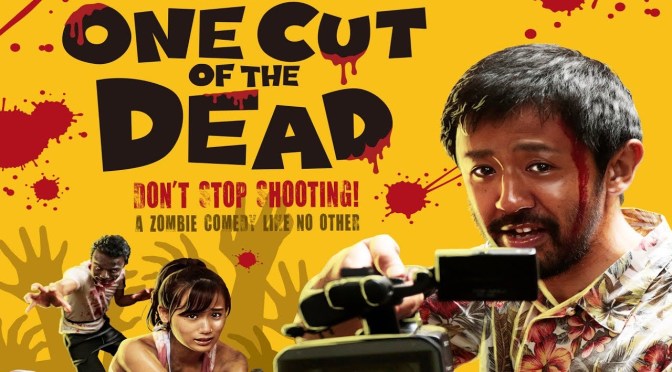
This film has both an amazing story on and off the screen. The budget of the One Cut of the Dead (2017) has been reported to be as low as $25,000. The film went on to be a massive hit in Japan, making over $25,000,000 at the box office there and abroad. Personally speaking, I am not a fan of indulgent one-take movies, but the sheer energy and invention of the initial thirty-seven minute take, followed by the hilarious scenes later, make this zombie-film-within-a-film-within-a-film a terrific watch. The lengthy set-up makes the furious splattering of punchlines in the film’s second half an absolute scream. To think it started out as part of an acting/filmmaking course makes the creative achievement all the more incredible. If you like zombie comedies and films about filmmaking too, this genuinely breathes new life into both sub-genres.
Mark: 9 out of 11
MAYHEM (2017) – DIRECTED BY JOE LYNCH
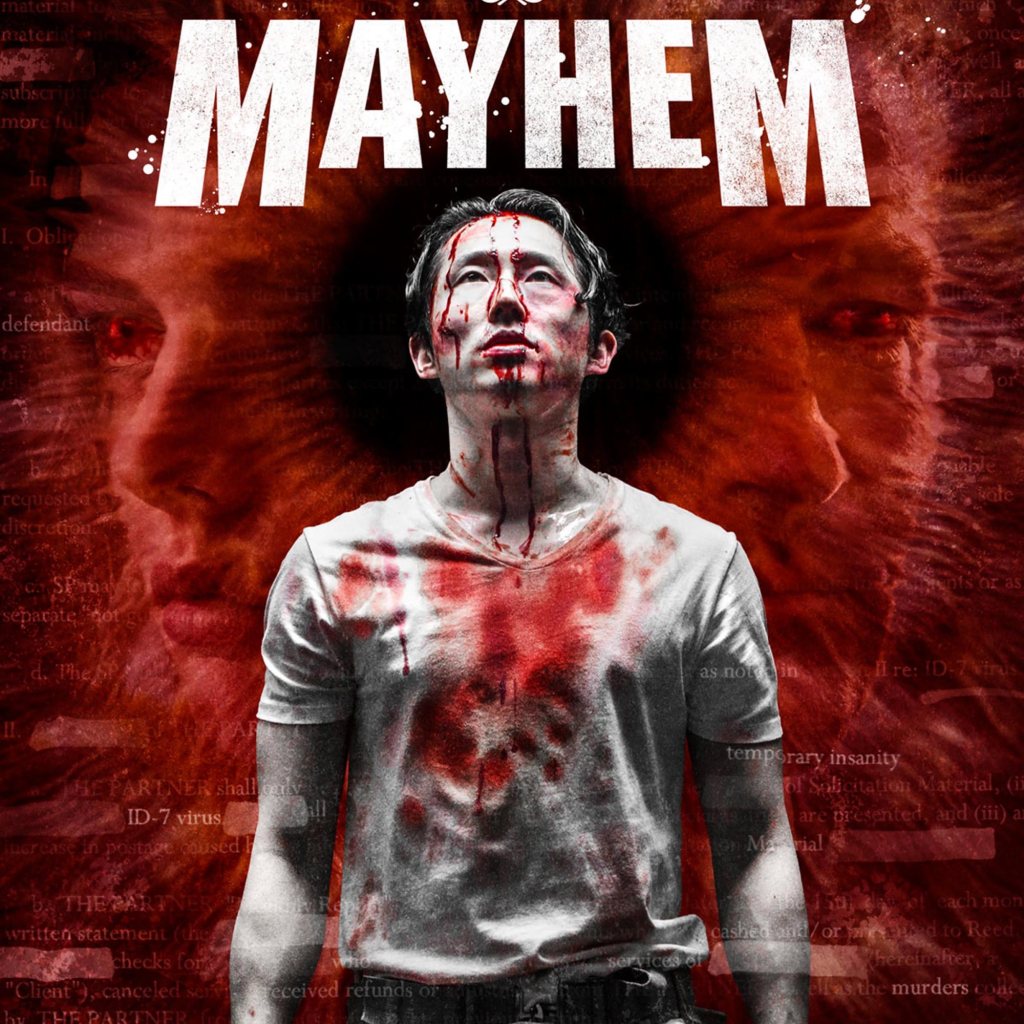
This office-based killer-thriller-horror-comedy resonated with me, as I myself have been trapped working in the corporate world. Steven Yuen is the jaded business attorney, Derek Cho, working for a law firm that regular screws over the less wealthy. When Derek is framed and fired, he plots revenge. However, his plans go sideways quickly when a nasty virus causes his office to be quarantined. The virus itself doesn’t kill, but it is capable of making people act out their wildest impulses – which tend to involve extreme sexual, verbal and violent behaviour. Mayhem(2017) uses a geographical structure similar to The Raid (2011) and Dredd (2012), where Derek must fight his way up from the ground floor to the corporate suits at the top. Steven Yuen is fantastic in the lead and he is ably supported by movie-star-in-waiting, Samara Weaving. The action, fighting and gore are well executed, and the script contains some great twists in this fast-paced horror gem.
Mark: 8.5 out of 11
THE CRAZIES (1973) – DIRECTED BY GEORGE A. ROMERO
Arguably, one of George Romero’s lesser known films is called The Crazies (1973). The narrative finds residents of a small American town accidentally infected by a darned biological weapon. The subsequent lockdown, quarantine and heavy-handed military invasion causes a small band of townspeople to fight back and attempt escape. As the soldier’s net closes in on them their lives are threatened by both the military and the virus. Overall, watching The Crazies is a dramatic, but chaotic experience. The ideas are strong, but Romero’s story is hamstrung by the low budget, choppy editing and some bad acting. Having said that, The Crazies echoes a lot of the issues our world has been experiencing lately. Although the deaths are more gruesome in Romero’s film and his characters don’t stockpile as much toilet roll as we have.
Mark: 7 out of 11
BLOOD QUANTUM (2019) – DIRECTED BY JEFF BARNABY
As well as providing a portal with which to watch older horror films, Shudder is also producing and buying up its own exclusive productions for streaming. One such release is Jeff Barnaby’s Blood Quantum (2019). Set in 1981, on the Red Crow Indian Reservation in Quebec, Canada, it’s an entertaining addition to the zombie genre, that perhaps would have been better served as a longer series. The story set-up is simple, as local sheriff, Traylor (Michael Greyeyes), is mystified when dead animals start to reanimate. Skip forward six months and a full-on viral assault has caused the dead to come back to life. The neat twist is that the indigenous American population is immune to the disease, but white people aren’t. Traylor and his community fight the dead (and living), attempting to keep safe from those that threaten their existence. Thematically, Blood Quantum (2019) is very powerful. The subtext of racial tension within the zombie genre is dramatically explored. Moreover, there are some explosively gory deaths and decent action. My main issue was with a script that laboured in places, as the film’s pace was slowed by overlong dialogues scenes.
I’m continuing the Shudder film review residency here on my site with this post. However, as I watched so many horror films on the channel recently, I have decided to break them down into categories. This one is called Extreme!
Essentially the films reviewed here are — because of their content, style or both — prime examples of nasty, violent, sickening and in some cases extremely depraved horror movies. So, be warned do not watch these films, unless you have a strong emotional constitution and actually enjoy witnessing graphic scenes of gore, sex and bloody mayhem.
For your information, the films are reviewed in order of my rating, which as usual is out of eleven.
REVENGE (2017) – DIRECTED BY CORALIE FARGEAT
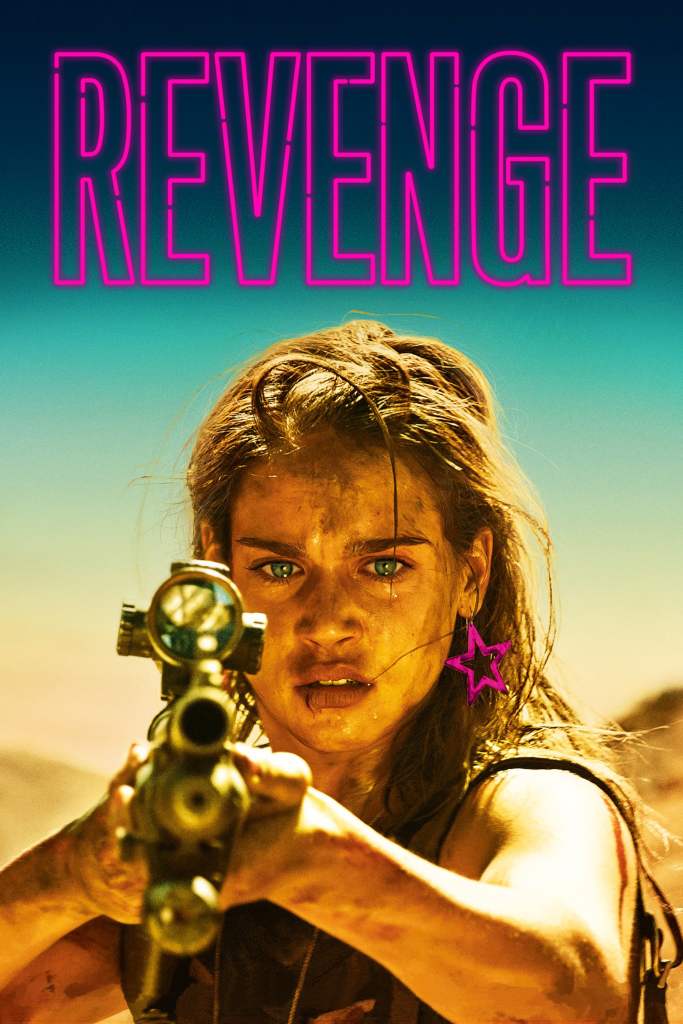
Featuring a B-movie rape and revenge plot, this exploitation story is raised way above its subject matter due to ultra-stylish direction, gorgeous cinematography and a compelling lead performance by Matilda Lutz. She portrays Jen, an aspiring actress, who is on a weekend getaway with handsome boyfriend (cheating husband), Richard (Kevin Janssens). He seems very well off as their break takes place at a stunning isolated villa location. However, things go awry when two of his hunting buddies turn up, and one, Stan (Vincent Colombe) attacks Jen while Richard is out. From then on events twist from incredibly bad to worse for Jen, and she finds herself being hunted down in the blazing heat of the desert. The film looks absolutely incredible with amazing photography and colour design. Overall, what it lacks in story and characterisation though, it more than makes up for in stunning action, searing violence and a powerful critique of toxic masculinity.
Mark: 8 out of 11
TERRIFIER (2016) – DIRECTED BY DAMIEN LEONE
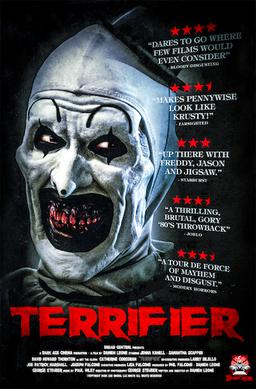
I saw this horror film appear in a post on the YouTube channel What Culture Horror. So, the story of a demented clown who never speaks and slashes people to death on Halloween definitely piqued my interest. It’s both extremely violent and low-budget, having been made for around $100,000. However, it is in fact impressively shot and edited for such a small amount of money. The gory effects are amazingly effective too, summoning up memories of 1980’s prosthetic film effects. There is no real subtext or thematic strength, but I was pretty tense and sickened throughout. Moreover, the clown called Art is a memorably monstrous creation. He kills without reason and purely for his own entertainment. Nihilistic in tone, the director sure knows his horror and delights in presenting many sick ways of murdering his characters. Thus, if you like disembowelling, strangulation, burning, beheading and other gruesome movie deaths then, Terrifier(2016), is worth watching from behind the safety of the sofa.
Mark: 7.5 out of 11
CITY OF THE LIVING DEAD (1980) / THE HOUSE BY THE CEMETERY (1981) – DIRECTED BY LUCIO FULCI
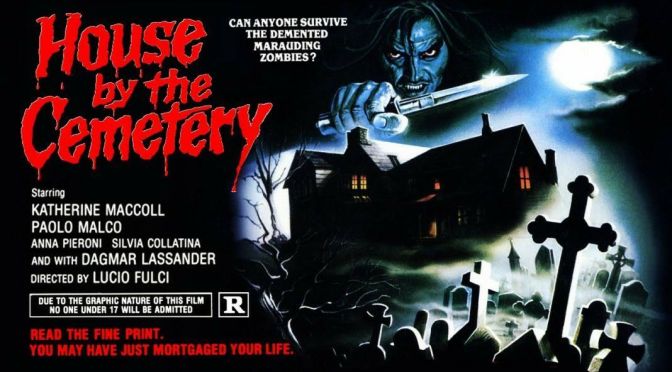
Filmmaker, Lucio Fulci, is often found lurking in the shadow of Italian horror filmmakers such as Mario Bava and Dario Argento, however, he truly knows how to frighten and sicken the life out of an audience. So much so he has been given the nickname, ‘Godfather of Gore’. As well as directing many films, notably, Zombie Flesh Eaters (1979) andThe New York Ripper (1982), he is infamous for his “Gates of Hell” trilogy which included: City of the Living Dead (1980), The House By the Cemetery (1981) and The Beyond (1981). I re-watched the first two recently and while not as terrifying as when I saw them in the past, they still have the power to shock. While lacking coherent plots, containing pretty bad acting and some chronically dreadful dubbing in places, paradoxically Fulci’s films can arguably be considered surreal horror classics. They may not make any narrative sense, but his ability to create stunningly violent set-pieces is legendary. Memorable scenes include: the spewing of intestines, crawling maggots, hanging priests, drilled brains, chopped heads and monsters rising from basements and graves. Such imagery and dreaded moments — all set to a creepy synth soundtrack — make Fulci’s movies unsettling viewing experiences.
Mark: 7 out of 11
ISLAND OF DEATH (1976) – DIRECTED BY NICO MASTORAKIS
Not only is this one of the sickest films I have seen, it is also one of the most appalling I have sat through. Having said that, that is in fact what Greek director Mastorakis, based on what I’ve read, set out to do. The story, if you can call it that, focusses on a couple called Christopher (Robert Behling) and Celia (Jane Lyle) who go on a sex-driven-kill-crazy-honeymoon-rampage on the Greek island of Mykonos. If you can get past the couple having sex in a phone booth while telephoning his mother, and stomach Christopher raping a goat before killing it, then do watch the rest of this conveyor belt of pornographic sex and violence. By the end, I was stunned to silence at how sick the film was.
Mark: 1 out of 11
TETSUO – THE IRON MAN (1989) – DIRECTED BY SHINYA TSUKAMOTO
Lauded as a low-budget Japanese extreme body horror cult classic, Tetsuo: The Iron Man (1989), is either the work of a genius or a complete madman. Filmmaker, Shinya Tsukamoto, deserves so much praise for literally making most of the film in his own house and paying for it out of his own pocket. Yet, the thumping industrial soundtrack, jump-cutting-stop-motion style and story of metal invading the body, soul and mind of various characters was too f*cked-up, even for me. I know it gets mentioned as a work of genius, but it was frankly unwatchable. Thankfully, it’s only sixty-seven minutes of hell to get through.
“If there’s specific resistance to women making movies, I just choose to ignore that as an obstacle for two reasons: I can’t change my gender, and I refuse to stop making movies. It’s irrelevant who or what directed a movie, the important thing is that you either respond to it or you don’t. There should be more women directing; I think there’s just not the awareness that it’s really possible. It is.“— Kathryn Bigelow in 1990
Having most recently directed the searing period drama, Detroit (2017), Bigelow has been making feature films, since her debut, The Loveless (1981), for over thirty-nine years. With a strong academic background, having studied at the San Francisco Art Institute and Columbia University, it’s fascinating to review a career which has eschewed arthouse cinema and essentially been spent working mainly on big-budget genre films. However, one can see in her directorial canon that Bigelow, while striving for commercial success, is constantly testing the boundaries of genre storytelling.
Along with a powerful visual style that attains symbiosis with the core material, she intelligently explores themes relating to violence, individual freedom versus the system, masculinity in crisis, gender representations and socio-political corruption. Lastly, her characters are often outsiders, morally complex and dealing with deep personal trauma. In short: Bigelow’s worldview is one of both healthy scepticism and cynicism, but also an element of hope within the longing for control. So, here are five of Kathryn Bigelow’s most impactful cinematic releases.
***ARTICLE CONTAINS FILM SPOILERS***
NEAR DARK (1987)
While The Lost Boys (1987) is rightly regarded as a very entertaining 80’s vampire film, Near Dark (1987) is way, way superior. Despite not catching fire at the box office, this neo-horror-western contains a fantastic cast of James Cameron alumni, including: Lance Henriksen, Bill Paxton and Jenette Goldstein. These great character actors inhabit this snarling gang of vampires perfectly as the film contains shockingly brutal violence and hard-bitten dialogue amidst a tender love story.
BLUE STEEL (1990)
While Jamie Lee Curtis is generally better known for her horror and comedy film performances, Kathryn Bigelow made excellent use of her dramatic acting ability as a rookie police officer caught up with Ron Silver’s psychotic commodities trader. Blue Steel (1990) is a variegated genre film which takes a standard police procedural narrative and twists it into something far more psychologically compelling. Lee Curtis excels, as does vicious bad-guy Silver, aptly named Eugene Hunt!
POINT BREAK (1991)
This classic heist meets surfing movie meets gay subtext bromance is jam-packed with classic action scenes and faux-deep philosophical musings. Keanu Reeves is the daftly named cop, Johnny Utah, who goes undercover, amidst the beach brigade to find a bunch of bank robbers. His suspicions fall on Patrick Swayze’s elemental surfer-dude-god and a dangerous “bromantic” game of cat-and-mouse ensues. Bigelow scored her first major hit with Point Break (1991), infusing it with some incredibly visceral stunt, surfing, robbery and chase sequences in an exhilarating film experience.
THE HURT LOCKER (2008)
After the box office failures of her previous three films, the under-rated sci-fi thriller, Strange Days (1995), enigmatic mystery, The Weight of Water (2000), and stodgy cold war film, K-19: The Widowmaker (2002), Bigelow’s seemingly took a career break. She would, however, come back with her most critically acclaimed and Oscar-winning film, The Hurt Locker (2008). From a brilliant script by Mark Boal and led by Jeremy Renner’s standout lead performance, The Hurt Locker (2008), put the audience right at the heart of a bomb disposal unit in Iraq. Putting aside the politics for a moment, the film is full of incredibly tense and superbly edited scenes which have your heart in your mouth. Simultaneously too, the film also shows the devastating emotional, physical and mental effect war has on the people of Iraq and the soldiers sent to fight this horrifically unjust conflict.
ZERO DARK THIRTY (2012)
Whereas The Hurt Locker (2008) had highly emotional and empathetic protagonists, Bigelow and Boal’s next film Zero Dark Thirty (2012), is a much more clinical and technically efficient cinematic experience. In parts, both a war drama and espionage thriller, the story also has a feel of an old-fashioned Western as American military and CIA operatives, led by the excellent Jessica Chastain and Jason Clarke, hunt down Osama Bin Laden. Politically speaking this is a film which makes me feel very uncomfortable for a number of reasons. It plays out like a revenge story. It also seems to both criticize and vindicate torture in the early scenes. This makes me uneasy as I understand the 9/11 attacks were just horrific, yet they seemed to get used as a motive for many more atrocities by the United States government. I guess that was what Bigelow and Boal were going for. They attempted to create a morally and emotionally complex war thriller that lets you interpret the events yourself and conclude one’s own judgements.
Produced by: Lindsay Law, Julie Dash, Arthur Jafa, Steven Jones
Written by: Julie Dash
Cast: Cora Lee Day, Barbara O, Alva Rogers, Trula Hoosier, Umar Abdurrahamn, Adisa Anderson, Kaycee Moore etc.
Music by: John Barnes
Cinematography: Arthur Jafa
***MAY CONTAIN SPOILERS***
“I didn’t want to tell a historical drama about African-American women in the same way that I had seen other dramas. I decided to work with a different type of narrative structure…[and] that the typical male-oriented western-narrative structure was not appropriate for this particular film. So I let the story unravel and reveal itself in a way in which an African Gullah would tell the story, because that’s part of our tradition. The story unfolds throughout this day-and-a-half in various vignettes. It unfolds and comes back. It’s a different way of telling a story. It’s totally different, new.” — Julie Dash
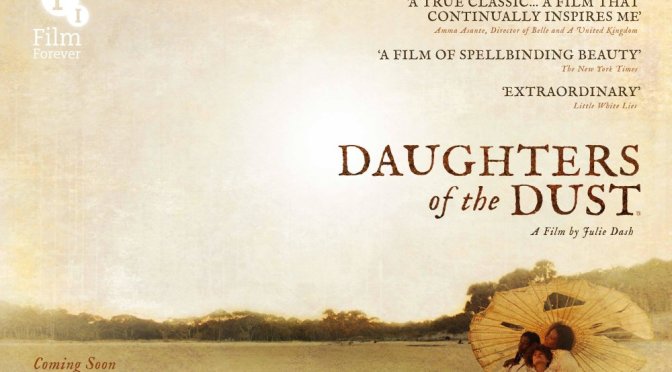
If you didn’t know the British Film Institute (or BFI) is the UK’s lead organisation for film, television and the moving image. It is a cultural charity that: presents world cinema for audiences in cinemas, at festivals and online; cares for the BFI National Archive, the most significant film and television archive in the world; is a registered charity that actively seeks out and supports the next generation of filmmakers; organises and runs the annual London Film Festival; and works with the government and industry to make the UK the most creatively exciting place to make film internationally. As my wife and I are members we get sent films on Blu-Ray/DVD as part of the membership. These can be re-released classics or remastered arthouse masterpieces such as Daughters of the Dust (1991).
Daughters of the Dust (1991) was a labour of love for writer and director Julie Dash. Originally inspired, way back in 1975, by her father’s experiences, she strived to create a short, poetic and cinematic account of a Gullah family’s migration from idyllic island life to New York at the turn of the century. Eventually, and after many year’s of development and struggle, PBS’ American Playhouse would grant the low budget for a feature film. The film is set in 1902. It tells the story of three generationsof Gullah women in the Peazant family and their varying viewpoints, thoughts and philosophies in regard to the move from Helena Island.
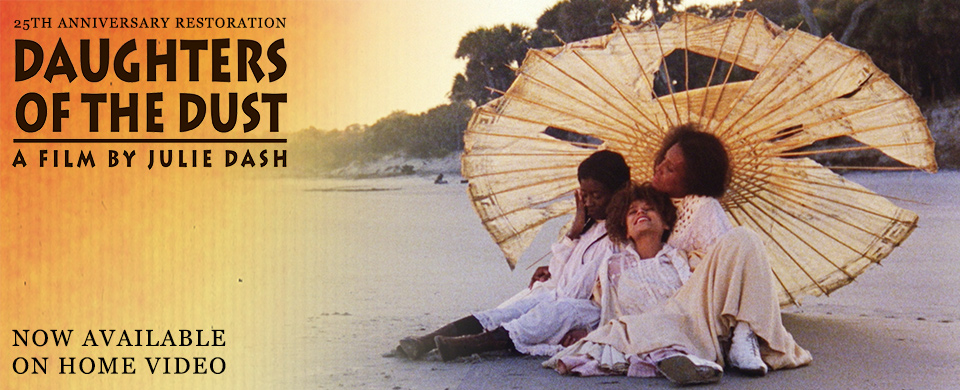
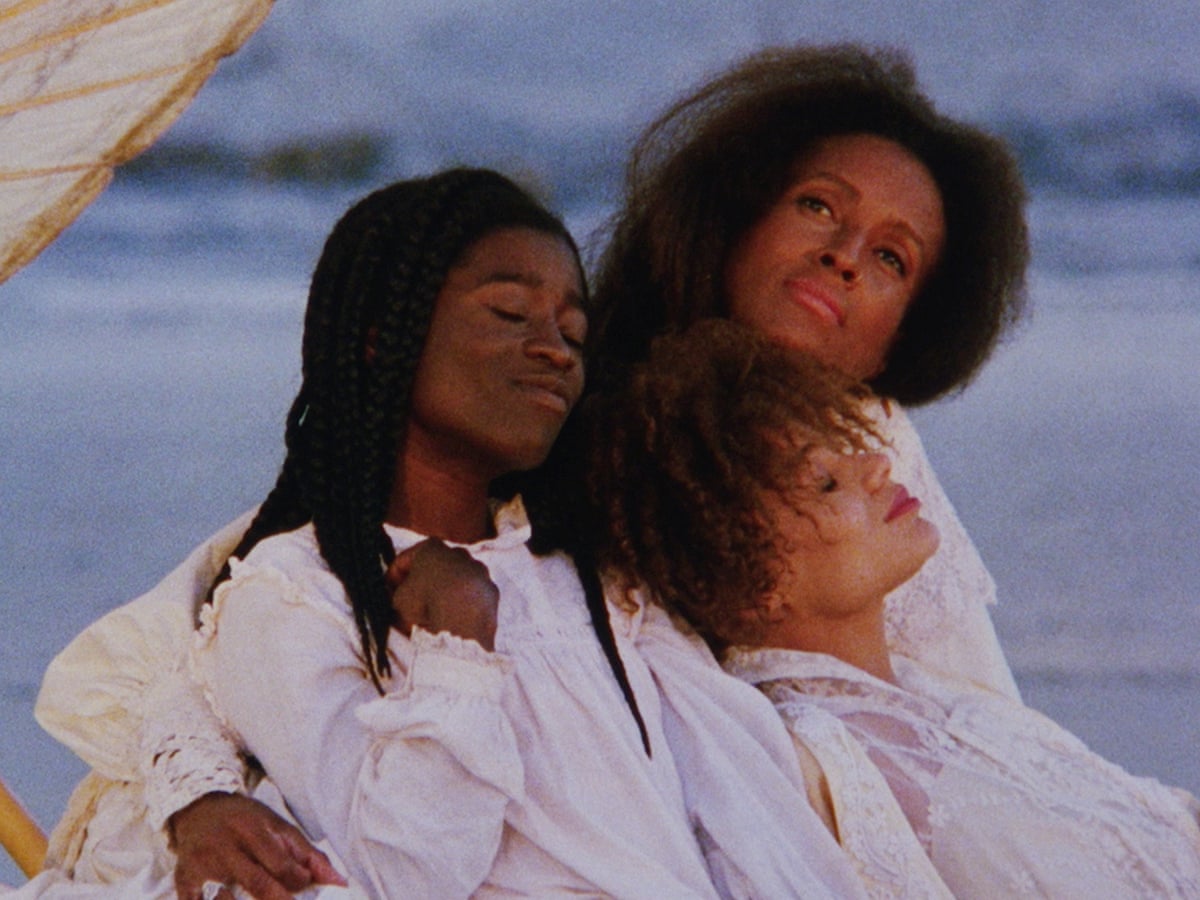
Daughters of the Dust (1991) was made for a reported $800,000, but it looks worth far more in terms of cinematography, costumes and settings. Arthur Jafa’s camera placement and use of the natural light, on the beach and swamp land especially, conjures up some magical imagery. The iconic images of the women on the beaches in their bright white dresses are stunningly memorable. While watching I felt like I was viewing a gallery of moving paintings, such was the exceptional nature of the composition. Again, despite a low budget and use of actors from independent cinema, Julie Dash, gets some incredibly natural and compelling performances from her cast. It’s all the more amazing as most of the cast had to learn the Gullah language employed from scratch.
Thematically the film is very powerful too. Conflict derives from dialectics such as the clashing of elder versus younger people, ancient beliefs versus Christian religion, African heritage versus Neo-American capitalism and nature versus technology. Julie Dash structures these themes and the character’s desires in a non-linear fashion over a period of a long weekend. There are poetic flashbacks and flashforwards too as the imagery is supported by a voiceover from a yet to be born child of parents, Eli and Eula. Ultimately, this film is a very immersive experience. There are no subtitles, so the language can be tricky to understand, but for me that enhanced the desire to feel the narrative. Indeed, the lyrical beauty of Daughters of the Dust (1991), combined with the humming percussion-driven music, stunning landscapes and inventive cinematic language mean you are swept out to sea by the powerful emotions of Julie Dash’s spectacular vision.
Executive producers: Alex Garland, Andrew Macdonald, Allon Reich, Eli Bush, Scott Rudin, Garrett Basch
Cast: Sonoya Mizuno, Nick Offerman, Jin Ha, Zach Grenier, Alison Pill, Stephen McKinlay Henderson, Cailee Spaeny, Karl Glusman, Jefferson Hall, Liz Carr, Janet Mock, Aimee Mullins, Linnea Berthelsen etc.
Cinematography: Rob Hardy
Composers: Ben Salisbury, Geoff Barrow, The Insects
Distribution / Screening Platform: FX / Hulu / BBC
*** MAY CONTAIN SPOILERS ***
“I read more about science than anything else, and it started with two things. One was getting my head around this principle of determinism, which basically says that everything that happens in the world is based on cause and effect. . . One is that it takes away free will, but the other is that if you are at a computer powerful enough, you could use determinism to predict the future and understand the past.”Alex Garland – Creator of Devs
Alex Garland has an impressive literary, cinema and now televisual curriculum vitae. He gained acclaim as the writer of the novel, The Beach, before moving onto screenwriting duties with fine films such as: 28 Days Later (2002), Sunshine (2007), Never Let Me Go (2010), and Dredd (2012). He made his directorial debut with Ex Machina (2014), which earned him an Academy Award nomination for Best Original Screenplay. His second film,Annihilation (2018), garnered further acclaim, so much so, FX bypassed a pilot and went straight to series for his latest science fiction narrative, Devs (2020).
While I am a massive fan of Garland’s work, I wasn’t too enamoured of Annihilation (2018). I found it brilliantly made with some fantastic concepts and incredible moments, yet overall it was too slowly paced. With the eight superlative episodes of Devs (2020), Garland has kept the meditative pace of Annihilation (2018), but also delivered a story which really connected with me this time. With Devs (2020) he has successfully merged a compelling technological espionage plot to an intelligent exploration of philosophical thought and behaviour. Moreover, Garland presents a complex group of themes and characters relating to Silicon Valley tech firms and how their work could control individuals, companies, governments, society as a whole, and actual time itself.
Set now in San Francisco, the narrative opens with two employees of the Amaya Corporation, Lily Chan (Sonoya Mizuno) and Sergei Pavlov (Karl Glusman), attending work. Sergei has a big presentation to pitch to Amaya CEO, Forest (Nick Offerman) and chief designer, Katie (Alison Pill). It goes well and Sergei is invited to work on the mysterious DEVS project. At DEVS he finds wondrous halo-style lighting in the woods and an incredibly expensive set of buildings, capsules, platforms, workstations and screens. Dominating the landscape also is a gigantic model of a young girl (Forest’s daughter, Amaya) who looms over the company and the San Franciscan horizon. These spectacular props, sets and locations are complimented by impressive cinematography from Rob Hardy throughout the eight episodes.
Sergei’s tenure at DEVS does not last long though as he goes missing. Lily, who was in a loving relationship with Sergei, is distraught and, with the help of ex-CIA head of security, Kenton (Zach Grenier), attempts to locate him. When Sergei turns up dead from an apparent suicide, Lily is convinced there is a conspiracy occurring in the Amaya company so begins a dangerous investigation. Even more intriguing, however, is the work that is occurring at DEVS itself. Led by Forest’s desire to “resurrect” his deceased daughter, this complex computer programme can somehow view events from the past, recreated via particle-driven software and projected on huge screens. Using this application the developers and programmers are attempting to determine the future from what has occurred in the past. If they can determine the future they may be able to control it. Mind blown yet? Safe to say, Lily’s investigation into Sergei’s death and the DEVS system become inextricably linked as the drama unfolds. As such, the drama works well as a conspiracy thriller as well as thoughtful sci-fi as Garland punctuates the brooding pace with some crushing stunts and brutal murder set-pieces.
I’ll be honest, the technological side of Devs (2020) was outside my knowledge repertoire as I do not comprehend coding or programming jargon. Nonetheless, I did understand what was occurring in the narrative as it was presented in a clear and digestible fashion. Unlike say the most recent seasons of HBO’s Westworld, which tied itself in knots with looping and over-lapping timelines, Alex Garland’s deft script, excellent direction and fantastic cast make Devs‘ (2020) complex science and tech theories comprehensible throughout. While Garland is dealing with theories relating to free will and deterministic cause and effect, the elegant structure, both linear and with flashbacks, builds a gripping narrative which maintains emotional impact for the characters and the choices they must make. Indeed, Lily Chan is a very empathetic leading protagonist and Sonoya Mizuno gives a compellingly magnetic acting portrayal. It was also fascinating to see Nick Offerman outside of his Parks and Recreation ‘Ron Swanson’ persona playing a highly driven and grieving father. Thus, to conclude, if you enjoy clever, meditative and Kubrickian style television in the science-fiction genre, then you should definitely use your free will and be determined to watch Devs (2020).
Cast: Robert De Niro, James Woods, William Forsythe, Jennifer Connelly, Elizabeth McGovern, Joe Pesci, Burt Young, Tuesday Weld, Treat Williams, William Forsythe, Richard Bright, James Hayden, Brian Bloom, William Forsythe, Adrian Curran, Darlanne Fluegel. Larry Rapp, Mike Monetti, Richard Foronji, Robert Harper, Dutch Miller, Gerard Murphy, Amy Ryder, Julie Cohen etc.
Music: Ennio Morricone
Cinematography: Tonino Delli Colli
***CONTAINS PLOT SPOILERS***
If you were, like me, thoroughly absorbed by Martin Scorsese’s recent directorial gangster epic, The Irishman (2019), you should definitely check out another incredible gangster drama, Once Upon A Time in America (1984). It is directed by acclaimed Italian filmmaker, Sergio Leone, he of “Spaghetti Western” fame. Indeed, Once Upon A Time in America (1984), was the first feature film he’d made since A Fistful of Dynamite (1971). Sadly, it was to be his final film.
With a director’s cut running at a behemoth 250 minutes and original theatrical release lasting 229 minutes, Once Upon A Time in America (1984), is certainly a marathon viewing experience and fitting epitaph to Leone’s cinematic craft. Yet, the film rarely feels over-long or slow because there are so many memorable scenes, fascinatingly complex characterisations, incredible intrigue and enough narrative density present to satisfy any audience member with the patience to let it absorb you. Structurally, the film is epic in nature too as it cross-cuts between three, arguably four, separate timelines in: 1918, the 1920’s, the 1930’s and 1968. Interestingly, I watched it via Amazon Prime in two sittings and is so long even the original ‘Intermission’ card remains.
Leone and his amazing production cast and crew took almost a year to film Once Upon A Time in America (1984). It’s reported to have had somewhere between eight to ten hours of footage on completion. He originally wanted to release it as a two-part epic, but the studio insisted it was distributed as one film. The almost-four hour theatrical release was received to great critical acclaim in Europe, however, a severely chopped down 139-minute version was put out in America. It was a critical and box office bomb. American critics however, lauded the European version, lamenting the non-release of Leone’s full cinematic vision.
For a filmmaker who was drawn to stories set in the America, Leone would generally film in European studios and locations. While some exteriors for Once Upon A Time in America (1984) were shot on location in Florida and New York, many of the interiors were recreated in Rome’s Cinecitta. Furthermore, a Manhattan restaurant was built in Venice, and incredibly, Grand Central Station was rendered at part of the Gare du Nord in Paris. Having said that, Once Upon A Time in America (1984), is so carefully and exquisitely designed and filmed, you would not notice. While possessing more than an air of European arthouse sensibilities, the film, based on a novel called The Hoods, represents Leone’s and his co-screenwriter’s tarnished vision of the American dream. Most significantly is the theme of a loss of innocence. 1920’s New York is presented through the eyes of these Jewish working-class children, many of them sons and daughter of migrants from Europe. These are tough times and the story explores the collision between young innocence and adult corruption by society and humanity. Once Upon A Time in America (1984) is also a story about friendship, loyalty, passion and crime.
The narrative revolves around the lives of young gang of Jewish friends growing up in Brooklyn called: Noodles, Max, Patsy, Cockeye and little Dominic. It’s majestic storytelling of the highest quality as we flit between past, present, now and future. Robert DeNiro’s older Noodles reminisces both from 1930 and 1968. There is a sense that he may be projecting from the hazy and drug-addled glow of an opium den. That is open to interpretation though. Thematically, the framework hangs a history of childhood friendships, juxtaposing it with the same people as adults and their victories, losses and betrayals. Further themes include: love, lust, greed, crime, broken relationships, Prohibition, union corruption; as well as focusing on the rise of mobsters in American society.
Noodles as portrayed by an imperious Robert DeNiro is calm on the outside, however, his often-rash actions show him as impetuous, emotional and wild on the inside. James Woods’ Max is much more careful, calculating and ice-cold in his business. But the two forge a friendship as teenagers which continues in adulthood. Their childhood gang subsequently becomes a renowned bootlegging and criminal outfit. Leone does not ask us to like or find sympathy for the characters, but rather respect that they are a product of a ruthless era. Sure, they could have got day jobs, but they decide to become criminals and very successful they are too. Even after Noodles gets out of jail for killing a rival, Max has saved a place for him in their illegal liquor trades. Only later does the true deception occur. Ultimately, while their stories are incredibly compelling, these men are violent lawbreakers who spill blood, bribe, threaten, kill and rape, all in an attempt to rise up the ladder of the American capitalist system.
I don’t want to spoil any more of the story, but safe to say the cast in this classic film are amazing. Along with DeNiro and Woods’ brutally convincing performances a whole host of young and older actors are directed beautifully by Leone’s careful hand. The standouts for me are Jennifer Connelly in a very early role. She portrays the younger Deborah, while Elizabeth McGovern is the older version of the same character. Connelly is a picture of angelic innocence and Noodles is smitten with her from the beginning. It’s sad therefore that when the adult Noodles’ is rejected by Deborah, his reaction is both toxic and unforgiveable.
Undeniably, sex and violence are powerful features in Once Upon A Time in America (1984). Sex especially is rarely, if at all, romantic or part of loving relationship. There are two brutal rape scenes in the adult years. Even when they are kids the character of younger Peggy is shown to use her promiscuity as a weapon to blackmail a police officer. There are some tender moments though, notably during the scene where young Patsy seeks to lose his virginity with Peggy. Her payment would be a cream cake, but Brian eats the cake and saves his innocence. Yet such scenes are fleeting as mob rule, violent robberies, fiery death and murder ultimately dominate the character’s bloody existences.
As I say, the actors all give memorable performances and the supporting cast including the likes of Treat Williams, Danny Aiello, Tuesday Weld and Joe Pesci are extremely strong too. A special mention to James Hayden who portrays the older Patsy. He doesn’t have the most dialogue compared to the characters of Max and Noodles; however, he has a quiet power which steals many scenes via strength of personality. The fact that Hayden died of a heroin overdose, in 1983, after completing filming only adds to the cult of tragedy. Dead at 30 years of age, James Hayden never got to see any completed version of Once Upon A Time in America (1984).
Given this review is getting near epic proportions itself I will begin to wrap up by heaping praise on the incredible production design. The costumes, locations, vehicles, props and era are slavishly and beautifully recreated. So much so you can almost smell the smoke as it drifts up from the Brooklyn streets. Moreover, the film is superbly photographed by Tonino Delli Colli. The music! I haven’t even mentioned the sumptuous score by the legendary Ennio Morricone. His score is a masterful symphony of haunting laments for loss of love, friendship, loyalty and life. Much indeed like Once Upon A Time in America (1984) itself, as a whole. In conclusion, if you haven’t seen it, I urge you to do so in the knowledge that Sergio Leone has transplanted that same brutally elegant vision of the Wild West to the American gangster genre with unforgettable emotional resonance and power.
Produced by: Claude Herroux, Pierre David, Victor Solnicki
Cast: James Woods, Sonja Smits, Deborah Harry, Les Carlson, Jack Creley, Peter Divorsky etc.
Music: Howard Shore
***CONTAINS SPOILERS***
With the lack of cinema-going action, I am now looking at building other review ideas and articles into my blog. I have regular new release reviews, classic film reviews, great ensemble casts and under-rated film reviews. I suppose that’s enough really, but there are some films that don’t quite fit these categories and they are cult movies. How does one define a cult film? It could have been a box-office bomb or be a no-budget gem, be transgressive or have controversial subject matter. Conversely, it could be a video nasty or banned or even an ultra-arthouse film which defies classical filmmaking conventions. More importantly, I do not have to actually like the film for it to qualify as a cult film. It could be a difficult film I am evaluating or re-evaluating from a fan or academic perspective. Lastly, it could just simply be a film that is uncategorizable or so bad it’s bad or so bad it’s good.
My first review in this category is David Cronenberg’s body-horror film, Videodrome (1983). Now, it may fit the specific rules of an under-rated classic laid down in previous articles, however, Videodrome (1983) is not necessarily a film I love or believe is a classic. It is a remarkably original narrative descent into the hellish and surreal world of demented psychological snuff television. It contains amazing practical special effects by the legend Rick Baker, yet, having re-watched it last week I cannot say it’s a film one can enjoy from an entertainment perspective. Don’t get me wrong, David Cronenberg is a true auteur and genius filmmaker, it’s just Videodrome (1983) is a hallucinatory and disturbing nightmare of a film that works outside the boundaries of usual image systems and narrative conventions. Basically, it’s more a powerful set of concepts and scenarios rather than a simple and satisfying story.
The story opens with anti-heroic, Max Renn (James Woods) as president of CIVIC-TV, seeking new content for his Toronto-based TV channel. Despite Woods’ charisma as an actor he is an expert at playing dominant alpha male types who challenge the audiences’ empathy. He portrays Max with a sleazy charm hunting for, what one may consider, soft-pornographic shows for his station. He’s basically an addict looking to push the walls of taste for his sex-hungry viewers. Max then discovers a channel, via a grainy satellite feed, called Videodrome. It shows unfiltered torture and sexual aggression, and Max becomes determined to tap into that market. At the same time, he begins a sado-masochistic sexual relationship with a radio host, Nikki Brand (Deborah Harry). Soon, these two intense narrative strands entwine and threaten Max’s mind, body and very existence.
Videodrome (1983) is a highly intelligent shocker which explores the nature of television violence, notions of taste and censorship, fears of technological programming, and the mental damage caused by over-exposure to violent pornography. It is an extremely psychologically and physically graphic film to watch. Nevertheless, it is also full of incredible imagery involving on-screen murder, Renn being swallowed by his TV; and also literally transforming into a human video cassette player. While an audience may not like Max Renn as a person, his journey is one that grips with magnetic shock and disgust. As he gets ever closer to the Videodrome channel his downward spiral plays out like a demented morality story, with Max representing the journey of those audience members who lose themselves in the illusory realities of television product. As he begins to lose touch with reality, Max experiences a complete lack of control over his mind and desires, all seemingly controlled by a heinous corporation led by insidious suit, Barry Convex (Leslie Carlson).
Incredibly, David Cronenberg apparently turned down directing The Return of the Jedi (1983) to write and direct this more personal vision of cinema. Could there be two more different films? Nonetheless, while it may not be a film I can easily recommend to those of a sensitive disposition or those who like their horror to have tidy conclusions, Videodrome (1983), retains its relevance and power to this day as a shocking critique of modern media. Hence qualifying it as a cult horror film which pushes all the wrong buttons in the right way.
Screenplay by: Lewis John Carlino – based on the novel, Seconds, by David Ely
Cast: Rock Hudson, Salome Jens, John Randolph, Richard Anderson, Will Geer, Karl Swenson, Jeff Corey etc.
Music by: Jerry Goldsmith
***MAY CONTAIN SPOILERS***
So, I continue my articles on films which have perhaps fallen off the radar and deserve more recognition. The rules are simple. An under-rated classic can be a film I love, plus satisfy the following criteria:
Must not have won an Oscar.
Must not have won a BAFTA.
Must not appear in the AFI Top 100 list.
Must not appear in the IMDB Top 250 list.
Must not appear in the BFI 100 Great British films.
Must not appear in the all-time highest grossing movies of list.
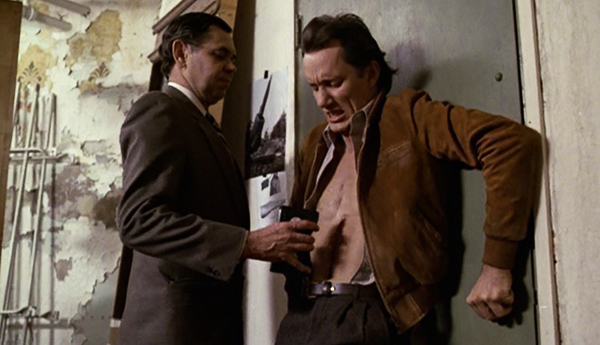
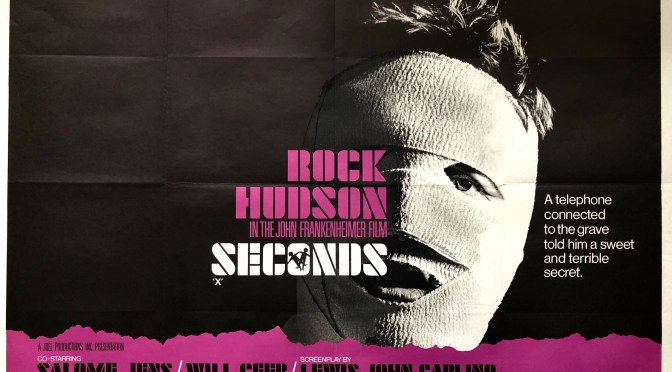
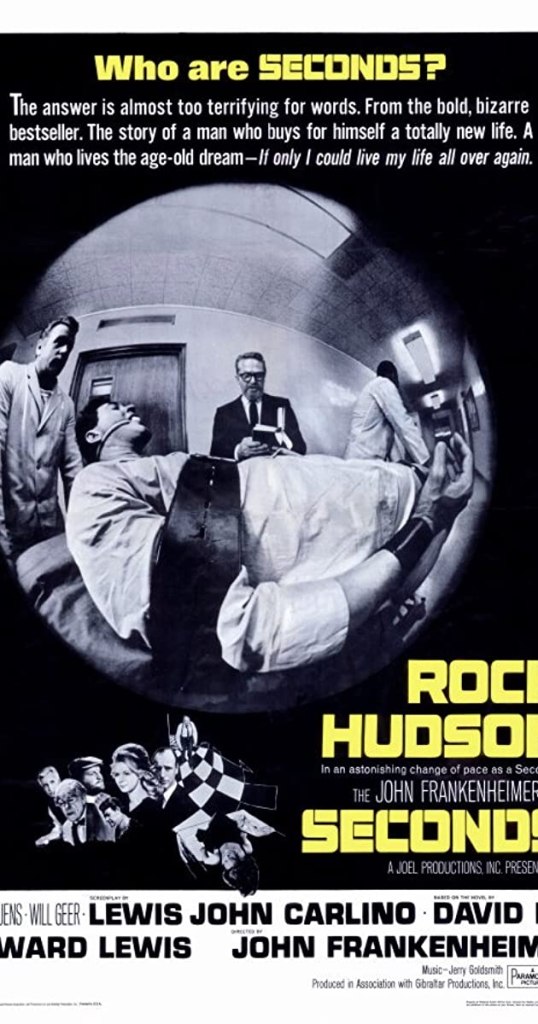
Seconds (1966) is a science fiction drama which is very much of its time, but also truly relevant today. It deals with identity and lifestyle transplants. The film explores notions of escaping one’s everyday existence and living out one’s dreams through plastic surgery and scientific procedure. However, it also contains an important message, that whatever physical, social and personal changes you make there are no guarantees your life will be better. Perhaps, it is best to accept what you have and work with what nature gave you. Make positive changes to your mind and body, but know that there is no such thing as a quick fix.
The character of Arthur Hamilton (John Randolph) certainly finds this out to his cost in the narrative of Seconds (1966). His life is reasonably good, but he is dissatisfied with his job, and love for his wife has dissipated. He discovers an outfit called ‘The Company’ can, at a price, exchange his body and life, allowing him to be reborn a new man. After the procedure that man happens to be called Tony Wilson, who has the movie star looks of Rock Hudson. Hamilton/Wilson settles into a creative and hedonistic life by the beach. Yet, the sand is always softer on the other side. Soon, holes begin to show in Hamilton/Wilson’s new life.
Seconds (1966), is a psychologically eerie body-swap-sci-fi-horror film. It’s shot in crisp black and white by influential cinematographer, James Wong Howe, and contains some psychedelic visuals, weird angles, mirrored images, fish-eye lens shots, and images of actual rhinoplasty during the transformation sequence. Brilliantly directed by John Frankenheimer, it is also thematically very powerful. Aside from the dystopic warnings about plastic surgery, it also explores the nature of cults and closed communities. Rock Hudson gives a career best performance as Tony Wilson. His desperate and paranoiac scramblings in the second half of the film are painfully stressful as the character realises he has not only lost his identity, but possibly also his mind. Overall, it’s important to reiterate that organic change in itself is a positive thing, however, as Seconds (1966) demonstrates, there are no shortcuts to happiness or success.
Produced: Antony Russo, Joe Russo, Mike Larocca, Chris Hemsworth, Eric Gitter, Peter Schwern
Screenplay by: Joe Russo – based on Ciudad by Ande Parks, Joe Russo, Fernando Leon Gonzalez
Cast: Chris Hemsworth, Rudhraksh Jaiswal, Randeep Hooda, Golshifteh Farahani, Pankaj Tripathi, David Harbour, etc.
Distribution: Netflix
***MAY CONTAIN SPOILERS***
Do you remember when action heroes used to be larger than life, filling up the screens with muscles, charisma, and wise-cracking one-liners. I am old, so I certainly do. The likes of Arnold Schwarzenegger, Steven Seagal, Bruce Willis, Jean Claude Van Damme and of course, Sylvester Stallone were just some of the leading men crunching and blowing up the cinema screens. Okay, they may have been reactionary 1980s and 1990s masculine archetypes, and arguably nationalistic, sexist, militarist and incredibly over-the-top characters, but I kind of miss them. Because today’s action heroes, while equally talented at killing and delivering mayhem, are somewhat less colourful.
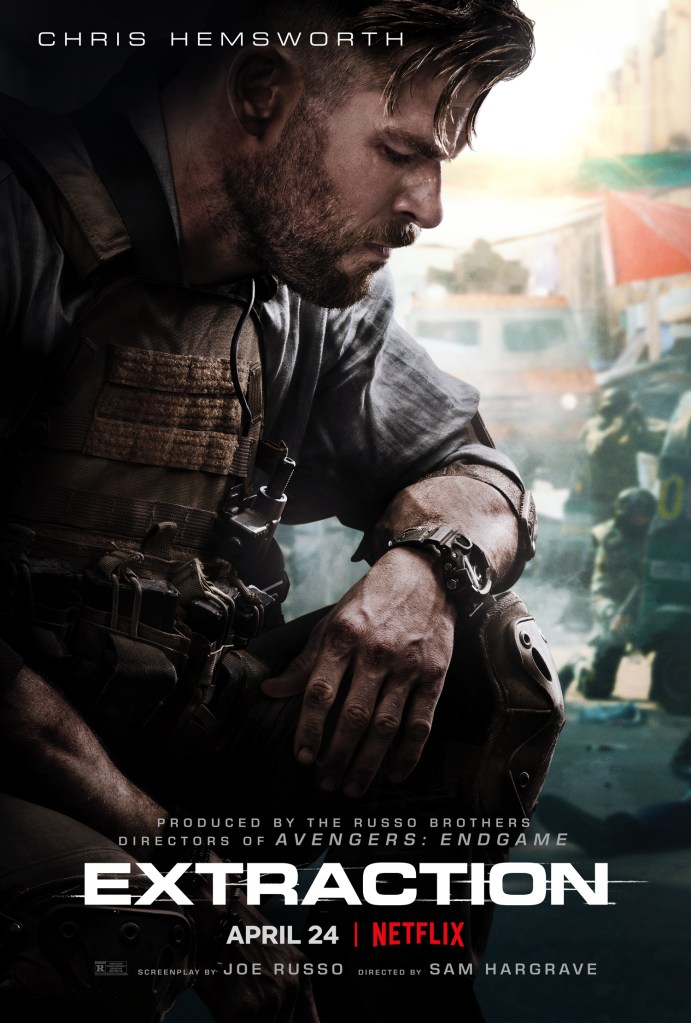
Don’t get me wrong, I still enjoy the technically excellent and brutally realised fight scenes and stunts of today. However, John Wick, Bryan Mills of Taken (2008), Lorraine Broughton of Atomic Blonde (2017), Jason Bourne, and now Chris Hemsworth’s mercenary, Tyler Rake in Extraction (2020), are individuals of fewer words and even less humour. I guess Jason Statham isn’t too bad, but he’s still quite serious. Lastly, while one can certainly rely on the sanitized fun of the Marvel Universe for some humour and personality within the action, it’s still not the same as a good old Arnie action flick. The more adult oriented superhero, Deadpool (2016), can be relied on for X-rated violence and constant verbal quips. But, he wears a suit and it’s just not as good as the action heroes I grew up watching. Ah, but that’s nostalgia for you.
Why the trip down memory lane, Paul? What about the kinetic and explosive action of Extraction (2020)? Yes, the well-choreographed manoeuvres are extremely exciting. They are also bone-crushingly relentless from the moment Tyler Rake enters Bangladesh to extract an imprisoned Indian gangster’s teenage son, Ovi Mahajan (Rudhraksh Jaiswal). Hemsworth and director Sam Hargrave get you in and out of hand-to-hand fights, car chases, leaps and falls from buildings, and constant gun battles with stunning brilliance throughout. The camera and editing work present virtuoso work, capped by an almost seamless eleven minute long take involving all manner of mayhem. While Ovi and Tyler kind of bond later in the film, I found myself needing more emotional or political subtext to narrative. Even John Wick (2014) created its own mythology and universe, where this relies on fast-paced movement, military tropes and lazy stereotypes. Ultimately, Extraction (2020) was like an explosive fireworks display. Great to watch while it lasted, but ultimately forgettable. Man on Fire (2004) did this story way better and with way more feeling.