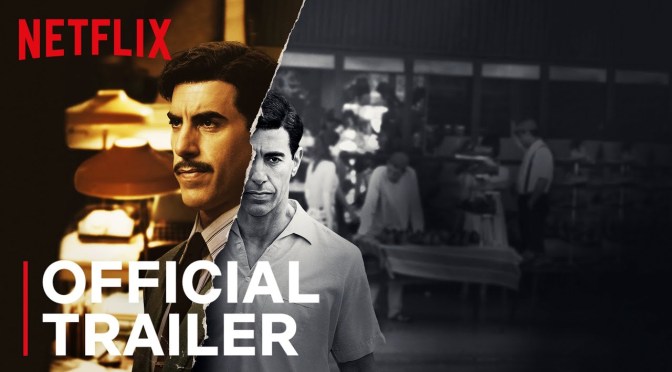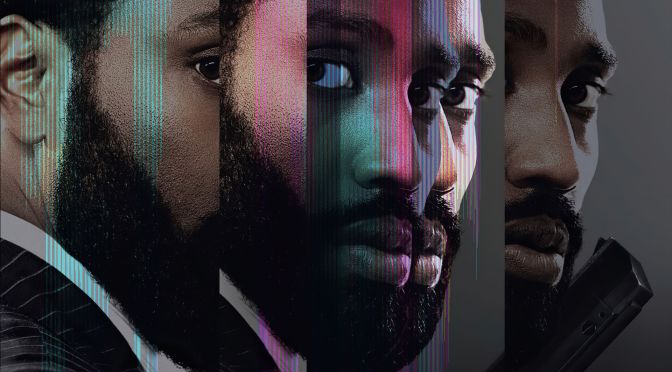
Screenplay by: Gideon Raff & Max Perry – based on the book L’espion qui venait d’Israël – written by Uri Dan and Yeshayahu Ben Porat.
Cast: Sacha Baron Cohen, Noah Emmerich, Hadar Ratzon-Rotem, Yael Eitan, Nassim Si Ahmed, Moni Moshonov, Alona Tal, Mourad Zaoui, Alexander Siddig, Marc Maurille, Waleed Zuaiter, Arié Elmaleh, Hassam Ghancy, Uri Gavriel etc.
Distribution: Netflix
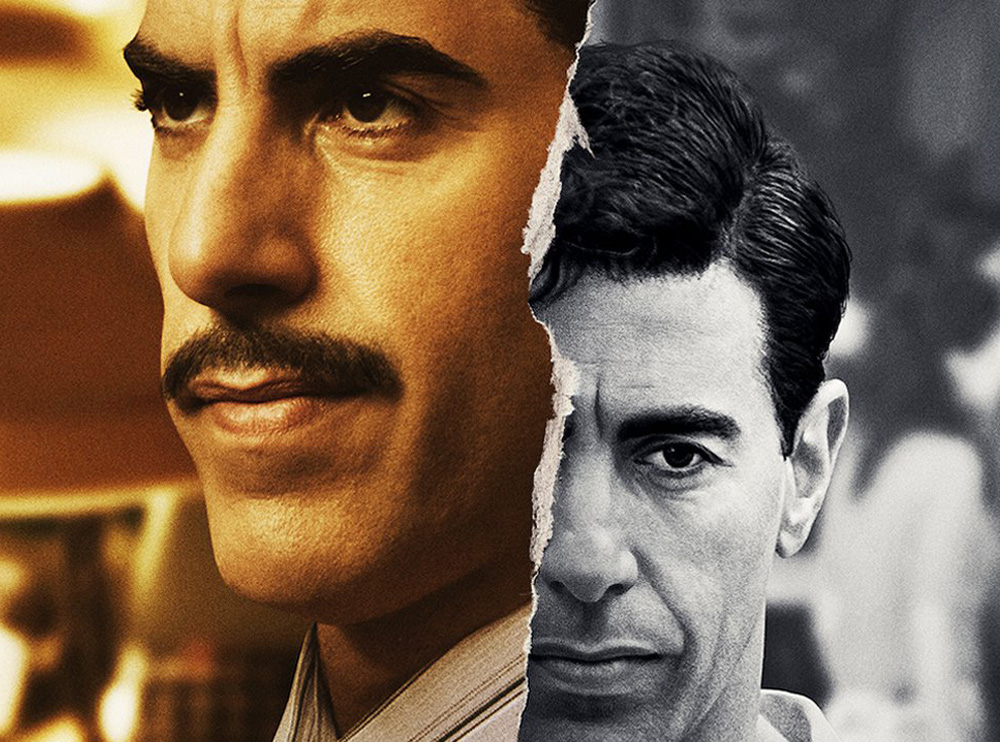
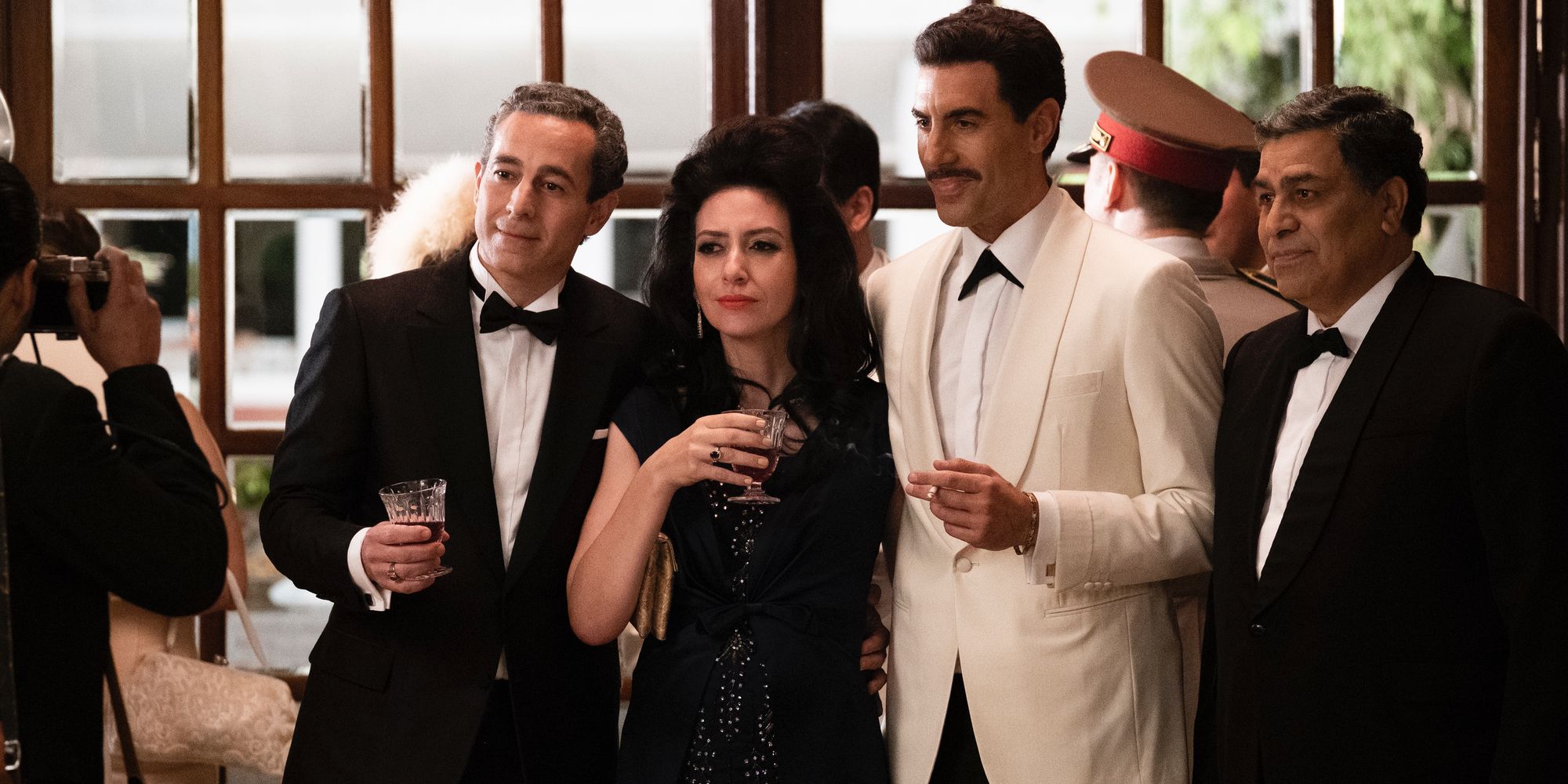
There’s a wonderful scene in a later episode of The Spy (2019) where Sacha Baron Cohen’s undercover Israeli agent laments his split identity. Taking on a Syrian alter ego in order to infiltrate their military and government infrastructure has meant Eli Cohen has sacrificed his safety and family life to become businessmen, Kamal Amin Thaabet. After years of successfully inveigling his way into the Syrian system, these battling personalities have created a psychological rift. As Eli spills his guts to handler, Dan Peleg (Noah Emmerich), he is so conflicted he feels Eli is lost and Kamal has taken over. He no longer knows who he is from one moment to the next. It’s a great scene and, like he does throughout this compelling drama, Baron Cohen excels. Indeed, given he has portrayed different comedic creations over the years, there is startling truth here.
Of course, portraying larger than life, and hilariously offensive characters, such as Borat, Ali G and Bruno marks Sacha Baron Cohen as a provocative comedic genius. His risk-taking-celebrity-baiting-devil’s-advocate-controversial television shows and films have been very successful commercially. Moreover, he has also won many awards in the process. While he was mooted to portray Freddie Mercury at one point, other than Les Miserables (2012) and perhaps Hugo (2011), Baron Cohen is obviously best known for his comedic work. However, the deft and nuanced performance presented here in The Spy (2019), I hope, leads to more dramatic roles for Baron Cohen. Because, he is absolutely outstanding in this split role.
Following the beats of espionage and undercover police narratives, Gideon Raff, who created the original Israeli drama which would become big TV hit, Homeland, has delivered a gripping and stylish period drama. The 1960’s set era is evoked expertly from the washed-out hues of the scenes set in Israel, to the more colour-drenched sequences set in Syria. Recruited by Mossad, Cohen trains, adopts his new identity as Kamal, and is transplanted to Buenos Aires. There he uses Israel-backed wealth, chutzpah and business acumen to further cement his Syrian cover. Eventually moving to Syria raises the stakes for Cohen/Kamal and the danger levels increase as his contacts become more dangerous and powerful within the Syrian government.
Overall, The Spy (2019), buoyed by Baron Cohen magnetic performance, is highly recommended. Further, I was constantly on edge for Cohen/Kamal’s safety as he transmits messages to Israel via Morse code and photographs exported in furniture out of Syria. Conversely, the process of being a spy is brilliantly developed and presented. While it is based on a true story, I’m sure many liberties have been taken by the writers to condense the years of espionage work Cohen/Kamal achieved for Israel. Similarly, the political complexity of Syria and Israel’s conflict is arguably glossed over in favour of more generic thriller leanings. Having said that, the Syrians are not shown in a negative light, but rather with much believability and humanity. In fact, it’s Cohen’s actions who I questioned more. He seemed to take too many risks and his obsessive nature, while working well for the Israeli cause, ultimately costs him, his identity and his family dearly.
Cast: Robert De Niro, James Woods, William Forsythe, Jennifer Connelly, Elizabeth McGovern, Joe Pesci, Burt Young, Tuesday Weld, Treat Williams, William Forsythe, Richard Bright, James Hayden, Brian Bloom, William Forsythe, Adrian Curran, Darlanne Fluegel. Larry Rapp, Mike Monetti, Richard Foronji, Robert Harper, Dutch Miller, Gerard Murphy, Amy Ryder, Julie Cohen etc.
Music: Ennio Morricone
Cinematography: Tonino Delli Colli
***CONTAINS PLOT SPOILERS***
If you were, like me, thoroughly absorbed by Martin Scorsese’s recent directorial gangster epic, The Irishman (2019), you should definitely check out another incredible gangster drama, Once Upon A Time in America (1984). It is directed by acclaimed Italian filmmaker, Sergio Leone, he of “Spaghetti Western” fame. Indeed, Once Upon A Time in America (1984), was the first feature film he’d made since A Fistful of Dynamite (1971). Sadly, it was to be his final film.
With a director’s cut running at a behemoth 250 minutes and original theatrical release lasting 229 minutes, Once Upon A Time in America (1984), is certainly a marathon viewing experience and fitting epitaph to Leone’s cinematic craft. Yet, the film rarely feels over-long or slow because there are so many memorable scenes, fascinatingly complex characterisations, incredible intrigue and enough narrative density present to satisfy any audience member with the patience to let it absorb you. Structurally, the film is epic in nature too as it cross-cuts between three, arguably four, separate timelines in: 1918, the 1920’s, the 1930’s and 1968. Interestingly, I watched it via Amazon Prime in two sittings and is so long even the original ‘Intermission’ card remains.
Leone and his amazing production cast and crew took almost a year to film Once Upon A Time in America (1984). It’s reported to have had somewhere between eight to ten hours of footage on completion. He originally wanted to release it as a two-part epic, but the studio insisted it was distributed as one film. The almost-four hour theatrical release was received to great critical acclaim in Europe, however, a severely chopped down 139-minute version was put out in America. It was a critical and box office bomb. American critics however, lauded the European version, lamenting the non-release of Leone’s full cinematic vision.
For a filmmaker who was drawn to stories set in the America, Leone would generally film in European studios and locations. While some exteriors for Once Upon A Time in America (1984) were shot on location in Florida and New York, many of the interiors were recreated in Rome’s Cinecitta. Furthermore, a Manhattan restaurant was built in Venice, and incredibly, Grand Central Station was rendered at part of the Gare du Nord in Paris. Having said that, Once Upon A Time in America (1984), is so carefully and exquisitely designed and filmed, you would not notice. While possessing more than an air of European arthouse sensibilities, the film, based on a novel called The Hoods, represents Leone’s and his co-screenwriter’s tarnished vision of the American dream. Most significantly is the theme of a loss of innocence. 1920’s New York is presented through the eyes of these Jewish working-class children, many of them sons and daughter of migrants from Europe. These are tough times and the story explores the collision between young innocence and adult corruption by society and humanity. Once Upon A Time in America (1984) is also a story about friendship, loyalty, passion and crime.
The narrative revolves around the lives of young gang of Jewish friends growing up in Brooklyn called: Noodles, Max, Patsy, Cockeye and little Dominic. It’s majestic storytelling of the highest quality as we flit between past, present, now and future. Robert DeNiro’s older Noodles reminisces both from 1930 and 1968. There is a sense that he may be projecting from the hazy and drug-addled glow of an opium den. That is open to interpretation though. Thematically, the framework hangs a history of childhood friendships, juxtaposing it with the same people as adults and their victories, losses and betrayals. Further themes include: love, lust, greed, crime, broken relationships, Prohibition, union corruption; as well as focusing on the rise of mobsters in American society.
Noodles as portrayed by an imperious Robert DeNiro is calm on the outside, however, his often-rash actions show him as impetuous, emotional and wild on the inside. James Woods’ Max is much more careful, calculating and ice-cold in his business. But the two forge a friendship as teenagers which continues in adulthood. Their childhood gang subsequently becomes a renowned bootlegging and criminal outfit. Leone does not ask us to like or find sympathy for the characters, but rather respect that they are a product of a ruthless era. Sure, they could have got day jobs, but they decide to become criminals and very successful they are too. Even after Noodles gets out of jail for killing a rival, Max has saved a place for him in their illegal liquor trades. Only later does the true deception occur. Ultimately, while their stories are incredibly compelling, these men are violent lawbreakers who spill blood, bribe, threaten, kill and rape, all in an attempt to rise up the ladder of the American capitalist system.
I don’t want to spoil any more of the story, but safe to say the cast in this classic film are amazing. Along with DeNiro and Woods’ brutally convincing performances a whole host of young and older actors are directed beautifully by Leone’s careful hand. The standouts for me are Jennifer Connelly in a very early role. She portrays the younger Deborah, while Elizabeth McGovern is the older version of the same character. Connelly is a picture of angelic innocence and Noodles is smitten with her from the beginning. It’s sad therefore that when the adult Noodles’ is rejected by Deborah, his reaction is both toxic and unforgiveable.
Undeniably, sex and violence are powerful features in Once Upon A Time in America (1984). Sex especially is rarely, if at all, romantic or part of loving relationship. There are two brutal rape scenes in the adult years. Even when they are kids the character of younger Peggy is shown to use her promiscuity as a weapon to blackmail a police officer. There are some tender moments though, notably during the scene where young Patsy seeks to lose his virginity with Peggy. Her payment would be a cream cake, but Brian eats the cake and saves his innocence. Yet such scenes are fleeting as mob rule, violent robberies, fiery death and murder ultimately dominate the character’s bloody existences.
As I say, the actors all give memorable performances and the supporting cast including the likes of Treat Williams, Danny Aiello, Tuesday Weld and Joe Pesci are extremely strong too. A special mention to James Hayden who portrays the older Patsy. He doesn’t have the most dialogue compared to the characters of Max and Noodles; however, he has a quiet power which steals many scenes via strength of personality. The fact that Hayden died of a heroin overdose, in 1983, after completing filming only adds to the cult of tragedy. Dead at 30 years of age, James Hayden never got to see any completed version of Once Upon A Time in America (1984).
Given this review is getting near epic proportions itself I will begin to wrap up by heaping praise on the incredible production design. The costumes, locations, vehicles, props and era are slavishly and beautifully recreated. So much so you can almost smell the smoke as it drifts up from the Brooklyn streets. Moreover, the film is superbly photographed by Tonino Delli Colli. The music! I haven’t even mentioned the sumptuous score by the legendary Ennio Morricone. His score is a masterful symphony of haunting laments for loss of love, friendship, loyalty and life. Much indeed like Once Upon A Time in America (1984) itself, as a whole. In conclusion, if you haven’t seen it, I urge you to do so in the knowledge that Sergio Leone has transplanted that same brutally elegant vision of the Wild West to the American gangster genre with unforgettable emotional resonance and power.
Produced: Antony Russo, Joe Russo, Mike Larocca, Chris Hemsworth, Eric Gitter, Peter Schwern
Screenplay by: Joe Russo – based on Ciudad by Ande Parks, Joe Russo, Fernando Leon Gonzalez
Cast: Chris Hemsworth, Rudhraksh Jaiswal, Randeep Hooda, Golshifteh Farahani, Pankaj Tripathi, David Harbour, etc.
Distribution: Netflix
***MAY CONTAIN SPOILERS***
Do you remember when action heroes used to be larger than life, filling up the screens with muscles, charisma, and wise-cracking one-liners. I am old, so I certainly do. The likes of Arnold Schwarzenegger, Steven Seagal, Bruce Willis, Jean Claude Van Damme and of course, Sylvester Stallone were just some of the leading men crunching and blowing up the cinema screens. Okay, they may have been reactionary 1980s and 1990s masculine archetypes, and arguably nationalistic, sexist, militarist and incredibly over-the-top characters, but I kind of miss them. Because today’s action heroes, while equally talented at killing and delivering mayhem, are somewhat less colourful.
Don’t get me wrong, I still enjoy the technically excellent and brutally realised fight scenes and stunts of today. However, John Wick, Bryan Mills of Taken (2008), Lorraine Broughton of Atomic Blonde (2017), Jason Bourne, and now Chris Hemsworth’s mercenary, Tyler Rake in Extraction (2020), are individuals of fewer words and even less humour. I guess Jason Statham isn’t too bad, but he’s still quite serious. Lastly, while one can certainly rely on the sanitized fun of the Marvel Universe for some humour and personality within the action, it’s still not the same as a good old Arnie action flick. The more adult oriented superhero, Deadpool (2016), can be relied on for X-rated violence and constant verbal quips. But, he wears a suit and it’s just not as good as the action heroes I grew up watching. Ah, but that’s nostalgia for you.
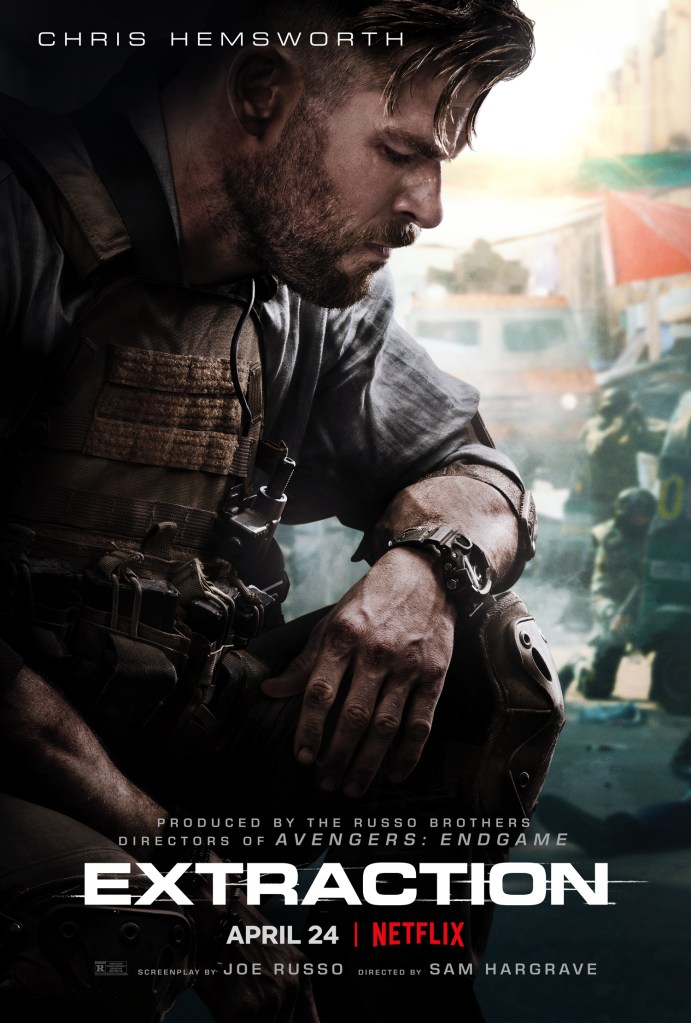
Why the trip down memory lane, Paul? What about the kinetic and explosive action of Extraction (2020)? Yes, the well-choreographed manoeuvres are extremely exciting. They are also bone-crushingly relentless from the moment Tyler Rake enters Bangladesh to extract an imprisoned Indian gangster’s teenage son, Ovi Mahajan (Rudhraksh Jaiswal). Hemsworth and director Sam Hargrave get you in and out of hand-to-hand fights, car chases, leaps and falls from buildings, and constant gun battles with stunning brilliance throughout. The camera and editing work present virtuoso work, capped by an almost seamless eleven minute long take involving all manner of mayhem. While Ovi and Tyler kind of bond later in the film, I found myself needing more emotional or political subtext to narrative. Even John Wick (2014) created its own mythology and universe, where this relies on fast-paced movement, military tropes and lazy stereotypes. Ultimately, Extraction (2020) was like an explosive fireworks display. Great to watch while it lasted, but ultimately forgettable. Man on Fire (2004) did this story way better and with way more feeling.
Producers: Jason Bateman, Chris Mundy, Bill Dubuque, Mark Williams
Director(s): Jason Bateman, Alik Sakharov, Ben Semanoff, Amanda Marsalis, Cherien Dabis
Writers: Chris Mundy, Paul Kolsby, Ning Zhou, Martin Zimmerman, Miki Johnson, John Shiban, Laura Deeley
Cast: Jason Bateman, Laura Linney, Sofia Hublitz, Skylar Gaertner, Julia Garner, Lisa Emery, Janet McTeer, Charlie Tahan, Tom Pelphrey, Joseph Bedford Lloyd, Joseph Sikora, Felix Solis, Jessica Frances Dukes etc.
Original Network: Netflix
**CONTAINS SEASON 1 & 2 SPOILERS**
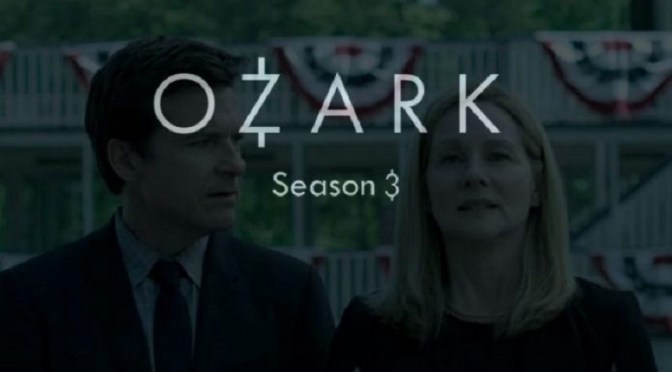
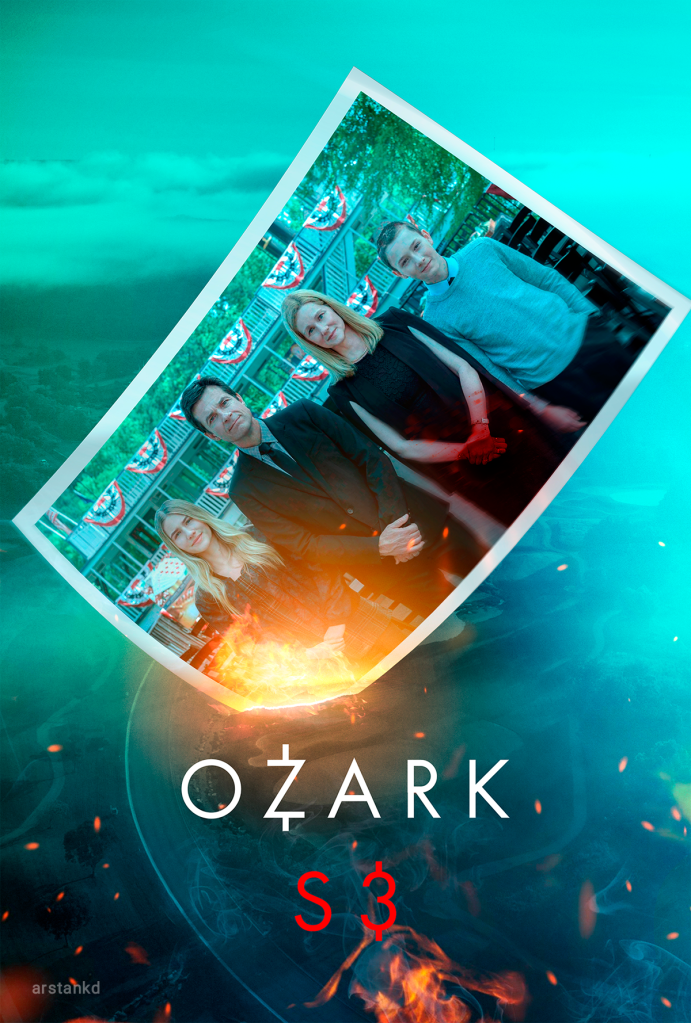
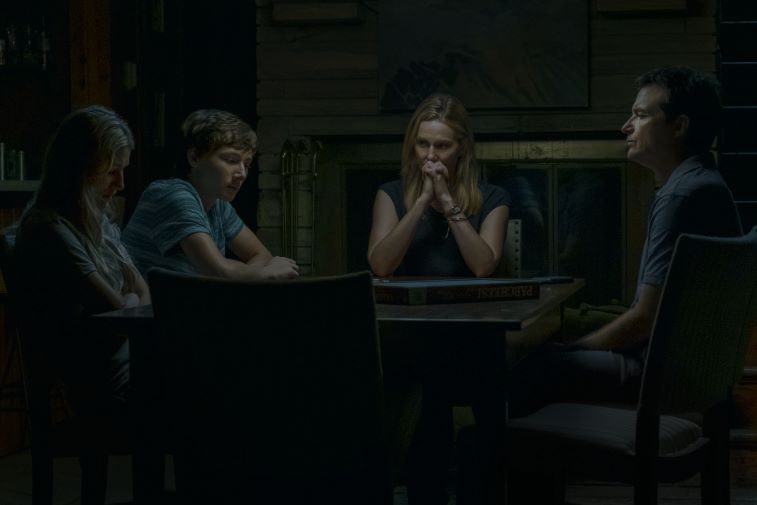
So, the third season of the Netflix crime drama, Ozark, confirms its status as one of my must-watch TV programmes. It joins the likes of Game of Thrones, Penny Dreadful, It’s Always Sunning in Philadelphia, Breaking Bad, Doctor Who, Curb Your Enthusiasm, Inside No. 9 and many more, which became essential viewing. If you haven’t seen the show, Jason Bateman plays an accountant who has to go on the run with his family to Ozark, Missouri, while working for a murderous Mexican drug cartel. Accompanying him are his wife, Wendy, portrayed by Laura Linney and their two teenage children, Jonah and Charlotte. The structure of the season one and two is to essentially place the American “nuclear family” at the heart of a noir thriller and watch them use their wits to survive. What is even more apparent though is that the ingenuity of the writing means we are rooting for the bad guys. Of course, there is always a bigger fish or predator, but slowly and surely the Byrdes are climbing a slippery ladder up the crime food chain.
Season 3 begins not long after season 2 ended. The explosive and brutal Mexican drug wars, involving the Navarro Cartel and bitter rivals, provides a violent back drop for the drama. It heightens the tension and danger for Marty and Wendy, who are now running a casino literally on the Ozark lakes. With the Cartel wars raging, the Byrdes also have major problems closer to home. They are attending marriage therapy, the FBI are about to audit their casino, Navarro himself is breathing down their necks about the flailing money-laundering operation, Janet McTeer’s devious lawyer, Helen Pierce, wants more control, and Frank Cosgrove Junior, from the Kansas City mob, is being a spoilt arsehole. His character and Julia Garner’s foul-mouthed Ruth Langmore face off many times during the season. In addition, Wendy’s erratic wanderer of a brother, Ben (Tom Pelphrey) is thrown into the heady mix, while always lurking is devilish Darlene Snell (Lisa Emery). The stakes are high, and the players are set for one almightily gripping game of life and death.
All the ingredients of what I loved in the first two seasons of Ozark are still present in the latest season. This is good old-fashioned crime and noir drama, with ultra-violence and shocking plot twists, presented via a stylish set of production values. The cinematography alone is just so stylish with natural lighting, shadows and silhouettes used to cloak the characters. Furthermore, many of the narrative twists and turns could be deemed as over-the-top, but the scriptwriting and lead performances are of such high quality you cannot fail to be drawn into this shady world of drug dealers, gangsters, assassins and liars. Indeed, pretty much every character is a liar and there are very few innocent or righteous characters in Ozark. Even the kids are in on the lies and have some of their own too.
Of the new characters introduced, FBI Agent Maya Miller (Jessica Frances Dukes) is a welcome addition to the machinations. Yet, her attempts to follow the rules leads her directly into dark water, as Marty attempts to manipulate her to his own ends. Not as innocent is Wendy’s brother, Ben. While he is lively and a bit of a maverick, he still has a good heart though. However, he has a secret which will come to the fore later in the season. This allows Wendy to face one of the most difficult life choices she ever has to make. In such scenes the acting from Tom Pelphrey and Laura Linney is incredibly powerful. Some may say that these episodes trivilize mental illness, but Ozark is not attempting to explore major issues. Instead, it uses them to serve the darker plot developments and continued tragedy within this savage world. Afterall, this is a show which literally had a character suffer a Caesarean section with a hunting knife.
Overall, season 3 of Ozark is a brutal and exciting wade through a swamp of vicious and calculating set of characters. There is also much dark humour, especially in the industrial language and biting delivery of the amazing Julia Garner. Even Jason Bateman as Marty Byrde, a cool and calm individual, continues to prove he will stop at nothing to keep him and his family alive. I think also that Marty enjoys the games and the gambles. He wants to win at all costs as demonstrated in flashbacks to his childhood experiences with a particular arcade game. Likewise, Wendy, whose character really came to the fore in season 2, is just as ruthless. To both of them death has become part of their everyday lives. As Bateman and Linney continue to give incredible performances, I’m hooked on where Ozark is leading us. Given season 4 promises old and new rivals to threaten the Byrde family, I bet it’s going to get darker and even more shocking.
REVIEWS OF THE BOYS (2019), THE EXPANSE (2016) & PREACHER (2016)
So, we are now a few weeks into the lockdown scenario caused by the COVID-19 virus and I have been off work for around that amount of time too. Tragically people are dying, and we owe it to be responsible by continuing to follow the rules laid down that will prevent the spread of the infection. It’s tough for everyone including families, employees and businesses. The capitalist system has taken a massive hit, and some will not survive in terms of life and work. I am not a religious person, but I pray to everyone’s God, whoever that may be, society comes through this. We are digging tunnels, looking for light and an escape. It cannot come soon enough.
In terms of escape it has never been easier to find both the time and formats with which to fill the gap. Thankfully the internet is still up and running, thus I have been filling my time in — aside from some minor administrative work-from-home stuff — writing my film reviews, editing and posting short videos, exercising and watching quite a lot of television and film content. Anything to stop me from becoming a beer monster or functioning alcoholic – AGAIN! The latest focussed viewing has been of Amazon Prime, and the many boxsets they have. So, here are mini reviews of three shows I have seen recently. All with the usual marks out of eleven.
***MAY CONTAIN SPOILERS***
THE BOYS (2019) – SEASON 1 – PRIME VIDEO
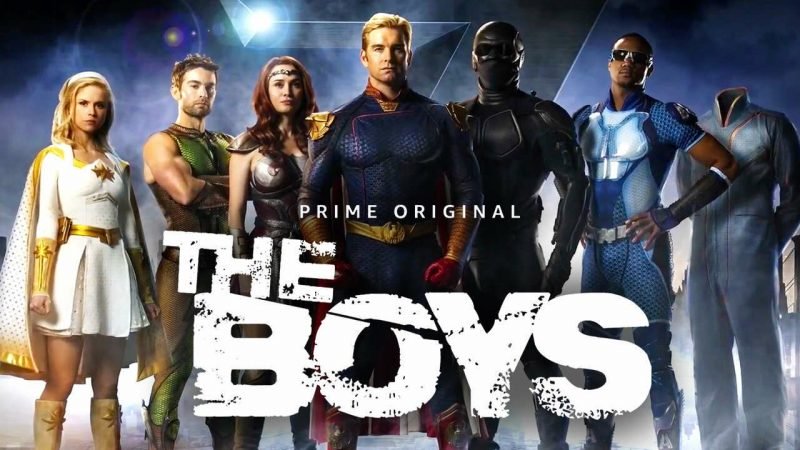
Based on the comic book series created by Garth Ennis and Darick Robertson, this violent superhero comedy is the complete antithesis of the Marvel Universe. Taking savage satirical swipes at huge corporations and United States foreign policy, it features a group of vigilantes, led by Billy Butcher (Karl Urban) called ‘The Boys.’ For a variety of reasons, including good old-fashioned revenge, they have targeted the most powerful business in the world, Vought International. Vought control and monetize ‘The Seven’, a group of all-powerful superheroes who happen to mostly be narcissistic, unstable and psychotic arseholes.
The initial episodes started slowly for me and I found it difficult to warm to any of the characters. This could simply be superhero fatigue or certain weaknesses in the writing throughout. However, the spikes of tremendous action, vicious humour and spectacular violence kept me on board. Elisabeth Shue and Antony Starr impress as the nefarious villains, while Erin Moriarty shone as the one decent superhero, Starlight. The least said about the shockingly bad English accent Karl Urban delivers the better. I mean his acting is impressive, but mate – come on!!
Mark: 8.5 out of 11
THE EXPANSE (2015) – SEASON 1 – SYFY/AMAZON PRIME
Usually when I see something is on the Syfy channel I baulk slightly. I mean the shows are pretty decent as a rule, but some right old fantasy schlock can get dumped there. So, with a saturated streaming market offering a plethora of U.S. cable shows, sometimes the Syfy channel shows get short shrift. It’s a shame because The Expanse is a really good science-fiction programme which began airing on Syfy, but is now on Amazon Prime. The sci-fi show hangs tonally betweenAlien (1979), Blade Runner (1982) and the Philip K. Dick-style “Mars v Terra” stories I have read. Indeed, while it doesn’t contain actual aliens or Dick’s surreal explorations of the psyche, it is, in fact, a fantastically plotted and styled industrial, political and humanistic set of narratives.
Based on James S. A. Corey’s (a pseudonym I believe for two writers), The Expanse(Season 1), is set hundreds of years into the Earth’s future and space has been colonized. But it’s not a utopia. Mars, Earth and an outer-planetary system of space stations called ‘The Belt’ are all conflicted on the brink of civil or galactic war. The multiple narratives follow the likes of the always-excellent, Thomas Jane, as a grizzled cop investigating a missing person and a space freighter gang led by Stephen Strait. The latter’s crew go from episode to episode finding life-threatening situations throughout. It’s a space-rock solid production full of twists, action and conspiracies; retaining a cynical, noir and unglamorous edge which makes me want to watch further seasons.
Mark: 8.5 out of 11
PREACHER (2016) – SEASON 1 – AMC/AMAZON PRIME
Developed by Hollywood players Seth Rogen and Evan Goldberg, along with Breaking Bad writer, Sam Catlin, this darkly comedic post-modern vision of heaven and hell is based on a comic book by Garth Ennis (that man again) and Steve Dillon. Starring the very reliable Dominic Cooper as hard drinking and former career criminal-turned Preacher, Jesse Custer, we find him losing faith in a small Texan town and a dwindling set of hopeless parishioners. That is until one day he is struck by some twisted divine interpretation. Then, literally, all hell breaks loose as Custer battles his inner demons and the local slaughterhouse baron portrayed with callous joy by Jackie Earle Haley.
Like The Boys, I initially found Preacher a little bit slow in terms of setting up the story and characters. But I think that was deliberate as there are so many crazy concepts relating to religion and the afterlife in here, a balance had to be given to combining the fantastic and more realistic elements. I’m not sure they’re wholly successful, however, Cooper is great, and he is ably supported by the effervescent Ruth Negga as his tough-talking ex-girlfriend, Tulip. Moreover, English actor Joseph Gilgun steals the show as the Irish sidekick with a dark secret. While the narrative moves steadily, with arguably too many secondary characters, the bloody gore levels during the fight scenes are absolutely spectacular. If, like me, you enjoy irreverent bible-black comedy which offends most religions and contains lashings of ultra-violence, then Preacher is definitely one to pray to the lords of television for.
Writers: Nick Antosca & Michelle Dean, Dan Dietz, Robin Veitch, Lisa Long, Heather Marion
Directors: Laure DeClermont-Tonnerre, Adam Arkin, Christina Choe, Steven Piet, Hannah Fidell, etc.
Cast: Joey King, Patricia Arquette, Chloe Sevigny, AnnaSophia Robb, Calum Worthy, Dean Norris, Denitra Isler, Margo Martindale etc.
Original Network: Hulu (US) – Starz/Amazon (UK)
*** CONTAINS SPOILERS ***
The capacity for human beings to lie and fake and forge simply knows no bounds. Clearly lying is bad, as it disintegrates trust in families, relationships and society in general. We should all strive for truth. But before one judges and jumps to conclusions there can be mitigating circumstances for lies. It could be a good lie. A lie that protects someone from the horrors of reality or a bad situation. It could be a falsehood which is worth denying in order to circumnavigate a tricky moment. This last example is a subjective decision though. But what if you’re not in your right mind? What if you have a mental illness? Does this forgive the darkest lies you tell or present? No, but it does explain why you’ve told such untruths.
Hulu’s exceptional true-life drama, The Act (2019), centres on a character who is both a liar and mentally disturbed. You would not know from the outside but Dee Dee Blanchard (Patricia Arquette) was a very troubled person. A seemingly loving single mother to a teenage daughter, Gypsy Blanchard (Joey King), Dee Dee unfortunately has to cope with Gypsy’s myriad of medical issues which leave her in a wheelchair and unable to feed herself. But Gypsy is actually incredibly healthy. Her mother has in fact been drugging and faking and benefiting financially from harming her daughter for years. Clingy, controlling and manipulative of her daughter’s every movement, routine and personal interactions, Dee Dee never wants her daughter to grow up. She wants a permanently powerless child and vicariously feeds off all the sympathy this brings. Yet Gypsy is growing up and she wants to do her own thing. Her body is changing and so are her desires. Something had to give.
Over eight brilliantly written and directed episodes, The Act (2019), unfolds as a powerful human tragedy. The story begins in 2015 with a serious crime; someone has been hurt. It then flashes back to when Dee Dee and Gypsy moved from hurricane hit New Orleans to Springfield, Missouri in 2008. Moving consummately back and forth in time the structure builds the drama very well. I genuinely couldn’t believe that someone would do that to their own child. Then, just when you think the story cannot twist any further the events take an even stranger and darker fall. Unsurprisingly, Patricia Arquette won an Emmy for her performance as the tragic faker, Dee Dee. Arquette inhabits the skin of this unhinged mother chillingly. But she’s not a scary monster, more one that subtly gets right under the skin. Joey King as Gypsy is equally brilliant as the co-dependent daughter, ultimately driven to extreme and shocking behaviour by her mother’s lies and twisted vision of love.
Created and written by: Steve Pemberton & Reece Shearsmith
Directors (Season5): Matt Lipsey, Guillem Morales, Steve Pemberton
Original Network: BBC (available on BBC Iplayer and Netflix)
No. of Episodes: 6
***CONTAINS PROPER SPOILERS***
Inside No. 9is written by and stars Steve Pemberton and Reece Shearsmith. Both are brilliant comedic and dramatic actors, having appeared in many TV shows and films down the years. They are arguably most famous for beginning their careers in amazing comedic troupe The League of Gentlemen; however, their work on Inside No. 9 surpasses the ‘League’ in my view.
If you have never seen Inside No. 9 before, I urge you to do so. It is an exceptional anthology series with six standalone episodes per season. Individual episodes feature a whole host of different characters and actors each time. As per the prior seasons, the latest one is absolutely brilliant. It privileges tightly woven thirty-minute short narratives, which more often than not, feature a twist in the tale. Moroever the events usually unfold in one location with never more than a handful of characters. This makes the narratives feel more focussed, intense and intimate.
Inside No. 9 is also a surprising delight because you never know what kind of genre you will get. One week you could get comedy, horror, drama, crime, romance or musical; and sometimes a combination of all of them. They also take chances with their use of form and structure, with many episodes either paying homage or parodying different genre styles. So, here are some short reviews of each episode from Season 5. Usually, I mark my reviews out of eleven (in homage to This is Spinal Tap (1984)), however, for obvious reasons, I will be marking these reviews out of NINE.
EPISODE 1 – THE REFEREE’S A W**NKER
Cast: David Morrissey, Ralph Little, Steve Pemberton, Reece Shearsmith
The number 9 of this episode occurs in a football referees’ changing room before, during and after a critical final game of the season. Tensions rise between players, mascots and officials in what is the referee’s last game before retirement. David Morrissey is brilliant as the ultra-professional ref attempting to keep control amidst the chaos. Ralf Little also excels as the vain referee’s assistant, with Shearsmith and Pemberton offering fine comedic support. On the main this plays out as a comedy, but there are also serious moments. Indeed, The Referee’s a Wanker explores themes of corruption, gay footballers, and the obsessive win-at-all-costs nature of football fanatics. Fast-paced, funny and containing a great twist, this episode kicked off the season very positively.
Mark: 8 out of 9
EPISODE 2 – DEATH BE NOT PROUD
Cast: Jenna Coleman, Kadiff Kirwan, Steve Pemberton, Reece Shearsmith, Sarah Solemani
This episode was a joy on many levels. Firstly, it was a fantastic mixture of dark comedy and bloody horror. Most significantly, it contained a wonderful series of meta-cultural call backs to Shearsmith’s and Pemberton’s prior work called Psychoville. A grotesque and demented sitcom, Psychoville contained a gallery of crazed characters with many portrayed by Pemberton and Shearsmith. In Death Be Not Proud the opening is quite conventional. Young couple (Jenna Coleman and Kadiff Kirwan) get what they think is a property bargain. However, the flat was host to a grisly murder and something from beyond the grave is tormenting the new tenants. When the previous owner, David Sowerbutts returns things get even weirder. Only then do we learn about the horrific history of this murder home, to sick and hilarious effect.
Mark: 8.5 out of 9
EPISODE 3 – LOVE’S GREAT ADVENTURE
Cast: Steve Pemberton, Debbie Rush, Gaby French, Bobby Schofield, Reece Shearsmith.
Once again displaying fine writing and actorly versatility, Love’s Great Adventure plays out as a straight family drama. It’s of such high quality and hits such emotional and dramatic peaks, TV writers like Paul Abbott, Jimmy McGovern and Jed Mercurio would have been proud to have written it. Cleverly structured around an advent calendar, the Christmas setting adds texture to the financial struggles of one working class family. Trevor (Pemberton) and Julia (Debbie Rush) are devoted to each other, their teenage daughter and grandson who lives with them. They are even prepared to forgive their self-destructive addict son. Set mainly in the kitchen on various days leading up to Christmas day, the events unfold in a subtle, but powerfully realistic manner. These are ordinary, but compelling characters, who prove there is nothing stronger than family love.
Mark: 8.5 out of 9
EPISODE 4 – MISDIRECTION
Cast: Reece Shearsmith, Steve Pemberton, Jill Halfpenny, Fionn Whitehead
One of my favourite ever TV shows is Tales Of The Unexpected and Inside No. 9 certainly owes a debt to that series of twisted genre narratives. Misdirection is a case in point. It is up there with the best Pemberton and Shearsmith plots, as a young student journalist, Fionn Whitehead, interviews Reece Shearsmith’s famous magician. Safe to say that as this is about magic there is much in the way of tricksy turns, bluffs and diversionary tactics. Shearsmith is on brilliant form as the arrogant traditionalist with a dark secret. He criticizes the inelegance of street magicians while a battle of wits ensues with Whitehead’s seemingly naive novice. Echoing the structural and stylish dexterity of Peter Schaffer’s brilliant Sleuth (1972), Misdirection holds all the cards when it comes to being a deviously clever and totally unexpected tale.
Mark: 9 out of 9
EPISODE 5 – THINKING OUT LOUD
Cast: Maxine Peake, Phil Davis, Ionna Kimbrook, Sandra Gayer, Sara Kestelman, Reece Shearsmith, Steve Pemberton
Before reviewing this season, I watched every episode twice. I’m glad I did because Inside No. 9 can be complex and pack a lot in thirty minutes. So, it proves in Thinking Out Loud, as we get seven seemingly disparate characters all unconnected. Or so we are led to believe. The episode uses the video diary format, which was something of a popular phenomenon in the 1990s, plus it echoes the “talking heads” style of Alan Bennett. Thus, we get a character in therapy, her therapist, a criminal on death row, a singer, a man suffering from cancer, a man looking for love and an Instagram influencer. All directly address the camera and as we cut between them, their connection slowly filters through until the incredible reveal. Owing much to films like Identity (2003) and Split (2017), this psychological thriller is very crafty with many chilling moments that bear up to multiple viewings.
Mark: 8 out of 9
EPISODE 6 – THE STAKEOUT
Cast: Steve Pemberton and Reece Shearsmith
This virtual two-hander concentrates all of the action within the confines of a police car. Steve Pemberton portrays the jaded and experienced police officer obsessed with finding out who killed his partner. Joining him in the vehicle is new partner, played by Shearsmith. The latter’s character is a Special Constable who seeks to follow the book causing tension on a stakeout during a literal graveyard shift. The two clash over diet, riddles, word-games and police procedure, but over three nights they eventually find mutual respect. The bulk of the episode’s enjoyment comes from Pemberton and Shearsmith’s sparring and their performances are exemplary. The writing is also impressive as it plays with the tropes of the police procedural genre. Finally, it also sets up a suspenseful opening only to confound us by the bloody fiendish denouement.
As you know The Cinema Fix is a website for all film and TV lovers everywhere. It’s a mix of reviews, articles, essays, news and thoughts on new and classic releases. It is intended to be honest, irreverent, funny and hopefully intelligent.
In this period of social distancing I have now found the time to make some short video film review content. This video article is a fun piece highlighting our favourite films set on a train.
Written by: Paul Laight Narrated by: Melissa Zajk Music: Classic Train – Simple Sound – No Copyright Check out our YouTube site: www.youtube.com/c/FixFilmsLtd
Film/Trailer credits:
1) The Cassandra Crossing (1976) – AVCO Embassy Pictures
2) The Lady Vanishes (1938) – United Artists
3) Murder on the Orient Express (1974) – EMI Film/Paramount Pictures
4) Snowpiercer (2013) – Radius TWC/CJ Entertainment
5) The Taking of Pelham 123 (1974) – United Artists
6) Train to Busan(2016) – Next Entertainment World
Based on: Tell Me Who I Am by Joanna Hodgkin, Alex Lewis and Marcus Lewis
Cinematography: Erik Alexander Wilson
***SPOILER FREE***
I recently reviewed a number of documentaries here, but it was only during a catch-up of Netflix films did I watch the harrowing family drama, Tell Me Who I Am (2019). Now, in my younger days I was naive enough to think documentaries were a representation of the whole truth and not a mediated version of events. There was fiction on one side and documentaries on the other. It’s a documentary so it must be true and must not be questioned.
That isn’t to say that the events of this incredible story are not true. No, my point is that Tell Me Who I Am (2019) is, while based on a true story, structured like a classic Hollywood thriller akin to something Hitchcock may have produced. Conversely, I was gripped throughout by the mystery, suspense and a gut-kicking reveal halfway through. Do not read anything about this moving family story beforehand, as going in with NO knowledge will make it all the more powerful.
The film is structured in the classic three act fashion. Firstly, we find Alex Lewis describing events of an accident he had when 18. The incident led to him totally losing his memory. The only thing he remembered was he had a twin brother, Marcus. His mother, father, friends, their farmhouse, the privileged background and their dogs were all forgotten. Like a film noir protagonist he was left in the dark as to his whole history. With the help of Marcus, he slowly begins to learn about his past and rehabilitate for the future. Thus, at first one feels this is a story of an individual overcoming near-tragedy and rebuilding their life moment by moment. However, it becomes something much more than that. I shall say no more.
Shot through talking heads, photo montage and reconstruction, this is an exquisitely edited and filmed documentary. The twins, Alex and Marcus are framed in close-ups, with pale backgrounds and shadowed foregrounds. As we move back and forth between their respective sides of the story, one is slowly pulled into the incredible events that confirm truth is more horrifying than fiction. By the resolution I was shook and deeply affected by the film, with still some questions left unanswered. Ultimately though, Tell Me Who I Am (2019) is a satisfying and very emotionally charged story about searching for truth amidst familial conflict, betrayal and a longing for redemption.
Screenplay by Leigh Whannell – based on H. G. Wells The Invisible Man
Produced by: Jason Blum, Kylie du Fresne
Main cast: Elisabeth Moss, Aldis Hodge, Storm Reid, Harriet Dyer, Oliver Jackson-Cohen, Michael Dorman,
Music: Benjamin Wallfisch
Cinematography: Stefan Duscio
***MAY CONTAIN SPOILERS***
Many a work, home, pub, dinner party and school conversation has started with the following question: what would YOU do if you were invisible? Depending on the company it’s something that can descend into wild fantasy territory. Being invisible will allow you the freedom to spy and become the ultimate voyeur. You could also become a criminal and creep into places without being seen to thieve. You could be a prankster and play tricks on your friends and family. You could become a superhero, battle crime and help people. You could simply just disappear not just literally, but philosophically from society. The possibilities are endless.
H. G. Wells original novel is an absolute genre masterpiece. Arguably the most famous version was filmed in 1933 with incredible practical effects and an exceptional performance from Claude Rains. In this new version the conventional invisible scientist-goes-mad story is twisted successfully into an exhilarating horror suspense film with themes relating to toxic masculinity and abusive relationships. Here invisibility is used to control and instil fear, as the recently deceased Griffin (Oliver Jackson-Cohen) is, according to his ex-partner, Cecilia (Elisabeth Moss), targeting her from the grave.
Leigh Whannell has great experience writing and producing low-budget horror films including: Saw (2004) andInsidious (2010). His last directorial release, Upgrade (2018), was a fantastic mix of 1980’s B-movies, sci-fi and horror cinema. Building on the crowd-pleasing thrills of Upgrade, Whannell has crafted a paranoiac classic with Elisabeth Moss giving a fantastically nerve-shredding and physically adept performance. From the tense opening scene, we empathise with her desire to escape a controlling and malevolent force. Building slowly throughout the first act, Whannell’s script brilliantly picks up the pace and plots Cecilia’s descent into a living hell. Consequently, Cecilia’s anxiety reaches peak stress as no one believes she is being set up by a gas-lighting, unseen and venal monster.
It pays to see this film on the big screen with the finest sound quality available. I watched it on an IMAX screen where the sound design and Benjamin Wallfisch’s amazing score really enhance the fear-inducing visuals. How the production team made this film for a reported $7 million dollars is beyond me. Yet, Whannell is an economical and highly efficient filmmaker. His writing is lean and mean, as the script is full of fantastic set-pieces and plot reversals. Moreover, the story is very relevant, exploring the themes of the day relating to domestic abuse, depression and mental illness. However, it’s not an overbearing message movie, but rather a smart and surprising thriller.
Overall, The Invisible Man (2020) starts strongly and proceeds to deliver a series of gripping and, at times, heart-in-the-mouth cinematic moments. There are none of the usual scientific and over-expositional set-ups that can slow down such films. The visuals, sound, score and performances deliver the story most effectively. I felt like there were a few fuzzy plot moments that Whannell could have explained in more detail, however, that could have hindered the pace of the story. Finally, with Elisabeth Moss imbuing her character with resilience, energy and steel, we get an individual who will never give up. She sees through her ghosting nemesis and will fight to the last breath to prove her innocence and remain in control.