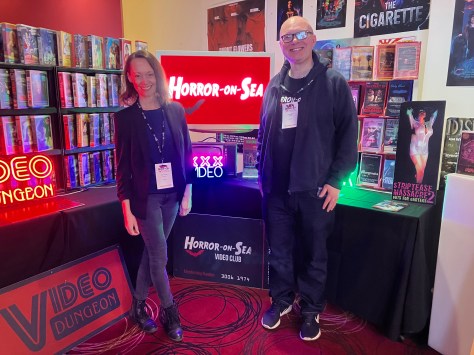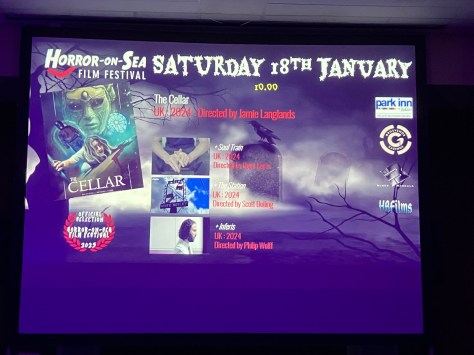
HORROR-ON-SEA FILM FESTIVAL is an amazing gathering in Southend-on-Sea. Every January horror filmmakers and fans flock to the Essex coastal town to satisfy their desire for all things horror.
The festival screens, over two weekends each year and features some of the most gruesome, scariest, funniest and entertaining independent horror films you’ll ever find. For more information please check out their website here.
This year Horror-on-Sea screened the short film I wrote and produced called, Inferis (2024). It’s an atmospheric horror which is a proof of concept short I intend to develop as a feature film I can describe as Saw meets The Office. You can watch it here:
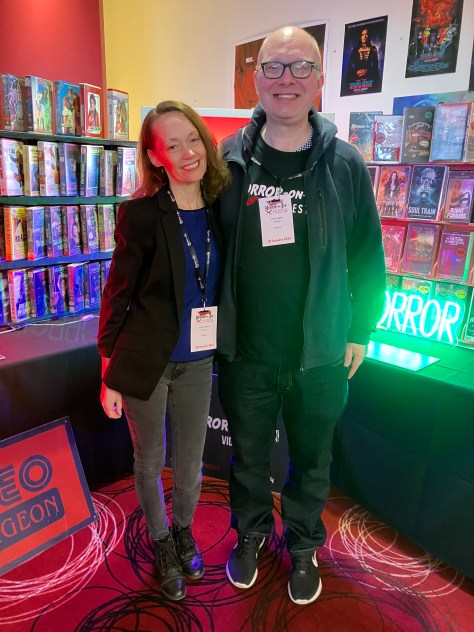
Myself, Julia (who appeared inInferis (2024) and my wife, Melissa, attended the packed 10am screening as the film supported an intriguing indie feature called The Cellar (2024). We also watched a gory and highly entertaining monster movie called, Hell-Hole (2024) that day. Many more films were screened over two weeks, plus masterclasses from horror filmmakers such as Pat Higgins.
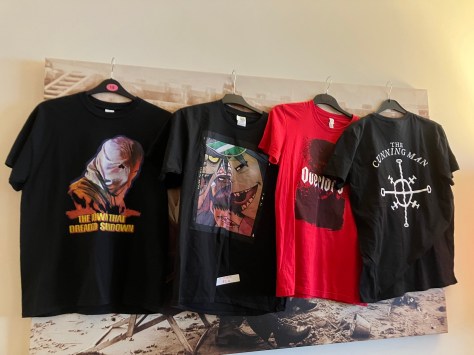
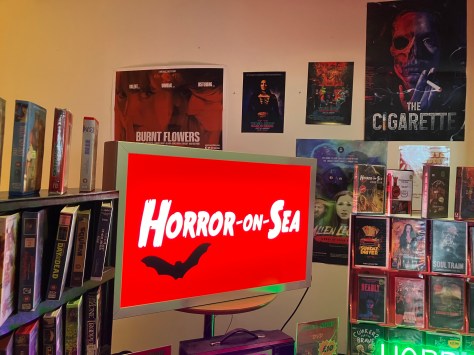
So, if you ever find yourself in Southend-on-Sea one January then do check it out. Or scroll through the gallery of photos I took over the weekend.
Last year I wrote and produced seven monologues inspired by the deadly sins. With careful planning, myself and a quality cast and crew shot them all in one day at Raindance Film School. I’m now releasing them online via YouTube. They are in essence a proof of concept project with an aim for myself to develop them into a feature film screenplay. Below are episodes 1 to 3, with episodes 4 to 7 to come soon.
PITCH
“Let those without sin cast the first stone.”
An anthology of 7 monologues based around the seven deadly sins. Moments, drama, humour, character studies and themes exploring the darker side of human nature. Influenced by: Alan Bennett’s Talking Heads, Inside No. 9, Tales of the Unexpected and Amicus/Hammer horror film anthologies.
SLOTH starring Paul Laight
Sloth, features Kevin, a Spurs fan, recounting how he took revenge on one of the laziest people he has ever met.
GREED starring Sydney Curtis
This moving monologue features, Gary, at an AA meeting, sharing how he believes greed has contributed to a close friend’s death.
GLUTTONY starring Antigone Duchesne
Kate Briggs serves up a monologue, via a video will, enacting a grudge-driven, but sweet revenge against her gluttonous pig of a brother.
CREDITS
Writer and Producer: Paul Laight Camera and Post-Production: Gary O’Brien Sound: Ali Kivanc Camera Assistant: Maka Natsvlishvili Music by: Epic Violin Music NO Copyright royalty free music Special thanks: Raindance Film School and Universal Video
Based on characters by George Miller & Byron Kennedy
Produced by: Doug Mitchell & George Miller
Main Cast: Anya Taylor-Joy, Chris Hemsworth, Tom Burke, Alyla Browne, Lachy Hulme, Angus Sampson, etc.
Cinematography by Simon Duggan
*** CONTAINS SPOILERS ***
George Miller’s fifth entry of the Mad Max series is Furiosa: A Mad Max Saga (2024). Given the meaning of the word ‘saga’ is defined as, “a long story of heroic achievement, especially a medieval prose narrative in Old Norse,” it’s an attempt by Miller to connect the Mad Max films to mythical storytelling and folk lore, yet paradoxically set such ye olde yarns in the future. Conversely, while being part of the post-apocalyptic sci-fi sub-genre, there is certainly more than a suggestion of marauding and pillaging Vikings within the freakish characters of the radioactive Aussie wasteland.
Of course, the hi-tech and vehicular monsters smashing up and down the ‘Fury Road’ render the action far from the medieval, replacing long boats for super-charged two, three and four-and-more-wheel souped-up demons driven by mutated future humans. The gigantic rock, bullet, fuel, and scrap metal designed bases of ‘The Citadel,’ ‘Bullet Farm’ and ‘Gas Town’ inhabited by these tattooed ravagers, while rough in exterior represent humanity’s industrial survival and base-building instincts par excellence. So much for the imperious nature of Miller’s world-building, what of the narrative?
If one is honest, the screenplays for all four of the previous Mad Max films are the exercises in economy, with hard-cut structures, granite-boiled dialogue often spat out via twisted one-liners, and poetically yelled slang-speak. Introduced as a maverick cop, but loving family man in Mad Max (1979), Max Rockatansky (Mel Gibson) is essentially a cops-versus-gangs-meets-revenge exploitation thriller. By the time gangs have killed his family and nuclear war has destroyed the world, Max has become the Road Warrior (1981), in what is one of the greatest action films and sequels of all time. However well regarded the mayhem of Fury Road (2015), and it is incredible, The Road Warrior remains one of my favourite films ever.
Beyond Thunderdome (1985) was the slicker third film, and while the action was terrific, there was too much money and sheen in there, reminiscent of what they did with the glamoured cast in the last season of Game of Thrones. Plus, the script was broken in half, with an amazing first section set in Bartertown with Tina and crew, before giving way to a more philosophical, but less exciting kids-in-a-commune driven story. In comparison Furiosa: A Mad Max Saga (2024) is certainly the most ambitious of all the narratives. It is set over several years, from the moment Furiosa (Alya Browne) witnesses her mother killed by Dementus (Chris Hemsworth) and his nasty marauders, to her rites of passage ascent toward gaining a vicious revenge.
Keeping the literary theme, the film is set over five chapters replete with headings to let the audience know what is about to occur. Easily the most impressive is – Chapter III – The Stowaway – where Furiosa comes of age in action during a brutal and mind-blowing action set-piece as the Octoboss, goes rogue and launches an air assault on the “War Rig” as it races along the ‘Fury Road.’ Here Furiosa also bonds with Praetorian Jack (Tom Burke) and the two become partners, with George Miller throwing in an under-cooked romance amidst the petrol, dust, blood and fire.
It is great that Miller and his co-writer Nico Lathouris have strived for more emotional depth and epic storytelling within Furiosa: A Mad Max Saga (2024). However, I felt that at times the rapid pacing and ramped-up action crushed any feelings I may have had about the characters of Furiosa and Jack. Plus, the film suffers a serious case of “prequelitis” where one is joining the dots of Furiosa’s backstory to connect with Charlize Theron’s characterisation in Fury Road. Yes, of course, we find out how she had her arm torn from her body, her drives and motivations, plus how she became a kick-ass future road warrior.
Taylor-Joy is striking in the all-action role of Furiosa, but a little anorexic on screen to really dominate. Gibson and Hardy are a hard act to follow! Tom Burke stands out amidst the support ensemble, while Chris Hemsworth treats us to another revved-up messianic lunatic. With the character of Mad Max on hiatus, the true stars of this show are Miller and his impressive production, camera, editing, driving, effects and stunt teams. They have once again produced cinematic carnage of the highest order.
Sadly, the uber-filmmaker, Roger Corman passed away on May 9th 2024. But given the longevity of his life and career in films it’s really time to celebrate his life in cinema. To me Roger Corman is a hero because he is a true independent filmmaker, working outside of the Hollywood system producing hundreds of films, many of which were extremely successful financially.
Of course, for a man known as the “King of the B-Movies” not all of the films were the height of artistic merit, however, they were NEVER boring. So many of his films have real invention and a crazy energy. What separates Corman from say Ed Wood is he knew how to tell a proper story on a low budget. Indeed, films such as Little Shop of Horrors (1960) and Death Race 2000 (1976) would latterly get the big-budget Hollywood remake treatment. Further, without Corman’s The Wild Angels (1966) starring Peter Fonda, Hopper and Fonda’s counter-cultural phenomenon Easy Rider (1969) may not have existed.
As well as boosting the careers of Peter Fonda and Dennis Hopper, as a producer Corman also gave starts to Francis Ford Coppola, Jonathan Demme, James Cameron, Sandra Bullock, Robert DeNiro, Jack Nicholson, Martin Scorsese, Pam Grier and many more. Corman did not just have a keen eye for talent, he was canny because he knew that such hungry filmmakers and actors could be “exploited” at a lower cost than bigger Hollywood names.
So, as a mini-tribute I have selected six of the best Corman films I have seen. Rest in peace, Mr Corman – you were a true cult and cinema legend!
LITTLE SHOP OF HORRORS (1960)
Incredibly, this film was shot in three days for $28,000 and would become a cult hit after initially struggling to find distribution. Amazingly, Corman did not expect the film to be successful so he didn’t bother to copyright it. It is therefore in the public domain! I myself saw it recently on Talking Pictures and it is a so entertaining. Look out for a hilarious early performance from Jack Nicholson.
THE INTRUDER (1962)
This is perhaps the most seriously raw and challenging film of Corman’s career. William Shatner portrays charismatic racist, Adam Cramer, a travelling salesman, who becomes hellbent on preventing racial desegregation in a Southern town. It was a landmark film for Corman who decided, “It was more of a lecture. From that moment on I thought my films should be entertainment on the surface and I should deliver any theme or idea or concept beneath the surface.”
MASQUE OF THE RED DEATH (1964)
Three masters of horror for the price of one with Edgar Allen Poe, Corman and Vincent Price, combining to chilling effect in this beautifully filmed period ghost story. Arguably the most artfully directed film of Corman’s career, the cinematography was by one Nicolas Roeg, proving once again Corman was an expert at spotting film talent way ahead of time.
BLOODY MAMA (1970)
Cashing in on the success of period gangster film, Bonnie and Clyde (1967), Bloody Mama (1970) is a gloriously over-the-top chase thriller, with Shelley Winters eating the scenery in a brilliant performance. Robert DeNiro appears at Ma Barkers drug addicted son, Lloyd, showing glimpses of the acting talent that would lead to so many incredible performances. But it is Winters’ film as the “loving” and gun-toting mother who leaves a lot to be desired as a positive parental role model.
DEATH RACE 2000 (1975)
The epitome of a high concept cult movie, directed by Paul Bartel, this features the brilliantly sick idea of racing drivers killing members of the public for entertainment. Full of terrific gore and gallows humour, this is one of those Corman produced films where a bigger budget would have served the action so much better. It was still a massive hit though. The imaginative deaths, cutting satire and demented characterisations from the likes of Sylvester Stallone, Martin Kove and deadpan David Carradine are memorably fantastic. I cannot help thinking Death Race 2000 must have been an influence on The Purge franchise too.
BATTLE BEYOND THE STARS (1980)
Corman’s biggest budgeted film at the time of release at $2 million, this film is both a rip-off of Star Wars and homage to The Seven Samurai, or it is the other way round? The massive budget was essentially due to George Peppard’s and Robert Vaughan’s salaries, both of whom would become stars of The A-Team. If you didn’t know many of the inventive practical special effects were supervised and created by a certain James Cameron, who got his big break as the lead production designer and art director on Battle Beyond the Stars.
Produced by Andrew Macdonald, Allon Reich, Gregory Goodman
Main Cast: Kirsten Dunst, Wagner Moura, Cailee Spaeny, Stephen McKinley Henderson, Sonoya Mizuno, Nick Offerman, etc.
Cinematography by Rob Hardy
*** MAY CONTAIN SPOILERS ***
Alex Garland has an impressive literary, cinema and televisual curriculum vitae. He gained acclaim as the writer of the novel, The Beach, before moving onto screenwriting duties with fine films such as: 28 Days Later (2002), Sunshine (2007), Never Let Me Go (2010), and under-rated Dredd (2012). He made his directorial debut with Ex Machina (2014), which earned him an Academy Award nomination for Best Original Screenplay. His second film,Annihilation (2018), garnered further acclaim, so much so, FX bypassed a pilot and went straight to series for his science fiction TV narrative, Devs (2020).
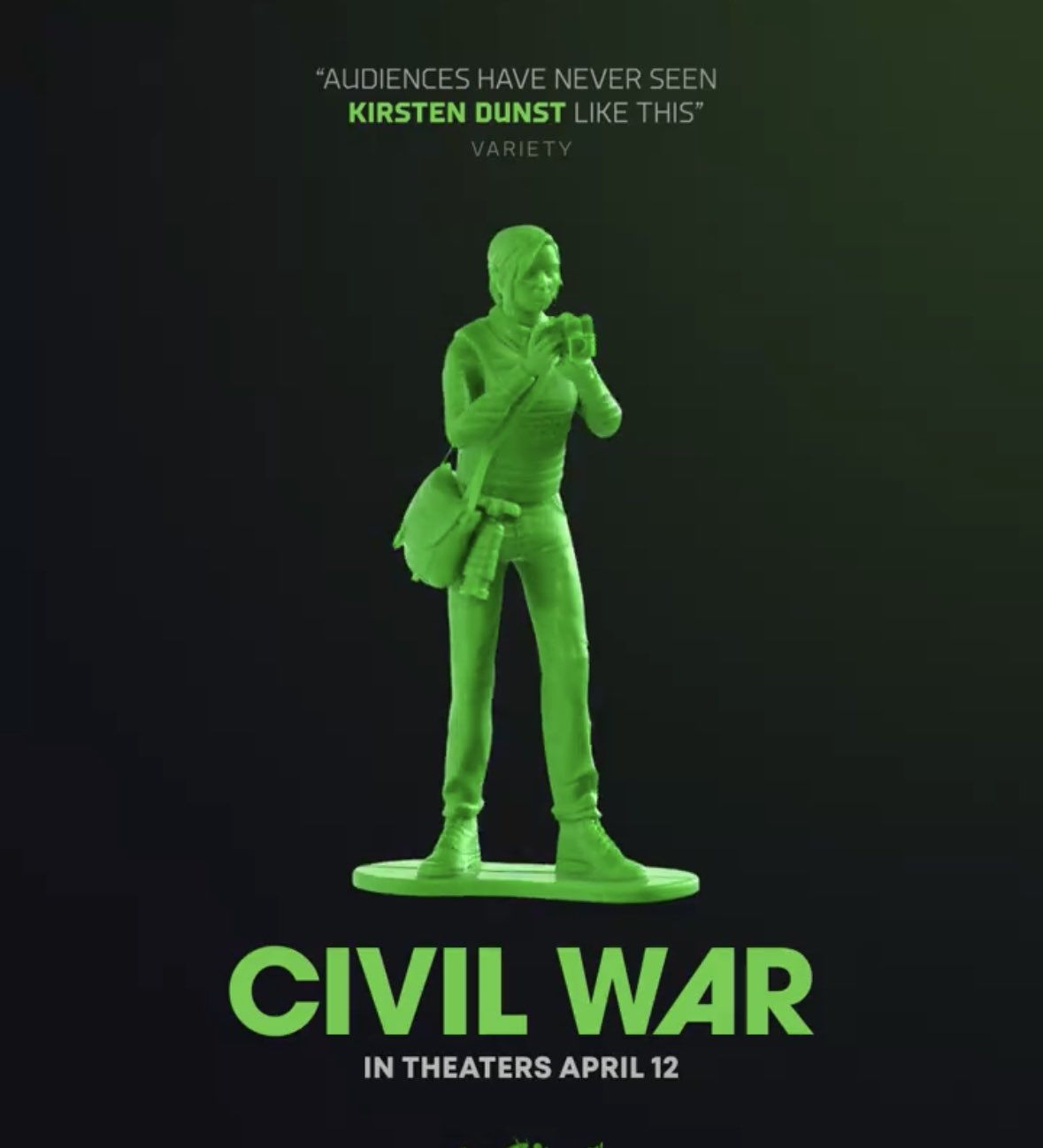
While I am a massive fan of Garland’s work, I wasn’t too enamoured of Annihilation (2018). I found it brilliantly made with some fantastic concepts and incredible moments, yet overall it was too slowly paced. With eight superlative episodes of Devs (2020), Garland delivered a story which really connected with me by merging a compelling technological espionage plot to an intelligent exploration of philosophical thought and human behaviour. Where Devs (2020) presciently examined the impact of artificial intelligence, Garland’s new political thriller, Civil War (2024), prophetically imagines an apocalyptic America in the throes of war between combined California and Texas state rebel forces and the current President’s (Nick Offerman) retreating army.
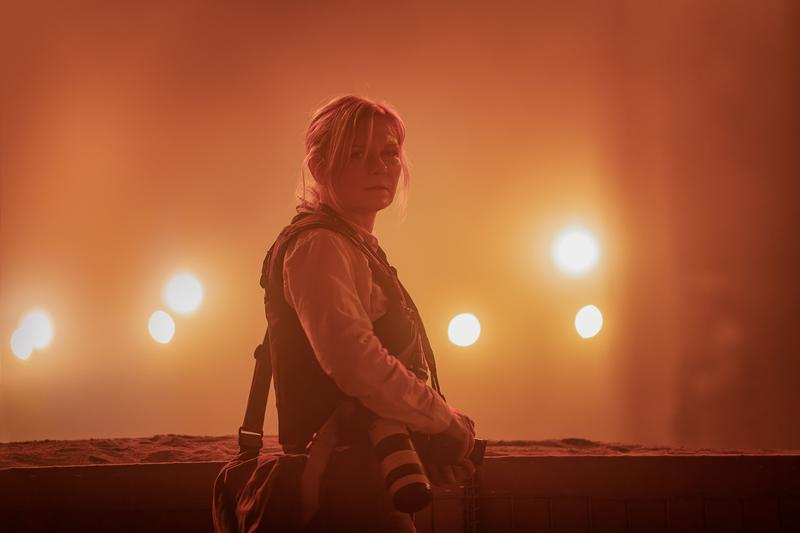
With the ‘January 6 United States Capitol attack’ in mind, Garland opens up a “what if” narrative where the whole of America is conflicted and consuming itself from within. At the heart of the violence is the war photographer, represented by Lee Smith (Kirsten Dunst) and Reuters journalist, Joel (Wagner Moura). Their journey to Washington to photograph the President reveals confusion, destruction and further bloodshed. Generically speaking, a road movie meets dystopian thriller, Civil War (2024) contains thought-provoking themes and incredible cinematography, but with shaky writing in places.
Films about war photographers and/or journalists can be problematic for me. Such characters lend themselves to heroic and the anti-heroic. The writing has to be right because I can lose empathy between such crusading journos and the narcissistic adrenaline junkies looking to deflect their own loathing and self-destructive tendencies. Civil War (2024) struggled to get me onside with the lead characters, although Dunst’s characterisation of Lee Smith is superb. However, her mentor-apprentice relationship with Cailee Spaeny, Jessie Cullen, was under-developed. Spaeny’s “innocent” being used more as a suspense device as opposed to learning the true horrors of humanity and war. Perhaps Garland intended for her to be a sociopath without depth just looking for blood? She finds it!
Moreover, Jessie’s journey from a political perspective was weak as there was no real sense of development in her character. That’s where the decision not to overtly take political sides causes a lack of sociological depth. War films such as Salvador (1986) and The Killing Fields (1984) are more successful as Civil War (2024) loses political impact by not choosing precise sides. But I guess whether they are Democratic or Republican is the whole point. Garland is saying that political parties are all as bad as each other, with human beings their own worst enemy. Politics, like football, gender, sexuality, and religion, are propellants for humans to fight each other.
For a film about photographers, the images on show are incredible and Rob Hardy’s work is genius. Fire, blood and war have never looked so brutal and aesthetically impressive. As well as Dunst, Wagner Moura and Stephen McKinlay Henderson are terrific in their respective roles. Further, there are some nail-biting and suspenseful scenes, notably one involving a film-stealing performance from Jesse Plemons. However, many of the characters’ decisions were weakly written for me. This is surprising given Garland’s prodigious literary and screenwriting talent. Civil War (2024), however, remains another stunning addition to his oeuvre and for all my perceived script weaknesses, the hell of war has never been so artistic and artful.
INFERIS (2024) – A new horror short poster and stills.
After a few years gap I finally managed to get back into the short filmmaking process last year with INFERIS (2024).
I wrote and produced it as a very low-budget psychological horror proof of concept short.
It was filmed at Raindance Film School in August 2023 and post was completed in February 2024.
Here’s the poster:
Here are some stills:
If you haven’t seen it, the trailer is here:
INFERIS (2024) – Production Details
Tagline – “They make you work like hell!”
Logline – Recent prison leaver, Joseph Mann, begins a new job at Inferis Security. Hoping for a fresh start he finds himself drawn toward a mysterious door that leads to god knows where.
Based on: Killers of the Flower Moon by David Grann
Produced by: Dan Friedkin, Bradley Thomas, Martin Scorsese and Daniel Lupi
Main cast: Leonardo DiCaprio, Robert De Niro, Lily Gladstone, Jesse Plemons, John Lithgow, Tantoo Cardinal, Scott Shephard, etc.
Cinematography: Rodrigo Prieto
Edited by: Thelma Schoonmaker
*** MAY CONTAIN SPOILERS ***
Who can tell how the world and society as we know it would’ve evolved if Christopher Columbus, the explorer credited with finding the Americas in 1492, had not landed and begun the first steps toward colonising this uncharted part of Earth. Of course, there were existing natives in the Americas and over time they would experience first contact with Spanish, Portuguese, British and other European, predominantly white, settlers. It may be that the natives would have had equally difficult experiences, and colonists brought with them many positive things. But one has to surmise they would not have had their land and lives gradually taken from them over the centuries without the European invasion.
The violent theft of land and wealth from Native Americans forms the bedrock of the narrative of Martin Scorsese’s latest epic drama, Killers of the Flower Moon (2023). Adapted from David Grann’s critically acclaimed nonfiction book, the film centres on the series of murders of wealthy Osage people that occurred in Oklahoma in the early 1920s. The motive for the heinous culling was the greed of white men. Such individuals lusted after the richness present after big oil deposits were discovered beneath the Osage people’s land. Whereas Grann’s book is a monumental study of the murders, perpetrators, the Osage culture, politics of the era, and how the newly formed FBI delved into the crimes, Scorsese’s incredibly slow and long adaptation does all that, while also exploring the romance and murderous treachery between Osage native, Mollie (Lily Gladstone) and war veteran, Ernest Burkhart (Leonardo DiCaprio).
Opening by establishing how the oil erupted and blackened the green land, the film then firmly sets up how the American businessmen used the legality of the headright system to manipulate the flow of sudden wealth that came to the Osage people. One such man is William King Hale (Robert DeNiro) who presents himself as a benefactor to the Osage, but truly speaks with a forked tongue. Having left the infantry unit after World War One, Hale’s nephew Ernest joins him to work and ultimately do his bidding. Hale cajoles Ernest to romance wealthy Mollie and get further feet under the table and closer to that beloved black gold money. Yet, enough is never enough for the likes of Hale and driven by another formidable Scorsese directed performance, De Niro delivers a deviously evil characterisation.
DiCaprio here takes the less charismatic role as the doltish Ernest. As Hale urges him to do further misdeeds the banality of everyday evil is palpable in Ernest’s actions. Along with a litany of professional and thuggish cowboy types Ernest and Hale’s other minions wreak havoc on the Osage people, committing arson, murder, poisonings, robbery, and shootings. All just for more money. The tragedy is that Ernest clearly has feelings for Mollie, serenely portrayed by a revelatory Lily Gladstone, but he just cannot stand up for himself against his wicked uncle. So much so that I just wondered why the hefty runtime was concentrating on Ernest’s character. I mean, Scorsese and DiCaprio give us little in the way of anti-heroism to bounce off, or even some cathartic sense of redemption. Ernest starts out as a loser and finished the story the same. Over three hours spent with a gurning idiot left me frustrated.
Directed, as one would expect with a masterful hand, mind and eye by Scorsese, who once again surrounds himself with an incredibly talented cast and production crew. Not to forget the unbelievable $200 million budget. But Scorsese’s movement of late to ultra-long and methodical cinema is an artistic choice that requires much patience. While Killers of the Flower Moon (2023 is thematically very powerful, beautifully filmed, and contains a number of exceptionally impressive sequences, there was genuinely not enough story to justify such a long running time. Whereas The Irishman (2019) was slow, it was methodically thrilling and absorbing throughout. Killers of the Flower Moon (2023) on the other hand becomes repetitive in its reveals of greedy Cowboys breaking bad and raising hell to the cost of the Osage. The introduction of the FBI and their subsequent investigation comes way too late to save the over-bloated length and pace. However, there is no doubt, the film remains vital in highlighting the historial horror perpetrated upon the Osage land and people. Perhaps Apple TV should have just given the money to the Osage descendants as reparation?
Produced by: Anthony Bregman, John Carney, Peter Cron, Rebecca O’Flanagan and Robert Walpole.
Main Cast: Eve Hewson, Jack Reynor, Orén Kinlan and Joseph Gordon-Levitt.
Cinematography: John Conroy
Edited by: Stephen O’Connell
John Carney is a brilliant and honest filmmaker who is attracted to outsiders and people with real emotional turmoil. They tend to be at crossroads in their lives and are struggling with their dreams and relationships. He also loves musicians, flaws and all. In Begin Again (2013), a washed-up musical executive, portrayed by Mark Ruffalo, meets unhappy singer-songwriter, Keira Knightley and their first-world romance is played out to bittersweet consequences. Similarly, in Sing Street (2016), a troubled teenager comes of age through his 1980’s pop band and bittersweet romance with a rebellious and equally-troubled schoolgirl. Notice a pattern? Well, this style of music, gritty city backdrops and salty romances were established in Carney’s breakout hit, Once (2007) and are continued in his current underdog musical comedy, Flora and Son (2023).
Flora and Son (2023), believe it or not, is set in Dublin and centres around a single mum, Flora and her delinquent teenage son, Max (Oren Kinlan). Eve Hewson is the foul-mouthed-council-estate-joker, who uses anger and black humour to hide her feelings of insecurity and loss. A mourning for the loss of youth having brought up a child virtually single-handed. Her relationship with Max’s father, Ian (Jack Reynor) is fractured to say the least and they spit sarcastic barbs at each other as shared custodians of disaffected Max. While leaving her cleaning job at a middle-class household, Flora finds a battered guitar in a skip. Attempting to bond with Max, by giving him the guitar, Flora finds herself shunned. She then opens another bottle of wine, picks up the guitar and gives it a crack herself.
Taking online guitar lessons from charming and chilled American musician, Jeff (Joseph Gordon-Levitt), Flora initially flirts but then knuckles down to learn the plucking instrument. The stakes aren’t particularly high here, but the feelgood acoustic numbers from Carney and co-composer, Gary Clark, certainly breeze along nicely and breath gold onto the screen. Max’s white-rap-Irish-hip-hop tracks are pretty good too and the video he and Flora make is really funny. Thus, you get the theme again from Carney that music helps to connect and heal and provide salvation to the most troubled of human situations. Overall, Flora and Son (2023), is a slight but enjoyable film with enough earthy humour, strumming harmony and kicking beats to please most.
31st RAINDANCE FILM FESTIVAL PREVIEW – ACTORS-TURNED-DIRECTORS!
As the Office Manager for the Raindance Film School, it is always exciting when the Raindance Film Festival is about to start. This year it runs from Wednesday 25 October 2023 to Saturday 4th November 2023 in Central London. All the amazing details can be found here: https://raindance.org/festival/
There are so many brilliant films to choose from, so it can be an impossibly difficult decision to narrow down one’s choice. If you have the time I recommend you buy a Festival Pass and go and watch everything. If you’re not fortunate enough to be able to do this you could thematically link your cinema choices.
I am always interested in following the careers of actors who become directors. The well-respected director, Dan Attias once said that, “. . . the best training he had for directing was being an actor.” Indeed, there are many great actors who have become fine film directors, including: Clint Eastwood, Jordan Peele, Jodie Foster, George Clooney, Greta Gerwig, Denzel Washington and Ben Affleck. So, here are four brilliant actors-turned-directors who have films screening at the 31st Raindance Film Festival.
DAY OF THE FIGHT (2023)
The opening gala film is written directed by Jack Huston and promises to be an incendiary drama of power and redemption.
Okay, the ultra-talented Adam Ethan Crow was not specifically an actor. Yet, he was certainly a prominent presence on the stand-up comedy scene, before turning his abundant skills to filmmaking. His latest film, Warhol, is a multi-stranded drama that connects various characters to powerful effect.
Paul Laight is a screenwriter, filmmaker, and blogger. In 2005, he formed Fix Films and has written and produced many shorts and other promos. Many of his films have been screened all over the world at various film festivals. Paul is currently working on feature and short film scripts for future productions. His work can be found here:
Based on: American Prometheus by Kai Bird and Martin J. Sherwin
Produced by: Emma Thomas, Charles Roven, Christopher Nolan
Cast: Cillian Murphy, Emily Blunt, Matt Damon, Robert Downey Jr., Florence Pugh, Josh Hartnett, Casey Affleck, Rami Malek, Kenneth Branagh, Tom Conti and many more.
Cinematography: Hoyte van Hoytema
*** MAY CONTAIN SPOILERS ***
One wonders if Christopher Nolan sees himself reflected, on some subconscious level, in the character of J. Robert Oppenheimer. Both are geniuses within their chosen field, and both have had their critics who do not always agree with their choices. The intrinsic difference is that the work of Oppenheimer and his team of scientists created one of the most expensive and deadly weapons the world has even seen. His actions led to destruction and death on a mass scale. Christopher Nolan, on the other hand, merely creates expensive drama and destruction on a cinema screen for our entertainment.
J. Robert Oppenheimer is clearly a complex character to bring to life on the screen. Indeed, scientists are not always the most riveting of characters, nor particularly cinematic. Especially since they spend their days in laboratories, classrooms and have their heads buried in books. Thus, visually speaking it is a constant challenge for filmmakers to present such biopic narratives. Moreover, thematically, and philosophically there is much internal conflict to wrestle with. Especially someone as (in)famous as Oppenheimer. I mean, how does a man overcome the guilt of being responsible for the deaths of so many people?
Having said that, Oppenheimer, as the leader of the ‘Manhattan Project’ at Los Alamos, could also be interpreted as the saviour of lives. The invention of nuclear weapons is an act of aggression, but paradoxically also a shield of peace. Such is the fear generated by such a devastating tool we will never know how many lives the existence of nuclear bombs has saved. Unfortunately, human beings find other ways to kill each other. That sadly will never stop. Does Nolan explore these themes within the intense three hours of cinematic propulsion, Oppenheimer (2023)? It is certainly there in the subtext, but perhaps not as pronounced as I would have hoped.
Adapting American Prometheus by Kai Bird and Martin J. Sherwin, Christopher Nolan’s screenplay is highly intelligent and clearly professionally researched. It is also, when compared with the often-baffling Tenet (2020), simply structured. Events from Oppenheimer’s early life, post-war troubles with the United States government and the key stages of the ‘Manhattan Project’ are cut together in juxtaposing timelines throughout the lengthy running time. Nolan builds from the Senate and court hearings Oppenheimer faces after the war, where his security status is threatened with revocation due to his alleged association with the Communist party before the war.
That McCarthyistic-Red-Scare-paranoia was vilifying genuine heroes such as Oppenheimer is quite incredible, but unsurprising. I mean, here is a man, who served his country to personal cost and his own mental degradation. It is therefore a measure of his character, as presented via Cillian Murphy’s formidable portrayal, that he refuses to break in the face of constant questioning of his patriotism and commitment to America. I felt that the constant jolts from the Senate hearings, where Robert Downey Jnr’s, Lewis Strauss, is seeking election, to Oppenheimer’s security status “trial,” brought about an overly repetitive and talky series of scenes which bogged down the emotions for me.
Where the film truly blooms is when Oppenheimer makes his scientific breakthrough, builds his team of geniuses and the construction and testing of the nuclear weapons at Los Alamos. There is palpable suspense (even though we know what happens) in the race with the Germans to make the bomb first. Imagine if the Germans had won the race? It does not bear thinking about. The history of the world would have been irrevocably altered beyond comprehension. Nolan also does an effective job of keeping the scientific language at an understandable level, as he promotes personalities over jargon. Indeed, Nolan’s ultra-talented ensemble cast including Matt Damon, Rami Malek, Josh Hartnett, Dane DeHaan, Jason Clarke, Florence Pugh and the best of the lot, Robert Downey Jnr, are all superbly marshalled by the director.
As well as being rich in history and thematic power,Oppenheimer’s (2023) visuals, allied with Hoyte Van Hoytema’s pristine cinematography, are unsurprisingly impressive. Nolan makes the choice to switch between black-and-white and colour photography. This is initially jarring but works with the shifting character perspectives it is intended to denote. On the other hand, I would say the pulsating sound design and score felt overbearing at times. Similarly, one could argue the overload of cutting, aural battering and switching of film colour stock combine to overload the viewer and remove emotional and dramatic resonance.
Oppenheimer (2023) is another Nolan masterwork as he and Cillian Murphy will surely get Oscar nominations. Lastly, the film works best as a bullet-pointed history lesson, a fine tribute to a complex and flawed genius, and a powerful damnation of United States paranoid politics. However, the solipsist nature of Oppenheimer’s character study and crowd of talking heads often becomes dizzying, watering down the drama and emotion of this immaculate and nuclear work of cinema.