Classic Film Review: Woman in the Dunes (1964)
Directed by Hiroshi Teshigahara
Screenplay by Kōbō Abe – Based on The Woman in the Dunes
by Kōbō Abe
Produced by Kiichi Ichikawa and Tadashi Ono
Main cast: Eiji Okada, Kyōko Kishida, Kōji Mitsui
Cinematography by Hiroshi Segawa
*** MAY CONTAIN SPOILERS ***
I’d never seen Woman in the Dunes (1964) before, but after watching the director’s cut on the BFI Player, it has now catapulted into one of the best films I have ever seen. This could be first-watch bias, however, thematically, emotionally, philosophically and stylistically speaking, it absolutely touched upon, connected and spoke to me greatly about my life’s experiences and the human condition.
Niki Junpei (Eiji Okada), a frustrated schoolteacher and amateur entomologist from Tokyo, travels to a remote coastal village in search of rare insects. After missing the last bus home, he accepts an invitation to stay overnight with a young widow (Kyōko Kishida) who lives alone in a hut at the bottom of a vast sand dune. He soon learns that her husband and daughter were killed in a sandstorm and that she spends every night shovelling away the endless sand that threatens to bury her home. Though Junpei initially sees himself as a temporary guest, strange comments from the villagers hint that something more sinister is unfolding.
The following morning, Junpei discovers that the rope ladder leading out of the sand pit has been removed. Trapped by the villagers, he realizes he has been chosen to become the widow’s permanent companion and labourer, helping her dig sand that the village secretly sells for profit. As he struggles to escape, Junpei learns that the widow is also a prisoner of the community, both of them controlled through dependence on the villagers for food and water. What begins as an accidental overnight stay becomes a nightmare of confinement, survival, and the gradual erosion of freedom beneath the relentless weight of the sand.
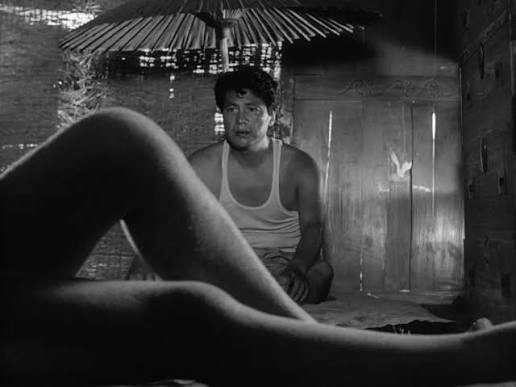
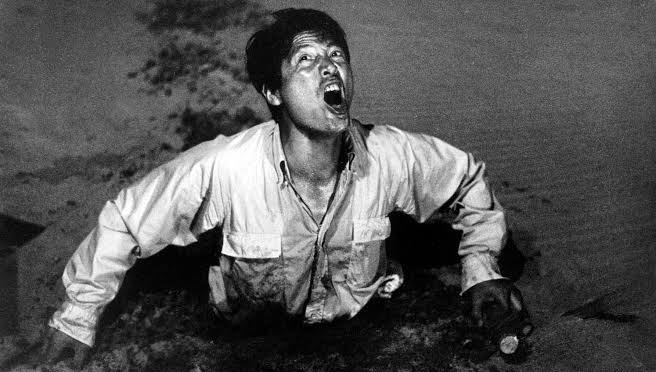
Hiroshi Teshigahara’s Woman in the Dunes (1964) is one of those rare films where image, character, theme and performance become inseparable. Shot in pristine black and white by cinematographer Hiroshi Segawa, it is visually astonishing: every grain of sand, bead of sweat and shadow across a human body is rendered with an almost microscopic intensity. The beauty of the photography is deliberately juxtaposed with the darkness of Niki Junpei’s predicament. What begins as an innocent expedition to collect insects becomes an existential prison, as he finds himself trapped by commerce, a surrogate marriage and, most powerfully, the natural wall of sand that pins both him and the unnamed widow to their strange subterranean existence.
The sand is both physical and metaphorical. It shifts, pours, consumes and rebuilds itself, turning Junpei’s captivity into a distinctly Sisyphean struggle. Every attempt at escape merely seems to return him to where he started, yet what makes Junpei such a compelling character is his absolute refusal to surrender. He builds ladders, devises increasingly ingenious escape plans, attempts to train crows to carry messages and continually tries to outwit the villagers who have ensnared him. Each failure intensifies rather than diminishes his determination. Like Sisyphus pushing the rock back up the hill, Junpei is condemned to confront an obstacle that endlessly renews itself.
Yet Woman in the Dunes (1964) is far more complicated than a straightforward story of imprisonment. Junpei is trapped by the villagers, but also by economic necessity, social expectation and an enforced domestic relationship that gradually begins to resemble a marriage. The villagers need the sand removed; the widow needs a man to help her survive; Junpei needs water, food and eventually human companionship. Teshigahara transforms this bizarre situation into a miniature society in which freedom itself becomes increasingly difficult to define. The more Junpei fights against his surroundings, the more deeply he becomes connected to them.
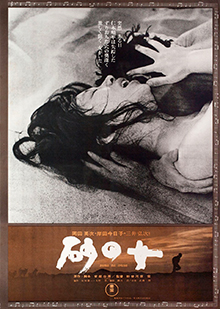
The relationship between Junpei and the widow, played with extraordinary physical and emotional commitment by Eiji Okada and Kyōko Kishida, gives the film its human core. Their intimacy moves between hostility, dependency, tenderness and desire without ever becoming conventional romance. Although sex is an important element of the film, Teshigahara rarely needs explicit imagery. Bodies appear as silhouettes, fragments and outlines; Kishida’s naked form is often suggested rather than displayed. A shoulder, a curve, a shadow or sand clinging to skin can communicate more than an explicit image ever could. One sees more from less throughout.

That principle extends to the entire film. Teshigahara makes the smallest details monumental. Sand resembles water, skin resembles landscape and the walls of the pit sometimes appear infinite. Extreme close-ups turn grains of sand into an entire universe, while wider compositions emphasise just how insignificant these two people are against the enormous shifting landscape surrounding them. The immaculate monochrome photography makes the film simultaneously beautiful and suffocating. The sand can look almost luminous in one shot and utterly threatening in the next.
There is also a wonderful irony at the heart of Junpei’s predicament. He arrives as an entomologist searching for insects, only to become a specimen himself: captured, observed and contained within a pit from which he cannot escape. The collector has become the collected. Teshigahara never labours the metaphor because he does not need to. It exists naturally within the imagery and situation, allowing the audience to discover its implications rather than having them explained.
Woman in the Dunes (1964) is virtually flawless in character, theme, cinematography, direction and performance. More than sixty years after its release, it remains startlingly modern and visually unlike almost anything else. Its central image — two human beings endlessly shovelling away a mountain of sand that will simply return tomorrow — is cinema distilled into an unforgettable metaphor for existence itself.
The only negative? Why didn’t I watch it sooner?