Tag Archives: horror

SHUDDER HORROR FILM REVIEWS – EXTREME!

SHUDDER HORROR FILM REVIEWS – EXTREME!

I’m continuing the Shudder film review residency here on my site with this post. However, as I watched so many horror films on the channel recently, I have decided to break them down into categories. This one is called Extreme!

Essentially the films reviewed here are — because of their content, style or both — prime examples of nasty, violent, sickening and in some cases extremely depraved horror movies. So, be warned do not watch these films, unless you have a strong emotional constitution and actually enjoy witnessing graphic scenes of gore, sex and bloody mayhem.

For your information, the films are reviewed in order of my rating, which as usual is out of eleven.


REVENGE (2017) – DIRECTED BY CORALIE FARGEAT

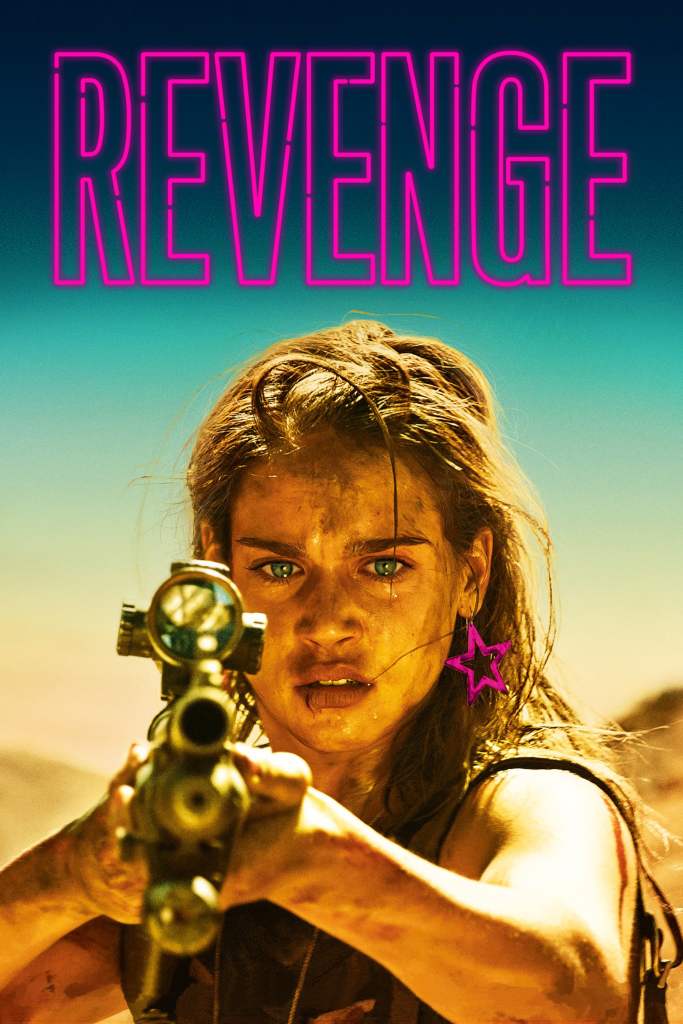
Featuring a B-movie rape and revenge plot, this exploitation story is raised way above its subject matter due to ultra-stylish direction, gorgeous cinematography and a compelling lead performance by Matilda Lutz. She portrays Jen, an aspiring actress, who is on a weekend getaway with handsome boyfriend (cheating husband), Richard (Kevin Janssens). He seems very well off as their break takes place at a stunning isolated villa location. However, things go awry when two of his hunting buddies turn up, and one, Stan (Vincent Colombe) attacks Jen while Richard is out. From then on events twist from incredibly bad to worse for Jen, and she finds herself being hunted down in the blazing heat of the desert. The film looks absolutely incredible with amazing photography and colour design. Overall, what it lacks in story and characterisation though, it more than makes up for in stunning action, searing violence and a powerful critique of toxic masculinity.

Mark: 8 out of 11


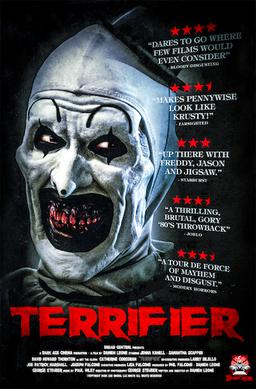
TERRIFIER (2016) – DIRECTED BY DAMIEN LEONE

I saw this horror film appear in a post on the YouTube channel What Culture Horror. So, the story of a demented clown who never speaks and slashes people to death on Halloween definitely piqued my interest. It’s both extremely violent and low-budget, having been made for around $100,000. However, it is in fact impressively shot and edited for such a small amount of money. The gory effects are amazingly effective too, summoning up memories of 1980’s prosthetic film effects. There is no real subtext or thematic strength, but I was pretty tense and sickened throughout. Moreover, the clown called Art is a memorably monstrous creation. He kills without reason and purely for his own entertainment. Nihilistic in tone, the director sure knows his horror and delights in presenting many sick ways of murdering his characters. Thus, if you like disembowelling, strangulation, burning, beheading and other gruesome movie deaths then, Terrifier (2016), is worth watching from behind the safety of the sofa.

Mark: 7.5 out of 11


CITY OF THE LIVING DEAD (1980) / THE HOUSE BY THE CEMETERY (1981) – DIRECTED BY LUCIO FULCI

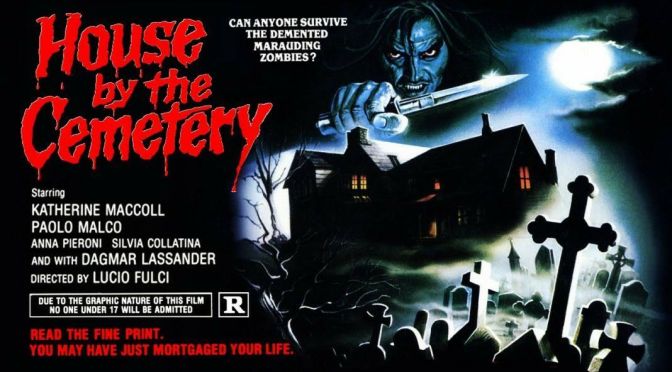
Filmmaker, Lucio Fulci, is often found lurking in the shadow of Italian horror filmmakers such as Mario Bava and Dario Argento, however, he truly knows how to frighten and sicken the life out of an audience. So much so he has been given the nickname, ‘Godfather of Gore’. As well as directing many films, notably, Zombie Flesh Eaters (1979) and The New York Ripper (1982), he is infamous for his “Gates of Hell” trilogy which included: City of the Living Dead (1980), The House By the Cemetery (1981) and The Beyond (1981). I re-watched the first two recently and while not as terrifying as when I saw them in the past, they still have the power to shock. While lacking coherent plots, containing pretty bad acting and some chronically dreadful dubbing in places, paradoxically Fulci’s films can arguably be considered surreal horror classics. They may not make any narrative sense, but his ability to create stunningly violent set-pieces is legendary. Memorable scenes include: the spewing of intestines, crawling maggots, hanging priests, drilled brains, chopped heads and monsters rising from basements and graves. Such imagery and dreaded moments — all set to a creepy synth soundtrack — make Fulci’s movies unsettling viewing experiences.

Mark: 7 out of 11


ISLAND OF DEATH (1976) – DIRECTED BY NICO MASTORAKIS

Not only is this one of the sickest films I have seen, it is also one of the most appalling I have sat through. Having said that, that is in fact what Greek director Mastorakis, based on what I’ve read, set out to do. The story, if you can call it that, focusses on a couple called Christopher (Robert Behling) and Celia (Jane Lyle) who go on a sex-driven-kill-crazy-honeymoon-rampage on the Greek island of Mykonos. If you can get past the couple having sex in a phone booth while telephoning his mother, and stomach Christopher raping a goat before killing it, then do watch the rest of this conveyor belt of pornographic sex and violence. By the end, I was stunned to silence at how sick the film was.

Mark: 1 out of 11


TETSUO – THE IRON MAN (1989) – DIRECTED BY SHINYA TSUKAMOTO

Lauded as a low-budget Japanese extreme body horror cult classic, Tetsuo: The Iron Man (1989), is either the work of a genius or a complete madman. Filmmaker, Shinya Tsukamoto, deserves so much praise for literally making most of the film in his own house and paying for it out of his own pocket. Yet, the thumping industrial soundtrack, jump-cutting-stop-motion style and story of metal invading the body, soul and mind of various characters was too f*cked-up, even for me. I know it gets mentioned as a work of genius, but it was frankly unwatchable. Thankfully, it’s only sixty-seven minutes of hell to get through.

Unmarked!

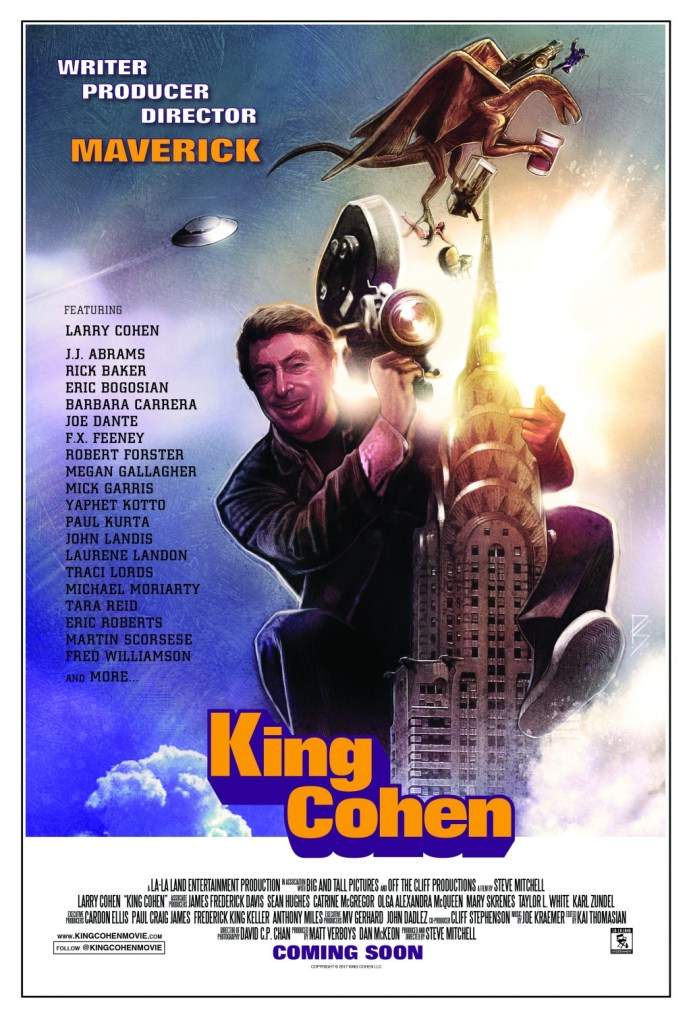
SHUDDER HORROR REVIEW: KING COHEN (2018)

SHUDDER HORROR REVIEW: KING COHEN (2018)

Directed by Steve Mitchell

Featuring: Larry Cohen, J.J. Abrams, Rick Baker, Eric Bogosian, Richard J. Brewer, Jon Burlingame, Barbara Carrera, Joe Dante, James Dixon, F.X. Feeney, Robert Forster, Megan Gallagher, Mick Garris, Paul Glickman, Frederick King Keller, David Kern, Yaphet Kotto, Paul Kurta, John Landis, Laurene Landon, Traci Lords, Michael Moriarty, Daniel Pearl, Eric Roberts, Martin Scorsese, Nathaniel Thompson, Ryan Turek, Janelle Webb, Fred Williamson etc.


In England, where I grew up in the 1970’s, we used to used have only THREE television channels to choose from. Latterly in the 1980’s that increased to four. Now, we have what seems like millions of streaming and cable channels to choose from. They’re coming out of our ears and minds and from the skies and the darkened underground. Of course, we have the major channels such as Sky, Apple, BBC, ITV, Netflix, Disney + and Amazon, to but name a few, however, there are now specific streaming outlets geared toward whole genres.

One of these is Shudderhttps://www.shudder.com/ – and they specialise in screening B-movies, video nasties, slasher, serial killer, monster, essential and non-essential horror films from past and present. Fellow blogger, Bobby Carroll, has recently been reviewing some of Shudder’s catalogue and I too will be doing the same. Check out his site here – it’s very good! So, over the last few weeks I have binged on so many horror films. Some are very good ones, some pretty bad ones and some just absolutely downright ugly releases. I guess one could consider me strange to immerse myself in so many horror films back-to-back; however, I love to be moved by fear and sickened with fright. Having said that the true terror on this Earth is happening out there in the real world. What occurs on the cinema or TV screen within the horror genre is actually an escape for me; albeit a gruesome, deathly and bloody one.


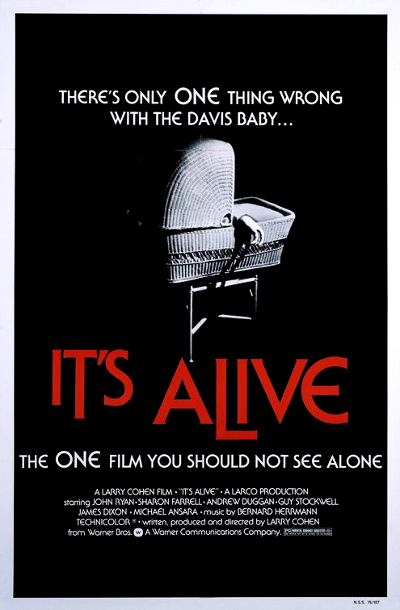
The first film I’d like to review is King Cohen (2018). It is a very lively jaunt through the career of independent filmmaker Larry Cohen. If you didn’t know Larry Cohen, he is one of the most prolific screenwriters ever. Born in 1941 in Washington Heights, New York, he began a stand-up career at the age of seventeen, before moving onto writing teleplays and TV scripts for CBS and NBC. Working within the TV and Hollywood system was creatively stifling for Cohen, so he decided to write, produce and direct his own films as a true independent. Examples of his directorial work include: Bone (1972), Black Caesar (1973), It’s Alive (1974), God Told Me To (1976), The Private Files of J. Edgar Hoover (1977), Q-The Winged Serpent (1982), The Stuff (1985), plus he wrote the screenplays for Best Seller (1987), Maniac Cop (1988), Phone Booth (2002) and Cellular (2004).        

As a tribute to Larry Cohen, who passed away last year, this is a tremendously lively and positive documentary about a true maverick filmmaker. Larry Cohen indeed features heavily in the interviews. He comes across as energetic, intelligent, funny and ballsy. Testimonies from Fred Williamson, Martin Scorsese, Joe Dante, Rick Baker, Eric Roberts and many, many more people who worked with Cohen bear witness to his prolific output and unorthodox ways of shooting films. Because he wanted control over his writing, many of his directorial releases were very low budget and he would often film in a guerrilla style on the streets of New York or even in his own house. He became famous for “stealing” scenes which included, unbeknown to them, the general public and NO film or work permits. I admired both his hubris and determination to tell his cinematic stories, and despite the lack of money his scripts were full of ingenuity, humour and much intelligence. Thus, if you love films about filmmaking and exploitation movies in general, then you should definitely check out King Cohen (2019) and Larry Cohen’s back catalogue of horrors too.

Mark: 8 out of 11


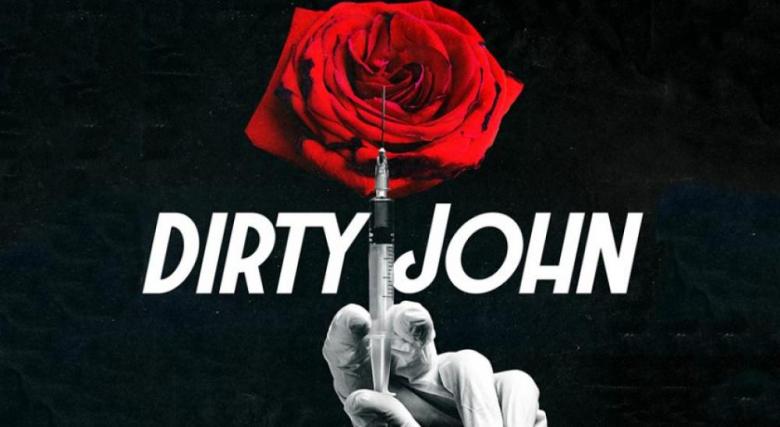
NETFLIX TV REVIEW – DIRTY JOHN (2018)

NETFLIX TV REVIEW – DIRTY JOHN (2018)

Created by: Alexandra Cunningham

Based on articles and podcast: Dirty John by Christopher Goffard

Directed by: Jeffrey Reiner

Writers: Alexandra Cunningham, Christopher Goffard, Sinead Daly, Lex Edness, Kevin J. Hynes, Evan Wright, Diana Son, etc.

Producer(s): Melinda Whitaker, Christopher Goffard, Nan Bernstein Freed, Jonathan Talbert, etc.

Cast: Connie Britton, Eric Bana, Juno Temple, Julia Garner, Jean Smart, Shea Whigham, Alan Ruck, Kevin Zegers, etc.

Composer: Mark Mothersbaugh

Original networks: Bravo (USA) and Netflix (UK)


Such is the veracious appetite journalists, writers, filmmakers, TV producers, podcasters and the audience have for true crime stories, it’s no surprise that the life of con-man, John Meehan, and his victims, was turned into a thrilling eight-part drama shown on Bravo and Netflix respectively. After decades of cons, fakery, impersonations, drug addiction, robberies, lawsuits, insurance scams, harassment, spying, stalking and consistent lying, Meehan’s criminal activities came to an end as recently as 2016. Meehan had been trained in the “art” of the con by his father from a young age. Alas, his nature could not, unlike his sister, overcome such spurious nurture and Meehan was destined for a life of crime. They say truth is stranger than fiction and that is very much the case here with some of his venomous antics quite unbelievable. However, Meehan must have had so much charm and confidence to trick the many women he deceived, his character sadly stands as a heinous example of toxic masculinity.

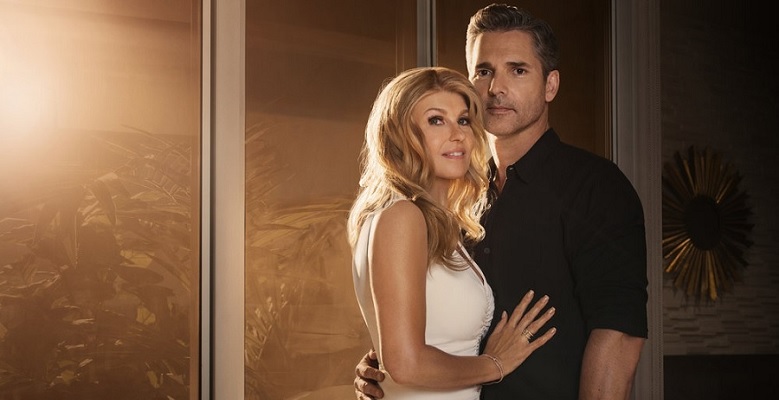
Eric Bana portrays John Meehan in Dirty John (2018). Bana is an excellent actor and arguably, based on his breakthrough performance in the film, Chopper (2000), one who I thought would achieve possibly more critical acclaim. His career is full of sterling work though and his handsome looks and rugged charisma are perfectly utilised as John Meehan. Indeed, when we first encounter him he is meeting Debra Newell (Connie Britton) for a date. After a sticky start the romance develops very quickly. Debra is a wealthy interior designer with her own business, and her character is exceptionally kind, but somewhat gullible. Even when her kids, Veronica (Juno Temple) and Terra (Julia Garner), warn her that something is rotten about John, her desire for John overcome any doubts she may harbour. As Debra, Connie Britton gives a brilliant representation of a woman who is desperate for love and companionship. Having said that, Juno Temple steals every scene as the mouthy daughter, Ronnie, someone who is certainly way more suspicious of John than her good-natured mother.


Structured around John and Debra’s developing romance are flashbacks to John’s prior relationships and crimes. While he is shown to be a really bad man, context is given during scenes from his youth. His father, portrayed by the excellent character actor, Shea Whigham, has young John eating a Taco with glass placed in it, so he can scam the restaurant. Such twisted examples of dire parenting give reason to John’s later behaviour, however, they should not excuse his actions in adulthood. They also explain John’s dependency on narcotics. This addiction to opiates, as well as a sociopathic desire to lie and cheat, drive the character and narrative powerfully. In the scenes where Debra, having incredibly given John another chance, helps him go cold turkey, Bana’s acting levels are most impressive.

As the drama proceeds and Debra and her daughters begin to discover the crimes of John’s past they themselves become targets of his malevolence. John is a beast Debra has alas invited into her life and one feels so much empathy for her and his other victims. Moreover, even when cornered and accused John Meehan is at his most dangerous. He often savagely attacked his accusers and their family members with severe vengeance. But, the scariest part for me was that he was “qualified” to be a Certified Registered Nurse Anaesthetist; a profession he exploited to rob and feed his drug addiction. Ultimately, I can recommend Dirty John (2018), to those who enjoy absorbing crime dramas. Some shows, with such “real life” narratives, can be exploitational in tone. However, this is a high quality production with excellent acting, writing and directing throughout. It really was edge-of-your-seat viewing, with Eric Bana’s multi-dimensional acting delivering a true monster for the millennium.

Mark: 8.5 out of 11


UNDER-RATED CLASSICS #8 – THE NINTH CONFIGURATION (1980)

UNDER-RATED CLASSICS #8 – THE NINTH CONFIGURATION (1980)

Directed, written and produced by: William Peter Blatty

Based on The Ninth Configuration by William Peter Blatty

Starring: Stacy Keach, Scott Wilson, Jason Miller, Ed Flanders, Robert Loggia, Moses Gunn, Joe Spinell, Neville Brand etc.

Music by: Barry De Vorzon

Cinematography: Gerry Fisher

*** MAY CONTAIN SPOILERS ***


“I became insane, with long intervals of horrible sanity.”
― Edgar Allan Poe

Sparked by uber-film critic Mark Kermode waxing lyrical about The Ninth Configuration (1980) in one of his cinema books, I was extremely pleased when I found a remastered 2016 reissue streaming on Amazon Prime. I don’t always agree with Kermode’s effusive praise of certain films, however, his opinion should always be respected. Having watched the film I can concur that it is indeed an under-rated classic. Just to clarify, for me, an under-rated classic can be a film I love, plus satisfy the following criteria:

  1. Must not have won an Oscar.
  2. Must not have won a BAFTA.
  3. Must not appear in the AFI Top 100 list.
  4. Must not appear in the IMDB Top 250 list.
  5. Must not appear in the BFI 100 Great British films.
  6. Must not appear in the all-time highest grossing movies of list.

While the writer and director, William Peter Blatty, won a Golden Globe for best screenplay, I feel that The Ninth Configuration (1980) is somewhat of a lost masterpiece. It was released at the same time as Ordinary People (1980) , The Elephant Man (1980) and Raging Bull (1980) and rarely seems to be discussed or praised at all these days. Well, aside from Mark Kermode’s gratefully received validation. Thematically, it is very strong as it deals with mental breakdown and illness amidst soldiers post-Vietnam. Moreover, it also contains memorable iconography within a curiously foreboding setting.


Based on Blatty’s 1978 novel, which in itself was a reworking of an earlier story called, Twinkle, Twinkle “Killer” Kane, The Ninth Configuration centres the action in a grand chateau located, rather weirdly in America somewhere. The dark, shadowy castle (which was actually in Germany), is surrounded by deep forestation and is used by the U.S. government as an insane asylum for military personnel. Spring-boarding themes and ideas from movies such as: One Flew Over The Cuckoo’s Nest (1975), Mash (1970) and, in regards to its exploration of P.T.S.D., The Deer Hunter (1978), the narrative features a whole host of eccentric and over-the-edge characters. They include an Astronaut, Captain Billy Cutshaw (Scott Wilson), who went mad and sabotaged a space launch, Jason Miller as Lieutenant Frankie Reno, a soldier attempting to direct Hamlet with a cast of dogs; and the recently arrived, new psychiatrist, Colonel Vincent Kane (Stacey Keach). It is Kane’s and Cutshaw’s developing relationship which powers many of the philosophical and existential debates within the film’s incredible script.

For a film set in an asylum Blatty unsurpisingly uses dark humour, hysterical personalities and some incredibly funny lines of dialogue to propel an absurd first half. However, as Cutshaw and Kane’s connection grows deeper, the two men push each other into some very dark places. Exploring the slight gap between insanity and sanity is a tricky thing to get right in terms of tone, however, Blatty, is a brilliant writer and succeeds with a script that zig-zags the line between chaos and structure. He also benefits from an amazing ensemble cast of character actors who throw themselves heartily into the chaos on show. Scott Wilson and Stacey Keach are especially memorable in their intense and honest portrayals of soldiers pushed too far by their respective commands.

Overall, The Ninth Configuration (1980) is a forgotten masterpiece which deserves revisiting. I was blown away by the endlessly quotable dialogue and the risks Blatty took as a director. I mean, he opens with an incongruous Country and Western song-backed montage before the credits. This pop video beginning is jarring, but somehow makes sense in the end. Blatty then veers between farcical humour, crazed episodes involving the lunatics taking over the asylum, and philosophical and theological discourse within the therapy sessions. Finally, the film finishes with a violent and cathartic denouement, yet one which, given the dark existentialism that has unfolded, is amazingly full of hope, faith and optimism.

Mark: 9.5 out of 11


SIX OF THE BEST #26 – ENNIO MORRICONE (R.I.P 1928-2020)

SIX OF THE BEST #26 – ENNIO MORRICONE – (R.I.P – 1928-2020)

“If you scroll through all the movies I’ve worked on, you can understand how I was a specialist in westerns, love stories, political movies, action thrillers, horror movies, and so on. So, in other words, I’m no specialist, because I’ve done everything. I’m a specialist in music.” Ennio Morricone


As if 2020 couldn’t get any more dramatic, one of the greatest musical composers and dramatists ever known has passed away. Ennio Morricone, rather incredibly, wrote the scores for over four hundred films and television works. He also managed to write well over one hundred classical pieces. To say Ennio Morricone was a prolific genius is somewhat of an understatement.

Morricone won six BAFTAs, eleven Nastro d’Argento, three Grammy Awards, three Golden Globes, six BAFTAs, ten David di Donatello, two European Film Awards, the Golden Lion Honorary Award and the Polar Music Prize. In 2007, he received the Academy Honorary Award for his outstanding commitment to cinema. Moreover, he was also nominated for a further six Oscars. Lastly, Morricone had to wait until 2016 to receive his only competitive Academy Award for the haunting score to Quentin Tarantino’s The Hateful Eight (2016). For Morricone to receive only one Oscar for musical composition is astounding and proves once again there is no justice in the world.

A meagre blog piece from a London-based hack will never be enough of a tribute to a composer who worked in every cinematic genre and with an incredible array of famous and infamous filmmakers. Notables include: Sergio Leone, Oliver Stone, Warren Beatty, John Carpenter, Quentin Tarantino, Sergio Corbucci, Dario Argento, Duccio Tessari, Sergio Sollima, Henri Verneuil, Bernardo Bertolucci, Mauro Bolognini, Giuliano Montaldo, Roland Joffé, Don Siegel, Mike Nichols, Brian De Palma, Barry Levinson and many more companies including advertisers, singers, recording artists and fashion designers. Morricone even found time to compose the 1978 World Cup theme song.

Thus, as a tribute to one of the greatest cinematic artists I have selected six of Morricone’s best film orchestrations. Although given his brilliance and spectacular output, one could certainly pick many more; even sixty of the best!! Riposa in pace, Ennio, il maestro!


THE GOOD, THE BAD AND THE UGLY (1966)


THE GREAT SILENCE (1968)


ONCE UPON A TIME IN THE WEST (1968)


ONCE UPON A TIME IN AMERICA (1984)


THE MISSION (1986)


THE HATEFUL EIGHT (2016)


FILMS THAT GOT AWAY #11 – HOUNDS OF LOVE (2016)

FILMS THAT GOT AWAY #11 – HOUNDS OF LOVE (2016)

Written and Directed by: Ben Young

Produced by: Melissa Kelly

Cast: Emma Booth, Ashleigh Cummings, Stephen Curry, Harris Gilbertson, Susie Porter, Damian De Montemas, etc.

Music by: Dan Luscombe

Cinematography: Michael McDermott

Edited by: Merlin Eden

*** MAY CONTAIN SPOILERS ***


Where narratives relating to rape, abduction, and serial killers are concerned, a filmmaker can tread a fine line between lurid exploitation and absorbing suspense and drama. Low budget B-movies are replete with stories of death, sexual assault and crazed murderers. Some overstep the mark becoming notorious beacons of bad taste. Many horror fans love the exploitational nature of “video nasties”, seeking out films like: Cannibal Holocaust (1980), A Serbian Film (2010), I Spit on Your Grave (1978), Driller Killer (1979), Texas Chainsaw Massacre (1974) and The Last House on the Left (1972), to name but a few. The latter two films directed by horror maestros Tobe Hooper and Wes Craven are arguably exceptional visions of terror which transcend their horror genre subject matter. Similarly, Ben Young’s The Hounds of Love (2016), in my view, represents the evil of human beings without exploiting the actors or audience.

While it may not be as gory on-screen as the films mentioned above, The Hounds of Love (2016), does offer a shattering and sickening set of images and sounds within these savage set of events. Set in Perth, Australia during 1987, this is a disturbing and all too realistic horror story. It opens with a majestic set of slow-motion shots from the point-of-view of suburban couple, Evelyn White (Emma Booth) and John White (Stephen Curry). They sit in their vehicle as the sun hazes and watch teenage girls playing netball in the school yard. They are stalking their next victim; patiently waiting to lure another unsuspecting soul into their nefariously sadistic crimes. Stylistically impressive, but at the same time incredibly unnerving, Ben Young skilfully establishes the canvas on which he will paint further horrors.


Having fed their violent and sexual lust with the opening victim, we are then introduced to their next. Vicki Moloney (Ashleigh Cummings) is a rebellious teenager who is smarting from her parents recent split. Acting with both charisma and defiance, Vicki is slightly annoying, yet empathetic. Obviously, she does not deserve the ordeal she is about to experience at the hands of the Whites. The sequence which finds them cajoling her into their clutches is so tense and had me screaming at the screen, “No!!!! Get out!!!” What follows then, as Vicki becomes a prisoner, is a series of heart-pounding and distressing scenes which raise the stakes to unbearable tension. Ashleigh Cummings performance is absolutely compelling as “final girl”, Vicki. She takes a potentially one-dimensional casualty and imbues her with fight, guile, pain, distress, intelligence and determination. No surprise therefore that she won a Best acting debut award at the Venice Film Festival.

Cummings performance is not the only one which impacts the story greatly. Emma Booth’s complex portrayal of Evelyn is quite startling. This is a character who is permanently on-the-edge and desperate to please her evil partner, John. Systematically controlled and bullied, there is no excuse for Evelyn’s part in the kidnappings and torture of these young girls. But, it is clear to see that toxic masculinity has, over the years contributed to her mental and emotional collapse. Booth’s persistently fraught acting is all bag-of-bones and shredded nerves. It is via Evelyn’s imploding emotional state that Vicki is able to attempt to turn her against John’s venal influence.

Ultimately, one could say this is an exploitation film in terms of theme and story. However, it feels different than the many B-movie serial killer films I have seen. I felt like I was in the hands of a filmmaker who was determined to explore the nature of sadistic relationships in a risky, but intelligent manner. The acting, cinematography, direction and haunting soundtrack all contribute to make this a highly effective psychological thriller. Of course, there are many which may feel differently and that the film has its cake and eats it in term of violence and sexual perversion. Yet, we never actually see much of the cake. Unlike many of the films I mention in the opening paragraph, the audience only see the build-up and aftermath of the crimes. Indeed, what we don’t see on screen is more frightening than what we do. That, overall, is what sets The Hounds of Love (2016) apart from many other films dealing with these unpalatable themes and subjects.

Mark: 9 out of 11


CULT FILM REVIEW – VIDEODROME (1983)

CULT FILM REVIEW – VIDEODROME (1983)

Written and directed by: David Cronenberg

Produced by: Claude Herroux, Pierre David, Victor Solnicki

Cast: James Woods, Sonja Smits, Deborah Harry, Les Carlson, Jack Creley, Peter Divorsky etc.

Music: Howard Shore

***CONTAINS SPOILERS***


With the lack of cinema-going action, I am now looking at building other review ideas and articles into my blog. I have regular new release reviews, classic film reviews, great ensemble casts and under-rated film reviews. I suppose that’s enough really, but there are some films that don’t quite fit these categories and they are cult movies. How does one define a cult film? It could have been a box-office bomb or be a no-budget gem, be transgressive or have controversial subject matter. Conversely, it could be a video nasty or banned or even an ultra-arthouse film which defies classical filmmaking conventions. More importantly, I do not have to actually like the film for it to qualify as a cult film. It could be a difficult film I am evaluating or re-evaluating from a fan or academic perspective. Lastly, it could just simply be a film that is uncategorizable or so bad it’s bad or so bad it’s good.

My first review in this category is David Cronenberg’s body-horror film, Videodrome (1983). Now, it may fit the specific rules of an under-rated classic laid down in previous articles, however, Videodrome (1983) is not necessarily a film I love or believe is a classic. It is a remarkably original narrative descent into the hellish and surreal world of demented psychological snuff television. It contains amazing practical special effects by the legend Rick Baker, yet, having re-watched it last week I cannot say it’s a film one can enjoy from an entertainment perspective. Don’t get me wrong, David Cronenberg is a true auteur and genius filmmaker, it’s just Videodrome (1983) is a hallucinatory and disturbing nightmare of a film that works outside the boundaries of usual image systems and narrative conventions. Basically, it’s more a powerful set of concepts and scenarios rather than a simple and satisfying story.

The story opens with anti-heroic, Max Renn (James Woods) as president of CIVIC-TV, seeking new content for his Toronto-based TV channel. Despite Woods’ charisma as an actor he is an expert at playing dominant alpha male types who challenge the audiences’ empathy. He portrays Max with a sleazy charm hunting for, what one may consider, soft-pornographic shows for his station. He’s basically an addict looking to push the walls of taste for his sex-hungry viewers. Max then discovers a channel, via a grainy satellite feed, called Videodrome. It shows unfiltered torture and sexual aggression, and Max becomes determined to tap into that market. At the same time, he begins a sado-masochistic sexual relationship with a radio host, Nikki Brand (Deborah Harry). Soon, these two intense narrative strands entwine and threaten Max’s mind, body and very existence.


Videodrome (1983) is a highly intelligent shocker which explores the nature of television violence, notions of taste and censorship, fears of technological programming, and the mental damage caused by over-exposure to violent pornography. It is an extremely psychologically and physically graphic film to watch. Nevertheless, it is also full of incredible imagery involving on-screen murder, Renn being swallowed by his TV; and also literally transforming into a human video cassette player. While an audience may not like Max Renn as a person, his journey is one that grips with magnetic shock and disgust. As he gets ever closer to the Videodrome channel his downward spiral plays out like a demented morality story, with Max representing the journey of those audience members who lose themselves in the illusory realities of television product. As he begins to lose touch with reality, Max experiences a complete lack of control over his mind and desires, all seemingly controlled by a heinous corporation led by insidious suit, Barry Convex (Leslie Carlson).

Incredibly, David Cronenberg apparently turned down directing The Return of the Jedi (1983) to write and direct this more personal vision of cinema. Could there be two more different films? Nonetheless, while it may not be a film I can easily recommend to those of a sensitive disposition or those who like their horror to have tidy conclusions, Videodrome (1983), retains its relevance and power to this day as a shocking critique of modern media. Hence qualifying it as a cult horror film which pushes all the wrong buttons in the right way.


UNDER-RATED CLASSICS #7 – SECONDS (1966)

UNDER-RATED CLASSICS #7 – SECONDS (1966)

Directed by: John Frankenheimer

Produced by: Edward Lewis

Screenplay by: Lewis John Carlino – based on the novel, Seconds, by David Ely

Cast: Rock Hudson, Salome Jens, John Randolph, Richard Anderson, Will Geer, Karl Swenson, Jeff Corey etc.

Music by: Jerry Goldsmith


***MAY CONTAIN SPOILERS***


So, I continue my articles on films which have perhaps fallen off the radar and deserve more recognition. The rules are simple. An under-rated classic can be a film I love, plus satisfy the following criteria:

  1. Must not have won an Oscar.
  2. Must not have won a BAFTA.
  3. Must not appear in the AFI Top 100 list.
  4. Must not appear in the IMDB Top 250 list.
  5. Must not appear in the BFI 100 Great British films.
  6. Must not appear in the all-time highest grossing movies of list.

Seconds (1966) is a science fiction drama which is very much of its time, but also truly relevant today. It deals with identity and lifestyle transplants. The film explores notions of escaping one’s everyday existence and living out one’s dreams through plastic surgery and scientific procedure. However, it also contains an important message, that whatever physical, social and personal changes you make there are no guarantees your life will be better. Perhaps, it is best to accept what you have and work with what nature gave you. Make positive changes to your mind and body, but know that there is no such thing as a quick fix.

The character of Arthur Hamilton (John Randolph) certainly finds this out to his cost in the narrative of Seconds (1966). His life is reasonably good, but he is dissatisfied with his job, and love for his wife has dissipated. He discovers an outfit called ‘The Company’ can, at a price, exchange his body and life, allowing him to be reborn a new man. After the procedure that man happens to be called Tony Wilson, who has the movie star looks of Rock Hudson. Hamilton/Wilson settles into a creative and hedonistic life by the beach. Yet, the sand is always softer on the other side. Soon, holes begin to show in Hamilton/Wilson’s new life.

Seconds (1966), is a psychologically eerie body-swap-sci-fi-horror film. It’s shot in crisp black and white by influential cinematographer, James Wong Howe, and contains some psychedelic visuals, weird angles, mirrored images, fish-eye lens shots, and images of actual rhinoplasty during the transformation sequence. Brilliantly directed by John Frankenheimer, it is also thematically very powerful. Aside from the dystopic warnings about plastic surgery, it also explores the nature of cults and closed communities. Rock Hudson gives a career best performance as Tony Wilson. His desperate and paranoiac scramblings in the second half of the film are painfully stressful as the character realises he has not only lost his identity, but possibly also his mind. Overall, it’s important to reiterate that organic change in itself is a positive thing, however, as Seconds (1966) demonstrates, there are no shortcuts to happiness or success.


CLASSIC HORROR FILM DOUBLE BILL REVIEW – BLACK SUNDAY (1960) & BLACK SABBATH (1963)

CLASSIC HORROR FILM REVIEWS – BLACK SUNDAY (1960) & BLACK SABBATH (1963)

What better way to distance oneself from the horror of real life than by watching some classic horror films? Not that my life is that bad as I am alive and healthy and doing very well in the lockdown circumstances. Thankfully I am not having to deal with the sick people like those in the NHS and medical facilities across the world. Kudos to those individuals trying to save lives and cure the sick. Who could have predicted that these events could unfold? It’s like society has been cursed.

Talking of curses, the horror genre is one of my favourites. Although, to be honest, I do love most genres of film. Indeed, while I’m not a massive fan of romance or musicals, if the film itself is well made, then I will watch and most likely enjoy it. However, if I want to be sure to favour a film, then horror will be one of my go to genres. One such legendary filmmaker of horror movies was Italian director, Mario Bava. I’m ashamed to admit I had not seen many of his releases, if any. Shocking really as he was known by many as the ‘Master of Italian horror’. Thus, I corrected that by recently watching both Black Sunday/Mask of Satan (1960) and Black Sabbath (1963). Here are two short reviews of these atmospheric horror classics.


Best Horror Movies of the 1960s: From Psycho to Blind Beast | Collider
Black Sunday (1960)

BLACK SUNDAY (1960)

Director: Mario Bava

Cast: Barbara Steele, John Richardson, Andrea Checchi, Ivo Garrani

Given Mario Bava was a talented cinematographer who worked on many Italian film productions it’s no surprise that Black Sunday (1960) looks incredible. The transfer I watched on Blu-ray was pristine with the black and white photography really shimmering on the screen. The lighting is all shards and jagged amidst the foreboding darkness and shadows. The story itself is a creepy gothic tale of curses, witchcraft and revenge. It starts with a grim opening scene as Asa, a witch (Barbara Steele), and her lover being punished by her brother for sorcery. This involves placing a spiked mask on their faces and burying them alive. She damns them to hell with the promise she will return one day to wreak retribution. Guess what happens centuries later? While it runs out of story toward the end the opening hour is full of scary imagery and chilling moments. While it may seem mild by today’s standards, Black Sunday (1960), was in fact heavily censored on release and was even banned in the United Kingdom until 1968. While today’s horror films rely much on cheap jump scares, this one is a good old-fashioned creepfest, spreading a pervading aura of fear from start to finish.

Mark: 8 out of 11


BLACK SABBATH (1963)

Director: Mario Bava

Cast: Boris Karloff, Mark Damon, Michele Mercier, Susy Anderson, Jacqueline Pierreux etc.

The original title of this film was The Three Faces of Fear and this is a much more compelling title than the one we got. Don’t get me wrong Black Sabbath (1960) works, but given this is an anthology featuring three short horror films relating to fear, it seems like a marketing ploy echoing previous horror Black Sunday (1960). Anyway, the three stories are very different in setting and tone but all work well with Boris Karloff introducing them. The first is a pre-Giallo style contemporary murder story called The Telephone. Here a glamorous call-girl is stalked by an unknown person via constant telephone calls. It’s a slow burn build up of fear, as silence then sudden ringing raises the heartrate before the fine twist at the end. The second story is called The Wurdalak. A more traditional vampire story, it finds a handsome nobleman falling in love with a rural village girl, whose family are threatened by a bloodsucking Wurdalak. This was so creepy as we get severed heads and vampiric children in a story which reminded me of Stephen King’s Salem’s Lot. The final story, The Drop of Water is arguably the best. With more than a hint of The Tell-Tale Heart about it, the story finds a nurse stealing something from a dead woman, only for the vengeful ghost (or her guilty conscience) to take exception. Overall, this is a brilliant anthology horror film, which is still scary now and definitely stands the test of time.

Mark: 9 out of 11


NETFLIX FILM REVIEW – THE PLATFORM (2019)

NETFLIX FILM REVIEW – THE PLATFORM (2019)

Directed by: Galder Gaztelu-Urrutia

Written by: David Desola and Pedro Rivero

Cast: Ivan Massague, Antonia San Juan, Zorian Eguileor, Emiliano Buale Coka, Alexandra Masangkay

Cinematography: Jon D. Dominguez

Original Platform: Netflix

*** MAY CONTAIN SPOILERS ***


Last night, just under a week into the stricter UK social distancing procedures, I finally got pangs of withdrawal symptoms from NOT going to the cinema. Of course, my feelings or emotions at this time pale into insignificance when compared to the thousands of people affected by or those who have lost their lives to the COVID-19 virus. Moreover, while one could describe our planet as currently resembling a massive open prison, it’s nothing compared to the horrific conditions of the vertical prison in Spanish horror thriller, The Platform (2019). Be warned: do not watch this film while eating your dinner, as it could affect your appetite.

While I recently wrote an article about some films that could make you feel better in this global crisis (link here), paradoxically a horror film such as The Platform (2019) can also work to make you feel better too. Because a film where prisoners are trapped in a multi-level jail and whose food intake is based on how high they are within the prison, is an ingenious, yet terrifying concept. Knowing my life can never be as bad as the main protagonist and the prisoners he encounters made me feel somewhat relieved. Furthermore, the gore levels, plot twists and social satire on display took my mind off the reality of my own situation.


Ivan Massague, with his hangdog-Zlatan-Ibrahimovic features is Goreng, our reasonable everyman at the start. For some bizarre reason he has volunteered to be in this Kafkaesque hell for reasons I won’t spoil. His first cellmate is an older man, Trimagasi (Zorian Eguileor). He is in for committing manslaughter. Trimagasi explains how the system works in the jail. Food comes down on a platform and is meant to be shared with everyone from top to bottom. Of course, it doesn’t work like that as greed prevails. The lower down you are the less food you get. What happens when you don’t eat? You look for alternative food sources. Goreng is naive initially, while Trimagasi knows how to play this vicious game, especially because they never know what level they will be on month to month. This is no Shawshank Redemption (1994), where the mentor coaches the younger man positively. In this environment it is a dog eat dog world; and it’s every dog for him or herself.

The Platform (2019) has a brilliant script, thus is a wicked delight from start to finish. Even the ambiguous ending, which while leaving our gallant lead protagonist’s fate open to interpretation, is fitting for a constantly surprising genre film. It is both a joy as horror film and social commentary. Indeed, the film has its pound of flesh and eats it. I just have to say there is some fantastic gore and memorably crunching deaths throughout of man, woman and beast. The film doesn’t have all the answers. In fact, it is actually quite nihilistic about human behaviour and our inability to share the wealth around. But as high concept and low budget horror movies go, it’s one of the most entertaining I have seen in sometime. Anything to take one’s mind off what is really happening in this world can only be positive.

Mark 9 out of 11